
I have seen too many PTZ cameras die within months — not from bullet hits or lightning, but from invisible moisture creeping inside the housing and eating the circuit board alive.
Not all Chinese-made PTZ cameras come with conformal coating on their PCBs. Many low-cost models skip this step entirely, or only brush a thin layer on the power board. To truly prevent corrosion in high-humidity areas, you must get a written commitment from your supplier confirming that all PCBs are fully coated, ask for the coating standard and test reports, and then verify by opening a sample unit yourself.
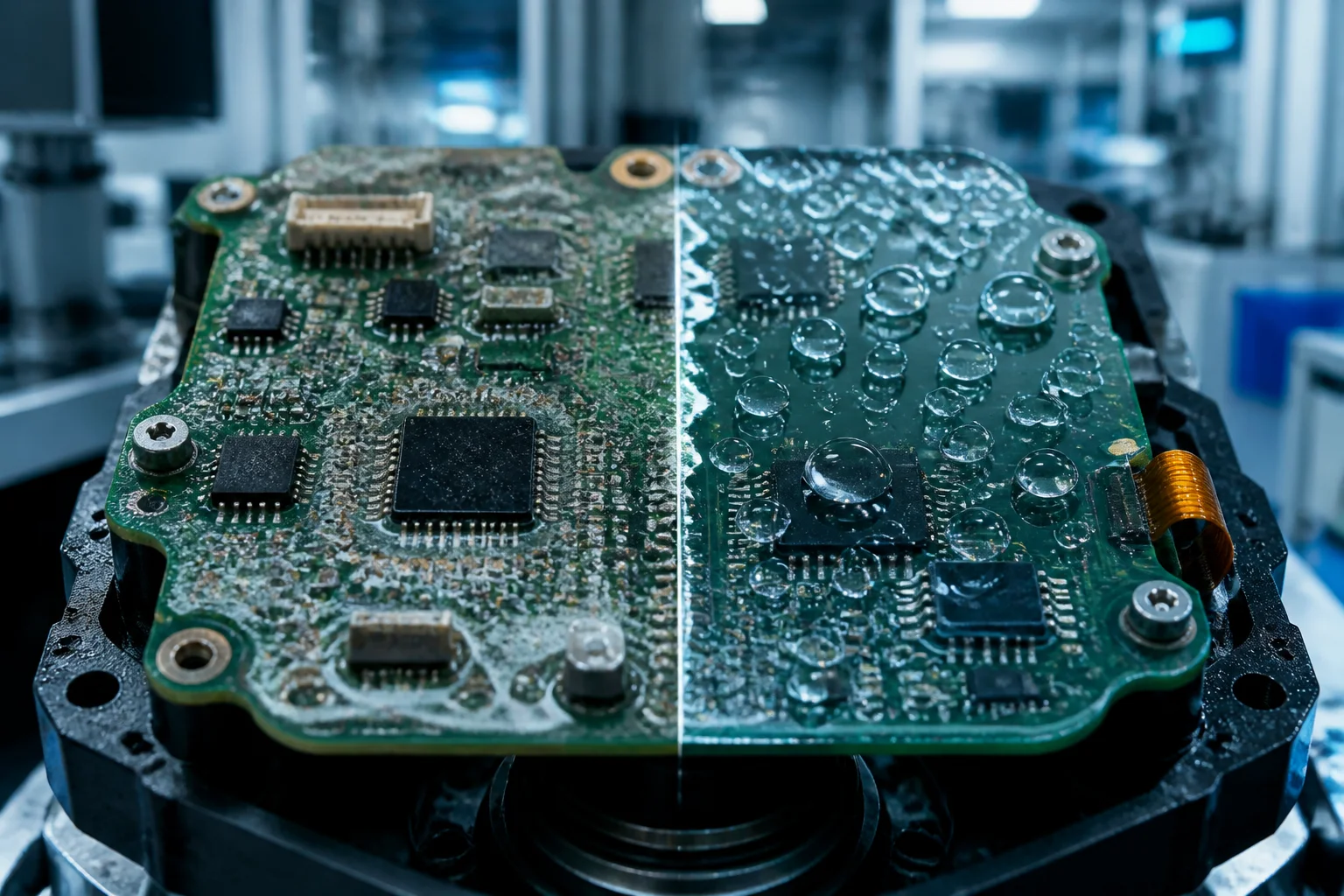
Below, I will walk you through exactly what conformal coating does, how to pick the right type for your project site, how to verify the coating quality, and what to write into your purchase agreement so that your Chinese supplier has no room to cut corners. If you deploy cameras in coastal Texas, Southeast Asia, or anywhere with humidity above 80% RH, keep reading.
Table of Contents
How does conformal coating protect my PTZ camera from salt-air corrosion in coastal regions?
I lost a batch of 20 cameras on a coastal port project once. The housings were IP66. The boards inside? No coating. Every single one corroded within 8 months.
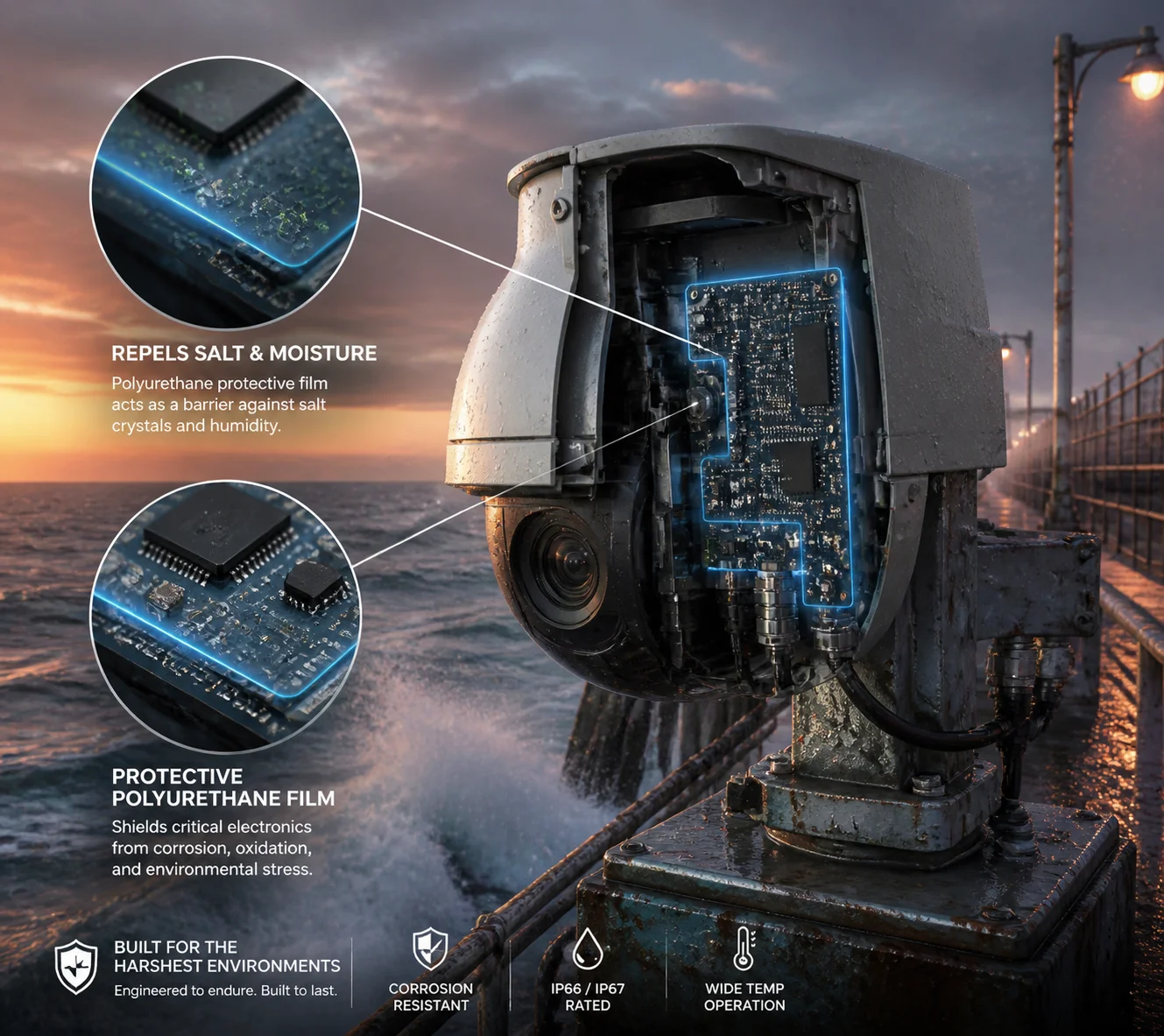
Conformal coating is a thin polymer film that covers the entire PCB surface, solder joints, and component leads. It creates a physical barrier against moisture, salt fog, dust, and fungal growth. Without it, exposed copper traces and solder joints corrode rapidly in salty, humid air — leading to short circuits, signal loss, and total device failure.
What exactly is “conformal coating”?
The word “conformal” means the coating follows the shape of whatever it covers. Think of it as shrink-wrap for your circuit board. It is a transparent layer — usually 25 to 250 microns thick — that hugs every component, every solder joint, and every copper trace on the PCB. It does not change how the board works. It just keeps the outside world from touching the board.
In Chinese, this process is called “三防漆” — which literally translates to “three-proof paint.” The three proofs are: moisture-proof, salt-fog-proof, and mold-proof. These are the three biggest killers of electronics in tropical and coastal environments.
Why coastal sites are especially dangerous
Salt air is not just “humid air.” It contains sodium chloride particles that land on PCB surfaces and attract moisture. This creates a thin, conductive film of saltwater on the board. Here is what happens next:
| Failure Mode | What Causes It | What You See |
|---|---|---|
| Copper corrosion | Saltwater reacts with exposed copper traces | Green or white deposits on the board |
| Electrochemical migration | Voltage difference between adjacent traces drives metal ions through moisture | Tiny metal “whiskers” or dendrites bridging traces |
| Solder joint degradation | Salt attacks tin-lead or SAC solder | Weak joints, intermittent connections |
| Insulation resistance drop | Moisture film lowers surface resistance | Random resets, ghost triggers, full system crash |
The conformal coating solution
A proper coating blocks all of this. The polymer film prevents salt particles from ever touching the copper. Even if condensation forms inside the housing — which happens when temperature drops at night — the water sits on top of the coating, not on the metal. The board stays dry at the electrical level.
At Loyalty-Secu, we treat conformal coating as a standard production step for all industrial-grade PTZ cameras. We do not sell it as an “upgrade” or “optional add-on.” If a camera is designed for outdoor use, it gets coated. Period.
For projects within 5 kilometers of any coastline, I always recommend polyurethane (UR) or silicone (SR) coatings instead of the cheaper acrylic type. These materials offer much stronger resistance to salt fog and chemical exposure.
Learn more about corrosion mechanisms in coastal electronics 1.
Can I verify the coating thickness to ensure long-term insulation against moisture?
I have had customers tell me, “Han, the last supplier said the boards were coated. When we opened the camera, we could barely see anything on the PCB.” That is a common problem. Words on a spec sheet mean nothing without verification.
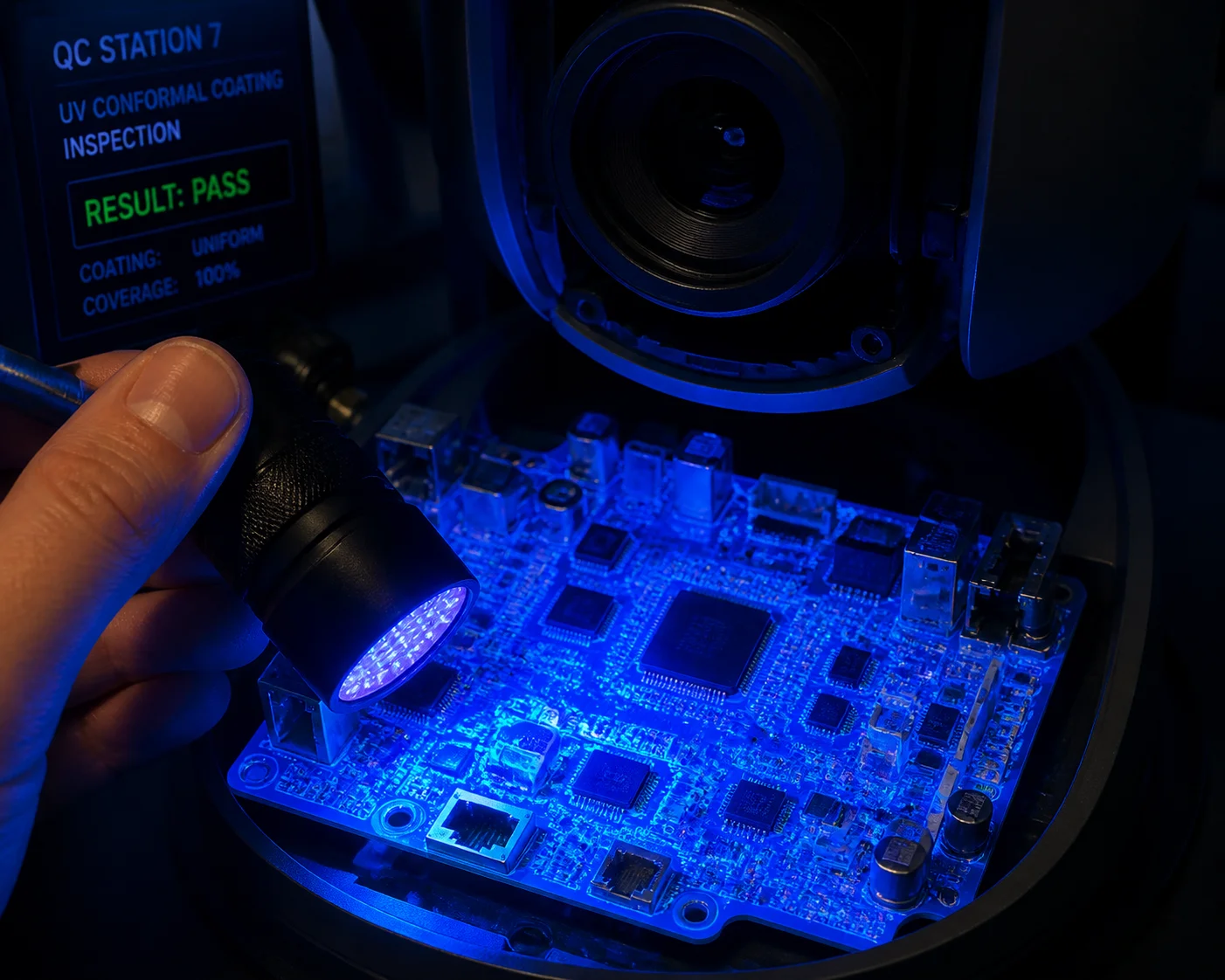
Yes, you can and should verify coating thickness. Request the supplier’s IPC-CC-830 conformal coating certification 2 documents and coating process records. Then pull a sample unit, open it, and inspect the PCB under a 365 nm UV lamp. Properly coated boards with fluorescent additives will glow brightly, and any missed spots will be immediately visible.
How to check coating from documents
Before you even open a camera, ask your supplier for these items:
- Material data sheet for the conformal coating used — it should list the chemical type (AR, UR, SR, or Parylene), recommended thickness range, and curing method.
- IPC-CC-830 compliance certificate — this is the current industry standard for conformal coatings. It replaced the old military spec MIL-I-46058C. A supplier who cannot provide this document is likely not using a qualified coating.
- Process flow document — a proper coating process includes: cleaning → drying → coating (spray, dip, or brush) → curing → visual inspection → UV inspection. Ask for this flow chart.
How to check coating physically
Documents can be faked. So I always tell my customers: open one unit and look.
Here is my recommended inspection process:
| Step | Method | What to Look For |
|---|---|---|
| 1. Visual check | Naked eye under bright light | A slight sheen or gloss on the board surface; coating should look even, no bare spots |
| 2. UV lamp check | 365–395 nm UV flashlight in a dark room | Coated areas glow blue or green; uncoated areas stay dark |
| 3. Touch test | Gently touch the board surface with a fingertip | Coated areas feel slightly tacky or smooth; bare FR4 feels rough |
| 4. Thickness gauge | Use an eddy-current or magnetic coating thickness meter | Reading should be between 30–100 µm for most applications |
What “good” looks like vs. “bad”
A well-coated board will glow uniformly under UV light. You should see coverage on both sides of the main control board, the pan-tilt motor driver board, and the power supply board. The only areas left bare should be connectors (RJ45, DC jack, SD card slot) and heat sink contact surfaces.
A poorly coated board will show patchy fluorescence — bright spots here, dark spots there. Some boards I have seen only had coating on the power supply section, leaving the main processor and video chipset completely exposed. That is not acceptable for any outdoor deployment, let alone a coastal one.
At Loyalty-Secu, we add fluorescent indicators to our conformal coating material specifically so that QC inspectors — and our customers — can verify coverage easily.
For a detailed guide, see this conformal coating inspection checklist 3.
Will the PCB’s thermal performance be affected by the protective chemical layer?
I get this question a lot from engineers. It makes sense — you are wrapping the board in plastic. Won’t it overheat?
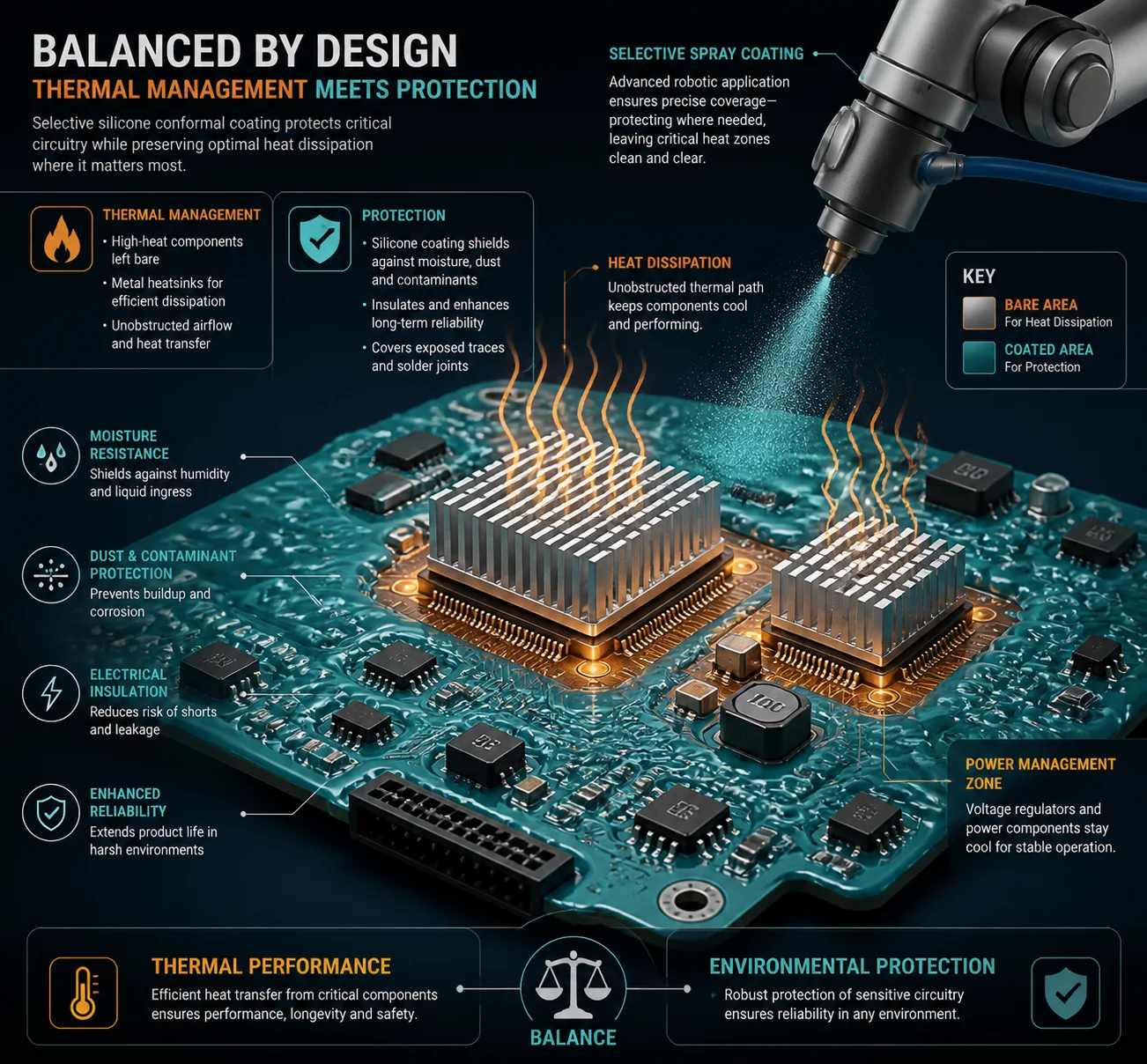
In most cases, conformal coating has minimal impact on thermal performance. The coating layer is extremely thin — typically 30 to 100 microns — and modern silicone or acrylic coatings have reasonable thermal conductivity. The key is to leave heat sink contact areas and high-power component pads uncoated, which is standard practice in selective spray coating.
Understanding the thermal impact
Let me put this in perspective. A typical conformal coating layer is 50 microns thick. That is 0.05 millimeters — about the thickness of a human hair. The thermal resistance added by this layer is extremely small compared to the overall thermal path from a chip to the outside air.
The real thermal bottlenecks in a PTZ camera are:
- The gap between the chip and the heat sink
- The quality of thermal paste or thermal pad
- Air circulation inside the housing
- The housing material itself (aluminum vs. plastic)
A 50-micron layer of silicone coating sitting on top of passive components and solder joints is not going to change the thermal picture in any meaningful way.
Where coating and heat management must coexist
That said, there are specific areas where you must not apply coating:
Critical bare zones
- Heat sink mounting surfaces — any area where a metal heat sink makes direct contact with a chip or board must stay bare for proper thermal transfer.
- High-power regulator pads — voltage regulators that dissipate significant heat need direct contact with copper pour or heat sinks.
- LED driver areas — on some IR illuminator boards, the LED pads need to transfer heat to the metal-core PCB below.
This is why we use selective spray coating with robotic arms at our factory. The machine is programmed to coat everything except these specific zones. Manual brush coating cannot achieve this level of precision — you either miss areas that need coating, or you coat areas that need to breathe.
Coating type matters for thermal performance
Different coating materials have different thermal properties:
- Acrylic (AR): Lowest thermal conductivity, but also the thinnest application. Fine for standard environments.
- Silicone (SR): Best thermal range (-40°C to +200°C). It stays flexible and does not crack under thermal cycling. This is our go-to choice for PTZ cameras that face extreme temperature swings.
- Polyurethane (UR): Harder film, slightly better thermal conductivity than acrylic, excellent chemical resistance.
For a PTZ camera running 24/7 in a desert or tropical environment where daytime temperatures hit 50°C and nighttime drops to 10°C, silicone coating handles the thermal cycling without cracking. Acrylic might crack after repeated expansion and contraction cycles, exposing the board underneath.
For more information, read this comparison of conformal coating materials 4.
Does the coating cover all critical solder joints to prevent “whiskering” in tropical climates?
I have pulled failed boards out of cameras returned from Southeast Asia. Under a microscope, I could see tiny metal filaments growing between solder pads — like tiny bridges connecting points that should never be connected. That is tin whisker growth, and it causes random short circuits that are almost impossible to diagnose remotely.
Yes, a properly applied conformal coating covers all critical solder joints and component leads, which directly prevents tin whisker growth and dendritic formation. In tropical climates where humidity stays above 80% RH for months, this full coverage is the only reliable way to stop electrochemical migration between closely spaced conductors.
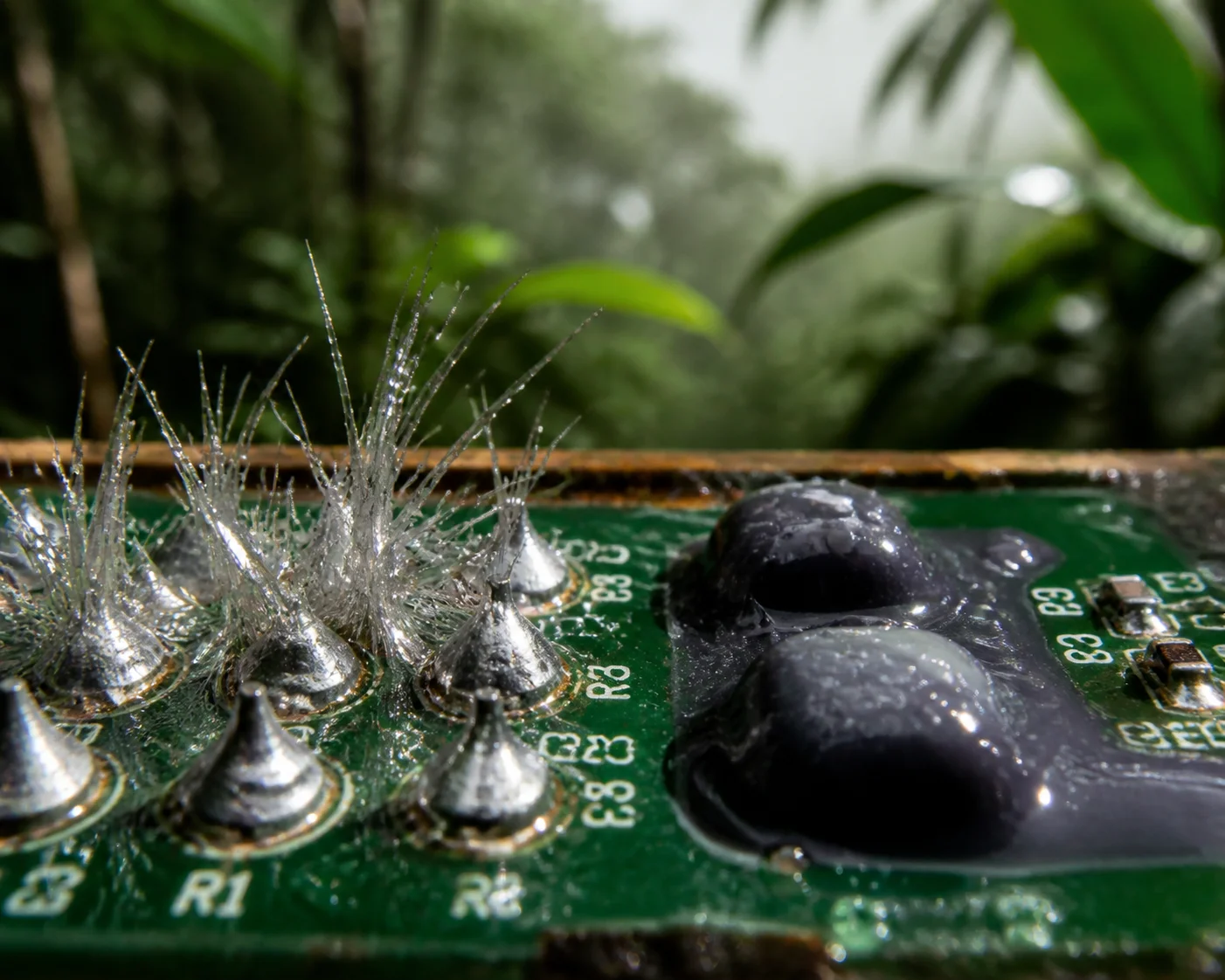
What are tin whiskers and dendrites?
Tin whiskers are thin, hair-like metal growths that sprout from tin-based solder and component leads. They can grow up to several millimeters long. When a whisker bridges two adjacent traces or pads, it creates a short circuit.
Dendrites are similar but grow differently. They form when moisture sits on a PCB surface between two conductors at different voltages. Metal ions dissolve from one conductor, travel through the moisture film, and deposit on the other conductor. Over time, a conductive metal tree grows across the gap.
Both problems share the same root cause: moisture on unprotected metal surfaces.
How coating stops the growth
Conformal coating works against whiskers and dendrites in two ways:
- Physical containment — even if a whisker starts to grow from a solder joint, the coating holds it down. It cannot extend far enough to reach the next conductor.
- Moisture exclusion — without a moisture film on the board surface, dendrites simply cannot form. The electrochemical migration process needs liquid water to work. No water, no dendrites.
What “full coverage” means in practice
At Loyalty-Secu, when we say “full coverage,” we mean:
- Main control board — both sides coated, including all BGA and QFP chip solder joints
- Pan-tilt motor driver board — coated, especially around the H-bridge driver ICs where voltage differences are high
- Power supply board — coated, with special attention to the AC-DC or DC-DC converter areas
- Laser IR illuminator board — coated on the control circuit side, bare on the LED thermal pad side
What to write in your purchase contract
To make sure your Chinese supplier actually delivers full-coverage conformal coating, here are the key clauses I recommend you include in your technical agreement:
| Clause | What to Write | Why It Matters |
|---|---|---|
| Coating standard | “All exposed PCBs shall be coated per IPC-CC-830 using silicone (SR) or equivalent.” | Gives a clear, testable standard |
| Coverage scope | “All PCBs including main board, driver board, and power board. Only connectors, test points, and heat sink contacts may be left bare.” | Prevents partial coating shortcuts |
| Thickness | “Average coating thickness 30–100 µm, uniform, no pinholes, bubbles, or cracks.” | Sets a measurable quality bar |
| Verification rights | “Buyer may randomly select units for disassembly and UV inspection at any time.” | Keeps the supplier honest |
| Environmental test | “Coated PCBs must pass 40°C / 95% RH / 96-hour humidity test with no corrosion or insulation failure.” | Proves the coating actually works |
The IP66 housing is not enough
I want to be very clear about this point. Many suppliers will say, “Our camera is IP66, so you do not need to worry about moisture.” That is only half true.
IP66 means the housing keeps water out under normal conditions. But here is what IP66 ingress protection rating 5 does not protect against:
- Seal aging — rubber gaskets degrade over 3–5 years, especially under UV exposure and temperature cycling.
- Maintenance events — every time a technician opens the housing to clean the lens or swap an SD card, humid air rushes in.
- Internal condensation — when the camera heats up during the day and cools down at night, moisture already trapped inside the housing condenses on the coldest surface — which is usually the PCB.
Conformal coating is your second line of defense. Think of it this way: the IP66 housing is the raincoat, and the conformal coating is the wetsuit underneath. Even if the raincoat leaks, the wetsuit keeps you dry.
At Loyalty-Secu, we call this our “IP-Plus” strategy — combining a sealed housing with full PCB coating to deliver true long-term reliability in the harshest environments on earth.
For more on tin whisker mitigation, see this NASA guide to tin whisker prevention 6.
Conclusion
Conformal coating is not optional for outdoor PTZ cameras in humid or coastal environments. Demand written proof, verify with UV inspection, and write it into your contract. Your field failure rate will drop dramatically.
1. NACE guide to corrosion mechanisms in coastal environments. ↩︎ 2. IPC-CC-830 conformal coating qualification standard. ↩︎ 3. Inspection checklist for conformal coating quality. ↩︎ 4. Material selection guide for conformal coating types. ↩︎ 5. IP rating chart explaining ingress protection levels. ↩︎ 6. NASA technical guide to tin whisker prevention. ↩︎