
I’ve watched too many installers waste money on PTZ cameras8 where the laser just blasts a fixed beam into the dark. The target moves closer, and the image blows out white. It moves farther, and you see nothing.
Yes, the laser activation and beam angle are driven in real-time by AI distance data. The AI chip calculates target distance using pixel size, zoom position, and tilt angle, then commands a micro stepper motor to adjust the laser’s divergence angle frame by frame. This is called Sync-Laser Zooming1.
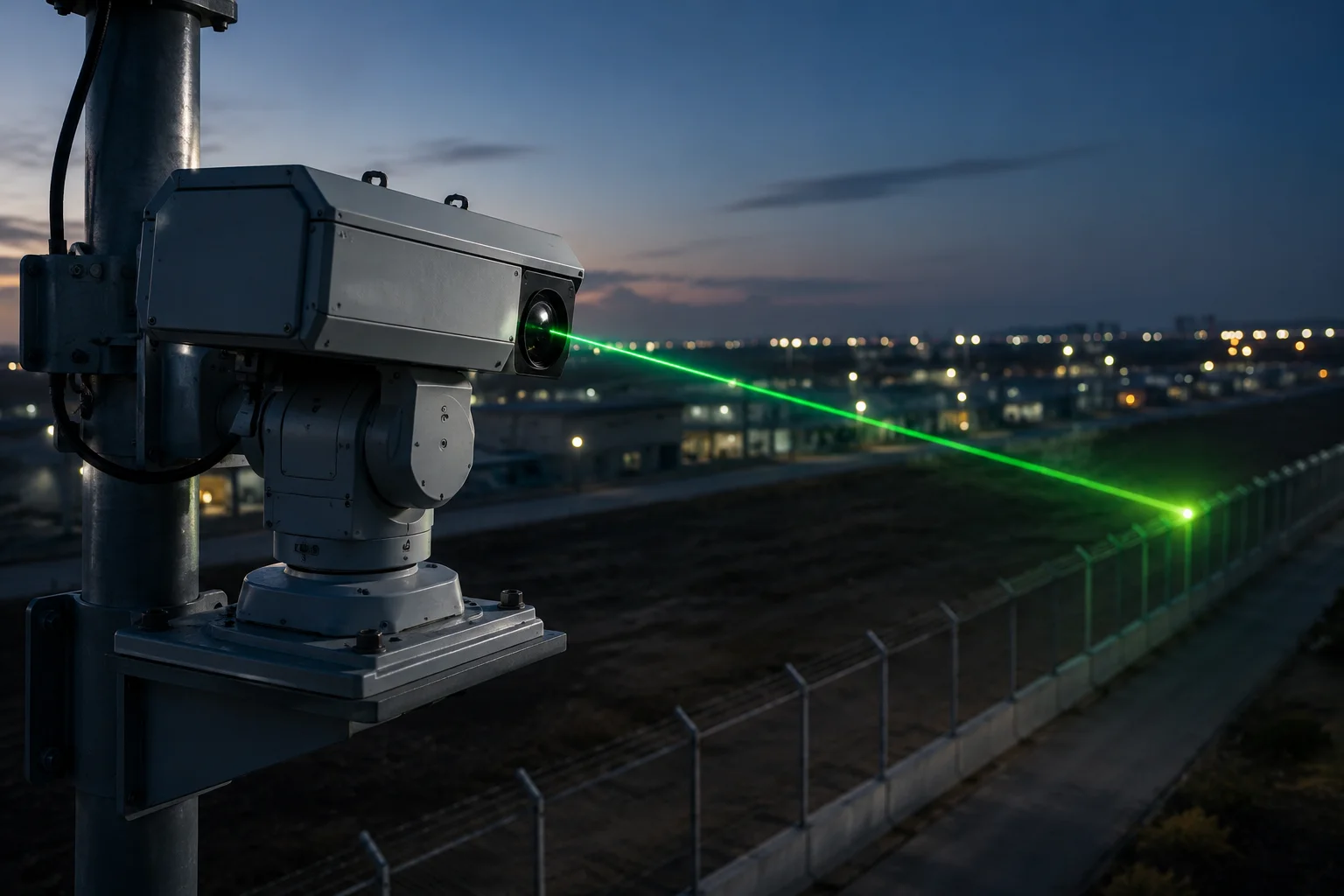
Below, I break down exactly how this works at each stage — from the moment the camera locks onto a target, to how the beam width changes, to when the laser stays off entirely. If you spec PTZ cameras for remote sites, this is the detail that separates a reliable deployment from a costly callback.
Table of Contents
Does the AI-Based “Laser Zoom Linkage” Ensure the Light Always Follows the Camera’s Focus?
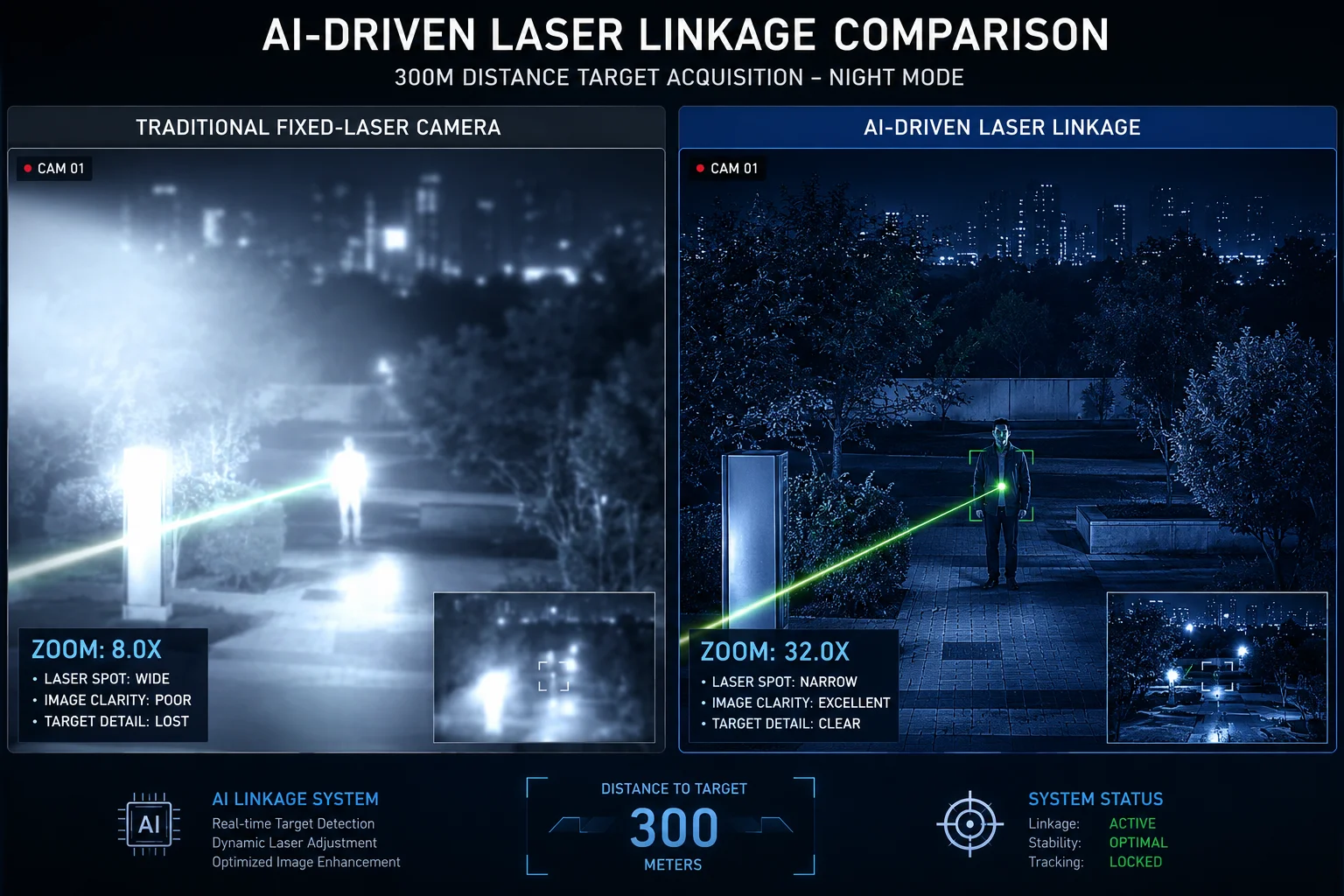
I used to think “laser zoom linkage” was just a marketing phrase. Then I saw the difference on a live feed at 300 meters — one camera with fixed laser, one with AI-driven linkage. Night and day.
The AI-based laser zoom linkage does ensure the light always follows the camera’s focus. The system reads the current optical zoom ratio and tilt angle in real time, then maps a 3D coordinate to the laser motor so the beam center stays locked on the exact area the lens sees.
How the Linkage Actually Works
The core idea is simple: the laser has its own tiny motor. That motor takes orders from the same AI chip that controls the PTZ head. Every time the lens zooms in or out, the AI recalculates two things — where the center of the frame is pointing in 3D space, and how wide the field of view is at that zoom level.
The laser motor then adjusts the beam angle to match. If the lens is at 40X zoom looking at a narrow slice of a fence 400 meters away, the laser narrows to about 1° to 2°. If the operator pulls back to 10X to scan a wider area at 80 meters, the laser opens up to maybe 8° to 10°.
The Feedback Loop
This is not a one-time calculation. It runs as a closed loop:
- The AI reads the current zoom encoder position.
- It reads the pan and tilt encoder positions.
- It calculates the expected field of view at the current focal length.
- It sends a pulse command to the laser stepper motor4.
- The motor moves the laser lens to match.
- The AI checks the image brightness in the center zone.
- If the center is too bright or too dark, it fine-tunes the laser power (PWM duty cycle).
This loop runs many times per second. The result is that no matter how fast the operator zooms or pans, the laser patch stays centered and correctly sized.
Why Fixed-Angle Lasers Fail
A fixed-angle laser has one beam width. At close range, it floods the frame and overexposes everything. At long range, the beam is too wide and the energy spreads thin — you get a dim, useless image. There is no middle ground.
| Scenario | Fixed Laser Result | AI-Linked Laser Result |
|---|---|---|
| Target at 50 m, 5X zoom | Severe overexposure, face detail lost | Beam widens, power drops, even lighting |
| Target at 200 m, 20X zoom | Dim edges, center hotspot | Beam narrows to match FoV, uniform fill |
| Target at 400 m, 40X zoom | Almost no useful light reaches target | Beam collimates to 1°, full energy on target |
This is why system integrators who deploy in open fields or along perimeters demand AI-linked laser. It is not a luxury feature. It is the difference between a camera that works at night and one that does not.
How Does the Laser Adjust Its Beam Width Automatically as the PTZ Tracks a Person Moving Closer?
I had a client in Texas ask me this exact question. His cameras watched a pipeline corridor. Guards needed to track a person walking toward the fence from 500 meters out. He wanted to know: will the image stay clear the whole way in?
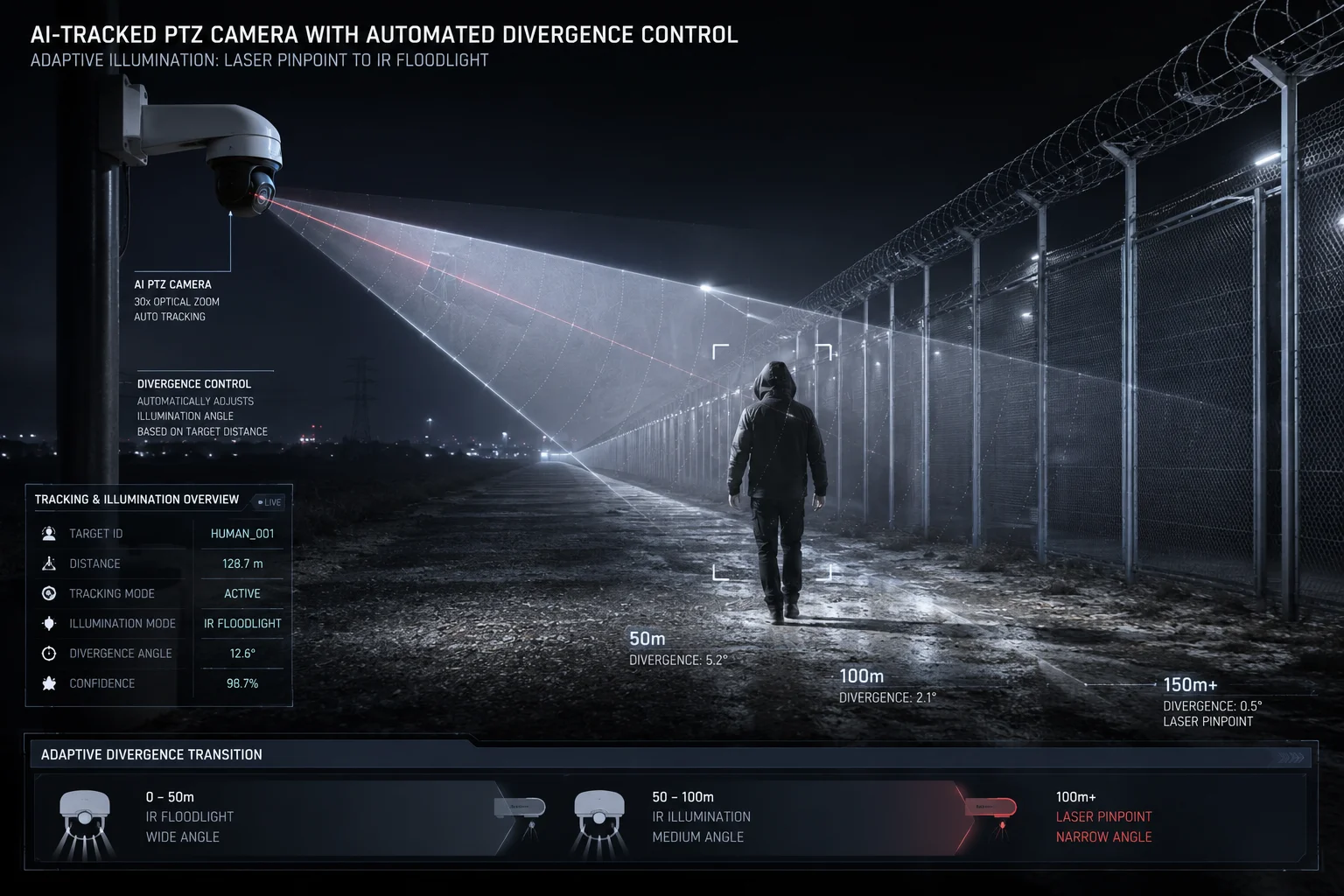
As the PTZ tracks a person moving closer, the AI continuously recalculates the target distance using pixel size growth and zoom position. It then commands the laser motor to widen the beam angle step by step, while simultaneously reducing laser power to prevent overexposure. The adjustment is smooth and automatic.
The Distance Calculation Method
The AI does not use a separate rangefinder in most models. Instead, it uses a software-based method. Here is the logic:
- The AI knows the current focal length (from the zoom encoder).
- It knows the vertical pixel height of the detected person.
- A standard human is roughly 1.7 meters tall.
- Using the thin-lens formula2, it calculates distance: $D = (H \times f) / (h \times sensor_size)$ where H is real height, f is focal length, h is pixel height on sensor.
As the person walks closer, their pixel height grows. The AI sees this growth frame by frame and updates the distance value every cycle.
What Happens to the Laser During Approach
Let me walk through a real sequence:
- Person detected at 350 m. The camera is at 35X zoom. The laser is at minimum divergence (about 1.5°). Power is at 80% PWM.
- Person at 200 m. The operator or auto-track pulls zoom back to 20X. The laser widens to about 4°. Power drops to 50%.
- Person at 80 m. Zoom is at 10X. Laser opens to 8°. Power drops to 25%.
- Person at 30 m. Zoom is at 5X. The AI decides the built-in IR LEDs can handle this range. Laser turns off. IR LEDs take over.
Adaptive Power Control
The power adjustment is not just about distance. The AI also reads the average brightness of the center region of the image (this is sometimes called AGC — Automatic Gain Control feedback3). If the target wears a white shirt that reflects a lot of light, the AI will cut laser power further. If the target wears dark clothing, it bumps power up.
This prevents two common problems:
- Center hotspot: Where the middle of the frame is blown out white but the edges are dark.
- Underlit target: Where the person is too dim to identify even though the laser is on.
The Mechanical Side
The beam width change is physical. Inside the laser module, there is a small lens that moves forward or backward on a rail driven by a stepper motor. Moving the lens closer to the laser diode spreads the beam. Moving it farther away collimates (narrows) the beam. The motor has enough precision to make very small steps, so the transition looks smooth on camera — no sudden jumps in brightness.
| Distance Range | Laser Beam Angle | Laser Power (PWM) | Supplemental IR LEDs |
|---|---|---|---|
| 300–500 m | 0.5°–2° | 70%–100% | Off |
| 100–300 m | 2°–6° | 40%–70% | Off |
| 30–100 m | 6°–10° | 15%–40% | Standby |
| < 30 m | Laser off | 0% | Active |
This graduated handoff is what makes the system reliable across the full zoom range without any manual intervention.
Will the Laser Remain Off if the AI Determines the Target Is Within the IR LED’s Effective Range?
I get this question a lot from integrators who worry about power draw on solar sites. Every watt matters when you run on a battery.
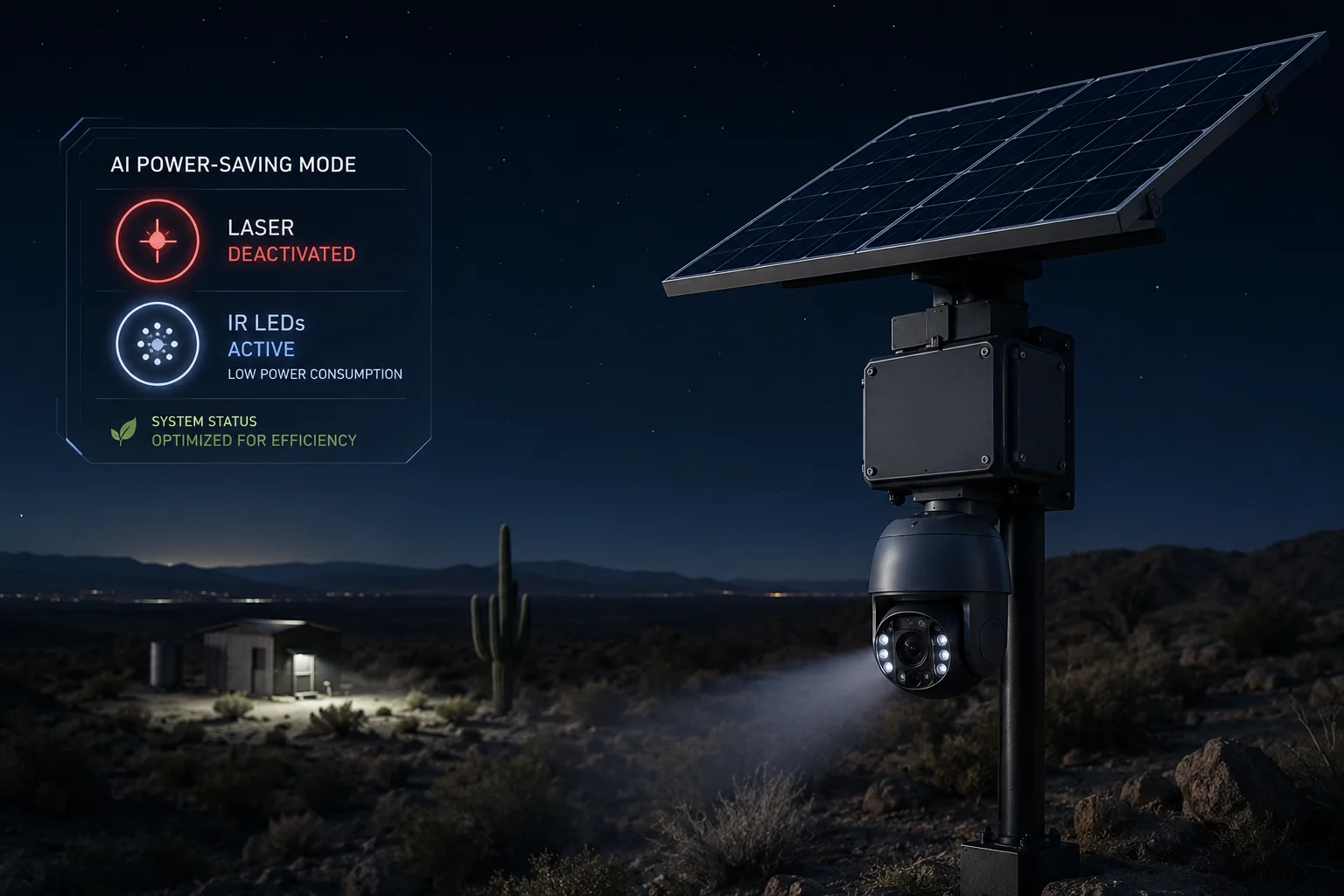
Yes, the laser stays off when the AI determines the target is within the IR LED’s effective range5. The system uses a dual-condition check — ambient light level from a photosensor plus AI-calculated target distance. If both conditions say IR LEDs are enough, the laser never fires. This saves significant power on solar and battery-powered sites.
The Decision Logic
The laser activation is not controlled by a simple light sensor alone. It uses what I call a ‘dual-gate logic’6:
Gate 1 — Is it dark enough to need any supplemental light? A photosensor on the camera housing measures ambient lux. If the scene is above a set threshold (usually around 1–3 lux), no supplemental light activates at all. The camera stays in color mode or low-light color mode.
Gate 2 — Is the target beyond IR LED reach? Once the camera switches to night mode (below the lux threshold), the AI checks target distance. If the target is within the effective range of the built-in IR LEDs (typically 30–80 meters depending on the model), the laser stays in standby. Only when the target exceeds that range does the laser fire.
Why This Matters for Solar Deployments
A high-power laser module can draw 10–20 watts. On a solar PTZ system with a 60–100 Ah battery, that is a meaningful load. If the laser runs all night regardless of whether targets are near or far, you drain the battery faster and shorten its cycle life.
By keeping the laser off when IR LEDs handle the job, the system can cut nighttime power consumption by 30% to 50% on typical nights where most activity happens within 100 meters of the camera.
Event-Based Pulse Activation
There is a third mode that sits between “always on” and “always off.” In low-power standby mode (common on 4G solar sites), the camera runs in a reduced frame rate with IR LEDs only. If the AI detects a human-shaped silhouette at the edge of IR range, it fires the laser in a short pulse — just long enough to grab a few high-resolution frames for secondary confirmation.
If the AI confirms the target (human body, vehicle, or other programmed object), the laser stays on and the system enters full tracking mode. If the shape turns out to be an animal or a moving branch, the laser shuts off again within 1–2 seconds. This “pulse activation” approach keeps average power draw very low while still catching real threats at distance.
Practical Benefit for Integrators
For David and other integrators who deploy in off-grid locations — ranches, oil fields, construction sites, border areas — this intelligence-driven activation means:
- Smaller solar panels (lower project cost).
- Longer battery life between replacements.
- Fewer false-alarm power spikes that could brown out the system.
- The laser diode itself lasts longer because it runs fewer total hours.
Can I See the Real-Time Distance (in Meters) of the Target Calculated by the AI Engine?
I remember the first time a client asked me to show the distance overlay on a live demo. He did not believe the number was real until we measured it with a laser rangefinder and got the same result within 5%.
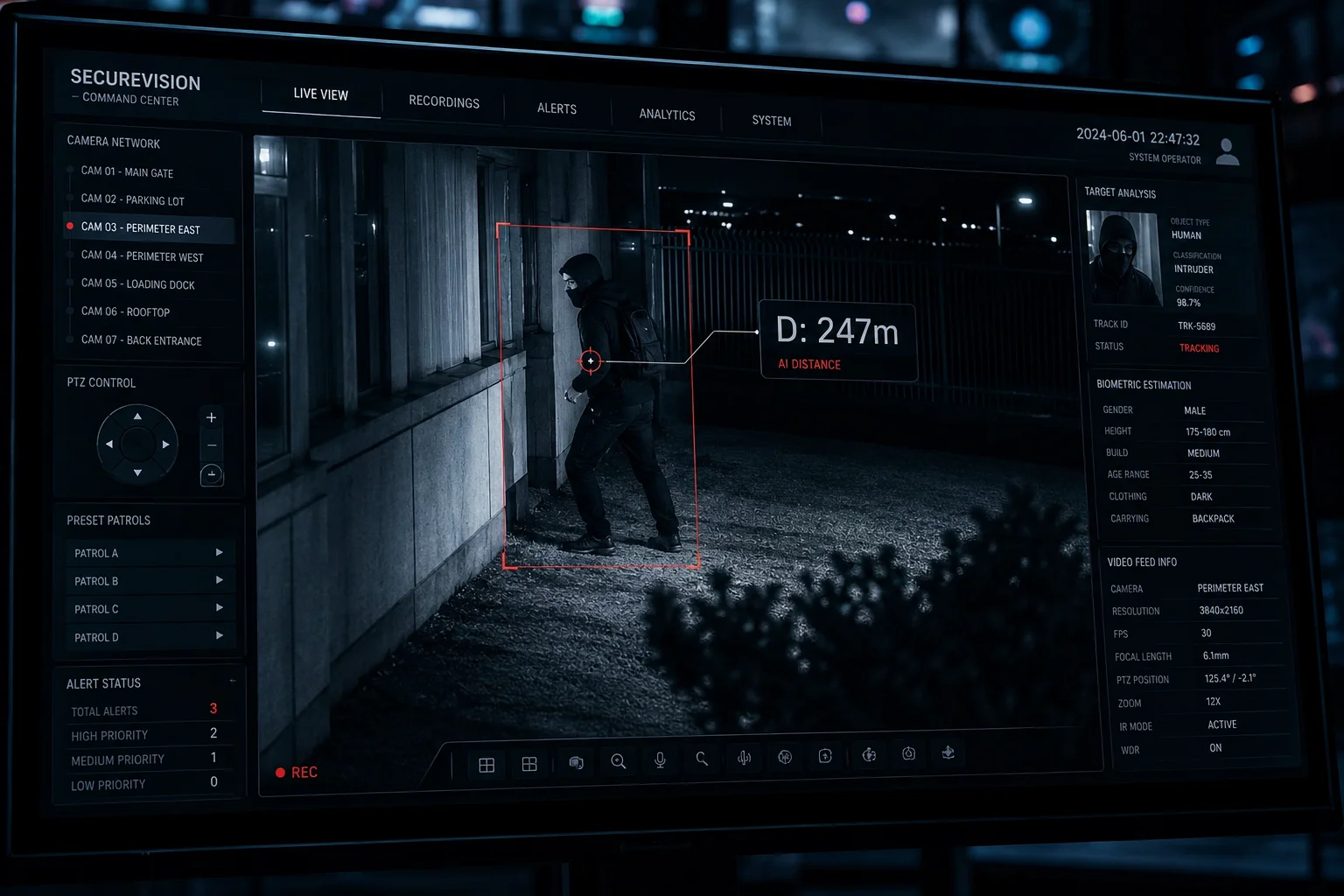
Yes, you can see the real-time distance of the target on screen. The AI engine calculates distance using pixel-based measurement and outputs it as an OSD (On-Screen Display) overlay in meters. This value updates continuously as the target moves or the camera zooms.
How the Distance Appears
The distance value shows up as a text overlay on the video stream. It typically appears near the bounding box of the tracked target or in a fixed corner of the screen. The format is simple — something like “D: 247m” — and it refreshes several times per second.
This data is also available through the camera’s API (usually via ONVIF7 or a proprietary SDK). That means your VMS or NVR can pull the distance value and log it alongside the video. Some integrators use this for automated reporting — for example, “intruder first detected at 380 m, reached fence at 12 m, total tracking duration 4 minutes.”
Accuracy and Limitations
The pixel-based distance calculation is not as precise as a dedicated laser rangefinder. But for security applications, it is accurate enough. Here are the typical accuracy ranges:
| Distance Range | Typical Accuracy | Notes |
|---|---|---|
| 30–100 m | ±5–8% | High confidence, large pixel size |
| 100–300 m | ±8–12% | Good confidence, medium pixel size |
| 300–500 m | ±12–18% | Lower confidence, small pixel size |
The accuracy depends on several factors:
- Target type: A standing person gives better results than a crouching one because the height assumption is more reliable.
- Zoom level: Higher zoom gives more pixels on target, which improves the calculation.
- Tilt angle: Steep downward angles (like a camera mounted very high looking at a nearby target) introduce more geometric error.
What Integrators Do With This Data
Beyond just displaying the number on screen, the distance data feeds back into the entire system:
- Laser control: As discussed above, the laser uses this distance to set beam angle and power.
- Alert zones: You can set rules like “trigger alarm only if a person is detected within 50 meters of the fence.” The AI uses its distance calculation to enforce this rule without needing to draw complex polygons on a map.
- Forensic review: After an incident, you can review the footage and see exactly how far away the intruder was at each moment. This helps in court cases and insurance claims.
- Auto-zoom behavior: Some modes use the distance to decide how far to zoom in. If the target is at 200 m, the camera might zoom to 25X automatically. If the target is at 50 m, it stays at 8X to keep context in the frame.
A Note on Calibration
For the distance reading to be accurate, the camera needs to know its installation height. During setup, the installer enters the mounting height (say, 6 meters on a pole). The AI uses this value along with the tilt angle to refine its trigonometric calculation. If the height is entered wrong, all distance readings will be off. This is a one-time setup step that takes 30 seconds but makes a real difference in accuracy.
Conclusion
The laser in a modern AI-driven PTZ camera is not a dumb floodlight. It is a precision tool — activated, angled, and powered entirely by real-time AI distance data to deliver clear night images while saving energy on every frame.
1. See how manufacturers implement synchronized laser zooming in PTZ cameras. ↩︎ 2. The optical principle behind distance calculation from pixel height. ↩︎ 3. How AGC adjusts laser power based on image brightness. ↩︎ 4. The precision motor that adjusts the laser beam angle. ↩︎ 5. Factors that determine the effective range of IR LEDs in security cameras. ↩︎ 6. Explanation of the two-condition check for laser activation. ↩︎ 7. The standard protocol for interfacing with PTZ camera data and controls. ↩︎ 8. Overview of pan-tilt-zoom camera technology and applications. ↩︎