
I’ve been asked this question dozens of times by integrators working in Texas, Alberta, and the Australian outback. The answer is not simple.
Yes, a 40X+ optical zoom PTZ camera with synchronized laser illumination and laser-assisted autofocus can identify static license plates at 500 meters. But success depends on meeting strict requirements: minimum 4K sensor resolution, 100+ horizontal pixels across the plate, optical image stabilization, and intelligent laser power control to prevent plate whiteout from high reflectivity.
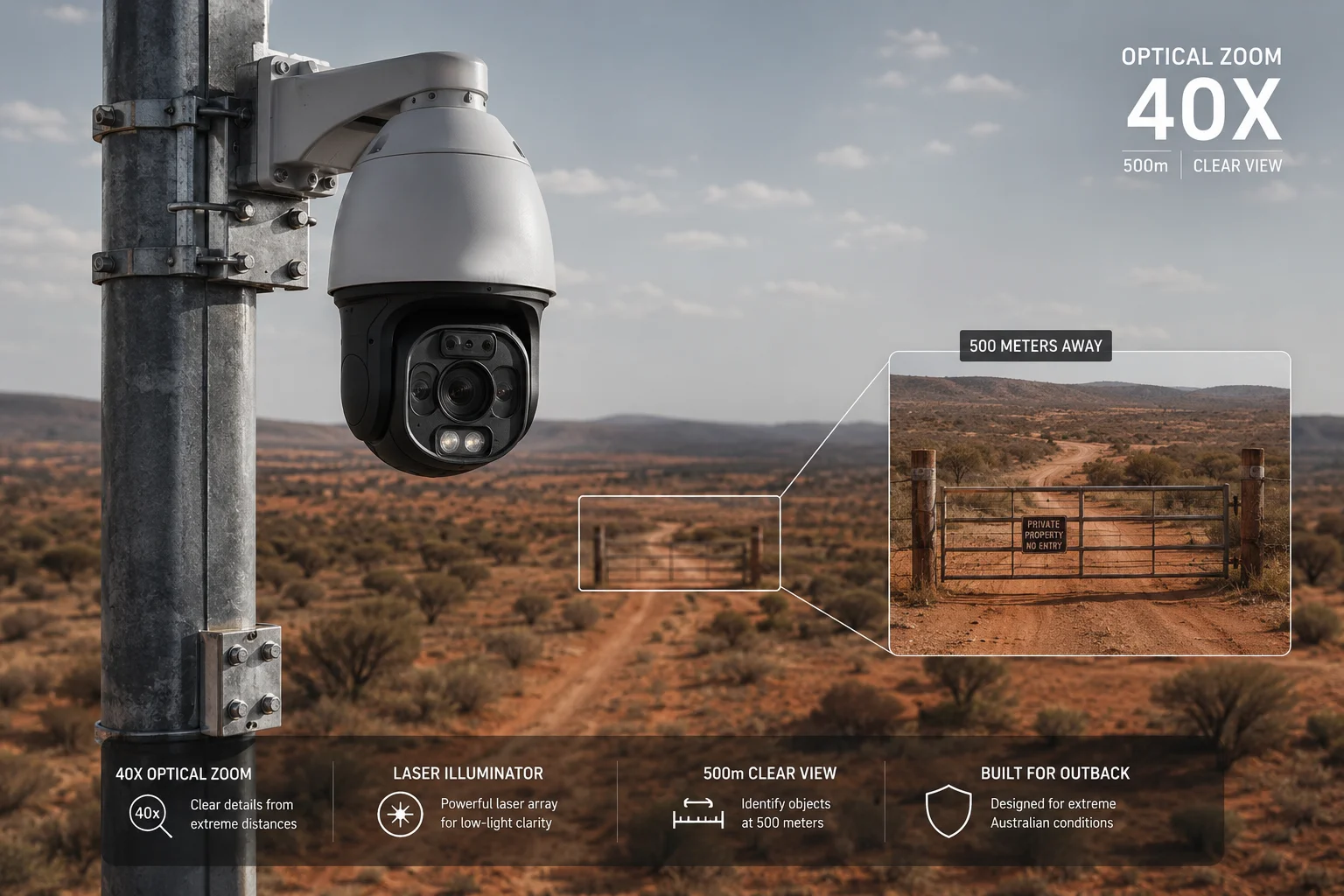
Below, I’ll break down each technical layer of this challenge. I’ll explain what the laser actually does, how the algorithm handles plate reflectivity, what 40X zoom really delivers at 500 meters, and whether multi-exposure can save you in total darkness. If you’re planning a remote perimeter project, this is the guide you need before you commit budget.
Table of Contents
Will the Laser Provide Enough Reflective Contrast to Read a U.S. License Plate in Total Darkness?
I’ve seen too many projects fail because the integrator assumed “night vision” meant “can read plates at any distance.” At 500 meters in total darkness, visible light is useless. You need laser.
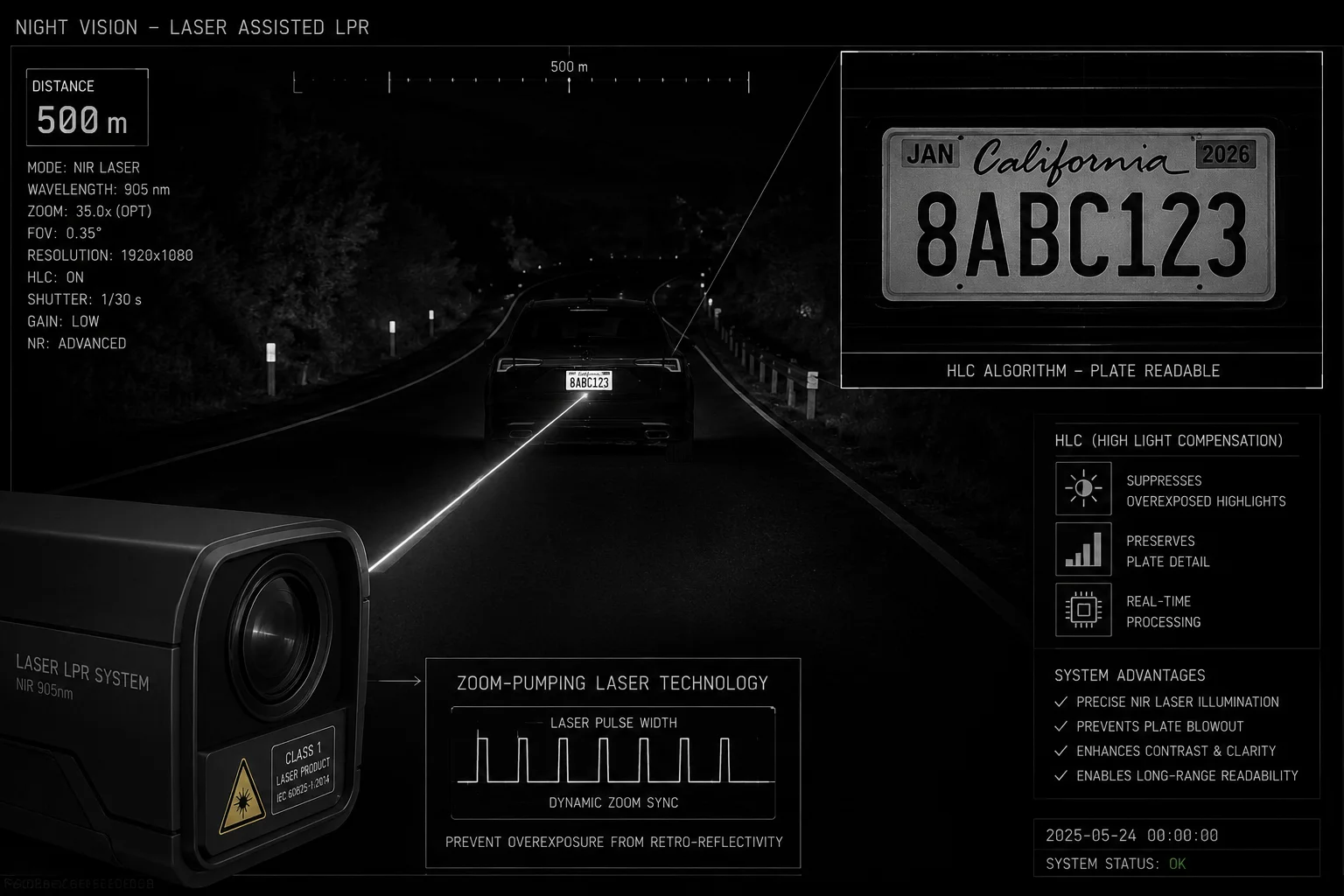
A synchronized 808nm or 940nm laser illuminator1 provides enough reflective contrast to read a U.S. retro-reflective2 license plate in total darkness at 500 meters, but only when the laser beam auto-zooms with the lens and the system includes HLC (High Light Compensation)3 to prevent the plate’s retro-reflective coating from blowing out to pure white.
How Laser Illumination Works at 500 Meters
In total darkness, your camera sensor receives zero photons from the scene. A standard IR LED array might reach 100 or 150 meters. Beyond that, the light scatters too much. Laser is different. A laser beam stays focused over long distances because it has very low divergence.
At 500 meters, the laser module projects a tight cone of near-infrared light onto the target area. The key feature is called “zoom pumping.” This means the laser beam angle automatically matches the lens field of view. When you zoom to 40X, the laser narrows its beam to cover only the small area you’re looking at. This concentrates all the laser energy onto a small spot, giving you very high illumination intensity at extreme range.
The Reflectivity Problem
U.S. license plates use retro-reflective sheeting. This material is designed to bounce light directly back toward its source. For a driver behind headlights, this makes plates easy to read. For a camera with a co-located laser, this creates a problem. The plate reflects so much laser light back that it becomes a white rectangle. All characters disappear.
How the System Solves It
| Feature | Function | Why It Matters at 500m |
|---|---|---|
| HLC (High Light Compensation) | Suppresses the brightest area in the frame | Prevents plate whiteout while keeping surroundings visible |
| Smart Laser Power Control | AI detects plate region and reduces laser output | Balances plate brightness with character contrast |
| Wide Dynamic Range (WDR) | Captures multiple exposures per frame | Recovers detail in both bright plate and dark vehicle body |
808nm vs 940nm: Which Laser Wavelength?
808nm lasers are more efficient. They produce more light per watt. But they emit a faint red glow visible to the human eye. 940nm lasers are completely invisible but need more power to achieve the same illumination distance. For covert surveillance at 500 meters, 940nm is preferred. For maximum performance where stealth is not critical, 808nm gives you a stronger signal return from the plate.
The bottom line: laser provides more than enough contrast. The real engineering challenge is controlling that contrast so the plate doesn’t overexpose.
How Does the LPR (License Plate Recognition) Algorithm Handle the “High Reflectivity” of Plates?
I’ve tested cameras that could clearly show a plate to my eyes on the monitor, but the LPR engine still failed to read it. The algorithm needs specific image conditions that go beyond what humans consider “readable.”
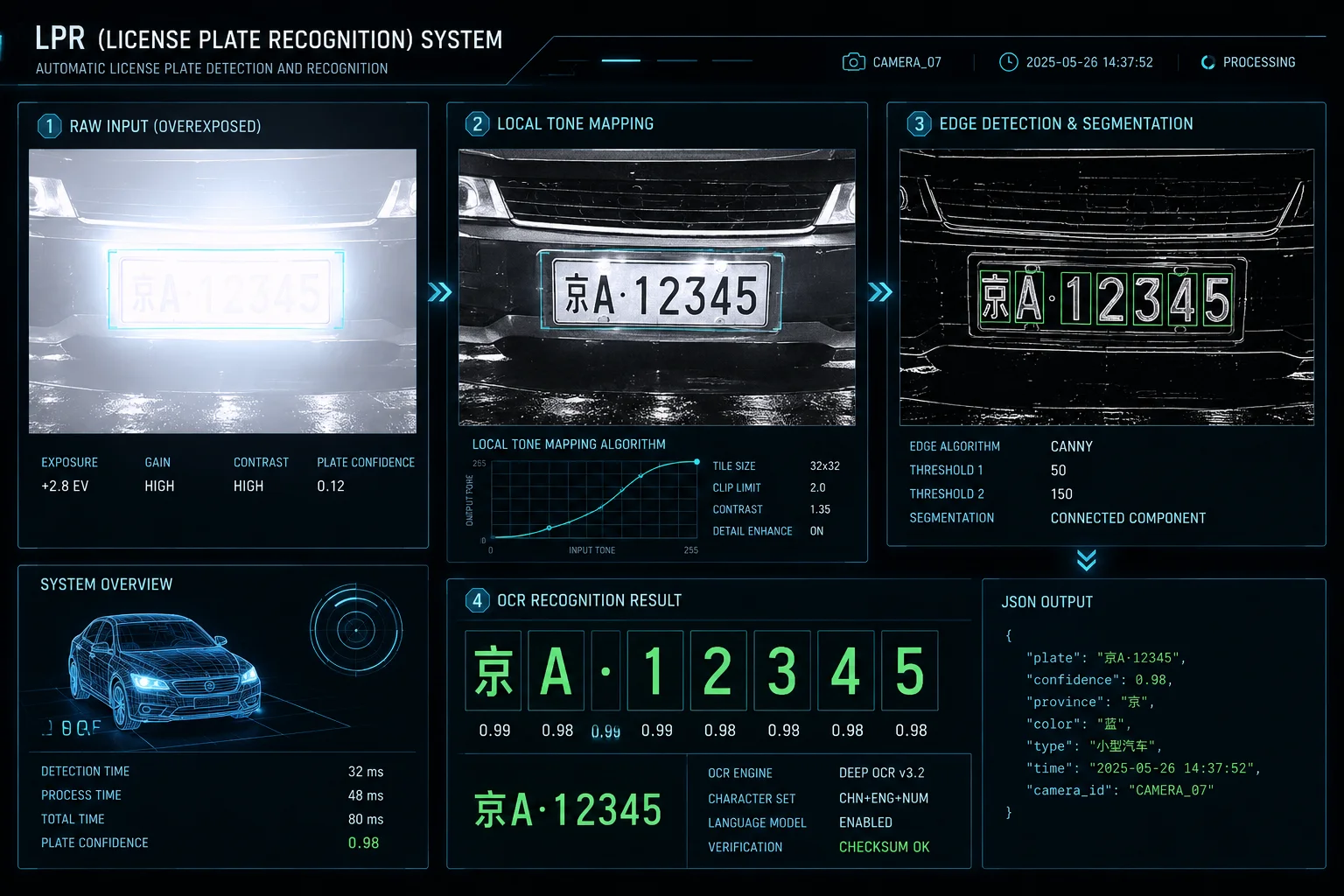
The LPR algorithm handles high reflectivity through a multi-step pipeline: first, the ISP (Image Signal Processor) applies local tone mapping to compress the dynamic range of the plate region; then, the OCR (Optical Character Recognition)4 engine uses edge-detection filters tuned for high-contrast character boundaries; finally, confidence scoring rejects partial reads and triggers re-capture at adjusted exposure settings.
What the Algorithm Actually Sees
When a retro-reflective plate bounces laser light back to the sensor, the pixel values in that region hit maximum (255 in 8-bit). At this point, there is no difference between the white background and the characters. The algorithm sees a flat white block. No edges. No features. Nothing to read.
The ISP Pre-Processing Stage
Before the LPR engine even receives the image, the ISP must fix this. Modern cameras use region-based tone mapping. The processor identifies the brightest cluster of pixels (the plate) and applies a local gain reduction. This is different from global exposure adjustment. The surrounding dark areas keep their brightness. Only the plate region gets compressed.
| Processing Stage | Input Condition | Output Result |
|---|---|---|
| Global Exposure | Entire frame too bright or dark | Adjusts overall brightness (not enough for plates) |
| Local Tone Mapping | Plate region saturated, surroundings dark | Compresses plate brightness independently |
| Edge Enhancement | Characters have soft boundaries | Sharpens transitions between character and background |
| Binarization | Grayscale plate image | Converts to pure black/white for OCR parsing |
Why Standard Cameras Fail
A standard security camera without dedicated LPR firmware treats the plate like any other bright object. It either reduces global exposure (making everything else too dark) or lets the plate blow out. Neither approach works for character recognition.
The Confidence Scoring Loop
Good LPR systems don’t just read once. They read multiple times across several frames. Each read gets a confidence score. If the score is below threshold (typically 85%), the system knows something is wrong. It can then trigger a micro-adjustment: slightly reduce laser power, shift exposure timing, or request a second capture at different settings. For static plates, this loop is extremely effective because the target isn’t moving. The system has time to iterate.
Character Segmentation at 500 Meters
At 500 meters with 40X zoom and a 4K sensor, a standard U.S. plate (12 inches wide) occupies roughly 100-130 horizontal pixels. Each character gets about 12-15 pixels of width. This is tight but workable for modern OCR engines trained on low-resolution plate images. The algorithm uses template matching combined with neural network classification to identify characters even when individual pixels are noisy or slightly blurred.
Can I Use the 40X Zoom to Capture Plate Details in an Unlit Remote Entrance at 500 Meters?
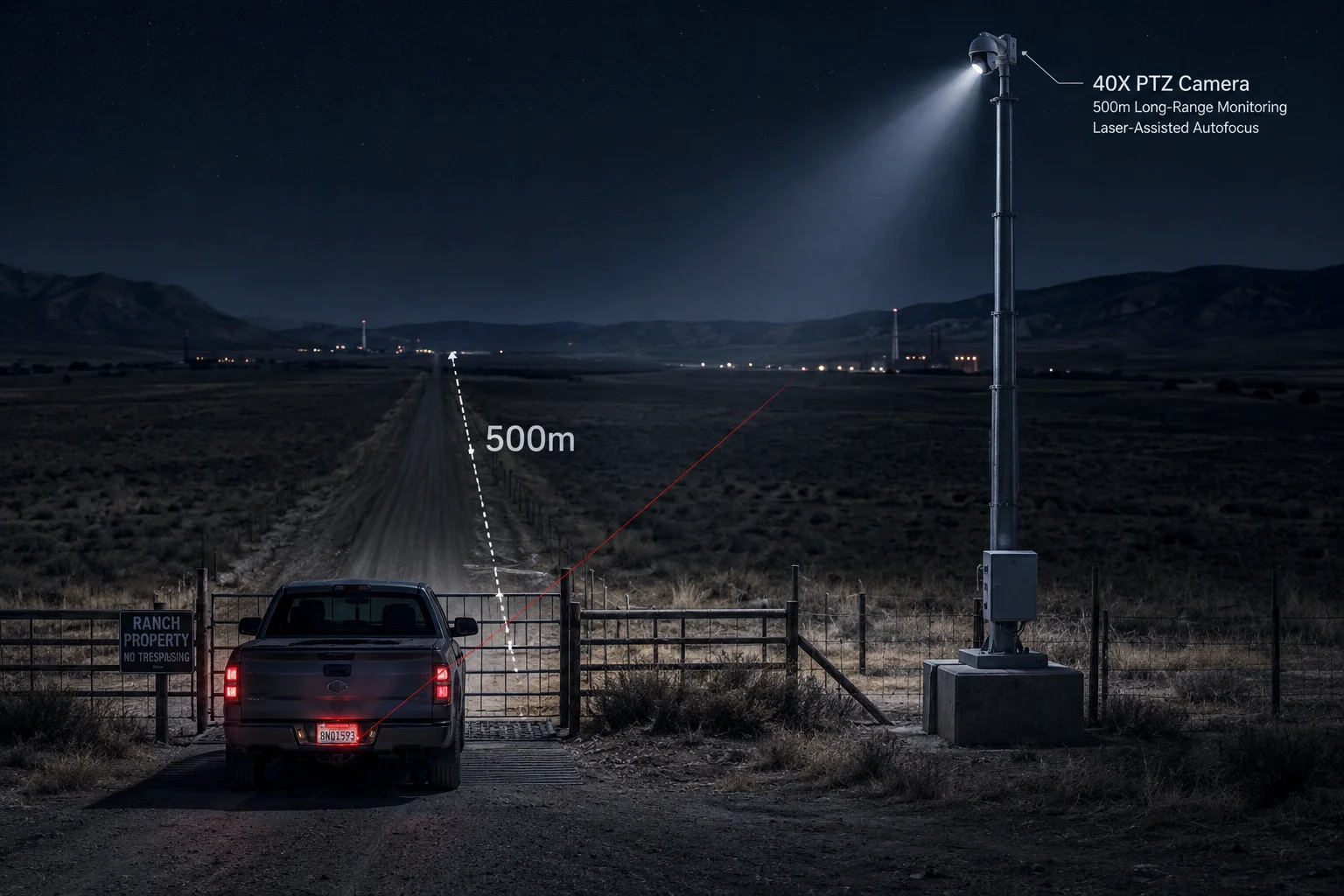
I get this question from ranch owners and oil field operators in Texas every month. They have a gate 500 meters down a dirt road with zero lighting. They want to know who’s coming in.
Yes, 40X optical zoom5 can capture plate details at 500 meters in an unlit entrance, but only when paired with synchronized laser illumination and laser-assisted autofocus. The 40X zoom provides the pixel density needed for character recognition, while the laser solves both the lighting and focusing challenges that make this distance impossible for conventional cameras.
Understanding Pixel Density at 500 Meters
The critical metric is PPM: Pixels Per Meter at the target distance. For license plate recognition, you need at least 100 pixels across the plate width. A U.S. plate is 0.3 meters wide. So you need roughly 330 PPM at the target.
The Math Behind 40X Zoom
A typical 40X zoom camera has a focal length range of about 6mm to 240mm. At 240mm focal length with a 1/1.8″ 4K sensor:
- Horizontal field of view at 500m: approximately 4.5 meters
- 3840 pixels across 4.5 meters = 853 PPM
- Plate width (0.3m) × 853 PPM = approximately 256 pixels across the plate
That’s well above the 100-pixel minimum. You have plenty of resolution. The numbers work.
Why Zoom Alone Is Not Enough
Here’s where projects fail. The integrator sees the zoom spec, does the math, and assumes success. But at 40X zoom and 500 meters, three things break down:
Focus accuracy: At 240mm focal length, the depth of field is extremely shallow. A focus error of just a few meters means a completely blurry image. Traditional contrast-based autofocus hunts back and forth in darkness because it has no contrast to lock onto. Laser rangefinder autofocus6 solves this by measuring the exact distance (500.3 meters, for example) and driving the focus motor to the precise position. No hunting. No delay.
Atmospheric distortion: In Texas summer heat, the air between your camera and the gate shimmers. At 40X zoom, this shimmer becomes severe image distortion. The plate characters wobble and blur. Optical image stabilization7 helps with mechanical vibration but cannot fix atmospheric turbulence. The only partial solution is electronic defog algorithms that analyze multiple frames and reconstruct a sharper composite image.
Mounting stability: At 40X zoom, a vibration of 0.01 degrees at the camera translates to roughly 9 centimeters of image shift at 500 meters. A gust of wind hitting the pole, a truck driving past the mount, even thermal expansion of the metal bracket throughout the day — all of these create blur. Heavy-duty mounts with vibration dampening are not optional. They are mandatory.
Installation Requirements for 500m Plate Capture
The camera must be mounted on a rigid structure. Wooden poles flex. Thin metal poles sway. A concrete base with a heavy steel pole (minimum 6-inch diameter) is the starting point. Some integrators pour a dedicated concrete pad with anchor bolts specifically for the camera mount.
Does the Camera Support “Multi-Exposure” to Balance the Bright License Plate With a Dark Vehicle?
I’ve watched recordings where the plate is perfectly readable but the vehicle is completely invisible. Or the vehicle is visible but the plate is a white blob. You need both for evidence.
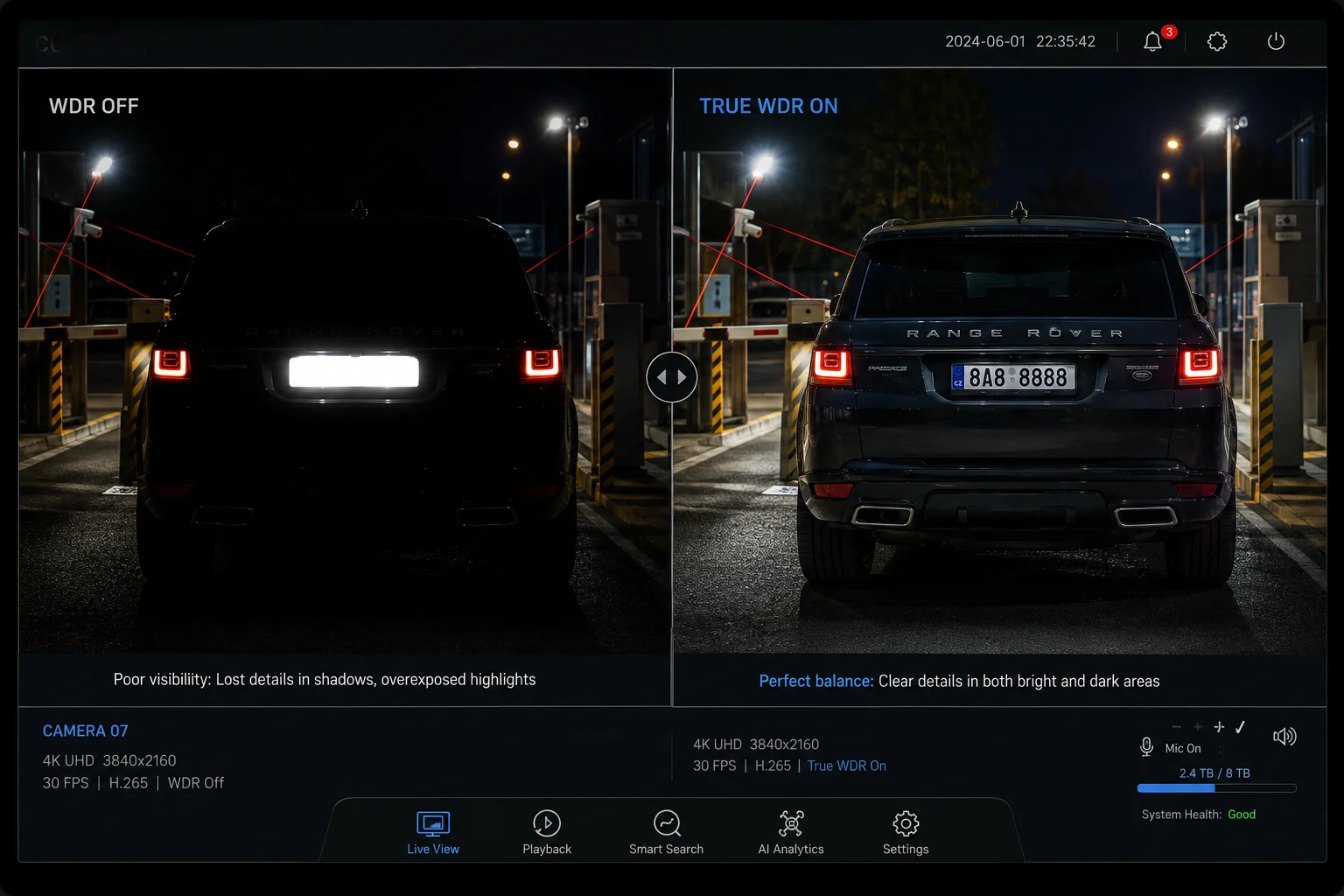
Yes, advanced PTZ cameras8 support multi-exposure (True Wide Dynamic Range (WDR)9) that captures separate short and long exposures within a single frame cycle. The short exposure freezes the bright license plate without overexposure, while the long exposure reveals the dark vehicle body, and the ISP merges both into a single balanced image with readable plate characters and visible vehicle details.
How Multi-Exposure Works in Practice
True WDR (Wide Dynamic Range) is not a software filter. It’s a hardware capability of the sensor. The sensor captures two or three exposures in rapid succession within one frame period (typically 33ms for 30fps):
- Short exposure (1/10000s): Captures the bright plate without saturation. Characters are clear. Surrounding area is black.
- Long exposure (1/100s): Captures the dark vehicle body, clothing color, face features. The plate is completely blown out in this frame.
- ISP fusion: The processor combines both frames, taking plate detail from the short exposure and vehicle detail from the long exposure.
The Dynamic Range Challenge at 500 Meters
| Scene Element | Brightness Level | Exposure Needed |
|---|---|---|
| Retro-reflective plate (laser lit) | ~10,000 lux equivalent | Very short (1/10000s) |
| Vehicle body (laser lit) | ~50-100 lux equivalent | Medium (1/500s) |
| Surrounding scene (no light) | ~0.01 lux | Very long (1/30s) |
| Driver face (through windshield) | ~5-20 lux equivalent | Long (1/100s) |
The brightness difference between the laser-lit plate and the dark surroundings can exceed 120dB. A standard camera without WDR handles about 60-70dB. You lose either the plate or the scene. True WDR cameras handle 120-140dB, which covers this scenario.
Why This Matters for Evidence Collection
Reading the plate tells you which vehicle entered. But for a complete security record, you also want vehicle color, make, model, and ideally the driver’s face. Without multi-exposure, you must choose: plate or context. With multi-exposure, you get both in a single frame.
Limitations at 500 Meters
Multi-exposure works best when the subject is static or slow-moving. At 500 meters, if a vehicle is driving at 30 mph, it moves about 0.4 meters during a 33ms frame cycle. At 40X zoom, this translates to noticeable motion blur in the long-exposure frame. For the short-exposure plate capture, motion blur is minimal because the exposure time is so brief.
For your use case of static plates (parked vehicles at a gate), multi-exposure is ideal. The vehicle isn’t moving. Both exposures are sharp. The fused image gives you a complete evidence frame: readable plate, visible vehicle, and surrounding context.
Sensor Size Matters
Larger sensors (1/1.8″ or 1/1.2″) collect more light per pixel. This means the long exposure doesn’t need to be as long, which reduces motion blur risk. A 1/1.8″ 4K sensor10 is the minimum I recommend for 500-meter multi-exposure plate capture. Smaller sensors (1/2.8″) simply don’t have enough light-gathering ability to produce clean long-exposure frames at this distance, even with laser assistance.
Conclusion
Identifying static license plates at 500 meters with laser assistance is achievable, but only when optical zoom (40X+), laser AF, synchronized laser illumination with smart power control, true WDR multi-exposure, and rock-solid mounting all work together. Skip any one element, and the system fails.
1. Comparison of laser vs. LED illuminators for long-range surveillance. ↩︎ 2. Explains how retro-reflective materials bounce light back toward the source. ↩︎ 3. HLC suppresses bright areas to prevent overexposure, crucial for reading retro-reflective plates. ↩︎ 4. How OCR engines convert images of text into machine-readable characters, used in LPR systems. ↩︎ 5. Explains how optical zoom magnifies images without losing resolution, essential for long-distance identification. ↩︎ 6. Describes autofocus methods, including laser-assisted rangefinding for precise focus at long distances. ↩︎ 7. Explains how optical image stabilization reduces blur from vibration, critical at high zoom levels. ↩︎ 8. Explains pan-tilt-zoom cameras and their applications in surveillance and monitoring. ↩︎ 9. WDR technology captures scenes with high contrast by merging multiple exposures. ↩︎ 10. Overview of sensor sizes and their impact on low-light performance and resolution for LPR. ↩︎