
I have seen PTZ cameras fall off their mounts. Not because of wind. Not because of a bad bracket. Because a single screw rusted through in salty coastal air.
Grade 316 stainless steel screws are mandatory for high-salinity coastal areas because they contain 2–3% molybdenum. This element creates a stronger protective layer on the metal surface that resists chloride attack from sea salt. Without it, screws corrode fast, fail early, and put the entire camera system at risk.
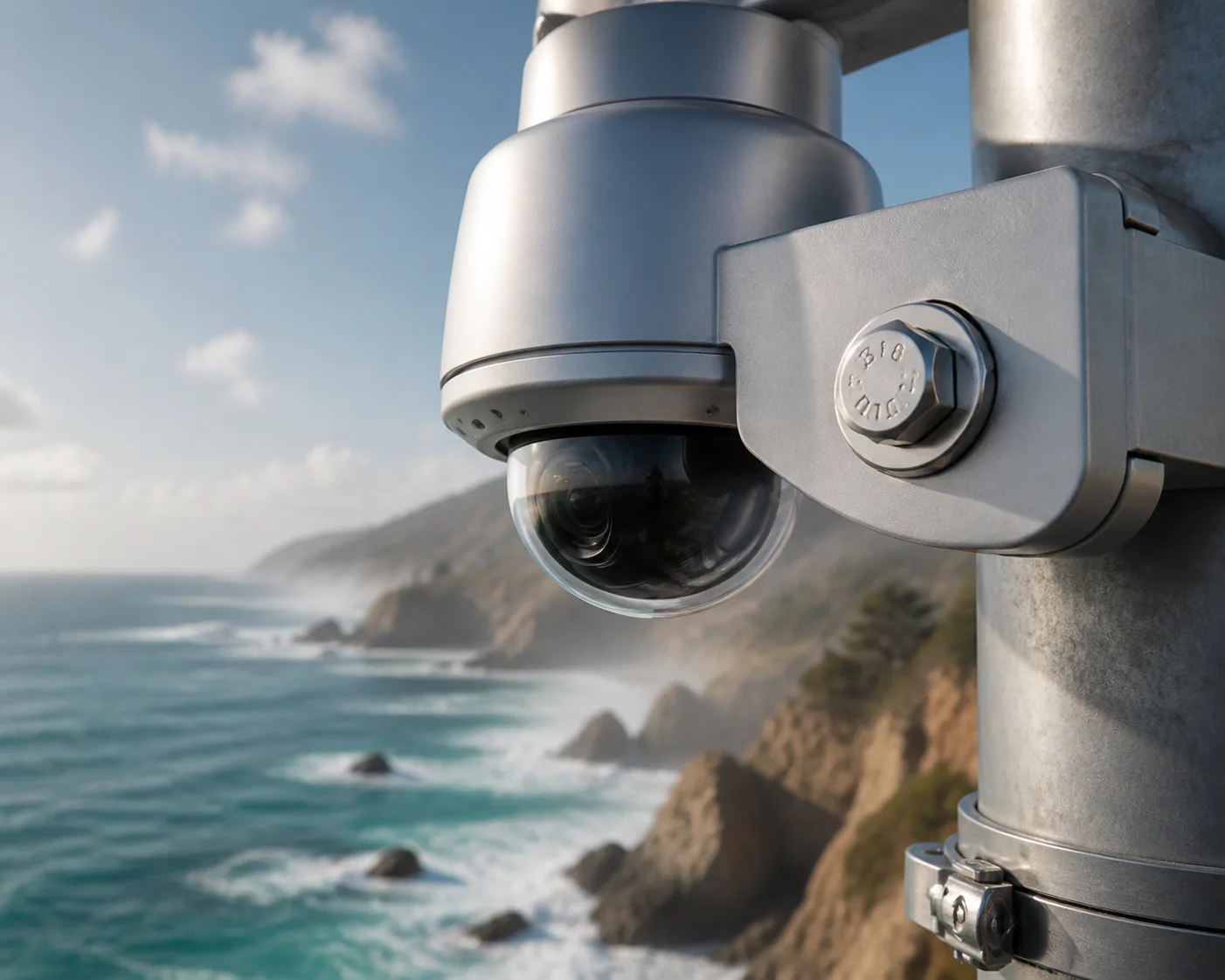
Below, I will break down the specific failure modes you should worry about, and explain why every single fastener on your coastal PTZ camera needs to be 316 grade. If you are sourcing cameras from China for projects in Florida, California, or the Gulf Coast, this is the article you need to read before signing your next purchase order.
Table of Contents
How Quickly Will Standard Grade 304 Screws Develop “”Pitting”” in a Sea-Salt Environment?
I learned this the hard way. A client called me about rust spots on brand-new cameras. The cameras were installed only eight months earlier. The screws were 304 grade.
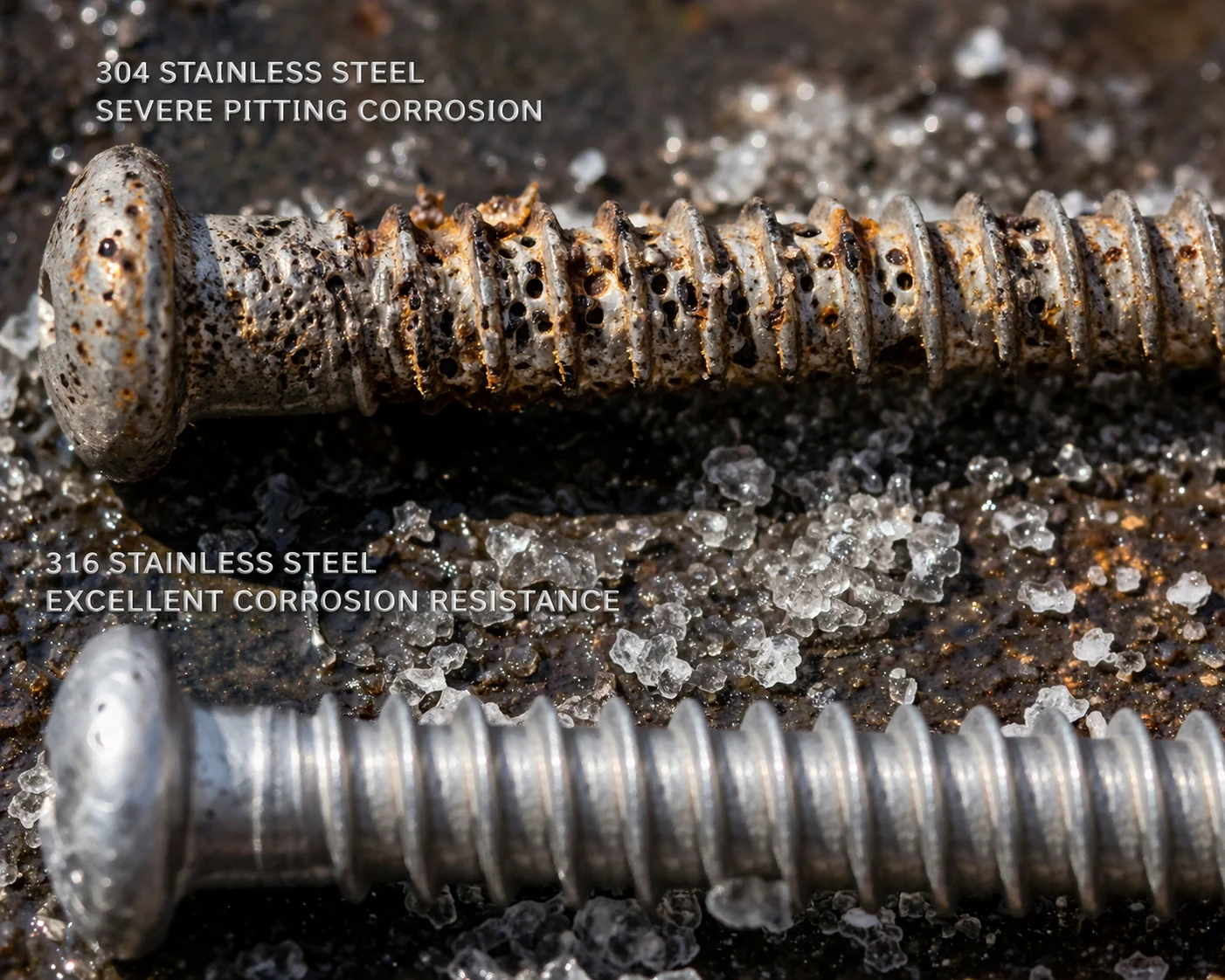
In high-salinity coastal zones within 5 km of the shoreline, standard 304 stainless steel screws can develop visible pitting corrosion 1 in as little as 6 to 12 months. Salt particles land on the screw surface, moisture evaporates, and the remaining concentrated chloride eats through the protective oxide layer.
What Is Pitting and Why Does It Happen So Fast?
Pitting corrosion is not like normal rust that spreads evenly across a surface. It is a localized attack. It drills tiny holes into the metal. These holes are small on the surface but can grow deep inside the screw body. That is what makes pitting so dangerous. You might not see the damage until the screw snaps.
Here is how it works in a coastal setting. Sea breeze carries tiny salt particles. These particles land on the screw head and along the threads. When the air is humid, a thin film of saltwater forms on the metal. When the sun comes out, the water evaporates, but the salt stays. Now you have a tiny spot with very high chloride concentration sitting right on the screw surface.
This concentrated chloride breaks through the chromium oxide passive layer 2 that protects stainless steel. Once the layer is broken, the bare metal underneath starts to dissolve. The hole gets deeper. More salt collects inside the hole. The process speeds up. This is called “”autocatalytic”” pitting — the corrosion feeds itself.
The PREN Number Tells the Story
Engineers use a number called Pitting Resistance Equivalent Number (PREN) 3 to compare how well different stainless steels resist pitting. The formula is simple:
PREN = %Cr + 3.3 × %Mo + 16 × %N
| Steel Grade | Chromium (%) | Molybdenum (%) | Typical PREN | Pitting Risk in Coastal Air |
|---|---|---|---|---|
| 304 | 18–20 | 0 | 18–20 | High — visible pitting in 6–12 months |
| 316 | 16–18 | 2–3 | 23–26 | Low — resists pitting for years |
| 316L | 16–18 | 2–3 | 23–26 | Low — also resists weld sensitization |
The difference is clear. A PREN of 18 versus 25 is not a small gap. It means 316 can handle chloride concentrations roughly ten times higher than 304 before pitting starts. In real-world terms, that is the difference between a screw that lasts one year and a screw that lasts ten years.
What Happens When a Screw Fails
For a PTZ camera mounted on a pole at a port or on a coastal highway, a failed screw is not just a cosmetic issue. The camera might weigh 15 to 30 kg with its housing and bracket. If one mounting bolt breaks due to pitting, the load shifts to the remaining bolts. In a strong coastal wind, the whole assembly can come loose. I have seen this happen. The replacement cost is small. The liability cost is not.
Will 316 Stainless Steel Prevent the “”Seizing”” of Mounting Bolts During Future Maintenance?
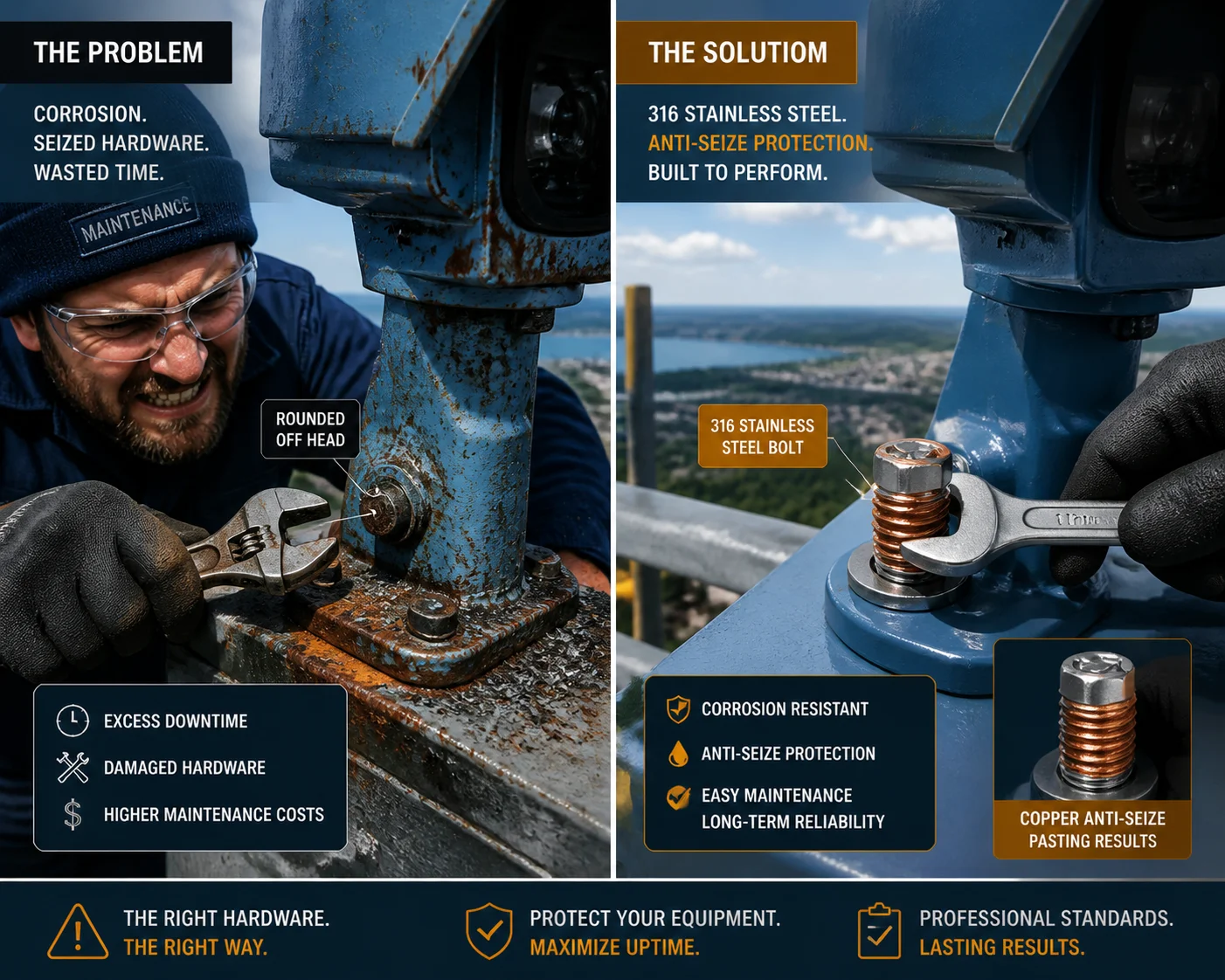
Every field technician I have talked to has the same complaint. They go to a coastal site for routine maintenance, and the bolts will not come out. The screws are frozen in place. The wrench just rounds off the head.
Grade 316 stainless steel significantly reduces the risk of bolt seizing in coastal environments. Its molybdenum content resists crevice corrosion in the tight spaces between threads, keeping bolts removable for years. However, using anti-seize compound during installation is still strongly recommended for best results.
Why Do Bolts Seize in Salty Air?
Bolt seizing in coastal areas is caused by crevice corrosion 4. When you tighten a bolt into a nut or a tapped hole, you create a very narrow gap between the threads. This gap is the perfect trap for saltwater.
Here is the problem. Stainless steel needs oxygen to maintain its protective oxide layer. Inside a tight thread gap, oxygen cannot flow freely. But saltwater can creep in through capillary action. So you end up with a situation where the metal has no way to repair its protective layer, and it is sitting in concentrated chloride solution at the same time.
The corrosion products — metal oxides — take up more volume than the original metal. They expand inside the thread gap. This expansion locks the bolt and nut together. The bolt is now “”seized”” or “”galled.”” Trying to force it out often breaks the bolt head off, leaving the shaft stuck inside the mount.
How 316 Helps — and What Else You Should Do
316 stainless steel handles crevice corrosion much better than 304. The molybdenum stabilizes the passive film even in low-oxygen conditions. But no stainless steel is completely immune to crevice corrosion. So here are the steps I recommend to my clients:
| Step | Action | Why It Matters |
|---|---|---|
| 1 | Use 316 or 316L bolts and nuts | Resists crevice corrosion in thread gaps |
| 2 | Apply marine-grade anti-seize compound 5 at installation | Creates a barrier between mating threads |
| 3 | Use flat washers under bolt heads | Reduces stress concentration and moisture trapping |
| 4 | Schedule annual torque checks | Catches early signs of corrosion buildup |
| 5 | Replace any bolt that shows surface staining | Staining means the passive layer has been compromised |
The Real Cost of a Seized Bolt
When a technician cannot remove a bolt, the job takes three to five times longer. They need to drill out the old bolt, re-tap the hole, and sometimes replace the entire bracket. For a camera mounted on a 15-meter pole at a remote coastal site, this means a crane truck, a two-person crew, and half a day of work. I have seen single maintenance visits cost over $2,000 just because of two seized bolts. Using 316 screws with anti-seize paste from day one costs maybe $5 extra per camera. The math is simple.
Does the Factory Provide a Certificate of Material Analysis for All External Fasteners?
I get this question a lot from project managers in the U.S. and Europe. They want proof. Not just a label on the box. They want a document that shows the exact chemical composition of every screw going into their coastal installation.
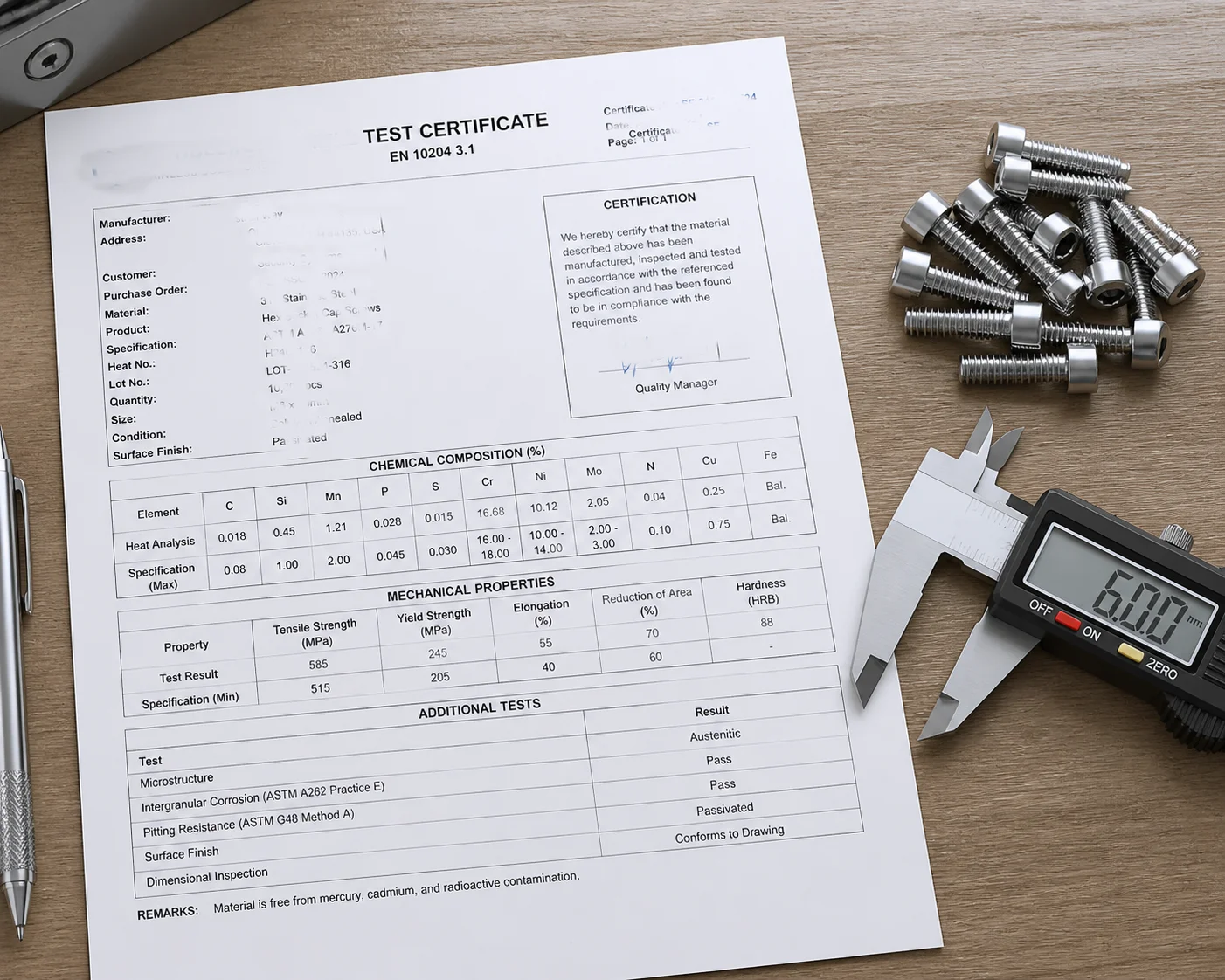
A reliable factory should provide a Mill Test Certificate (MTC) 6 or Certificate of Material Analysis for all external fasteners. This document lists the exact percentages of chromium, nickel, molybdenum, and other elements, confirming the screws are true 316 grade and not downgraded 304 or 201 substitutes.
Why You Cannot Trust Labels Alone
In my years of working with overseas buyers, I have seen a pattern. Some factories use 304 or even 201 grade screws on products that are marketed as “”marine grade”” or “”anti-corrosion.”” The screws look the same. They feel the same. You cannot tell the difference by looking at them. The only way to know is through chemical analysis.
Grade 201 stainless steel uses manganese instead of nickel to save cost. It has very poor corrosion resistance. Grade 304 is decent for indoor use but fails in salt air. Only 316 stainless steel composition 7 includes molybdenum for true coastal performance. Without a material certificate, you are trusting a label that anyone can print.
What a Proper MTC Should Include
A Mill Test Certificate, also called a 3.1 certificate under EN 10204, should include the following information:
- Heat number or batch number of the steel
- Chemical composition showing Cr, Ni, Mo, Mn, C, Si, P, S, and N percentages
- Mechanical properties (tensile strength, yield strength, elongation)
- The applicable standard (e.g., ASTM A193, ASTM F593)
- Name and signature of the testing authority
What I Recommend to My Clients
At Loyalty-Secu, when a client specifies 316 stainless steel for a coastal PTZ camera project, we provide material certificates for the fasteners as part of the delivery documentation. We also welcome third-party inspection. If you are sourcing from any factory in China, put this requirement in your purchase agreement before production starts. Do not ask for it after the goods are shipped. By then, it is too late to verify anything.
If the factory hesitates or says “”we don’t have that document,”” treat it as a red flag. A factory that actually uses 316 grade fasteners will have MTCs from their steel supplier. It is standard practice in the fastener industry. If they cannot produce it, the screws are probably not 316.
Are the Internal Screws Also Treated to Prevent Galvanic Corrosion Between Different Metals?
This is a question that separates experienced engineers from beginners. Most people focus on the external screws. But what about the screws inside the camera housing? What happens when a stainless steel screw meets an aluminum body?
Yes, internal screws must also be addressed. When different metals like stainless steel and aluminum are in direct contact, galvanic corrosion 8 occurs — the less noble metal (aluminum) dissolves faster. Internal fasteners should be 316 grade, and isolation washers or coatings should be used to break the galvanic circuit.
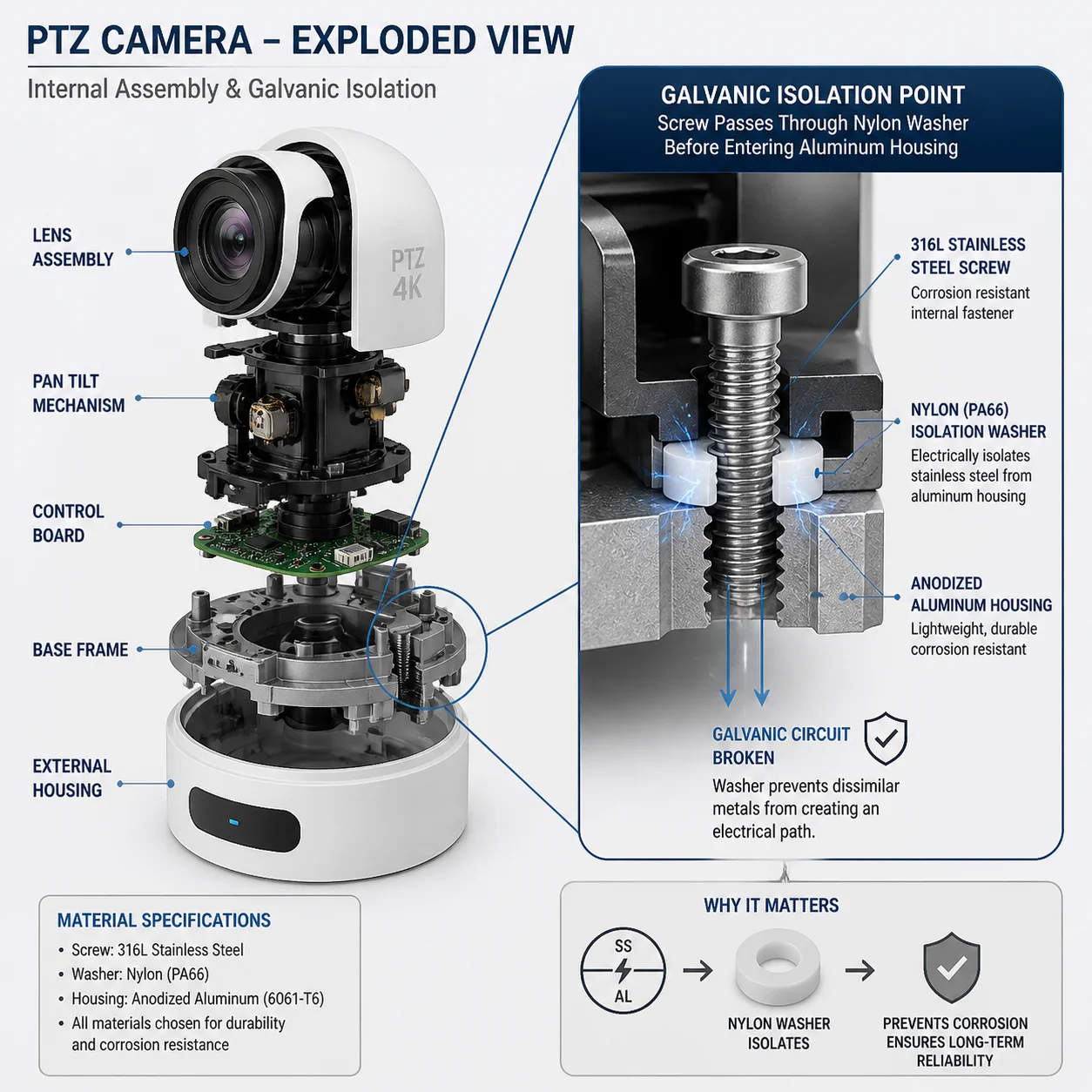
How Galvanic Corrosion Works
Galvanic corrosion happens when two different metals touch each other in the presence of an electrolyte — like saltwater or even humid air with salt particles. The two metals form a tiny battery. One metal becomes the anode (it corrodes). The other becomes the cathode (it is protected).
The farther apart two metals are on the galvanic series of metals 9, the faster the corrosion. Stainless steel is quite noble. Aluminum is much less noble. When a 316 stainless steel screw is threaded directly into an aluminum housing in a salty environment, the aluminum around the screw hole will start to corrode. You will see white powder forming around the screw. Over time, the hole enlarges, the screw loosens, and the seal is broken.
How to Prevent It
There are several proven methods to stop galvanic corrosion between internal fasteners and the camera body:
| Method | How It Works | Best For |
|---|---|---|
| Nylon isolation washers | Physically separates the two metals | Screw-to-housing joints |
| Dielectric grease | Blocks moisture from reaching the contact zone | Thread interfaces |
| Anodized aluminum housing | Creates a non-conductive oxide layer on the aluminum | Entire housing surface |
| Same-metal fasteners | Uses aluminum screws in aluminum bodies | Low-stress internal joints |
| 316L screws with coating | Adds a barrier layer on the screw surface | High-stress joints in salt air |
Why This Matters for Sealed PTZ Cameras
A PTZ camera rated IP66 or IP67 relies on gaskets and tight screw joints to keep water out. If galvanic corrosion eats away at the aluminum around an internal screw, the gasket seat deforms. Water gets in. Once moisture enters the housing, you get fogging on the lens, corrosion on the circuit board, and eventually total failure.
I have seen cameras returned from coastal sites where the external housing looked perfect, but the inside was destroyed. The root cause was always the same — galvanic corrosion at internal screw points where no isolation was used. The fix is cheap. A nylon washer costs pennies. But if the factory does not include it, the camera might not survive two rainy seasons at a coastal site.
At Loyalty-Secu, we design our anti-corrosion PTZ models with this in mind. We use 316L external fasteners, and we apply isolation measures at every internal metal-to-metal joint. When you evaluate any factory’s “”marine grade”” camera, ask them specifically: “”What do you do to prevent galvanic corrosion at internal screw points?”” If they do not have a clear answer, the product is not truly designed for coastal use.
Conclusion
For any PTZ camera deployed within 20 km of a coastline, every external and internal fastener should be verified 316 grade stainless steel. Ask for the material certificate. Check for galvanic isolation. Your project’s long-term reliability depends on it.
1. Explains localized pitting corrosion mechanisms in metals. ↩︎ 2. Describes protective oxide layers on stainless steel surfaces. ↩︎ 3. Explains PREN calculation and corrosion resistance comparison. ↩︎ 4. Overview of crevice corrosion in confined environments. ↩︎ 5. Explains purpose and function of anti-seize compounds. ↩︎ 6. Defines mill test reports and material verification standards. ↩︎ 7. Details chemical composition of 316 stainless steel. ↩︎ 8. Explains galvanic corrosion between dissimilar metals. ↩︎ 9. Shows how galvanic series determines corrosion rate. ↩︎