
I once lost a whole batch of outdoor cameras to a single rainstorm. That day taught me one thing: an IP66 label without real proof is just a sticker.
No single international agency universally certifies IP66 ratings for cameras. The IP66 code is defined by the IEC 60529 standard 1, and any accredited third-party laboratory—such as TÜV SÜD, Intertek, or SGS—can perform the required tests. To find out which lab tested your specific camera, you must check the manufacturer’s official test report.
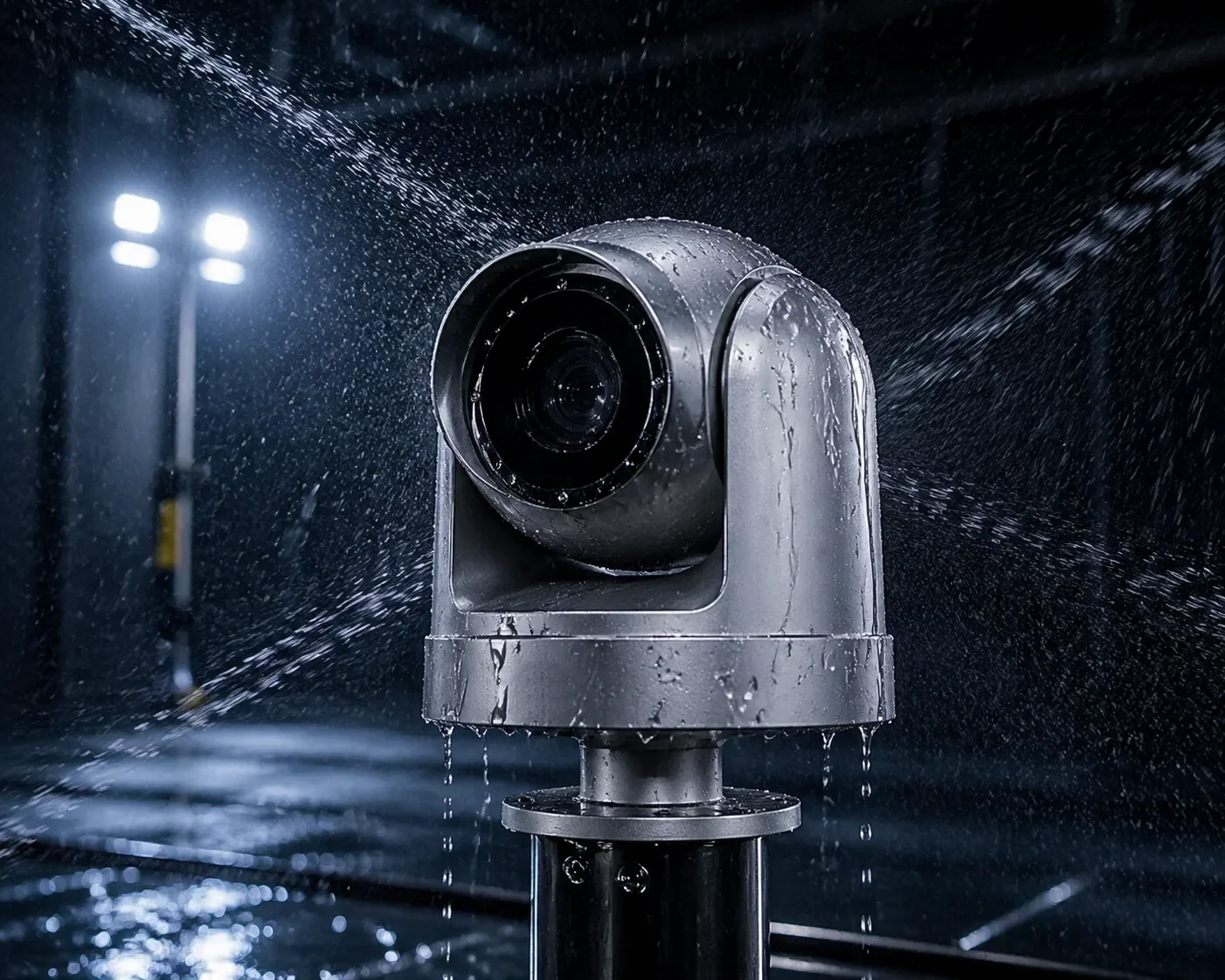
Below, I walk through what real IP66 certification looks like, how to verify it, and how to stop buying cameras that fake their waterproof claims. If you buy PTZ cameras for large security projects, this article can save you from expensive field failures.
Table of Contents
Can I See the Official Test Report from SGS, Intertek, or TUV for the IP66 Rating?
I hear this question from system integrators almost every week. They need hard proof before signing a purchase order. And I respect that—because they should.
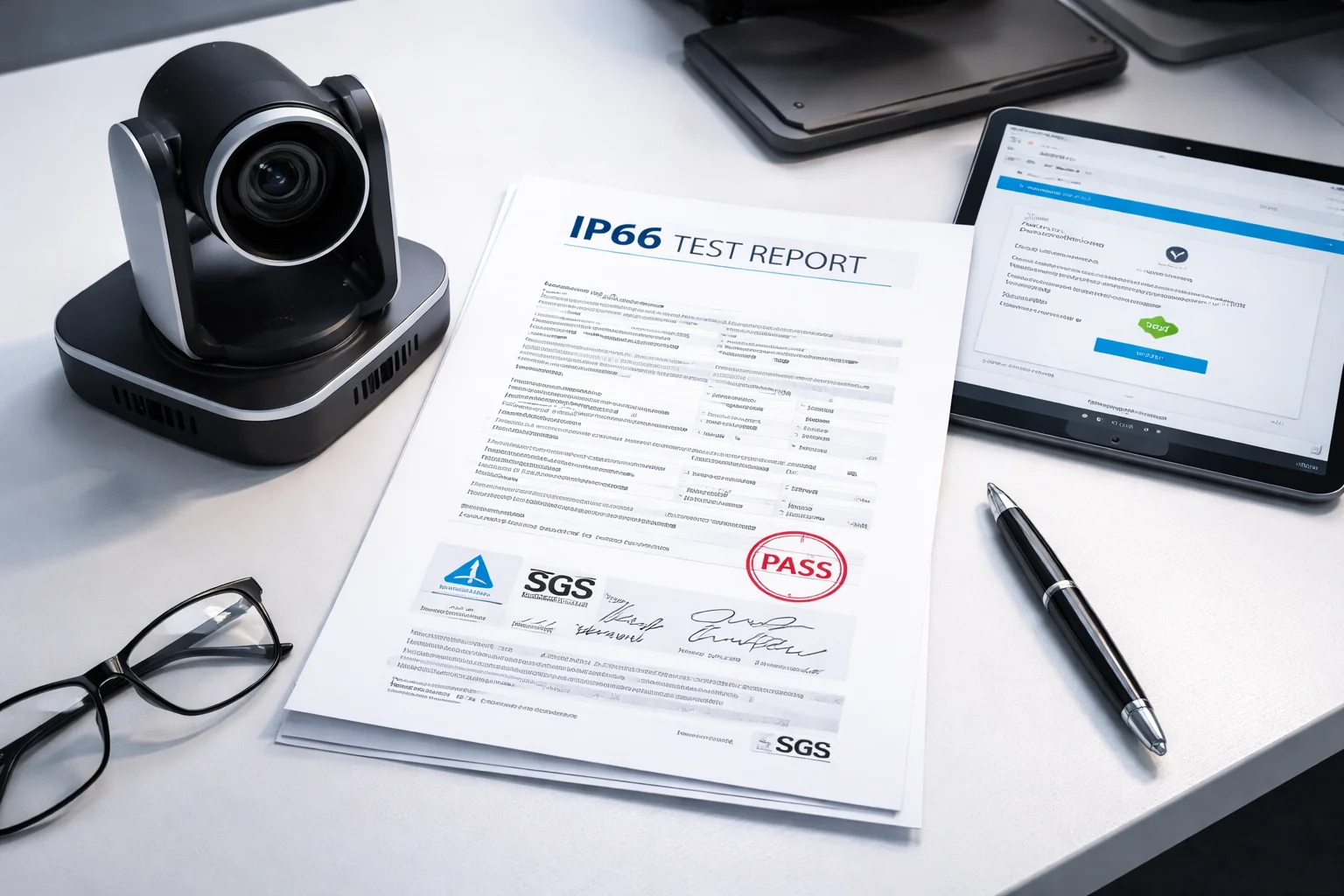
A legitimate IP66 test report is issued by an accredited laboratory recognized under CNAS 2 or ILAC 3 frameworks. It includes a unique report number, the testing standard reference (IEC 60529), detailed test parameters, and the lab’s accreditation credentials—all of which can be verified on the issuing lab’s official website.
Why the Test Report Matters More Than the Label
Here is something most people don’t realize. The IP66 marking on a camera shell does not tell you who tested it. It does not tell you when it was tested. And it does not tell you if it was tested at all. The only document that answers those questions is the test report itself.
In the security industry, I see a dirty pattern. Many low-cost factories print “IP66” on their datasheets based on nothing more than a quick splash test in their own workshop. That is not a real test. A real IP66 test follows IEC 60529 procedures inside an accredited lab. The lab must hold accreditation from a body like CNAS (China National Accreditation Service for Conformity Assessment) or be part of the ILAC (International Laboratory Accreditation Cooperation) mutual recognition arrangement.
At Loyalty-Secu, I make sure our cameras go through labs that meet these standards. When David or any integrator asks me for the report, I send a full copy. That report has a tracking number. David can go to the lab’s website and verify that the report is real. No guessing. No trust-me games.
What a Real IP66 Test Report Contains
| Report Element | What It Shows | Why You Should Check It |
|---|---|---|
| Report Number | Unique ID assigned by the lab | You can verify it on the lab’s website |
| Test Standard | IEC 60529 reference | Confirms the correct standard was used |
| Test Date | When the test was performed | Ensures the report is current |
| Lab Accreditation No. | CNAS or ILAC credential | Proves the lab is internationally recognized |
| Test Result | Pass or Fail for dust and water | The actual proof of IP66 compliance |
| Sample Description | Model number and batch info | Links the report to your specific product |
My Advice for Integrators
If a supplier cannot produce this document within 48 hours of your request, that is a red flag. At Loyalty-Secu, I keep these reports on file and ready to share. For David and other project managers, this report is not just a nice-to-have. It is a compliance requirement. Government tenders, insurance claims, and project audits all demand it. I always tell my clients: the report is your shield. Ask for it before you place the order, not after the cameras are already on the poles.
How Does the IP66 Seal Hold Up Against High-Pressure Water Jets and Heavy Dust?
I installed cameras in a desert mining site once. Sand got into two units within three months. That project taught me the real meaning of “dust-tight.”
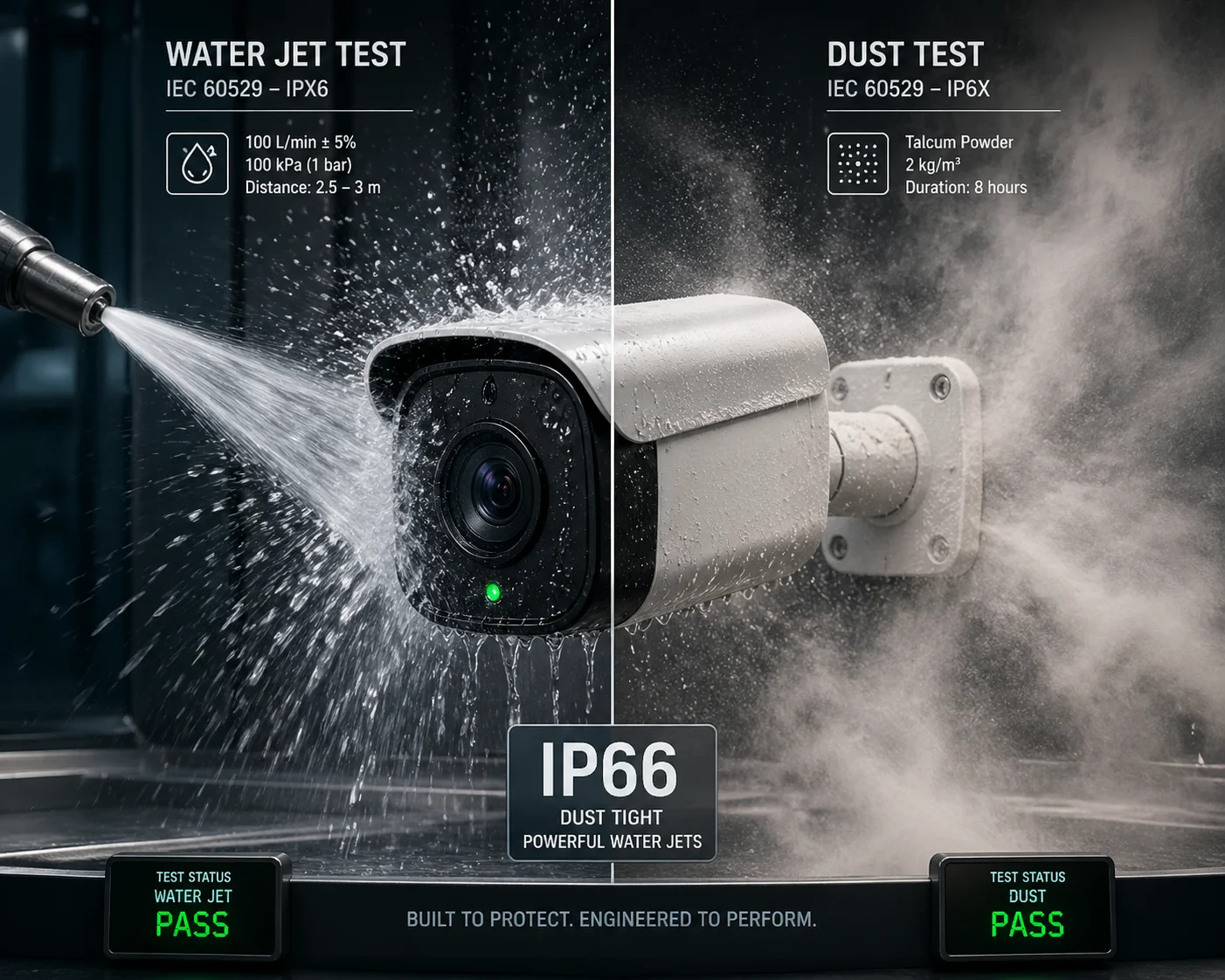
IP66 means the camera is completely dust-tight (level 6) and can withstand powerful water jets from any direction at 100 kPa pressure for at least 3 minutes (level 6). After testing, the enclosure must show zero dust ingress and zero water entry to pass IEC 60529 requirements.
Breaking Down the IP66 Code
The “IP” stands for Ingress Protection. The first digit (6) rates solid particle protection. The second digit (6) rates liquid ingress protection. Both digits are at a high level, which is why IP66 is the go-to rating for outdoor security cameras in harsh environments.
Let me break it down further.
| Digit | Rating Level | What It Means in Practice |
|---|---|---|
| First digit: 6 | Dust-tight | No dust enters the enclosure at all, even under vacuum conditions |
| Second digit: 6 | Powerful water jets | Water projected at 12.5 liters per minute from a 12.5 mm nozzle at 100 kPa from all directions causes no harmful entry |
What Happens During the Actual Test
In the lab, the camera sits on a test stand. For the dust test, the lab places it inside a sealed chamber filled with talcum powder. A vacuum pulls air through the enclosure for up to 8 hours. After the test, technicians open the camera and check for any trace of powder inside. If they find even a small amount, the camera fails.
For the water test, a technician aims a high-pressure nozzle at the camera from every angle. The water pressure is set to 100 kPa—that is roughly the force of a strong fire hose. The spray lasts at least 3 minutes. Then the technician opens the camera and inspects for any water inside.
At Loyalty-Secu, I don’t stop at the lab test. On our production line, every single PTZ dome goes through a 100% airtight test using our MES (Manufacturing Execution System). I pump high-pressure air into the housing and monitor for pressure drop. If the pressure drops, that unit gets pulled off the line. This means even if the lab tested 5 samples, I am making sure every unit that ships to David’s warehouse meets the same seal quality.
Real-World Conditions vs. Lab Conditions
I want to be honest here. A lab test is controlled. The real world is not. Wind-driven rain can hit at angles and speeds that differ from the lab setup. That is why I always tell my clients: IP66 is your baseline, not your ceiling. Good gasket design, proper cable gland sealing, and correct installation angle all matter. I train my clients on these details because a perfect camera installed the wrong way will still leak.
Is the Camera Housing Treated with Anti-Corrosion Coating for Coastal Installations?
I had a client in Florida who installed 30 cameras near the shoreline. Within 18 months, the housings started showing white corrosion spots. He called me and asked what went wrong. That conversation changed how I think about materials.
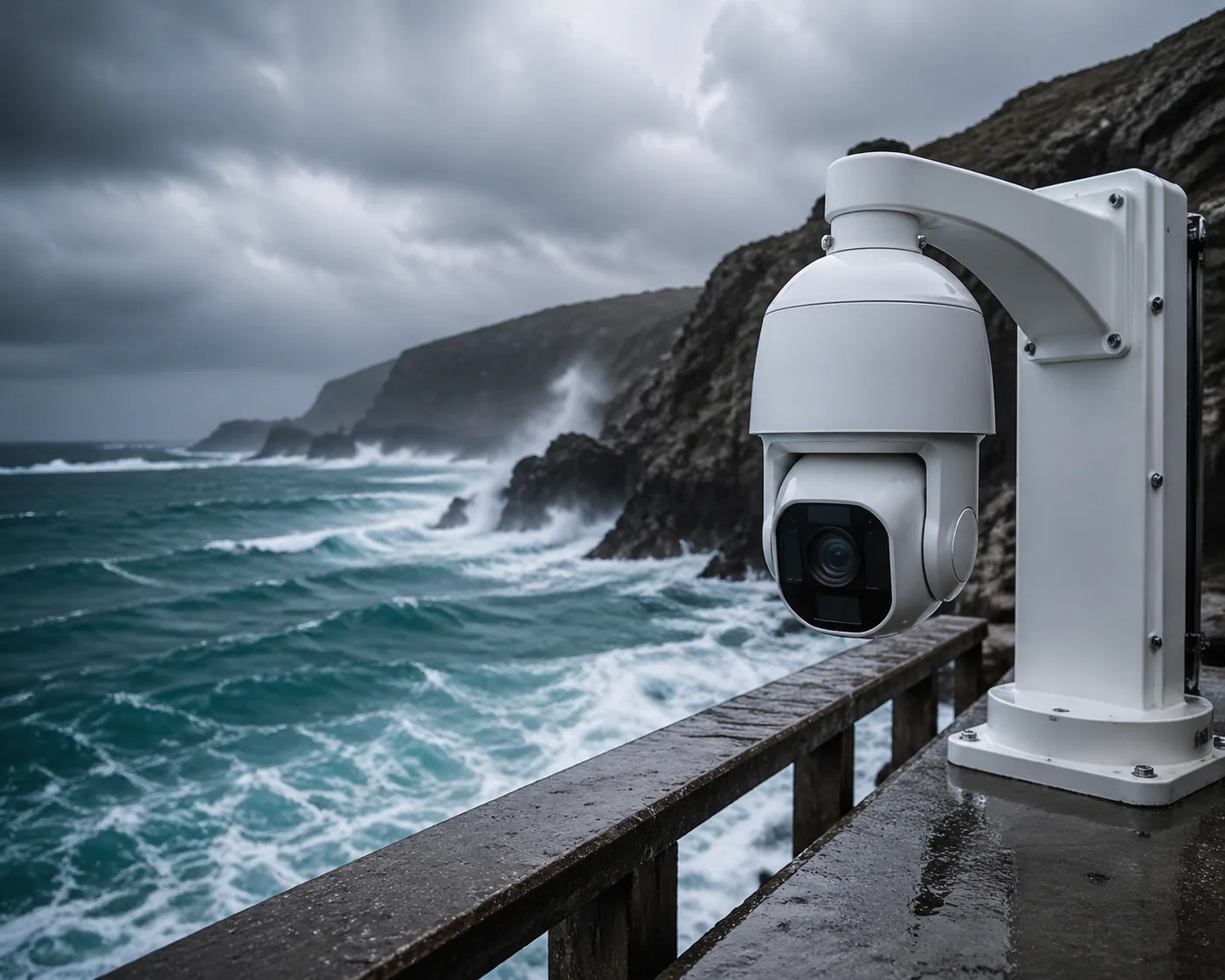
For coastal deployments, a camera housing must use corrosion-resistant materials such as ADC12 aluminum alloy with outdoor-grade powder coating, and it should pass at least 96 hours of salt spray testing (per ASTM B117 4 or ISO 9227 5) to confirm long-term durability in high-humidity, salt-laden air.
Why IP66 Alone Is Not Enough Near the Ocean
IP66 tells you the camera keeps water and dust out. But it says nothing about what happens to the housing material itself. Salt air attacks metal. It eats through cheap coatings. It corrodes screws. Over time, the seal degrades, and then your IP66 protection is gone.
This is why I pay close attention to material selection at Loyalty-Secu. Our PTZ camera housings use ADC12 die-cast aluminum alloy. ADC12 is strong, lightweight, and holds up well against corrosion when properly treated. But the raw alloy alone is not enough. We apply an outdoor-grade powder coating on top. This coating acts as a barrier between the salt air and the metal underneath.
The Salt Spray Test Explained
To validate our coating, I send housing samples through a salt spray test. This test follows the ASTM B117 or ISO 9227 standard. The sample sits inside a chamber filled with a 5% sodium chloride (salt) mist at 35°C. We run this test for a minimum of 96 hours.
After 96 hours, I check the surface for blistering, peeling, or corrosion. If the coating holds up with no visible damage, it passes.
| Test Parameter | Specification | Purpose |
|---|---|---|
| Salt concentration | 5% NaCl solution | Simulates ocean-level salt exposure |
| Chamber temperature | 35°C (95°F) | Accelerates corrosion reaction |
| Test duration | 96 hours minimum | Represents long-term coastal exposure |
| Evaluation criteria | No blistering, peeling, or base metal corrosion | Confirms coating integrity |
Beyond the Coating: Stainless Steel Hardware
I also use stainless steel 6 screws and fasteners on our coastal-grade models. Regular carbon steel screws will rust within weeks near the ocean. Stainless steel costs more, but it removes a common failure point. I learned this the hard way from that Florida project. Now, every camera I ship to a coastal location uses 304-grade stainless hardware as standard.
David once asked me: “Han, why should I pay more for your housing when other factories offer the same IP66 rating for less?” My answer was simple. Their IP66 might last a year on the coast. Ours will last five. The cost difference is small. The warranty claim difference is huge.
Why Did My “Waterproof” Camera Develop Internal Fogging After a Heavy Storm?
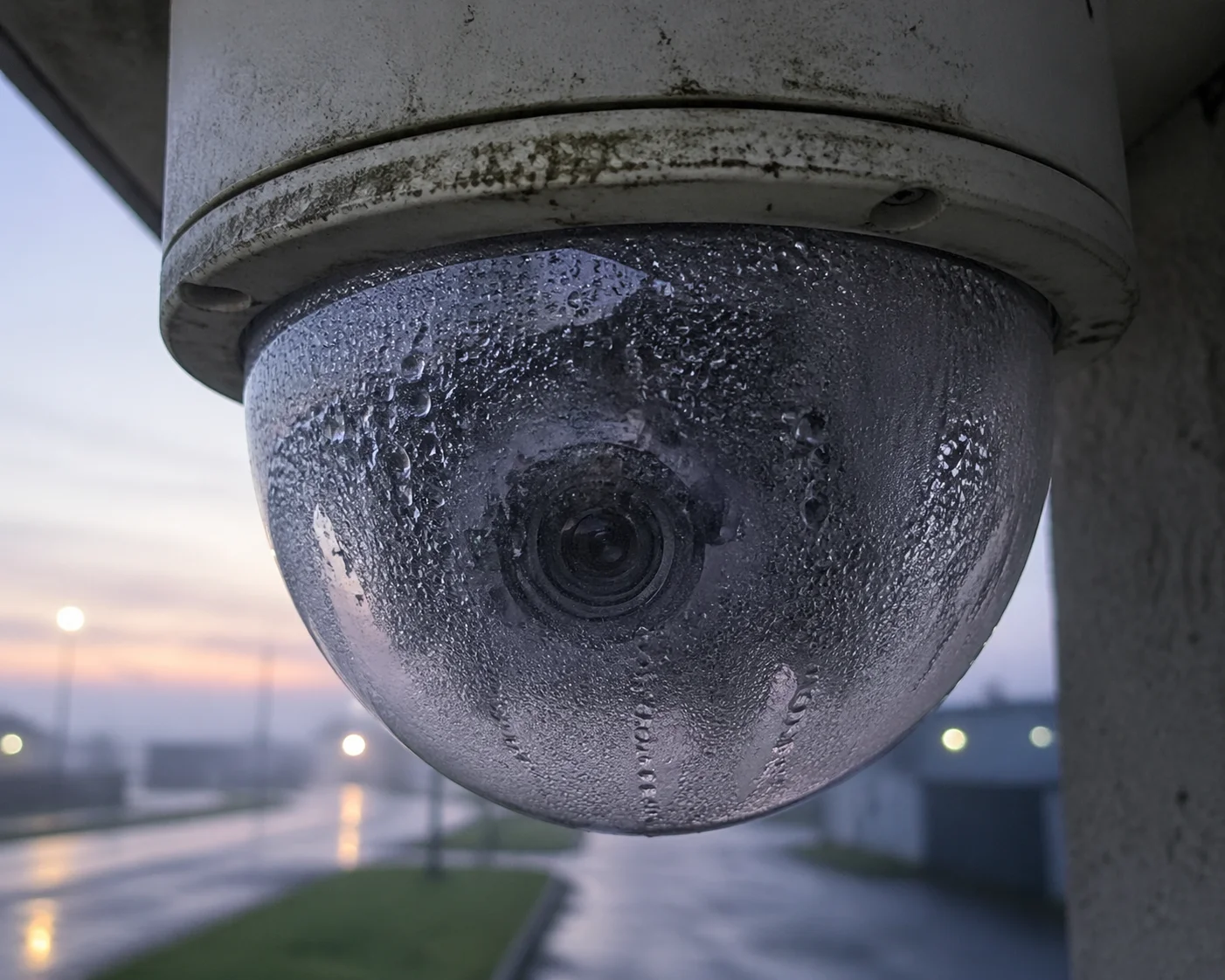
I got a support ticket last year from a client in Texas. He sent me a photo of his PTZ camera with thick fog on the inside of the dome cover. The camera was only six months old. He was frustrated, and I understood why.
Internal fogging usually happens because of a broken seal, a cracked gasket, or improper installation—not because the camera was never waterproof. Temperature swings cause moisture trapped inside the housing to condense on the dome glass, and this is a sign that the IP66 barrier has been compromised at some point.
The Physics Behind Fogging
When a camera sits in direct sunlight all day, the air inside the housing heats up and expands. At night, the air cools and contracts. This cycle creates a slight vacuum effect. If there is even a tiny gap in the gasket or cable entry, the vacuum pulls in moist outside air. When the temperature drops further, that moisture condenses on the coldest surface inside the camera—the dome glass. That is your fog.
This is why I always say: IP66 is not just about passing a lab test. It is about maintaining the seal over thousands of thermal cycles in the field.
Common Causes I See in the Field
From my experience, these are the top reasons cameras fog up after storms:
- Damaged O-ring gaskets. If the installer opens the housing in the field and does not re-seat the gasket correctly, the seal breaks. Even a single hair or grain of sand on the gasket surface can create a gap.
- Over-tightened or under-tightened screws. Housing screws need the right torque. Too tight cracks the gasket. Too loose leaves a gap.
- Cable gland not sealed. Many installers forget to tighten the cable gland at the bottom of the camera. Water travels along the cable and enters through this point.
- Thermal cycling fatigue. In regions with large day-night temperature swings (like Texas or the Middle East), gasket materials degrade faster. Cheap rubber gaskets harden and crack after 2-3 years.
How I Solve This at the Factory Level
At Loyalty-Secu, I attack this problem from multiple angles. First, I use silicone-based gaskets instead of cheap rubber. Silicone holds its flexibility across a wide temperature range, from -40°C to +60°C. Second, every camera includes a small packet of industrial-grade desiccant 7 inside the housing. This desiccant absorbs any trace moisture that might exist during assembly. Third, I run a 100% airtight pressure test on the production line. I do not sample-test. I test every single unit. If a camera cannot hold pressure for the required time, it does not ship.
For David’s projects, I also include spare gaskets and desiccant packs in every shipment. If his field technicians need to open a camera for maintenance, they can replace the gasket and desiccant on site. This simple step prevents 90% of fogging issues.
When Fogging Is Not a Seal Problem
Sometimes fogging happens even in a perfectly sealed camera. How? If the factory assembles the camera on a humid day and does not use desiccant, moisture is trapped inside from day one. The camera passes the water test because no new water enters. But the moisture that was already inside causes fog when the temperature drops. This is a quality control issue, not a design issue. At Loyalty-Secu, our assembly area is humidity-controlled, and we add desiccant to every unit before the housing is closed. I check this step in our MES system logs.
Conclusion
Real IP66 protection needs accredited lab testing, quality materials, and factory-level sealing control. Always ask your supplier for the test report before you buy.
1. Official IEC 60529 standard for ingress protection (IP) ratings. ↩︎ 2. CNAS accreditation body for Chinese testing laboratories. ↩︎ 3. ILAC mutual recognition for international lab accreditation. ↩︎ 4. ASTM B117 standard for salt spray (fog) corrosion testing. ↩︎ 5. ISO 9227 international standard for corrosion tests in salt spray. ↩︎ 6. Overview of stainless steel grades and corrosion resistance. ↩︎ 7. How desiccants absorb moisture to prevent internal fogging. ↩︎ 8. TÜV SÜD certification services for environmental testing. ↩︎ 9. Intertek IP code testing and certification for electronics. ↩︎ 10. SGS ingress protection (IP) testing laboratory services. ↩︎