
I’ve seen cameras die after a single Texas storm. The seal looked fine on the outside, but moisture had already killed the board inside.
A well-designed PTZ camera seal recovers itself through elastic gasket memory, pressure-equalizing breather valves, and internal heating modules that actively dry out residual moisture within 2 to 4 hours after a flood event subsides.
 PTZ camera seal recovery after flooding
Most people think waterproofing is a one-time thing. You seal it at the factory, and it stays sealed forever. That’s not how it works in the real world. Temperature swings, water pressure, and repeated open-close cycles all stress the seal. Below, I break down exactly how each recovery mechanism works and what it means for your field deployments.
Table of Contents
Will the Gaskets Return to Their Original Shape and Maintain an IP67 Seal After a Flood Event?
After a flood, I always get the same question from integrators: “Do I need to replace every gasket on site?” The short answer is no, if the right material was used.
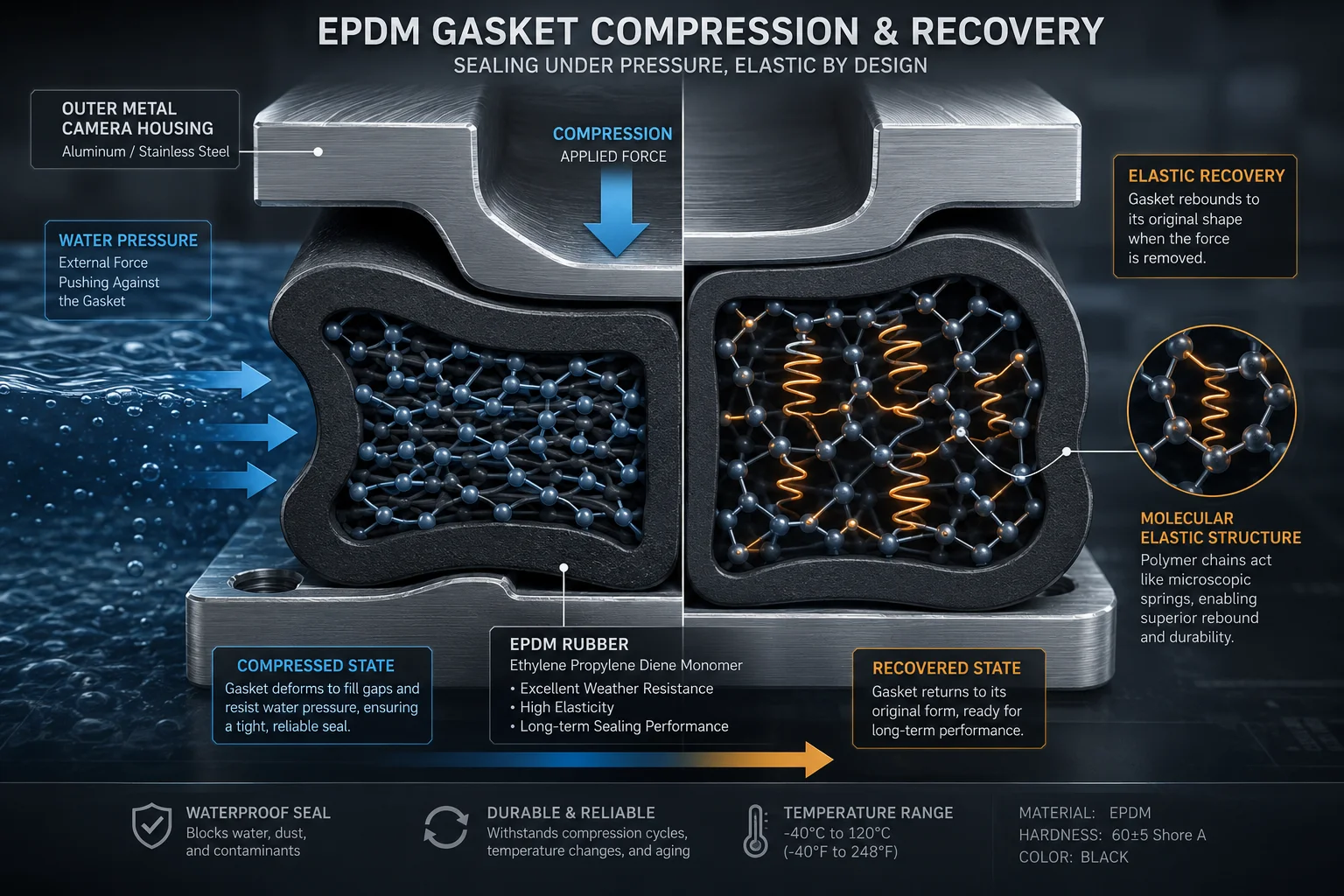
Industrial-grade EPDM and silicone gaskets have elastic memory that allows them to return to their original shape within seconds after water pressure is removed, maintaining full IP67 seal integrity without manual intervention.
 PTZ camera gasket elastic memory after flood
Why Gasket Material Matters More Than Gasket Thickness
Not all rubber is the same. Cheap cameras use generic nitrile rubber. It works fine for a year. Then it hardens. Once it hardens, it cannot bounce back after compression. That means after one flood, the seal is permanently compromised.
We use EPDM (Ethylene Propylene Diene Monomer)1 for a reason. This material has a compression set resistance2 below 10%. That means if you squeeze it flat under water pressure for hours, it still returns to 90%+ of its original height when the pressure goes away.
How the Recovery Actually Happens
Here is the sequence during and after a flood:
- Water rises and applies hydrostatic pressure4 against the housing seam.
- The gasket compresses slightly under this pressure, which actually improves the seal during immersion.
- Water recedes. External pressure drops to normal atmospheric levels.
- The EPDM gasket rebounds to its original cross-section within 3 to 5 seconds.
- The seal is intact. No gap. No path for residual moisture.
The Role of Silicone Grease
The gasket surface is coated with a thin layer of silicone-based lubricant3. This serves two purposes. First, it prevents the gasket from bonding to the housing surface over time. In hot climates like Texas, rubber can literally fuse to metal if left dry. Second, it keeps the material flexible through wet-dry cycles. Without this grease, even good EPDM will crack after 2 to 3 years of UV and heat exposure.
| Gasket Material | Compression Set (%) | Recovery Time | Lifespan in Field |
|---|---|---|---|
| EPDM (our standard) | < 10% | 3–5 seconds | 8–10 years |
| Silicone | < 15% | 5–10 seconds | 6–8 years |
| Nitrile (NBR) | 25–40% | 30+ seconds | 2–3 years |
| Generic PVC | 50%+ | May not recover | < 1 year |
What This Means for David’s Projects
David, if your cameras are deployed on construction sites or along flood-prone roads in Texas, you do not need to send a crew out after every storm to inspect gaskets. The material does the work for you. Just confirm via remote access that the image is clear and fog-free. If it is, the seal recovered on its own.
How Does the “Gasket Memory” Ensure That the Seal Doesn’t Fail After the Camera Is Reopened?
Every time a technician opens the housing for SD card access or firmware updates, I worry about one thing: did they seat the gasket correctly? Human error is the number one cause of seal failure.
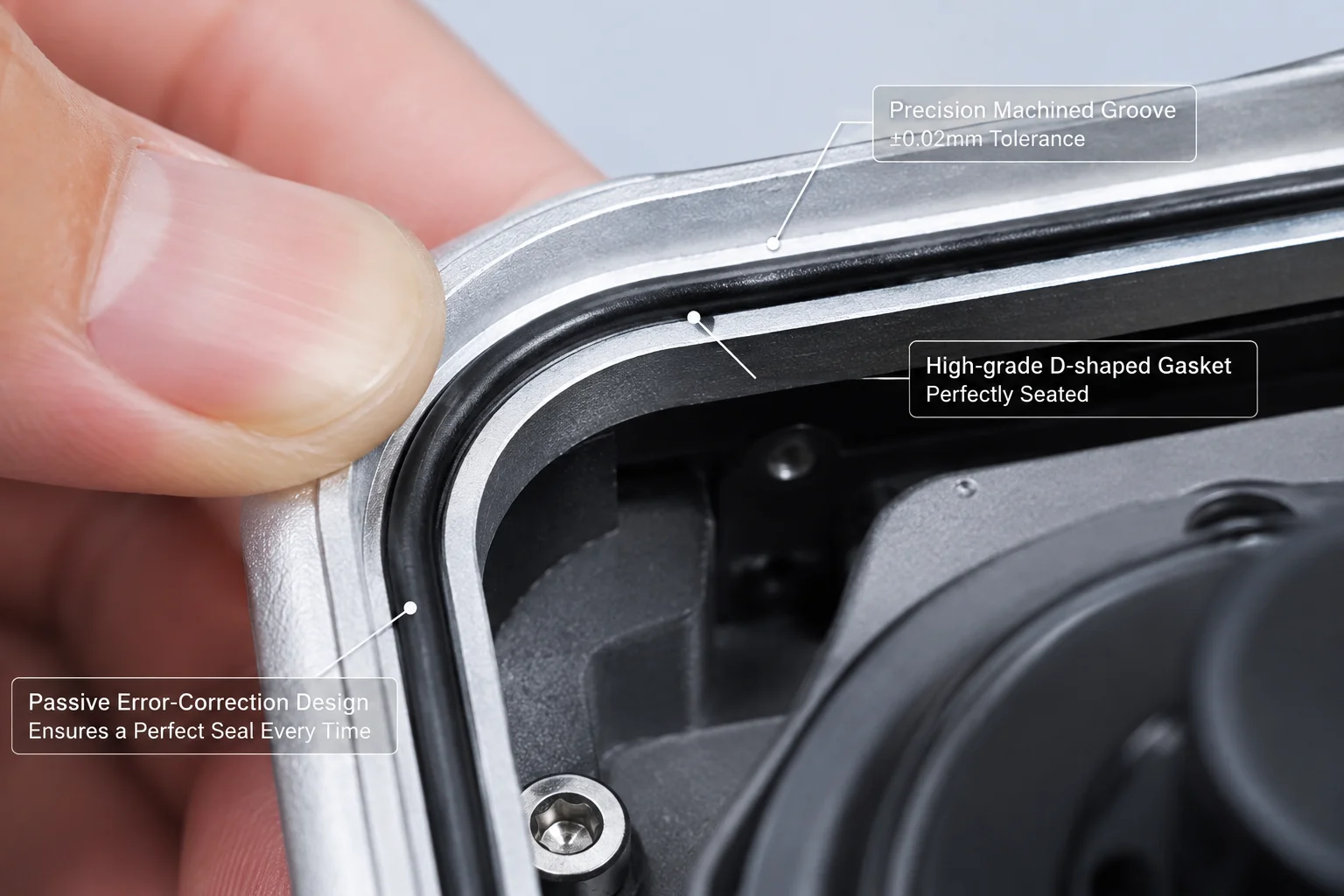
Gasket memory works through the material’s molecular structure, which stores its molded shape permanently. Even after being displaced or compressed during housing access, the gasket returns to its designed profile and re-establishes the seal without special tools or alignment.
 Gasket memory mechanism in PTZ camera housing
What “Memory” Actually Means in Material Science
When we say a gasket has “memory,” we are not talking about electronics. We are talking about polymer chain behavior5. EPDM rubber is cross-linked during vulcanization. These cross-links act like tiny springs at the molecular level. When you deform the material, the chains stretch. When you release the force, the chains pull back to their original configuration.
This is different from plastic deformation, where the material stays in its new shape. Cheap gaskets undergo plastic deformation. Good gaskets undergo elastic deformation. The difference determines whether your camera survives its second year in the field.
The Real-World Problem: Repeated Access Cycles
A typical PTZ camera in an active project might be opened 5 to 10 times during its first year. Each time, the gasket is:
- Removed from its groove
- Possibly stretched or twisted
- Placed back (sometimes incorrectly)
- Compressed again when the housing is closed
Without strong elastic memory, each cycle degrades the seal slightly. After 10 cycles, you might have a gasket that sits 0.2mm lower than it should. That 0.2mm gap is enough for water vapor to enter.
How We Design Against This
Our gaskets are molded with a specific cross-section profile, usually a D-shape or P-shape rather than a simple O-ring. This profile has a built-in “over-height” of about 20%. When the housing is closed, the gasket compresses by 20%, creating positive pressure against both surfaces. Even if the gasket loses 5% of its height over 1,000 cycles, it still has 15% compression margin.
The Groove Design Matters Too
The gasket sits in a machined groove. This groove is designed with tight tolerances so the gasket cannot shift sideways. Even if a technician places it back slightly off-center, the groove walls guide it into the correct position when the housing is closed. This is a passive error-correction system. It does not rely on the technician being careful. It relies on geometry.
| Access Cycle Count | Gasket Height Loss | Remaining Compression Margin | Seal Status |
|---|---|---|---|
| 0 (new) | 0% | 20% | Full seal |
| 100 cycles | ~2% | 18% | Full seal |
| 500 cycles | ~5% | 15% | Full seal |
| 1,000 cycles | ~8% | 12% | Full seal |
| 2,000+ cycles | ~12% | 8% | Recommend replacement |
Is There a Secondary “Backup Seal” to Protect the Core Electronics if the Primary Gasket Fails?
I learned early in this industry that single-point-of-failure designs do not survive in the field. If one gasket is all that stands between a $2,000 camera and a dead board, that is bad engineering.
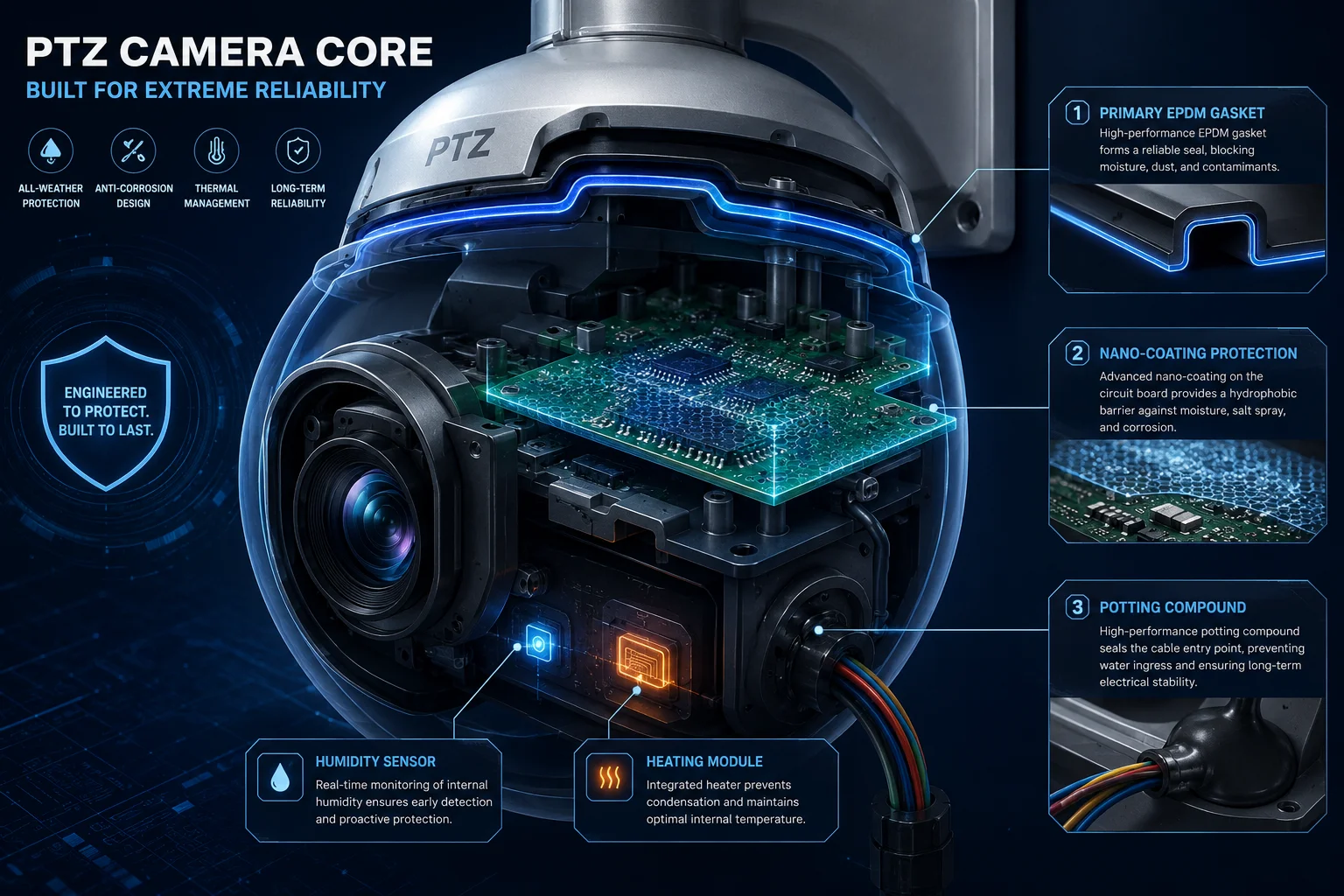
Yes. Our cameras use a multi-barrier defense system. Behind the primary gasket, a conformal nano-coating on the PCB and potting compound on cable entry points act as secondary and tertiary seals, ensuring electronics survive even if the outer gasket is breached.
 Backup seal layers in PTZ camera electronics
Layer 1: The Primary Gasket (First Line of Defense)
This is the EPDM gasket we discussed above. It stops 99.9% of water intrusion under normal conditions. But “normal” does not cover everything. A cracked housing, a piece of debris lodged in the seam, or a manufacturing defect can all compromise this layer.
Layer 2: Conformal Nano-Coating on the PCB
Every circuit board inside our cameras is coated with a hydrophobic nano-layer. This coating is applied at the factory using a vapor deposition process6. It is invisible. It adds zero thickness. But it causes water droplets to bead up and roll off the board surface rather than spreading across traces and causing short circuits.
This is not a theoretical backup. I have personally seen boards that were exposed to condensation for weeks. The ones with nano-coating showed zero corrosion. The ones without it had green oxidation on every exposed copper trace.
Layer 3: Potting Compound at Cable Entry Points
The most vulnerable point on any outdoor camera is not the housing seam. It is the cable entry. Water follows cables. It wicks along the jacket, between individual conductors, and into the housing through capillary action. This is called the siphoning effect.
We eliminate this by filling the cable gland interior with a two-part epoxy potting compound7. Once cured, it forms a solid, waterproof block around the cable. Water cannot pass through it. Period.
Layer 4: Internal Humidity Sensor + Active Heating
If all physical barriers fail and moisture enters the housing, the system detects it. A humidity sensor8 monitors internal conditions continuously. If relative humidity exceeds 70%, the system triggers an internal heater. This heater raises the internal temperature by 5 to 10°C, which evaporates trapped moisture. The water vapor then exits through the breather valve9.
This is active self-recovery. The camera heals itself without anyone touching it.
Why This Matters for Remote Deployments
David, when your cameras are on solar poles 50 miles from the nearest technician, you cannot afford a single point of failure. These backup layers mean that even in a worst-case scenario, your electronics stay alive long enough for you to schedule a maintenance visit on your terms, not on an emergency basis.
Does the Factory Test the “Seal Resilience” After 1,000 Cycles of Temperature Fluctuations?
I get skeptical when manufacturers claim IP67 based on a single dunk test. One test tells you nothing about year-three performance. I want to know what happens after 1,000 thermal cycles.
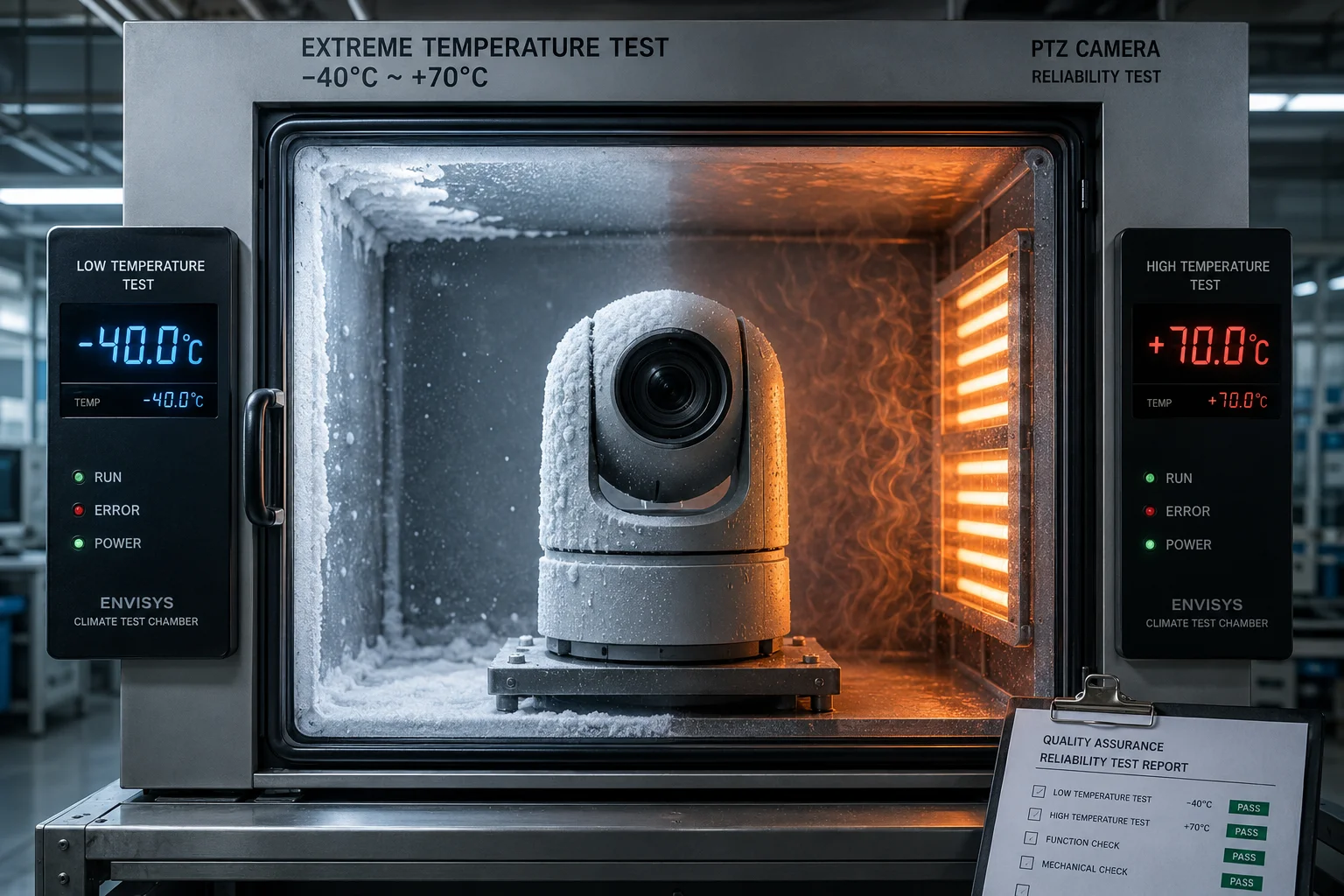
Yes. Every seal design undergoes accelerated aging tests that simulate 1,000+ thermal cycles between -40°C and +70°C, followed by re-testing for IP67 compliance. Only designs that pass post-aging immersion tests enter mass production.
 Factory thermal cycling test for PTZ camera seals
What a Thermal Cycle Test Actually Does
A single thermal cycle means: heat the camera to +70°C, hold for 2 hours, then cool it to -40°C, hold for 2 hours. That is one cycle. We run 1,000 of these back-to-back. This takes approximately 170 days in the test chamber.
Why does this matter? Because temperature changes cause two things that destroy seals:
- Differential expansion. The aluminum housing expands and contracts at a different rate than the EPDM gasket. Over hundreds of cycles, this can create micro-gaps.
- Material fatigue. Repeated stretching and compressing weakens polymer chains over time. A gasket that seals perfectly on day one might leak on day 500.
Our Test Protocol
Here is the exact sequence we follow:
- Assemble camera with production gaskets (not hand-picked samples).
- Run 1,000 thermal cycles (-40°C to +70°C).
- Immediately after the last cycle, submerge the camera in 1 meter of water for 30 minutes (IP67 standard).
- Remove and inspect for any internal moisture using humidity indicators.
- Disassemble and inspect gasket for permanent deformation, cracking, or adhesion failure.
What Failure Looks Like
In our R&D phase, we tested 6 different gasket compounds. Three of them failed before 500 cycles. The failure mode was always the same: the gasket developed a “compression set” where it no longer returned to full height. The gap was less than 0.1mm, but it was enough for water vapor to enter during the cooling phase when internal pressure drops.
The two compounds that passed all 1,000 cycles with zero moisture ingress are the ones we use in production today.
Beyond the Seal: Full System Aging
We do not just test the gasket in isolation. The entire assembled camera goes through this process. That means the breather valve, the cable glands, the window seal, and the wiper mechanism are all tested together. A system is only as strong as its weakest seal point.
| Test Parameter | Specification | Pass Criteria |
|---|---|---|
| Temperature range | -40°C to +70°C | No cracking or permanent deformation |
| Number of cycles | 1,000 minimum | Gasket height loss < 10% |
| Post-cycle immersion | 1m depth, 30 minutes | Zero internal moisture detected |
| Humidity indicator | Cobalt chloride strips | Must remain blue (dry) |
| Gasket adhesion check | Manual pull test | No bonding to housing surface |
| Breather valve flow test | Airflow measurement | Must maintain rated flow ±10% |
What This Means for Your 5-Year TCO
David, when you calculate total cost of ownership for a 200-camera deployment, seal failure is the silent budget killer. Each failed unit costs you $300 in truck rolls plus $200 in replacement parts plus project downtime. Our thermal cycling validation means you can confidently project less than 1% seal-related failure rate over 5 years. That is the difference between a profitable project and a money pit.
Conclusion
A PTZ camera’s seal recovery capability is not magic. It is material science, smart geometry, and layered redundancy working together. When you choose a camera with EPDM gaskets, breather valves, nano-coated boards, and factory-validated thermal cycling, you are buying years of maintenance-free operation in the harshest conditions.
1. Learn about EPDM rubber’s excellent resistance to weather, ozone, and aging, making it ideal for outdoor seals. ↩︎ 2. Discover how compression set measures a gasket’s ability to recover its original shape after compression. ↩︎ 3. Silicone grease prevents gasket bonding and maintains flexibility over temperature extremes. ↩︎ 4. Learn how water depth creates hydrostatic pressure that can compress gaskets during flooding. ↩︎ 5. Explore the science of how cross-linked polymer chains provide elastic recovery in rubbers. ↩︎ 6. Discover how vapor deposition applies ultra-thin conformal coatings at the molecular level. ↩︎ 7. Explore how epoxy potting compounds create a watertight barrier around cable entry points. ↩︎ 8. Check how humidity sensors trigger active drying to prevent internal condensation. ↩︎ 9. Learn how pressure-equalizing breather valves prevent moisture ingress and allow internal drying. ↩︎