
I’ve seen PTZ cameras fail in the field — not because of electronics, but because a $2 rubber seal cracked in a cold snap.
Fluororubber (FKM/Viton) seals are highly reliable at 158°F, but standard grades become brittle near -40°F. For full-range reliability from -40°F to 158°F, you need low-temperature FKM (LT-FKM) or fluorosilicone (FVMQ) to maintain a true IP66 seal.
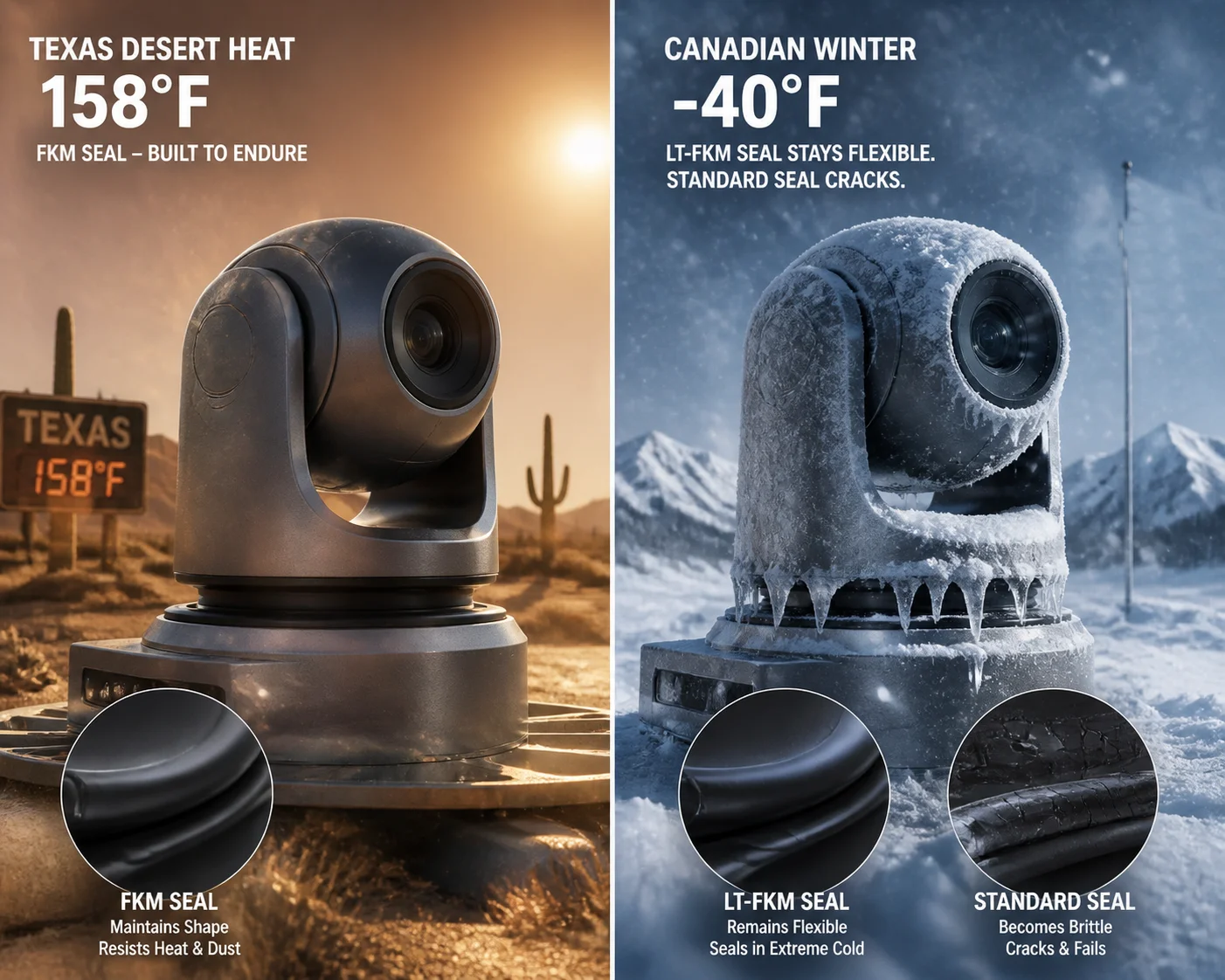
If you’re deploying PTZ cameras in Texas summers or Canadian winters, this article breaks down exactly where standard fluororubber works, where it fails, and what to specify instead. I’ll also cover how we test seals at our factory before they ever leave the production line.
Table of Contents
Will the Seals Become Brittle and Leak After a Winter in Canada or a Summer in Texas?
The short answer keeps me up at night — because I’ve had customers call me from job sites in Alberta at -35°F, asking why their camera housing is fogging up inside.
Standard FKM seals handle Texas heat with zero issues. But in a Canadian winter below -20°F, they lose elasticity and can crack. The glass transition temperature of regular FKM is around -10°F to -15°F — well above the -40°F you need.
Why 158°F Is Easy for FKM
Let me put this in simple terms. FKM rubber is rated for continuous use up to 400°F (200°C). So when your PTZ camera sits on a pole in Dallas at 158°F, the seal material is barely working. It won’t soften. It won’t degrade. It won’t lose its compression force against the housing.
At this temperature, FKM keeps a very low compression set. That means the O-ring stays squeezed tight in its groove, even after years. Heat is not the problem.
Why -40°F Is a Real Threat
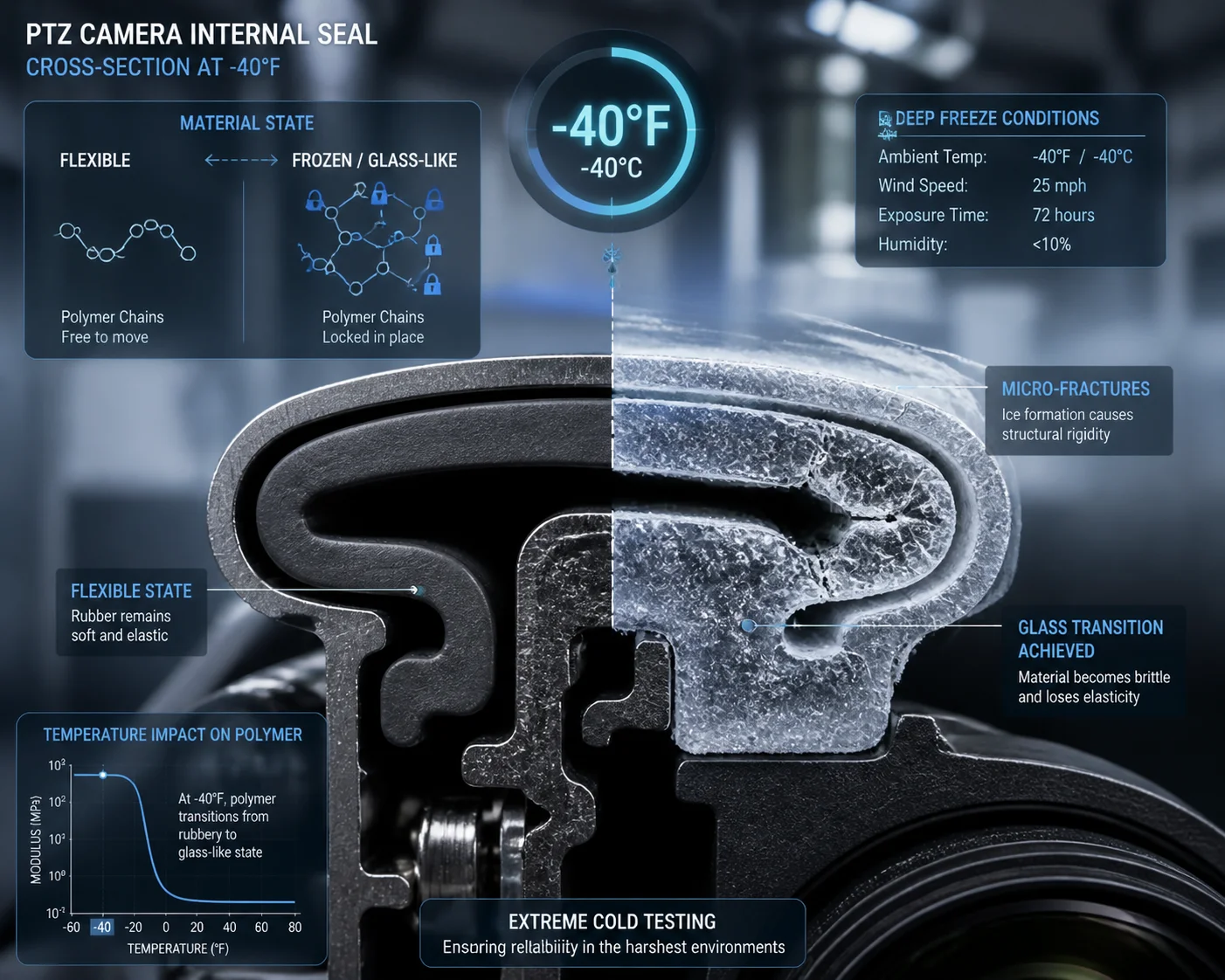
Now flip to the other end. When temperature drops below -10°F, standard FKM starts to harden. By -20°F, it feels like hard plastic. By -40°F, it is essentially frozen stiff.
Here’s what happens physically:
- The seal loses its ability to spring back when the housing contracts in cold.
- Tiny gaps form between the seal and the metal groove.
- Moisture and cold air creep in.
- You get internal condensation, fog on the lens, and eventually corrosion on the PCB.
If the PTZ is rotating during this time, the mechanical vibration makes it worse. A hardened seal can develop micro-cracks from the movement of the pan-tilt motor.
The Glass Transition Problem
Every rubber has a glass transition temperature ($T_g$). Below this point, the material changes from flexible rubber to a rigid, glass-like state. For detailed material property data, refer to the glass transition temperature tables for rubber compounds 1.
| FKM Type | Typical $T_g$ | Usable Low Temp (Static) | Usable Low Temp (Dynamic) |
|---|---|---|---|
| Standard FKM (Type A) | -10°F to -15°F | -15°F | -5°F |
| Low-Temp FKM (GLT/GFLT) | -35°F to -40°F | -40°F | -30°F |
| Fluorosilicone (FVMQ) | -80°F+ | -76°F | -60°F |
For a PTZ camera that needs to pan and tilt in a Canadian winter, you need dynamic seal performance at -40°F. Standard FKM cannot do this. You must specify LT-FKM or FVMQ. Independent dynamic seal wear tests on fluororubber compounds 2 confirm that low-temperature grades retain flexibility far longer under motion.
What I Tell My Customers
When a customer like David tells me his cameras go to northern Alberta or Montana, I flag the seal material immediately. I ask the engineering team to switch to a low-temperature grade before we even start production. It costs a little more per unit. But it costs far less than sending a technician 200 miles to swap a fogged-up camera on a 30-foot pole in January.
How Does Fluororubber Compare to Standard EPDM or Silicone for Chemical and UV Resistance?
I get this question a lot from system integrators who have used EPDM gaskets on other outdoor equipment and wonder why they should pay more for FKM.
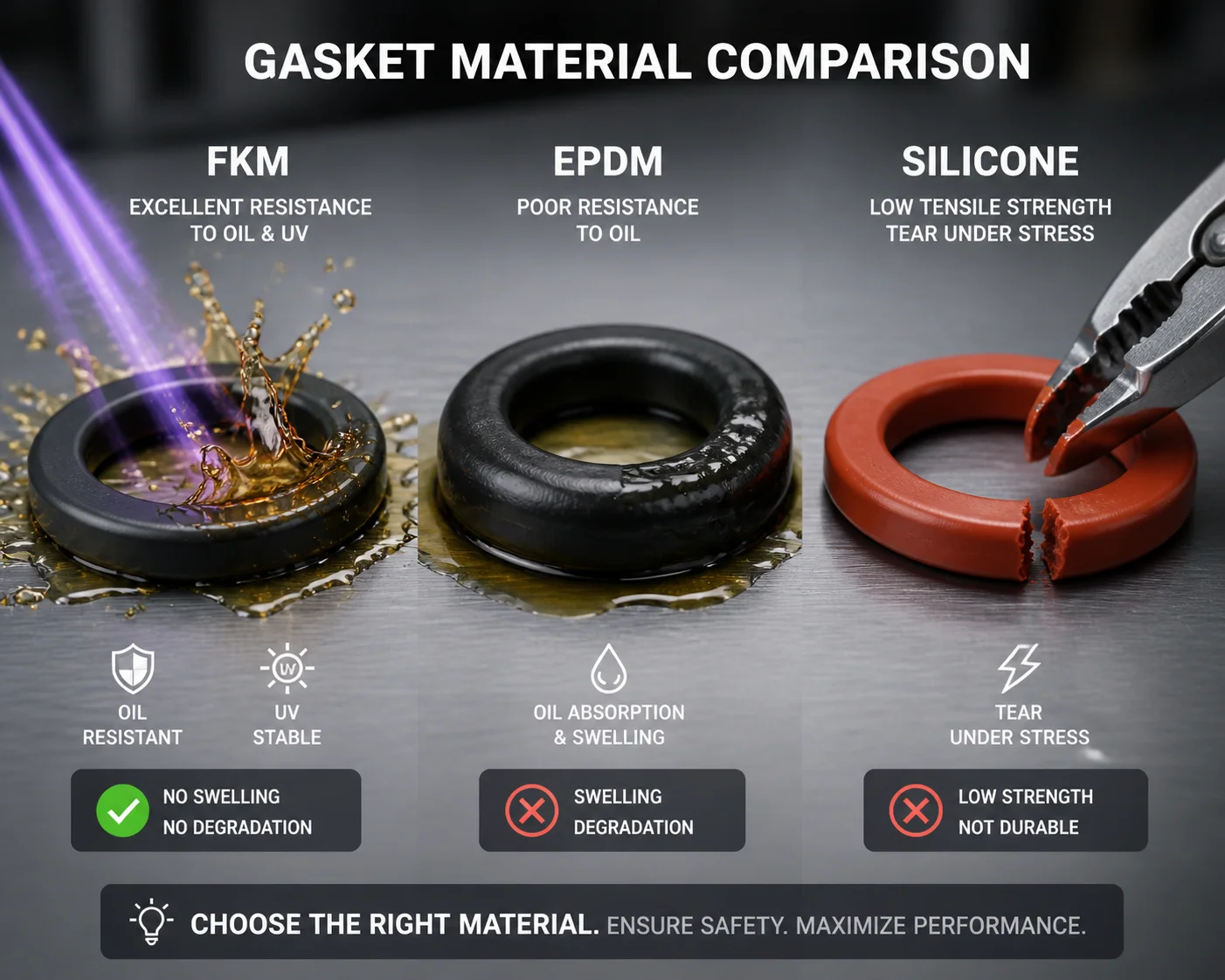
FKM outperforms EPDM and silicone in UV resistance, ozone resistance, and chemical exposure. EPDM handles cold better but degrades faster under oil or fuel contact. Silicone offers the widest temperature range but has poor abrasion and tear resistance for mechanical seals.
The Three-Way Comparison
Let me break this down material by material, because each one has a clear strength and a clear weakness.
| Property | FKM (Fluororubber) | EPDM | Silicone (VMQ) |
|---|---|---|---|
| UV / Ozone Resistance | Excellent | Good | Good |
| Temperature Range | -15°F to 400°F (std) | -70°F to 300°F | -76°F to 400°F |
| Oil / Fuel Resistance | Excellent | Poor | Poor |
| Tear / Abrasion Resistance | Good | Good | Poor |
| Chemical Resistance (acids) | Excellent | Good | Fair |
| Cost | High | Low | Medium |
| Compression Set (high temp) | Excellent | Moderate | Moderate |
Where EPDM Falls Short
EPDM is a great general-purpose rubber. It handles cold weather very well — down to -70°F in some grades. It also resists water and steam. So for a simple outdoor enclosure that never contacts oil or solvents, EPDM works fine.
But here’s the catch. Many PTZ camera installations sit near roads, parking lots, or industrial sites. Road salt spray, diesel exhaust, hydraulic fluid mist — these are common. EPDM swells and breaks down when it contacts petroleum-based chemicals 3. One splash of hydraulic oil on an EPDM gasket, and the seal starts to degrade within weeks.
FKM does not have this problem. It resists nearly all hydrocarbons, acids, and solvents. That is why it is the default choice for industrial-grade outdoor cameras.
Where Silicone Falls Short
Silicone rubber (VMQ) has an amazing temperature range. It stays flexible at -76°F and works up to 400°F. On paper, it looks perfect.
But silicone is soft. It tears easily. It wears down fast in any application with friction or mechanical movement. A PTZ camera has rotating joints. The seal at the pan axis and tilt axis moves every time the motor runs. Silicone gaskets in dynamic applications wear out much faster than FKM 4.
Silicone also has poor resistance to abrasion from dust and sand. In desert or construction site deployments, fine particles act like sandpaper on the seal surface. FKM holds up. Silicone does not.
Why FKM Wins for Outdoor PTZ Cameras
For a solar-powered 4G PTZ camera sitting on a pole in the sun for 5 to 10 years, FKM gives you the best combination of UV resistance, chemical resistance, and mechanical durability. It outlasts EPDM and silicone by 3 to 5 times under direct sunlight exposure. According to accelerated UV aging studies on rubber seals 5, FKM retains over 90% of its tensile strength after 2,000 hours of UV exposure.
The only weakness is cold. And that is solved by specifying a low-temperature FKM grade or using fluorosilicone at the critical seal points.
Can the Seals Maintain an Airtight IP66 Rating During Rapid Pressure Changes?
This is a question most people forget to ask — until they find water inside a camera that “passed IP66 testing” at the factory.
Yes, but only if the seal material stays elastic. Rapid pressure changes from temperature swings or altitude shifts create a pumping effect on the gasket. If the FKM seal is hardened by cold, it cannot flex with the pressure change, and moisture gets pulled in.
How Pressure Changes Happen in the Field
You might think a camera housing is a sealed box. It is. But sealed boxes have a problem. When the sun heats the housing during the day, the air inside expands. When night comes and the temperature drops 40 or 50 degrees, the air contracts. This creates a slight vacuum inside the housing.
That vacuum pulls air — and moisture — through any tiny gap in the seal. This is called the “breathing effect.” Over weeks and months of daily temperature cycles, even a small imperfection in the seal lets enough moisture in to cause condensation on the lens or corrosion on the circuit board.
The Role of Seal Elasticity
A good seal handles this breathing effect because the rubber flexes with the pressure change. When the housing contracts slightly in cold, the elastic seal follows the movement and stays tight. When the housing expands in heat, the seal compresses a little more and still stays tight.
But if the seal is hardened — because the temperature dropped below the FKM’s glass transition point — it cannot flex. It sits rigid in the groove. The housing moves. The seal does not. A gap forms. Water gets in.
What We Do at Loyalty-Secu
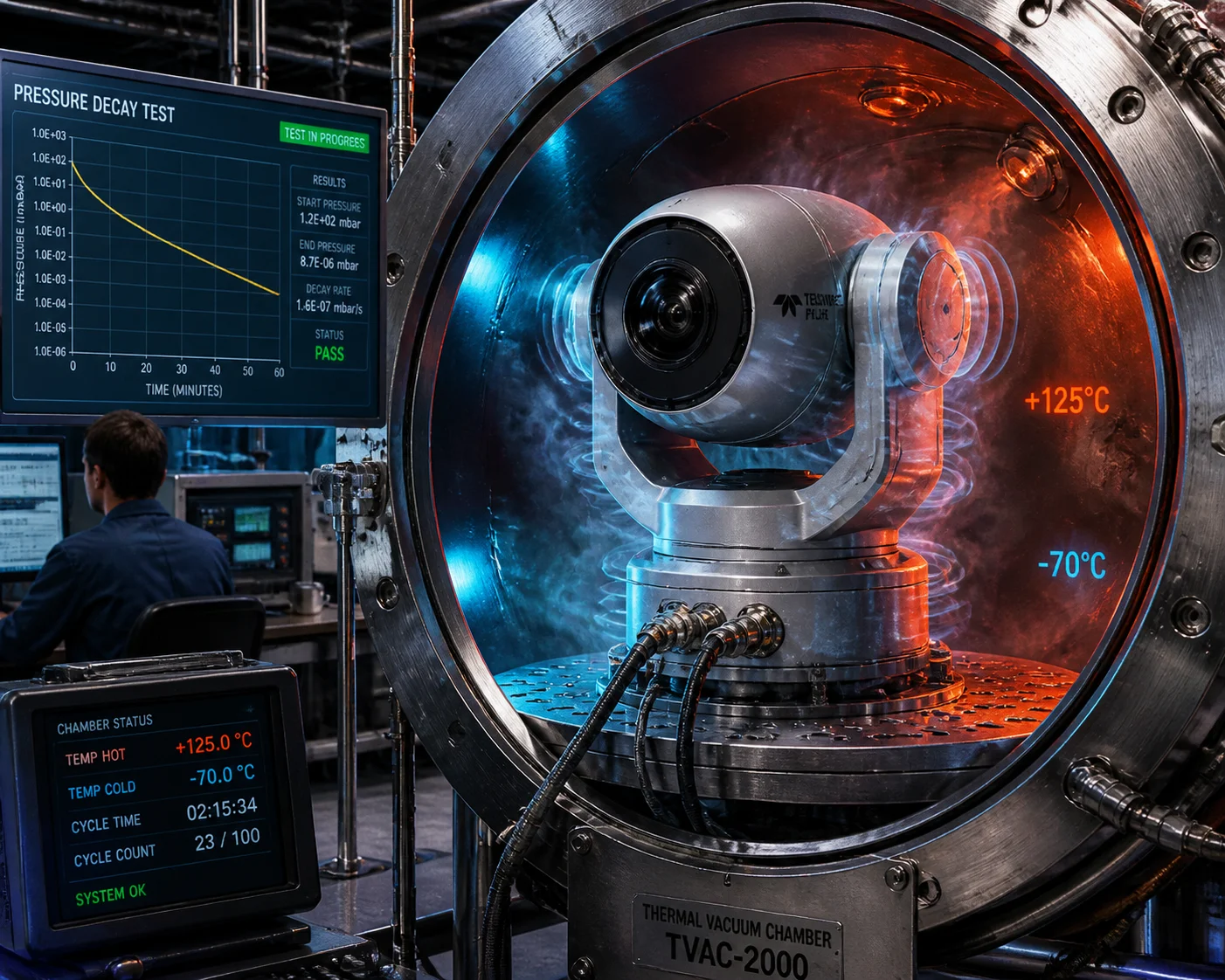
At our factory, we run thermal cycling tests based on IEC 60068-2-14 6. We cycle the complete PTZ camera assembly between -40°C and 70°C. We hold each extreme for 30 to 60 minutes. We repeat this for 50 to 100 full cycles.
After the cycling, we run a full IP66 water jet test. We also do a simplified air pressure decay test on the sealed housing to measure any increase in leak rate.
Here is what we check at each stage:
Our Thermal Cycling Test Protocol
- At 25% of cycles: Visual inspection of seals, basic function test, quick air pressure check.
- At 50% of cycles: Full function test including PTZ rotation, zoom, and video output. Air pressure decay measurement.
- At 75% of cycles: Repeat all checks. Compare leak rate to baseline.
- At 100% of cycles: Full IP66 water spray test. Disassemble and inspect seals under magnification for micro-cracks.
Only cameras that pass all four checkpoints with zero moisture ingress ship to customers. If a seal shows any sign of hardening or cracking, we change the material grade and retest.
Altitude and Shipping Pressure Changes
One more thing. If your cameras ship by air freight, the cargo hold pressure is lower than sea level. This creates an outward pressure on the housing seals during flight, then an inward pressure when the plane lands. It is a small effect, but over a long flight, it can stress a marginal seal.
We pack our cameras with internal desiccant pouches and recommend customers inspect the desiccant indicator on arrival. If it has changed color, the seal may need attention before installation.
Is There a Recommended Inspection Interval for the Waterproof Gaskets on My PTZ?
I always tell my customers — the best time to inspect a seal is before it fails, not after you see fog on the lens.
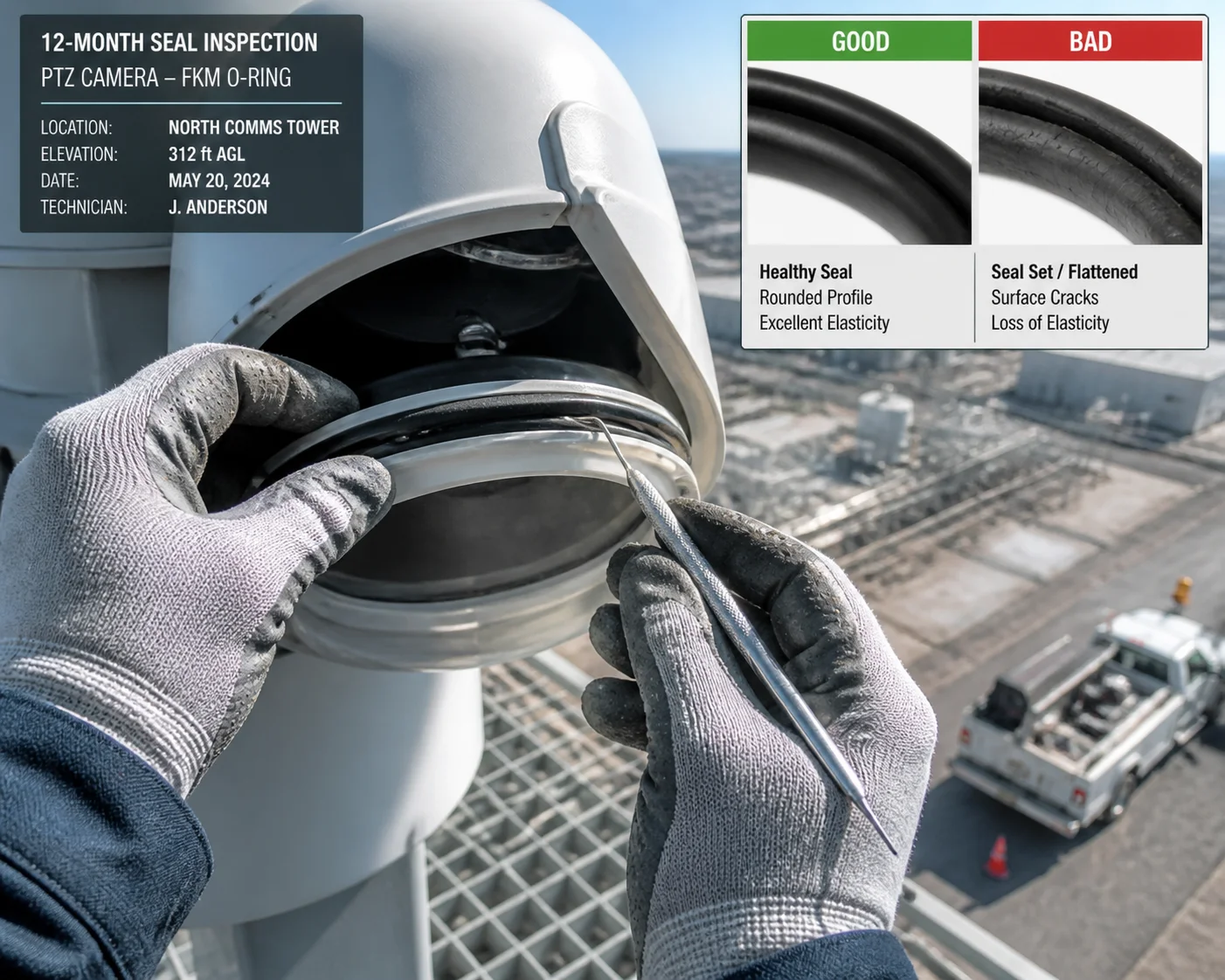
For FKM-sealed PTZ cameras in extreme climates, inspect gaskets every 12 months. In harsh environments with wide temperature swings, chemical exposure, or heavy dust, shorten the interval to 6 months. Replace seals every 3 to 5 years regardless of visible condition.
Why Seals Degrade Even When They Look Fine
Rubber aging is invisible at first. UV light breaks down polymer chains on the surface. Heat increases the compression set of elastomeric seals over time 7. Cold cycles cause micro-fatigue. None of these show up as obvious cracks until the seal is close to failure.
By the time you see a crack or feel that the O-ring has gone flat and hard, the IP rating is already compromised. Moisture may have been slowly entering the housing for weeks.
Recommended Inspection Schedule
Here is the schedule I recommend to my customers based on deployment environment:
| Environment Type | Example Locations | Inspection Interval | Seal Replacement Interval |
|---|---|---|---|
| Moderate climate | Coastal California, UK | Every 18 months | Every 5 years |
| Hot and sunny | Texas, Arizona, Middle East | Every 12 months | Every 3-4 years |
| Extreme cold | Canada, Northern US, Scandinavia | Every 6-12 months | Every 3 years |
| Industrial / chemical | Oil fields, factories, ports | Every 6 months | Every 2-3 years |
What to Check During Inspection
When you open the housing for inspection, here is what to look for:
Visual Signs of Seal Degradation
- Flattening: The O-ring cross-section should be round. If it looks oval or flat, the compression set is too high. The seal has lost its spring-back force.
- Surface cracks: Even tiny surface cracks mean UV or thermal damage. Replace immediately.
- Hardening: Press the seal with your fingernail. Fresh FKM feels firm but gives slightly. Aged FKM feels like hard plastic.
- Discoloration or swelling: This suggests chemical attack. Check if any solvents, cleaners, or fuels have contacted the seal.
- Debris in the groove: Dust, sand, or insect debris in the seal groove prevents proper seating. Clean the groove and reseat the seal.
What We Provide to Help
At Loyalty-Secu, we supply spare seal kits with every bulk order. Each kit includes the correct O-rings and gaskets for that specific PTZ model, plus a small tube of compatible silicone grease for reinstallation. We also include a simple one-page inspection guide with photos so field technicians know exactly what to look for.
For customers running large deployments — 50 cameras or more — we offer a preventive maintenance consultation. We review the deployment locations, climate data, and expected service life, then build a custom maintenance schedule. This helps our customers avoid the most expensive problem in remote surveillance: an unplanned truck roll to a site 100 miles from the nearest town. For remote solar sites like pipeline cameras, we follow the field maintenance guidelines for extreme-environment PTZ seals 8 to ensure long-term reliability.
The Real Cost of Skipping Inspections
I had a customer in West Texas who deployed 30 solar PTZ cameras on pipeline right-of-ways. He skipped the 12-month inspection because the cameras were still working fine on the live feed. At month 18, seven cameras had internal condensation. Three had corroded connectors. One had a dead main board from moisture damage.
The total repair cost — including truck rolls, crane rentals, and replacement parts — was more than the original cost of all seven cameras combined. A 30-minute inspection at month 12 would have caught the early signs and saved him over $15,000. Independent chemical resistance charts for FKM vs. EPDM vs. silicone 9 confirm that FKM is the right choice for industrial environments, but only if low-temperature grades are specified for cold climates.
Conclusion
FKM seals dominate in heat and UV, but cold-weather sites demand low-temperature grades. For complete O-ring material specifications and low-temperature performance data, refer to the Parker O-Ring Handbook 10. Specify the right material, test it properly, and inspect it on schedule.
1. Technical guide to glass transition temperature measurements for elastomers. ↩︎ 2. Parker O-Ring Handbook section 3: dynamic seal wear and low-temperature FKM. ↩︎ 3. Study on EPDM swelling and failure from petroleum-based chemical contact. ↩︎ 4. Comparative wear testing of silicone rubber vs. FKM in dynamic seals. ↩︎ 5. ASTM G154 standard for accelerated UV aging of non-metallic materials. ↩︎ 6. IEC 60068-2-14 environmental testing procedure for temperature cycling. ↩︎ 7. How compression set affects O-ring sealing force and service life. ↩︎ 8. Field inspection protocols for PTZ camera seals in extreme climates. ↩︎ 9. Comprehensive rubber chemical resistance chart for industrial environments. ↩︎ 10. Parker O-Ring Handbook — full elastomer material specifications. ↩︎