
I have seen too many solar-powered PTZ systems go offline in winter. The root cause is almost always the same — the installer sized the panel for summer, not for the worst month.
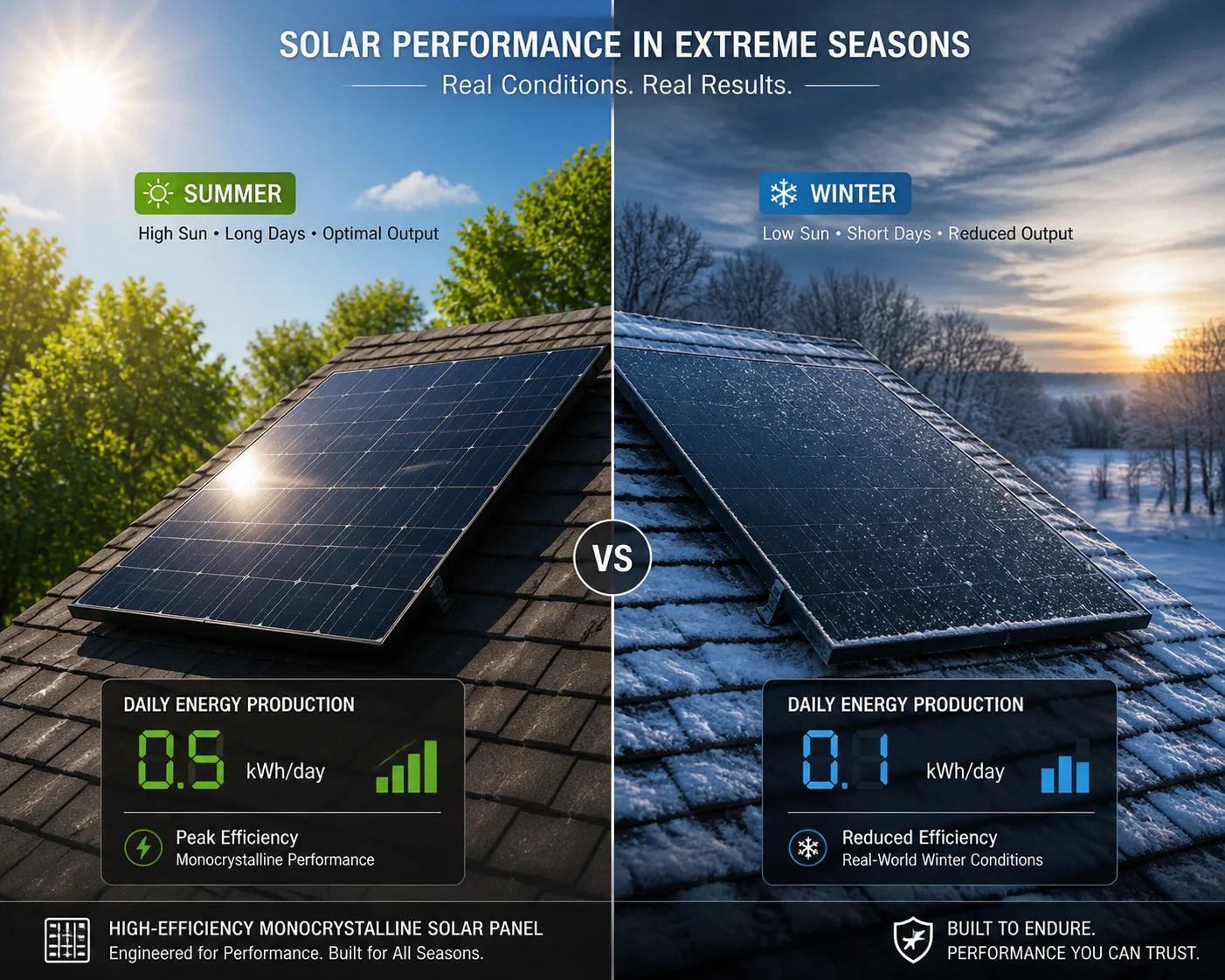
Monocrystalline solar panels in the U.S. can produce 2 to 4 times more energy in summer than in winter. The main drivers are seasonal sunlight hours, sun angle, temperature, and cloud cover. A 100W panel in Arizona may generate 0.5 kWh/day in July but only 0.2 kWh/day in December. In the Pacific Northwest, that winter number can drop below 0.1 kWh/day.
Below, I break down the four biggest questions I hear from system integrators across North America. Each one matters if you are designing a solar-powered 4G surveillance system that must stay online 365 days a year. Let’s walk through them one by one.
Table of Contents
How Much Does My Solar Yield Drop During the Low-Light Winter Months in the North?
If you deploy solar cameras in Minnesota or upstate New York, winter is not just cold — it is dark. I have watched customers lose entire weeks of footage because their battery bank could not keep up.
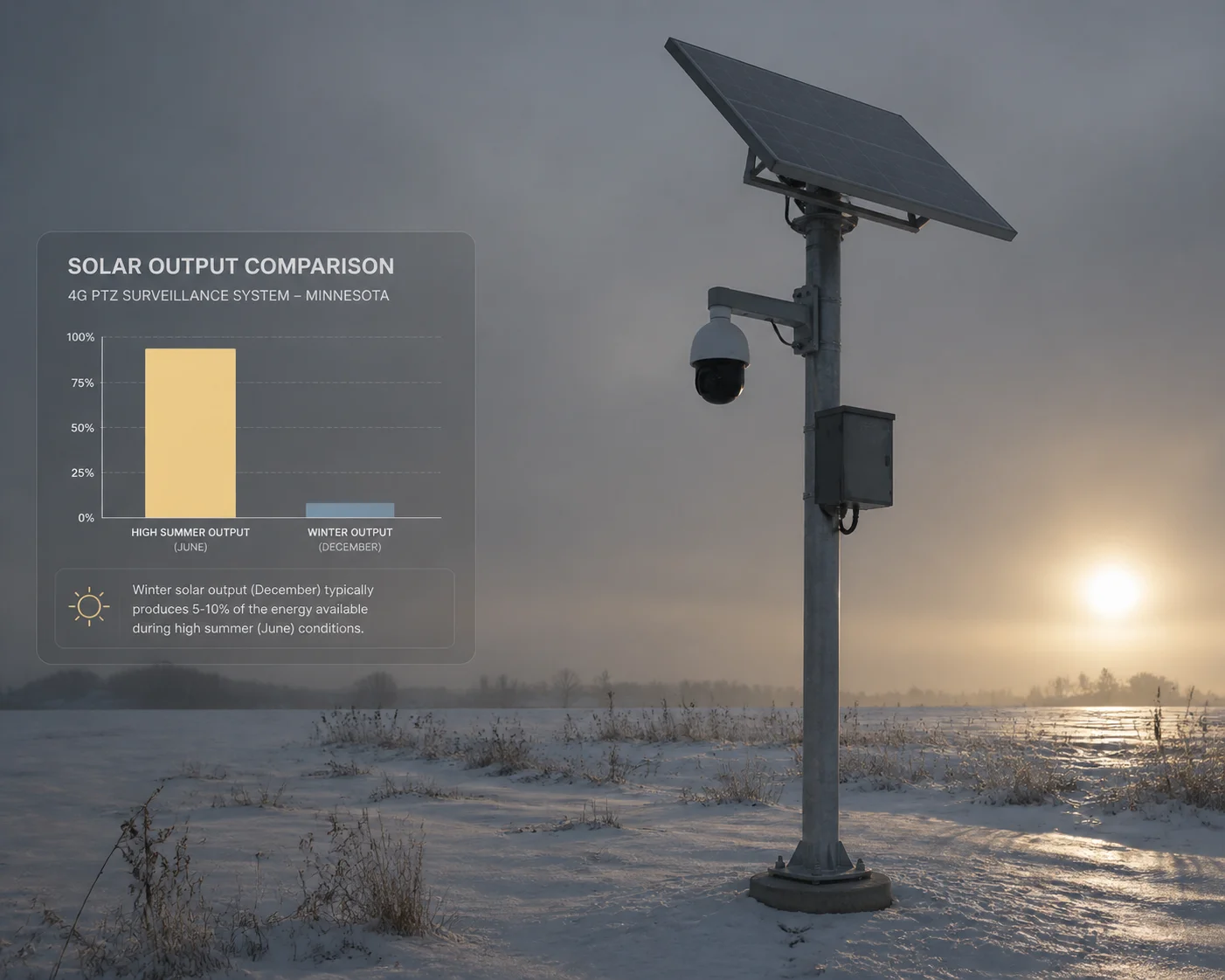
In northern U.S. states (above 42°N latitude), winter solar yield can drop to just 25–40% of summer output. A 100W monocrystalline panel that produces around 0.4 kWh/day in June may only deliver 0.1–0.15 kWh/day in December. This is the single largest source of power generation fluctuation for off-grid systems.
Why Does Winter Hit So Hard?
Two things happen at the same time in winter. First, the days get shorter. In Seattle, you get about 8.5 hours of daylight in December versus 16 hours in June. Second, the sun stays low in the sky. A low sun angle means the light hits your panel at a steep angle, and the atmosphere absorbs more energy before it reaches the surface.
The industry uses a metric called Peak Sun Hours (PSH) 5 to measure usable solar energy per day. One PSH equals one hour of sunlight at 1,000 W/m² intensity. Here is how PSH changes across the U.S. by season:
| Region | Summer PSH (Jun–Jul) | Winter PSH (Dec–Jan) | Summer-to-Winter Ratio |
|---|---|---|---|
| Southwest (AZ, TX west) | 7–8 | 3–4 | ~2.0–2.5× |
| Mid-latitude (CO, IL, KS) | 5–6 | 2–3 | ~2.0–2.5× |
| Northeast / Pacific NW (WA, NY, MN) | 5–6 | 1–2 | ~3.0–4.0× |
What Does This Mean for a Real System?
Let me put this in real numbers. Take a standard 100W monocrystalline panel with a system efficiency of 0.75 (accounting for wiring loss, controller loss, dust, and temperature). The daily energy output formula is simple:
Daily Energy (kWh) = Panel Wattage (kW) × PSH × System Efficiency
For a 100W panel in the Northeast:
- Summer: 0.1 × 5 × 0.75 = 0.375 kWh/day
- Winter: 0.1 × 1.5 × 0.75 = 0.113 kWh/day
That winter number is only 113 watt-hours. A 4K PTZ camera running at 15W draws 360 Wh per day. So one 100W panel in winter gives you less than one-third of what you need. This is why I always tell customers: size your solar array for December, not July.
The 2.5× Redundancy Rule
For northern deployments, I recommend at least 2.5 times the panel wattage your load calculation suggests. If your camera system needs 15W average, that is 360 Wh/day. In winter at 1.5 PSH, you need:
360 Wh ÷ (1.5 PSH × 0.75 efficiency) = 320W of panel capacity
Round that up. Use 350W or 400W. It sounds like overkill in summer, but your MPPT controller will handle the excess. The alternative is a dead camera in January.
Is the Panel Efficiency High Enough to Charge the Battery During a Cloudy Day in Seattle?
Seattle gets about 226 cloudy days per year. I have had customers there ask me point-blank: “Will your solar panel even work here?” The honest answer is — it depends on how you design the system.
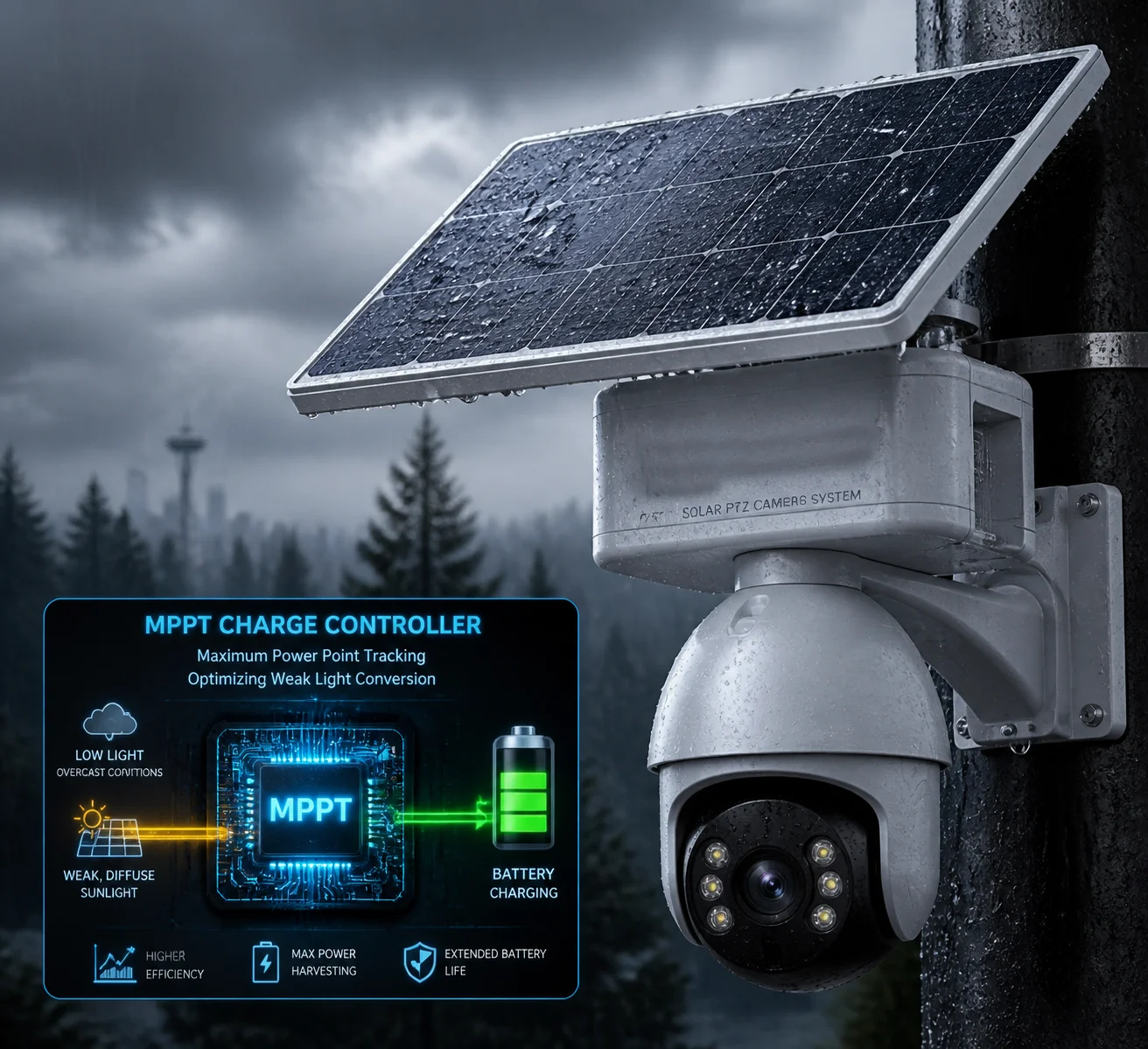
On a fully overcast day in Seattle, a monocrystalline panel may only produce 10–20% of its rated power. A 100W panel could output as little as 10–20W under heavy clouds. This is usually not enough to fully charge a battery in a single day, but with proper battery sizing and MPPT control, the system can still stay online through 3–5 consecutive cloudy days.
How Clouds Cut Your Power
Monocrystalline silicon panels respond to light intensity in a roughly linear way. When the sun is bright at 1,000 W/m², you get close to rated power. When clouds cut that down to 100–200 W/m², your output drops to 10–20% of the nameplate rating.
Here is a rough breakdown of how different sky conditions affect a 100W monocrystalline panel:
| Sky Condition | Irradiance (W/m²) | Approx. Panel Output (W) | % of Rated Power |
|---|---|---|---|
| Clear sky, full sun | 900–1,000 | 85–95 | 85–95% |
| Thin / hazy clouds | 400–600 | 35–55 | 35–55% |
| Overcast, thick clouds | 100–200 | 10–20 | 10–20% |
| Heavy rain / storm | 50–100 | 5–10 | 5–10% |
Note: The “clear sky” output is below 100% because of temperature effects and real-world losses. STC ratings assume 25°C cell temperature, which rarely happens in the field. This is related to the solar panel temperature coefficient 7 and winter performance.
Why MPPT Matters More in Low Light
A cheap PWM charge controller connects the panel directly to the battery. When the panel voltage drops under clouds, the PWM controller cannot do much about it. An MPPT (Maximum Power Point Tracking) 1 controller is different. It constantly adjusts the electrical load to find the voltage-current combination that pulls the most watts out of the panel.
The PWM vs MPPT efficiency comparison 6 shows that in low-light conditions, MPPT can recover 20–30% more energy compared to PWM. That is the difference between your camera staying on or going dark on day three of a cloudy stretch.
Battery Sizing Is the Real Answer
You cannot fight the weather. But you can store enough energy to ride through it. For a Seattle deployment, I recommend sizing the battery to cover at least 5 days of autonomy — meaning 5 full days of camera operation with zero solar input.
If your 4G PTZ system draws 15W average:
- Daily consumption: 15W × 24h = 360 Wh
- 5-day autonomy: 360 × 5 = 1,800 Wh
- With 80% depth of discharge on LiFePO₄ 2: 1,800 ÷ 0.8 = 2,250 Wh battery capacity
That is roughly a 180 Ah battery at 12V. It sounds large, but in the Pacific Northwest, this is what it takes to keep a system online through November and December.
What Is the Impact of Snow Accumulation on the Panel’s Power Output?
Snow is the silent killer of solar-powered surveillance in northern states. I have seen panels buried under six inches of snow for days. During that time, the output is effectively zero.
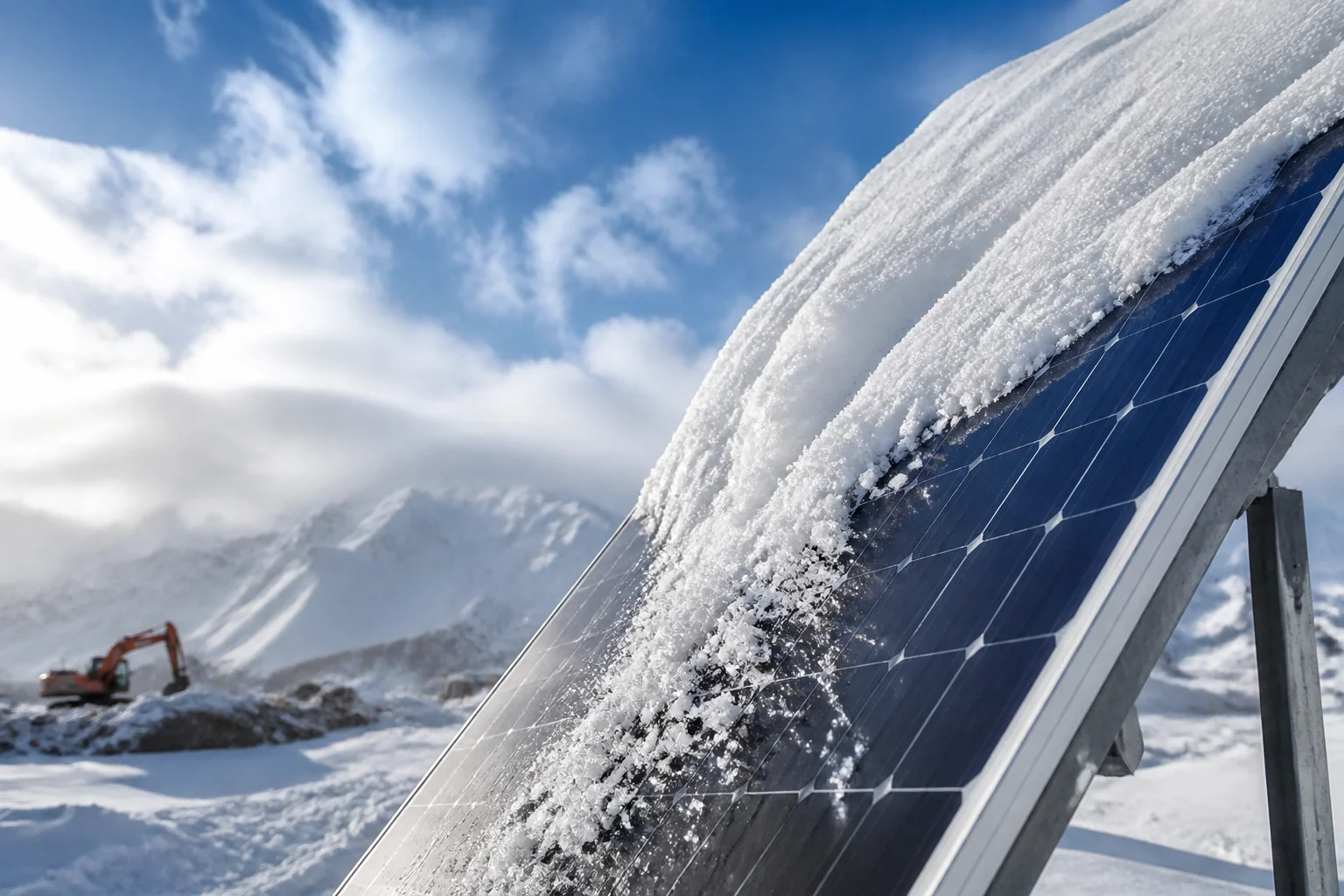
Snow covering a solar panel can reduce power output by 80–100%. Even a thin layer of snow blocks most sunlight from reaching the cells. Unlike dust or dirt, snow does not just reduce efficiency — it can shut down the panel completely until it melts or slides off.
Partial Snow Is Worse Than You Think
Most monocrystalline panels are built with cells wired in series. This means all cells in a string must produce power for the string to work. If snow covers even one row of cells at the bottom of the panel, it can block the entire string. The result is not a 10% loss — it can be a 50–100% loss depending on the panel’s internal wiring and bypass diode 3 design.
How Tilt Angle Helps With Snow Shedding
A steeper tilt angle helps snow slide off faster. Panels mounted flat (0°) will hold snow for days. Panels at 45° or steeper will shed snow much faster, often within hours after the snowfall stops, especially if the panel surface warms even slightly above freezing. The optimal snow shedding angle for photovoltaic modules 8 is typically 40–50°.
Here is a general guide:
- 0–15° tilt: Snow stays. You may need to manually clear it.
- 30° tilt: Snow slides off within 1–2 days in most cases.
- 45°+ tilt: Snow sheds quickly, often the same day.
The Hot Spot Problem
When part of a panel is covered by snow (or any shadow), the shaded cells can become reverse-biased. They start consuming power instead of producing it. This creates localized heating called a hot spot 9. Over time, hot spots can permanently damage cells.
Good panels have bypass diodes that route current around blocked cell groups. But bypass diodes only limit the damage — they do not eliminate the power loss. A panel with three bypass diodes and one-third covered by snow will still lose at least one-third of its output, and often more due to mismatch losses.
Practical Tips for Snow Regions
For deployments in states like Montana, Wisconsin, or Vermont, I recommend:
- Mount panels at 40–50° minimum to encourage natural snow shedding.
- Use frameless or low-frame panels — thick aluminum frames at the bottom edge can trap snow.
- Add extra battery capacity — assume 3–7 days of zero solar input during heavy snow events.
- Consider a small wind turbine as a backup charging source. Wind is often strongest during winter storms when solar is weakest.
How Does the Angle of the Solar Mount Affect the Daily Amp-Hour Production?
I get this question a lot from installers who want a simple answer. The truth is, the “best” angle changes every month. But for a fixed mount, there is a sweet spot.
The tilt angle of your solar panel directly affects how much sunlight hits the surface. For fixed mounts in the U.S., a tilt angle equal to your site’s latitude (typically 25–50°) maximizes annual energy. Adjusting the angle for winter (latitude + 15°) can boost cold-season output by 10–25%, which is critical for off-grid surveillance systems that must run year-round.
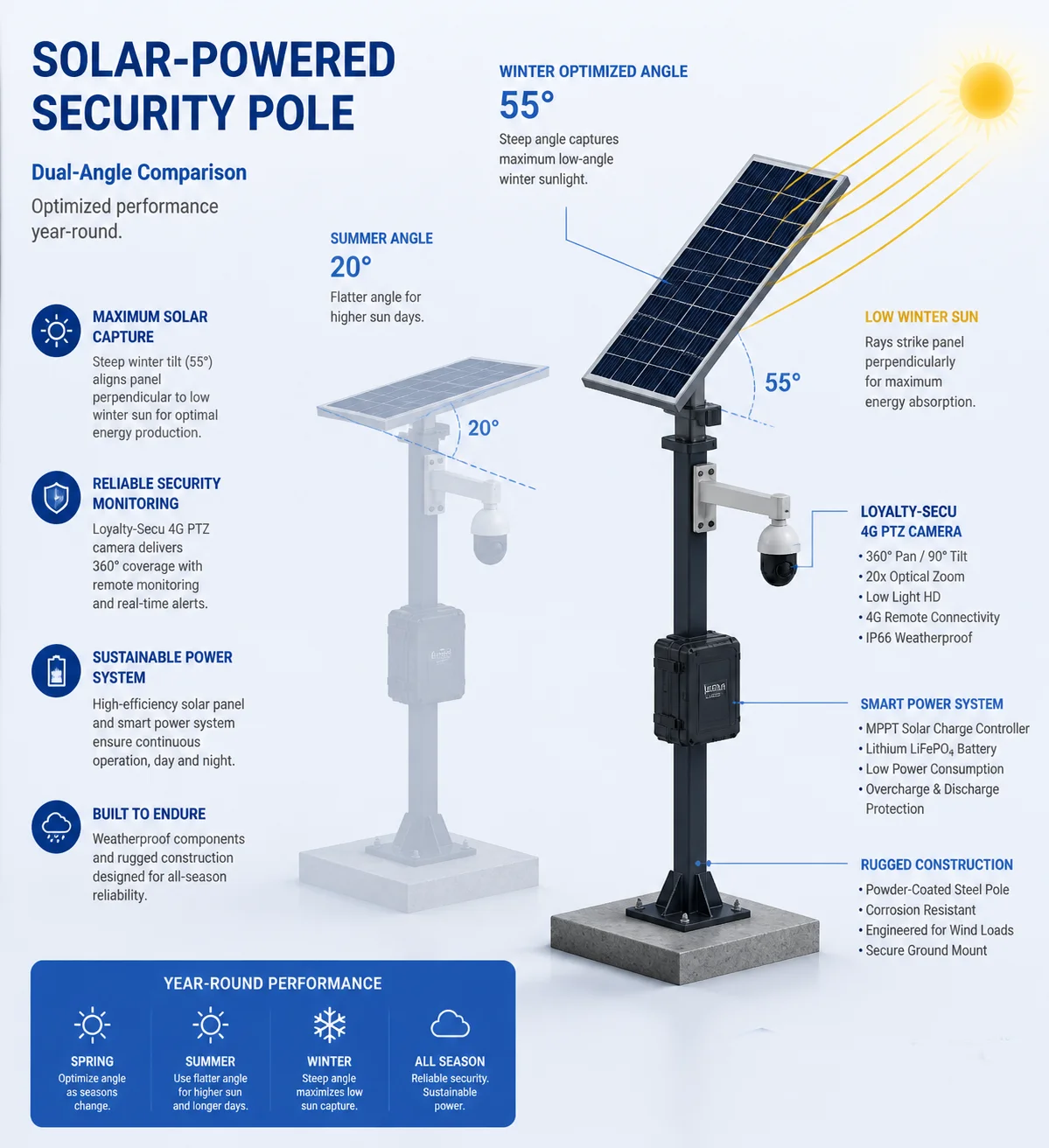
Why Angle Matters
The sun’s position in the sky changes throughout the year. In summer, the sun is high. In winter, it is low. A panel tilted to match the sun’s average angle captures the most direct sunlight.
When sunlight hits a panel at a perpendicular (90°) angle, you get maximum energy transfer. As the angle of incidence increases (light hitting at a slant), the effective irradiance drops. At 60° off-perpendicular, you lose about 50% of the energy.
Fixed Tilt Angle Guidelines for the U.S.
| Site Latitude | Best Year-Round Fixed Tilt | Winter-Optimized Tilt | Summer-Optimized Tilt |
|---|---|---|---|
| 25°N (South TX, FL) | 20–25° | 35–40° | 10–15° |
| 35°N (Mid TX, NC, AZ) | 30–35° | 45–50° | 15–20° |
| 45°N (MN, WA, OR, NY) | 40–45° | 55–60° | 20–25° |
Source: National Renewable Energy Laboratory (NREL) 4 PVWatts Calculator latitude-based tilt recommendations.
Year-Round vs. Winter-Optimized: The Trade-Off
If you tilt for winter (steeper angle), you capture more energy in December and January. But you lose some energy in June and July because the panel is angled too steeply for the high summer sun.
For a grid-tied residential system, you would optimize for annual total. But for an off-grid 4G PTZ camera, the goal is different. You need to survive winter. Summer surplus does not help you if the battery is full by 10 AM anyway.
This is why I recommend fixed tilt winter optimization 10 for all off-grid surveillance deployments. The extra 10–25% winter gain is far more valuable than the summer energy you “lose” (which your system cannot even use).
The Self-Cleaning Bonus
A steeper tilt angle also helps with maintenance. Rain runs off faster, carrying dust and pollen with it. Bird droppings slide off more easily. In dusty environments like construction sites or farms, a flat panel can lose 5–10% of output from dirt buildup within weeks. A 40–45° panel stays much cleaner with no human intervention.
Converting to Amp-Hours
Many off-grid installers think in amp-hours (Ah) rather than watt-hours. The conversion is simple:
Ah = Wh ÷ Battery Voltage
For a 12V system with a 100W panel producing 375 Wh/day in summer:
375 Wh ÷ 12V = 31.25 Ah/day
In winter at 113 Wh/day:
113 Wh ÷ 12V = 9.4 Ah/day
If your camera system draws 1.25A (15W ÷ 12V) continuously, that is 30 Ah/day. In summer, one 100W panel barely covers it. In winter, you are short by 20 Ah/day. This is why two or three panels are the minimum for any serious off-grid PTZ deployment in the northern half of the U.S.
Conclusion
Size your solar system for the worst winter month, not the best summer day. Use MPPT controllers, steep tilt angles, and enough battery to ride through cloudy stretches. That is how you keep a 4G PTZ camera online all year.
1. MPPT charge controller for low-light solar energy harvesting. ↩︎ 2. LiFePO₄ depth of discharge and cycle life. ↩︎ 3. Bypass diode function in partially shaded solar panels. ↩︎ 4. NREL PVWatts solar irradiance data by U.S. region. ↩︎ 5. Peak Sun Hours (PSH) definition for off-grid solar sizing. ↩︎ 6. PWM vs MPPT efficiency comparison in low irradiance. ↩︎ 7. Solar panel temperature coefficient and winter performance. ↩︎ 8. Snow shedding angle for photovoltaic modules. ↩︎ 9. Hot spot formation and bypass diode protection. ↩︎ 10. Fixed tilt winter optimization for off-grid systems. ↩︎