
I have seen too many integrators get burned by a “40X” label that hides weak optics behind a big number. Buying on spec alone risks failed site inspections and costly rework.
The industry measurement standard for a 40X real focal length range is straightforward: divide the maximum focal length by the minimum focal length. If the result equals 40, the lens qualifies as 40X. For example, 5.6mm to 224mm gives 224 ÷ 5.6 = 40. This focal-length ratio — not magnification relative to the human eye — is the universal definition.
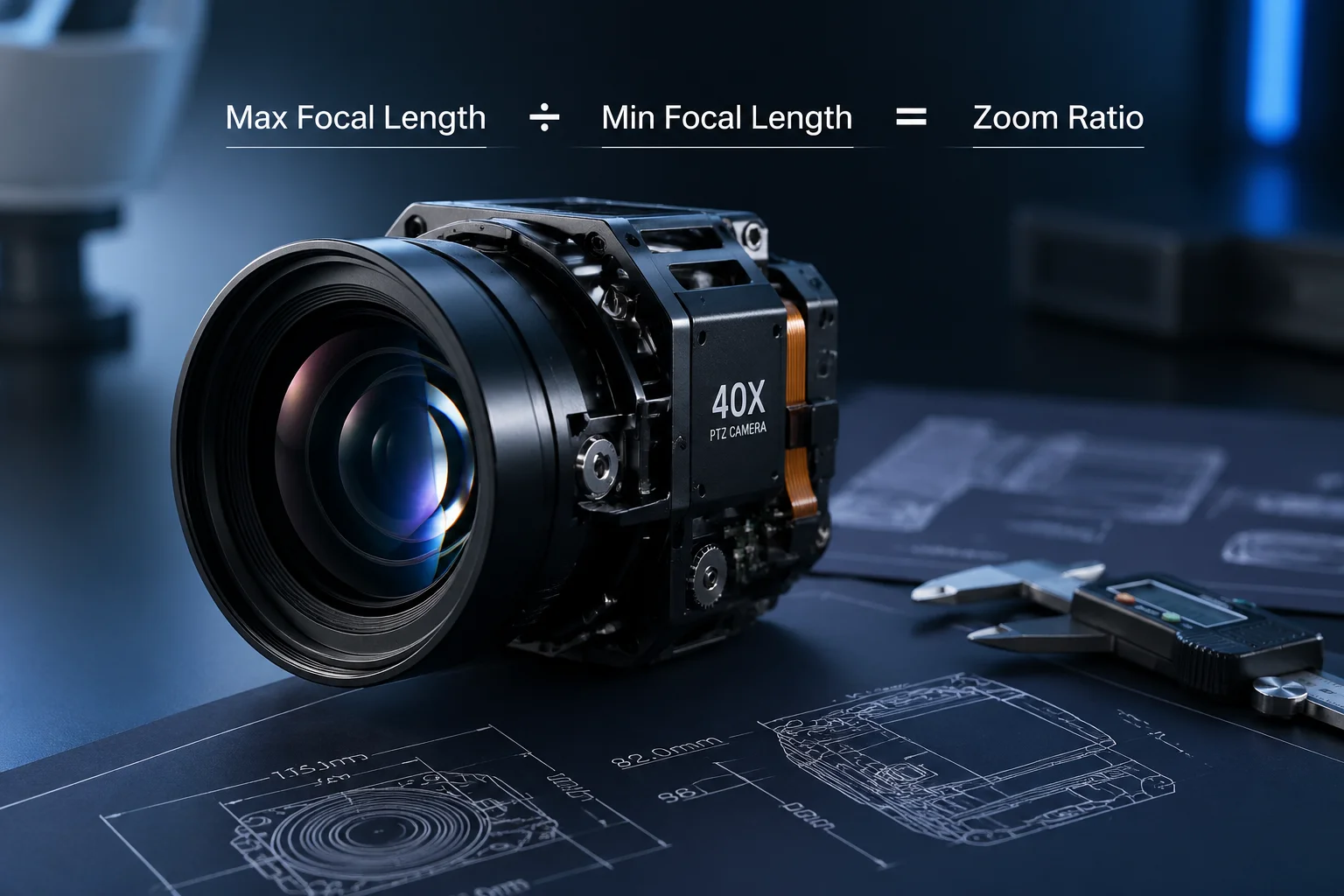
Below, I break down the four questions I hear most from integrators and project managers when they evaluate 40X PTZ modules. Each answer includes real numbers, industry standards, and the verification methods I use at our own factory in Shenzhen.
Table of Contents
How Do I Verify That the Focal Length Is Truly 4.8mm to 192mm as Claimed?
I get this question at least once a week. A datasheet says “4.8–192mm,” but how do you know those numbers are real before you lock in a 500-unit purchase order?
To verify claimed focal length, request the lens module’s optical test report that shows measured focal length at both the wide end and tele end. Then divide the tele value by the wide value. The result should be approximately 40. You can also field-test by measuring the horizontal field of view at both zoom extremes.
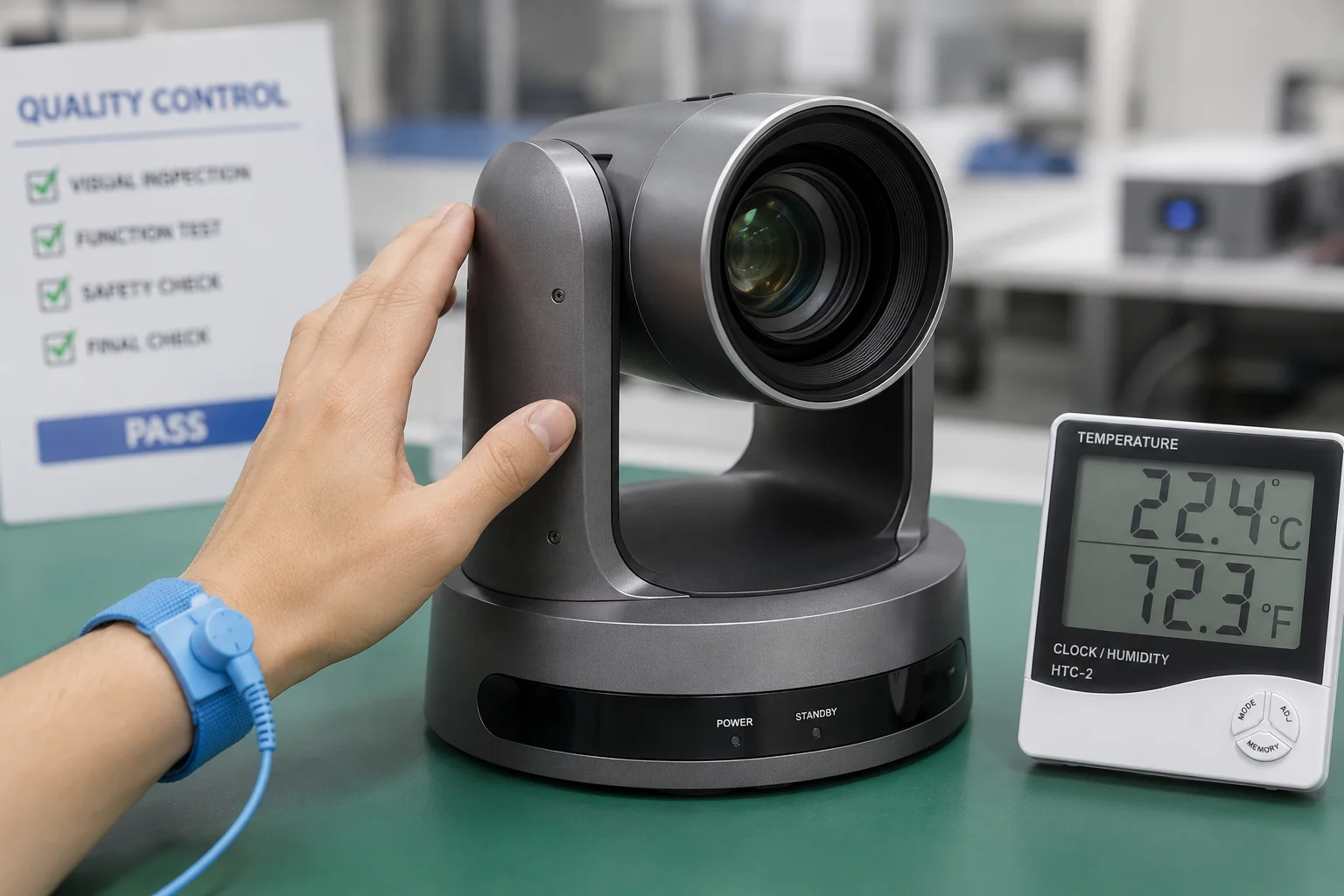
Why Datasheets Alone Are Not Enough
A datasheet is a marketing document. It tells you what the factory wants you to believe. In my years of working with lens suppliers, I have seen datasheets list “4.8–192mm” when the actual tele end only reaches 185mm. That 7mm gap sounds small. But it changes your pixel density at 400 meters. And it can mean the difference between reading a license plate and seeing a blur.
Step-by-Step Verification Method
Here is how I verify focal length at our Loyalty-Secu facility before we ship any 40X PTZ unit:
- Request the Optical Calibration Certificate. Every reputable lens maker — Tamron, Sunny Optical, or our in-house module partner — produces a test report during QC. This report lists the measured focal length at the wide end and tele end for each production batch.
- Check the Horizontal Field of View (HFOV). Focal length and sensor size together decide the HFOV. If the sensor is 1/2.8″ and the datasheet says 4.8mm wide, the HFOV should be about 62°. If your measured HFOV is only 55°, the real wide-end focal length is longer than claimed.
- Do a Simple Ratio Test on Site. Place a known-width target (say, a 1-meter ruler) at a fixed distance. Zoom to full wide. Measure how many pixels the ruler fills. Then zoom to full tele and measure again. The ratio of tele pixels to wide pixels should be close to 40.
What the Numbers Look Like in Practice
| Claimed Spec | Wide-End Focal Length | Tele-End Focal Length | Actual Ratio | Verdict |
|---|---|---|---|---|
| 40X (4.8–192mm) | 4.8mm | 192mm | 40.0 | ✅ Matches claim |
| 40X (5.6–224mm) | 5.6mm | 224mm | 40.0 | ✅ Matches claim |
| 40X (4.8–192mm) | 5.0mm | 185mm | 37.0 | ❌ Only 37X real |
| 40X (5.6–224mm) | 5.8mm | 210mm | 36.2 | ❌ Only 36X real |
The bottom two rows happen more often than you think, especially with white-label modules from unknown lens factories. I always tell my clients: if the supplier refuses to share the calibration report, walk away.
Manufacturing Tolerance to Expect
Even top-tier lens makers allow a tolerance of about ±3% to ±5% on focal length. So a “224mm” lens might actually measure 218mm. That is within normal range. But if the tele end measures 200mm or less, the product does not deserve a “40X” label.
Is the “40X” Zoom Based on the Optical Lens or a Combination with Digital Zoom?
This one catches new buyers off guard. I once had a client in Texas who bought 200 PTZ cameras labeled “40X zoom.” He assumed it was all optical. It was 20X optical + 2X digital, marketed as “40X.” His team could not read plates at 300 meters. The project failed acceptance testing.
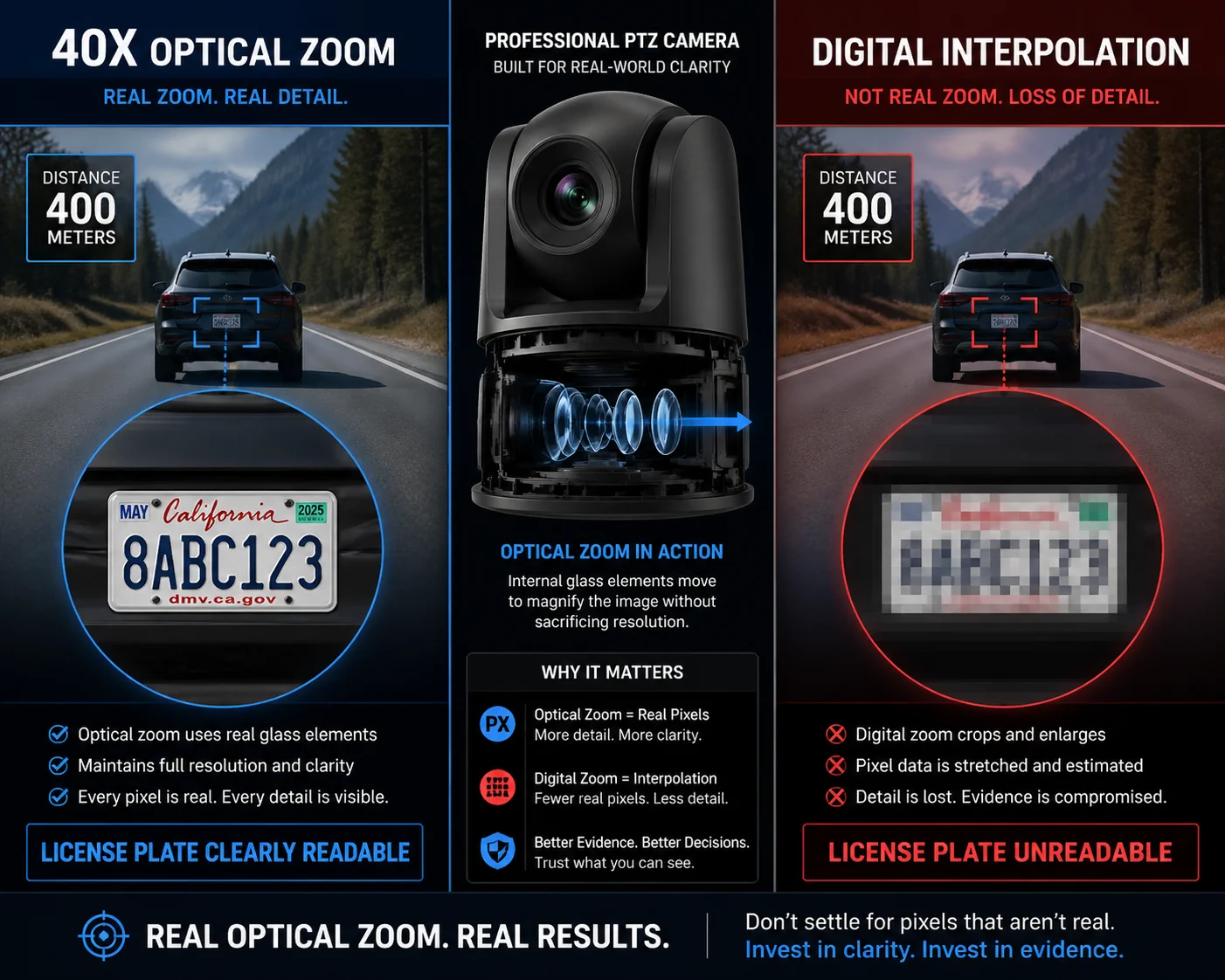
A true 40X optical zoom means the lens itself physically changes focal length from wide to tele at a 40:1 ratio. No digital crop is involved. If a manufacturer combines optical and digital zoom to reach “40X,” the image quality at full zoom is much worse because digital zoom 1 just enlarges pixels without adding detail.
Optical Zoom vs. Digital Zoom: The Core Difference
Optical zoom moves glass elements inside the lens barrel. The sensor captures a full-resolution image at every zoom level. Digital zoom, on the other hand, crops the center of the image and stretches it. No new detail is created. The result is a blurry, noisy picture — exactly the thing you do not want at 400 meters.
How to Spot a Fake “40X”
Some manufacturers play a naming trick. They write “40X zoom” on the product page, then bury the details: “20X optical zoom + 16X digital zoom.” Technically, 20 × 2 = 40 if they pick a partial digital multiplier. But the image quality at “40X” in this case is nowhere near a true 40X optical lens.
Here is how I check:
- Read the full spec sheet. Look for two separate lines: “Optical Zoom” and “Digital Zoom.” If only one combined number is listed, ask for clarification in writing.
- Check the lens focal length. A 20X optical lens typically has a range like 4.7–94mm. A true 40X optical lens has a range like 4.8–192mm or 5.6–224mm. The focal length numbers do not lie.
- Ask for the lens module model number. A legitimate 40X optical zoom module comes from known suppliers. I can look up the module model and verify its real optical spec.
Real-World Impact on Image Quality
| Zoom Method | At Max Zoom (Target at 400m) | Resolution on Target | License Plate Readable? |
|---|---|---|---|
| 40X Optical (5.6–224mm) | Full sensor resolution | ~250 px/m | ✅ Yes |
| 20X Optical + 2X Digital | Half effective resolution | ~125 px/m | ⚠️ Maybe (poor conditions = no) |
| 10X Optical + 4X Digital | Quarter effective resolution | ~63 px/m | ❌ No |
The table above shows why this matters. At 250 px/m, you meet the DORI “Identify” standard — you can read a face or plate. At 63 px/m, you can barely tell a person from a post. I always remind my clients: optical zoom is real detail; digital zoom is fake detail.
Can I See the Lens Manufacturer’s Calibration Report for My Specific PTZ Module?
I ask this question to every lens supplier I work with. And I expect my clients to ask me the same thing. If a factory cannot produce this document, it tells me they either do not test or do not want you to see the results.
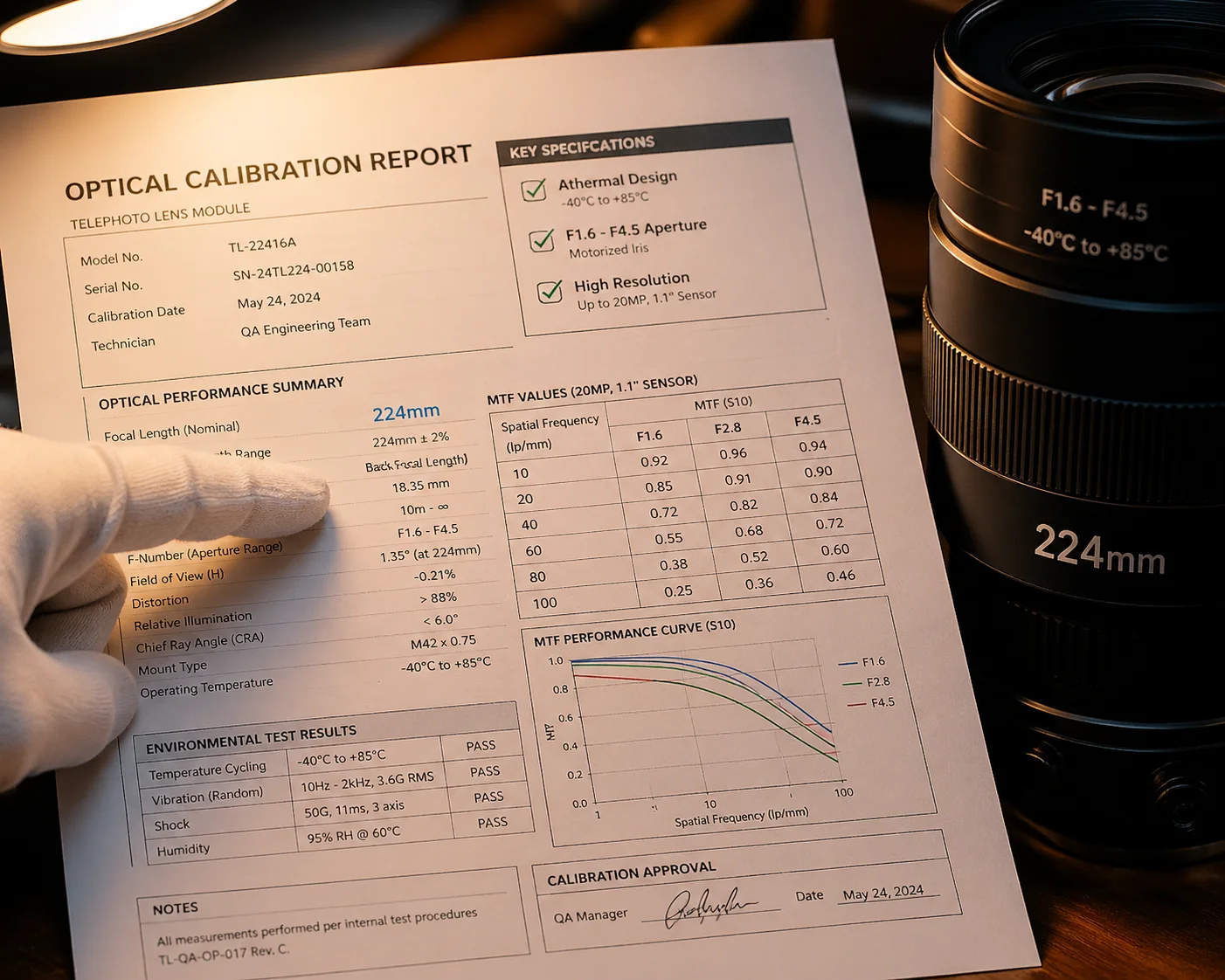
Yes, you should be able to request a calibration report from the lens or PTZ module manufacturer. This report typically includes measured focal length at wide and tele positions, back focal length, MTF (modulation transfer function) 2 values, and field of view angles. Reputable factories provide batch-level or unit-level test data.
What a Real Calibration Report Contains
A proper optical calibration report from the lens maker covers several key parameters. At our factory, when we receive 40X zoom modules from our lens partner, every batch arrives with test documentation. Here is what I look for:
Key Parameters in the Report
- Focal Length (Wide & Tele): The actual measured values, not just the nominal spec. I compare these to the datasheet.
- MTF (Modulation Transfer Function): This tells me how sharp the lens is at different points across the image. Higher MTF at the image edges means less blur in the corners.
- Back Focal Length (BFL): This must match the sensor’s flange distance. If BFL is off, the camera cannot focus properly at certain zoom levels.
- Relative Illumination: This shows how much light reaches the corners versus the center. A drop below 50% means dark corners at wide angle.
- F-Number at Wide and Tele: A critical spec for low-light performance. Cheap 40X modules might show F1.6 at wide but drop to F5.0 at full tele. That means the image gets very dark when you zoom in. A professional-grade 40X module should hold F4.5 or better at the tele end.
Why This Matters for Your Project
I had a client in Canada who was deploying PTZ cameras on oil pipeline stations. The temperature swings from –30°C in winter to +40°C in summer. He asked for the calibration report and noticed the lens had no thermal drift compensation data. I worked with our lens partner to provide a module that included athermal design — meaning the focus stays sharp even when the glass expands or contracts with temperature. Without the calibration report, he would never have caught this gap.
How to Request It
When you contact any PTZ manufacturer — including us at Loyalty-Secu — simply ask: “Can you provide the optical calibration report for this 40X lens module, including MTF curves and measured focal length?” If they say no, or give you a generic PDF that does not match the model, consider it a red flag.
How Does the Actual Field of View Change When I Zoom from 1X to 40X?
I always show this to new clients during sample evaluation. Numbers on paper feel abstract. But when you see the field of view shrink from a wide parking lot to a single license plate 400 meters away, the meaning of “40X” becomes very clear.
When you zoom from 1X (wide end) to 40X (tele end) on a 5.6–224mm lens with a 1/2.8″ sensor, the horizontal field of view drops from approximately 58° down to about 1.4°. This means the visible area narrows by 40 times, and distant objects appear 40 times larger in the frame.
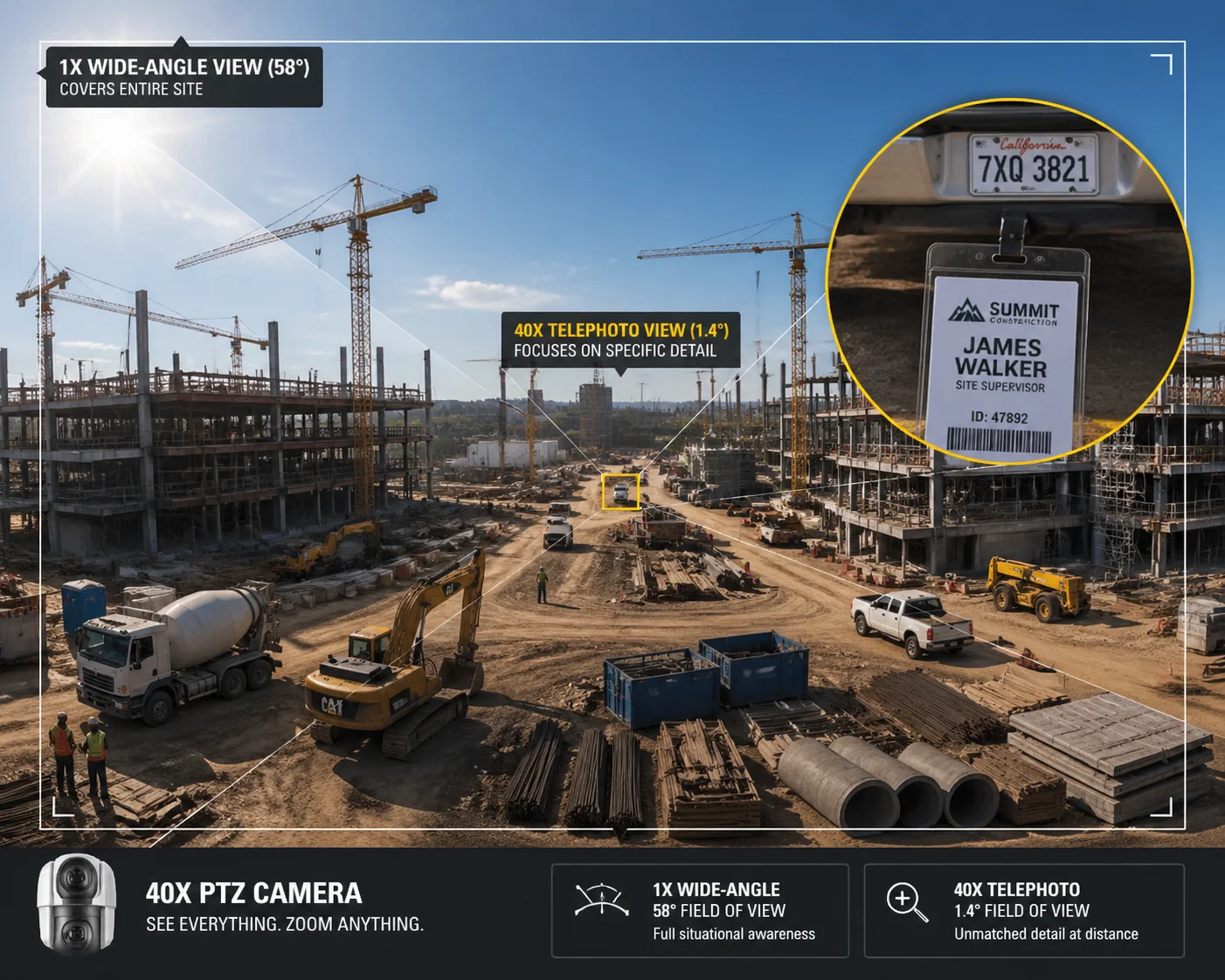
Understanding Field of View in Practical Terms
Field of view (FOV) is the width of the scene your camera can see. At the wide end, a 40X PTZ with a 5.6mm focal length covers a large area — useful for overview shots of a parking lot or a farm perimeter. At the tele end (224mm), the FOV narrows to a tiny slice — just enough to fill the frame with a face or a license plate hundreds of meters away.
FOV Table: 40X Lens on 1/2.8″ Sensor
| Zoom Position | Focal Length | Horizontal FOV | What You See at 400m Distance |
|---|---|---|---|
| 1X (Full Wide) | 5.6mm | ~58° | Entire parking lot (~450m wide) |
| 10X | 56mm | ~5.8° | A row of cars (~40m wide) |
| 20X | 112mm | ~2.9° | Two cars side by side (~20m wide) |
| 30X | 168mm | ~1.9° | One full vehicle (~13m wide) |
| 40X (Full Tele) | 224mm | ~1.4° | License plate fills the frame (~10m wide) |
This table shows a smooth, linear narrowing of the view. Each 10X step cuts the visible width roughly in half compared to the previous step.
The DORI Standard: Turning FOV into Real Distances
North American engineers often use the DORI standard (EN 62676-4) 3 to translate focal length into usable detection ranges. DORI stands for Detect, Observe, Recognize, and Identify. Each level requires a specific pixel density on the target:
- Detect (25 px/m): You see something is moving. With a 224mm tele end, this reaches about 4,400 meters.
- Observe (63 px/m): You see the general shape. About 1,700 meters.
- Recognize (125 px/m): You can tell if it is a known person or vehicle. About 880 meters.
- Identify (250 px/m): You can read facial features or a license plate. About 440 meters.
These numbers assume a 2MP (1080p) sensor. If you use a 4K (8MP) sensor with the same 224mm lens, the identify range extends further because you have four times more pixels.
Why the Starting Focal Length Matters Just as Much
Many buyers focus only on the tele end. But the wide end matters too. A 40X lens starting at 4.8mm gives you a wider overview than one starting at 5.6mm. If your job requires broad situational awareness at 1X — say, monitoring a large construction site — that extra few degrees of width can eliminate the need for an additional fixed camera.
On the other hand, if your priority is long-range identification, you want the tele end to be as long as possible. A 5.6–224mm lens reaches further than a 4.8–192mm lens, even though both are labeled “40X.” I always advise my clients: pick the focal length range that fits your project distance, not just the zoom number.
Conclusion
Always verify the real focal length range behind “40X.” Ask for calibration data, check the ratio, and match the lens to your actual project distance requirements.
1. Digital zoom vs optical zoom quality difference explained. ↩︎ 2. MTF (Modulation Transfer Function) for lens sharpness measurement. ↩︎ 3. EN 62676-4 DORI standard for security camera detection ranges. ↩︎ 4. F-number relationship to light transmission and aperture size. ↩︎ 5. Athermal design for temperature-stable lens focus. ↩︎ 6. Sunny Optical lens modules for PTZ security cameras. ↩︎ 7. Pixel density calculation for license plate recognition. ↩︎ 8. Horizontal field of view formula based on focal length and sensor size. ↩︎ 9. Optical zoom testing equipment and calibration methods. ↩︎ 10. 1/2.8″ sensor size and its impact on effective focal length. ↩︎