
I’ve seen too many PTZ cameras go blind — not from sensor failure, but from a cracked wiper blade that can’t clear dust anymore.
Industrial PTZ camera wipers use either high-density EPDM rubber or special silicone rubber. EPDM is the standard choice for most outdoor deployments. Silicone is reserved for extreme temperature ranges. Under harsh UV like the Texas sun, expect a functional lifespan of 3 to 5 years before the blade loses its flexibility and starts leaving streaks.
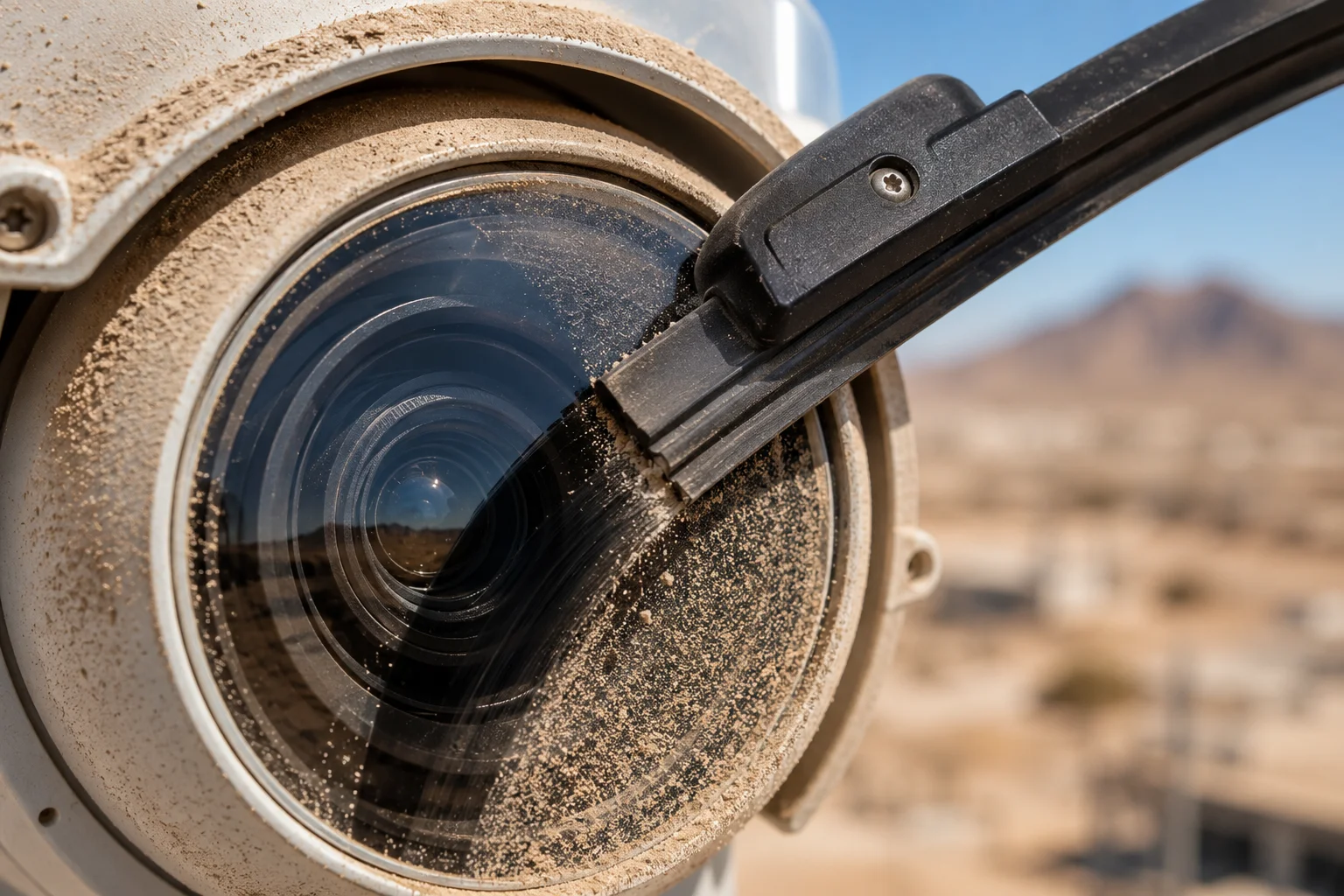 PTZ camera wiper blade material UV aging
Below, I break down the exact material science, cycle ratings, field replacement, and cold-weather performance so you can plan your maintenance budget with real numbers.
Table of Contents
Is the Wiper Blade Made of High-Grade Silicone or EPDM to Resist Cracking in the Texas Sun?
I get this question a lot from integrators running projects in the American Southwest. The sun there doesn’t just heat things up — it breaks chemical bonds inside rubber.
Most industrial PTZ wiper blades use high-density EPDM (Ethylene Propylene Diene Monomer) rubber with added UV stabilizers and carbon black. This is the proven “outdoor king” material. For extreme temperature swings beyond -40°C, we use special silicone rubber because its Si-O chemical bonds are stronger than the C-C bonds in standard rubber and resist UV breakdown better.
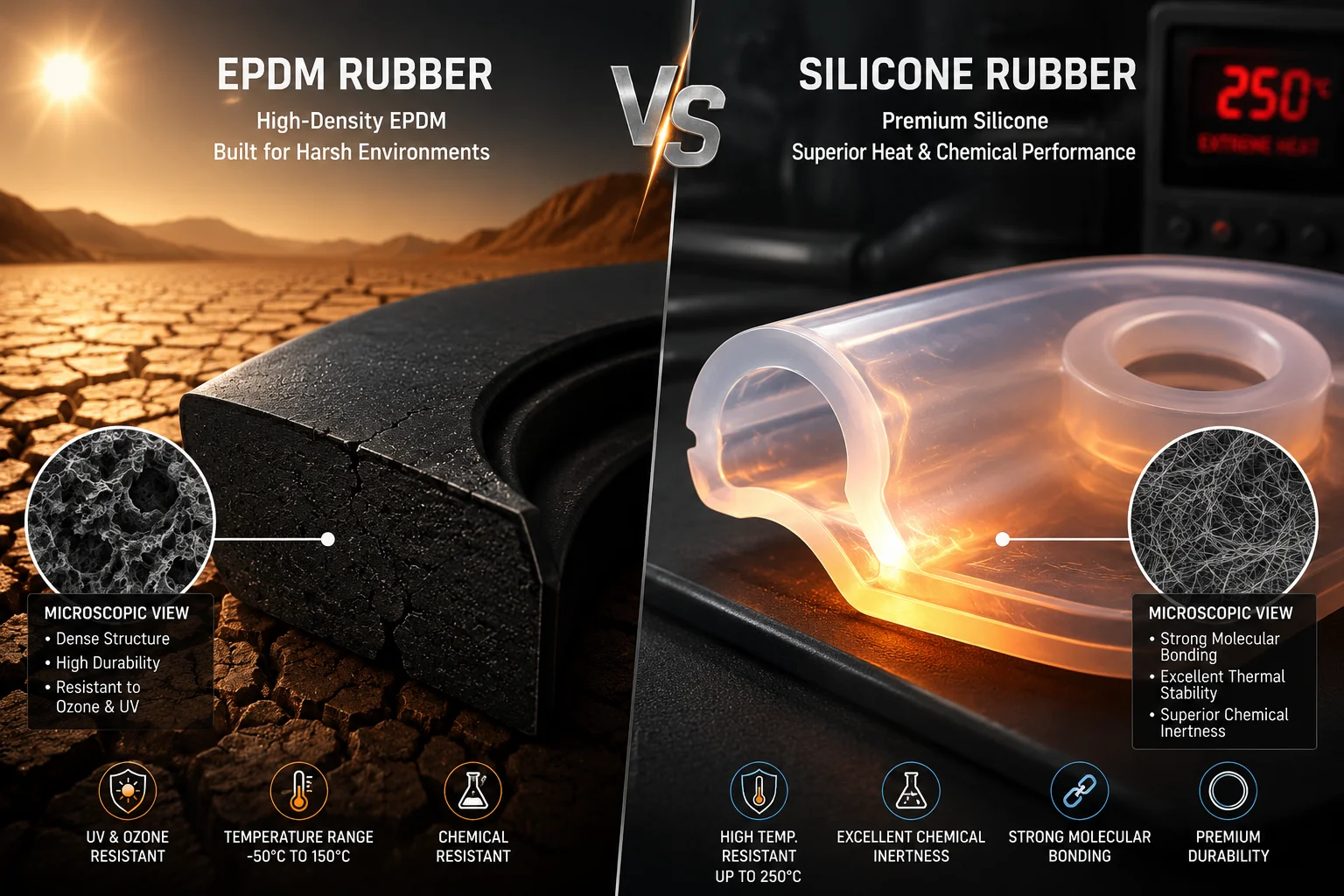 EPDM vs silicone wiper blade PTZ camera
Why EPDM Is the Default Choice
EPDM has earned its reputation in outdoor applications for good reason. It resists ozone, heat, acid, and alkali exposure. But the EPDM used in industrial camera wipers is not the same grade you find in car windshield wipers. We add higher concentrations of UV stabilizers1 and carbon black into the compound. The carbon black2 does two jobs: it absorbs high-energy UV photons before they can reach the polymer chains, and it reinforces the rubber’s mechanical strength.
In a place like Texas, the UV index regularly hits 10 or 11 during summer. At that intensity, standard rubber compounds start showing surface micro-cracks within 18 months. Our industrial-grade EPDM formula pushes that timeline out to 3–5 years because of the enhanced additive package.
When Silicone Makes More Sense
Silicone rubber costs more. But it earns its price in specific conditions. The Si-O bond in silicone has a bond energy of about 452 kJ/mol, compared to 348 kJ/mol for the C-C bond in organic rubbers. That means UV photons simply cannot break silicone’s backbone as easily.
| Property | Industrial EPDM | Special Silicone |
|---|---|---|
| UV Resistance | Very good (with additives) | Excellent (inherent) |
| Temperature Range | -40°C to +150°C | -60°C to +200°C |
| Cost | Standard | 2–3× higher |
| Hardness Stability | Good for 3–5 years in extreme UV | Good for 5–7 years in extreme UV |
| Best Use Case | Most outdoor PTZ deployments | Desert, high-altitude, or arctic sites |
The Real Enemy: Compression Set
Here is something most spec sheets won’t tell you. The wiper blade doesn’t fail by snapping in half. It fails by losing its spring. UV radiation changes the cross-link density inside the rubber over time. The blade slowly takes a permanent curved shape — we call this “compression set3.” Once that happens, the blade can no longer press flat against the glass. It skips. It leaves streaks. Your 40X zoom image goes from sharp to useless.
I always tell my clients: if you press the blade with your finger and it doesn’t bounce back quickly, the UV has already won. Replace it immediately.
How Many Thousands of Wipe Cycles Is the Blade Rated for Before It Leaves Streaks?
Every time I spec a system for a remote solar site, the client asks me: “How long before I need to send a truck out there just to change a wiper?”
A properly formulated industrial EPDM wiper blade is rated for 100,000 to 150,000 wipe cycles under normal conditions. In extreme UV environments with abrasive dust, that number drops to 50,000–80,000 effective cycles. After that, the blade edge loses its precision and begins leaving visible streaks on the lens cover glass.
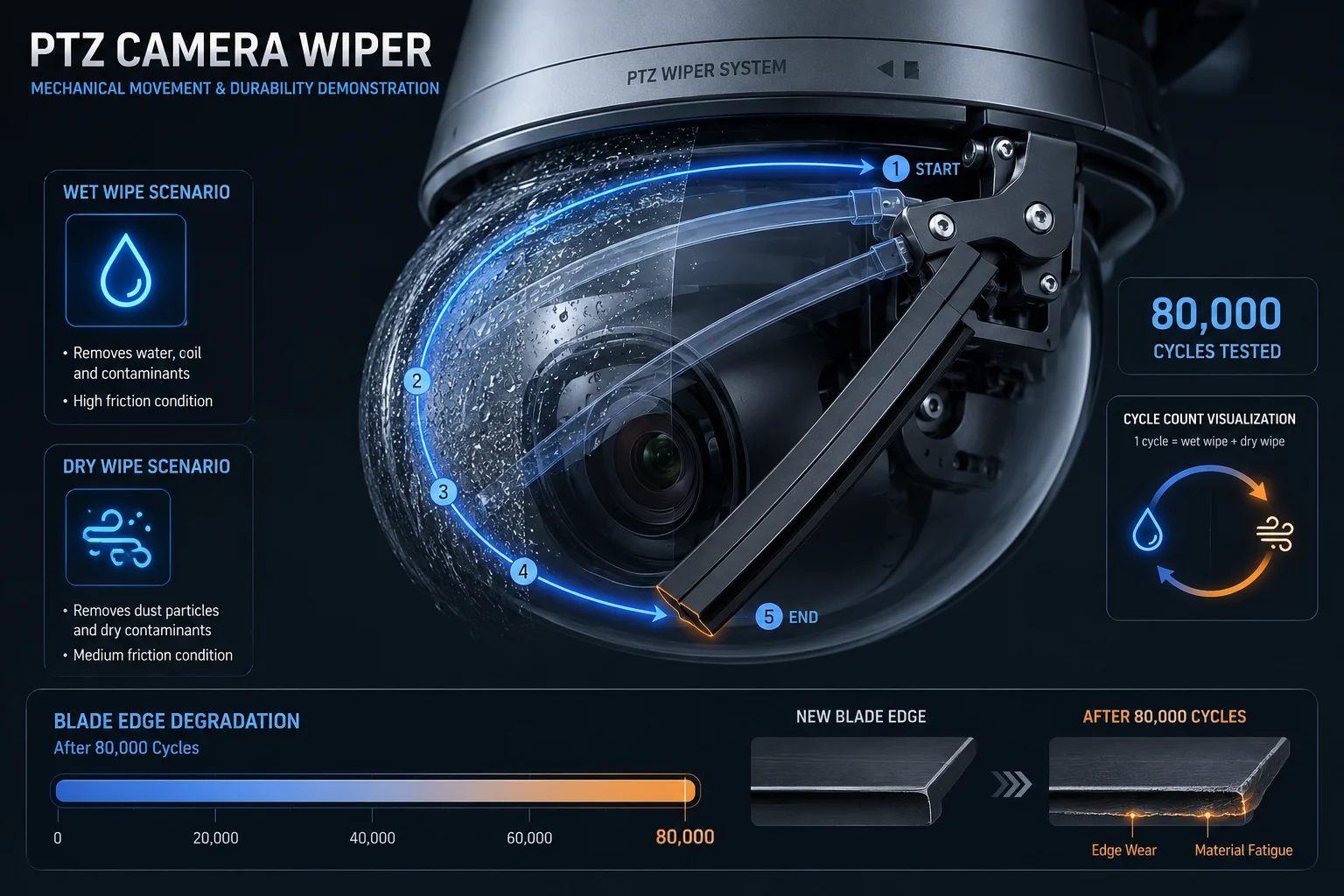 PTZ wiper cycle lifespan rating
What Counts as a “Cycle”
One cycle means one full pass across the glass and back. Most PTZ wipers operate at about 45–60 cycles per minute when active. If you trigger the wiper for 30 seconds during a rain event, that’s roughly 25–30 cycles consumed. Sounds small. But over months of automated triggers, it adds up fast.
The Math for Remote Sites
Let me walk through a real scenario. Say your system triggers the wiper 4 times per day, running 20 seconds each time at 50 cycles per minute. That’s about 67 cycles per day. Over one year, that’s roughly 24,000 cycles. So a blade rated for 80,000 cycles in dusty UV conditions gives you about 3.3 years of service.
But here’s the catch — dry wiping kills blades faster than anything else.
Dry Wipe vs. Wet Wipe
| Condition | Effective Cycle Life | Reason |
|---|---|---|
| Wet wipe (with washer fluid) | 100,000–150,000 cycles | Fluid lubricates and lifts particles |
| Dry wipe (no fluid) | 50,000–80,000 cycles | Sand and dust act as abrasive paper |
| Dry wipe in extreme UV | 30,000–50,000 cycles | UV-hardened dust scratches the blade edge |
This is why I always recommend the “don’t wipe unless you must” logic. Our PTZ firmware can be set to trigger the wiper only when a rain sensor4 detects moisture or when the image analytics5 detect a blur pattern. This simple rule can double your blade life.
PTFE Coating Extends Cycle Life
High-end wiper blades get a micro-layer of PTFE (Teflon) coating6 on the wiping edge. This does two things. First, it reduces friction between the blade and glass by about 40%. Less friction means less edge wear per cycle. Second, the PTFE layer acts as a physical shield against UV penetration into the rubber surface. I’ve seen PTFE-coated blades last 30–50% longer than uncoated ones in the same environment.
Can I Easily Replace the Wiper Blade in the Field Without Disassembling the PTZ Head?
I’ve heard horror stories from technicians who had to remove an entire PTZ dome just to swap a $5 rubber strip. That’s bad design.
Yes. On a properly engineered PTZ camera, the wiper blade uses a quick-release clip or slide-lock mechanism. You can replace it in under 2 minutes with no tools, and without removing the PTZ head from its mount. The blade slides out from the wiper arm, and the new one clicks into place.
 field replacement PTZ wiper blade
How the Quick-Release Works
The wiper arm has a small spring-loaded tab at the connection point. You press the tab, slide the old blade out sideways, and slide the new one in until it clicks. No screws. No Allen keys. No need to power down the camera. The whole process takes less time than changing a pen refill.
This matters because of where these cameras live. They sit on 6-meter poles in the middle of construction sites. They hang off bridge structures over highways. They watch over solar farms 50 miles from the nearest town. Every minute a technician spends on a ladder is a cost — and a safety risk.
What to Check During a Field Swap
When you’re already up there changing the blade, take 60 seconds to inspect these items:
- Wiper arm tension: The spring inside the arm should hold the blade firmly against the glass. If the arm feels loose, the spring may need replacement too.
- Glass surface: Run your finger across the lens cover. If you feel pitting or deep scratches, the glass itself may need replacement — no wiper blade will clear water cleanly off damaged glass.
- Washer nozzle: Blow into the nozzle hole to confirm it’s not clogged with calcium deposits from hard water.
Design Comparison: Good vs. Bad
| Design Feature | Field-Friendly Design | Poor Design |
|---|---|---|
| Blade attachment | Tool-free clip/slide | Screws requiring hex key |
| Access | External, no dome removal | Hidden under housing |
| Arm material | SS316 stainless7 | Painted carbon steel (rusts) |
| Spare blade included | Yes, in box | No |
| Replacement time | < 2 minutes | 15–30 minutes |
I always ship 2–3 spare blade strips with every unit. For a 40X camera8 where image clarity is everything, a $3 spare blade in the box saves your client a $500 truck roll.
Will the Wiper Material Remain Flexible Enough to Function at -40°C in Northern Winters?
I work with integrators in Canada and Scandinavia who need cameras running through months of -30°C darkness. A frozen wiper is a useless wiper.
Yes. Industrial EPDM maintains functional flexibility down to -40°C, and special silicone rubber stays flexible to -60°C. At these temperatures, the blade will feel stiffer than at room temperature, but it will still conform to the glass surface and clear ice crystals effectively. Below -40°C, only silicone formulations remain reliable.
 PTZ camera wiper cold weather performance
What Happens to Rubber in Extreme Cold
All rubber gets stiffer as temperature drops. This is basic polymer physics. The polymer chains lose mobility and the material approaches its ‘glass transition temperature (Tg)9‘. Below Tg, rubber becomes brittle like plastic and will crack under stress.
For standard EPDM, the Tg sits around -55°C. That gives you a comfortable margin above -40°C. The blade will be noticeably firmer, but it won’t crack. For silicone, the Tg is around -70°C to -80°C, which is why it’s the go-to material for arctic deployments.
The Ice Adhesion Problem
Cold temperature alone isn’t the biggest challenge. The real problem is ice forming between the blade and the glass. When the wiper sits in its parked position and temperature drops below freezing, moisture trapped under the blade freezes and bonds the rubber to the glass. If the motor tries to force the blade to move, it can tear the rubber edge.
Our solution is a combination of two features:
- Heated parking zone10: A small resistive heater element near the parking position keeps the blade above 0°C when the camera detects freezing conditions. This uses minimal power — about 2W — which matters for solar-powered sites.
- Smart parking position: The firmware parks the blade under the sunshield where radiant heat loss is lower. This alone can keep the blade 3–5°C warmer than the ambient air.
Cold-Weather Maintenance Tips
For projects in Northern Alberta, Minnesota, or Scandinavia, I recommend these practices:
- Use silicone blades if your site regularly sees temperatures below -35°C. The cost difference is small compared to a failed deployment.
- Enable the pre-heat cycle in firmware. Before the wiper activates, the system runs the heater for 10 seconds to break any ice bond.
- Avoid parking the blade at the top of its stroke. Water runs down and pools at the lowest point. Park it at the bottom where drainage is better.
- Apply a thin layer of silicone lubricant11 to the blade during fall maintenance. This reduces ice adhesion by up to 60% and doesn’t affect wipe quality.
The combination of proper material selection and smart firmware control means your wiper will work reliably across a temperature range of -40°C to +60°C — covering everything from a January night in Yellowknife to an August afternoon in Riyadh.
Conclusion
The wiper is a small part with a big job. Choose EPDM for most sites, silicone for extremes, plan for replacement every 2–3 years in high-UV zones, and make sure your camera design lets you swap the blade in minutes — not hours.
1. Learn how UV stabilizers protect polymers from photodegradation. ↩︎ 2. Explanation of how carbon black absorbs UV and reinforces rubber. ↩︎ 3. Definition and significance of compression set in elastomers. ↩︎ 4. How rain sensors detect moisture to trigger wiper operations automatically. ↩︎ 5. Overview of video analytics that detect blur patterns for wiper activation. ↩︎ 6. Properties of PTFE coating and its use in reducing friction and UV penetration. ↩︎ 7. Corrosion resistance and mechanical properties of 316 stainless steel. ↩︎ 8. Typical zoom specifications for high-magnification PTZ cameras. ↩︎ 9. Scientific explanation of Tg and its impact on rubber flexibility in cold conditions. ↩︎ 10. Explanation of resistive heating elements designed to prevent ice buildup on camera wipers. ↩︎ 11. How silicone lubricant reduces ice adhesion on rubber components. ↩︎