
I have seen integrators spend more on truck rolls and repairs than on the PTZ camera itself. Choosing the wrong drive system is often the root cause.
Gear-driven PTZs cost less to maintain day-to-day but hit you hard when they finally need repair — typically 20–30% of the device price over three years. Belt-driven PTZs need more frequent attention, but each fix is cheap — around 5–10% of the device price over three years. Your total cost depends on payload, environment, and how often you can send a technician.
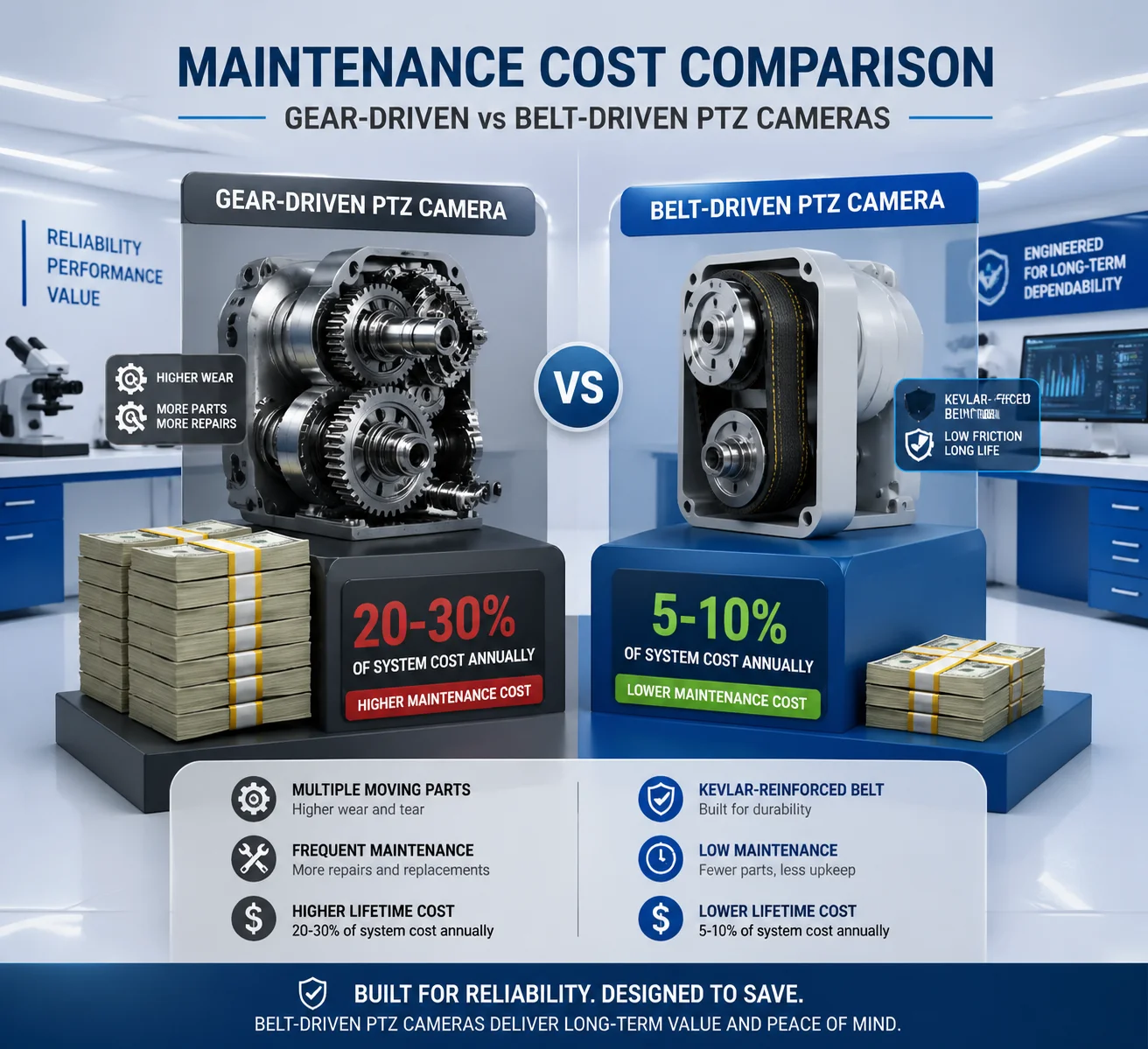
I want to break this down further. Below, I will walk through the four questions I hear most from integrators like David Miller — guys managing remote sites across Texas or running large-scale projects in Canada and Europe. Each section gives you real numbers and practical advice so you can pick the right drive system before you place your next order.
Table of Contents
Will a Belt-Driven System Require Tension Adjustments After a Year of Heavy Use?
I get this question a lot, especially from integrators running PTZ cameras on 24/7 patrol schedules. The short answer might surprise you.
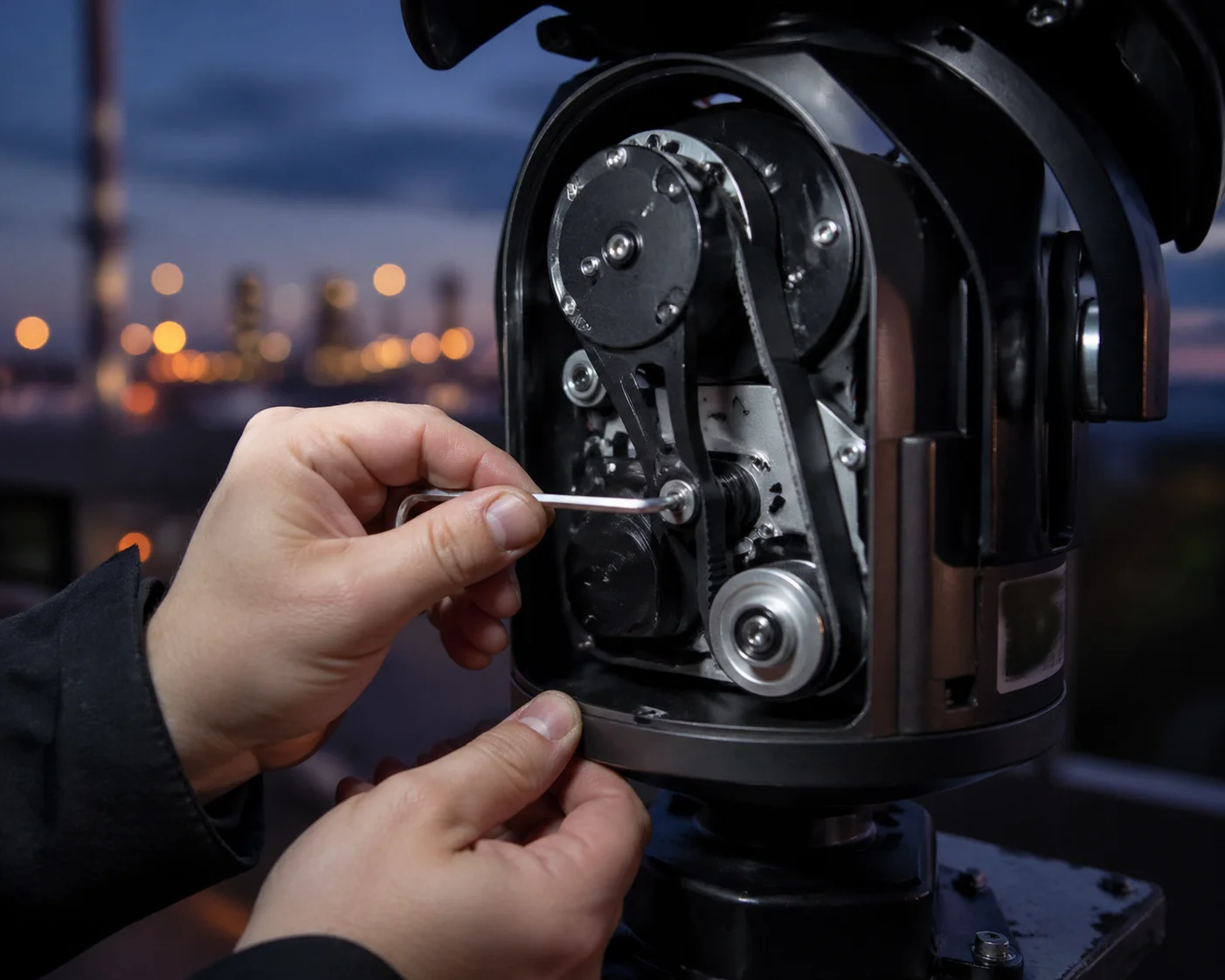
Yes, a belt-driven PTZ will likely need a tension check after 12 months of heavy use. Timing belts stretch over time due to continuous load and temperature changes. But modern industrial-grade belts — like Kevlar-reinforced ones — stretch far less, and most adjustments take under 15 minutes with basic tools.
Why Belts Stretch in the First Place
A timing belt 1 is made of rubber or polyurethane, often reinforced with fibers. When a PTZ camera runs patrol tours all day, the belt is under constant tension. Over months, the material slowly elongates. This is normal. It happens in every belt-driven machine — not just PTZ cameras.
The rate of stretch depends on three things:
- Load weight. A heavier camera module puts more stress on the belt.
- Duty cycle. A PTZ running 20 hours a day stretches faster than one running 8 hours.
- Temperature swings. In places like West Texas, daytime heat and nighttime cold cause the belt material to expand and contract repeatedly.
What Happens If You Skip the Adjustment
If you ignore belt tension for too long, you will notice two things. First, the preset positions start to drift. The camera stops a few degrees off from where it should. Second, the belt may start skipping teeth on the pulley. That means the motor spins but the camera does not move smoothly.
Neither of these will destroy the camera overnight. But they will reduce your image quality on preset tours, and your end client will notice.
How the Adjustment Works
Most belt-driven PTZs have a tensioner screw or a spring-loaded idler pulley inside the housing. You open the dome or enclosure, turn the screw, and the belt tightens. Some of our models at Loyalty-Secu also support closed-loop stepper control. This means the software detects the position error and compensates automatically — even before you send a technician.
Here is a quick comparison of maintenance effort between standard and reinforced belts:
| Belt Type | Typical Adjustment Interval | Tools Needed | Estimated Field Time |
|---|---|---|---|
| Standard rubber timing belt | Every 6–9 months (heavy use) | Allen key, torque gauge | 10–15 minutes |
| Kevlar-reinforced timing belt | Every 12–18 months (heavy use) | Allen key, torque gauge | 10–15 minutes |
| Polyurethane with steel cord | Every 18–24 months (heavy use) | Allen key, torque gauge | 10–15 minutes |
The bottom line: yes, you will need to check tension. But it is fast, cheap, and predictable. I always tell my clients — a 15-minute belt adjustment is far better than a $2,000 truck roll to swap out a seized gearbox.
Are Metal Gears More Prone to “Backlash” Issues Compared to Reinforced Rubber Belts?
I have personally tested PTZ units that came back from the field with obvious backlash drift after just two years. It is a real problem, and it costs real money to fix.
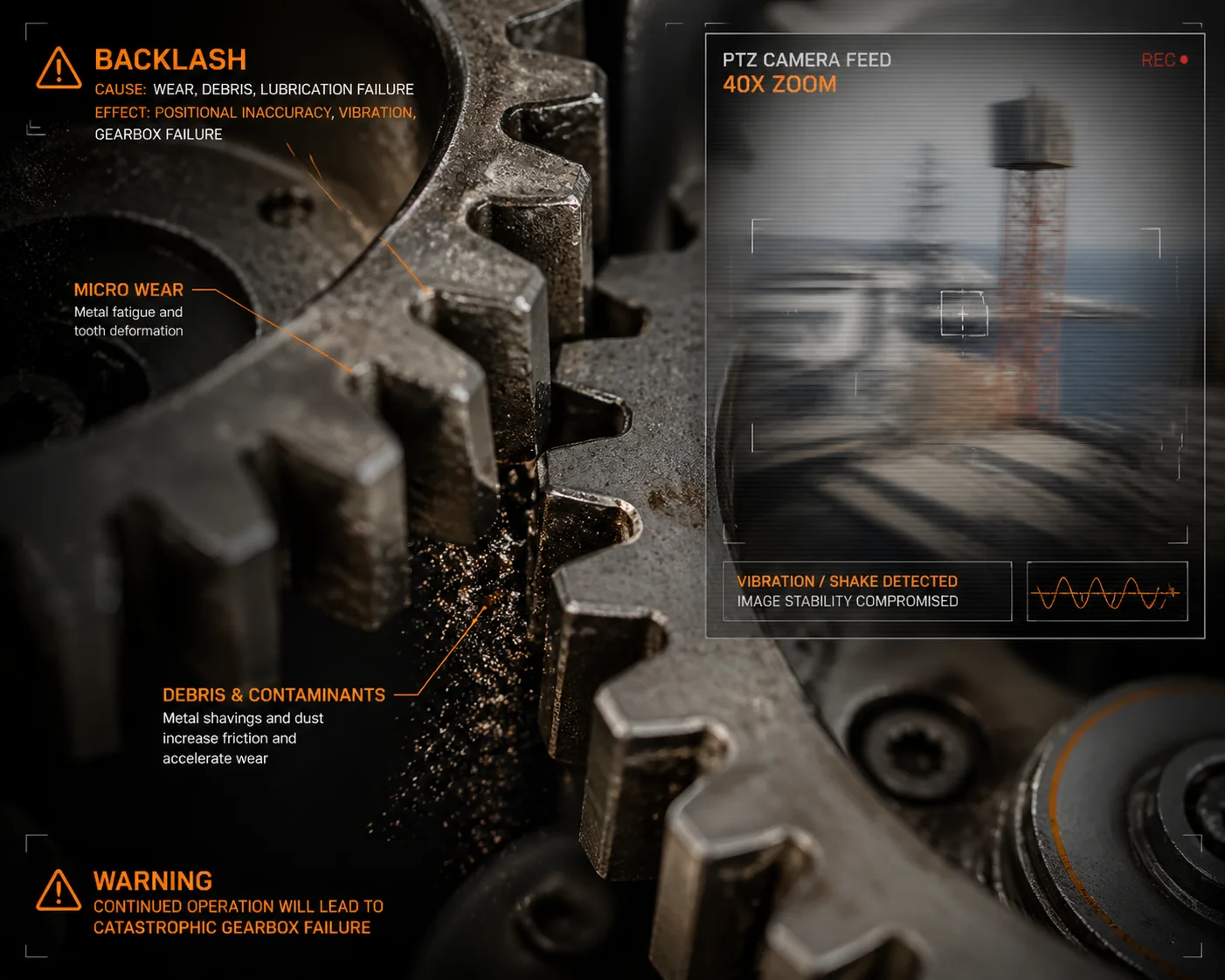
Yes, metal gears are more prone to backlash than reinforced belts. As gear teeth wear down over time, the gap between meshing teeth grows. This gap causes the camera to wobble when stopping at a preset position. Belts, by contrast, maintain tighter contact with the pulley and develop backlash much more slowly.
What Backlash Actually Looks Like on a PTZ Camera
Backlash is the tiny bit of free play between two meshing gear teeth. When a PTZ motor reverses direction — say, going from panning left to panning right — the gear teeth have to cross that gap before they engage again. During that gap, the camera head moves without control.
On a 40X zoom PTZ, even 0.1 degrees of backlash becomes visible as a jitter or wobble at the end of a preset movement. If your end client is a city traffic department or a border security agency, that wobble means blurry license plates or missed facial details. That is not acceptable.
Why Gears Wear Faster Than You Expect
Metal gears in PTZ cameras are usually helical or planetary types. They are strong. They handle heavy loads well. But every time two metal surfaces slide against each other, microscopic particles come off. This is normal wear. Over 2–5 years, the accumulated wear widens the gap between teeth.
Factors that speed up gear wear:
- Dust and sand ingress. Even with IP66 or IP67 ratings, fine particles can get inside over years. These particles act like sandpaper between gear teeth.
- Insufficient lubrication. If the grease dries out — common in hot climates — metal-on-metal contact increases dramatically.
- High-speed continuous patrol. The more the gears spin, the faster they wear.
How Belts Handle the Same Problem
A reinforced rubber or polyurethane belt wraps around a toothed pulley. The teeth on the belt fit into the grooves on the pulley. There is very little free play by design. As the belt wears, it stretches — but it does not develop the same kind of directional backlash that gears do. You can re-tension the belt and restore most of the original precision.
Here is how the two systems compare on backlash over time:
| Time in Service | Gear-Driven Backlash | Belt-Driven Backlash | Fix Difficulty |
|---|---|---|---|
| Year 1 | Minimal (< 0.05°) | Negligible (< 0.02°) | Neither needs fixing |
| Year 2–3 | Noticeable (0.1–0.3°) | Still low (0.03–0.08°) | Gear: needs pro repair. Belt: tension adjustment |
| Year 4–5 | Significant (> 0.5°) | Moderate (0.1–0.2°) | Gear: gearbox replacement. Belt: belt replacement |
The Cost Impact
When backlash on a gear-driven PTZ reaches the point where presets are unreliable, you have two choices. Send a technician to disassemble the unit, replace the gearbox, re-calibrate, and reassemble. Or replace the entire PTZ. Either way, you are looking at hundreds or even thousands of dollars — especially in remote locations.
With a belt-driven PTZ, I can ship you a replacement belt for a few dollars. Your local technician swaps it in 20 minutes. The camera is back to factory-level precision. That difference in repair cost adds up fast across a fleet of 50 or 100 cameras.
Which Drive System Is Quieter for Indoor or High-End Residential Installations?
I once had a client install a gear-driven PTZ inside a luxury hotel lobby. The guests complained about the noise on day one. That was an expensive mistake.
Belt-driven PTZ systems are significantly quieter than gear-driven ones. Typical belt-driven units produce less than 35 dB of noise during operation, while gear-driven units range from 50 to 65 dB. For indoor spaces like hospitals, museums, courtrooms, or upscale residences, belt-driven is the only practical choice.

Why Gears Are Loud
Metal gears create noise because of direct tooth contact. Every time a tooth on one gear meshes with a tooth on another, there is a small impact. Multiply that impact by hundreds of rotations per minute, and you get a constant, audible hum or whine. Helical gears are quieter than spur gears 2, but they still produce more noise than any belt system.
The noise also gets worse over time. As gear teeth wear and backlash increases, the impacts become less smooth. The sound shifts from a hum to a rattle. In a quiet room, this is very noticeable.
Why Belts Are Quiet
A timing belt moves smoothly over a pulley. There is no metal-on-metal contact. The belt material itself absorbs vibration. The result is near-silent operation. In my experience, most people standing 2 meters from a belt-driven PTZ cannot hear it move at all.
When Noise Matters More Than You Think
I want to share a practical point here. Many integrators focus only on outdoor projects when they think about PTZ cameras. But indoor PTZ installations are growing fast — in retail analytics, hospital security, house of worship live streaming, and courtroom recording.
In these environments, noise is not just annoying. It is a deal-breaker. A hospital operating room cannot have a buzzing camera. A church cannot have a whining motor during a sermon. A courtroom cannot have any distraction.
My Recommendation for Indoor Projects
If your project is indoors or in any noise-sensitive setting, I always recommend a belt-driven PTZ. The maintenance is simple, the noise is minimal, and the cost savings on sound-dampening accessories alone make it worth it. You do not need to add rubber mounts or acoustic enclosures — the belt system is already quiet enough.
For heavy outdoor applications — port surveillance, border monitoring, wind farm perimeter — gear-driven still has its place because of load capacity and raw durability. But for indoor work, belt-driven wins every time.
Can I Easily Replace a Worn Belt in the Field, or Does It Require a Factory Repair?
I have had integrators ask me this before they even look at specs. For them, field serviceability is not a feature — it is a requirement.
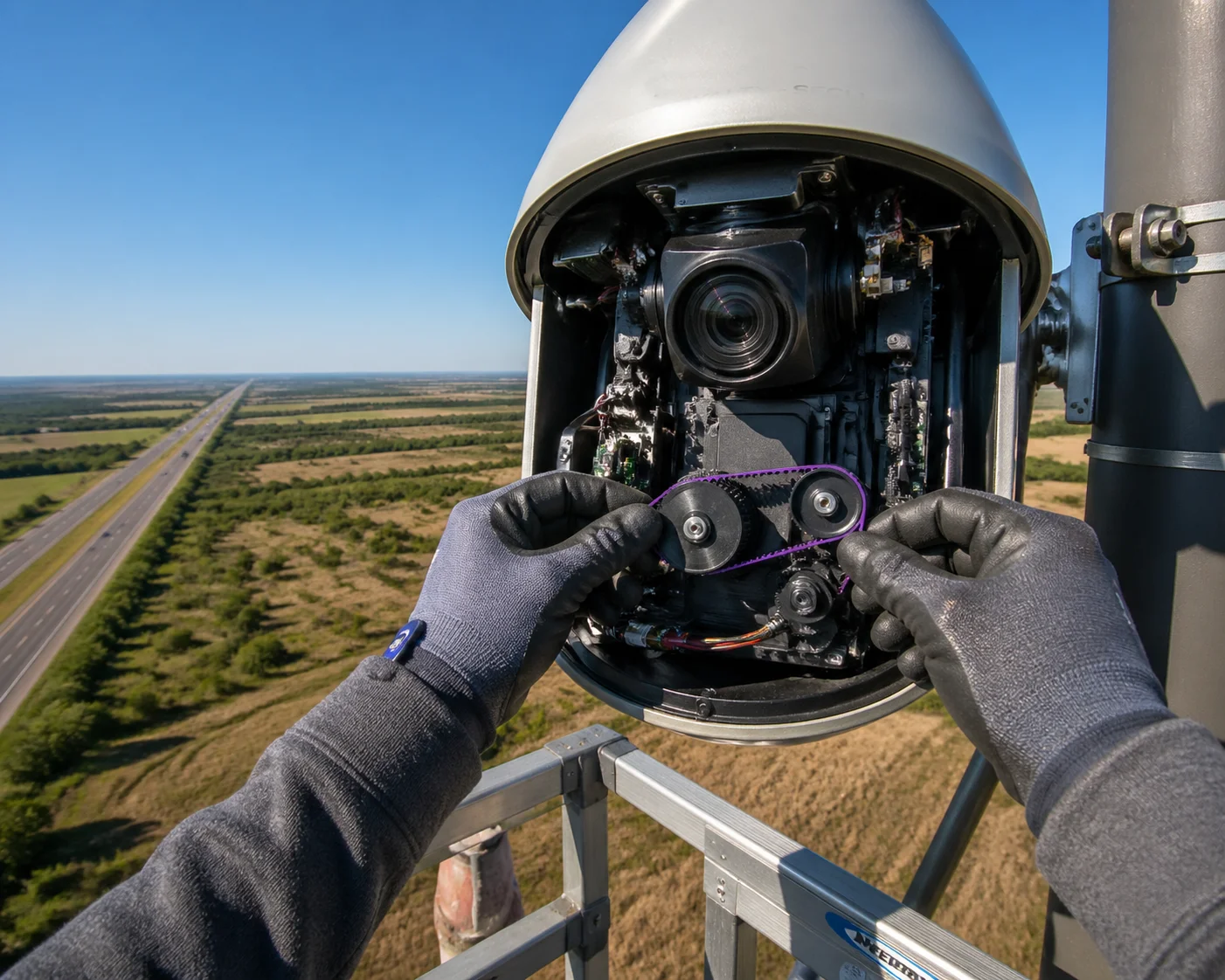
In most well-designed belt-driven PTZ cameras, you can replace the belt in the field. It typically takes 15 to 30 minutes with basic tools. You do not need to send the unit back to the factory. However, some cheaper models use sealed housings that make belt access difficult, so always confirm with your supplier before you buy.
What a Typical Belt Replacement Looks Like
On our Loyalty-Secu belt-driven PTZ models, the process is straightforward. You remove the dome cover, unscrew the belt guard, slide the old belt off the pulleys, slide the new one on, adjust the tensioner, and close it up. No special tools. No calibration equipment. A trained technician can do it on a pole or a rooftop without bringing the camera down.
The Gear-Driven Alternative Is Much Harder
Compare that to a gear-driven PTZ. If the gearbox fails or develops unacceptable backlash, here is what you are dealing with:
- Remove the entire PTZ unit from its mount.
- Ship it to a service center or open it in a clean environment.
- Disassemble the pan and tilt mechanisms to access the gearbox.
- Replace the gears or the entire gearbox module.
- Reassemble, lubricate, and re-calibrate all preset positions.
- Re-install on the mount.
This process can take a full day per camera. In the US, a single technician day costs $500–$1,500 depending on location and travel. For a remote Texas ranch or a Canadian pipeline, add travel costs on top.
Field Serviceability Comparison
| Maintenance Task | Belt-Driven PTZ | Gear-Driven PTZ |
|---|---|---|
| Remove from mount needed? | Usually no | Usually yes |
| Tools required | Allen key, screwdriver | Full tool kit, torque wrench, grease |
| Time per unit | 15–30 minutes | 2–8 hours |
| Skill level needed | Basic technician | Experienced mechanic or factory tech |
| Need to recalibrate presets? | Sometimes (minor) | Always (full recalibration) |
| Can be done on the pole? | Yes, in most models | Rarely |
What to Ask Your Supplier
Before you commit to any PTZ model, I always recommend asking these questions:
- Is the belt accessible without removing the camera from the mount?
- Do you sell replacement belts as spare parts?
- Is there a maintenance guide or video I can give to my field technicians?
- Does the firmware support automatic position compensation after a belt swap?
At Loyalty-Secu, I make sure every belt-driven model we ship comes with a clear maintenance guide in English. I also keep replacement belts in stock so you can order them alongside your cameras. That way, your technicians are ready before a problem even shows up.
Why This Matters for Your Bottom Line
Think about it from David Miller’s perspective. He manages 200 cameras across 15 sites in rural Texas. If 10% of those cameras need a belt swap in year two, that is 20 cameras. At 20 minutes each, his team handles it in a single week with no downtime. Total parts cost: maybe $100.
Now imagine those were gear-driven units. Twenty gearbox repairs at $800 each — that is $16,000 in parts alone, plus weeks of labor. The math speaks for itself.
Conclusion
Belt-driven PTZs cost less to maintain over time for most projects. Gear-driven PTZs suit extreme-load scenarios but carry higher repair bills. Choose based on your site conditions, not just specs.
1. Timing belt stretch and tension maintenance for PTZ cameras. ↩︎ 2. Spur gear vs helical gear noise comparison in PTZ drives. ↩︎ 3. Kevlar-reinforced belt versus standard rubber belt lifespan. ↩︎ 4. Backlash measurement method for PTZ preset accuracy. ↩︎ 5. Gear wear acceleration due to dust ingress in IP66 housings. ↩︎ 6. Silicone versus lithium grease for PTZ gearbox longevity. ↩︎ 7. Lubrication dry-out temperature thresholds for PTZ gears. ↩︎ 8. Decibel comparison for PTZ motors in indoor applications. ↩︎ 9. Field belt replacement tools and procedure guide. ↩︎ 10. Closed-loop stepper compensation for belt stretch detection. ↩︎