
I have seen laser modules die in the field after just one summer. The cost of a truck roll to swap it out is brutal. This is the question that keeps my clients up at night.
In standard conditions, a quality laser diode in a PTZ camera lasts 30,000 to 50,000 hours. But in extreme environments like desert heat or coastal humidity, that number drops fast — often to 10,000 to 20,000 hours. The real killer is junction temperature, not calendar age.
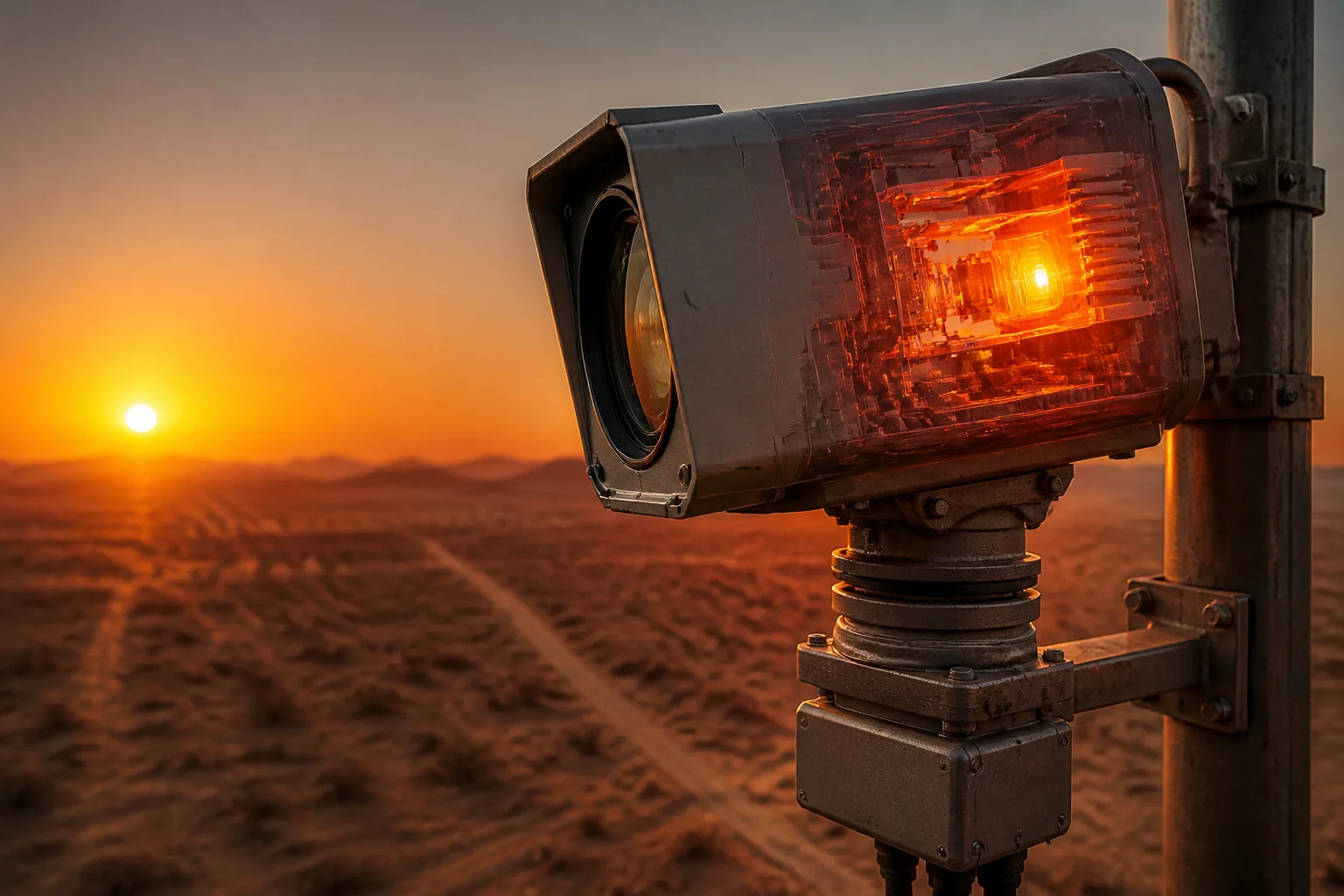
Below, I will break down the four questions I hear most from integrators like David Miller. Each one digs into a different angle of laser lifespan. If you are deploying long-range laser night vision cameras in harsh sites, this is the data you need before you sign a purchase order.
Table of Contents
How Many Hours of Continuous Operation Can I Expect from the Laser Generator?
Every project manager asks me this first. You need a number for your maintenance budget. But the honest answer is not a single number — it depends on how hard you push the laser.
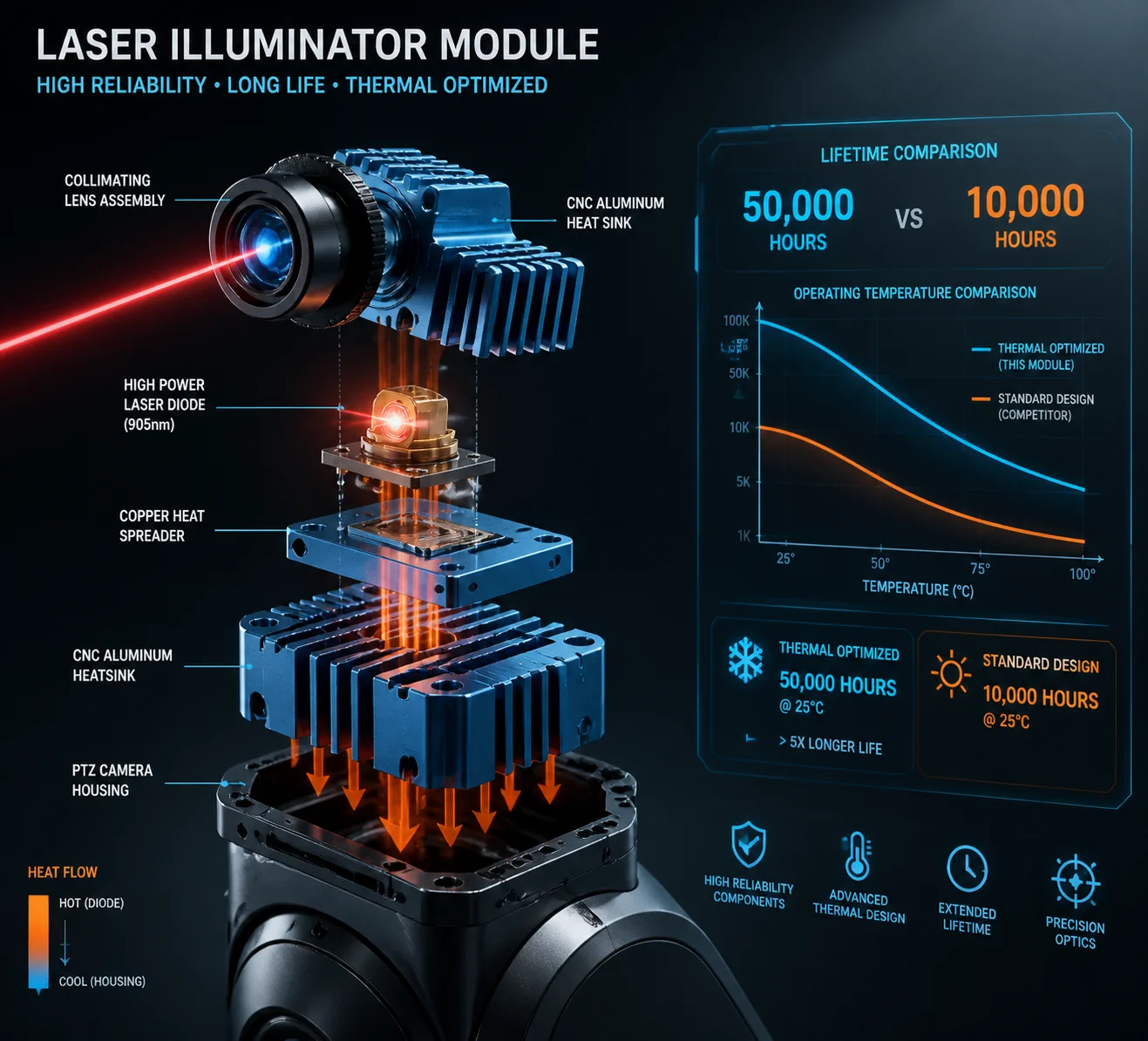
Expect 20,000 to 50,000 hours of continuous operation from a quality laser illuminator module. At 12 hours per night, that is roughly 4.5 to 11 years. But running at full power in high heat can cut this to 8,000 to 15,000 hours.
What Does “Lifespan” Actually Mean for a Laser Diode?
When a manufacturer says “50,000 hours,” they do not mean the laser suddenly dies at hour 50,001. They are talking about the L70 lumen maintenance standard 2. This means the laser output drops to 70% of its original brightness. At that point, your camera’s night vision range shrinks. A camera that once lit up targets at 800 meters might only reach 500 meters. The laser still works. But it no longer does the job you bought it for.
Here is how the numbers break down in practice:
| Operating Scenario | Estimated L70 Lifespan | Real-World Equivalent |
|---|---|---|
| Lab conditions (25°C, 70% power) | ~50,000 hours | ~11.4 years at 12 hrs/night |
| Standard outdoor (35°C, full power) | ~30,000 hours | ~6.8 years at 12 hrs/night |
| Extreme heat (50°C+, full power) | ~10,000–15,000 hours | ~2.3–3.4 years at 12 hrs/night |
The Arrhenius Rule: Why Temperature Is Everything
There is a well-known rule in semiconductor physics. For every 10°C rise in junction temperature, the laser diode’s lifespan roughly cuts in half. This is called the Arrhenius equation 1. It is not a rough guess. It is backed by decades of failure data from telecom laser manufacturers.
Accurate laser junction temperature measurement 3 is critical for predicting lifespan. So if a laser module is rated for 50,000 hours at 25°C junction temperature, running it at 55°C junction temperature means you might only get around 6,000 to 8,000 hours. That is a massive difference. And in a sealed PTZ housing sitting in direct Texas sun, the internal temperature can easily hit 60°C or more without proper thermal design.
How Loyalty-Secu Extends These Numbers
At Loyalty-Secu, we do not just bolt a laser module onto a camera and call it done. Our laser illuminator sits on a CNC-machined aluminum heat sink. The entire PTZ shell acts as a heat spreader. We also use a constant-current driver with real-time temperature feedback via ATPC (Automatic Temperature Power Control) 4. When the internal sensor detects high heat, the firmware automatically reduces drive current by 10–15%. You lose a small amount of range. But you gain thousands of extra hours of life. For a remote site where a truck roll costs $2,000, that trade-off makes perfect sense.
Does the Laser Brightness Degrade Significantly After Two Years of Nightly Use?
I get this question a lot from integrators who warranty their installations for 2 to 3 years. They need to know if the laser will embarrass them at a client site review.
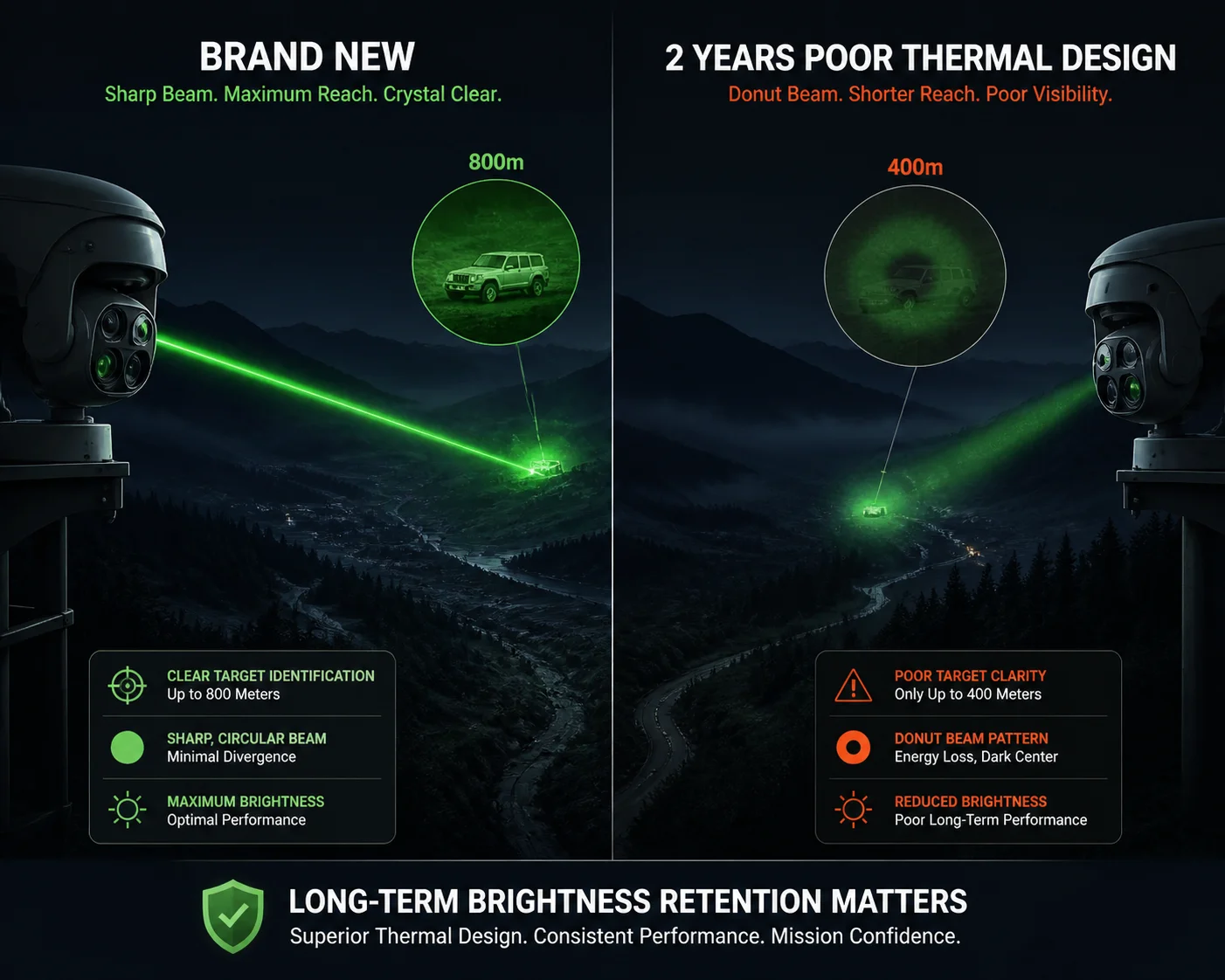
After two years of nightly use (roughly 8,700 hours), a well-designed laser module should retain 85–95% of its original brightness. You will not notice the drop on camera. But cheap modules without thermal management can lose 30% or more in the same period.
How to Spot Early Degradation
The easiest way to check laser health is to look at the beam spot on a wall or flat surface at close range. A healthy laser produces a clean, round, even spot. When the laser core starts to degrade, you will see specific signs:
- Dark center (“donut” pattern): The middle of the beam loses intensity before the edges. This means the laser cavity is developing internal defects.
- Irregular edges: The beam shape becomes oval or has bright and dark patches. This points to facet damage on the laser chip.
- Reduced throw distance: If your camera used to identify a person at 600 meters and now struggles at 400 meters, the laser output has dropped below useful levels.
The Two-Year Reality Check
| Laser Module Quality | Brightness at Year 1 | Brightness at Year 2 | Brightness at Year 3 |
|---|---|---|---|
| Premium (good thermal design) | ~97% | ~92% | ~85% |
| Mid-range (basic heat sink) | ~90% | ~80% | ~65% |
| Budget (no thermal management) | ~80% | ~60% | Failed or unusable |
These numbers assume 12 hours of nightly operation in a moderate climate (average 30°C). In hotter environments, shift everything one column to the left.
What Causes the Curve to Steepen?
Laser degradation is not linear. It follows a bathtub curve 10 failure rate pattern. In the first few hundred hours, weak units fail early — this is infant mortality. Then the curve flattens out for a long stable period. After a certain point, the curve bends upward sharply. This is the wear-out phase.
The physics behind this is straightforward. As the laser operates, tiny crystal defects inside the semiconductor slowly grow. These defects absorb light instead of emitting it. The laser driver compensates by pushing more current. More current means more heat. More heat means faster defect growth. It becomes a feedback loop. Once you are on the steep part of the curve, the laser can go from “slightly dim” to “dead” in just a few weeks.
This is why I always tell clients: if you notice a 20% drop in range, do not wait. Plan your replacement now. The decline will accelerate.
ATPC: The Feature That Buys You Time
ATPC stands for Automatic Temperature Power Control. Our Loyalty-Secu laser PTZ cameras include this feature as standard. The system reads the internal temperature sensor every second. When the temperature rises, the driver reduces current in small steps. When it cools down at night, the system ramps back up. This keeps the laser operating in its “sweet spot” and prevents the runaway degradation loop I described above. For David’s Texas desert project, this is not optional — it is essential.
Will Extreme Humidity or Heat Shorten the MTBF of the Laser Diode?
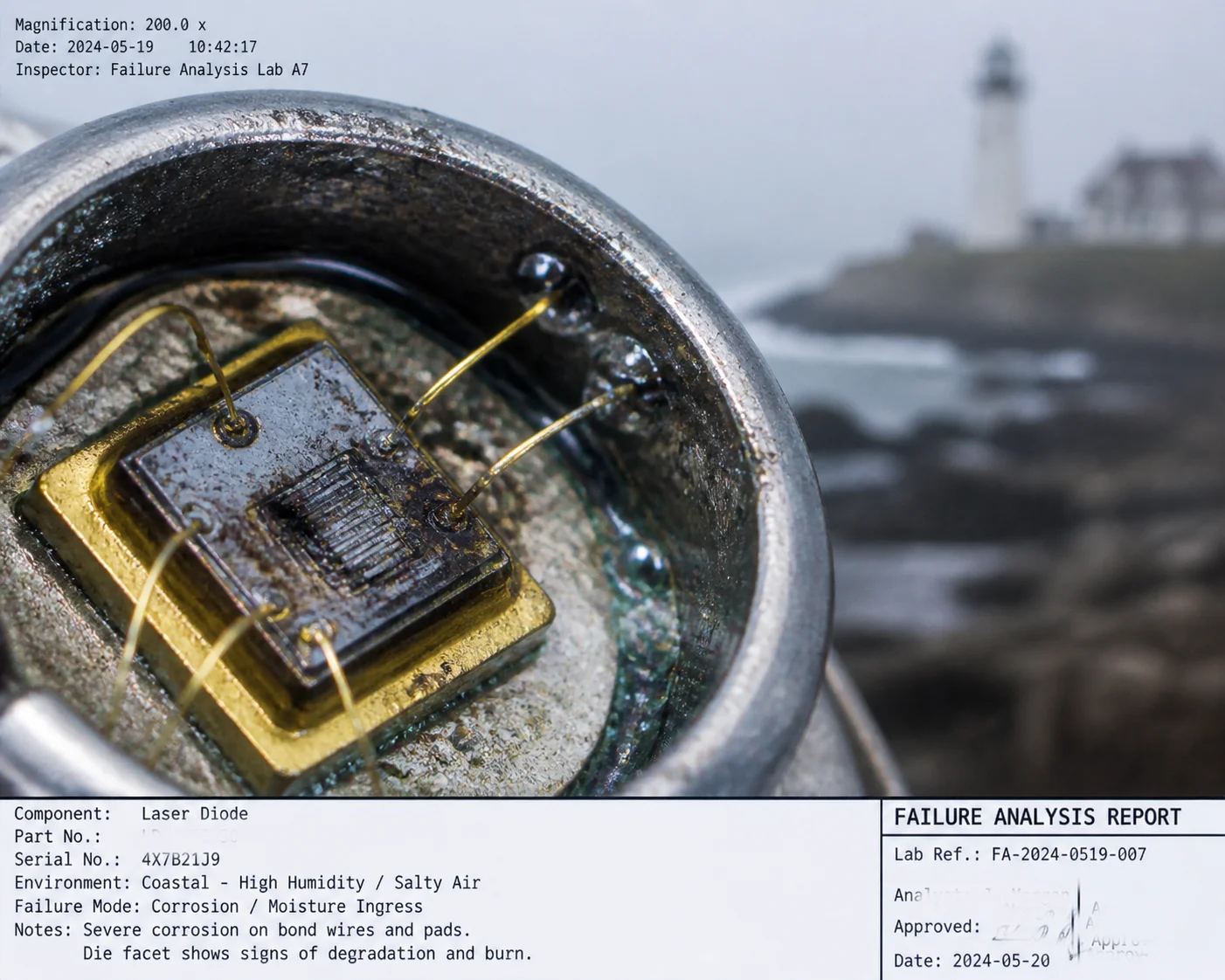
I have personally seen laser modules destroyed by moisture in less than six months. It is not a slow death. One day the laser works fine. The next morning, it is gone. Humidity is the silent killer.
Yes. Extreme humidity can cause sudden, catastrophic failure of the laser diode — not just gradual degradation. Heat shortens life predictably through the Arrhenius rule. But moisture kills through electrochemical corrosion, and it can happen overnight if the seal fails.
The Three Environmental Killers, Ranked
Not all extreme conditions are equally dangerous. Here is how I rank them based on years of field failure data:
Killer #1: Humidity + Poor Sealing
A laser diode chip is incredibly small. The active area is often less than 1 mm wide. Even a tiny amount of water vapor inside the sealed module can cause electrochemical corrosion on the chip’s facet. Under electrical bias, metal ions migrate across the surface. This creates a short circuit. The laser does not dim slowly — it burns out in a flash.
The fix is simple in theory but hard in practice: hermetic sealing 5. At Loyalty-Secu, we use a double-encapsulation process for the laser core. The laser chip sits inside its own sealed sub-module. That sub-module then sits inside the camera’s IP67-rated housing. Two barriers, not one. For coastal or tropical deployments, this is non-negotiable.
Killer #2: Sustained High Temperature
As I explained above, the Arrhenius rule governs thermal aging. But there is a second effect that many people miss. At high temperatures, the laser’s threshold current increases. This means the driver must push more current just to get the laser to turn on. More current means more waste heat. This creates a thermal runaway risk. If the driver does not have a temperature feedback loop, the laser can destroy itself in a single hot afternoon.
Killer #3: Power Cycling Stress
In solar-powered 4G systems, the laser often turns on and off many times per night — triggered by motion alerts. Each startup sends a surge of current through the laser chip. This surge can damage the facet coating. Over thousands of cycles, micro-cracks form. Eventually, the facet fails.
Our solution is a soft-start driver circuit 6. Instead of slamming the laser with full current instantly, we ramp the current up over 2–3 milliseconds. This sounds like a tiny detail. But it can double the number of safe power cycles from 50,000 to over 100,000.
MTBF vs. MTTF: Know What You Are Buying
Many suppliers quote MTBF (Mean Time Between Failures) 7. But for a laser diode, MTTF (Mean Time To Failure) is more honest. MTBF implies the unit can be repaired and returned to service. A burned-out laser diode cannot be repaired. It must be replaced. Always ask your supplier: “Is this MTBF or MTTF? And at what temperature was it tested?”
| Environmental Factor | Impact on Laser MTTF | Mitigation Strategy |
|---|---|---|
| High humidity (>80% RH) | Can cause instant failure | Double-sealed laser cavity (IP67) |
| Sustained heat (>50°C ambient) | Reduces MTTF by 50–75% | Aluminum heat sink + ATPC firmware |
| Frequent power cycling (>100x/day) | Facet damage over 6–12 months | Soft-start driver circuit |
| Salt spray (coastal sites) | Corrodes connectors and seals | Marine-grade conformal coating 8 |
Can I Replace Only the Laser Module if It Fails, or Do I Need a New Camera?
This is the money question. When a laser dies in the field, the last thing you want to hear is “you need to buy a whole new camera.” I designed our system so that never happens.
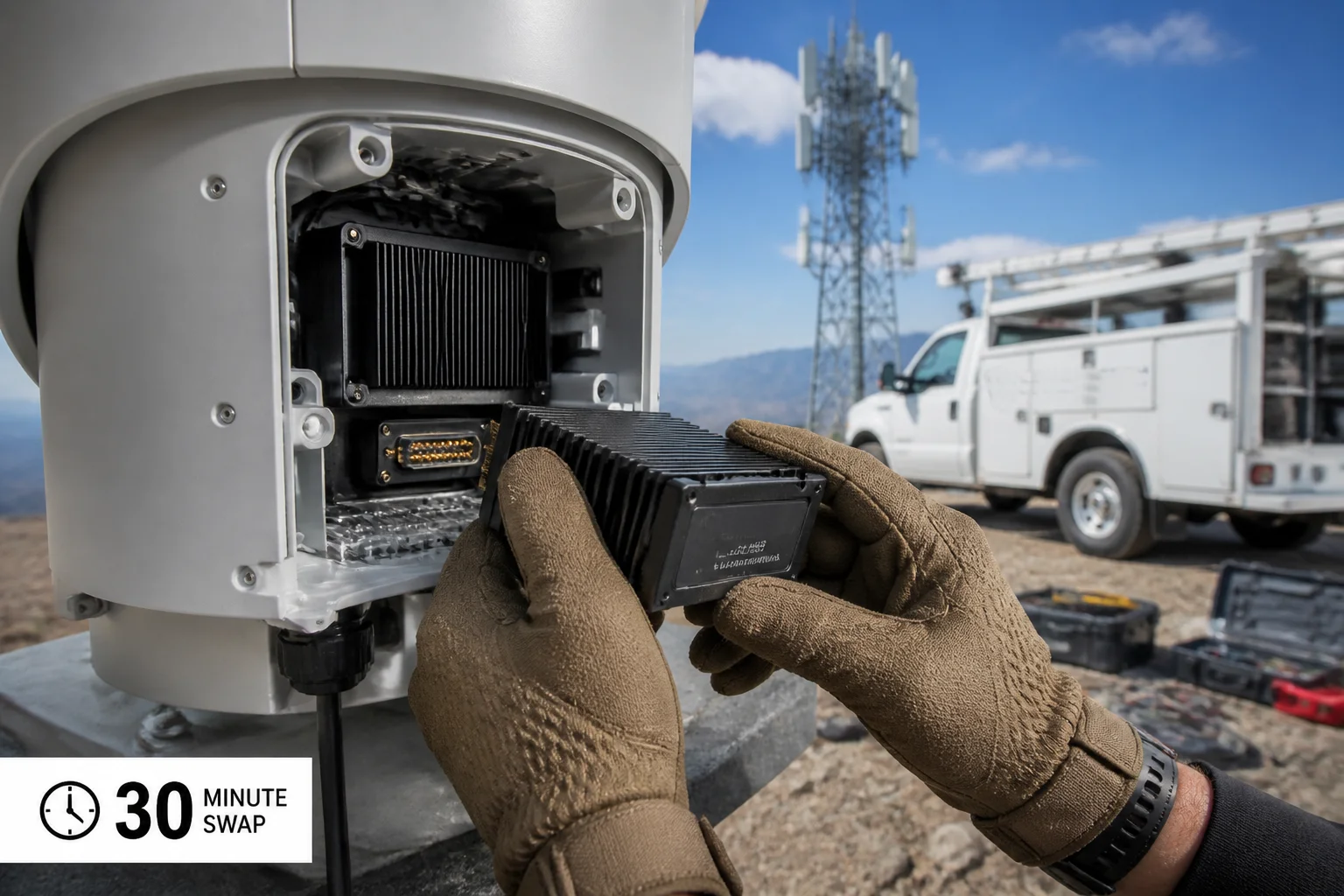
On most Loyalty-Secu laser PTZ cameras, the laser illuminator module is a separate, field-replaceable unit. You do not need to replace the entire camera. A trained technician can swap the laser module on-site in under 30 minutes without special tools.
Why Modular Design Matters for Total Cost of Ownership
Let me put this in dollars. A complete long-range laser PTZ camera might cost $1,500 to $3,000 depending on specs. The laser illuminator module alone might cost $200 to $500. If the laser dies after 3 years and you have to replace the entire camera, your cost-per-year of ownership just doubled. But if you can swap just the module, you extend the camera’s useful life to 8–10 years. For a fleet of 50 cameras across a pipeline or border project, that difference adds up to tens of thousands of dollars.
How Our Modular Architecture Works
At Loyalty-Secu, the laser module connects to the main camera board through a standardized connector 9. The module includes:
- The laser diode chip
- The collimating lens assembly
- The driver PCB with soft-start and ATPC circuits
- The aluminum heat sink base
When you remove four screws and disconnect one cable, the entire module slides out. The replacement slides in. You power up the camera, and the firmware auto-detects the new module. No recalibration needed. No firmware reflash. No laptop required on-site.
What to Ask Your Supplier Before You Buy
Not all manufacturers design for field replacement. Some pot the laser module in epoxy inside the camera body. Others use proprietary connectors that require factory service. Before you commit to a supplier, ask these questions:
- “Is the laser module a separate, replaceable component?” If the answer is no, walk away — unless the price is so low that you treat the camera as disposable.
- “Can I buy replacement laser modules separately?” Some suppliers will sell you the camera but refuse to sell spare parts. This locks you into buying a new camera every time.
- “What is the replacement procedure?” Ask for a video or a step-by-step guide. If it requires sending the camera back to China, factor in 4–6 weeks of downtime and $200+ in shipping.
- “Does the replacement module need firmware calibration?” On our cameras, it does not. But some competitors require a factory calibration step that cannot be done in the field.
The Real-World Replacement Timeline
For David’s projects in remote Texas locations, I always recommend keeping one spare laser module for every ten cameras deployed. The cost is minimal. And when a module does reach end-of-life — which it will, eventually — the swap takes less time than driving to the site. That is the whole point of modular design. You plan for failure. You make failure cheap and fast to fix. And you keep your client’s system running without drama.
Conclusion
Laser lifespan depends on heat, humidity, and design quality. Choose cameras with ATPC, double-sealed laser cavities, and field-replaceable modules. Plan for replacement — do not hope it never happens.
1. Arrhenius equation for semiconductor laser lifespan prediction. ↩︎ 2. L70 lumen maintenance standard for laser diodes. ↩︎ 3. Laser junction temperature measurement and monitoring. ↩︎ 4. ATPC (Automatic Temperature Power Control) for laser drivers. ↩︎ 5. Hermetic sealing vs. standard encapsulation for laser diodes. ↩︎ 6. Soft-start driver circuit for reduced power cycling stress. ↩︎ 7. MTBF vs MTTF terminology for laser reliability reporting. ↩︎ 8. Conformal coating for coastal salt spray protection. ↩︎ 9. Field-replaceable laser module connector standards. ↩︎ 10. Bathtub curve failure rate phases for laser diodes. ↩︎