
I watch every second because a delay can turn a small alert into a bigger loss. I need the push to be fast, clear, and reliable.
For a 4G solar PTZ system in North America, cloud push latency1 usually averages 2 to 5 seconds after a line-crossing alarm. The exact speed depends on edge AI detection2, 4G signal quality, cloud location, and how fast the phone wakes and renders the alert.
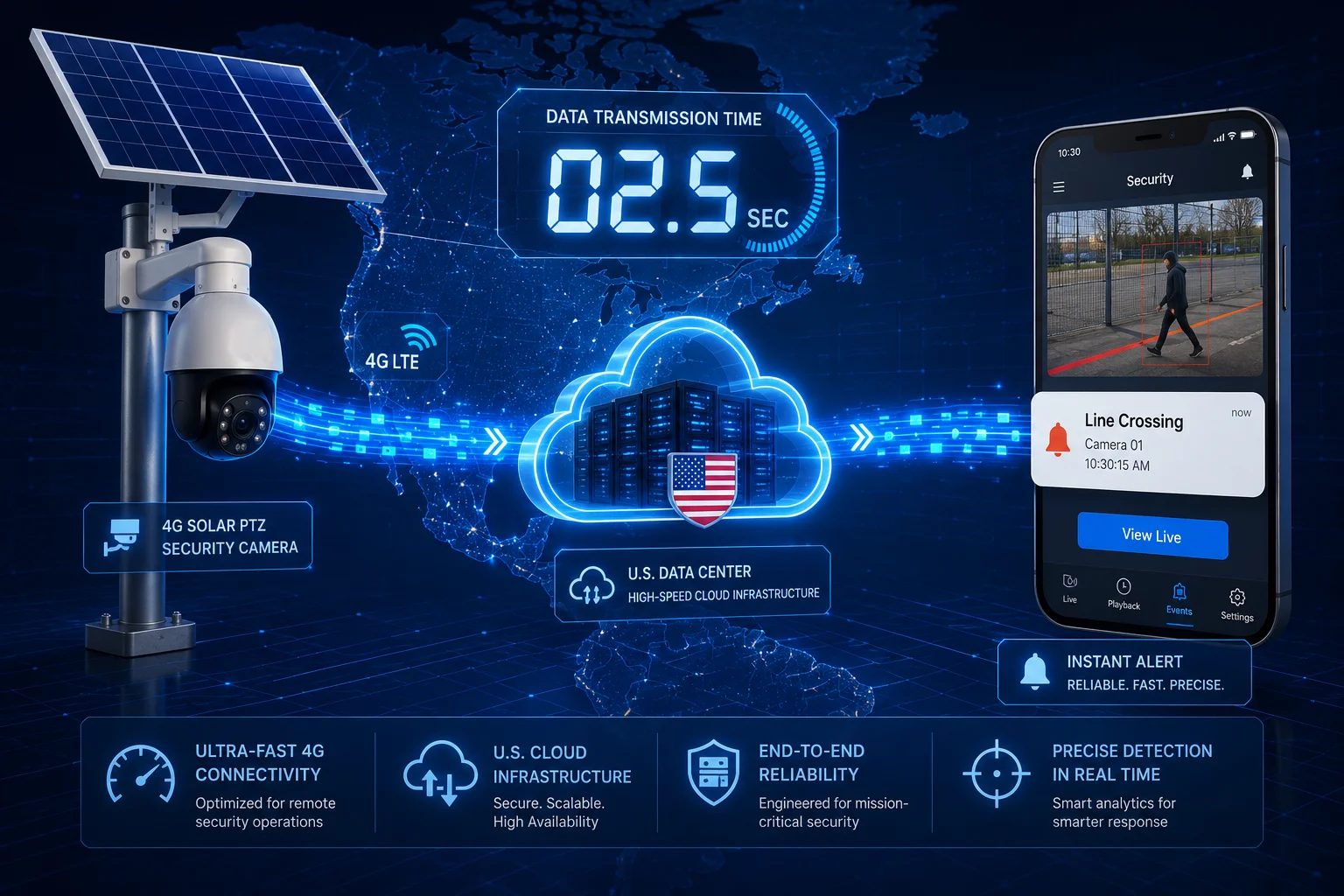
I want readers to see that this number is not random. It is the result of a few short steps that happen one after another. If I understand each step, I can find the real bottleneck and improve the full alarm path.
Table of Contents
Does the P2P server in the U.S. (AWS/Azure) guarantee sub-2 second alerts to my mobile app?
I know why this matters. If I am working with a remote site, I do not want a “fast” system that still feels slow when an alarm happens.
A U.S.-based P2P server3 on AWS4 or Azure5 can help reduce delay, but it does not guarantee sub-2 second alerts. The final speed still depends on camera detection time, 4G upload time, mobile push services, and phone wake-up time.
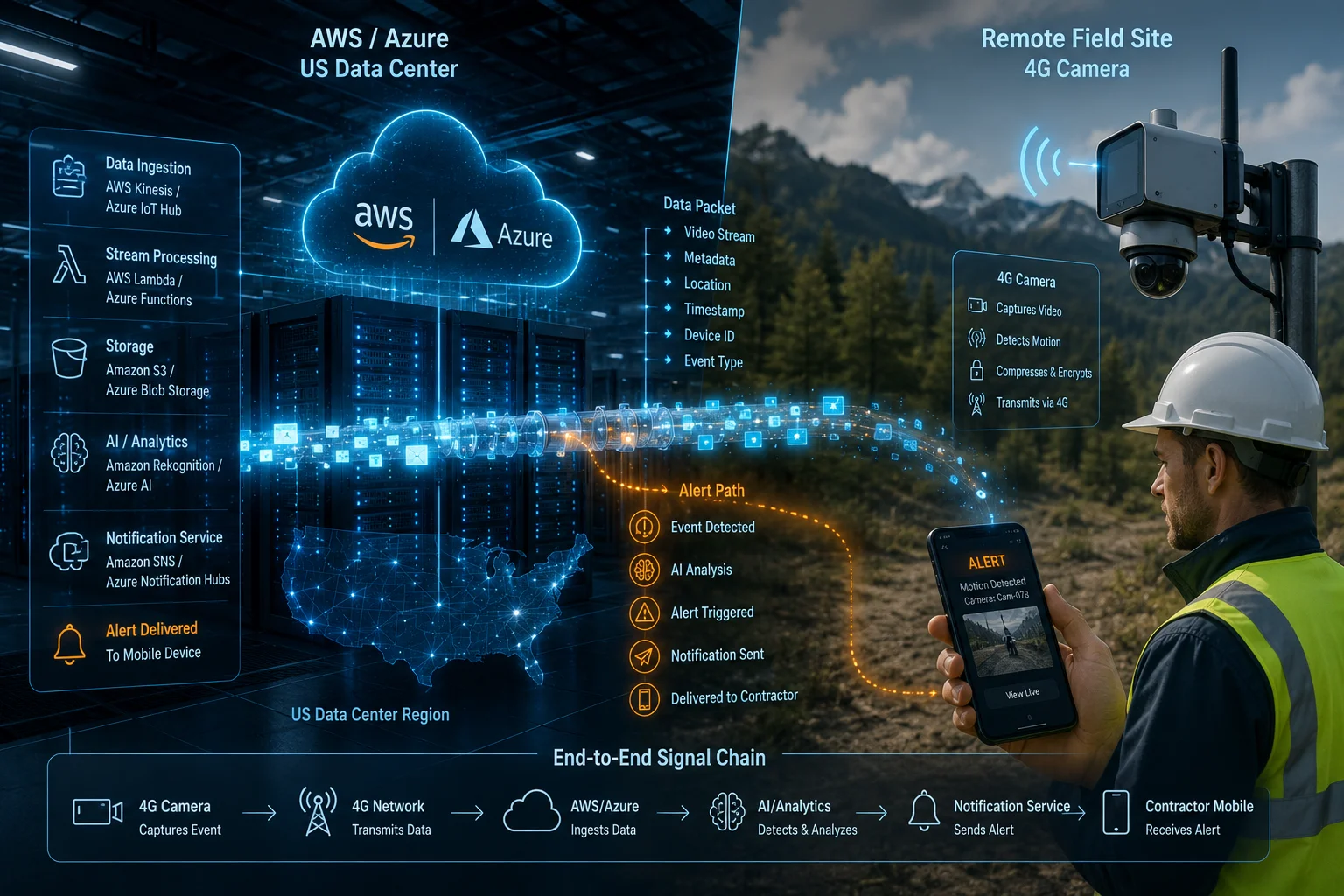
I need to be honest about the path. The server location matters, but it is only one part of the chain. If the camera is in weak signal, the server can be very close and still not save the full delay. I also know that Apple APNs6 and Google FCM7 are fast, but they are not the only delay source. The camera must first detect the event, package the alarm, and send it out. Then the cloud must receive it and hand it to the phone push system. After that, the phone must wake the app and show the alert. I treat the cloud as a relay, not a magic fix. When I design a system for North America, I care about the whole path. I also care about how stable the network is at night, in rain, or in wide open farm areas. That is where the real risk sits.
How does the 4G network’s “Heartbeat” interval impact the speed of the initial push notification?
I have seen many systems look fine in the lab and then slow down in the field. The reason is often simple. The link sleeps too long, and the first alarm pays the price.
A shorter 4G heartbeat interval8 usually helps the first push arrive faster because the modem keeps the connection warm. If the connection sleeps or drops, the first alert may need a new handshake, which can add 1 to 2 seconds.
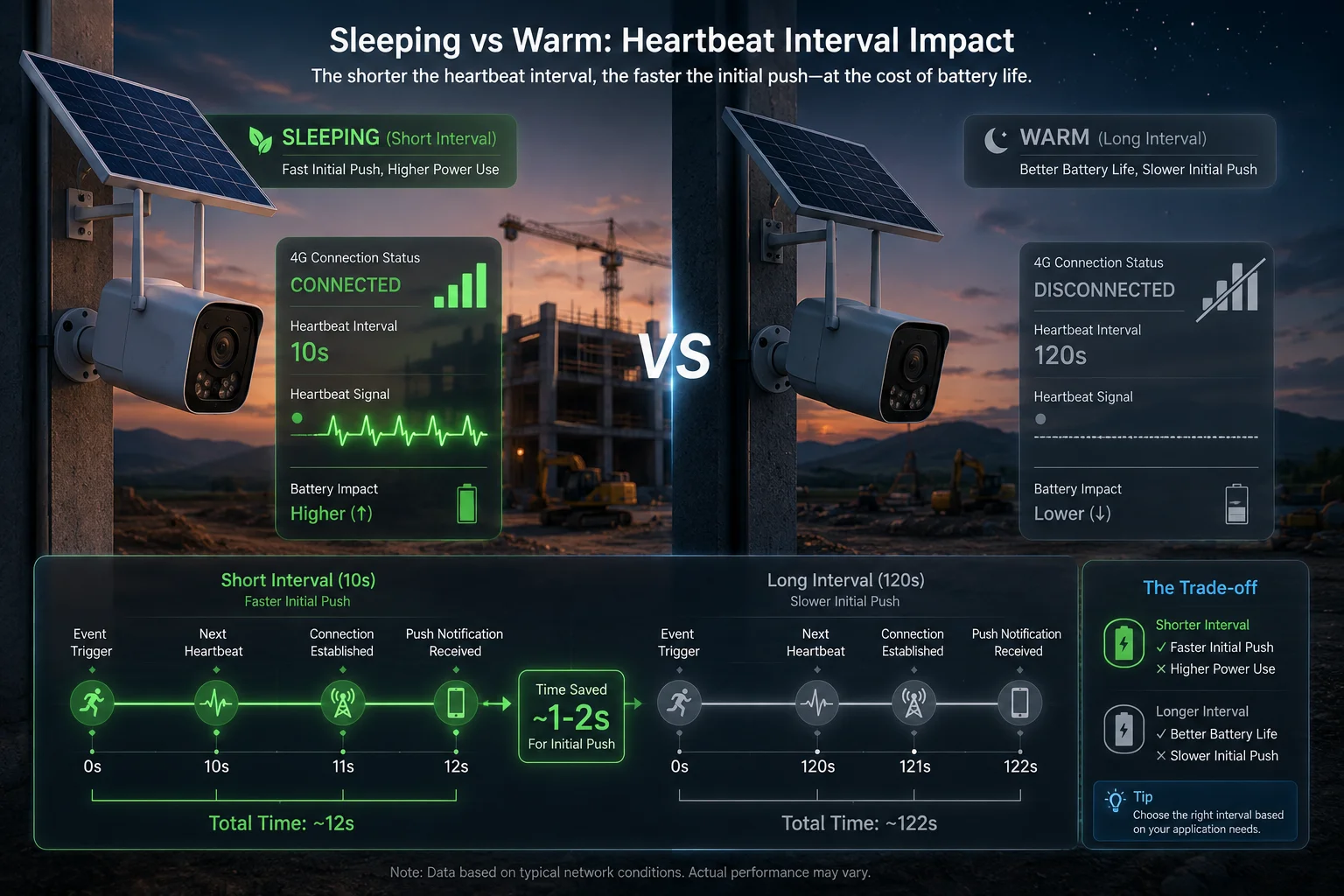
I think about the heartbeat as a small keep-alive signal. It tells the network, “I am still here.” When I set the interval well, the modem stays ready and does not need to rebuild everything from zero when an alarm starts. That matters a lot in solar systems, because power saving is always a concern. If I make the heartbeat too short, I may waste battery. If I make it too long, I may let the link go cold. So I look for balance. I also look at carrier behavior. Some networks hold state better than others. A clean signal in one city can behave very differently in a rural zone. I have learned that the heartbeat is not just a technical setting. It is also a field tuning tool. It can shift the first notification from “barely acceptable” to “good enough for action.” For customers like David Miller, that difference can shape the whole project result.
Heartbeat, battery, and first alert speed
| Heartbeat Setting | Effect on First Alert | Battery Impact | Best Use Case |
|---|---|---|---|
| Very short | Faster wake-up | Higher drain | Critical security sites |
| Medium | Balanced speed | Moderate drain | Most solar sites |
| Very long | Slower first push | Lower drain | Low-risk monitoring |
Can I choose to push a low-res thumbnail before the high-res metadata to speed up the alert?
I like this idea because it follows a simple rule: send the smallest useful thing first. That can make the alert feel much faster.
Yes, I can push a low-res thumbnail11 or text-only alert first, and send high-res metadata later. This lowers the first packet size and can help the user see the alarm sooner, often within about the first second of delivery.
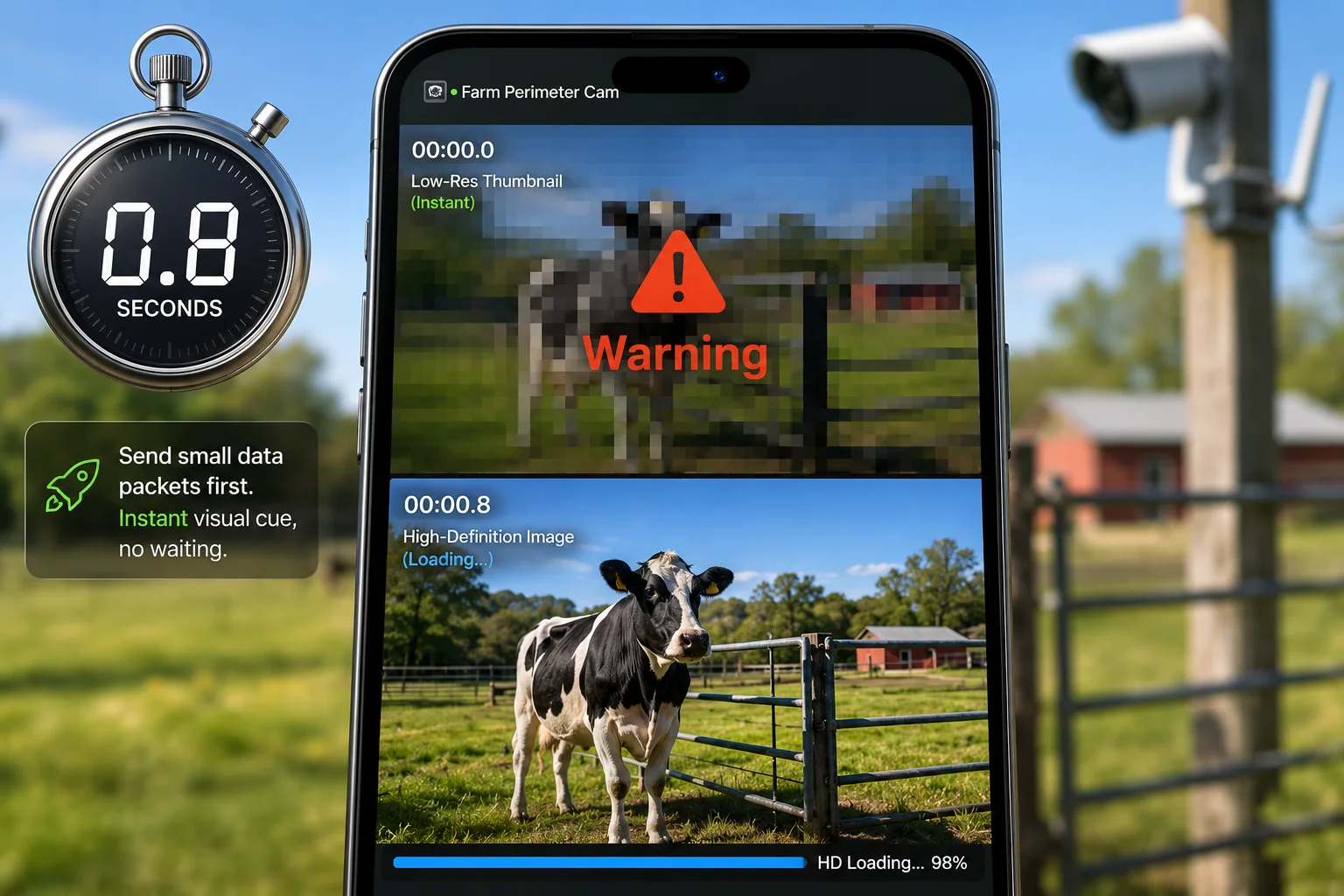
I usually think of this as a two-step alert. Step one gives the user the signal. Step two gives the user the detail. That split can be very smart for North America, where some sites sit far from the nearest tower or use weak 4G backhaul. If I send the image first, I may delay the warning just to wait for bytes that are not needed yet. If I send text first, the user can act faster. Then the image can follow as proof. I also see a second benefit. Smaller first messages are less likely to fail on unstable links. That matters on farms, construction zones, and border sites. I do not need perfect media quality at the first moment. I need a fast and reliable signal. Later, I can deliver the full image, clip, or metadata. This method does not solve every delay problem, but it often improves the user experience in a very real way. It also gives integrators a cleaner story when they sell a project to a customer who cares about response time.
Alert payload order and user speed
| Alert Order | First User Experience | Network Load | Practical Value |
|---|---|---|---|
| Text first, image later | Fastest notice | Low | Best for urgent alarms |
| Thumbnail first, metadata later | Fast visual cue | Low to medium | Good for mobile review |
| Full image first | Slower notice | Higher | Better for review, not speed |
Will the app prioritize “Human Line-Crossing” over generic motion events for faster processing?
I always prefer a system that knows what matters most. Not every event deserves the same path, and not every alarm should fight for the same queue.
Yes, human line-crossing events should be prioritized over generic motion events because they are more meaningful and usually need faster action. A good app and cloud workflow can send these alarms ahead of low-value motion alerts.
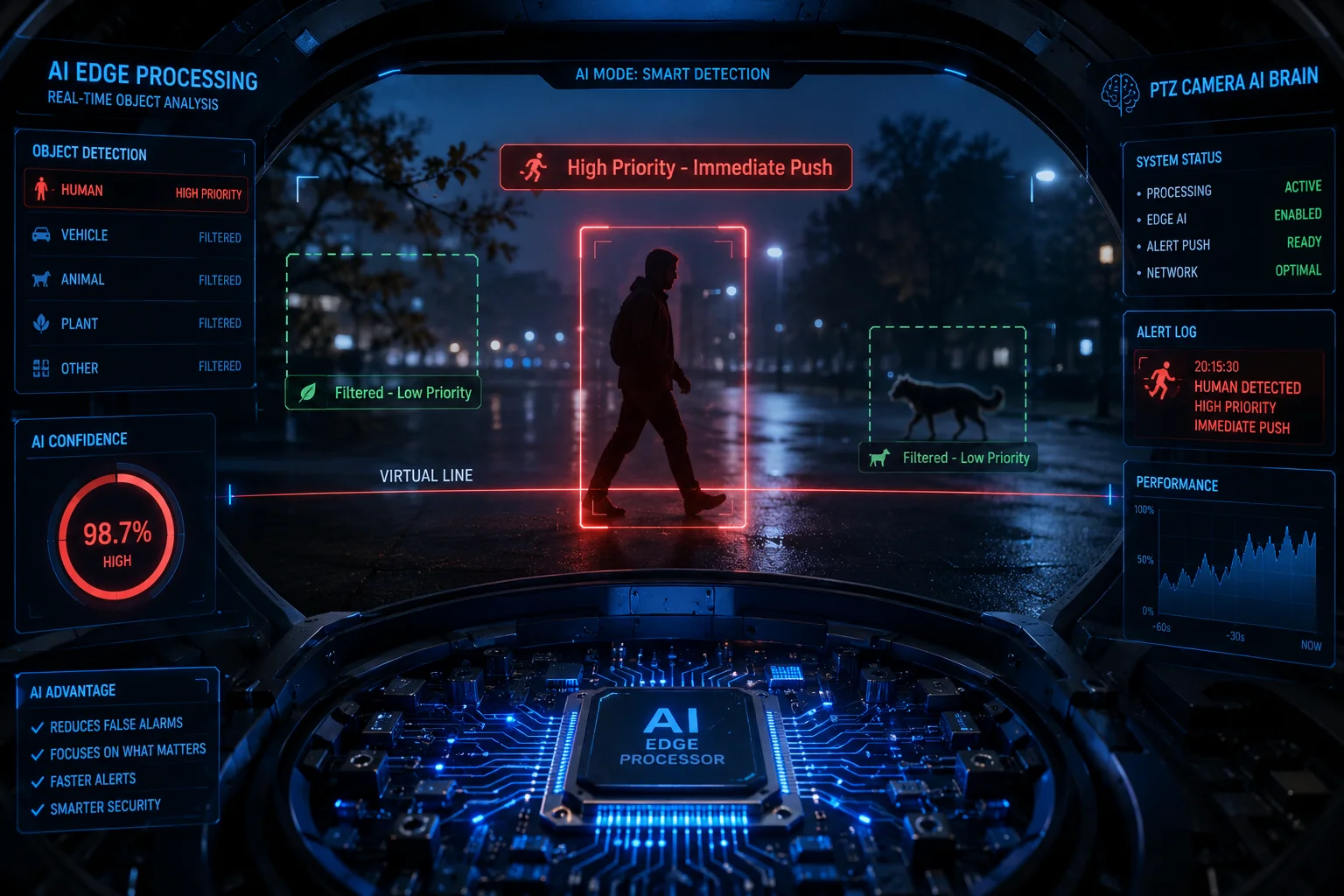
I see this as a filtering problem before it becomes a speed problem. If a cloud system gets too many random motion alerts, the queue can get noisy. Then the important alarm may wait behind a tree branch, a shadow, or a moving animal. That is not good enough for a serious security project. I want human line-crossing to move to the front because it tells me that a person crossed a boundary that I already care about. That is a stronger signal than generic motion. I also want the AI model at the edge to do as much work as possible before the cloud gets involved. If the camera can classify the event early, the cloud can route it with more confidence. That can reduce wasted push traffic and make the app feel faster. For customers in the U.S., Canada, and Europe, this can matter even more because they often run many cameras in one system. A clean priority rule keeps the app useful. It also protects the user from alert fatigue. When the system sends the right alert first, people trust it more, and they respond faster.
Event priority and app response
| Event Type | Priority Level | Typical Value to User | Speed Impact |
|---|---|---|---|
| Human line-crossing | High | Very high | Faster processing |
| Vehicle crossing | Medium | High | Fast, but secondary |
| Generic motion | Low | Low | Can be delayed or filtered |
What really decides cloud push latency in North America?
I do not look at latency as one single number. I break it into parts, because each part has a different weak point.
1. Edge AI detection
I let the camera decide the event first. If the AI model is strong, the camera can mark the crossing fast and avoid false alarms. If the model is weak, the cloud gets messy data and the whole path slows down.
2. 4G upload quality
I care a lot about signal strength, carrier behavior, and reconnect time. In North America, a city site and a rural site do not behave the same. A strong RSRP9 and SINR10 value usually help the alarm move faster. A weak link usually means retries and delay.
3. Cloud relay speed
I want the cloud node to stay close to the target region. A U.S. node on AWS or Azure helps reduce distance, but it still needs good routing and stable service calls. The cloud should not become a traffic jam.
4. Mobile push wake-up
I know the phone is its own bottleneck. The app has to wake up, read the message, and display the alert. If the phone is in deep sleep or if the system limits background work, the last step can stretch longer than expected.
| Stage | Typical Delay | Main Bottleneck |
|---|---|---|
| Edge AI detection | 200 to 500 ms | AI compute |
| 4G upload | 800 to 2500 ms | Signal quality |
| Cloud relay | 100 to 300 ms | Server routing |
| Phone wake-up | 500 to 1500 ms | Mobile OS behavior |
I use this breakdown when I talk to system integrators and distributors. It helps me explain why one site feels instant while another site feels slow. It also helps me avoid fake promises. If I want better speed, I must improve the weakest link. Sometimes I tune the heartbeat. Sometimes I change the event priority. Sometimes I split text and image delivery. Sometimes I place the cloud closer to the user market. In many real projects, the best result comes from combining all of these small wins, not from one big trick.
How do I use this in a real North American project?
I use a simple rule set when I design a project for a customer like David Miller. I focus on speed, trust, and field stability.
My practical setup
- I let the edge AI classify the event first.
- I send a text alert or low-res thumbnail first.
- I keep the 4G modem alive with a balanced heartbeat.
- I route cloud traffic through a nearby North American node.
- I give human line-crossing higher priority than generic motion.
- I test the system in weak signal, not only in strong signal.
I like this order because it matches real life. A site manager does not care about theory when a fence line is crossed. He cares about the first useful alert. He wants to know what happened, where it happened, and whether he should react now. That is why I build my 4G solar PTZ systems with field use in mind. I want them to work in open land, in cold weather, in long cable-free runs, and in places where a second of delay can matter. I also want them to fit B2B buyers who need OEM or ODM work, white-label firmware, and stable VMS compatibility. If I can keep the alert path simple and fast, I make the whole product easier to sell, install, and support.
Conclusion
I treat cloud push latency as a full chain problem, and I win it by improving the weakest step, not by trusting one server or one setting.
1. Understand the concept of push latency and its impact on real-time notifications. ↩︎ 2. Discover how on-camera AI reduces cloud dependencies and speeds up alerts. ↩︎ 3. See how peer-to-peer servers simplify remote access to cameras. ↩︎ 4. Amazon Web Services provides cloud infrastructure for P2P relay. ↩︎ 5. Microsoft Azure offers another cloud region option for North America. ↩︎ 6. Apple Push Notification service is used for iOS alert delivery. ↩︎ 7. Firebase Cloud Messaging manages Android push notifications. ↩︎ 8. Learn how keep-alive signals affect modem readiness and battery life. ↩︎ 9. Reference Signal Received Power is a key metric for 4G signal strength. ↩︎ 10. Signal-to-Interference-plus-Noise Ratio determines data reliability. ↩︎ 11. Small image payloads reduce delivery time and improve user experience. ↩︎