
I’ve seen too many spec sheets that claim “5km night vision.” Then the camera arrives, and you can barely read a license plate at 200 meters. That gap between marketing and reality costs integrators real money.
In total darkness (0 Lux), a 40X laser PTZ camera can reliably identify a human face or license plate at approximately 300 to 400 meters. It can detect movement up to 2,000 meters. The gap between these two numbers is huge, and understanding why is critical before you commit to a project bid.
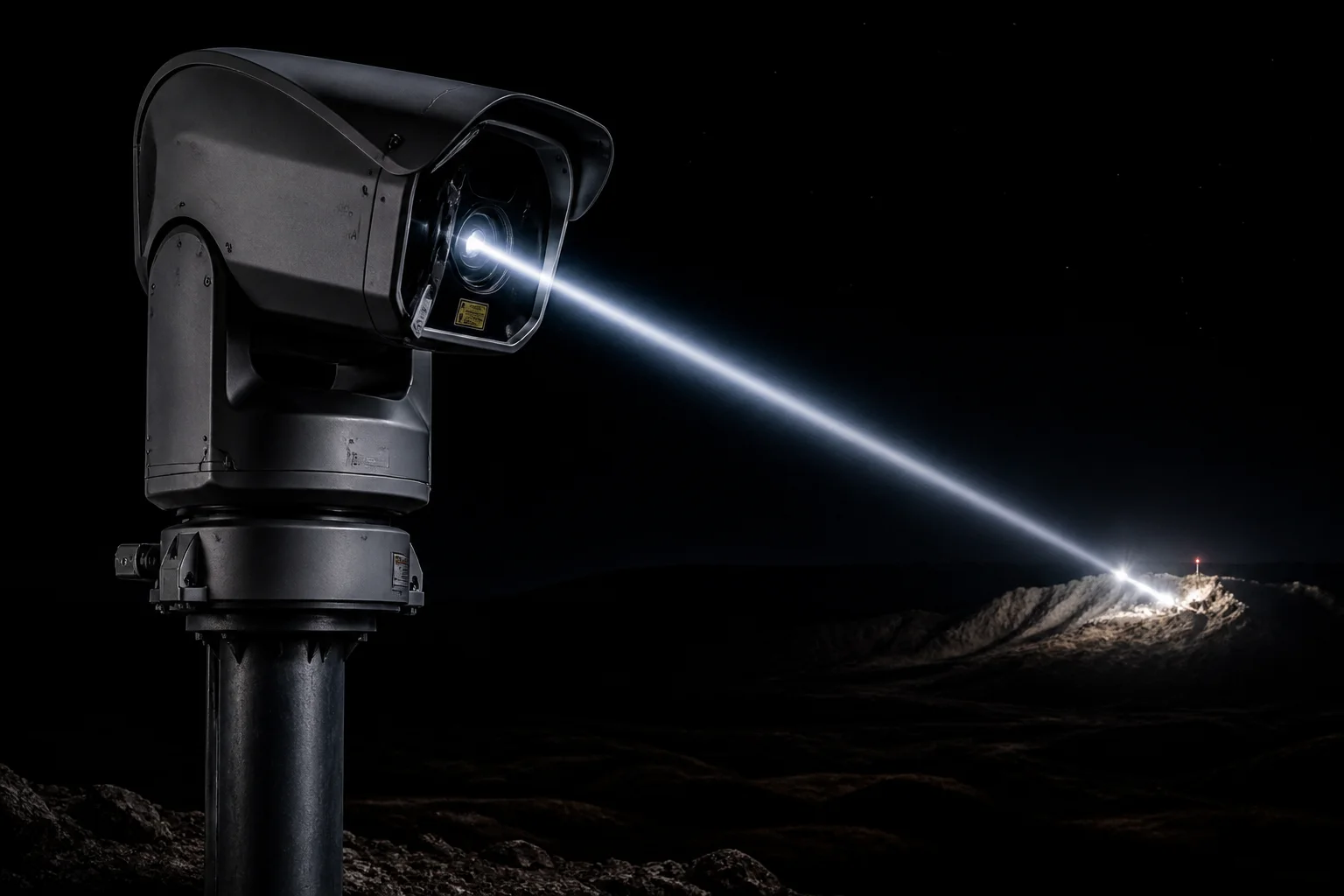
Below, I break down the real-world performance data, the physics behind the limits, and the testing methods you can use to hold any supplier accountable. If you are an integrator bidding on a border, farm, or critical infrastructure project, this is the article you need before you write that proposal.
Table of Contents
Can I Clearly Identify a Human Face or License Plate at 500 Meters in 0 Lux?
I get this question from integrators almost every week. They have a client who wants face-level detail at half a kilometer in pitch black. And they need a straight answer before they promise something they cannot deliver.
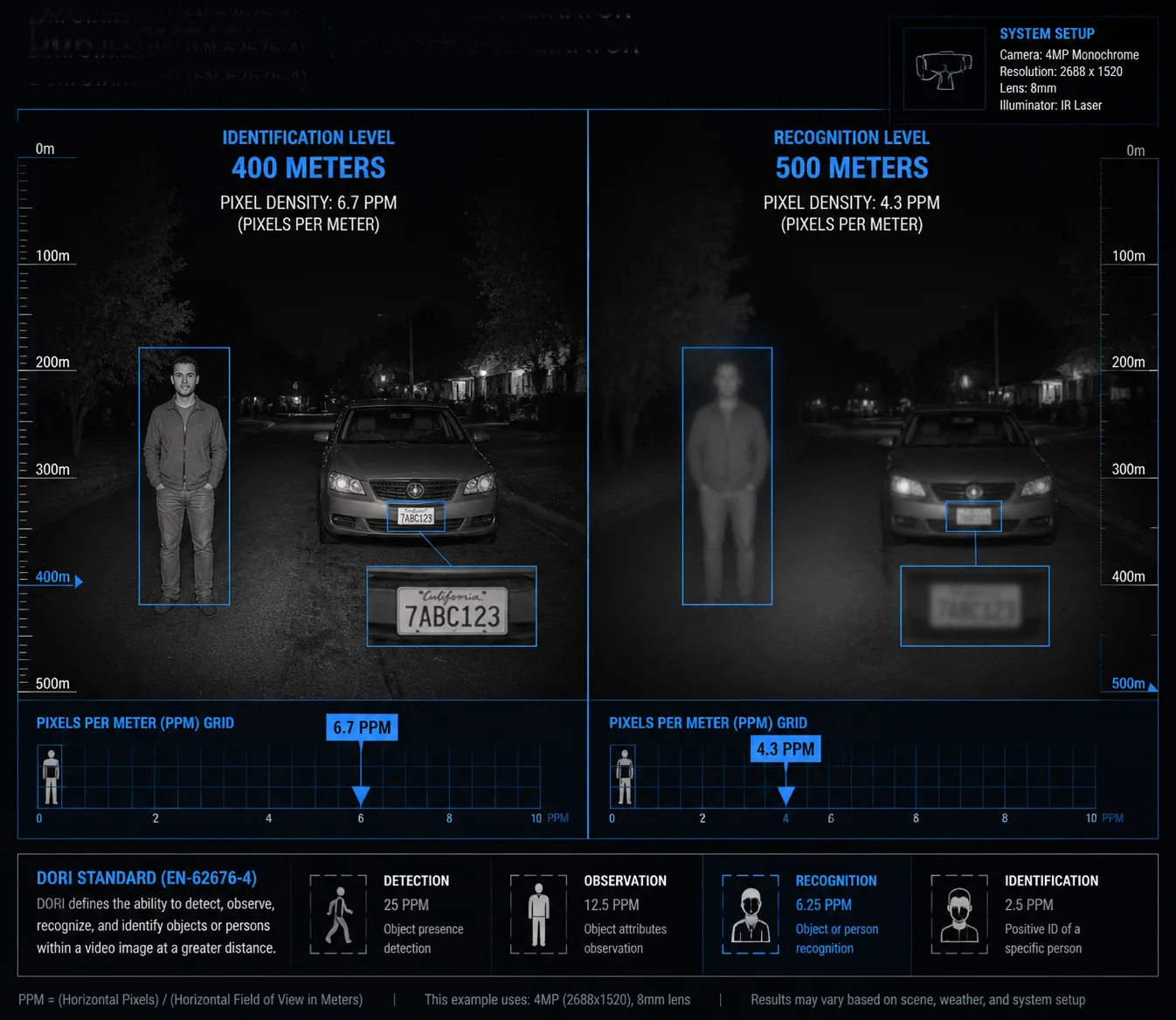
No. At 500 meters in 0 Lux, a 40X laser PTZ will give you recognition-level detail — enough to tell a man from a woman, or a sedan from a pickup. But for true identification of a face or license plate, the reliable limit is around 300 to 400 meters.
Why 400 Meters Is the Real Ceiling
The security industry uses a standard called DORI — Detection, Observation, Recognition, Identification. The DORI standard definition 3 is widely used for security camera performance measurement. Here is what a typical 40X laser PTZ delivers in complete darkness:
| DORI Level | Distance (meters / yards) | What You Can See |
|---|---|---|
| Detection | 1,500m – 2,000m (~1,640 – 2,187 yds) | A moving dot. Enough to trigger motion detection. |
| Observation | 800m – 1,000m (~875 – 1,094 yds) | Target type — sedan vs. pickup, person with or without a backpack. |
| Recognition | 500m – 600m (~547 – 656 yds) | Known individual or vehicle color and model. |
| Identification | 300m – 400m (~328 – 437 yds) | Clear facial features or readable license plate characters. |
The difference between “Recognition” at 500 meters and “Identification” at 400 meters might sound small. It is not. Recognition means you can say “that looks like the same guy we saw yesterday.” Identification means you can pull a face from the frame and match it against a database, or read every character on a plate. Courts, law enforcement, and serious end users care about identification. Everything else is just an alert.
Three Physics Bottlenecks That Cap the Distance
1. Laser energy density. A high-power 850nm laser illuminator sends a beam out into the dark. As that beam travels, water vapor, dust, and particles in the air scatter the photons. By 400 meters, enough light bounces back to the sensor to support a shutter speed of roughly 1/500s. That shutter speed is the minimum you need to freeze a walking person without motion blur. Push past 400 meters, and the return light drops. The camera compensates by slowing the shutter or boosting gain. Both destroy detail. This is why understanding shutter speed requirements for freeze-frame identification 6 is critical.
2. Pixel density on target (PPM). To identify a face, the industry rule of thumb is about 250 pixels per meter on the target. Pixels per meter (PPM) calculation 4 is essential for determining identification range. A 40X optical zoom on a 1080p sensor at 400 meters puts just enough pixels across an adult face to meet that threshold. At 500 meters, the pixel count drops below the line. You can still see a person. You just cannot see who that person is.
3. Atmospheric turbulence. Even on a clear night, air at different temperatures creates micro-layers that bend light. The result is a shimmer or ripple effect in the image. Below 400 meters, this effect is manageable. Above 500 meters, it becomes a serious problem. Frames that looked sharp at the sensor level come out wavy and soft. No amount of software sharpening fixes physics.
What About Larger Sensors?
If your project absolutely requires identification beyond 400 meters, one option is a camera with a 1/1.2-inch or larger sensor. A 1/2.8″ vs 1/1.2″ sensor low-light performance comparison 7 shows that bigger sensors collect more photons per pixel. In practice, this can extend the identification range by 20% to 30% under the same laser power. But it also increases cost. For most projects, the smarter move is to position the PTZ closer to the target zone rather than pay for a flagship sensor.
What Is the Difference Between “Detecting” a Target and “Identifying” It at 800 Meters?
Many integrators I talk to mix up these two words. A client hears “the camera can see 800 meters at night” and assumes they will get a clear face shot. That misunderstanding leads to failed acceptance tests and angry phone calls.
At 800 meters in total darkness, a 40X laser PTZ can observe a target — you will know if it is a person or a vehicle, and you may see general features like clothing color or vehicle shape. But you will not get a usable face capture or plate read. That requires the target to be within 400 meters.
The Johnson Criteria: A Simple Way to Set Expectations
The Johnson Criteria 1 is a framework originally developed for military imaging systems. It defines how many “line pairs” (or, in digital terms, pixels) you need across a target to achieve each level of recognition. Here is a simplified version for security cameras:
| Task | Minimum Pixels Across Target’s Critical Dimension | Practical Meaning |
|---|---|---|
| Detection | ~2 pixels | “Something is there.” |
| Recognition (type) | ~8 pixels | “It is a person, not a dog.” |
| Identification (detail) | ~14 pixels | “It is a male, approximately 6 feet, wearing a red jacket.” |
| Face/Plate ID | ~250 PPM (pixels per meter) | “I can read the plate: ABC-1234.” |
At 800 meters with a 40X zoom on a 2MP sensor, a standing person might occupy only 30 to 50 vertical pixels in the frame. That is enough for recognition — you know it is a human. But the face itself might only be 5 to 8 pixels wide. That is not enough for any face recognition algorithm to work with. It is not even enough for a human operator to say with confidence who that person is.
Why This Matters for Project Bids
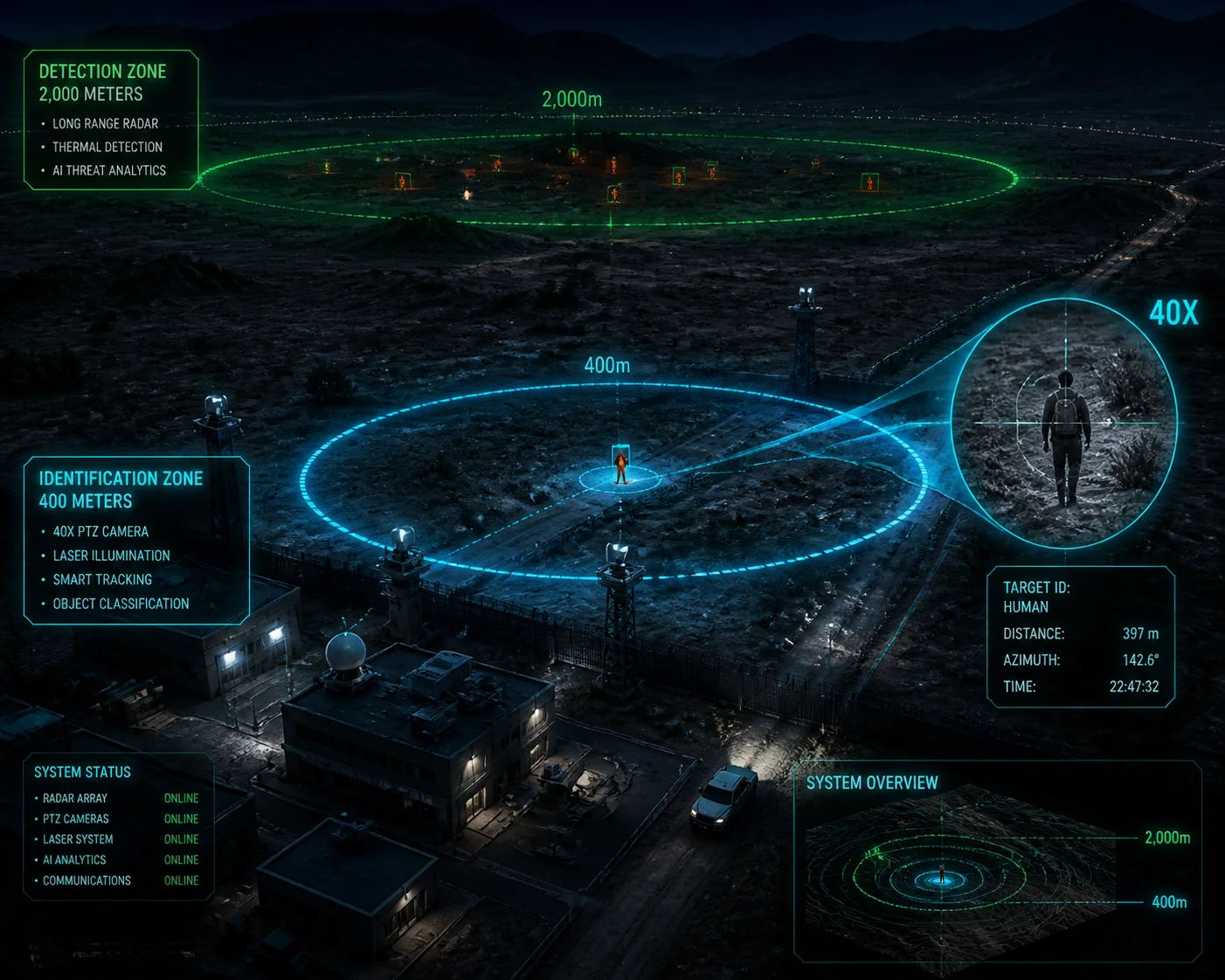
If you are writing a proposal for a border security or critical infrastructure project, you need to separate your detection zone from your identification zone. Here is how I suggest thinking about it:
- Detection zone (800m – 2,000m): Use the PTZ’s wide-angle view or pair it with a radar or thermal sensor. The goal here is to know that something is approaching. You trigger an alert.
- Identification zone (under 400m): The PTZ zooms in to 40X. The laser narrows its beam to match the field of view. You capture the face or plate.
If the gap between your perimeter and your identification zone is too large, you need either more cameras or a closer mounting position. No amount of zoom fixes the physics of light loss over distance.
A Common Trap: Auto-Exposure “Cheating”
Some manufacturers demo their cameras with auto-exposure wide open. The shutter drops to 1/30s or even 1/15s. The image looks bright and detailed — on a still target. But any movement creates a smeared mess. When you test a camera, lock the shutter to at least 1/250s for pedestrian targets and 1/500s for vehicles. If the image falls apart, the camera cannot do what the spec sheet claims.
How Does Atmospheric Haze Affect the Real-World Distance of the Laser Beam?
I have tested cameras on clear desert nights where the laser punched out to 1,500 meters with no problem. Then I tested the same camera on a humid coastal night, and the effective range dropped to 600 meters. Same camera. Same settings. Different air.
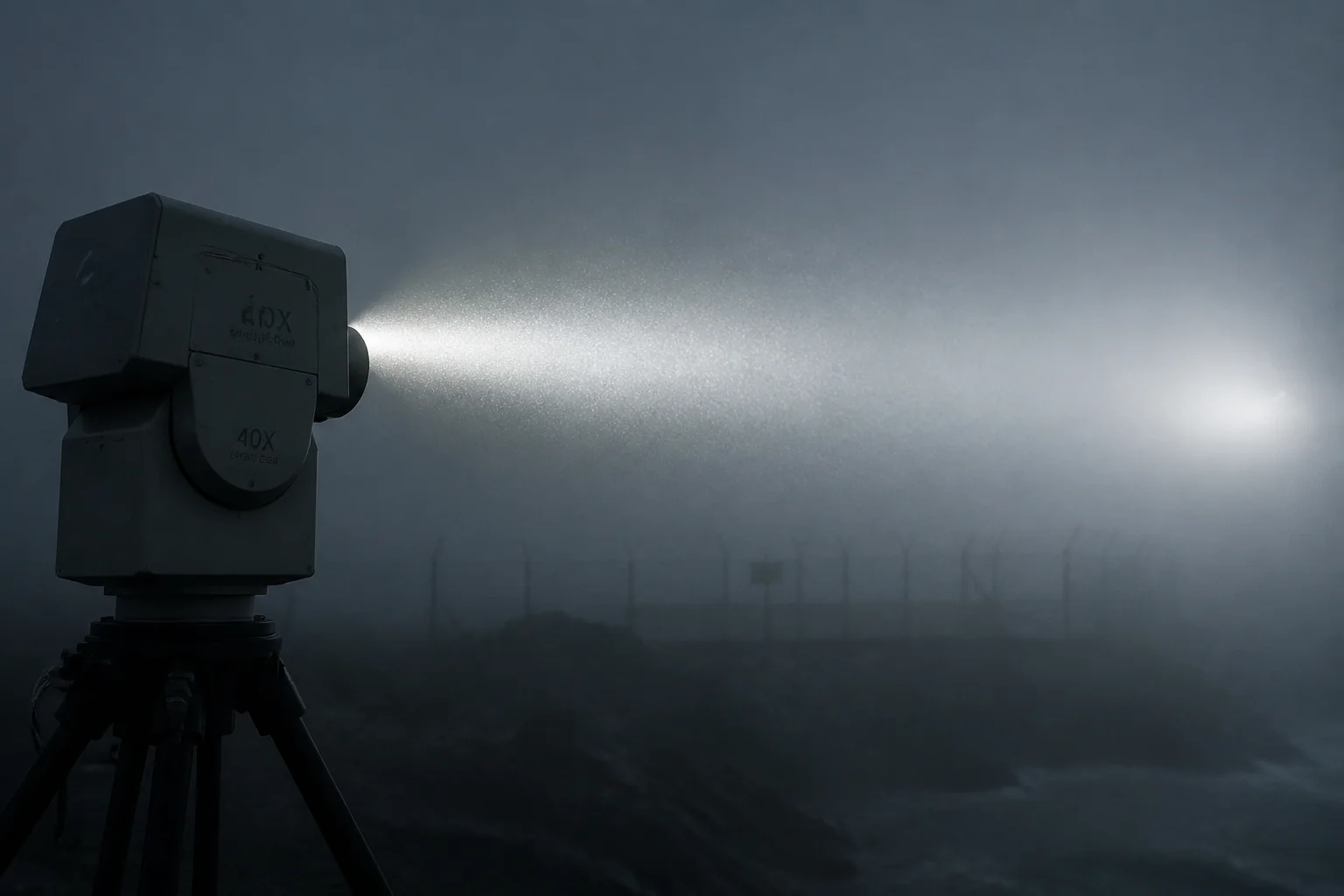
Atmospheric haze — caused by humidity, dust, fog, or smog — absorbs and scatters the laser beam before it reaches the target. In moderate haze (visibility 2–3 km), expect the effective identification distance to drop by 30% to 50%. In heavy fog (visibility under 500m), laser illumination becomes almost useless beyond 100 to 150 meters.
How the Laser Beam Loses Power
An 850nm laser illuminator sends infrared light in a focused beam. As that light travels through air, three things happen:
- Absorption. Water molecules in the air absorb some of the infrared energy. The higher the humidity, the more energy is lost. This is related to atmospheric scattering and absorption at 850nm vs 940nm 5.
- Scattering. Dust, pollen, smoke, and water droplets deflect photons away from the beam path. This is the same reason car headlights look like a white wall in fog — the light bounces everywhere instead of going forward.
- Backscatter. Some of the scattered light bounces directly back into the camera lens. This creates a bright haze in the image that washes out the target. This is known as laser backscatter effect 8 in foggy conditions.
What This Means for Your Installation
If you are deploying a 40X laser PTZ in a humid region — the Gulf Coast, Southeast Asia, Northern Europe — you need to derate the manufacturer’s claimed distance. Here is a rough guide:
| Weather Condition | Visibility | Expected ID Distance (% of Clear Night Max) |
|---|---|---|
| Clear night, low humidity | >10 km | 100% (up to 400m for ID) |
| Light haze | 5 – 10 km | 70% – 85% (~280m – 340m) |
| Moderate haze / high humidity | 2 – 5 km | 50% – 70% (~200m – 280m) |
| Heavy fog or rain | <1 km | 20% – 40% (~80m – 160m) |
| Dense fog | <200m | Laser is effectively useless for ID |
How to Protect Your Project Against Weather
Record the conditions. Every test you run, every demo you watch — write down the visibility, humidity, and temperature. If a supplier shows you a beautiful demo video, ask them: “What was the visibility that night?” If they cannot answer, the demo is not trustworthy.
Add a thermal channel. Thermal imaging 2 is far less affected by haze than laser-illuminated visible light. A dual-spectrum PTZ 9 — one laser visible channel and one thermal channel — gives you detection capability even when the laser is struggling. You will not get face or plate detail from thermal, but you will still see that someone is there.
Position the camera closer. This sounds obvious, but it is the most reliable solution. If your site has frequent fog, do not mount the PTZ 800 meters from the fence line and hope for the best. Mount it 200 meters away. In fog, 200 meters with a 40X zoom will give you better results than 400 meters with perfect weather.
A Note on Laser Wavelength
Most security-grade laser illuminators use 850nm wavelength. This is a good balance between sensor sensitivity and eye safety. Some manufacturers offer 940nm lasers, which are invisible to the naked eye (no red glow). But 940nm is absorbed more heavily by the atmosphere, so the effective range is shorter — typically 20% to 30% less than 850nm under the same conditions. If maximum distance matters more than covert operation, stick with 850nm.
Can You Provide a Raw Video Sample of the 40X Zoom Performance at Midnight?
Every serious integrator I work with asks for video proof. And they should. A spec sheet is a promise. A raw video is evidence.
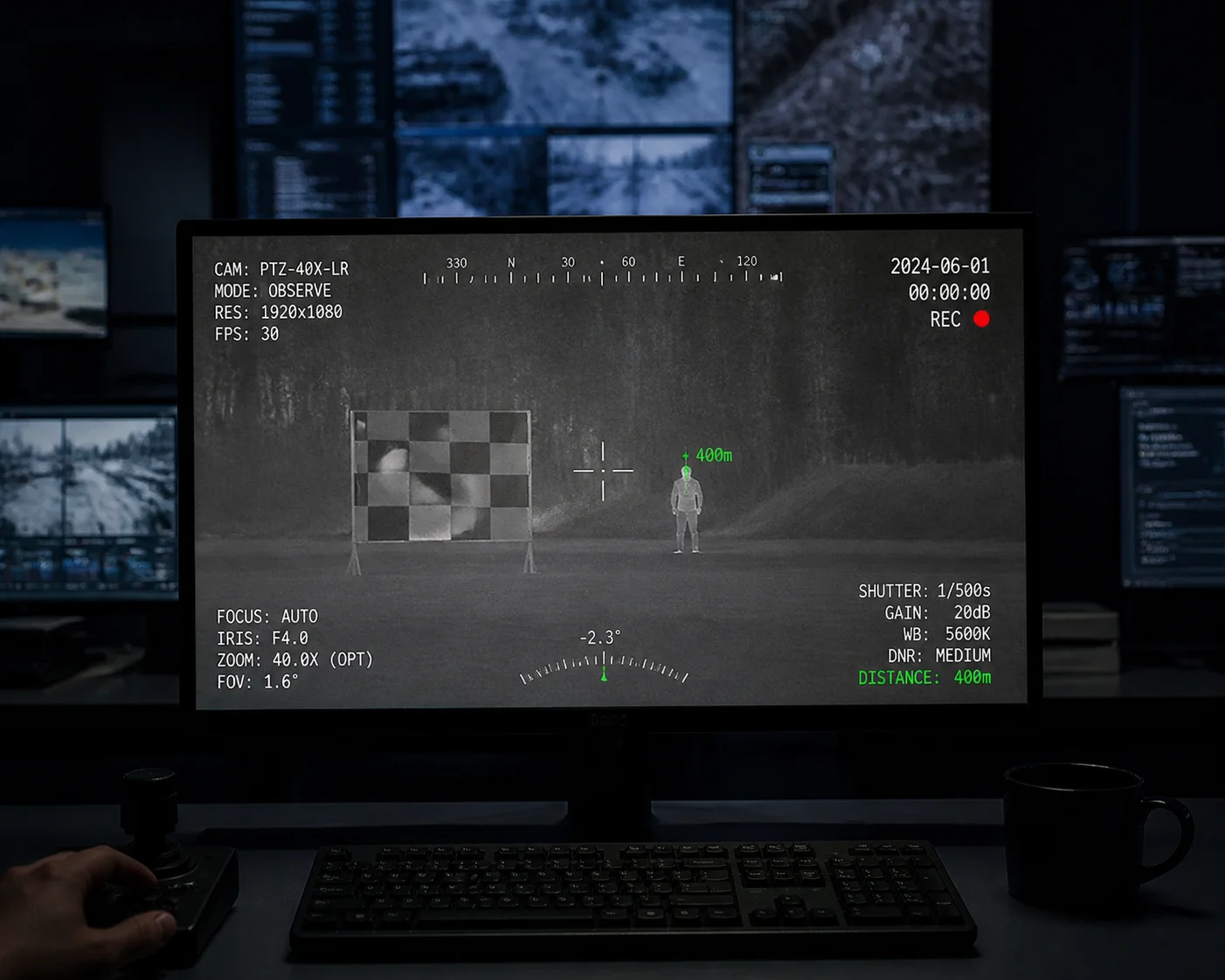
Yes, we can provide unedited video samples shot at midnight in 0 Lux conditions. But more importantly, you should know exactly what to look for in that video — and what tricks to watch out for — so you can judge the footage like an engineer, not a marketing audience.
What a Legitimate Test Video Should Include
When you ask any supplier — including us — for a midnight video sample, here is the checklist you should use:
1. Fixed, known distances. The video should show targets at marked distance points: 100m, 200m, 300m, 400m, 500m, and beyond. Each distance should be verified with a laser rangefinder, not estimated. A proper test chart design for camera identification distance validation 10 is essential for accurate measurement.
2. Fixed exposure settings. The shutter speed, gain, and resolution should be locked and displayed on screen or stated in the video description. If the supplier used auto-exposure, the footage is not a fair test. A slow shutter makes everything look brighter but destroys detail on any moving target.
3. Standard targets. The video should show recognizable objects — a person standing, a person walking, a vehicle with plates, and ideally a test chart with letters or numbers. A video of a distant building or tree tells you nothing about identification performance.
4. Weather data. The temperature, humidity, and visibility at the time of recording should be stated. Without this, you cannot compare the video to any other test.
What to Watch Out For
Post-processing. Some suppliers sharpen or enhance the video before sending it. Ask for the raw file straight from the NVR or SD card. Check the file metadata for signs of editing.
Cherry-picked frames. A single sharp frame out of 1,000 blurry ones is not proof of performance. Ask for a continuous clip of at least 10 seconds at each distance. Watch the whole clip. If 9 out of 10 seconds are soft and one second is sharp, the camera is not reliable at that distance.
Mismatched laser angle. If the laser beam is not synchronized with the zoom lens, the center of the image might be well-lit but the edges will be dark. This is a sign of poor optical calibration. A properly engineered PTZ matches the laser beam angle to the lens field of view at every zoom level automatically.
How We Handle This at Loyalty-Secu
When a client like David asks us for test footage, we provide:
- Raw .mp4 or .h265 files exported directly from the recorder.
- A test report that includes the distance points, exposure settings, weather conditions, and pixel-on-target measurements.
- A side-by-side comparison at multiple distances so you can see exactly where the image quality transitions from “identification” to “recognition” to “detection.”
We do this because we know that integrators who test properly become long-term partners. The ones who get burned by fake demos never come back — to any supplier. Transparency is not charity. It is business strategy.
How to Run Your Own Test
If you want to verify performance yourself — and I strongly recommend that you do — here is a simple protocol:
- Set up targets at 100m intervals along a straight, unlit road.
- Mount the PTZ at one end. Lock the zoom to 40X.
- Set the shutter to 1/250s minimum. Fix the gain. Record at the camera’s native resolution.
- Record 20 seconds at each distance point.
- Export the raw files. Measure the pixel width of the target’s face and any license plates in each clip.
- Note the weather conditions with a handheld weather meter.
This test takes about two hours. It will tell you more than any datasheet ever will.
Conclusion
In total darkness, a 40X laser PTZ identifies faces and plates at up to 400 meters — not the 3 to 5 kilometers some spec sheets claim. Test it yourself. Trust the data.
1. Johnson Criteria for military target detection and identification. ↩︎ 2. Thermal imaging degradation in atmospheric haze conditions. ↩︎ 3. DORI standard definition for security camera performance. ↩︎ 4. Pixels per meter (PPM) calculation for facial identification. ↩︎ 5. Atmospheric scattering and absorption at 850nm vs 940nm. ↩︎ 6. Shutter speed requirements for freeze-frame identification. ↩︎ 7. 1/2.8″ vs 1/1.2″ sensor low-light performance comparison. ↩︎ 8. Laser backscatter effect in foggy conditions. ↩︎ 9. Dual-spectrum PTZ for thermal and visible fusion. ↩︎ 10. Test chart design for camera identification distance validation. ↩︎