
I’ve seen too many integrators buy a PTZ camera, install it on site, and then realize it can’t cover what they promised the client.
A typical 20x–30x PTZ camera shifts its Horizontal Field of View (HFoV) from about 55°–72° at wide-angle down to just 1.8°–3.5° at maximum telephoto. At 100 meters, that means your coverage drops from over 100 meters wide to roughly 3–6 meters wide.
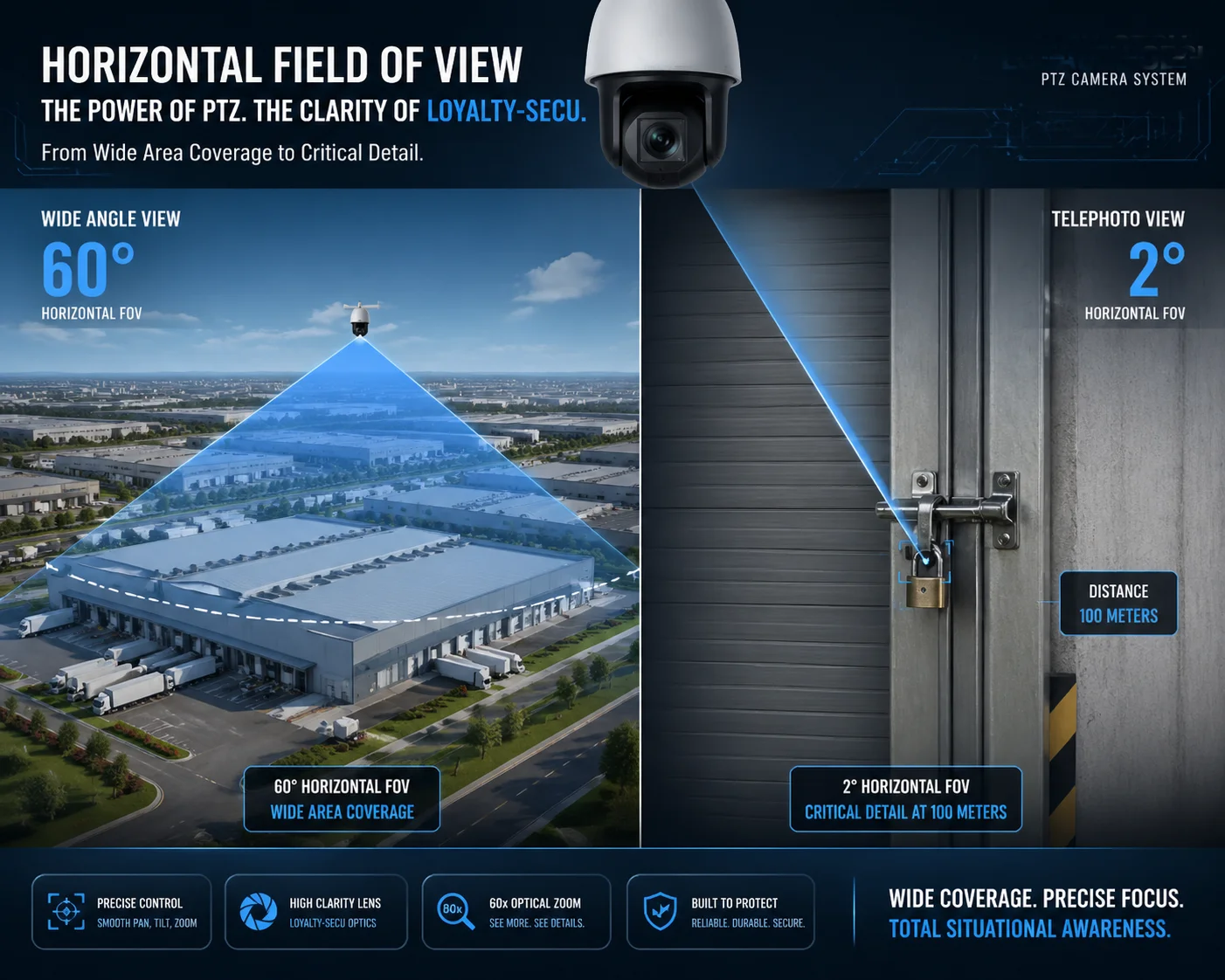
This gap between wide and tele is where most site planning mistakes happen. Below, I break down the math, the real-world numbers, and the practical tips you need to plan your coverage correctly. Let’s get into it.
Table of Contents
How Does the Horizontal Field of View (HFoV) Translate to Real-World Meters at 800m?
Clients ask me this all the time. They want a number in meters, not degrees. And honestly, degrees mean nothing when you’re standing in a field trying to figure out if your camera can see the fence line.
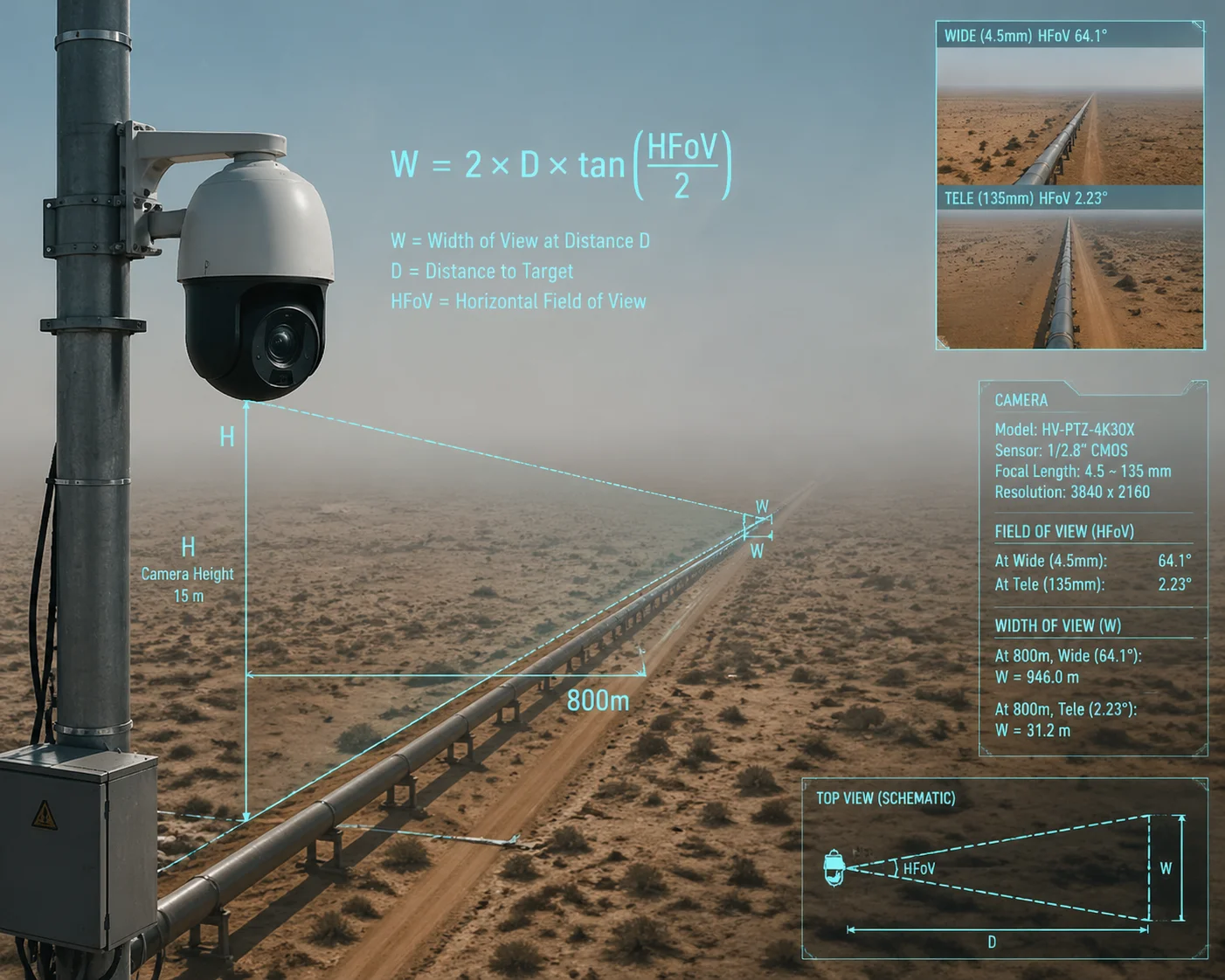
To convert HFoV to real-world width, use this formula: W = 2 × D × tan(HFoV / 2). At 800 meters with a 2.5° HFoV (30x telephoto), your camera covers only about 34.9 meters wide. At wide-angle (59°), that same distance gives you over 900 meters of coverage.
The Core Formula You Need to Know
The formula is simple. You don’t need an engineering degree. Here it is again:
W = 2 × D × tan(HFoV / 2)
- W = the horizontal width your camera can see (in meters)
- D = the distance from camera to target (in meters)
- HFoV = the horizontal field of view angle (in degrees)
That’s it. Plug in the numbers and you get your answer.
Real Numbers at 800 Meters
Let me put this into a table so you can see it clearly. I’m using a standard 30x PTZ with HFoV ranging from 59° (wide) to 2.5° (tele):
| Zoom Setting | HFoV (degrees) | Coverage Width at 800m |
|---|---|---|
| Wide (1x) | 59° | ~ 904 m |
| Mid-zoom (10x) | ~6° | ~ 83.8 m |
| Max tele (30x) | 2.5° | ~ 34.9 m |
At 800 meters, even the telephoto end still gives you about 35 meters of width. That’s enough to cover a road or a section of perimeter fence. But here’s the catch — 800 meters is a long distance. Atmospheric haze, heat shimmer, and sensor resolution all start to matter. The HFoV tells you what the lens can frame, but whether you can actually identify a person or read a plate at 800 meters depends on pixel density and IR illumination.
Why This Matters for Long-Range Projects
If you’re deploying along a border, a pipeline, or a large agricultural property, you need to know the exact coverage width at your target distance. I’ve worked with integrators who assumed their 30x PTZ would “see everything” at 500+ meters. It does see a lot at wide-angle. But the moment they zoom in to identify an intruder, the view narrows to a slit.
This is why I always tell clients: plan for two scenarios. Plan your wide-angle coverage for situational awareness. Then plan your telephoto coverage for identification. They are two completely different jobs, and the same camera handles both — but not at the same time.
A Quick Mental Shortcut
Here’s a trick I use. For every 1° of HFoV, you get roughly 17.5 meters of width per 1,000 meters of distance. So at 800 meters:
- 2.5° → about 2.5 × 17.5 × 0.8 = ~35 m
- 6° → about 6 × 17.5 × 0.8 = ~84 m
- 59° → use the full formula (the shortcut breaks down at wide angles)
This shortcut is good enough for quick field estimates. For exact planning, use the full formula or ask us for a coverage chart for your specific model.
Will the Wide-Angle Setting Cover My Entire Parking Lot Without Corner Distortion?
I get this question from almost every system integrator who handles commercial properties. They want one camera to cover the whole lot. And they want clean, usable footage from edge to edge.
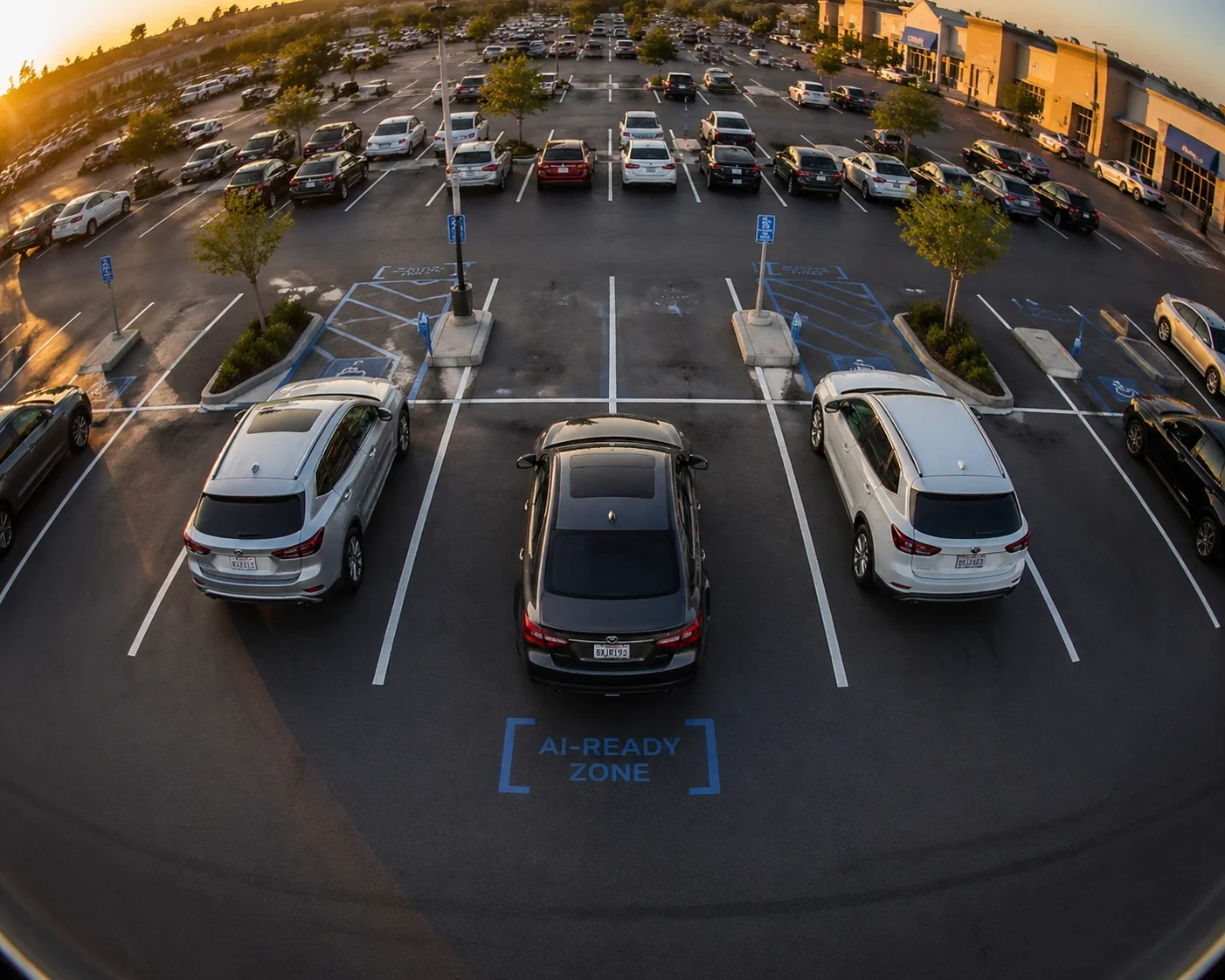
At wide-angle (1x zoom), a typical PTZ with 55°–62° HFoV can cover a very large area — over 100 meters wide at 100 meters distance. But the outer 10–20% of the image will show barrel distortion 1, which reduces the accuracy of AI analytics like license plate and face recognition near the edges.
What Is Barrel Distortion and Why Should You Care?
Barrel distortion is that “fisheye” bending effect you see at the edges of a wide-angle image. Straight lines — like parking space markings or building walls — appear curved. This happens because of the physics of short focal length lenses. The shorter the focal length, the more the light bends at the edges of the sensor.
For general surveillance — just seeing that someone is in the parking lot — barrel distortion is not a big deal. You can still see movement, shapes, and general activity.
But if you need AI-powered analytics like license plate recognition (LPR) or facial recognition, distortion is a real problem. The algorithms expect straight lines and consistent pixel spacing. When the image is warped at the edges, recognition accuracy drops fast.
How Much of the Image Is Actually Usable?
Here’s my rule of thumb:
| Image Zone | Area of Frame | Usability for AI Analytics |
|---|---|---|
| Center (0–70%) | Core viewing area | Excellent — minimal distortion |
| Mid-edge (70–85%) | Transition zone | Acceptable — slight warping |
| Outer edge (85–100%) | Extreme corners | Poor — visible barrel distortion |
So if David is planning a parking lot project and needs LPR at every entry point, I’d say: don’t rely on the extreme edges of a wide-angle shot. Either position the camera so that the entry lanes fall within the center 70–80% of the frame, or use a dedicated fixed camera for LPR at each lane.
The “90° Wide-Angle” Trap
Some cheap PTZ cameras claim a 90° or even 100° HFoV at wide-angle. Stay away from those for security work. At 90°+, the barrel distortion becomes so severe that the image looks like a doorbell camera. It might be fine for a lobby overview, but for any serious perimeter or parking lot monitoring at distance, it’s useless.
A well-designed 55°–65° wide-angle lens gives you plenty of coverage without turning your footage into a funhouse mirror. At Loyalty-Secu, our 33x and 38x PTZ models are designed with this balance in mind — wide enough for full-scene awareness, clean enough for AI processing in the center zone.
Practical Tip for Parking Lot Layouts
If the parking lot is 80 meters wide and the camera is mounted at 8 meters high on a pole at one end, the horizontal distance to the far edge is about 90–100 meters. At 60° HFoV, your coverage width at 100 meters is about 115 meters. That’s more than enough to see the entire lot.
But remember: “seeing” and “identifying” are different. For identification, you need pixel density. And pixel density drops as you move further from the camera and closer to the edges. So plan your camera position to put the most critical zones — entrances, exits, high-value parking areas — in the center of the wide-angle frame.
Can You Provide a FOV Chart for My Specific Lens Model to Help with Site Planning?
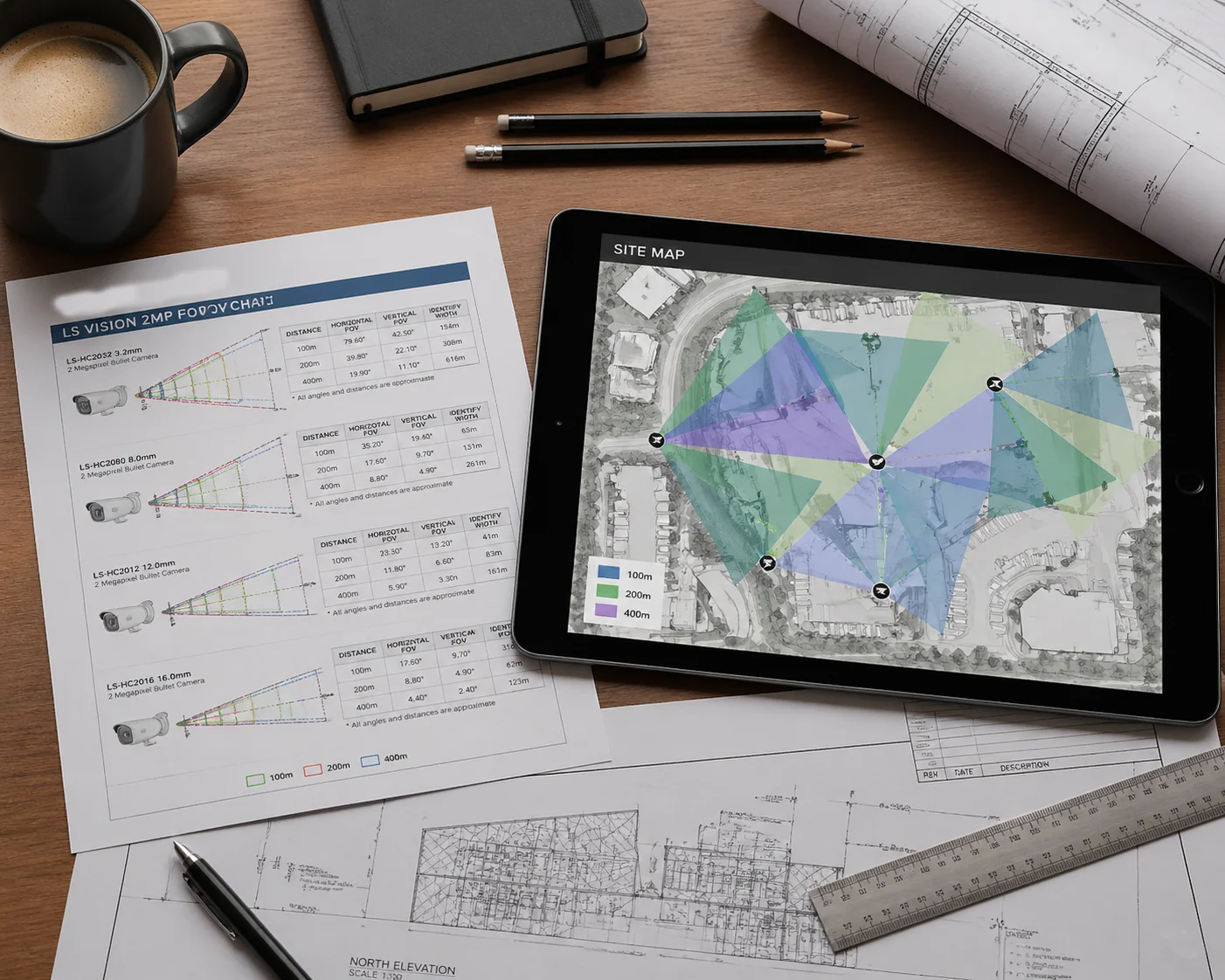
Every time I start a new project discussion with an integrator, the first thing they ask for is a coverage chart. Not marketing fluff. Real numbers they can put on a site map.
Yes — for any Loyalty-Secu PTZ model, I can provide a detailed FOV chart showing HFoV, VFoV, and calculated coverage width at key distances (50m, 100m, 200m, 400m, 800m). Just send me your model number or project requirements, and I’ll generate a custom chart within 24 hours.
Why Generic Specs Are Not Enough
Here’s the problem. Most datasheets from Chinese OEM factories only list two numbers: the wide-angle HFoV and the telephoto HFoV. Something like “HFoV: 60°–3.5°.” That’s a start, but it tells you nothing about what happens at 5x, 10x, 15x, or 20x zoom.
In real-world deployments, you rarely use full wide or full tele. Most of the time, you’re somewhere in the middle — maybe 8x to 15x — trying to get a good balance between coverage area and detail. Without a chart that shows HFoV at intermediate zoom steps, you’re guessing.
What a Good FOV Chart Looks Like
Here’s an example of what I provide to clients. This is based on a 33x optical zoom PTZ with a 1/2.8″ sensor (4.5mm–148.5mm focal length):
| Zoom Level | Focal Length (mm) | HFoV (degrees) | Width at 100m | Width at 200m | Width at 400m |
|---|---|---|---|---|---|
| 1x (Wide) | 4.5 | 62.5° | 121 m | 242 m | 484 m |
| 5x | 22.5 | 12.8° | 22.4 m | 44.8 m | 89.6 m |
| 10x | 45 | 6.5° | 11.4 m | 22.7 m | 45.4 m |
| 20x | 90 | 3.2° | 5.6 m | 11.2 m | 22.3 m |
| 33x (Tele) | 148.5 | 2.1° | 3.7 m | 7.3 m | 14.7 m |
This is the kind of table that lets David sit down with a site map, draw circles, and know exactly what each camera position can cover at each zoom level.
How to Use This Chart for Site Planning
Step one: measure the distances on your site map. How far is the camera from the fence line? From the gate? From the parking lot edge?
Step two: decide what you need at each distance. Do you need full-scene awareness (wide)? Or do you need to read a license plate (tele)?
Step three: match the distance and the required coverage width to the chart. If you need to cover a 20-meter-wide gate at 200 meters, look at the chart. At 10x zoom, you get 22.7 meters of width at 200 meters. That’s a good fit.
Step four: set your PTZ presets accordingly. Program preset 1 as the wide overview. Program preset 2 as the 10x gate view. Program preset 3 as the 20x zoom for the far corner. Now your operator — or your AI — can switch between views instantly.
Custom Charts for OEM/ODM Projects
If you’re doing an OEM or ODM project with us, I can generate FOV charts tailored to your exact sensor and lens combination. Different sensor sizes (1/2.8″, 1/1.8″, 1/1.2″) change the HFoV even with the same focal length. A 1/1.8″ sensor gives a wider field of view than a 1/2.8″ sensor at the same focal length. So the chart must match your actual hardware.
Just email me at sales05@loyalty-secu.com with your project details, and I’ll send you a chart you can hand directly to your field engineers.
Is There a “Blind Spot” in the Zoom Range Where the Field of View Becomes Too Narrow?
This is the question that separates experienced integrators from beginners. Most people think about wide and tele. They forget about the middle — and that’s where things get tricky.
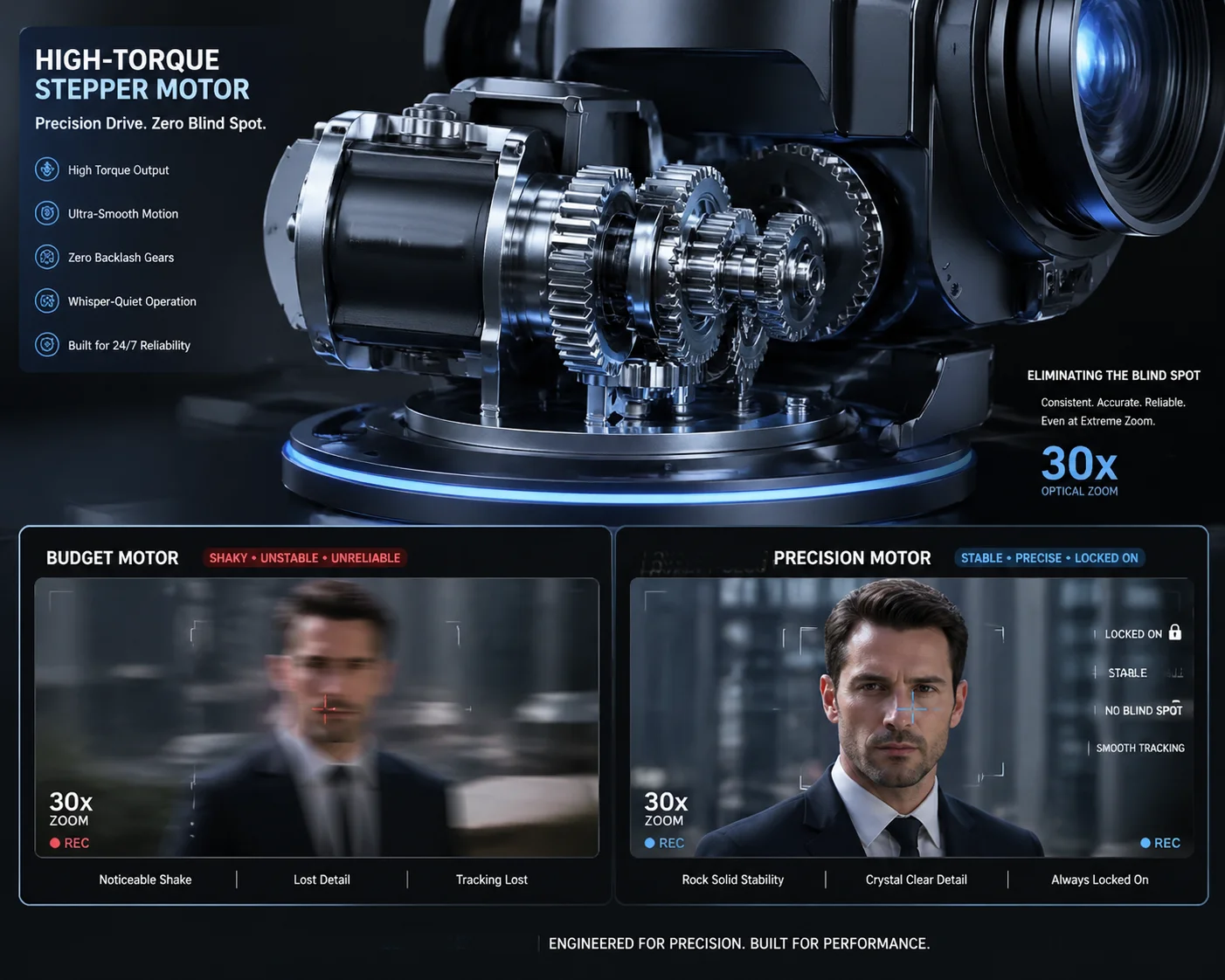
Yes, there is a practical “blind spot” zone. At around 20x–30x zoom (HFoV below 3°), the field of view becomes so narrow that even tiny vibrations or motor inaccuracies can cause the target to drift out of frame. This is not a lens defect — it’s a physics and mechanics challenge that requires high-precision pan-tilt motors.
The Math Behind the Problem
At 33x zoom, the HFoV is about 2.1°. Let’s think about what that means in practical terms.
At 300 meters, your total coverage width is:
W = 2 × 300 × tan(1.05°) = 2 × 300 × 0.01833 ≈ 11 meters
That sounds okay. But now think about what happens if the pan motor shifts by just 0.5°. Half of your 2.1° view just moved. The target that was in the center of the frame is now at the very edge — or completely gone.
This is why cheap PTZ cameras with sloppy motors are useless at high zoom. They might have a great lens, but if the pan-tilt mechanism can’t hold position with sub-degree accuracy, the image shakes, drifts, and loses the target constantly.
What “Motor Precision” Actually Means
When I say Loyalty-Secu’s PTZ supports 0.1° precision, here’s what that means in real terms:
At 300 meters with a 2.1° HFoV, a 0.1° adjustment moves the center of the frame by:
Shift = 300 × tan(0.1°) ≈ 300 × 0.00175 ≈ 0.52 meters
That’s about half a meter. So the operator can nudge the camera in half-meter steps at 300 meters. That’s fine-grained enough to keep a person centered in the frame.
Now compare that to a budget PTZ with 1° minimum step size. At 300 meters, each step moves the frame by 5.2 meters — more than half the total view width. You’d overshoot the target every time.
The “Sweet Spot” Zoom Range for Most Applications
Based on my experience working with integrators across the US, Europe, and the Middle East, here’s how I think about zoom ranges:
- 1x–5x: Situational awareness. See the whole scene. Detect motion and general activity.
- 5x–15x: The sweet spot. Good balance between coverage and detail. This is where most AI tracking and human/vehicle classification works best. HFoV is roughly 4°–12°, which gives you enough width to track a moving target without losing it.
- 15x–33x: Identification and evidence capture. Read a license plate. See a face. But the view is so narrow that you need either a skilled operator or a very good auto-tracking algorithm to keep the target in frame.
The “blind spot” I mentioned isn’t really a dead zone in the optics. It’s a usability gap. The lens can see fine. But the system — motor precision, tracking software, wind resistance of the housing — may not be able to keep up.
How Loyalty-Secu Solves This
Our PTZ cameras use high-torque stepper motors 2 with closed-loop feedback. This means the motor knows exactly where it is at all times, and it corrects for drift automatically. Combined with our AI auto-tracking module, the camera can lock onto a moving person at 20x+ zoom and follow them smoothly — even in wind.
This is not something you get from a $150 PTZ off Alibaba. It’s the result of our in-house R&D and our own mold shop, where we control every mechanical tolerance from the ground up.
Conclusion
HFoV is the single most important number for planning PTZ coverage. Know the formula, demand real specs from your supplier, and always test motor precision at max zoom before you commit to a large order.
1. Barrel distortion causes and correction in wide-angle lenses. ↩︎ 2. Stepper motor precision for PTZ pan-tilt positioning. ↩︎ 3. Horizontal field of view formula derivation for lens optics. ↩︎ 4. Pixel density versus field of view for identification tasks. ↩︎ 5. Sensor size impact on effective field of view. ↩︎ 6. Minimum angular step size for telephoto target tracking. ↩︎ 7. Vibration effect on narrow FoV at long focal lengths. ↩︎ 8. Lens distortion center zone for AI analytics accuracy. ↩︎ 9. Focal length to field of view conversion calculator. ↩︎ 10. Closed-loop feedback for PTZ motor position correction. ↩︎