
I lost a batch of PTZ cameras to overheating last summer. The housing trapped heat like an oven. That failure cost me a client and a painful lesson about material choice.
ADC12 die-cast aluminum beats stainless steel for PTZ camera housings in four key areas: thermal management, weight reduction, design flexibility, and cost efficiency. Its thermal conductivity is nearly 7 times higher than 304 stainless steel, making it the go-to material for high-power surveillance equipment that runs 24/7 outdoors.
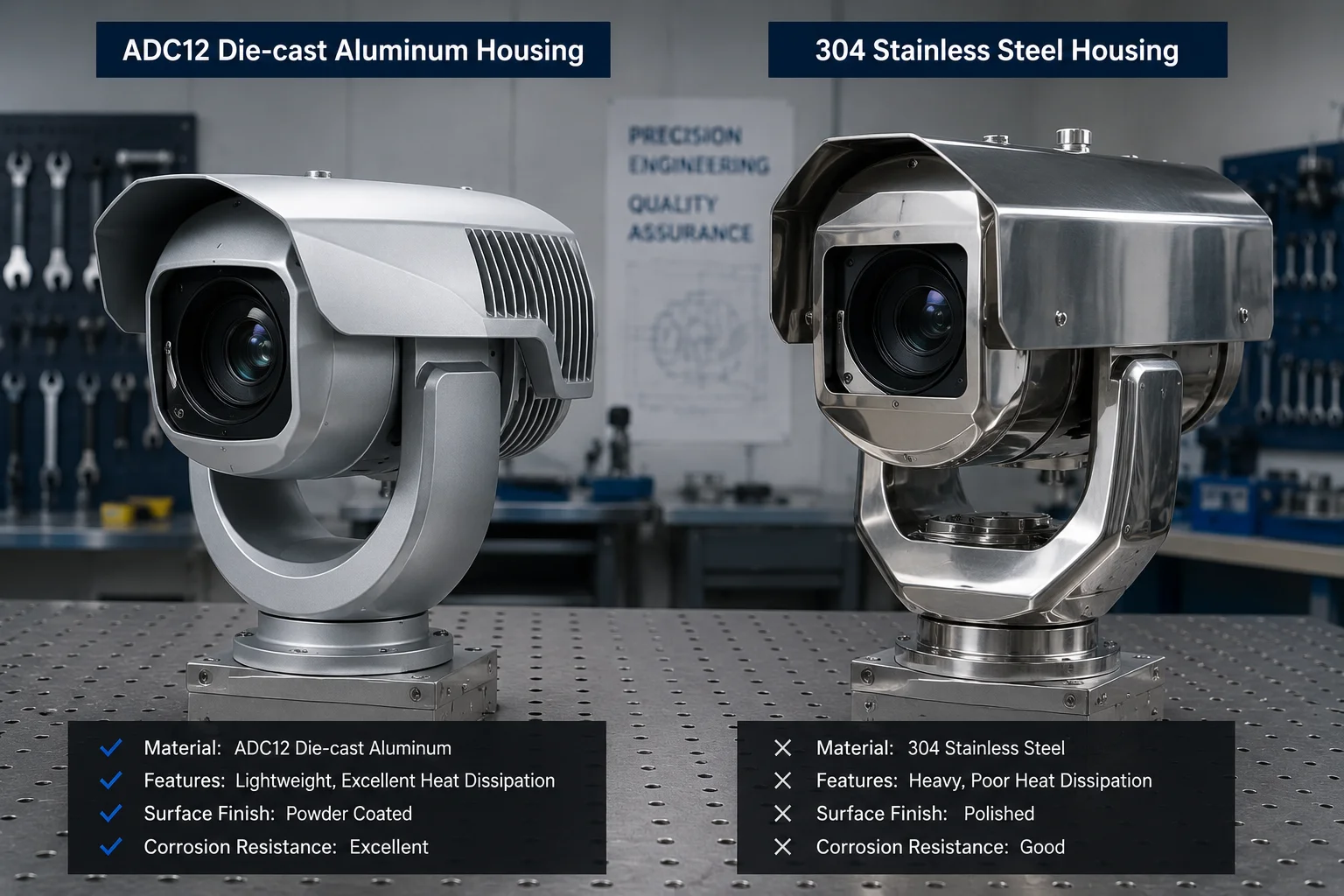 ADC12 die-cast aluminum vs stainless steel PTZ camera housing
Below, I break down each advantage with real numbers and field data. If you are choosing a housing material for your next PTZ project, this guide will save you time and money.
Table of Contents
How Does ADC12 Aluminum Help Keep the 4K Sensor Cool During a 100°F Summer?
I have seen 4K sensors shut down mid-recording because the housing could not move heat fast enough. In Texas summer heat, a bad housing is a ticking time bomb.
ADC12 aluminum conducts heat at 100 W/m·K, while 304 stainless steel only manages 15 W/m·K. This means an aluminum housing pulls heat away from the 4K sensor nearly 7 times faster, preventing thermal throttling and image noise even when ambient temperatures exceed 100°F.
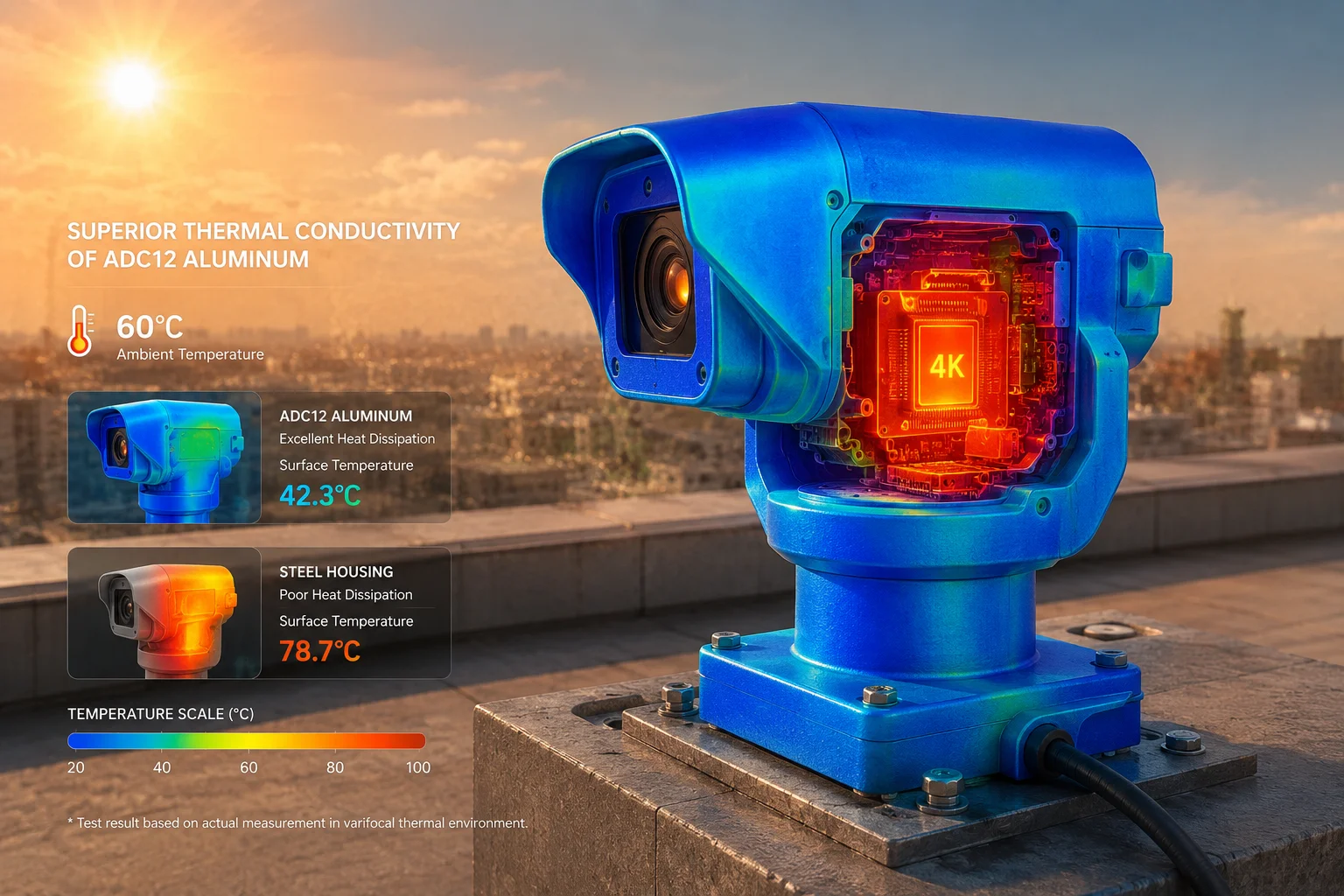 ADC12 aluminum thermal conductivity vs stainless steel for PTZ camera
Why Thermal Conductivity Matters for 4K PTZ Cameras
A 40X PTZ camera is not a simple device. Inside the housing, you have a high-speed SoC processor2, zoom motors, IR LEDs, and sometimes an AI chip1 all running at the same time. Each component generates heat. When you add direct sunlight on a dark rooftop, the internal temperature can climb past 160°F if the housing cannot dissipate heat.
Here is what happens when heat builds up:
- The 4K sensor produces more image noise. Your client sees grainy footage.
- The SoC chip throttles its clock speed. Frame rates drop. AI detection slows down.
- Solder joints on the PCB expand and contract repeatedly. After a few summers, they crack. The camera dies.
An ADC12 aluminum housing works like a giant heatsink. The entire shell conducts heat from the internal components to the outer surface, where air carries it away. Stainless steel traps that heat inside. I call it the “oven effect.”
Real-World Temperature Comparison
| Condition | ADC12 Aluminum Housing | 304 Stainless Steel Housing |
|---|---|---|
| Ambient temp: 100°F, direct sun | Internal temp: ~125°F | Internal temp: ~155°F |
| Sensor noise level | Low (clean image) | High (visible grain) |
| AI chip performance | Full speed | Throttled by 20-30% |
| Expected PCB lifespan | 8-10 years | 4-6 years |
The “Passive Cooling” Advantage
With ADC12, you do not need internal fans. Fans add cost, consume power, create noise, and eventually fail. A well-designed aluminum shell with integrated fins provides passive cooling that lasts the entire life of the camera. For solar-powered PTZ systems, this is critical. Every watt saved on cooling is a watt available for the motor and sensor.
At our factory, we run a 72-hour thermal stress test at 140°F ambient. Our ADC12 housings keep the internal SoC below 175°F consistently. That is well within the safe operating range for most Hisilicon and Ambarella chipsets.
Is the Weight Saving of an Aluminum PTZ Significant for My Solo-Installer Team?
I once watched a two-man crew struggle to mount a 14kg stainless steel PTZ on a 30-foot pole in 95°F heat. It took them three hours. A lighter camera would have cut that job in half.
ADC12 aluminum has a density of 2.7 g/cm³, roughly one-third of stainless steel’s 8.0 g/cm³. A typical 40X PTZ camera in an aluminum housing weighs around 5-6 kg, while the same design in stainless steel would weigh 13-15 kg. This difference directly reduces installation labor, pole load, and wind vibration.
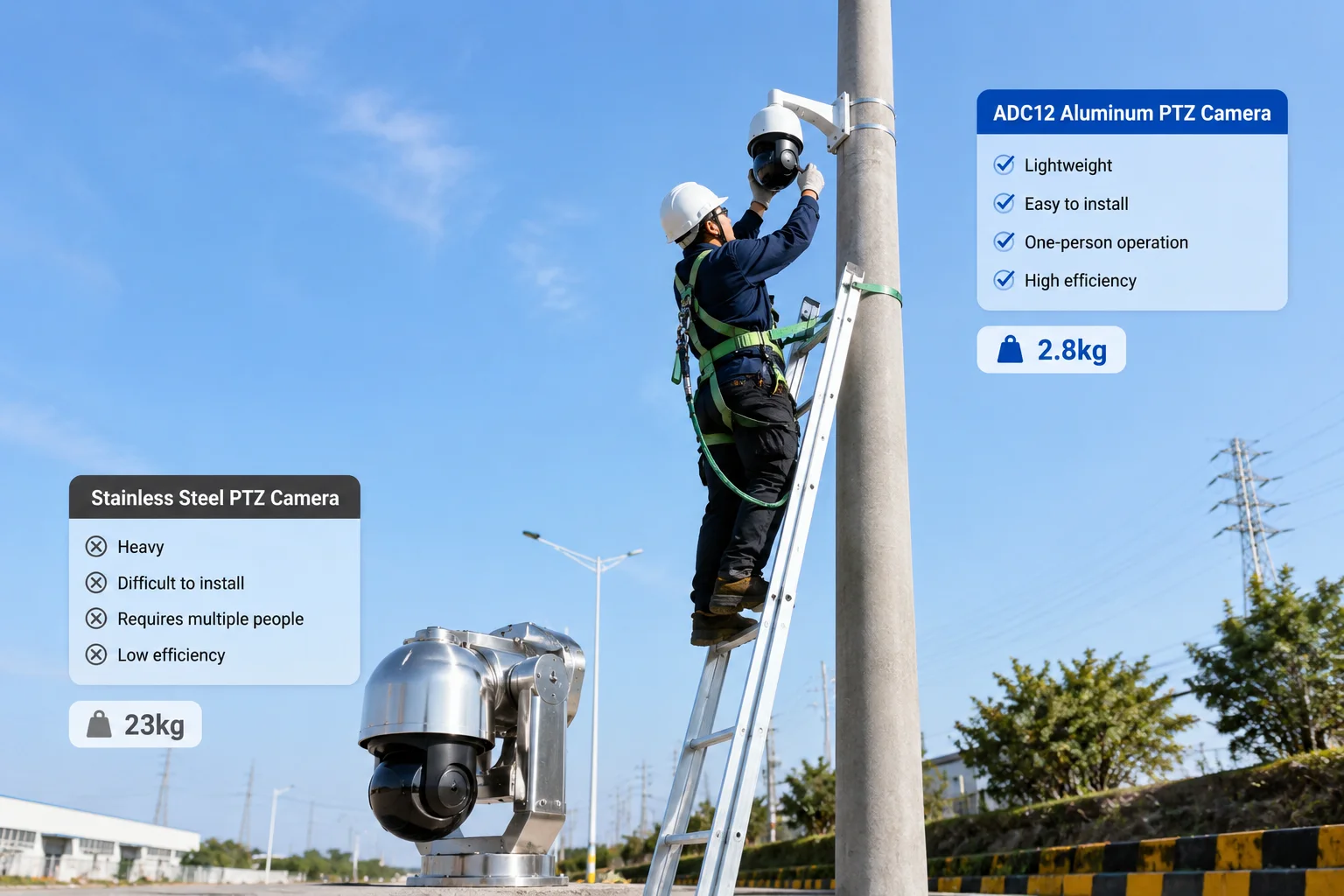 Lightweight ADC12 aluminum PTZ camera for solo installation
Why Weight Matters More Than You Think
For a system integrator like David, the camera price is only part of the project cost. Installation labor, pole infrastructure, and long-term maintenance all add up. A heavier camera affects every one of these line items.
Installation Labor Savings
A 5 kg camera can be mounted by one technician with a basic ladder. A 14 kg camera needs two people, a safety harness, and sometimes a bucket truck. In rural areas where solar PTZ systems are common, the nearest second technician might be an hour away.
| Factor | 5 kg Aluminum PTZ | 14 kg Stainless Steel PTZ |
|---|---|---|
| Installers needed | 1 person | 2 people minimum |
| Equipment required | Ladder, basic tools | Bucket truck or harness |
| Average install time | 45 minutes | 2-3 hours |
| Labor cost (US rates) | ~$150 | ~$500+ |
Wind Load and Image Stability
This is the hidden cost that most buyers miss. A heavier camera on a pole acts like a pendulum in the wind. The higher the mass, the more momentum it carries when the pole sways. This causes:
- Blurry frames during gusts
- False AI alerts triggered by image shake
- Faster wear on the pan/tilt motor bearings
A lighter aluminum housing reduces the moment of inertia at the top of the pole. In high-wind regions like the Texas panhandle or coastal Florida, this translates directly into cleaner footage and fewer false alarms.
Structural Pole Requirements
Many solar PTZ projects use galvanized steel poles rated for a specific wind load. A 14 kg camera requires a thicker, more expensive pole to meet local building codes. A 5 kg camera can use a standard pole, saving $200-$400 per installation point. Multiply that across a 50-camera farm project, and the savings are substantial.
Will the ADC12 Housing Provide Better Corrosion Resistance Than 304 Stainless Steel?
I will be honest here. This is the one area where stainless steel has a natural edge. But “natural edge” does not always mean “better choice.”
In most outdoor environments, ADC12 aluminum with powder coating7 provides 10+ years of corrosion protection and outperforms bare stainless steel in UV resistance. Stainless steel only wins in extreme salt spray environments like coastal installations within 500 meters of the ocean or chemical plant interiors.
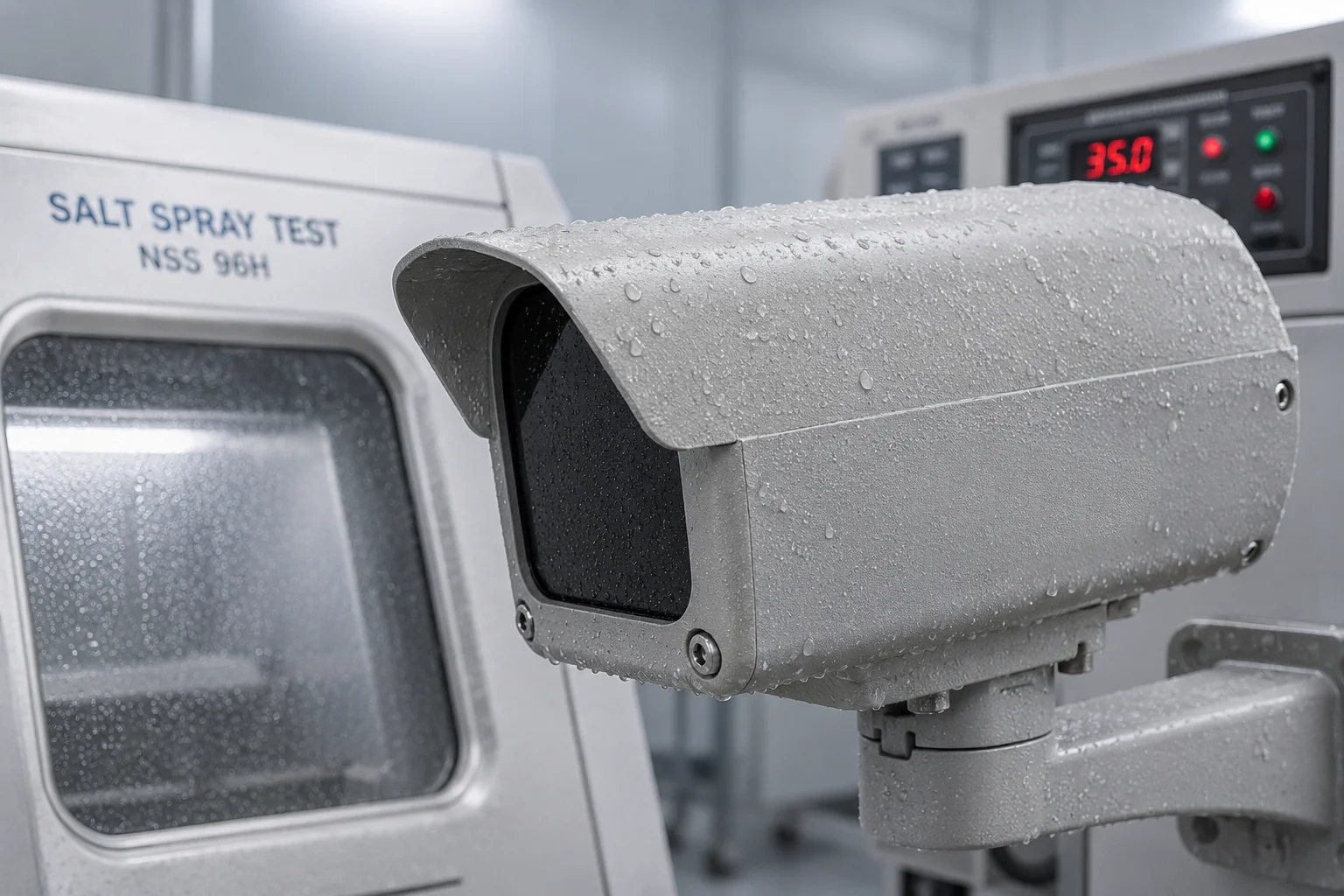 Powder-coated ADC12 aluminum housing corrosion resistance test
Understanding Corrosion in the Real World
Corrosion is not one thing. It takes many forms, and each material responds differently to each type. Let me break this down.
Types of Corrosion and Material Response
Atmospheric corrosion is what most cameras face. Rain, humidity, UV light, and temperature cycles attack the surface over years. ADC12 aluminum forms a natural aluminum oxide layer8 (Al₂O₃) that self-heals when scratched. Add a 60-80 micron powder coat on top, and you have a double barrier that handles 1,000+ hours of salt spray testing (ASTM B1173).
Pitting corrosion is stainless steel’s hidden weakness. If the passive chromium oxide layer gets damaged by a scratch, a chloride-rich environment (coastal air, road salt) can create deep pits that spread under the surface. You cannot see them until the housing fails. This is why “stainless” steel is not truly stainless in every condition.
Galvanic corrosion happens when two different metals touch in the presence of moisture.galvanic corrosion4 This is why we use stainless steel screws with nylon isolation washers on our ADC12 housings. Without that insulation, the junction between aluminum and steel becomes a battery that eats the aluminum. It is a simple fix, but many cheap manufacturers skip it.
When to Choose Each Material
- ADC12 aluminum (90% of projects): Urban, suburban, rural, desert, and inland installations. Anywhere more than 500 meters from salt water.
- 316 stainless steel (10% of projects): Directly on a pier, offshore platform, or inside a chemical processing facility with chlorine or acid exposure.
For David’s typical projects, farms, construction sites, highways, and suburban commercial properties, ADC12 with proper coating is the right call every time.
Does the Die-Casting Process Allow for Better Internal “Heat-Sync” Fins for the AI Chip?
I remember the first time I opened a competitor’s stainless steel PTZ housing. The inside was smooth and flat. No fins. No channels. Just a metal box trapping heat. Their AI chip was running at 95°C. That is dangerously close to failure.
Yes. High-pressure die-casting5 allows ADC12 aluminum to form complex internal fin structures, mounting bosses, and airflow channels in a single shot. These integrated heat-sync fins sit directly above the AI chip and increase the cooling surface area by 300-400% compared to a flat stainless steel interior. This is physically impossible to achieve with sheet metal fabrication or stainless steel welding.
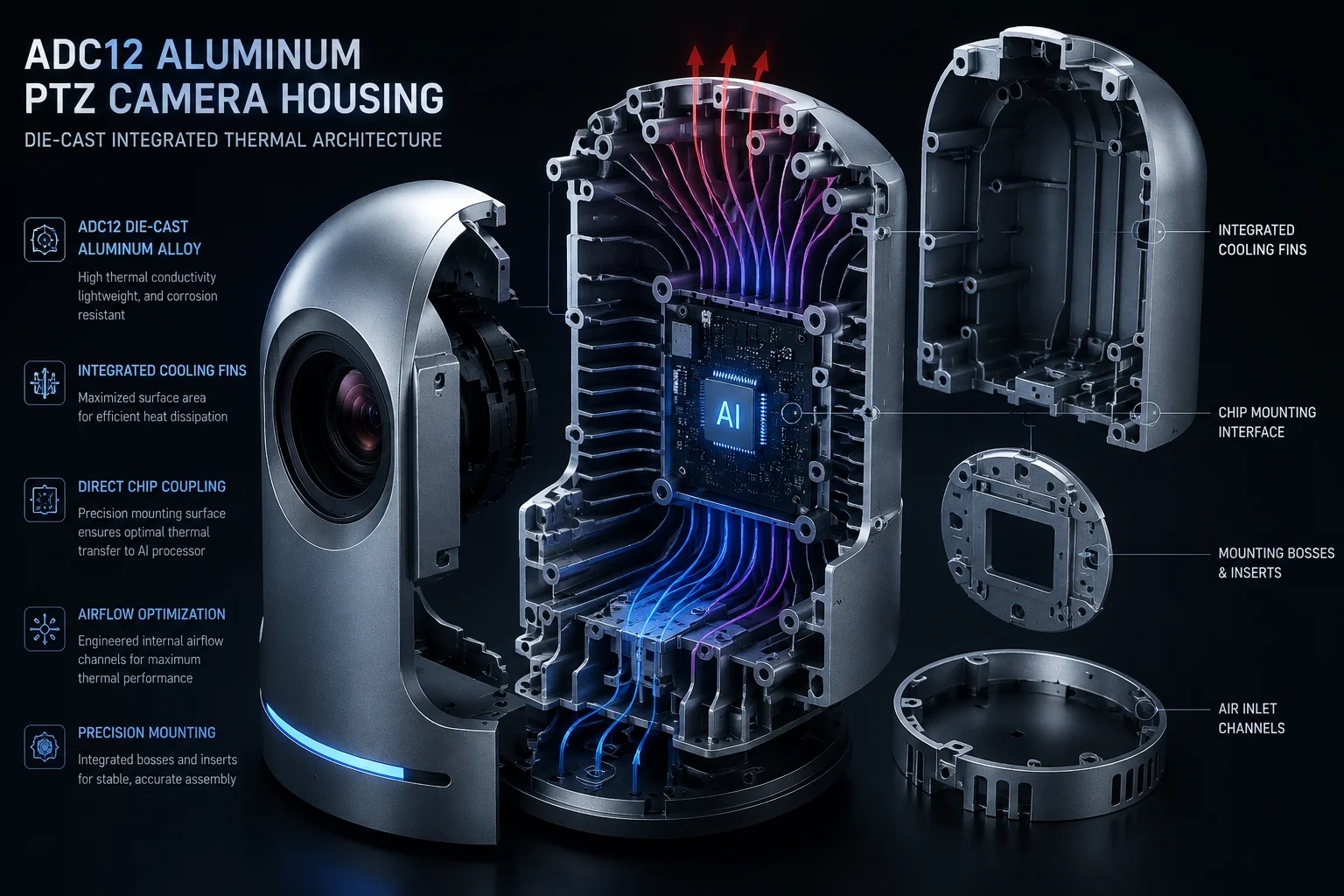 ADC12 die-cast internal heat fins for AI chip cooling
How Die-Casting Creates Superior Thermal Structures
The die-casting process injects molten ADC12 aluminum into a steel mold at 10,000-15,000 PSI. This extreme pressure forces the metal into every tiny detail of the mold cavity. The result is a single-piece housing with:
- Internal cooling fins as thin as 1.5 mm with 2 mm spacing
- Thermal contact pads that press directly against the AI chip’s heat spreader
- Air channels that guide natural convection from bottom to top
- Mounting bosses with threaded inserts cast in place
All of this comes out of the mold as one piece. No assembly. No welding. No weak points.
Why Stainless Steel Cannot Match This
Stainless steel housings are typically made by:
- Laser cutting flat sheets
- Bending them into shape
- Welding the seams
- Grinding and polishing
This process cannot create internal fins. You would need to machine them from a solid block, which wastes 80% of the material and costs 5-10 times more. Or you could weld separate fin pieces inside, but each weld is a potential leak point for IP66 sealing.
The AI Chip Cooling Problem
Modern PTZ cameras with AI features (human detection, vehicle tracking, face recognition) use chips that draw 5-15 watts continuously. That heat concentrates in a space smaller than a postage stamp. Without direct thermal coupling to the housing, the chip temperature rises until it throttles performance or fails.
| Cooling Method | AI Chip Temperature | AI Processing Speed | Expected Chip Life |
|---|---|---|---|
| ADC12 with integrated fins | 65-75°C | 100% (full speed) | 8-10 years |
| Stainless steel flat interior | 90-100°C | 60-70% (throttled) | 3-5 years |
| Stainless steel with added heatsink | 80-85°C | 85-90% | 5-7 years |
Dimensional Precision and IP66 Sealing
Die-casting holds tolerances of ±0.1 mm. This precision means the O-ring groove, the lens port, and the cable gland all fit perfectly every time. There is no hand-fitting or shimming on the production line. For IP666 certification, this consistency is everything. One housing out of tolerance means one camera that leaks in the rain.
At our facility, we control the mold tooling in-house. If a dimension drifts during production, we catch it within the same shift. This vertical control is something you cannot get from a supplier who outsources their metalwork.
Conclusion
ADC12 die-cast aluminum wins for PTZ camera housings in thermal performance, weight, design complexity, and cost. Choose stainless steel only for extreme salt or chemical exposure. For 90% of outdoor security projects, aluminum is the smarter, longer-lasting choice.
1. Learn about AI accelerators used in modern PTZ cameras for object detection. ↩︎ 2. Understand how system-on-a-chip designs integrate CPU, GPU, and other functions. ↩︎ 3. Explore the standard salt spray test method for corrosion resistance. ↩︎ 4. Learn how galvanic corrosion occurs when dissimilar metals contact in electrolyte. ↩︎ 5. Understand the high-pressure die-casting process and its advantages. ↩︎ 6. Check the IP code rating for dust and water ingress protection. ↩︎ 7. Learn about powder coating as a durable corrosion-resistant finish. ↩︎ 8. Understand how the natural oxide layer self-heals and protects aluminum. ↩︎