
I have seen many outdoor cameras fail after hot days and cool nights. Moisture sneaks in, and soon the lens fogs up and the system loses trust.
Yes, a Gore-style pressure compensation vent1 can help prevent internal condensation12.
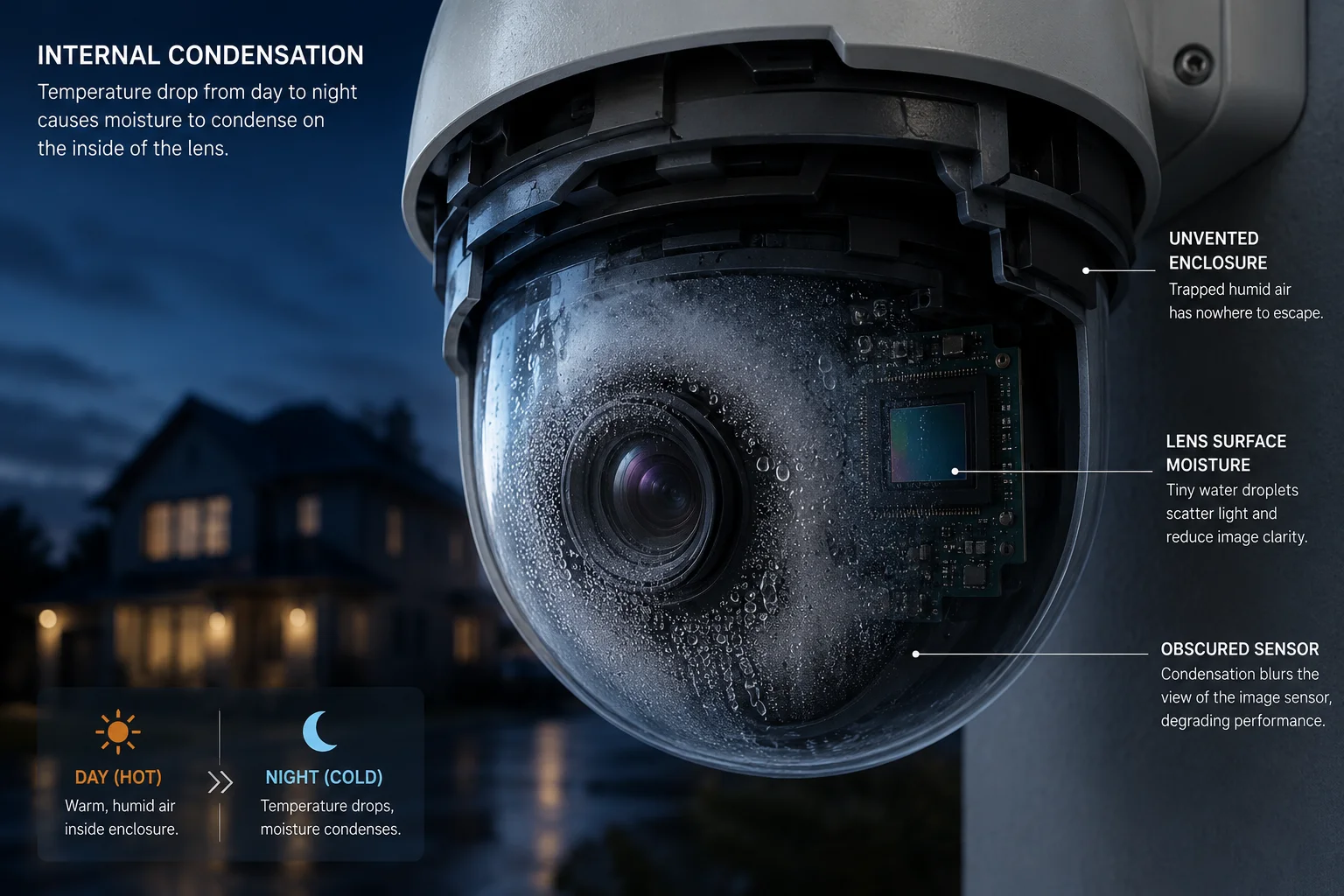 pressure compensation vent and PTZ camera
I want to explain why this small part matters so much, because in harsh outdoor installs, one weak seal can ruin the whole project.
Table of Contents
How does the Gore Valve equalize internal pressure while blocking liquid water and dust?
I have dealt with outdoor enclosures that looked fine on the outside but still built up fog inside. That problem usually starts with pressure changes, not with a bad lens.
A Gore-style vent lets air and water vapor move through a special ePTFE membrane2 while it keeps out liquid water and dust. This helps the inside and outside pressure stay close, so the enclosure does not “breathe” through weak seals in a harmful way.
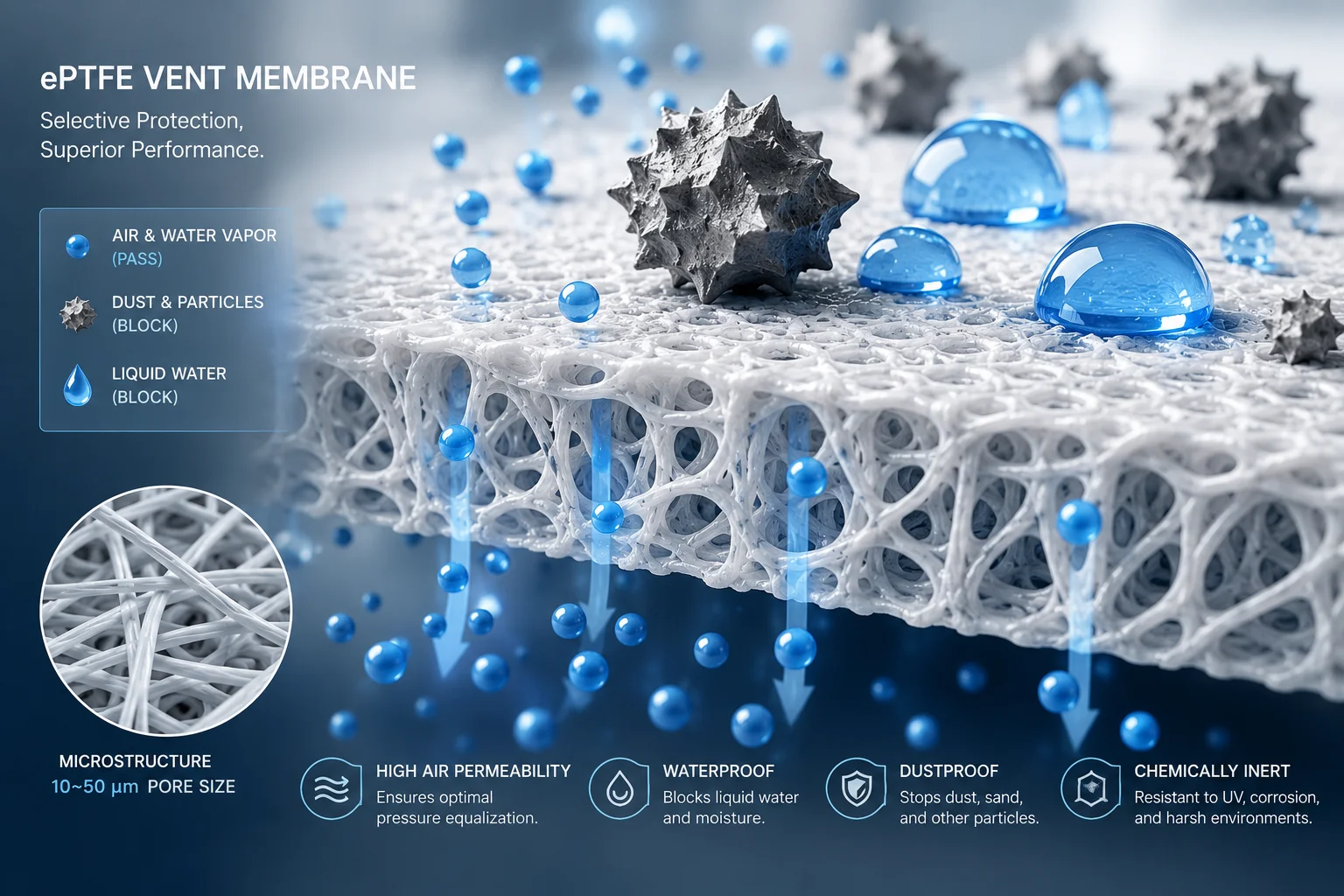 ePTFE vent membrane for outdoor camera
I think the key idea is simple. Warm air expands in the sun. Cold air contracts at night. If the housing is sealed too tightly with no pressure path, it can suck in humid air through cable holes, gasket edges, or tiny gaps. That moist air then condenses when the temperature drops. The vent gives that air a better path. It does not open the housing like a hole. It works like a smart filter. It allows gas exchange, but it resists water droplets and dirt.
What I look for in a good vent design
| Feature | What I want | Why it matters |
|---|---|---|
| Water resistance | Blocks rain and spray | Keeps liquid out |
| Air flow | Allows pressure balance | Reduces seal stress11 |
| Dust protection | Stops fine particles | Protects optics and PCB |
| Stable performance | Works in heat and cold | Fits outdoor use |
| Long life | Does not need frequent change | Lowers service cost |
I also pay attention to placement. A vent works best when I put it in a spot that does not face standing water. I avoid low points where rain can sit. I also make sure the vent is not covered by paint, glue, or dirt during assembly. If the membrane gets blocked, the whole pressure control idea loses value. In real projects, I treat this part as a small but important system piece, not as a simple accessory.
Will the valve prevent the “Vacuum Effect” that sucks moisture through seals during rapid cooling?
I have seen this happen after a hot afternoon and a sudden cold night. The camera housing cools fast, the air inside shrinks, and the unit pulls outside air inward.
Yes, the valve helps stop the vacuum effect3 by letting pressure drop or rise in a controlled way. This means the enclosure does not create strong negative pressure that drags humid air through seals and cable entry points.
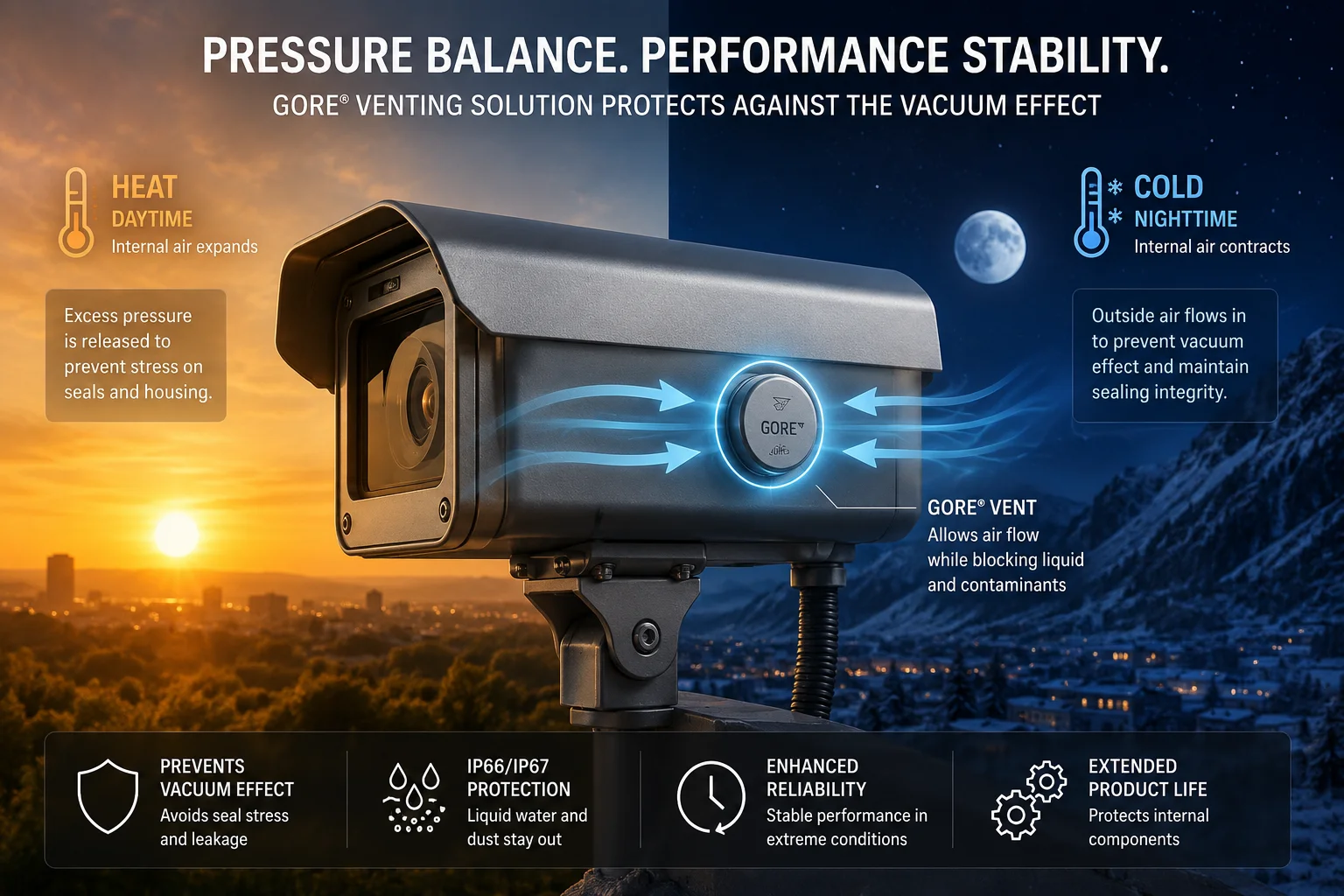 camera enclosure pressure balance vent
Why the vacuum effect is so damaging
| Situation | What happens inside | Risk |
|---|---|---|
| Fast cooling | Internal air contracts | Negative pressure forms |
| Rapid heating | Internal air expands | Seal stress rises |
| Humid night air | Moisture gets pulled in | Condensation starts |
| Poor cable sealing | Air enters through small gaps | Fog and corrosion |
I think many people focus only on rainproof ratings like IP664 or IP675. Those ratings are useful, but they do not solve every problem by themselves. A sealed box still needs to deal with thermal cycling6. Every day, the housing expands and contracts. If I leave that pressure change unmanaged, the seals age faster. Rubber gets tired. Gaskets flatten. Tiny paths open up. Then the system starts to inhale moist air again and again.
How I explain the process to customers
I often explain it like this: a camera enclosure is not a stone box. It changes with weather. When the sun heats it, the air inside pushes out. When the night gets cold, the air inside pulls back. If the box has no vent, the air moves through the easiest weak point. That weak point is often the cable gland or the door seal. Once moist air gets inside, the dew point7 can be reached very fast. Then water droplets form on the lens, the IR window, or the board.
I also think it helps to compare this with a car cabin. If a car window is slightly open and the temperature changes fast, the inside feels different right away. The same logic applies here, but the stakes are higher because the camera must work all day and night. The vent does not remove all moisture in a magical way. It just keeps pressure changes calm. That calm state makes condensation far less likely.
How often should the Gore Valve be replaced in a high-humidity tropical environment?
I know this question matters because many buyers want a low-maintenance product. They do not want more truck rolls, more labor, or more surprise failures.
In most cases, a quality pressure compensation vent10 does not need frequent replacement. In a high-humidity tropical environment8, I inspect it during regular service checks and replace it only if it becomes blocked, damaged, contaminated, or aged beyond spec.
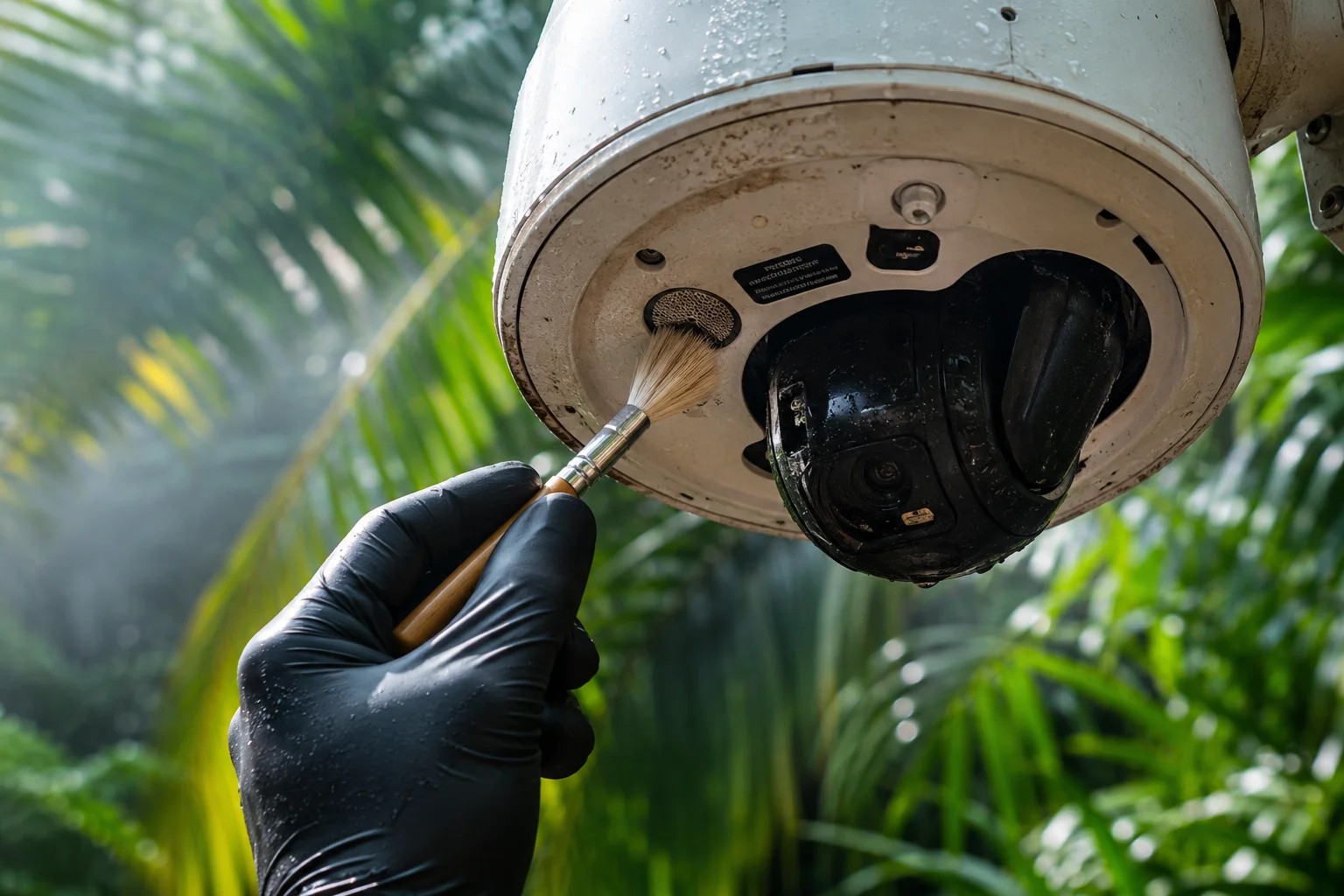 maintenance check for camera vent replacement
What changes vent life in tough weather
| Factor | Effect on vent life | My action |
|---|---|---|
| Constant humidity | More moisture load | Check for clogging |
| Salt air | Faster surface wear | Inspect more often |
| Dust and pollen | Can block membrane pores | Clean the housing area |
| Oil mist or paint | Can seal the vent shut | Avoid exposure |
| Strong sun | Affects materials over time | Use tested parts |
I do not like giving a fixed replacement number without seeing the real use case. A rooftop unit in Florida, a farm site in Southeast Asia, and a city pole in the Middle East all age in different ways. The better question is not “How many months?” The better question is “Is the vent still breathing normally, and is the enclosure still dry?” I check for fog inside, water marks, dust buildup, and pressure issues after fast weather changes. If the camera stays clear and the seals stay healthy, I usually leave the vent in place. If the membrane gets coated with dirt or chemical residue, then I replace it sooner.
What I tell field teams to watch
I ask installers and service teams to look for three signs. First, they should watch for repeat internal fog that does not go away. Second, they should look for corrosion near the connector or board. Third, they should inspect the vent face for grime, paint, glue, or insect blockage. A vent can fail quietly. It may still look fine, but it may not move air well anymore. That is why I prefer a simple inspection step during routine maintenance. It costs little and can save the whole camera.
Can the valve handle the extreme pressure changes of a 4G PTZ operating in high-altitude zones?
I think this is where the design matters most. A 4G PTZ9 in high-altitude zones10 faces low air pressure, cold nights, strong sun, and often harsh wind. That is a hard mix.
Yes, a proper Gore-style vent can help handle extreme pressure changes by equalizing pressure across the enclosure. It supports stable operation in high-altitude areas, but it must be paired with good sealing, proper vent placement, and tested materials.
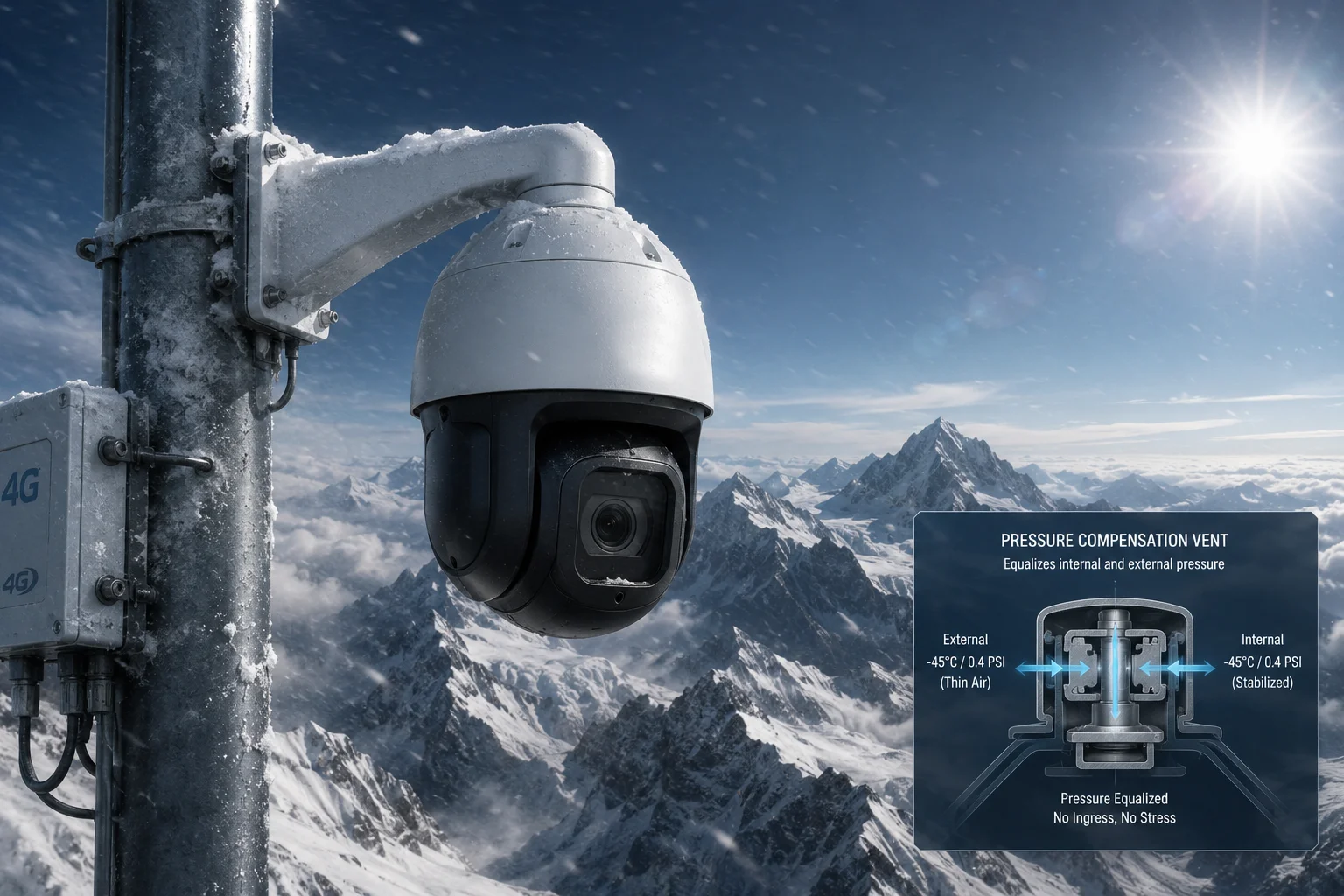 high altitude PTZ pressure compensation solution
Why altitude makes the problem harder
At high altitude, the outside air pressure is lower than at sea level. That means the pressure difference between the inside and outside of the camera can become larger and more frequent. I have seen this matter in mountain sites and remote towers. The camera is not just fighting rain. It is also fighting fast thermal shifts and lower atmospheric pressure. When a 4G PTZ pans, tilts, zooms, heats up, and cools down, the enclosure gets many small stress cycles. If the pressure path is weak, the unit can pull in moisture or lose seal life faster than expected.
What I need the whole system to do
| System part | Needed job | Why it matters in altitude |
|---|---|---|
| Vent membrane | Equalize pressure | Prevents seal stress |
| Main gasket | Keep water out | Supports IP protection |
| Cable gland | Block air leaks | Stops moisture entry |
| Housing material | Stay stable in heat and cold | Reduces warping |
| Internal coating | Resist condensation damage | Protects board and connectors |
I also want to be careful here. A vent is not a cure for bad engineering. If the housing has poor machining, weak gasket compression, or loose cable sealing, the vent can only do so much. In high-altitude deployments, I prefer to test the whole unit in pressure and temperature cycles before shipment. I also prefer to use materials that do not crack in cold air and do not soften too much in strong heat. For a 4G PTZ, this matters even more because the moving parts create extra heat and vibration. The vent helps the enclosure stay balanced, but the full design must still be solid.
Conclusion
I see the Gore-style vent as a small part with a big role. It helps stop condensation, reduce pressure stress, and keep outdoor PTZ cameras stable in hard weather.
1. Understand the technology and product range of Gore’s ePTFE pressure vents for electronic enclosures. ↩︎ 2. Learn about expanded PTFE (ePTFE), the material used in Gore vents that allows air passage while blocking liquids. ↩︎ 3. Explore the physics of thermal contraction that creates negative pressure inside sealed enclosures. ↩︎ 4. Review the international standard for ingress protection ratings, including IP66 for dust-tight and water-jet resistance. ↩︎ 5. Check the IP67 rating for temporary immersion resistance, compared to IP66. ↩︎ 6. Learn about repeated heating and cooling that stresses seals and causes pressure changes. ↩︎ 7. Understand how dew point temperature relates to condensation inside enclosures. ↩︎ 8. Find information on humidity levels and their impact on electronics in tropical climates. ↩︎ 9. Learn about PTZ (Pan-Tilt-Zoom) cameras that use 4G cellular networks for remote operation. ↩︎ 10. Understand the lower atmospheric pressure and temperature extremes found at high altitudes. ↩︎ 11. Review how pressure differentials create mechanical stress on seals and gaskets. ↩︎ 12. Explore the causes and prevention of condensation inside electronic enclosures. ↩︎