
I’ve seen too many PTZ cameras fail in the field — not from electronics, but from a single gasket that cracked after two summers in the sun.
Yes, high-end PTZ cameras use a double gasket design at the base-to-housing junction. This setup places two separate seals — an outer dust gasket and an inner O-ring — to create a redundant barrier that protects internal components from moisture, dust, and pressure changes in harsh outdoor environments.
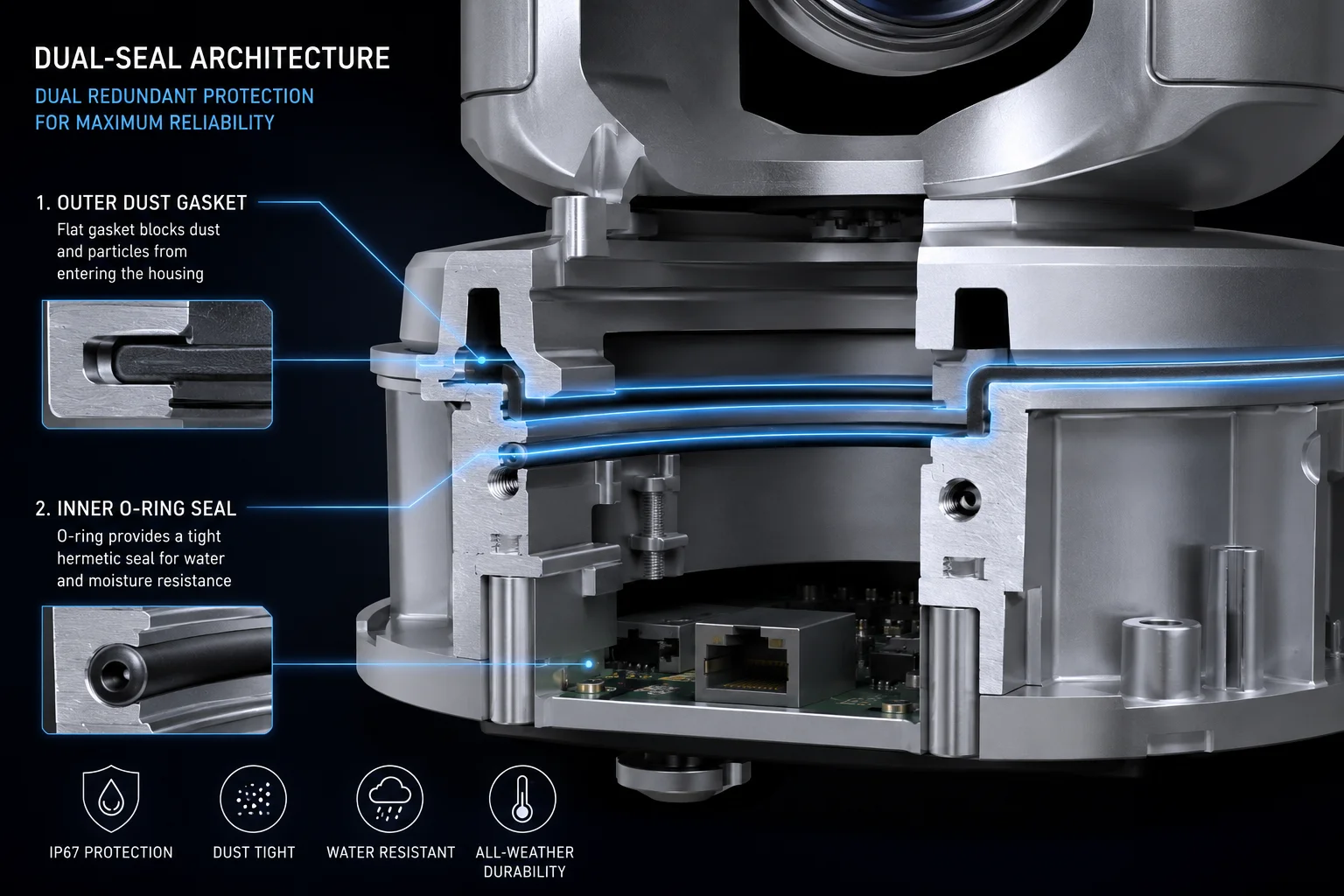
Below, I’ll break down exactly how this dual-seal architecture works under rain, vibration, pressure, and field maintenance scenarios. If you’re sourcing PTZ cameras for off-grid or industrial sites, this is the structural detail that separates reliable hardware from warranty nightmares.
Table of Contents
How Does the Double-Sealing Groove Provide a Redundant Barrier Against High-Pressure Rain?
I’ve tested units in simulated storm conditions. A single gasket can hold up for a year. But when UV and heat degrade it2, water finds a way in — every time.
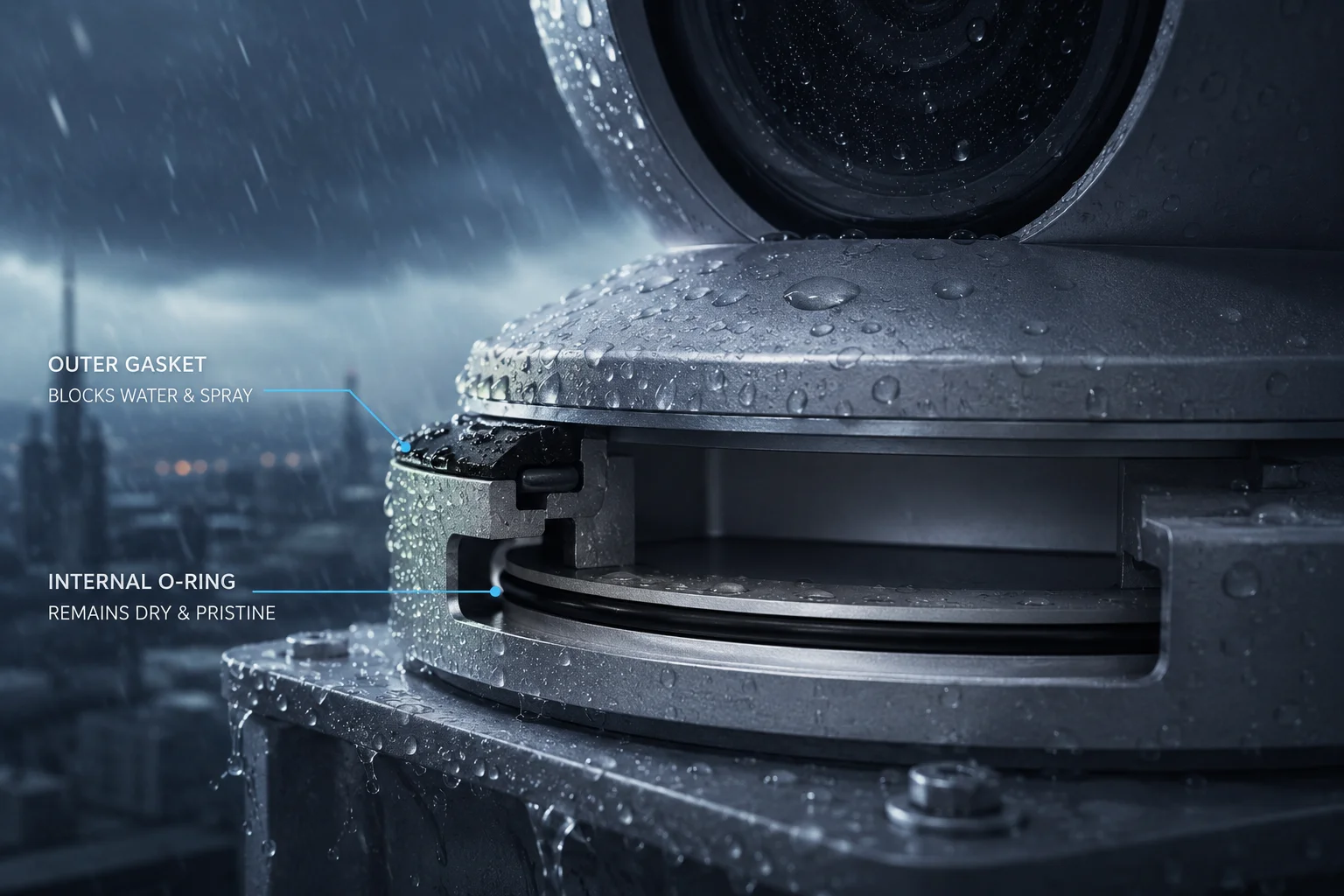
The double-sealing groove provides redundancy by placing two independent barriers in series. If high-pressure rain forces water past the outer flat gasket3, the inner compressed O-ring4 blocks it completely. This means no single point of failure can compromise the IP66 or IP67 rating5.
How the Two Seals Work Together
Think of it like two doors in an airlock. The outer seal handles the bulk of the work. The inner seal handles what gets through.
The outer seal is a flat, thickened gasket. It sits on the outermost contact surface of the base. When you tighten the mounting bolts, this gasket compresses evenly against the housing lip. Its job is simple: block direct water spray, sand, insects, and debris. In most rain events, this seal alone stops over 95% of water from reaching the interior.
The inner seal is a high-compression O-ring. It sits in a machined groove deeper inside the junction. This groove is precision-cut so the O-ring compresses to a specific ratio — usually between 15% and 25% of its cross-section diameter. That compression creates a gas-tight barrier.
Why Redundancy Matters in Real Storms
In Texas, Florida, or coastal Europe, rain doesn’t fall gently. Wind-driven rain hits at angles. It finds gaps. It pools in crevices. A single gasket under these conditions faces:
- Direct water jet pressure (up to 100 kPa in IP66 testing)
- Capillary action6 pulling water into micro-gaps
- Thermal cycling7 that shrinks and expands the housing daily
With two seals, even if the outer gasket develops a micro-crack after 3 years of UV exposure, the inner O-ring remains untouched by sunlight and maintains its seal. The space between the two seals acts as a buffer zone — water that passes the first barrier has nowhere to go but sit in a shallow channel that never reaches the second seal.
Material Selection for Each Layer
| Seal Layer | Material | Function | Lifespan |
|---|---|---|---|
| Outer Gasket | Thickened flat EPDM | Blocks splash water, dust, insects | 5-7 years outdoor |
| Inner O-Ring | VMQ (Silicone)8 or EPDM | Gas-tight moisture barrier | 8-10 years (UV-shielded) |
| Groove Surface | Anodized aluminum | Prevents corrosion at seal contact | 15+ years |
The “Siphon Effect” Problem
Here’s something most buyers don’t think about. At night, the camera housing cools down. The air inside contracts. This creates a slight vacuum — a siphon effect. If there’s only one seal and it has even a tiny gap, that vacuum pulls moist air inward. By morning, you get condensation on the dome glass. The double gasket design eliminates this because the inner O-ring maintains gas-tight integrity regardless of pressure changes.
Does the Double-Gasket Design Help in Dissipating Vibrations From the PTZ’s High-Speed Motors?
I once had a client return a batch of cameras. The seals looked fine visually. But the pan motor’s vibration had slowly walked the single gasket out of its seat over six months.
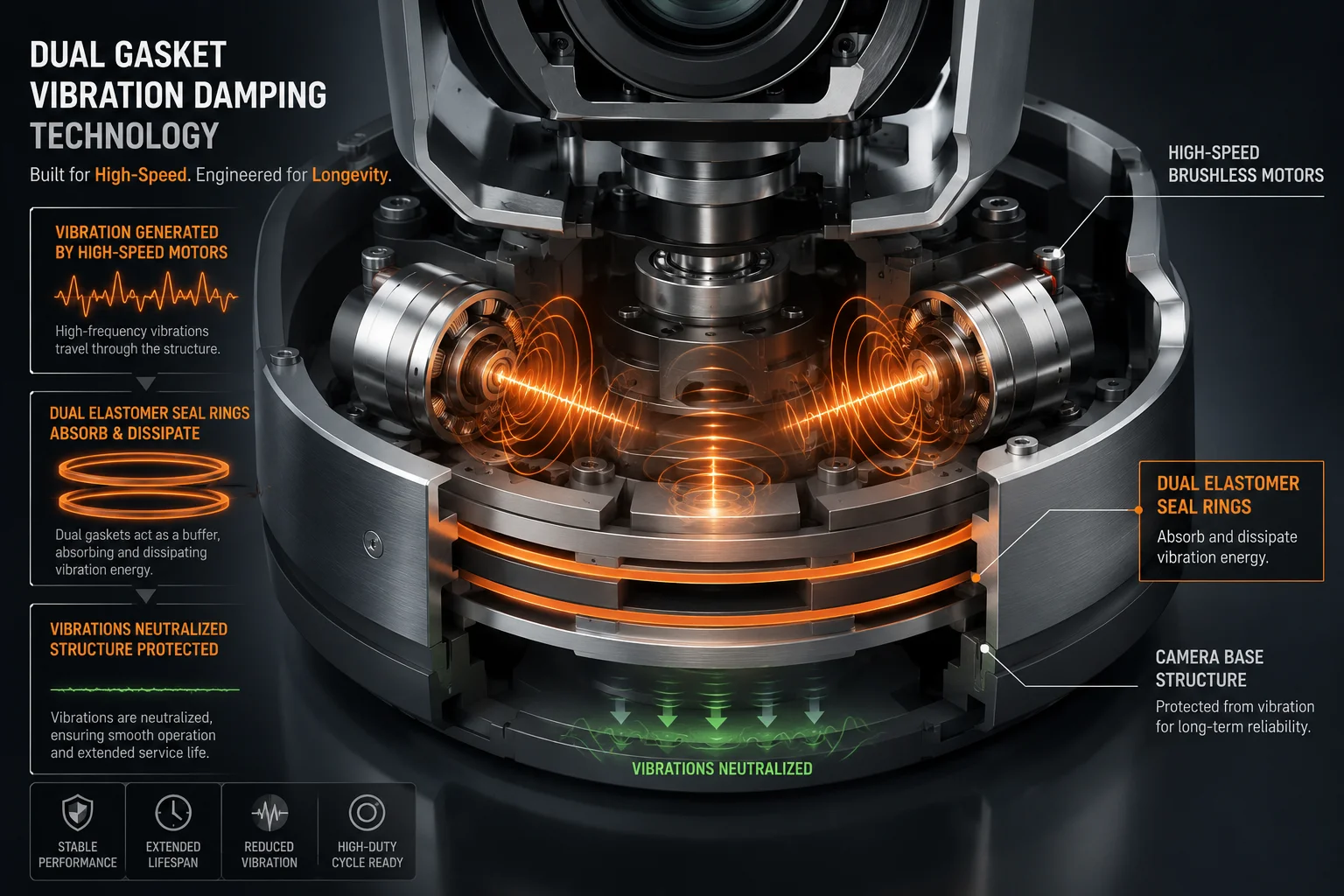
Yes, the double-gasket design absorbs and isolates motor vibrations. The two elastomer seals act as damping layers between the metal base and housing, preventing resonant vibration from loosening the mechanical connection or degrading seal compression over time.
Why PTZ Motors Create a Seal Problem
A PTZ camera isn’t static. The pan motor spins the housing. The tilt motor shifts the camera module. High-speed preset tours can cycle dozens of times per hour. Each movement creates micro-vibrations that travel through the metal structure.
These vibrations are small — you can’t feel them by hand. But over thousands of cycles per day, they do two things:
- They cause “fretting” — tiny back-and-forth movements at the gasket-to-metal contact surface
- They create resonant frequencies that can amplify at certain motor speeds
A single gasket in this environment slowly loses its compression set. The rubber fatigues. It flattens permanently. After 6-12 months, the seal pressure drops below the threshold needed for IP66.
How Two Gaskets Solve This
With two gaskets at different positions and different compression levels, the vibration energy gets absorbed in stages:
- The outer gasket (softer, thicker) absorbs low-frequency vibrations from pan rotation
- The inner O-ring (harder, higher compression) resists high-frequency vibrations from the tilt motor’s stepper pulses
Because they sit at different radial distances from the rotation axis, they don’t resonate at the same frequency. This breaks up the vibration path and prevents harmonic amplification.
Durometer and Vibration Resistance
| Seal | Shore A Hardness | Vibration Role | Compression Set Resistance |
|---|---|---|---|
| Outer Gasket | 40-50A (soft) | Absorbs low-frequency pan vibration | Moderate — replaced at service intervals |
| Inner O-Ring | 60-70A (firm) | Resists high-frequency tilt pulses | High — maintains shape for 8+ years |
Real-World Impact on Motor Longevity
The damping effect isn’t just about keeping water out. It also reduces mechanical stress on the motor mounts themselves. When vibration reflects back from a rigid seal, it returns to the motor bearings. With two elastomer layers absorbing that energy, the motors run quieter and last longer. I’ve seen this add 2-3 years to motor life in high-duty-cycle deployments like traffic monitoring or perimeter patrol.
Is the Space Between the Two Gaskets Vented to Prevent “Pressure Buildup” During Assembly?
I learned this the hard way on an early prototype. We sealed everything perfectly — too perfectly. The trapped air between the gaskets expanded in the afternoon heat and pushed the outer seal out of its groove.
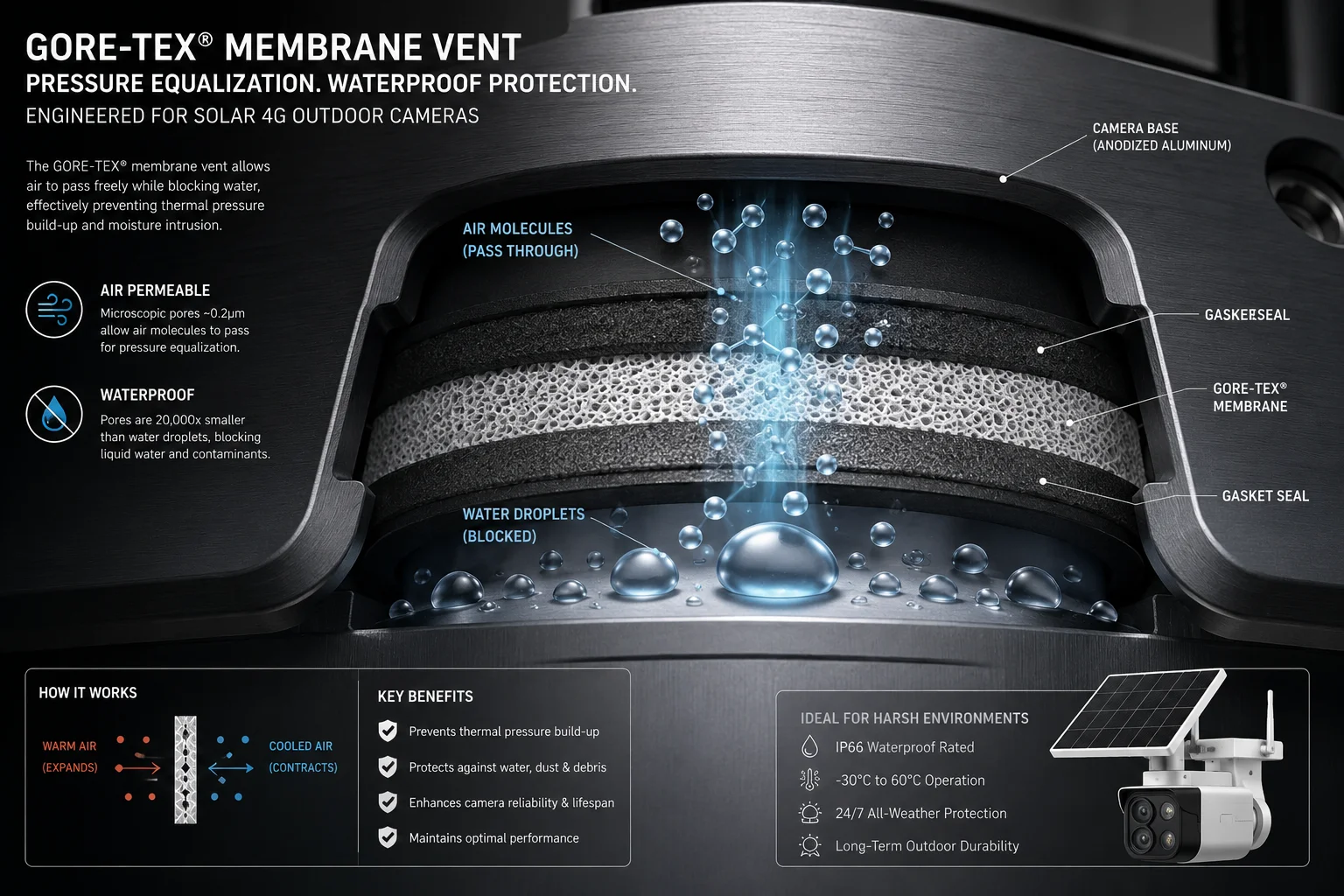
Yes, the inter-seal space is typically vented through a Gore-Tex breathing membrane9 or a micro-channel. This prevents trapped air from expanding under heat and disrupting seal integrity, while still blocking liquid water and dust from entering the housing.
The Trapped Air Problem
When you assemble a double-gasket junction, you create a small sealed chamber between the two gaskets. This chamber contains air at whatever temperature and pressure existed during assembly — usually a factory at 25°C.
Now ship that camera to a job site in Arizona. The housing surface hits 70°C in direct sun. That trapped air expands. The pressure rises. With nowhere to go, it pushes outward against the outer gasket and inward against the inner O-ring. Over repeated thermal cycles, this pressure cycling fatigues both seals.
How the Vent Works
The solution is a controlled breathing path. There are two common approaches:
Option 1: Gore-Tex Membrane Vent
A small disc (usually 5-8mm diameter) of expanded PTFE membrane is installed on the housing wall near the inter-seal zone. This membrane has pores sized at 0.1-0.2 microns. Air molecules pass through freely. Water droplets (smallest raindrop is about 200 microns) cannot.
Option 2: Micro-Channel in the Gasket Groove
Some designs machine a tiny channel (0.3mm wide) in the groove between the two seal seats. This channel connects to the exterior through a labyrinth path10 — a series of right-angle turns that allow slow air exchange but block water intrusion through surface tension effects.
Why This Matters for 4G Solar PTZ Systems
In off-grid solar PTZ cameras, the electronics generate heat during 4G transmission bursts. A 10-second video upload can spike the internal temperature by 5-8°C. Without venting, this creates rapid pressure pulses inside the housing. The breathing membrane smooths these pulses out, keeping both gaskets under consistent, predictable compression.
Assembly Considerations
For installers, this vent also makes assembly easier. Without it, pressing the housing onto the base compresses the trapped air, creating back-pressure that fights against the mounting bolts. With the vent, the air escapes smoothly during assembly, and the bolts seat evenly without fighting pneumatic resistance.
Vent Performance Specs
| Parameter | Gore-Tex Membrane | Micro-Channel |
|---|---|---|
| Air Flow Rate | 500-2000 ml/min | 50-200 ml/min |
| Water Entry Pressure | >1 bar (blocks rain) | >0.5 bar (blocks splash) |
| Dust Blocking | >99.9% at 0.1μm | >95% at 5μm |
| Best For | High-temp environments | Cost-sensitive designs |
Will This Design Allow for Easier On-Site Maintenance Without Compromising the IP67 Rating?
I’ve talked to integrators who avoid certain camera brands because opening the housing for a SIM card swap means destroying the seal — and then hoping the replacement gasket holds.
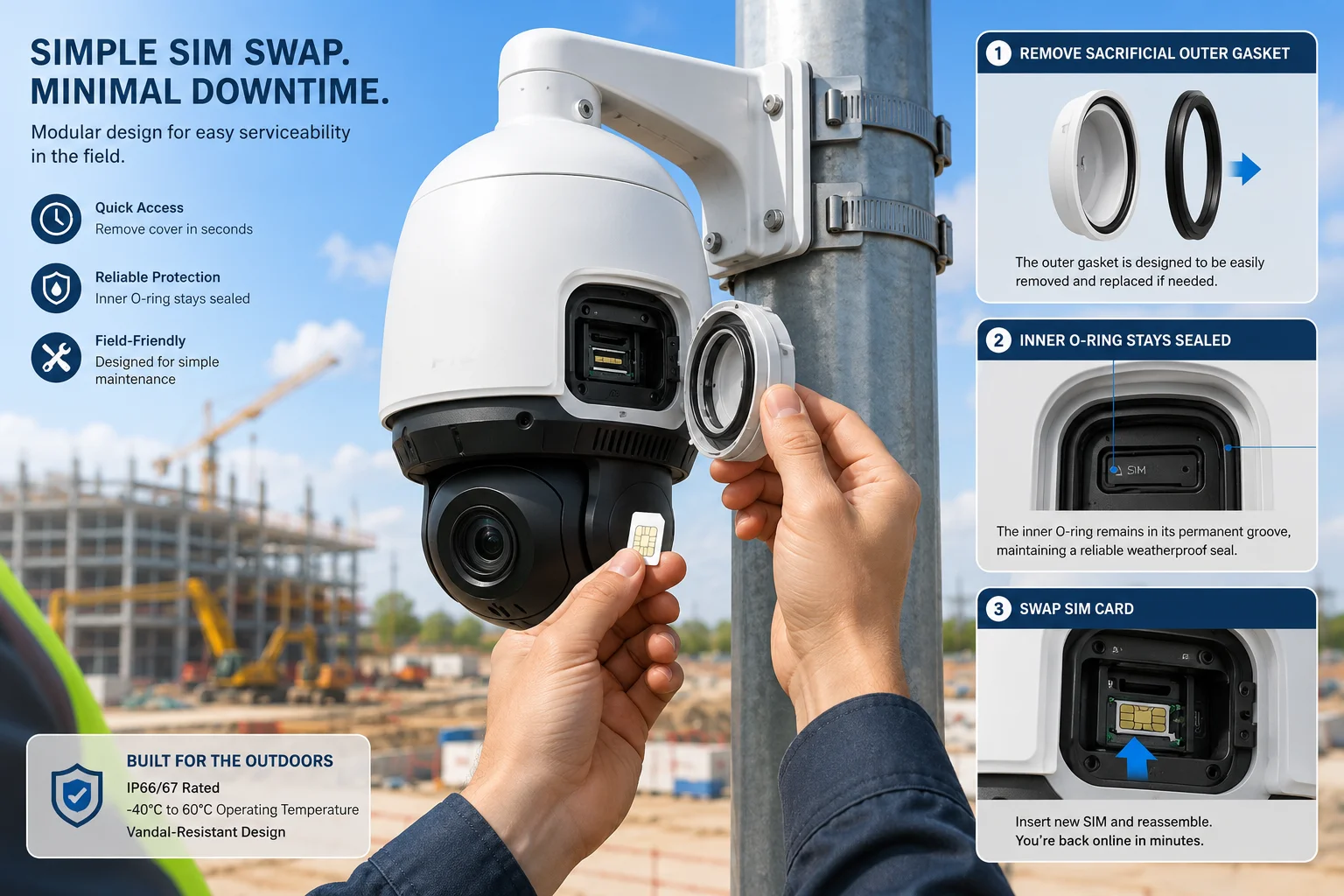
Yes, the double-gasket design simplifies field maintenance. Because the inner O-ring sits in a protected groove and rarely degrades, technicians can open the outer housing, replace the outer gasket if needed, and reseal the unit without touching the critical inner seal — preserving the IP67 rating.
The Maintenance Reality for Remote Sites
David, you know this scenario. A camera is mounted on a 6-meter pole at a construction site 40 miles from the nearest town. The 4G SIM card needs swapping. Or the SD card is full. Or a firmware update requires physical access.
With a single-gasket design, opening the housing means:
- Removing the gasket (which often tears or deforms)
- Cleaning the groove
- Installing a new gasket from a maintenance kit
- Re-torquing all bolts to exact spec
- Hoping the new gasket seats correctly without a pressure test
That’s 30-45 minutes of careful work on a ladder. One mistake and the camera leaks on the next rain.
How Double Gaskets Change the Workflow
With the double-gasket architecture, the maintenance path is different:
- The outer gasket is designed as a “sacrificial” seal — easy to remove and replace
- The inner O-ring stays seated in its groove permanently — you never touch it
- Even with the outer gasket removed, the inner O-ring alone provides IP65-level protection temporarily
- After maintenance, you press a new outer gasket into place and tighten the bolts
This takes 10-15 minutes. The critical seal (the inner O-ring) was never disturbed. The IP67 rating depends primarily on that inner seal, so it remains valid.
Torque Sequence for Reassembly
This is important. When you put the base back together after maintenance:
- Use a cross-pattern (star pattern) when tightening bolts
- Tighten in three stages: finger-tight, then 50% torque, then full torque
- This ensures even compression on both gaskets
- Uneven tightening creates a high-pressure side and a low-pressure side — the low side leaks
Silicone Grease: The Field Technician’s Best Friend
For coastal or high-humidity sites, I recommend applying a thin layer of silicone grease11 (Dow Corning 111 or equivalent) on the outer gasket’s contact surface during reassembly. This does three things:
- Fills microscopic surface imperfections in the metal
- Prevents the gasket from bonding to the aluminum over time (makes next removal easier)
- Adds a hydrophobic layer that repels water at the seal face
What Not to Do
Never use petroleum-based lubricants on EPDM or silicone gaskets. They swell the rubber and destroy the compression set within weeks. Stick to silicone-based grease only.
Conclusion
The double-gasket design at the base-housing junction is not a luxury feature — it’s the structural foundation that makes long-term outdoor PTZ deployment reliable, maintainable, and truly weatherproof.
1. Understand the engineering principles of using dual seals for redundancy. ↩︎ 2. How ultraviolet radiation and high temperatures affect elastomer lifetime. ↩︎ 3. Learn about flat gaskets and their common applications in sealing. ↩︎ 4. O-ring compression ratios and how they achieve a gas-tight seal. ↩︎ 5. IP ratings define the degree of protection against solids and liquids. ↩︎ 6. The tendency of water to wick into microscopic gaps under surface tension. ↩︎ 7. The effect of repeated temperature changes on seal compression and material fatigue. ↩︎ 8. Silicone rubber’s high-temperature stability and UV resistance. ↩︎ 9. How expanded PTFE membranes allow air passage while blocking water and dust. ↩︎ 10. Non-contact sealing technique using tortuous paths to block water entry. ↩︎ 11. Proper lubricant for EPDM and silicone gaskets to prevent bonding and enhance seal. ↩︎