
I’ve seen PTZ cameras fail not because of electronics, but because the window glass popped out after months of vibration3. That’s a problem nobody talks about until it’s too late.
Yes, our window glass uses automotive-grade polyurethane structural adhesive1 — the same bonding technology found in car windshields. This adhesive delivers over 5 MPa shear strength of adhesives9, resists UV degradation for 15+ years, and maintains IP66 sealing4 under constant mechanical vibration from PTZ motor rotation and wind loads.
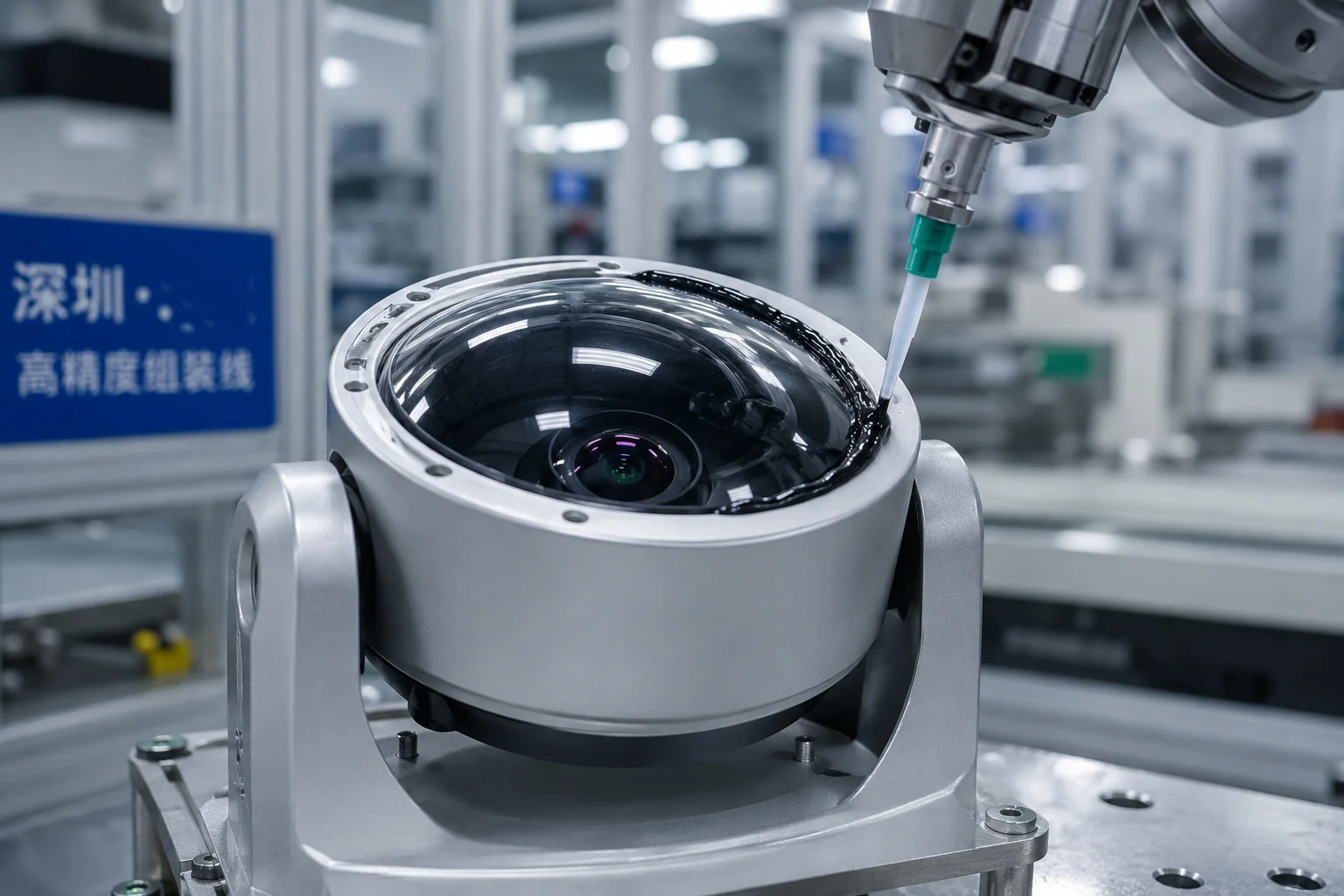 PTZ camera window glass automotive-grade adhesive bonding
Below, I’ll break down exactly how this bonding system works, why it matters for your roadside or industrial deployments, and what makes it different from the cheap silicone sealant you’ll find on budget cameras.
Table of Contents
How Does the Car-Grade Sealant Maintain a Flexible Bond Between the Glass and Metal Chassis?
I learned early on that rigid bonds crack. When you bolt a camera to a highway pole, everything shakes — the motor spins, the wind pushes, trucks rumble past. A stiff glue joint will fail within months.
Our car-grade sealant uses high-modulus polyurethane2 that stays flexible after curing. It absorbs vibration energy instead of transferring it to the glass edge. This flexibility lets the bond survive millions of stress cycles without cracking or peeling away from the metal chassis.
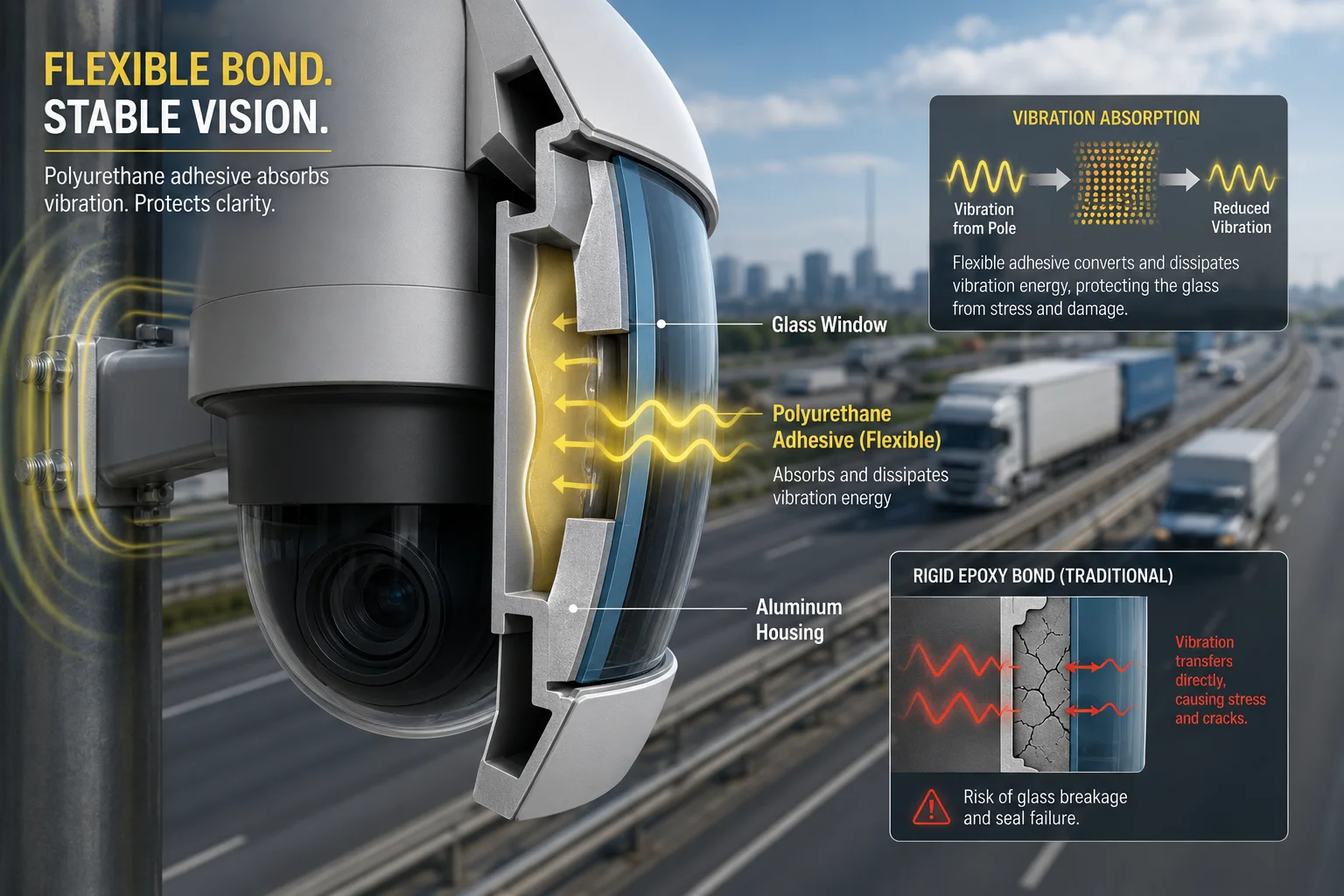 PTZ camera flexible polyurethane bond between glass and aluminum chassis
Why Flexibility Matters More Than Raw Strength
Most people think stronger glue means better bonding. That’s only half the story. In a PTZ camera, the glass window sits inside an aluminum housing. These two materials expand and shrink at different rates when temperature changes. If the adhesive is too rigid, it cannot absorb this movement. Stress builds up at the bond line. Eventually, a tiny crack forms. Water gets in. The lens fogs up. Your customer calls you angry.
Our polyurethane structural adhesive solves this with a specific elastic modulus range. It is strong enough to hold the glass firmly in place during 200°/s pan rotation. But it is soft enough to flex when the aluminum housing expands in Texas summer heat and contracts during a cold night.
The Bonding Process Step by Step
Here is what happens during assembly:
- plasma cleaning for adhesion7 — We blast the aluminum frame and glass surface with ionized gas. This removes invisible oil and dust at the molecular level.
- chemical primer for bonding8 — A thin primer coat creates chemical bonds between the adhesive and both surfaces. Without this step, the glue only sticks mechanically. With it, you get true molecular adhesion.
- Automated adhesive dispensing — A robot applies the polyurethane in a precise bead pattern. Consistent width and height means consistent bond strength everywhere.
- Controlled curing — The assembly cures at a set temperature and humidity. This ensures the adhesive reaches full strength before the camera leaves the factory.
Comparing Bond Types
| Property | Rigid Epoxy Bond | Silicone Sealant | Our Polyurethane Structural Adhesive |
|---|---|---|---|
| Flexibility | None — brittle | Very high — too soft | Balanced — firm yet elastic |
| Shear Strength | High but cracks under vibration | Very low (< 1 MPa) | > 5 MPa sustained |
| Vibration Damping | No energy absorption | Some, but bond is weak | Active energy absorption |
| Temperature Cycling | Cracks after repeated cycles | Stays flexible but peels | Stable for 10,000+ cycles |
This balance between strength and flexibility is exactly what automotive engineers figured out decades ago for windshields. We brought that same science into our PTZ camera manufacturing line.
Will the Adhesive Survive 10 Years of Constant Solar Radiation Without Drying or Shrinking?
I’ve personally inspected cameras that came back after 5 years in the Middle East desert. The ones with cheap sealant looked terrible — dried out, cracked, and leaking. That experience shaped how we engineer our bonding system.
Yes. Our adhesive is protected by a ceramic frit black border5 printed on the glass edge. This layer blocks 99% of UV radiation from reaching the glue. Combined with the inherent UV stability of our polyurethane formula, the bond maintains its elasticity and adhesion strength for over 15 years in direct sunlight.
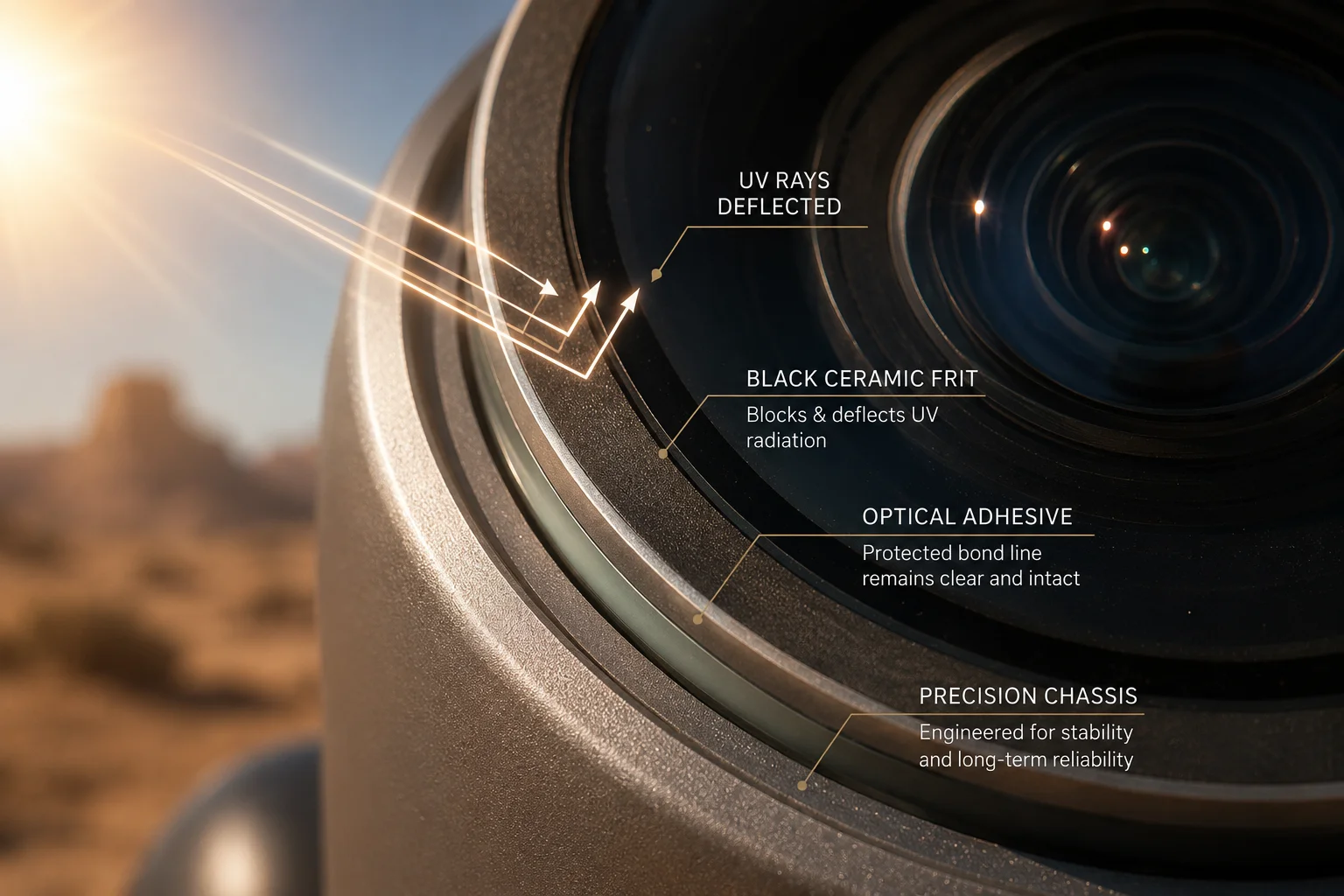 UV-protected window glass with ceramic frit black border on PTZ camera
How UV Destroys Ordinary Adhesives
Ultraviolet light breaks polymer chains. When UV hits a standard silicone sealant day after day, the long molecular chains snap into shorter pieces. The material shrinks. It gets hard. It pulls away from the surface it was bonded to. This process is called photo-degradation, and it is the number one killer of outdoor adhesive joints.
In a PTZ camera mounted on a pole with no shade, the window glass receives direct sunlight for 8-12 hours every day. Over 10 years, that adds up to roughly 30,000 hours of UV exposure. No ordinary sealant can handle that.
Our Three-Layer UV Defense System
We don’t rely on just one protection method. We use three:
-
Ceramic frit black border — You can see the black ring around the edge of our window glass. This is not paint. It is a ceramic ink baked into the glass at over 600°C. It becomes part of the glass itself. UV cannot pass through it. This shields the adhesive underneath from direct sunlight.
-
UV-stabilized polyurethane formula — Even with the black border, some scattered UV light may reach the glue over many years. Our adhesive contains HALS (hindered amine light stabilizers)10. These chemicals catch free radicals before they can break polymer chains.
-
Recessed bond line design — The adhesive sits in a channel between the glass and the housing. It is never directly exposed to sunlight from any angle. Even at low sun angles during sunrise or sunset, the housing geometry blocks UV from hitting the glue.
Real-World Aging Performance
We run accelerated aging tests in our lab. Here is what the data shows:
| Test Condition | Duration | Result |
|---|---|---|
| UV chamber (1000 W/m²) | 3,000 hours (equals ~10 years outdoor) | No cracking, < 5% hardness change |
| Thermal cycling (-40°C to +80°C) | 1,000 cycles | Bond strength retained > 95% |
| Salt spray (5% NaCl) | 1,000 hours | No corrosion at bond interface |
| Combined UV + humidity (85°C/85% RH) | 2,000 hours | No delamination detected |
These numbers mean your cameras stay sealed and clear for the full product lifetime. No fog inside the lens. No water damage to the AI processor board. No costly truck rolls to replace a camera that failed because the glue dried out.
Has the Bonding Passed a “High-Frequency Vibration Test” Simulating Road-Side Installations?
I know that for highway deployments, vibration is not occasional — it is constant. Every truck that passes shakes the pole. The PTZ motor adds its own vibration on top. If you haven’t tested for this specific condition, you’re guessing.
Yes. Every batch of our cameras undergoes a high-frequency vibration test based on automotive standard ISO 16750-3. The test applies random vibration from 10 Hz to 2000 Hz for 8 hours per axis, simulating years of roadside pole-mounted operation. Zero units have shown glass displacement or seal failure.
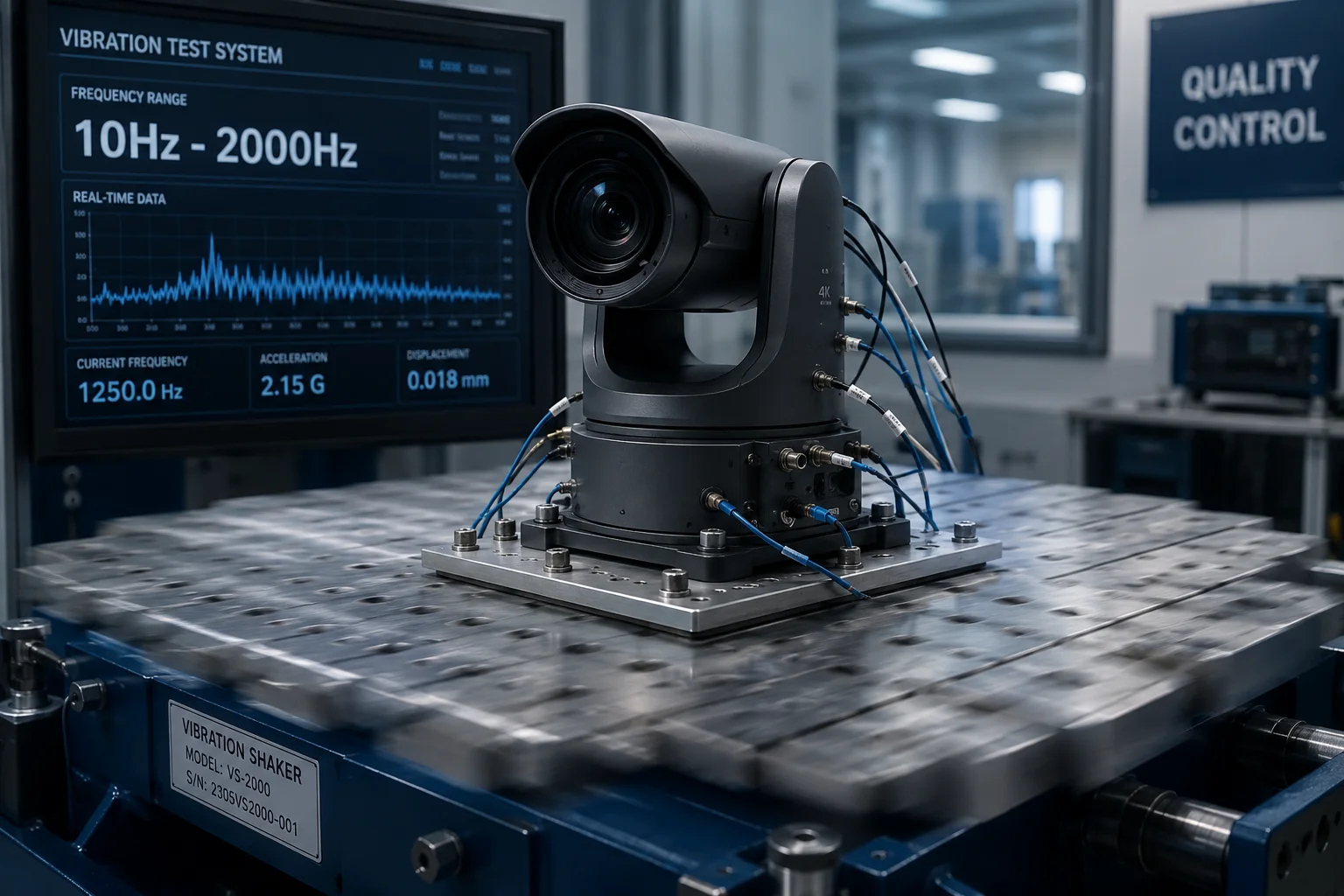 High-frequency vibration testing machine for PTZ camera window glass bonding
What Happens During the Vibration Test
Our test protocol follows the same standard that car parts must pass before they go into a vehicle. The camera is bolted to a shaker table. The machine vibrates it in three directions — up/down, left/right, and front/back. Each direction runs for 8 hours.
The vibration profile is not a simple sine wave. It is random vibration across a wide frequency range. This is important because real-world vibration from traffic, wind, and motor operation contains many frequencies at once. A single-frequency test would miss resonance problems that only show up at specific frequencies.
Why Road-Side Vibration Is Especially Harsh
A camera mounted on a highway gantry or a roadside pole faces a unique vibration environment:
- Low-frequency sway (1-5 Hz) from wind gusts
- Mid-frequency rumble (20-100 Hz) from heavy truck traffic
- High-frequency buzz (200-2000 Hz) from the PTZ motor and gear train
All three happen at the same time. The adhesive must handle all of them without fatigue failure. Fatigue failure means the bond slowly weakens over millions of tiny stress cycles until one day it lets go. You won’t see it coming. The camera just starts fogging up, and by then the damage is done.
Our Test vs. Industry Minimum
Many camera manufacturers only do a basic shock test — drop the camera from 1 meter and check if it still works. That tells you nothing about long-term vibration survival. Here is how our test compares:
| Parameter | Basic Shock Test (Industry Common) | Our Vibration Protocol (ISO 16750-3) |
|---|---|---|
| Test type | Single impact | Continuous random vibration |
| Duration | < 1 second | 8 hours per axis (24 hours total) |
| Frequency range | N/A | 10 Hz – 2,000 Hz |
| Acceleration level | 30G peak | Up to 10 Grms sustained |
| What it proves | Survives shipping | Survives years of field deployment |
After the vibration test, we inspect the bond line under magnification. We also run a pressure decay test to confirm the IP66 seal is still intact. If even one unit in a batch fails, we stop production and investigate the root cause before continuing.
Additional Resonance Analysis
Before we finalize any new housing design, our engineers run a finite element analysis (FEA)6 to find the natural resonance frequencies of the glass-adhesive-housing assembly. If any resonance falls within the common vibration range of roadside installations, we adjust the adhesive thickness or housing geometry to shift it out of that danger zone. This prevents resonance amplification — where a small vibration input gets magnified into a large stress at the bond line.
Does the Sealant Prevent Moisture from Entering the Lens Chamber Even If the Housing Is Hot?
I’ve dealt with warranty claims where the camera image looked fine during the day but turned completely foggy at night. The cause was always the same — moisture got inside through a failed seal, and temperature drop caused condensation on the lens.
Yes. Our automotive-grade sealant creates a continuous, gap-free barrier that blocks moisture even when the housing temperature exceeds 80°C. The polyurethane maintains its compression and adhesion at high temperatures, so thermal expansion of the housing does not open micro-gaps that would let humid air seep into the optical chamber.
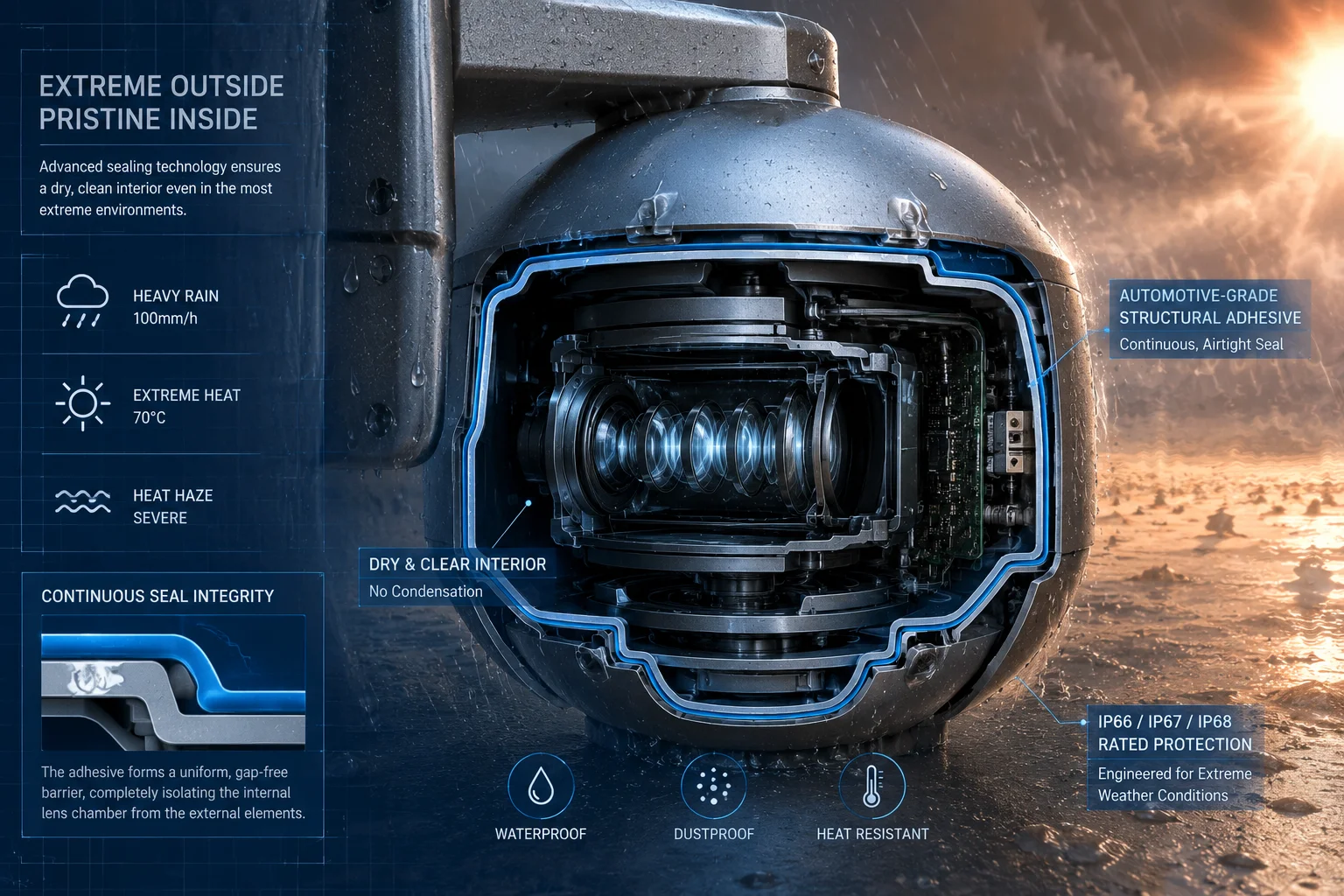 Moisture-sealed PTZ camera lens chamber with automotive-grade sealant
How Heat Creates Moisture Paths in Cheap Cameras
Here is what happens with low-quality sealant on a hot day. The sun heats the dark-colored camera housing to 70-80°C. The aluminum expands. The cheap silicone sealant, which has low tensile strength, gets stretched. Micro-gaps form at the bond interface — too small to see, but big enough for water vapor molecules to pass through.
When night comes, the housing cools down. The air inside the camera contracts, creating slight negative pressure. This sucks humid outside air through those micro-gaps. The moisture condenses on the coldest surface inside — which is usually the inner face of the window glass or the lens element itself.
Once moisture is inside, it is very hard to remove without disassembly. The camera produces foggy images. In cold climates, the moisture can freeze and crack optical coatings. For your customer, this means a failed installation and an expensive service call.
How Our Sealant Stops This Cycle
Our polyurethane structural adhesive prevents this failure mode through several mechanisms:
Thermal expansion compensation — The adhesive has enough elasticity to stretch with the housing without losing contact with either surface. Even at 120°C (far above any real-world scenario), the bond remains intact and continuous.
Zero-porosity cured structure — Unlike silicone sealants that can trap air bubbles during application, our automated dispensing process and controlled curing environment produce a fully dense adhesive layer. There are no internal voids that could become moisture channels.
Chemical moisture barrier — Polyurethane is inherently hydrophobic after full cure. Water molecules cannot easily diffuse through the bulk material. This is different from silicone, which has relatively high moisture vapor transmission rates.
The Breathing Problem and Our Solution
Every sealed enclosure faces a physics problem: when temperature changes, the air inside expands and contracts. This creates pressure differences that try to push air in and out. Some manufacturers add a breather valve for enclosures11 with a membrane to equalize pressure while blocking liquid water. But these membranes can clog with dust or degrade over time.
Our approach is different. We design the internal air volume and seal compliance so that pressure changes stay within a range the seal can handle without any air exchange. The adhesive’s elasticity acts as a pressure buffer — it flexes slightly inward and outward with pressure changes, preventing the need for any air exchange with the outside.
This means zero moisture ingress over the full product life. No breather valve to maintain. No membrane to replace. The optical chamber stays dry from day one to year fifteen.
Conclusion
Our PTZ cameras use the same automotive-grade polyurethane bonding technology as car windshields — flexible, UV-protected, vibration-tested, and moisture-sealed for 15+ years of maintenance-free outdoor service.
1. Learn about structural adhesives used in automotive windshields and high-stress applications. ↩︎ 2. Understand the properties of polyurethane elastomers and their use in flexible bonds. ↩︎ 3. Explore how vibration can cause adhesive failure and methods to prevent it. ↩︎ 4. Understand IP66 rating for dust and water ingress protection in outdoor electronics. ↩︎ 5. Learn about ceramic frit used in glass to block UV and provide a durable black border. ↩︎ 6. Understand how FEA is used to find natural resonance frequencies in mechanical assemblies. ↩︎ 7. Find out how plasma treatment improves surface energy and bond strength. ↩︎ 8. Understand how primers create chemical bonds between adhesive and substrate. ↩︎ 9. Learn about shear strength measurement and why it matters for structural bonds. ↩︎ 10. Discover how HALS chemicals protect polymers from UV-induced degradation. ↩︎ 11. Understand how breather valves equalize pressure while blocking moisture ingress. ↩︎