
I’ve seen too many integrators lose money because their camera dome yellowed or distorted the image after just one year in the field.
Most industrial PTZ cameras use modified Polycarbonate (PC) domes for impact resistance, but long-range laser models with 40X zoom require tempered glass windows with AR coating to maintain optical clarity. The best designs use a hybrid approach — glass for the optical path and PC for the protective shell.
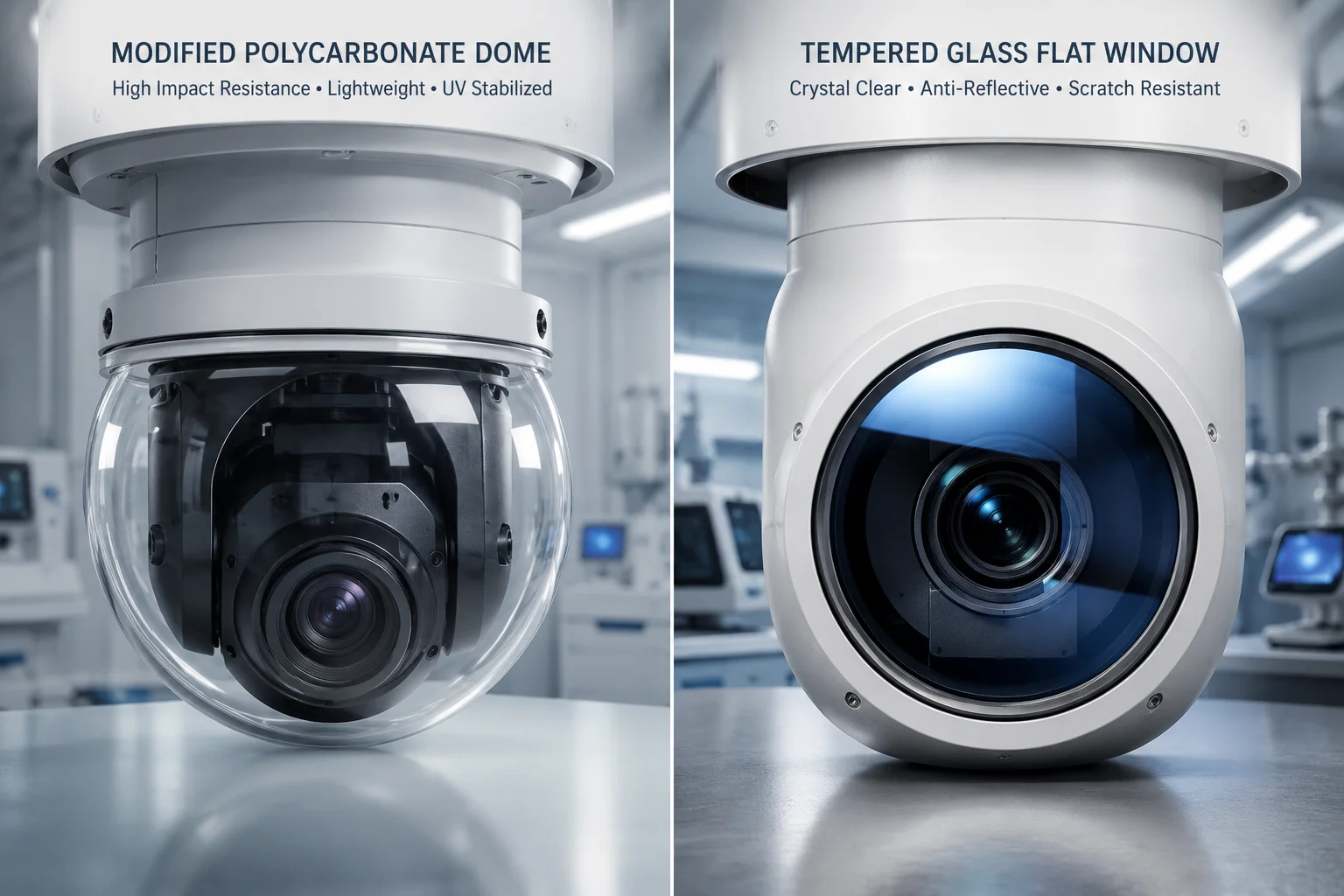 PTZ camera dome material comparison PC vs tempered glass
Below, I break down the four most common questions I get from system integrators about dome materials. Each answer comes from real-world testing and field feedback across thousands of deployments.
Table of Contents
Will the Modified PC Dome Maintain Its Optical Clarity Without “Yellowing” After 3 Years of UV Exposure?
I’ve personally replaced dozens of cheap PC domes that turned yellow in under 18 months. It’s a costly mistake that’s easy to avoid.
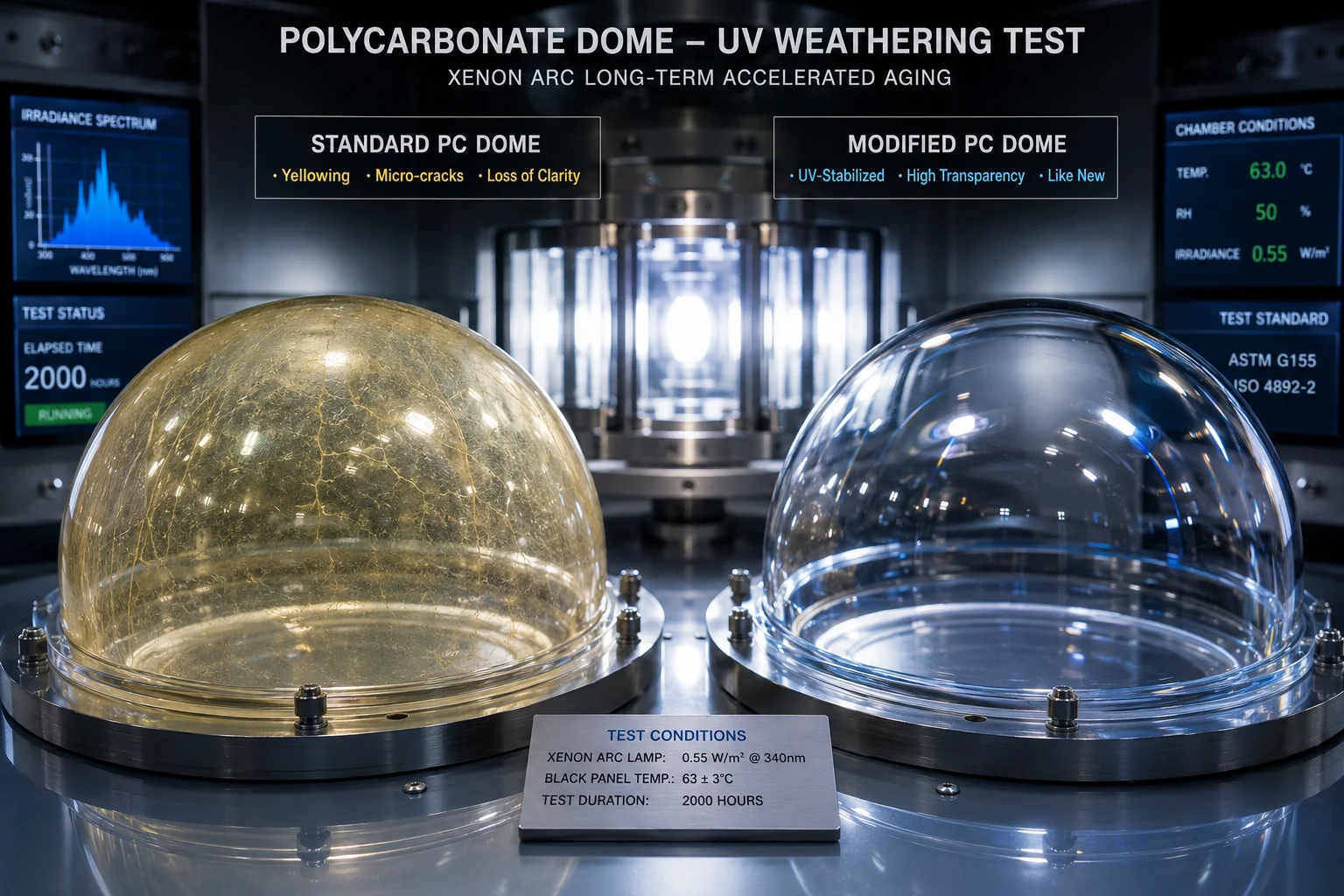
A properly modified PC dome with UV stabilizers and hardened coatings will maintain optical clarity for 5+ years without yellowing. The key word is “modified” — raw polycarbonate without UV protection will degrade quickly under direct sunlight, especially in southern US states or Middle Eastern climates.
 Modified PC dome UV resistance and yellowing test results
What Causes Yellowing in PC Domes?
Polycarbonate is a strong plastic. It can take a bullet without shattering. But it has one weakness: ultraviolet light breaks down its molecular chains over time. This process is called photo-degradation1.
The speed of yellowing depends on three factors:
- UV intensity — A camera in Arizona gets 3X more UV than one in Seattle.
- Material grade — Cheap PC uses recycled pellets with impurities that speed up degradation.
- Surface treatment — Coatings act as sunscreen for the plastic.
How “Modified” PC Solves the Problem
When we say “modified polycarbonate,” we mean the raw material has been enhanced at the molecular level. Here’s what we add:
| Additive | Function | Effect on Lifespan |
|---|---|---|
| UV-327 Stabilizer | Absorbs UV radiation before it reaches the PC core | Extends clarity to 5-7 years |
| HALS (Hindered Amine Light Stabilizer) | Traps free radicals that cause chain scission | Prevents brittleness |
| Nano-silica hard coat | Creates a glass-like surface layer | Blocks scratches from sand and dust |
Real-World Performance Data
In our accelerated aging tests, we expose dome samples to 2,000 hours of xenon arc lamp2 radiation. This simulates roughly 5 years of outdoor exposure in a high-UV region like Texas or Saudi Arabia.
Results from our lab:
- Unmodified PC: Visible yellowing at 400 hours. Transmittance drops below 85% at 800 hours.
- Modified PC (our standard): No visible yellowing at 2,000 hours. Transmittance stays above 90%.
- Tempered glass: Zero change at 2,000 hours. Transmittance remains at 98%.
So yes, modified PC holds up well. But if your project runs in extreme UV zones and you need zero degradation over 10 years, glass is the safer bet for the optical window.
When Should You Worry?
If your supplier cannot tell you what UV stabilizers they use, that’s a red flag. Ask for the xenon aging test report. Any serious manufacturer will have one. If they don’t, the dome is likely unmodified commodity PC — and it will yellow.
How Does a Tempered Glass Dome Compare in Terms of Impact Resistance and Nighttime IR Reflection?
I once had a client in Canada reject a glass-dome camera because he assumed glass meant fragile. He was wrong — but his concern about IR reflection was valid.
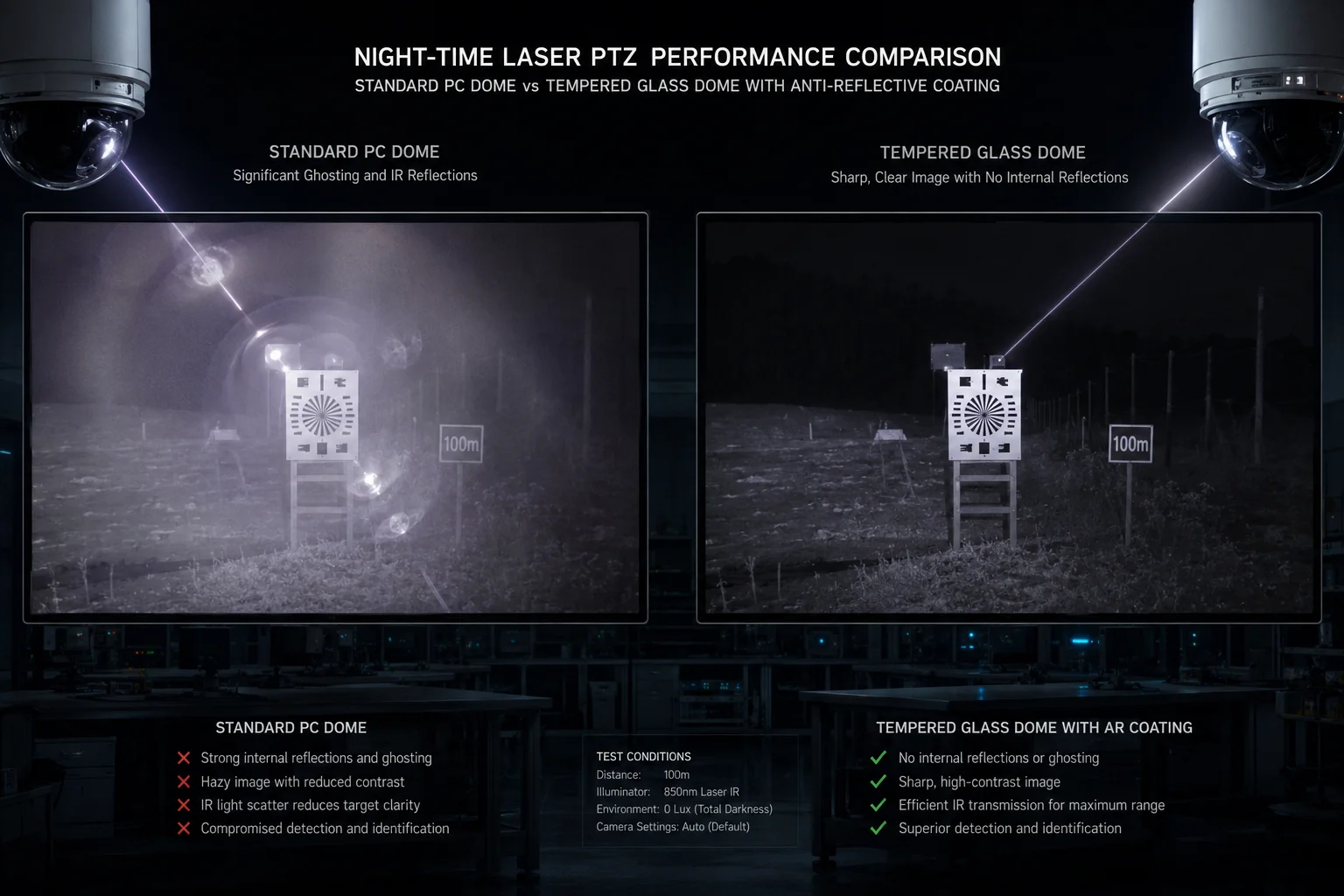
Tempered glass is 4-5X stronger than regular glass and passes IK09 impact tests3, but it cannot match PC’s IK10 rating. However, glass with multi-layer AR coating reduces internal IR reflection to below 0.5%, which is critical for laser-equipped PTZ cameras that operate at night.
 Tempered glass dome impact test and IR reflection comparison
Impact Resistance: Glass vs. PC
Let’s be direct. PC wins on impact. It’s not even close in raw energy absorption. But tempered glass is not weak either. Here’s how they compare under standard IK impact tests:
| IK Rating | Impact Energy (Joules) | PC Result | Tempered Glass Result |
|---|---|---|---|
| IK08 | 5 J | Pass | Pass |
| IK09 | 10 J | Pass | Pass |
| IK10 | 20 J | Pass | Fail (cracks) |
| Beyond IK10 | 50 J | Pass (deforms) | Shatter |
For most commercial installations — parking lots, city intersections, building perimeters — IK09 is more than enough. You only need IK10 if the camera is within arm’s reach of potential vandals, like in a prison yard or a riot-prone public square.
The IR Reflection Problem
Here’s where glass earns its place. When a laser illuminator fires infrared light at night, some of that light bounces off the inside surface of the dome. This creates a bright haze or “ghost image” that washes out the picture.
PC domes have a higher surface reflectance — around 8-10% per surface without coating. That means up to 20% of your laser energy can bounce around inside the dome. For a short-range camera, this is manageable. For an 800-meter laser system, it’s a disaster.
Glass with AR coating brings surface reflectance down to 0.2-0.5% per surface. The laser passes through cleanly. No ghosts. No haze. The full power reaches the target.
Why Not Just Coat the PC?
You can coat PC with anti-reflective films. Some manufacturers do this. But there are two problems:
- Adhesion: AR coatings bond better to glass at the molecular level. On PC, they tend to peel or crack after thermal cycling.
- Surface flatness: PC domes are curved. Curved surfaces create uneven coating thickness, which causes color fringing at high zoom levels.
This is why our 800m laser PTZ models use a flat glass window for the optical path. Flat glass accepts uniform AR coating. The result is clean, ghost-free night images at full zoom.
Is the PC Material “Optically Correct” to Prevent Image Distortion at 40X High-Zoom Levels?
I’ve tested cameras that looked sharp at 1X but turned into a blurry mess at 40X. The lens was fine. The dome was the problem.
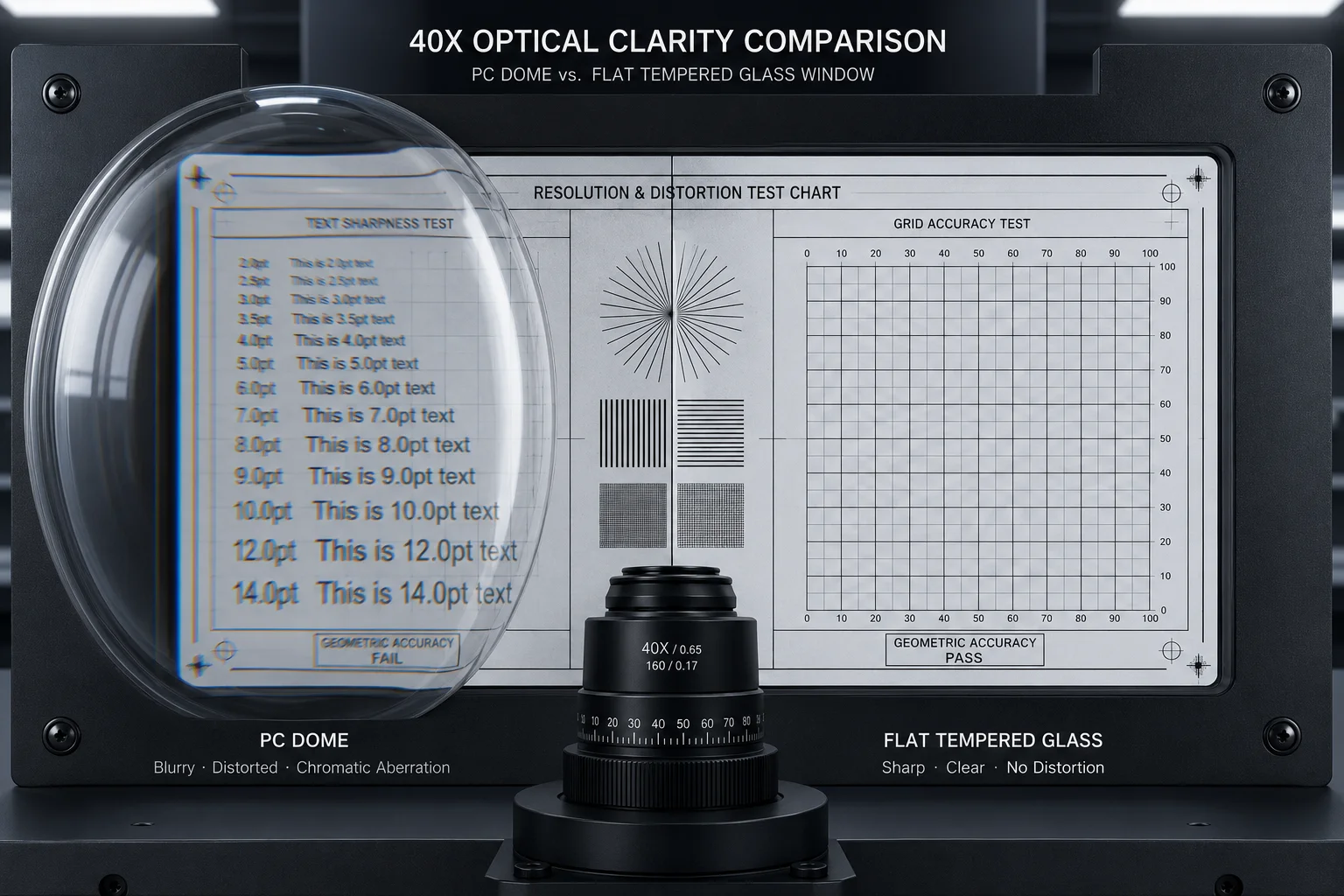
Standard curved PC domes introduce measurable optical distortion at zoom levels above 20X, making them unsuitable for long-range identification tasks. For 40X zoom applications, a flat tempered glass window with controlled thickness tolerance (±0.1mm) is required to maintain edge-to-edge sharpness.
 Optical distortion comparison PC dome vs flat glass window at 40X zoom
Why Curved Domes Distort the Image
A curved dome acts like a weak lens. Light bends as it passes through the curved surface. At low zoom, this bending is too small to notice. But at 40X, you’re magnifying everything — including the dome’s optical errors.
The main types of distortion from a curved PC dome:
- Spherical aberration5: Light at the dome’s edge focuses at a different point than light at the center.
- Chromatic dispersion6: Different wavelengths (colors) bend at slightly different angles, creating color fringing.
- Astigmatism: Horizontal and vertical lines focus at different distances, making text unreadable.
The “Optically Correct” Standard
“Optically correct” means the dome introduces less than 1/4 wave of distortion across the field of view. This is a standard borrowed from telescope optics. Very few PC domes meet this standard because:
- Injection molding creates uneven wall thickness.
- PC has a higher refractive index7 variation than glass.
- Curved geometry amplifies any thickness inconsistency.
How Flat Glass Solves This
A flat window has zero curvature. Light passes straight through without bending. The only distortion source is the glass thickness itself. By controlling thickness to ±0.1mm and using optical-grade float glass, we keep distortion below the 1/4 wave threshold even at 40X.
Practical Impact on Your Project
If you’re deploying a 40X PTZ to read license plates at 500 meters, dome distortion is not a minor issue. It’s the difference between a readable plate and a blurry smear. I always tell integrators: your lens can be perfect, your sensor can be perfect, but if the dome adds distortion, you’ve wasted your money on premium optics.
For cameras used at 20X or below — general area surveillance, crowd monitoring, perimeter overview — a quality modified PC dome works fine. The distortion at those zoom levels is invisible in the final image.
Does the Dome Meet the IK10 Vandal-Proof Standard for Public Safety Installations?
I’ve had project managers ask me for IK10 glass domes. I have to be honest with them — that combination doesn’t exist in a practical form factor.
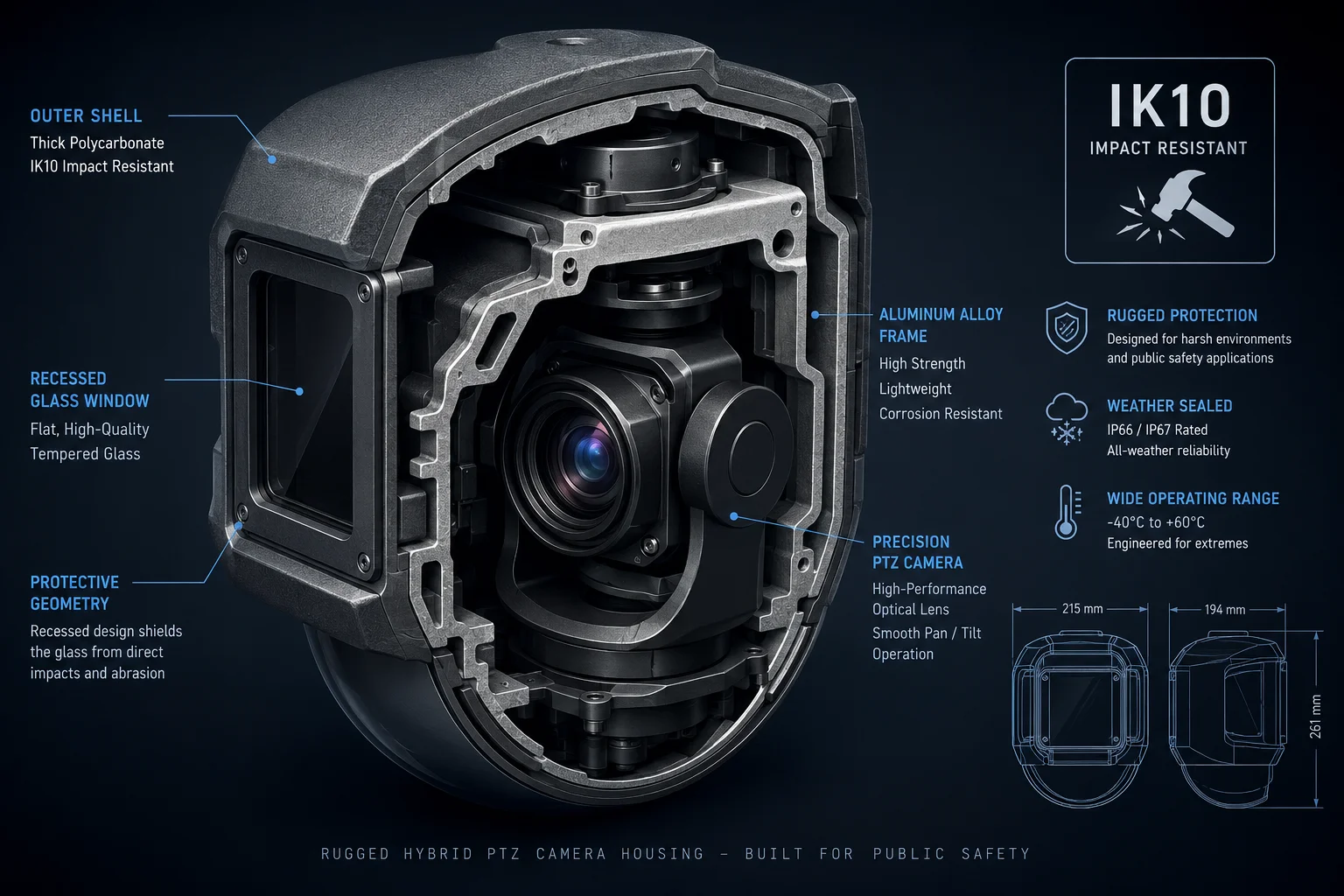
Modified PC domes meet IK10 (20 joules impact resistance) and are the only practical choice for vandal-proof public safety installations. Tempered glass tops out at IK09. For projects that need both IK10 protection and optical clarity for long-range zoom, a hybrid design with a PC outer shell and a recessed glass optical window is the correct solution.
 IK10 vandal-proof PTZ dome impact resistance test
What IK10 Actually Means
IK10 is the highest rating in the IEC 622624 standard. It means the enclosure can survive a 20-joule impact — equivalent to a 5 kg weight dropped from 40 cm. In real life, that’s roughly a full-force hit with a hammer or a thrown rock.
For public safety cameras mounted on poles in city centers, transit stations, or correctional facilities, IK10 is often a mandatory spec in the tender document. No IK10, no bid.
Why Glass Cannot Reach IK10
Tempered glass is strong in compression but weak against point impacts. A sharp object concentrates force on a tiny area, and the glass cracks. PC, on the other hand, deforms and absorbs the energy. It might dent, but it won’t shatter or lose transparency.
The Hybrid Solution
This is where smart engineering matters. Our approach for long-range PTZ cameras in public safety projects:
| Component | Material | Purpose |
|---|---|---|
| Outer dome shell | Modified PC (IK10) | Absorbs impacts, protects internal components |
| Optical window (lens path) | Flat tempered glass with AR coating | Zero distortion, no IR reflection |
| Laser window | Flat tempered glass with IR-pass coating | Maximum laser transmission |
| Non-optical body | Die-cast aluminum alloy | Structural rigidity, heat dissipation |
The glass window sits recessed behind the PC shell. A vandal hitting the dome strikes the PC first. The glass window is protected by geometry — it’s set back from the outer surface and surrounded by the aluminum frame.
Field Validation
We’ve tested this hybrid design under the following conditions:
- 20J impact on the PC dome at -40°C (cold makes plastic brittle — our modified PC still passes).
- Salt spray test8 for 1,000 hours (coastal installations).
- Thermal shock cycling9 from -40°C to +70°C, 100 cycles.
The result: zero optical degradation, zero structural failure. The PC dome shows impact marks on the surface but maintains full transparency. The glass window behind it remains untouched.
When to Specify What
My recommendation based on installation environment:
- Urban pole mount (4m+ height): Hybrid design. Vandal risk is low at height, but specs often require IK10 for compliance.
- Ground-level or indoor public area: Full PC dome. Maximum vandal resistance. Accept the slight optical trade-off at extreme zoom.
- Remote site (farm, pipeline, border): Glass window priority. Vandal risk is low. Optical performance and laser clarity matter more.
Conclusion
Choose modified PC for impact resistance and tempered glass for optical clarity. For long-range laser PTZ cameras, a hybrid design gives you both without compromise.
1. Learn about the chemical process of UV-induced polymer degradation. ↩︎ 2. Xenon arc testing is the industry standard for accelerated UV aging of plastics. ↩︎ 3. Defines the standard rating for impact protection of enclosures (10 Joules). ↩︎ 4. International standard specifying degrees of protection provided by enclosures against external mechanical impacts (IK codes). ↩︎ 5. An optical distortion where light at the edge of a curved surface focuses differently than at the center. ↩︎ 6. The separation of light into its component colors due to different wavelengths bending differently. ↩︎ 7. The measure of how much light bends when passing through a material. ↩︎ 8. Standard corrosion test for coastal installations, often run for 1,000 hours. ↩︎ 9. A reliability test that exposes materials to rapid temperature changes to check for failure. ↩︎