
I’ve seen too many integrators lose a project bid because they picked the wrong lens configuration. The pixel split between panoramic and PTZ lenses is not just a spec — it decides whether your system actually works in the field.
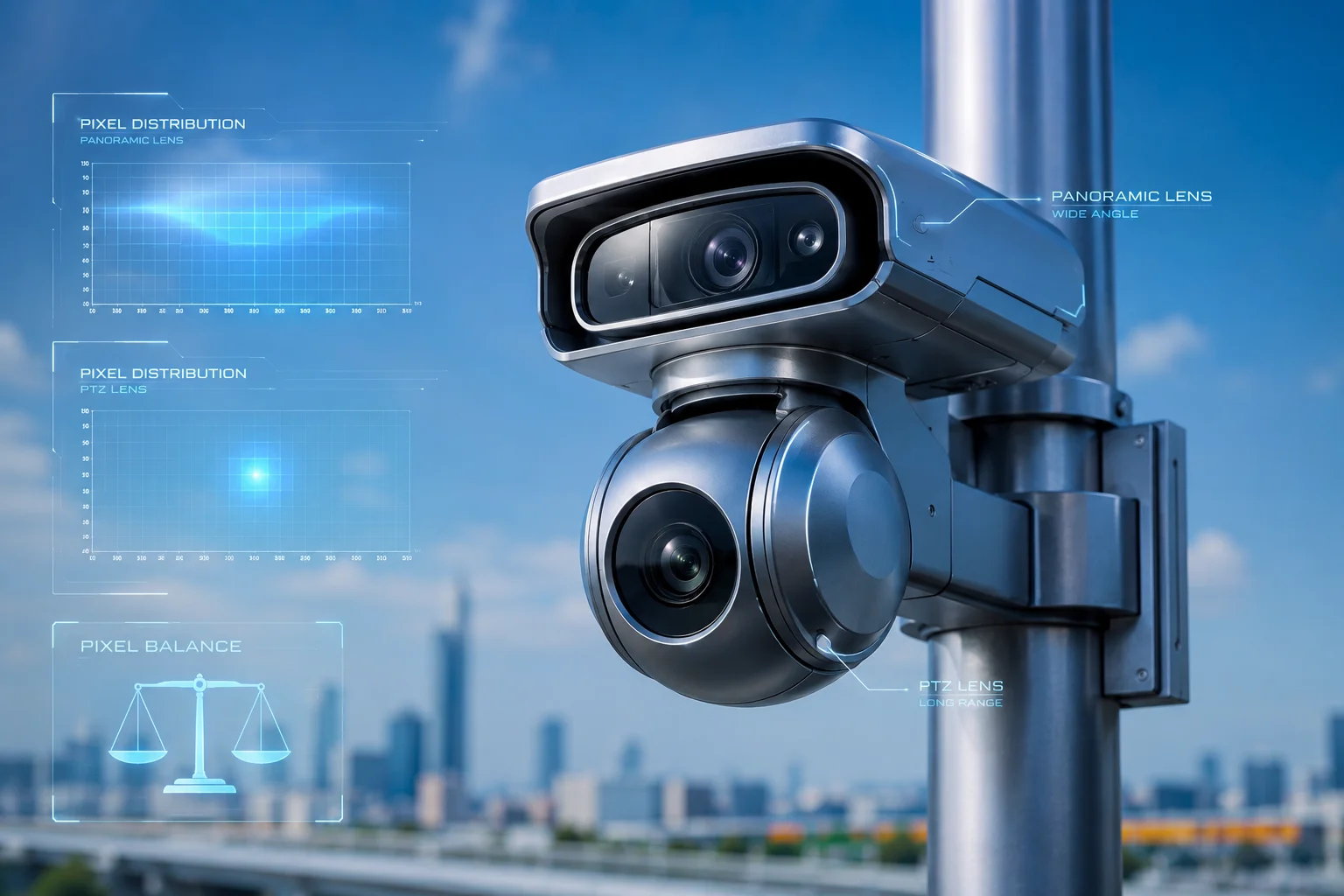
In a dual-lens camera, the 4MP + 4MP configuration is functionally balanced — not because the numbers match, but because each lens uses its pixels for a different job. The panoramic lens spreads 4MP across a wide scene for AI detection, while the PTZ lens concentrates 4MP through optical zoom for long-range detail capture.
 dual lens PTZ camera pixel distribution balance
Below, I break down the four most common questions I get from system integrators about this pixel split. Each answer comes from real deployment data and engineering trade-offs we deal with daily at our factory.
Table of Contents
Will a 4MP Panoramic Lens Provide Enough Detail for the AI to Trigger a 40X PTZ at 500 Meters?
This is the question that keeps project managers up at night. If the panoramic lens can’t see far enough, the PTZ never gets the command to zoom in — and you’ve just installed an expensive paperweight.
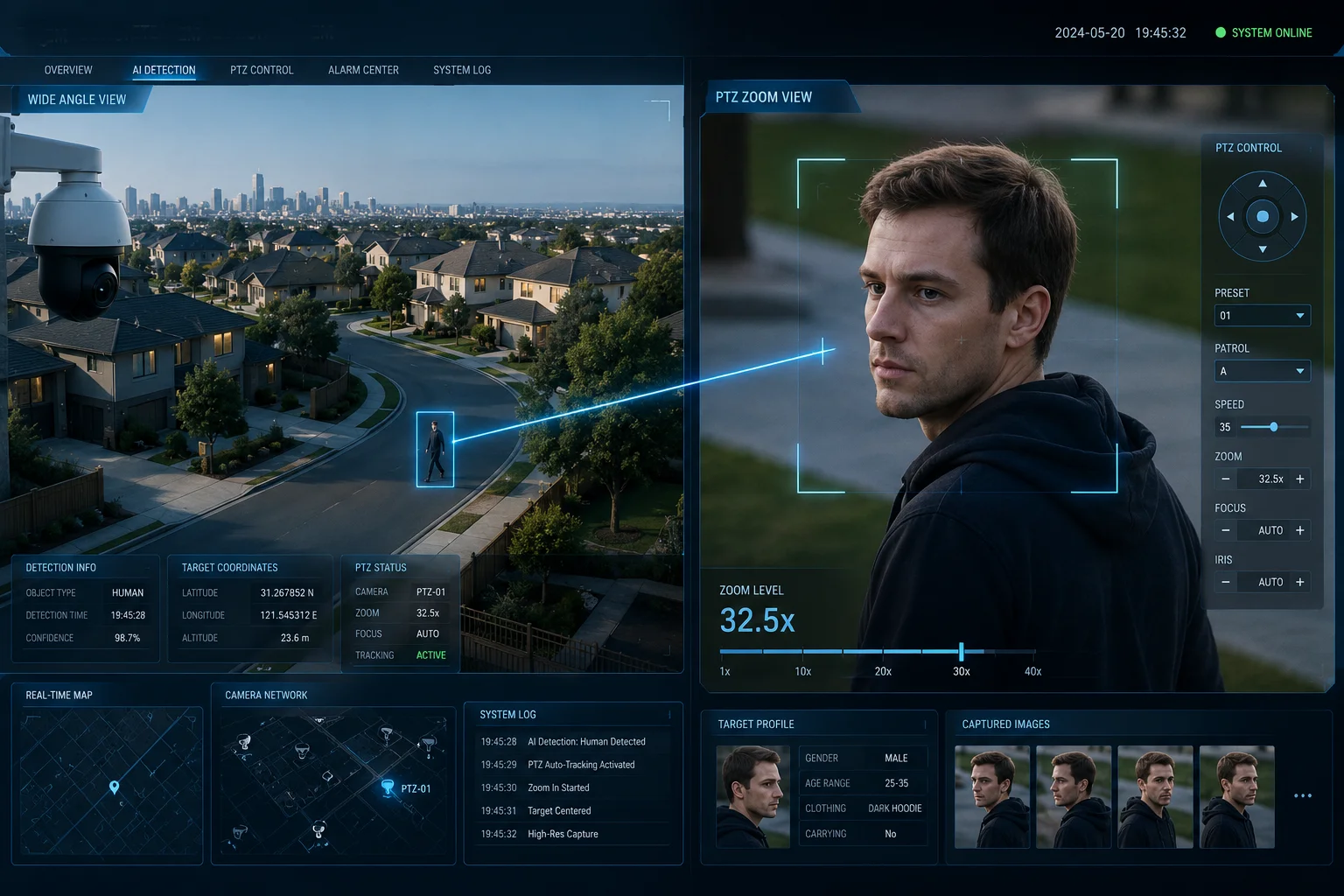
Yes, a 4MP panoramic lens provides enough pixel density to trigger AI detection at distances up to 80–120 meters. Beyond that range, the AI relies on motion-based algorithms rather than shape recognition. For a 500-meter PTZ lock-on, the system uses a staged detection approach — not a single-frame trigger.
 4MP panoramic lens AI detection range for PTZ trigger
How the Staged Detection Works
Let me be clear: no 4MP wide-angle lens can identify a human face at 500 meters. That’s not how dual-lens systems work. The real process has multiple steps.
The panoramic lens (usually 2.8mm or 4mm focal length) covers a field of view between 90° and 110°. At this angle, the pixel density drops fast as distance grows. Here’s what that looks like in practice:
| Distance from Camera | Pixels Per Meter (4MP, 4mm lens) | AI Capability |
|---|---|---|
| 30 meters | ~52 PPM | Full body recognition, face outline |
| 80 meters | ~20 PPM | Human shape detection, vehicle type |
| 150 meters | ~10 PPM | Motion blob detection only |
| 500 meters | ~3 PPM | No useful detection |
So how does the PTZ lock onto a target at 500 meters? The answer is coordinate mapping with predictive tracking1.
The Role of Coordinate Mapping
The panoramic lens does not need to “see” the target clearly at 500 meters. Instead, the system works like this:
- The panoramic lens detects motion or a human shape within its effective AI range (30–120m).
- The AI engine calculates the target’s direction and speed.
- It sends PTZ coordinates ($x, y$) to the detail lens.
- The PTZ lens slews to that position and uses its own 4MP sensor — now focused through 40X optical zoom — to confirm and track.
Once the PTZ is locked on, it uses its own onboard AI to continue tracking. The panoramic lens goes back to scanning.
Why 4MP Is the Minimum — Not the Maximum
I’ve tested 2MP panoramic lenses in this role. The result: the AI detection range drops to about 50 meters. That gives the PTZ less than 2 seconds of reaction time for a walking person. In most cases, the target exits the PTZ’s slew range before it finishes rotating.
With 4MP, you get roughly 80–120 meters of reliable detection. That gives the PTZ 5–8 seconds of lead time. Enough for a full lock-on, even with a 360° rotation.
Real-World Limitation
At 500 meters, the panoramic lens is essentially blind. The PTZ must already be pointed in the right direction — either through preset patrol routes or manual operator control. The “4MP triggers PTZ at 500m” claim you see in some datasheets refers to the full system workflow, not a single-frame miracle.
Does the Dual-4MP Configuration Cause a Significant Heat Spike in the ISP During 4G Transmission?
Heat is the silent killer of outdoor cameras. I’ve pulled failed units from the field where the ISP chip literally desoldered itself from the PCB. When you push dual 4MP streams over 4G, thermal management becomes a real engineering problem.
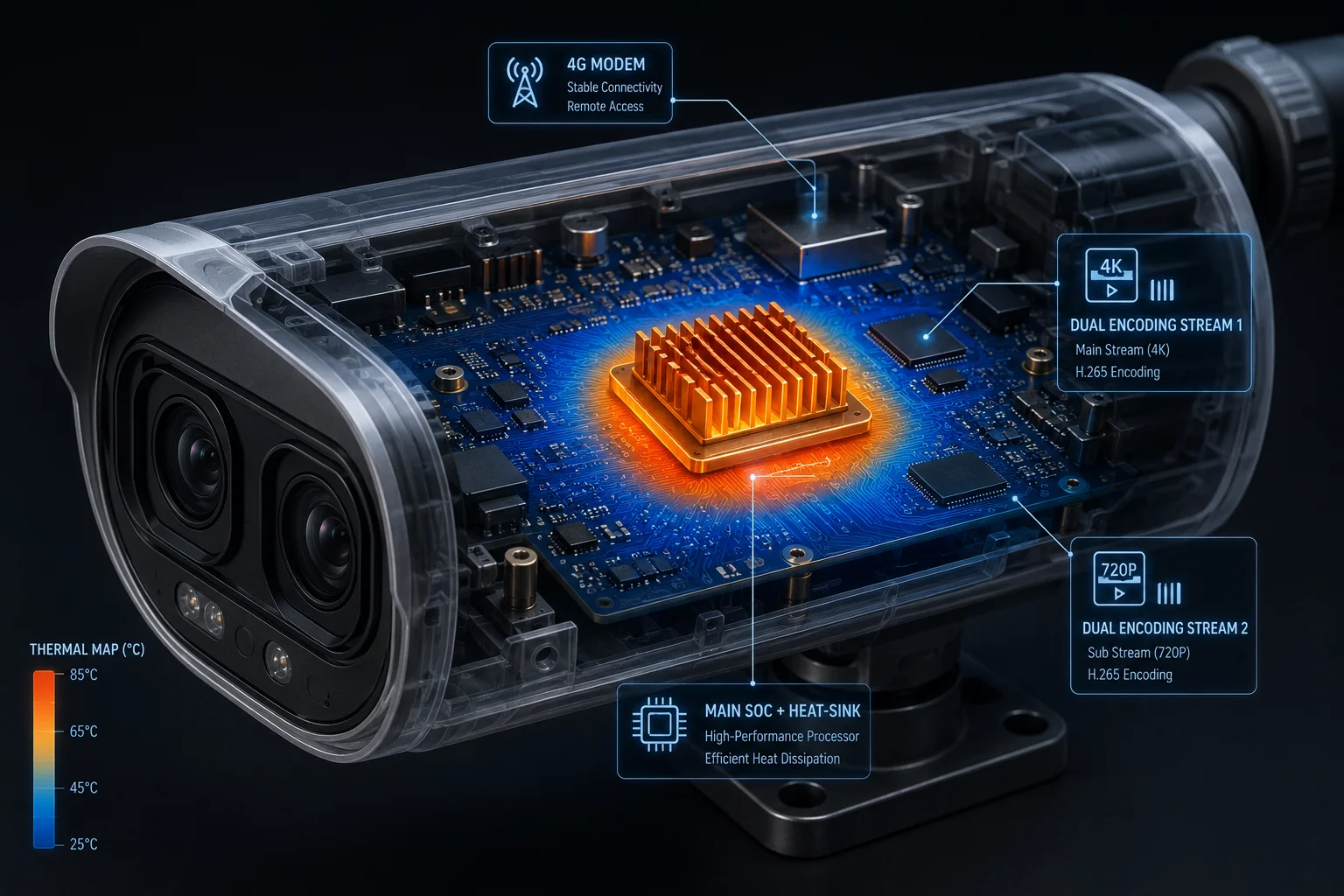
Yes, dual 4MP encoding generates measurable heat in the ISP — typically 8–12°C above single-lens operation. However, a well-designed thermal architecture keeps junction temperatures within safe limits (under 105°C) even at 50°C ambient. The real risk comes from poor housing design, not the pixel count itself.
 dual 4MP ISP heat management in 4G PTZ camera
Where the Heat Comes From
The ISP (Image Signal Processor)2 inside a dual-lens 4G camera does three heavy jobs at once:
- Dual-channel encoding: Two 4MP streams at H.265 encoding7, typically 25fps each.
- AI inference: Running human/vehicle detection models on at least one stream.
- 4G modem coordination: Packaging encoded data for LTE upload.
Each of these tasks draws power. Combined, they push the SoC’s power draw to 3.5–5W — which doesn’t sound like much until you realize it’s all concentrated on a chip the size of your thumbnail.
Thermal Budget Breakdown
| Component | Power Draw | Heat Contribution |
|---|---|---|
| ISP dual-channel encode | 1.8–2.2W | 45% of total heat |
| AI co-processor | 0.8–1.2W | 25% of total heat |
| 4G modem (Cat-4) | 0.6–1.0W | 20% of total heat |
| Memory + I/O | 0.3–0.5W | 10% of total heat |
Why This Matters for 4G Solar Systems
In a wired PoE camera, heat dissipation is easier — the metal housing acts as a heatsink, and power is unlimited. But in a solar-powered 4G system3, you face two extra constraints:
- Sealed housing: IP66/IP67 enclosures trap heat inside. There’s no ventilation.
- Limited power budget: The solar panel and battery must power everything. Higher heat means higher power draw, which means bigger panels and batteries — which means higher cost.
How We Solve It
At our factory, we use a three-layer thermal approach:
- Copper heat spreader bonded directly to the SoC die.
- Thermal pad interface connecting the spreader to the aluminum housing shell.
- Selective stream throttling: When the ISP temperature hits 95°C, the system drops the sub-stream resolution (not the main stream) to reduce encoding load by ~30%.
This keeps the camera alive in desert environments (Saudi Arabia, Arizona) where ambient temperatures hit 55°C regularly.
The Practical Takeaway
If your supplier can’t show you thermal test data — junction temperature curves over 72 hours at 50°C ambient — walk away. A camera that works fine in a lab at 25°C will throttle or crash in the field. I’ve seen it happen dozens of times.
Can I Customize the Resolution Balance (e.g., 8MP Panorama + 4MP PTZ) for Wide-Area Coverage?
Every few months, a client asks me: “Why not just put an 8MP sensor on the panoramic side for better AI range?” It’s a fair question. The answer involves trade-offs that aren’t obvious from the spec sheet.
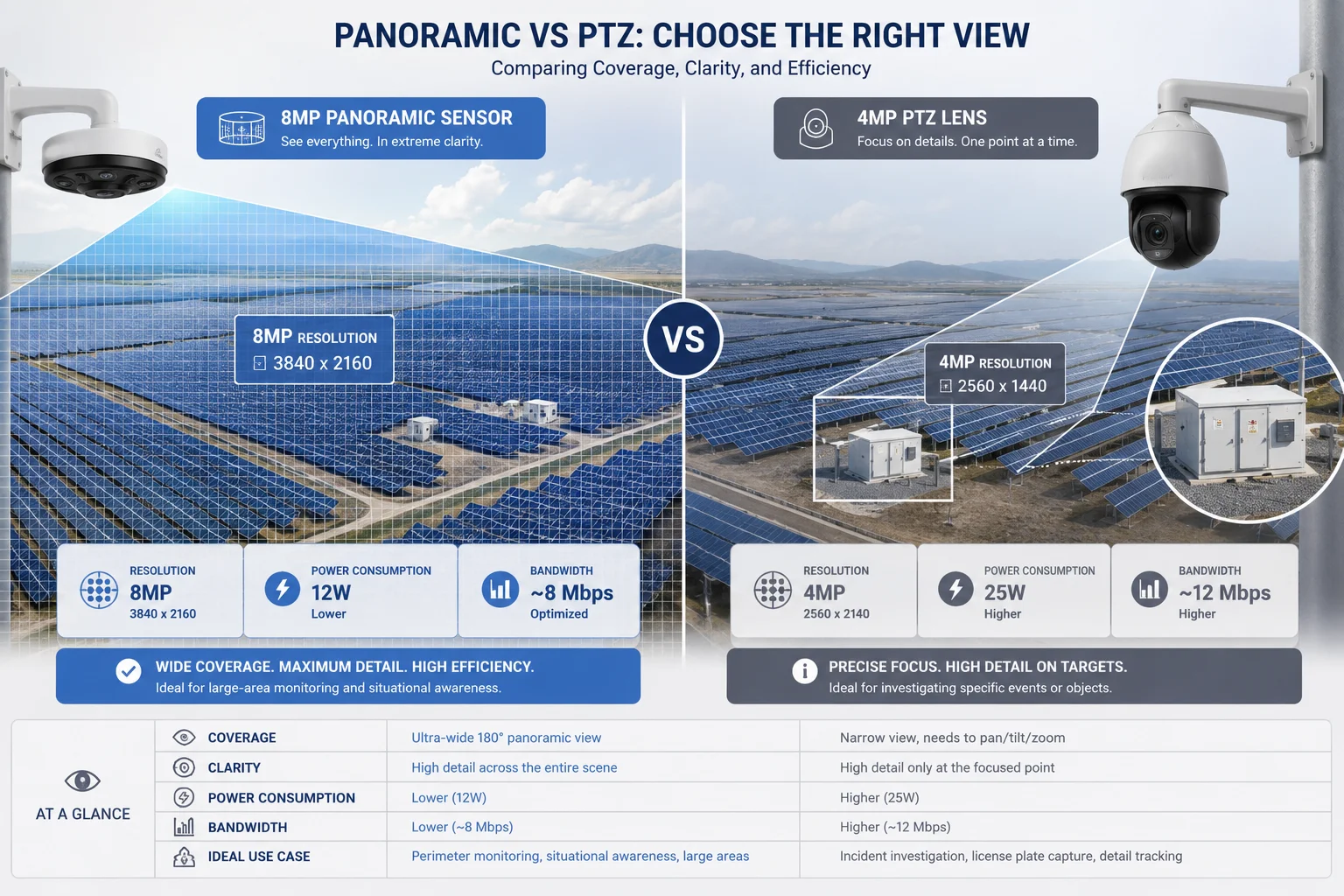
Yes, asymmetric configurations like 8MP + 4MP are technically possible and we offer them as OEM options. However, this creates trade-offs in encoding latency, power consumption, and coordinate mapping accuracy that must be evaluated against your specific deployment scenario.
 8MP panoramic plus 4MP PTZ custom resolution configuration
What You Gain with 8MP Panoramic
An 8MP panoramic sensor (3840×2160) roughly doubles your pixel density at every distance compared to 4MP. That means:
- AI human detection extends from ~100m to ~160m.
- Vehicle classification extends from ~150m to ~250m.
- The panoramic recording itself becomes useful for post-event forensics, not just live triggering.
For wide-area sites — solar farms, port perimeters, highway corridors — this extra range can eliminate the need for additional camera poles.
What You Lose
Here’s where it gets complicated:
SoC Encoding Pressure
Dual-stream encoding at 8MP + 4MP = 12 megapixels total. Most mid-range surveillance SoCs (like the Hi3559A or similar) can handle this, but with consequences:
- Encoding latency increases by 40–80ms per frame.
- The PTZ stream may drop from 25fps to 15fps during peak AI load.
- 4G upload becomes the bottleneck — you’ll need Cat-6 or Cat-12 modems instead of Cat-4.
Power and Heat
An 8MP sensor draws roughly 40% more power than a 4MP sensor. In a solar system, that translates to:
- 20–30W additional solar panel capacity needed.
- Battery reserve drops by ~2 hours on cloudy days.
- ISP temperature rises by an additional 5–8°C.
Coordinate Mapping Complexity
When both lenses share the same resolution, the pixel-to-angle mapping4 is straightforward. A pixel at position (1920, 1080) on the panoramic view maps to a specific PTZ preset with simple linear math.
With asymmetric resolutions, the mapping requires interpolation. This introduces a small but measurable error — typically 0.3–0.5° of angular offset. At 200 meters, that’s a 1–2 meter targeting error. The PTZ can still find the target, but it takes an extra 0.5–1 second of search time.
When 8MP + 4MP Makes Sense
| Scenario | Recommended Config | Reason |
|---|---|---|
| Urban intersection, short range | 4MP + 4MP | Sufficient AI range, lower cost |
| Highway corridor, 200m+ detection needed | 8MP + 4MP | Extended AI range justifies trade-offs |
| Solar-powered remote site | 4MP + 4MP | Power budget cannot support 8MP |
| Wired PoE with NVR storage | 8MP + 4MP | No power or bandwidth constraints |
My Honest Recommendation
For most B2B integrators running 4G solar projects, stick with 4MP + 4MP. The engineering headaches of 8MP panoramic — heat, power, bandwidth — usually outweigh the detection range benefit. If you truly need longer AI range, consider upgrading the panoramic lens focal length (from 4mm to 6mm) instead. This narrows the field of view but increases pixel density at distance — without touching the power budget.
How Does the Sub-Stream Resolution of Both Lenses Impact the Remote Preview Experience on Mobile?
This is the question that separates experienced integrators from beginners. Everyone focuses on the main stream resolution. But your end client — the security guard watching on a phone — never sees the main stream. They see the sub-stream. And if that sub-stream is poorly configured, your $2,000 camera looks like a $50 webcam on their screen.
The sub-stream resolution5 (typically D1 or 720P) directly controls the mobile preview quality and data consumption. In a dual-lens system, both sub-streams compete for the same 4G uplink bandwidth. Poor sub-stream configuration causes choppy video, high latency, or excessive data costs — all of which trigger client complaints.
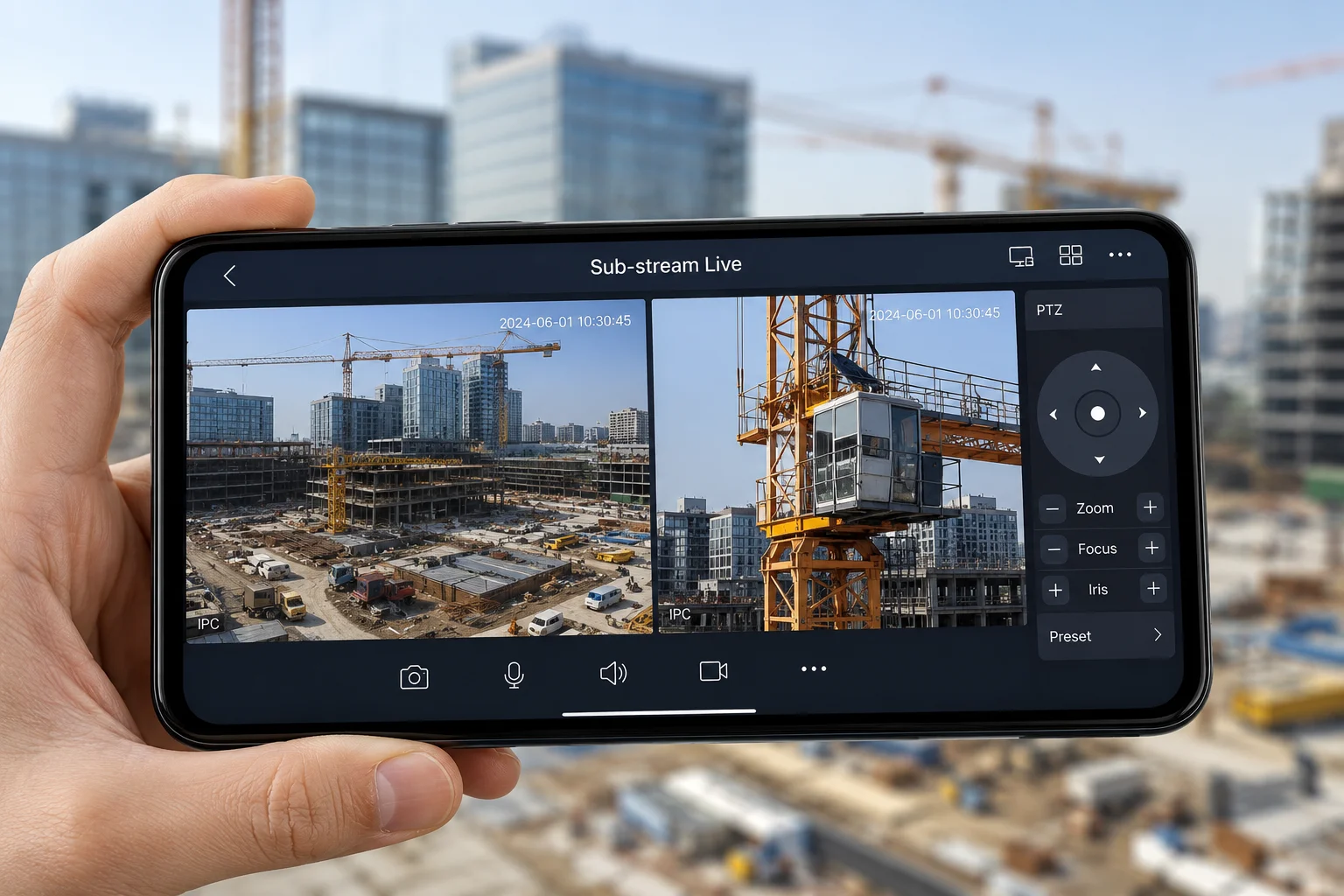 sub-stream resolution mobile preview dual lens camera
Understanding the Stream Hierarchy
Every dual-lens camera outputs multiple streams simultaneously:
- Main stream (per lens): Full 4MP, 25fps, H.265. Used for NVR recording and forensic review.
- Sub-stream (per lens): Reduced resolution, 15fps, H.264 or H.265. Used for live preview on phones and tablets.
- Third stream (optional): Ultra-low resolution for thumbnail previews or AI-only processing.
When a security guard opens the app on their phone, the platform pulls the sub-stream — not the main stream. This is by design. A full 4MP stream at 25fps requires 4–6 Mbps of bandwidth. Over 4G, that would drain the data plan in hours and cause constant buffering.
The Bandwidth Math
A typical 4G LTE connection in the field delivers 5–15 Mbps upload speed. But that’s the theoretical peak. Real-world sustained throughput is usually 2–5 Mbps. Now divide that between two lenses:
- Panoramic sub-stream: 720P @ 15fps = 0.5–0.8 Mbps
- PTZ sub-stream: 720P @ 15fps = 0.5–0.8 Mbps
- Total sub-stream load: 1.0–1.6 Mbps
That leaves headroom for packet loss, retransmission, and signal fluctuation. If you push both sub-streams to 1080P, the total jumps to 2.5–3.5 Mbps — dangerously close to the real-world 4G ceiling.
What Happens When Bandwidth Is Tight
When the 4G link can’t keep up, the camera’s streaming engine makes choices. These choices vary by firmware, but the common behaviors are:
- Frame dropping: The stream stays at 720P but drops from 15fps to 5–8fps. The video looks “jumpy.”
- Resolution downgrade: The stream drops to D1 (704×576) to maintain frame rate. The video looks blurry.
- Latency increase: Frames queue up in the buffer. The live view falls 3–8 seconds behind real time.
None of these are acceptable for a professional deployment. Your client paid for “real-time monitoring” and they’re getting a slideshow.
How to Configure Sub-Streams Correctly
The key is matching sub-stream settings to the actual 4G conditions at the site. Here’s what I recommend to our OEM partners:
- Default config: Both lenses at 720P, 15fps, H.265, VBR (Variable Bit Rate)8 with 1.0 Mbps cap per stream.
- Weak signal sites (< 3 Mbps upload): Drop panoramic sub-stream to D1. Keep PTZ sub-stream at 720P. Rationale: the PTZ view is what the operator actively watches; the panoramic view is just for context.
- Strong signal sites (> 8 Mbps upload): Push both sub-streams to 1080P @ 15fps for a premium preview experience.
The Hidden Cost of Ignoring This
I had a client in Canada who deployed 40 dual-lens solar cameras across a pipeline corridor. They left sub-streams at factory default (1080P dual). Within the first month, their 4G data bill was $12,000. After we reconfigured to 720P with adaptive bitrate6, the bill dropped to $3,800 — with no visible quality loss on the operators’ phones.
Sub-stream configuration is not glamorous. It doesn’t appear on any marketing brochure. But it’s the difference between a project that runs smoothly and one that bleeds money every month.
Conclusion
The 4MP + 4MP pixel distribution is balanced by function, not by number. Each lens serves a distinct role — wide detection and deep detail — and the real engineering challenge lies in thermal management, bandwidth allocation, and sub-stream optimization, not raw megapixel count.
1. Discover how panoramic and PTZ lenses coordinate via geometric mapping for seamless target handoff. ↩︎ 2. The ISP handles dual-channel encoding, AI inference, and modem coordination, making it the thermal hub of the camera. ↩︎ 3. Solar-powered surveillance systems require careful matching of solar panel capacity, battery reserve, and camera power draw. ↩︎ 4. Mapping pixel coordinates from a panoramic view to PTZ presets requires precise geometric calibration. ↩︎ 5. Sub-streams are low-resolution video feeds optimized for mobile preview; their configuration directly impacts data usage and user experience. ↩︎ 6. Adaptive bitrate streaming automatically adjusts video quality based on available network bandwidth, preventing buffering and data overage. ↩︎ 7. H.265 (HEVC) halves bitrate compared to H.264, enabling dual 4MP streams over limited 4G bandwidth. ↩︎ 8. VBR adjusts bitrate dynamically based on scene complexity, saving bandwidth during static scenes and allocating more when motion occurs. ↩︎