
I have seen too many border projects fail at night. The root cause is almost always the same — the wrong laser wavelength on the PTZ camera.
For long-range border monitoring beyond 800 meters, 808nm laser is the better choice over 940nm. The 808nm wavelength delivers stronger illumination, sharper images, and longer effective range because camera sensors convert its energy into usable light far more efficiently than they do with 940nm.
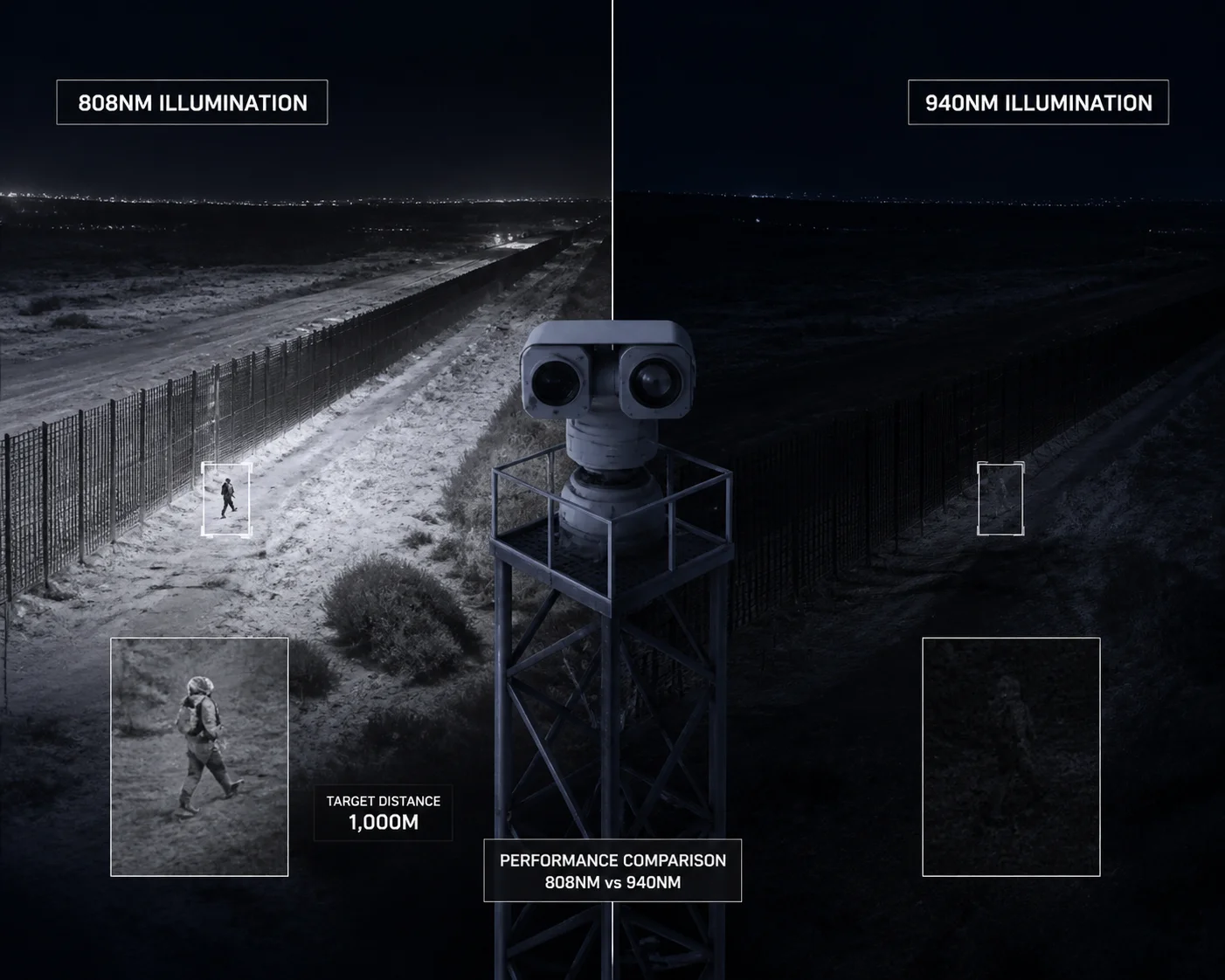
Below, I break down the physics, the real-world trade-offs, and the scenarios where each wavelength actually makes sense. If you are planning a border surveillance project with distances over 1 km, keep reading — this could save you from a costly mistake.
Table of Contents
Why is 808nm preferred for 800m+ range over the stealthier 940nm wavelength?
I get this question from almost every client who is new to laser PTZ systems. The answer comes down to basic physics, not marketing.
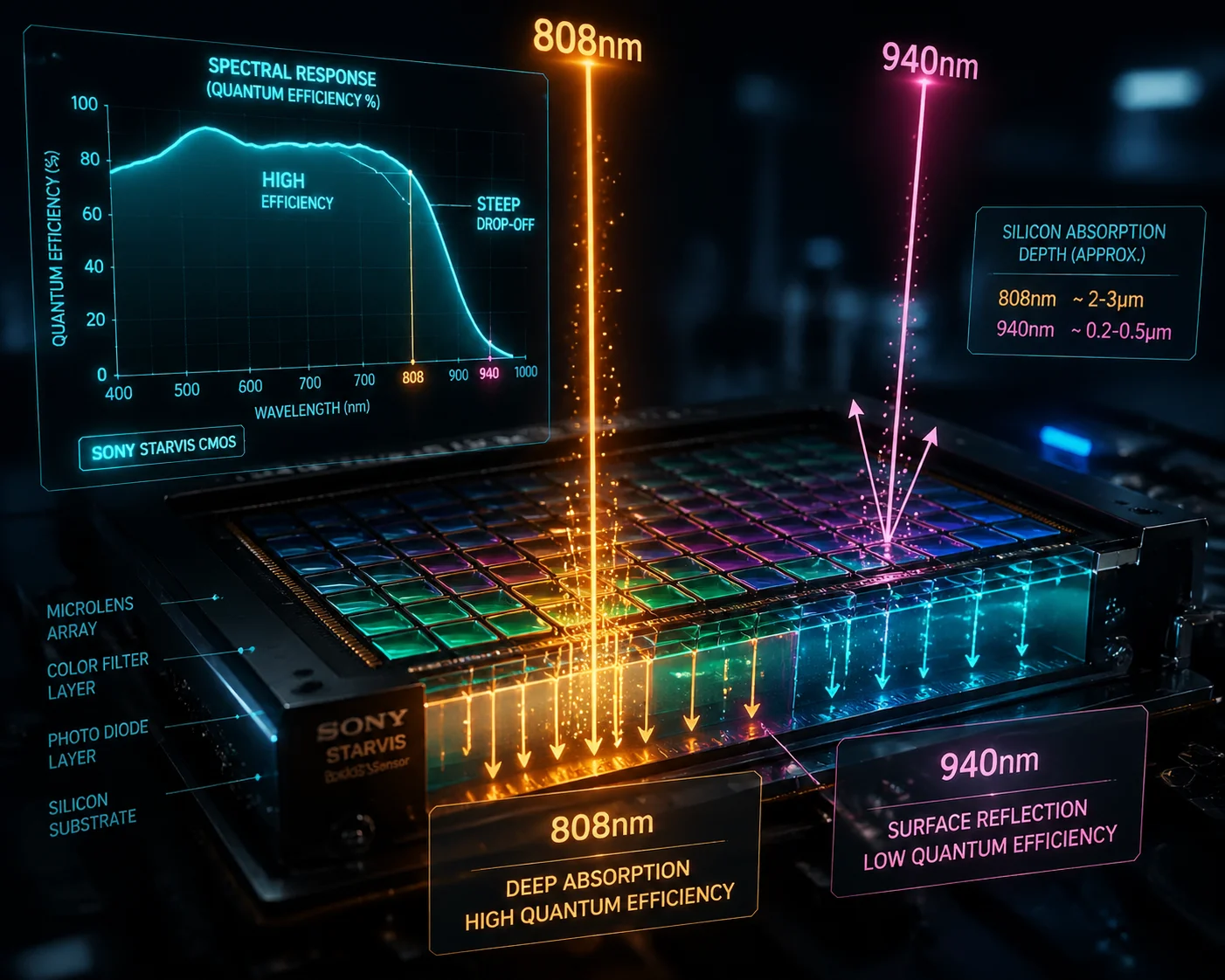
808nm wins at long range because silicon-based camera sensors have much higher quantum efficiency 1 at this wavelength. At 940nm, the sensor captures only 30%–40% of the light energy compared to 808nm, so the image gets darker, noisier, and loses detail — especially beyond 800 meters.
The physics behind quantum efficiency
Every security camera sensor is made from silicon. Silicon has a natural limit — it absorbs near-infrared light very well between 700nm and 900nm, but its ability drops fast after 900nm. This is not a design flaw. It is just how silicon works.
When I say “quantum efficiency,” I mean the percentage of incoming photons that the sensor actually converts into an electrical signal. For most Sony STARVIS 2 sensors used in security cameras today, the quantum efficiency at 850nm is close to its peak. At 940nm, it falls to roughly one-third of that value.
What this means in real distance
Here is a simple way to think about it. If a 808nm laser PTZ can clearly illuminate a person at 2 km, the same camera with a 940nm laser of the same power might only reach 1 km — or even less. The light is there, but the sensor cannot use it.
| Factor | 808nm / 850nm | 940nm |
|---|---|---|
| Sensor quantum efficiency | High (near peak) | Low (30%–40% of 808nm) |
| Effective illumination range | 1.5 km – 3 km+ | 300 m – 800 m |
| Image brightness (same power) | Bright, clear | Dim, noisy |
| Typical use in border PTZ | Standard choice | Rarely used |
Why more power does not fix 940nm
Some people think: “I will just use a stronger 940nm laser.” I have tested this. Doubling the laser power does help, but it still cannot close the gap. The sensor bottleneck remains. You also run into higher heat, higher cost, and stricter laser safety classification 3 requirements. In my experience, pushing 940nm past 1 km for usable footage is not practical with standard security-grade sensors.
The bottom line is simple. For border monitoring where every meter of range counts, 808nm gives you more distance per watt. That is why nearly every long-range laser PTZ on the market — including the ones we build at Loyalty-Secu — uses 808nm as the default.
Will 808nm laser light be visible as a “red glow” to people at the monitoring site?
This is the concern I hear most from military and border clients. They worry that the laser will give away the camera’s position.
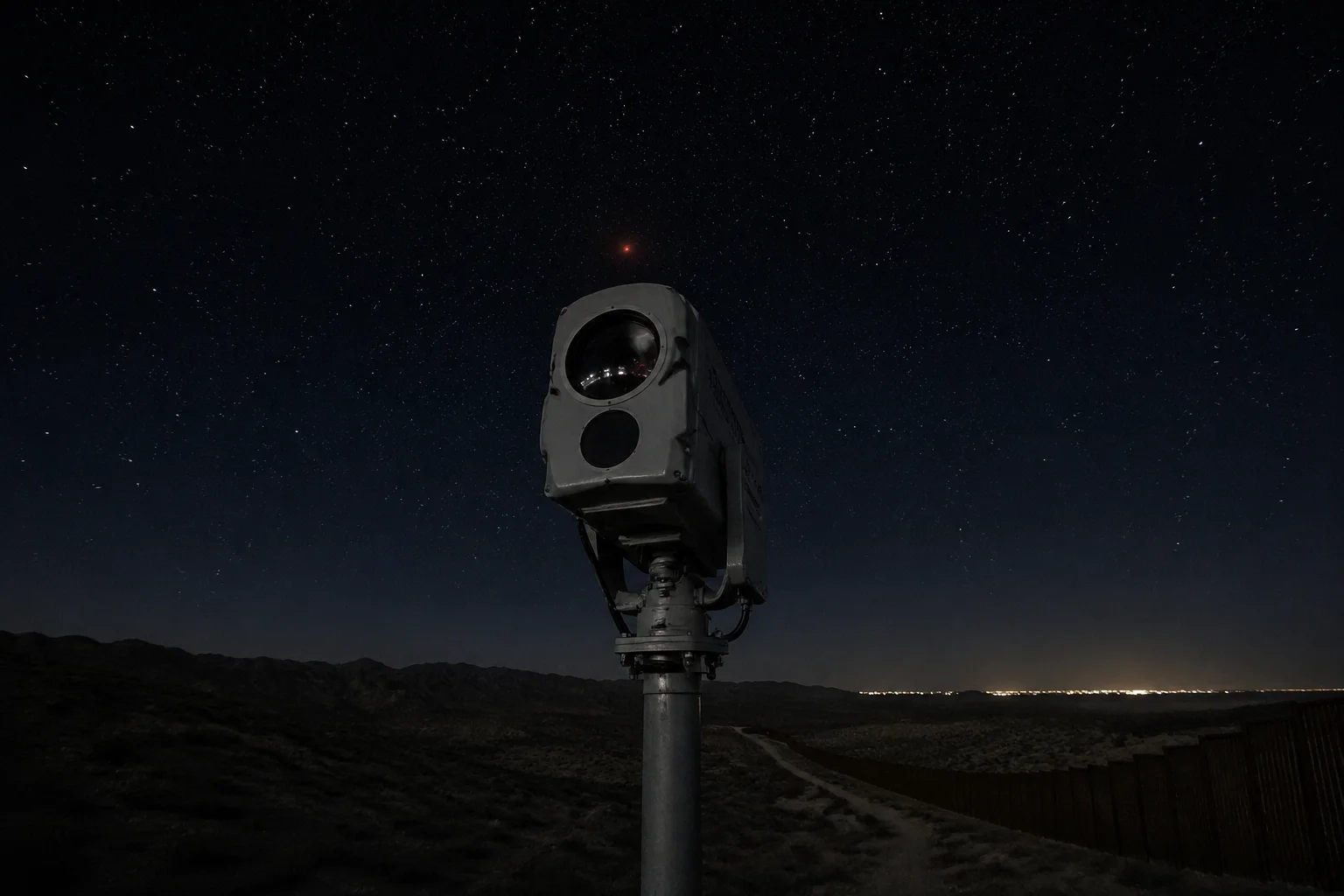
Yes, 808nm does produce a faint dark-red glow at the emitter. But this glow is only visible when someone looks directly at the laser source in complete darkness and from a short distance. At border monitoring ranges of 500 meters or more, this red dot is extremely hard to spot with the naked eye.
How visible is the red glow in practice?
I have stood in front of our 808nm laser PTZ units during night testing many times. At 10 meters, yes, I can see a faint red spot on the emitter lens. At 50 meters, it becomes very hard to notice unless I know exactly where to look. At 200 meters and beyond, I cannot see it at all.
Now think about a border scenario. The camera sits on a 6-meter pole or a watchtower on your side of the border. The potential intruder is 1 km away, moving through rough terrain in the dark. The chance of that person spotting a dim red dot at that distance is extremely low.
When does the red glow actually matter?
There are real situations where even a tiny red glow is a problem. Close-range covert operations — like a hidden camera watching a doorway from 20 meters — fall into this category. In those cases, 940nm is the right call.
But for fixed border infrastructure, the red glow is not a real operational risk. In fact, some of my clients see it as a bonus. A visible red dot can work as a deterrent. Intruders who notice it may think twice before crossing.
A practical comparison of visibility
| Scenario | 808nm visibility | 940nm visibility |
|---|---|---|
| Direct view at 10 m, total darkness | Faint red dot visible | Not visible |
| Direct view at 100 m, total darkness | Barely visible | Not visible |
| Direct view at 500 m+ | Not visible to naked eye | Not visible |
| Through binoculars / night vision goggles 4 at 500 m | Possibly visible | Not visible |
The only edge case is when the intruder has night vision goggles (NVGs). NVGs can pick up 808nm easily. But here is the thing — NVGs can also detect 940nm. No infrared wavelength is truly invisible to a quality NVG. So if your threat model includes NVG-equipped adversaries, the wavelength choice alone will not solve that problem. You need additional countermeasures.
For standard border patrol against foot traffic, vehicles, or smuggling activity, I always recommend 808nm. The red glow is a non-issue at real operating distances.
How does the sensor’s sensitivity differ between these two laser wavelengths?
I have spent years matching lasers to sensors, and this is where most spec sheets fail you. They list the laser power but never tell you how much of that power the camera can actually use.
At 808nm, a typical Sony STARVIS CMOS sensor converts light into image signal at near-peak efficiency. At 940nm, that same sensor loses 60%–70% of its sensitivity. This means a 940nm system needs roughly 2–3 times the laser power just to match the image quality of an 808nm system at the same distance.
Understanding spectral response curves
Every camera sensor has a spectral response curve 5. This curve shows how well the sensor detects light at each wavelength. For silicon-based sensors, this curve rises from the visible spectrum, peaks somewhere around 800nm–850nm, and then drops sharply toward 1000nm.
I always tell my clients to think of it like a hill. At 808nm, you are near the top of the hill. At 940nm, you are already on the downhill slope, and the ground is falling away fast.
Real-world impact on image quality
Here is what I see in actual field tests:
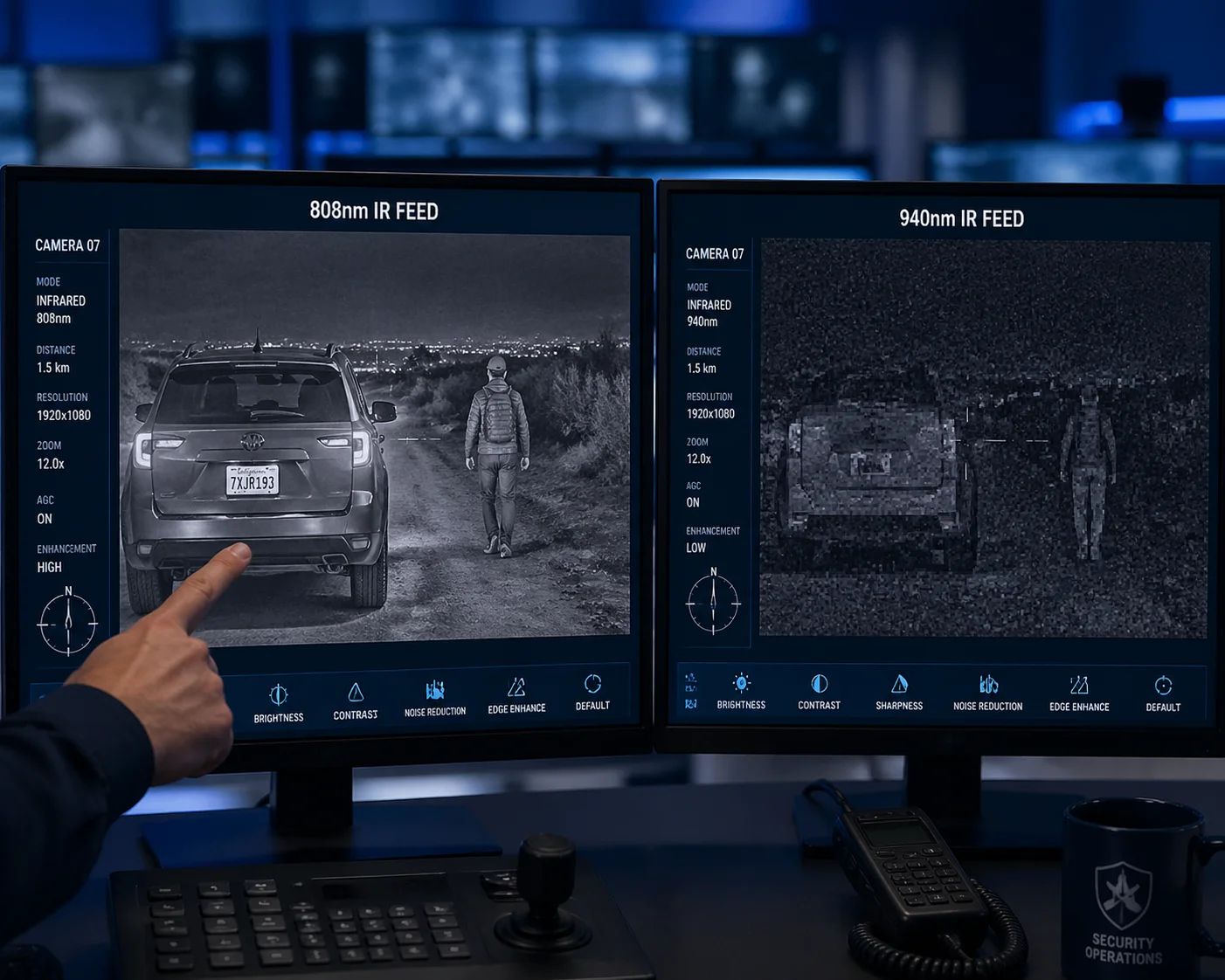
- 808nm at 1.5 km: I can identify a person’s clothing color (in grayscale), body shape, and walking direction. The image is crisp with low noise.
- 940nm at 1.5 km: The image is dark. I can see a moving blob, but I cannot tell if it is a person or an animal. The noise level is high, and the automatic gain control pushes the image into a grainy mess.
This is not a small difference. It is the difference between evidence that holds up in a report and footage that is useless.
The cost of compensating for 940nm
Some manufacturers try to compensate for 940nm’s weakness by using “enhanced” sensors with extended NIR response. These sensors do exist, but they come with trade-offs:
- They cost significantly more.
- They often have lower resolution or higher noise in the visible spectrum.
- They are not widely available in standard security camera modules.
For a border project where I need to deploy 20 or 50 PTZ units, using specialty sensors for every camera is not realistic from a budget standpoint. Standard Sony STARVIS sensors with 808nm lasers give me the best performance-to-cost ratio every time.
Signal-to-noise ratio matters more than raw power
At the end of the day, what determines whether you can identify a target at 2 km is the signal-to-noise ratio (SNR) 6 of the image. A stronger signal from the laser (808nm) combined with high sensor sensitivity at that wavelength gives you a clean image. A weak signal (940nm) forces the camera to amplify everything — including noise. That is why 940nm images look grainy even when the laser itself is powerful.
Can I customize my PTZ with a 940nm laser for covert nighttime operations?
Some of my clients have specific missions that require total stealth. They ask me if we can swap the 808nm laser for a 940nm unit. The short answer is yes. But I always make sure they understand the trade-offs first.
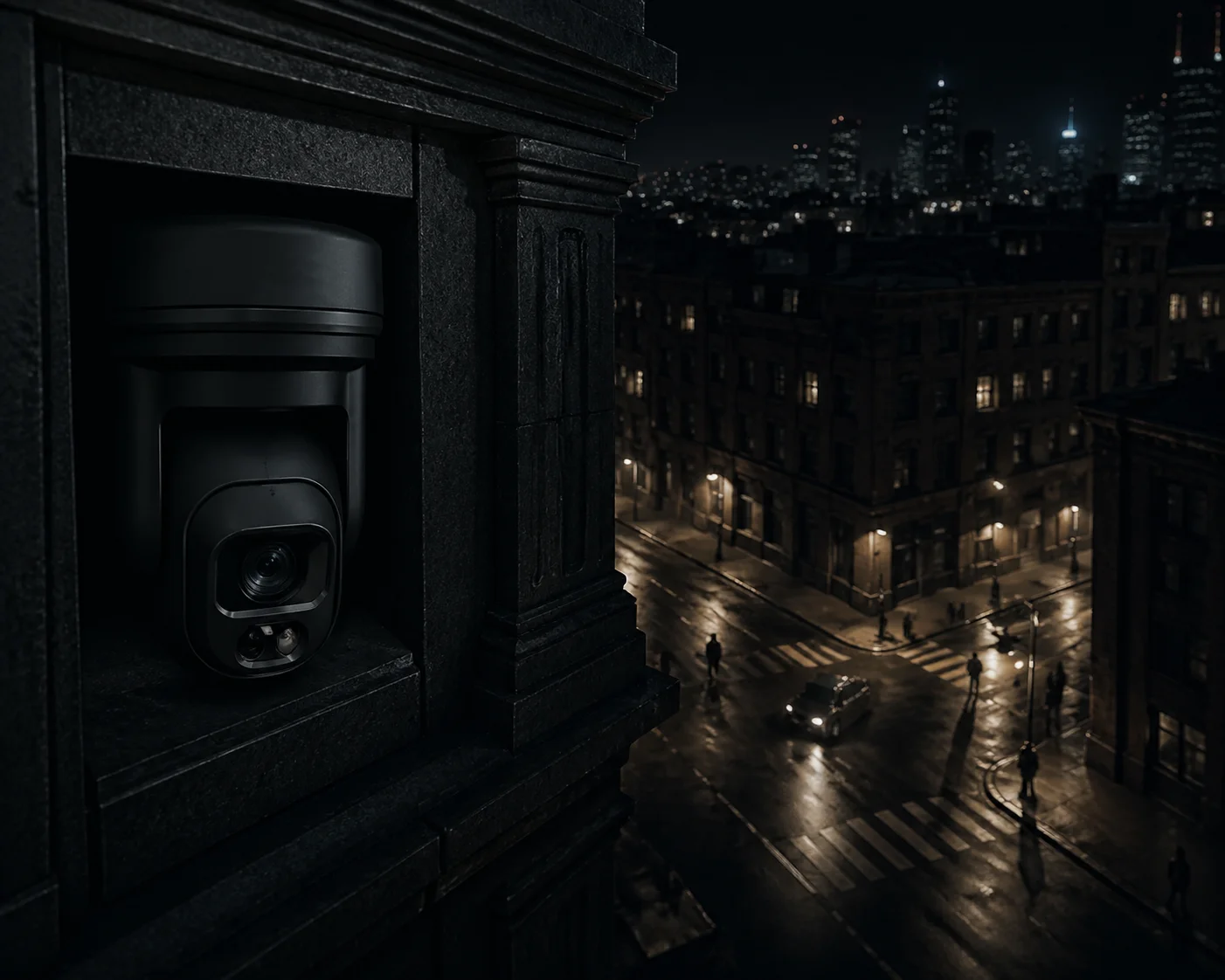
Yes, we offer 940nm laser customization for our PTZ cameras through our OEM/ODM service. However, I always recommend this only for short-range covert applications under 500 meters, because the effective illumination distance and image quality will drop significantly compared to our standard 808nm configuration.
When 940nm makes sense
I do not want to sound like 940nm is always wrong. It has a clear role in security. Here are the scenarios where I support a 940nm build:
- Close-range covert surveillance (under 500 m): Hidden observation posts, undercover checkpoints, or stakeout positions where the camera must be invisible.
- Urban environments with light pollution: In cities, there is often enough ambient IR light that the 940nm laser only needs to supplement, not fully illuminate.
- Counter-surveillance situations: When the target may be actively scanning for IR sources using detectors (not NVGs), 940nm is harder to pick up on basic IR detectors.
What we change in a 940nm custom build
When a client orders a 940nm version, I do not just swap the laser diode. We adjust several parts of the system:
- Laser module: We replace the 808nm diode with a 940nm diode and re-calibrate the beam divergence.
- IR-pass filter: We may swap or modify the bandpass filter in front of the sensor to better pass 940nm light while blocking other wavelengths.
- Gain and exposure settings: We tune the firmware to use longer exposure times and higher gain to compensate for the lower signal.
- Distance spec: We re-rate the effective illumination distance. A camera rated at 800 m with 808nm might drop to 300–400 m with 940nm.
Consult the IEC 60825-1 7 laser safety standard for proper classification of both wavelengths.
Choosing the right wavelength for your project
| Project requirement | Recommended wavelength | Notes |
|---|---|---|
| Border fence, 1–3 km range | 808nm | Maximum range and image clarity |
| Military outpost, 500 m–1 km | 808nm | Good balance of range and performance |
| Covert observation post, under 500 m | 940nm | Stealth is the top priority |
| Urban perimeter, under 300 m | 940nm | Ambient light helps compensate |
| Critical infrastructure, 500 m–2 km | 808nm | Reliable identification is non-negotiable |
My honest advice
I always ask my clients one question before we finalize the wavelength: “What matters more to you — hiding the camera, or seeing the target clearly at maximum range?”
For border monitoring, the answer is almost always the second one. You are protecting a perimeter that stretches for kilometers. You need to detect, identify, and track. You need footage that is clear enough for a report. That means 808nm.
If a client still wants 940nm after understanding the trade-offs, we build it for them. That is what OEM/ODM means — we deliver what the project actually needs, not just what is easy to manufacture. For applications requiring extreme stealth, also consider the atmospheric transmission 8 differences between 808nm and 940nm.
Conclusion
For border monitoring beyond 800 meters, 808nm laser is the clear winner. It delivers longer range, cleaner images, and better sensor efficiency 9 than 940nm. Choose 940nm only for short-range covert tasks where stealth 10 is the absolute priority.
1. Quantum efficiency of silicon photodiodes at NIR wavelengths. ↩︎ 2. Sony STARVIS sensor NIR sensitivity specification. ↩︎ 3. Laser safety classification for infrared illuminators. ↩︎ 4. Night vision device detection of IR wavelengths. ↩︎ 5. Spectral sensitivity of CMOS image sensors. ↩︎ 6. Signal-to-noise ratio in low-light imaging. ↩︎ 7. IEC 60825-1 laser product safety standard. ↩︎ 8. Atmospheric infrared windows for long-range transmission. ↩︎ 9. Sony STARVIS 2 technology for enhanced NIR sensitivity. ↩︎ 10. Covert surveillance techniques and IR countermeasures. ↩︎