
I’ve watched too many 40X zoom cameras fail to lock focus on a moving car. The image stays blurry for seconds. That blurry footage is useless. And it costs real money when a project fails inspection.
PDAF (Phase Detection Autofocus) is roughly 5 to 10 times faster than Contrast Detection AF in high-zoom cameras. Contrast Detection typically needs 1 to 3 seconds to find focus at full zoom. PDAF does the same job in 0.1 to 0.3 seconds. This speed gap matters most when you track moving targets at long range.
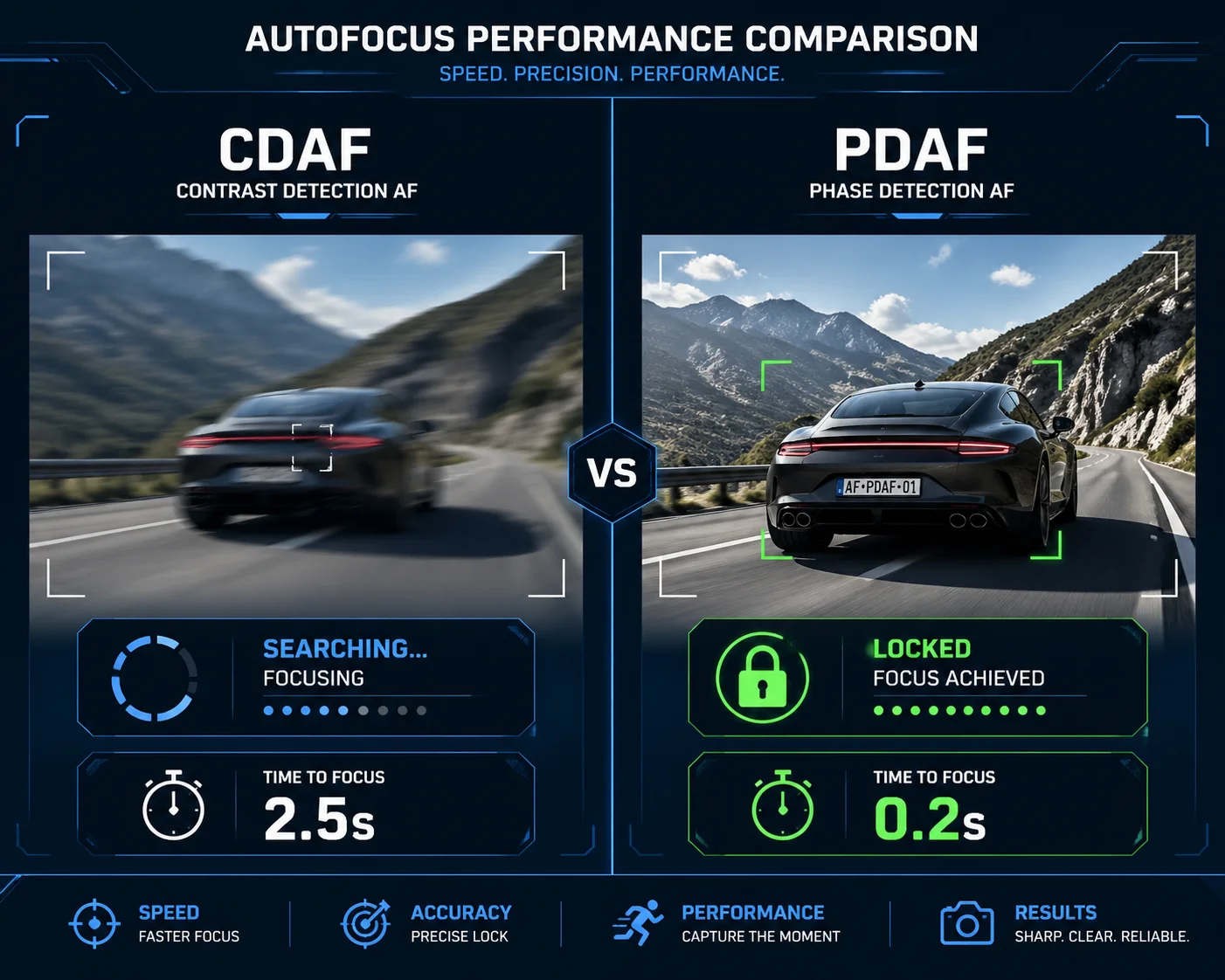 PDAF vs Contrast Detection autofocus speed comparison for high-zoom PTZ cameras
Below, I break down exactly why this speed difference exists, how it affects your real-world surveillance results, and what to ask your supplier before you commit to a purchase. If you deploy PTZ cameras at 30X zoom or above, this is the most important autofocus decision you will make this year.
Table of Contents
Can PDAF Reduce the “Hunting” Effect When I Zoom Into a Moving Target?
I’ve seen it happen on dozens of job sites. You zoom into a vehicle at 40X, and the lens starts pulsing back and forth. The image goes sharp, then soft, then sharp again. That pulsing blur is called “hunting.” It makes your footage useless for license plate capture or facial recognition.
Yes, PDAF nearly eliminates the hunting effect. It calculates the exact distance to your target in one step, so the lens moves directly to the correct position. Contrast Detection must scan back and forth to find the sharpest point, which causes that visible pulsing blur on screen.
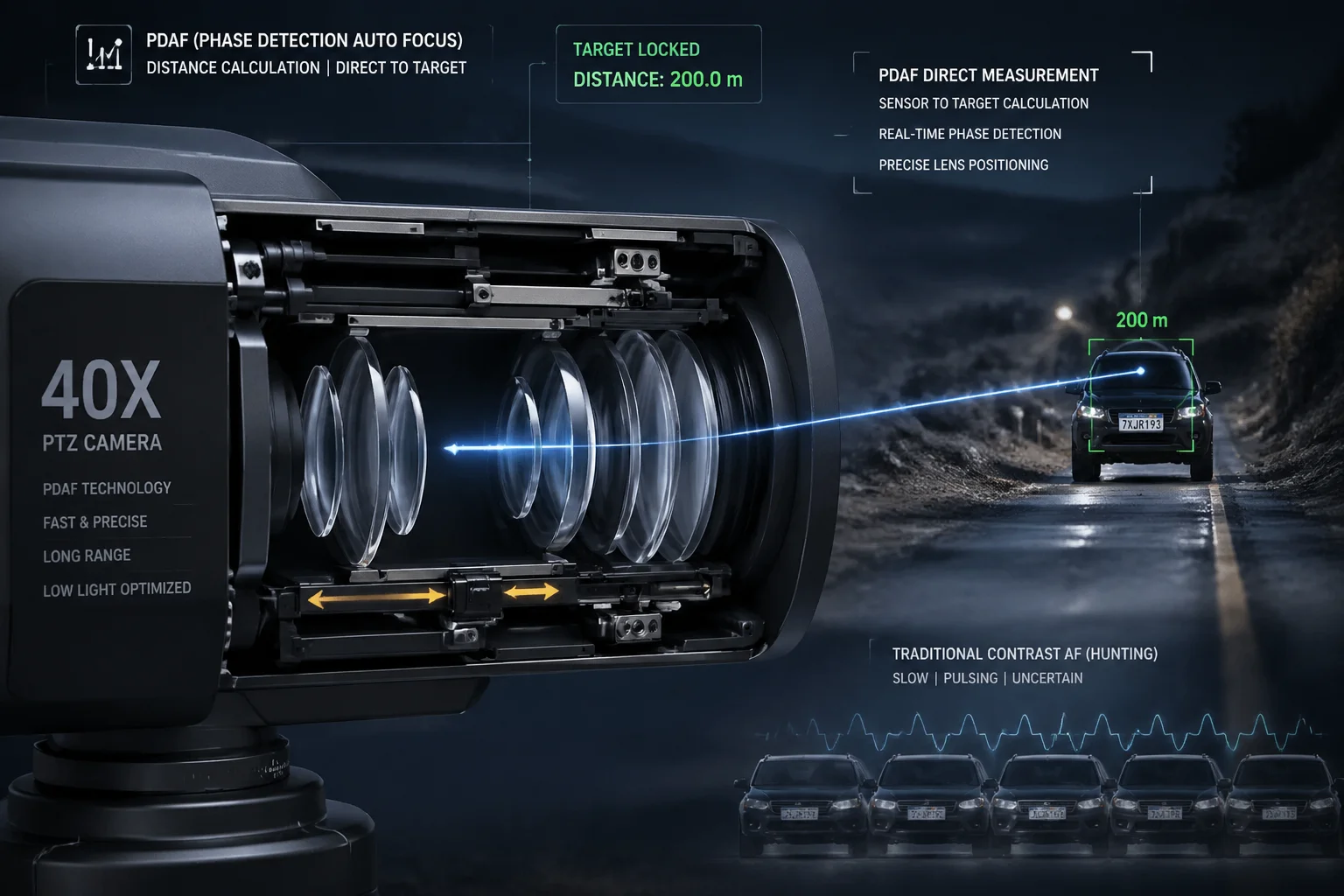 PDAF reducing hunting effect on moving target at high zoom
Why Does Hunting Happen in the First Place?
Hunting is not a defect. It is how Contrast Detection AF 1 works by design. The system moves the lens forward, checks if the image got sharper, then moves it further or reverses direction. At wide angle, this process is fast because the depth of field is large. The lens finds the sharp zone quickly.
But at 33X or 40X zoom, the depth of field becomes paper-thin. The sharp zone might be only a few centimeters deep at 200 meters away. So the Contrast Detection system has to make very small, very precise movements. Each movement takes time. And if the target is moving — a car driving through an intersection, a person walking across a parking lot — the correct focus point keeps changing while the lens is still searching.
This creates a feedback loop. The lens moves, the target moves, the lens has to start over. You see this on screen as a constant pulsing between sharp and blurry.
How PDAF Breaks the Loop
PDAF uses a completely different method. Special pixels on the image sensor are split into pairs. Each pair looks at the same point from a slightly different angle. By measuring the gap between these two views (the “phase difference”), the processor knows instantly:
- Which direction the lens needs to move
- How far the lens needs to move
There is no trial and error. The lens goes straight to the target position in one motion.
Hunting Comparison: CDAF vs. PDAF at High Zoom
| Factor | Contrast Detection (CDAF) | Phase Detection (PDAF) |
|---|---|---|
| Focus method | Scan back and forth | One-step calculation |
| Typical hunting cycles at 40X | 3–7 passes | 0–1 passes |
| Time to lock on moving target | 1.0–3.0 seconds | 0.1–0.3 seconds |
| Visible blur pulsing | Frequent and obvious | Rare or none |
| Success rate in low light | Drops significantly | Stays relatively stable |
For a system integrator deploying cameras at highway on-ramps or busy intersections, this difference is not academic. It is the difference between capturing a readable license plate and capturing a blur.
A Practical Test You Can Run
When you evaluate a PTZ sample, try this: zoom to maximum, point the camera at a car about 150 meters away, and then quickly pan to a different car at a different distance. Count the seconds until the new car is sharp. If you see the image pulse more than once before locking, the camera is relying on Contrast Detection. A true PDAF system will snap into focus with little or no visible hunting.
Why Is Phase Detection (PDAF) Essential for Real-Time Tracking in Busy Intersections?
I work with integrators who install PTZ cameras above intersections with four lanes of traffic moving in different directions. When the camera tracks one vehicle and then switches to another, every millisecond of focus delay means lost frames. In a busy intersection, lost frames mean lost evidence.
PDAF is essential for intersection tracking because it predicts focus distance continuously, not reactively. While Contrast Detection restarts its search every time the target changes distance, PDAF calculates the new position instantly. This keeps the image sharp even when the camera jumps between targets moving at different speeds and distances.
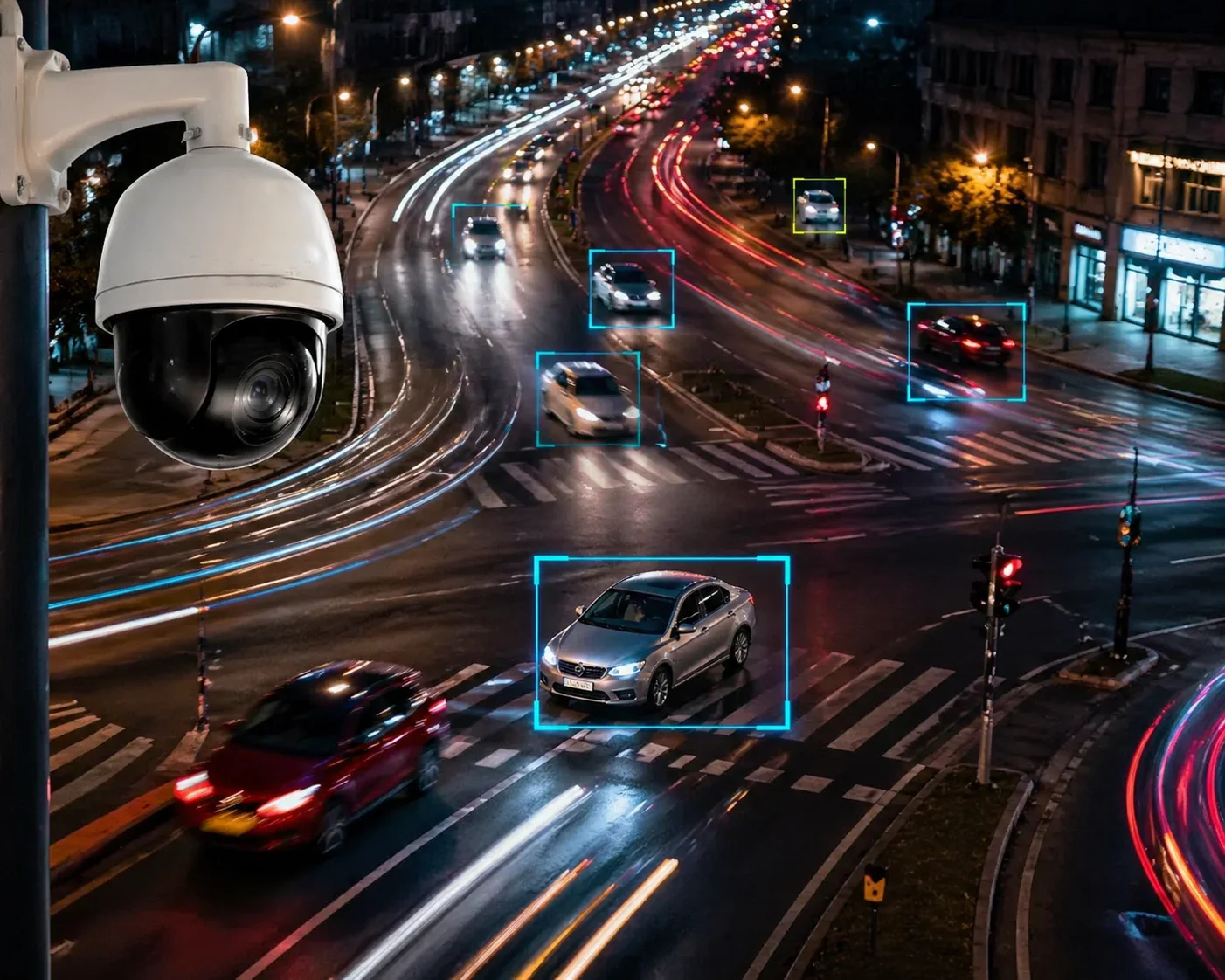 PDAF real-time tracking at busy intersection with PTZ camera
The Intersection Problem: Multiple Targets, Multiple Distances
A busy intersection is one of the hardest environments for any autofocus system. Here is why:
- Cars move at 30–60 km/h through the frame
- Distances change rapidly as vehicles approach and pass
- The camera may need to switch from tracking a car at 80 meters to a pedestrian at 30 meters
- Lighting changes constantly — headlights, shadows, reflections off wet pavement
Contrast Detection AF struggles here because it needs a stable image to measure contrast. When the camera pans quickly to a new target, the image is motion-blurred during the pan. The CDAF system cannot get a reliable contrast reading until the camera stops moving. So there is a delay: the camera stops, the lens hunts, the image locks. That delay can be 1 to 3 seconds at high zoom.
PDAF does not need the camera to stop. It reads the phase difference from the sensor data in real time, even during a pan. The lens adjusts while the camera is still moving. By the time the camera reaches the new target, the image is already sharp or nearly sharp.
How AI Tracking and PDAF Work Together
Modern PTZ cameras with AI auto-tracking use object detection algorithms to identify and follow people or vehicles. But the AI only works well when the image is in focus. If the lens is hunting, the AI loses the target because the blurry image breaks the detection algorithm.
This is why our dual-lens linkage cameras at Loyalty-Secu pair a fixed wide-angle lens with a PTZ lens. The wide-angle lens spots the target using AI. Then the PTZ lens zooms in and tracks it. If the PTZ lens uses PDAF, the handoff is smooth. If it uses only Contrast Detection, there is a visible delay where the zoomed image is blurry and the AI tracker can lose the target.
What Happens When AF Fails at an Intersection
The consequences are real and expensive:
- License plates unreadable: The camera captures the car, but the plate is blurred during the focus hunt. The footage is useless for law enforcement.
- Project fails acceptance testing: Your client tests the system by driving through the intersection. If the camera cannot capture a clear plate within the required time window, the project does not pass. You eat the cost.
- Reputation damage: Word travels fast among integrators. One failed intersection project can cost you future bids.
I have seen integrators lose contracts worth tens of thousands of dollars because the PTZ camera they chose could not keep up with real-time tracking. The root cause was almost always autofocus speed.
Does Your Camera Use Hybrid AF to Combine the Speed of PDAF With the Precision of CDAF?
I get this question a lot from engineers who know that PDAF is fast but worry about its precision at extreme zoom levels. They are right to ask. Pure PDAF is fast, but it is not always pixel-perfect at 40X zoom. The best systems use both.
Yes, high-end PTZ cameras use Hybrid AF. The system fires PDAF first to move the lens to roughly the right position in milliseconds. Then Contrast Detection fine-tunes the last tiny adjustment for maximum sharpness. This two-step process gives you PDAF speed plus CDAF precision in a single focus cycle.
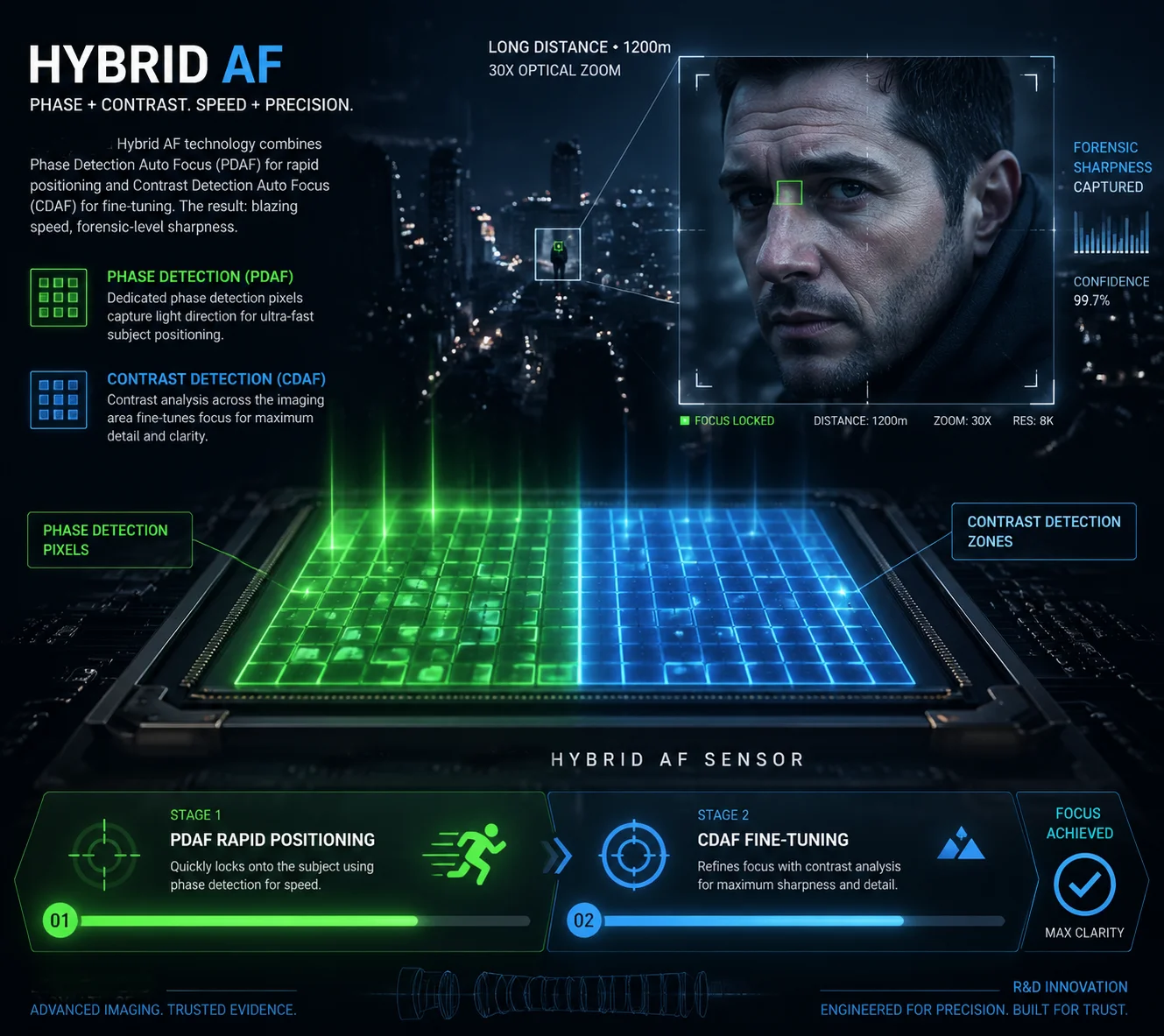 Hybrid AF combining PDAF speed and CDAF precision in PTZ camera
How Hybrid AF Works Step by Step
Think of it like parking a car. PDAF is the part where you drive into the parking space quickly. CDAF is the part where you make small adjustments to center the car perfectly between the lines.
Here is the sequence:
- PDAF fires first. The phase detection pixels calculate the target distance. The lens motor moves directly to that position. This covers about 95% of the total lens travel. It takes roughly 50–150 milliseconds.
- CDAF takes over. The contrast detection algorithm checks the image sharpness in a very small range around the PDAF position. It makes micro-adjustments — sometimes just a few microns of lens movement — to reach peak sharpness. This takes another 30–80 milliseconds.
- Focus locked. Total time from start to finish: typically under 200 milliseconds.
Without the PDAF step, the CDAF system would need to scan the entire lens range. At 40X zoom, that range is large, and the scan takes 1–3 seconds. With PDAF doing the heavy lifting, CDAF only needs to fine-tune a tiny portion of the range.
When Pure PDAF Is Not Enough
PDAF calculates distance based on phase difference. But at very long focal lengths, even a small calculation error translates to a visible focus miss. Here is why:
- At 40X zoom, the depth of field at 200 meters might be only 0.5 meters deep
- A PDAF calculation error of just 2% could put the focus point outside that 0.5-meter window
- The image looks “almost sharp” but not crisp enough for facial recognition or plate reading
This is where the CDAF fine-tuning step matters. It catches that last 2% error and corrects it. The result is an image that is both fast to acquire and sharp enough for forensic use.
Hybrid AF Performance Comparison
| AF Type | Speed to 95% Focus | Final Precision | Total Lock Time | Best Use Case |
|---|---|---|---|---|
| Pure CDAF | 1.0–3.0 s | Excellent | 1.0–3.0 s | Static scenes, studio |
| Pure PDAF | 0.05–0.15 s | Good | 0.05–0.15 s | Fast action, sports |
| Hybrid AF | 0.05–0.15 s (PDAF) + 0.03–0.08 s (CDAF) | Excellent | 0.1–0.25 s | High-zoom surveillance |
What to Look for in Supplier Specifications
Not every supplier that claims “fast autofocus” is using Hybrid AF. Some use marketing language that sounds similar but means something different. Here is what to look for:
- Clear mention of “Phase Detection” or “PDAF” in the sensor or AF specification. If the spec only says “Auto Focus” or “Fast AF,” it is probably pure CDAF.
- Sensor model matters. Certain Sony STARVIS 2 and STARVIS 2 sensors have on-chip PDAF pixels. Ask your supplier which sensor the camera uses, and then verify whether that sensor supports PDAF.
- Ask for the AF architecture. Is it PDAF-only, CDAF-only, or Hybrid? A good manufacturer will tell you exactly how their AF pipeline works.
At Loyalty-Secu, we use Hybrid AF in our 38X and 40X zoom modules. We are happy to share the technical architecture with any integrator who asks. We believe transparency builds trust.
How Many Milliseconds Does It Take for My 40X Camera to Lock Focus Using PDAF?
I know this is the question every engineer really wants answered. Not theory. Not “it depends.” A number. I respect that, so let me give you the most honest answer I can.
A well-engineered 40X PTZ camera with PDAF or Hybrid AF typically locks focus in 100 to 300 milliseconds under normal lighting (3,000–5,000 lux). In low light (10–50 lux), expect 200 to 500 milliseconds. Pure Contrast Detection cameras in the same conditions take 1,000 to 3,000 milliseconds — that is 5 to 10 times slower.
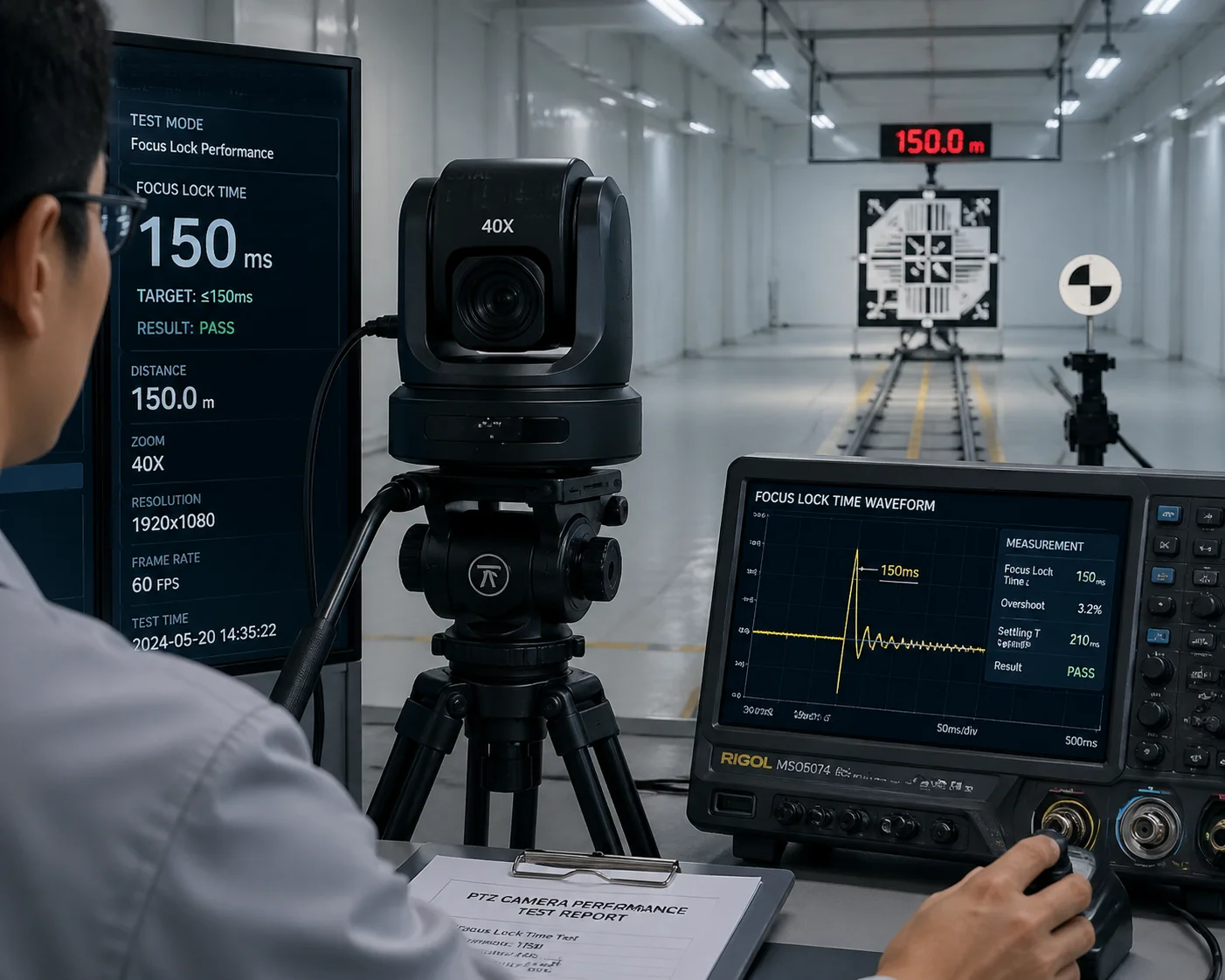 40X PTZ camera PDAF focus lock time measurement
Why There Is No Single Universal Number
I wish I could say “exactly 127 milliseconds.” But focus lock time depends on several variables that change from shot to shot:
- Starting position of the lens: If the lens is already close to the correct focus distance, lock time is shorter. If it has to travel from minimum focus distance to infinity, it takes longer.
- Target contrast: A white car against a dark road is easy. A gray wall against a gray sky is hard. Low-contrast targets slow down even PDAF systems.
- Lighting level: More light means stronger signal for the phase detection pixels. Less light means more noise, which forces the algorithm to average more frames before making a decision.
- Lens motor speed: The AF algorithm can calculate the target position in microseconds, but the motor still needs time to physically move the lens elements. Heavier glass (common in 40X zoom lenses) requires more powerful and more precise motors.
Real-World Focus Time Ranges
Based on testing across multiple PTZ modules, here are the ranges you can realistically expect:
| Condition | PDAF / Hybrid AF | Pure CDAF |
|---|---|---|
| Bright daylight, high-contrast target | 80–150 ms | 500–1,200 ms |
| Bright daylight, low-contrast target | 150–300 ms | 1,000–2,000 ms |
| Low light (50 lux), high-contrast target | 200–400 ms | 1,500–3,000 ms |
| Low light (10 lux), low-contrast target | 300–600 ms | 2,000–5,000 ms or fail |
| Full darkness with IR illumination | 250–500 ms | Often fails to lock |
These numbers come from bench tests where the camera starts at one focus extreme and must lock onto a target at a known distance. Your real-world results will vary, but the ratio between PDAF and CDAF stays roughly consistent: PDAF is 3 to 10 times faster depending on conditions.
How to Test This Yourself
When you receive a sample camera, here is a simple test protocol:
- Mount the camera on a stable surface
- Set zoom to maximum (40X)
- Point the camera at a target about 100–200 meters away (a sign with text works well)
- Manually defocus the lens completely
- Trigger autofocus and start a stopwatch (or record the screen and count frames later)
- Note the time until the text on the sign becomes readable
Do this test five times and average the results. Then do it again at night with only streetlight illumination. Compare your results to the table above. If the camera takes more than 1 second to lock at full zoom in daylight, it is almost certainly using pure Contrast Detection, regardless of what the marketing materials say.
Why Milliseconds Matter for Your Business
For an integrator like David, focus speed is not a spec sheet number. It is a business risk factor.
If your camera takes 2 seconds to lock focus at a gate entrance, and a car passes through in 3 seconds, you have only 1 second of sharp footage. That might not be enough frames for reliable ANPR software 3. Your ANPR software needs at least 2–3 clear frames to confirm a plate number. A PDAF camera that locks in 200 milliseconds gives you 2.8 seconds of sharp footage — enough for multiple confirmed reads.
This is why I always tell our partners: test the focus speed before you commit to a volume order. The few hours you spend testing will save you from months of headaches on failed deployments.
Conclusion
PDAF is 5 to 10 times faster than Contrast Detection at high zoom. For any PTZ camera above 30X, it is not optional — it is essential. Test it yourself before you buy.
1. Contrast detection autofocus scanning algorithm explained. ↩︎ 2. Sony STARVIS sensor PDAF pixel implementation details. ↩︎ 3. ANPR frame quality requirements for plate recognition. ↩︎ 4. Depth of field calculation at 40X zoom and long range. ↩︎ 5. Phase detection autofocus optics and split-pixel design. ↩︎ 6. Low-light AF performance degradation in CDAF systems. ↩︎ 7. Dual-lens AI tracking handoff latency optimization. ↩︎ 8. Hybrid AF engineering for high-zoom surveillance cameras. ↩︎ 9. Lens motor speed and step response at telephoto range. ↩︎ 10. Focus lock time measurement methodology for PTZ tests. ↩︎