
I have seen laser modules burn out in weeks. The cause is almost always the same — trapped heat inside a sealed camera housing with no way out.
Laser night vision modules dissipate heat inside sealed metal housings through a layered system of physical conduction, phase-change heat pipes, and internal air circulation. The metal housing itself acts as a giant heat sink. Active thermal management using PWM power scaling prevents the laser diode from overheating and failing.
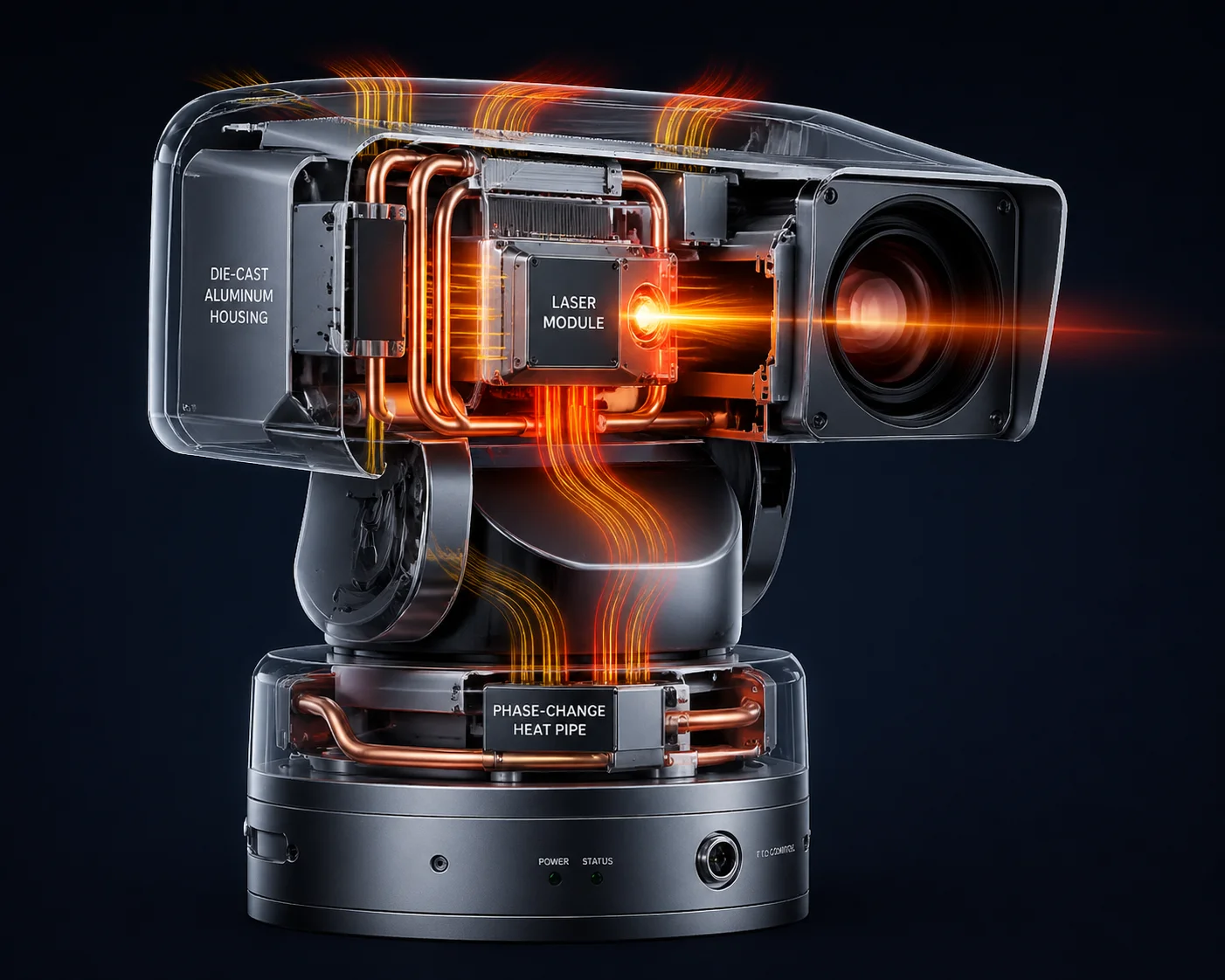
Most people think a sealed box means the heat has nowhere to go. That is only half true. The heat cannot escape through airflow. But it can escape through metal. Every surface of the housing becomes a path for heat to leave. Below, I will walk you through exactly how this works — and why it matters for your project’s long-term reliability.
Table of Contents
Does My PTZ Camera Use Active Fan Cooling or Passive Heat Sink Technology?
Many buyers ask me this question first. They assume a fan means good cooling. But inside a sealed IP66 housing, a fan alone does not solve the problem — it can actually make things worse if the design is wrong.
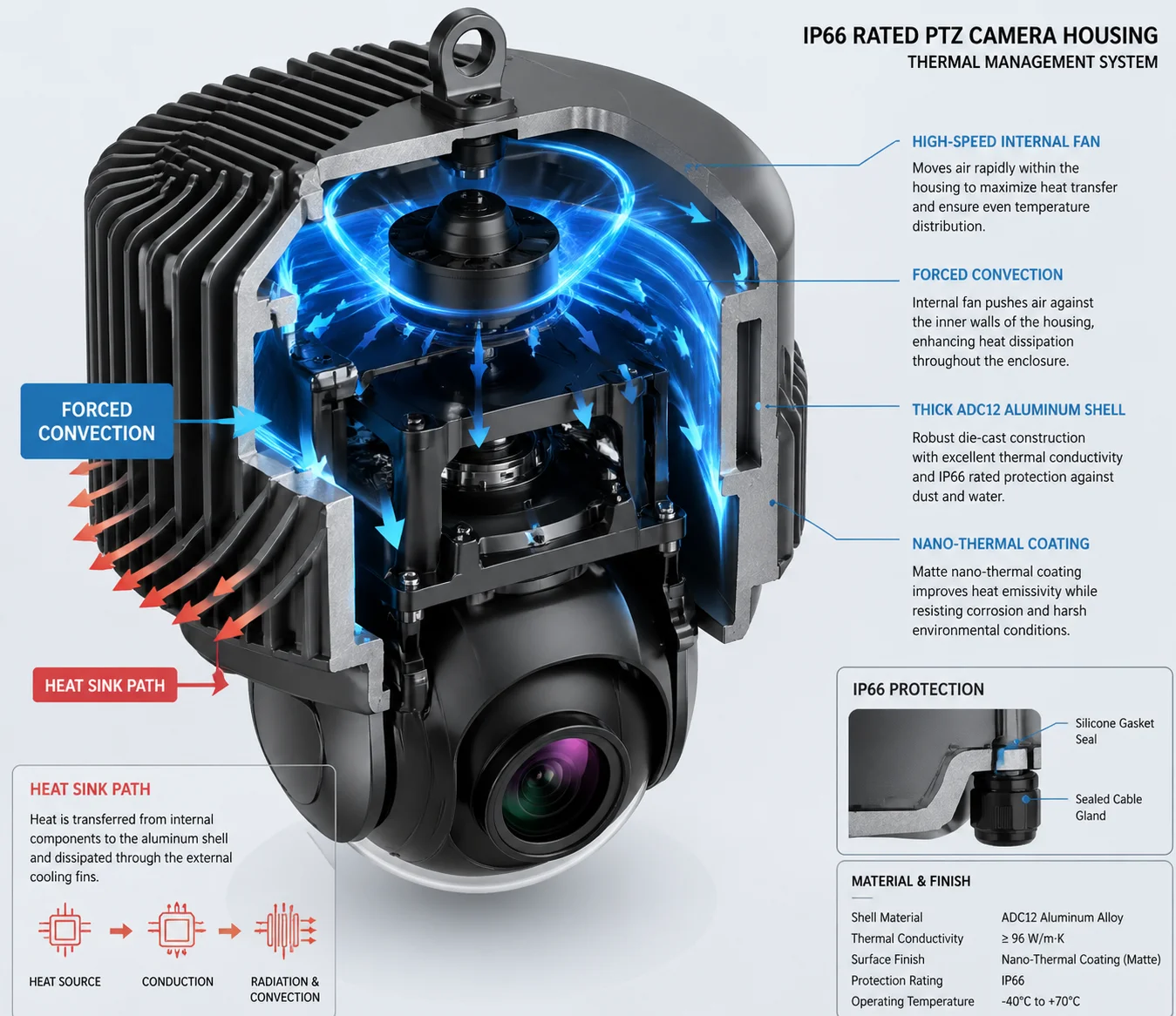
Most industrial PTZ cameras use both. An internal fan circulates air to eliminate hot spots, while the sealed aluminum housing acts as a passive heat sink. The fan does not push air out. It pushes heat toward the metal walls, where it conducts to the outside.
Why a Fan Inside a Sealed Box Is Not What You Think
Here is a common mistake. A customer sees “fan cooling” in a spec sheet and assumes the camera has ventilation holes. It does not. In an IP66 or IP67 rated housing, there are zero openings. The fan sits inside a completely closed space.
So what does the fan do? It moves air around inside the box. That sounds useless, but it is not. Without the fan, heat from the laser module creates a “hot spot” — a small area where the temperature is extremely high. The rest of the housing stays cool. This uneven heat distribution is dangerous. The laser diode sits in a tiny oven while the rest of the camera is fine.
The internal fan breaks up that hot spot. It forces the hot air to spread across the entire inner surface of the metal housing. Now the whole housing absorbs heat, not just one small patch. The housing becomes a 360-degree heat sink.
Passive Heat Sink: The Housing Itself
The housing material matters a lot. Most professional PTZ cameras use ADC12 die-cast aluminum. This alloy has a thermal conductivity of about 96 W/m·K — not as high as pure aluminum (200 W/m·K), but strong enough to survive outdoor abuse while still moving heat effectively.
On the outside of the housing, you will often see cooling fins — raised ridges that increase the surface area. More surface area means more contact with outside air. More contact means faster heat loss through natural convection and radiation.
The Combined Strategy
| Cooling Method | Role Inside Sealed Housing | Heat Transfer Type |
|---|---|---|
| Internal fan | Eliminates hot spots, spreads heat to all walls | Forced internal convection |
| Aluminum housing body | Conducts heat from inner wall to outer wall | Solid conduction |
| External cooling fins | Increases surface area for heat release | Natural convection + radiation |
| Nano thermal coating | Boosts infrared emissivity of outer surface | Thermal radiation |
Some top-tier outdoor PTZ cameras also apply a special high-emissivity powder coating on the outer shell. This coating does two things. It protects against corrosion. And it increases the rate at which the housing radiates heat as infrared energy. This is a small detail that makes a measurable difference in desert or tropical deployments where ambient temperatures exceed 45°C.
At Loyalty-Secu, our laser PTZ housings use this combined approach. The internal fan is not an afterthought — it is part of a calculated thermal architecture. Every watt of laser heat has a designed path from the diode to the outside air.
Will the Internal Heat Affect the Lifespan of My Sony Image Sensor?
This is a question I hear from almost every technical buyer. They invest in a Sony CMOS sensor for image quality. Then they worry that the laser module sitting nearby will cook it slowly over time.
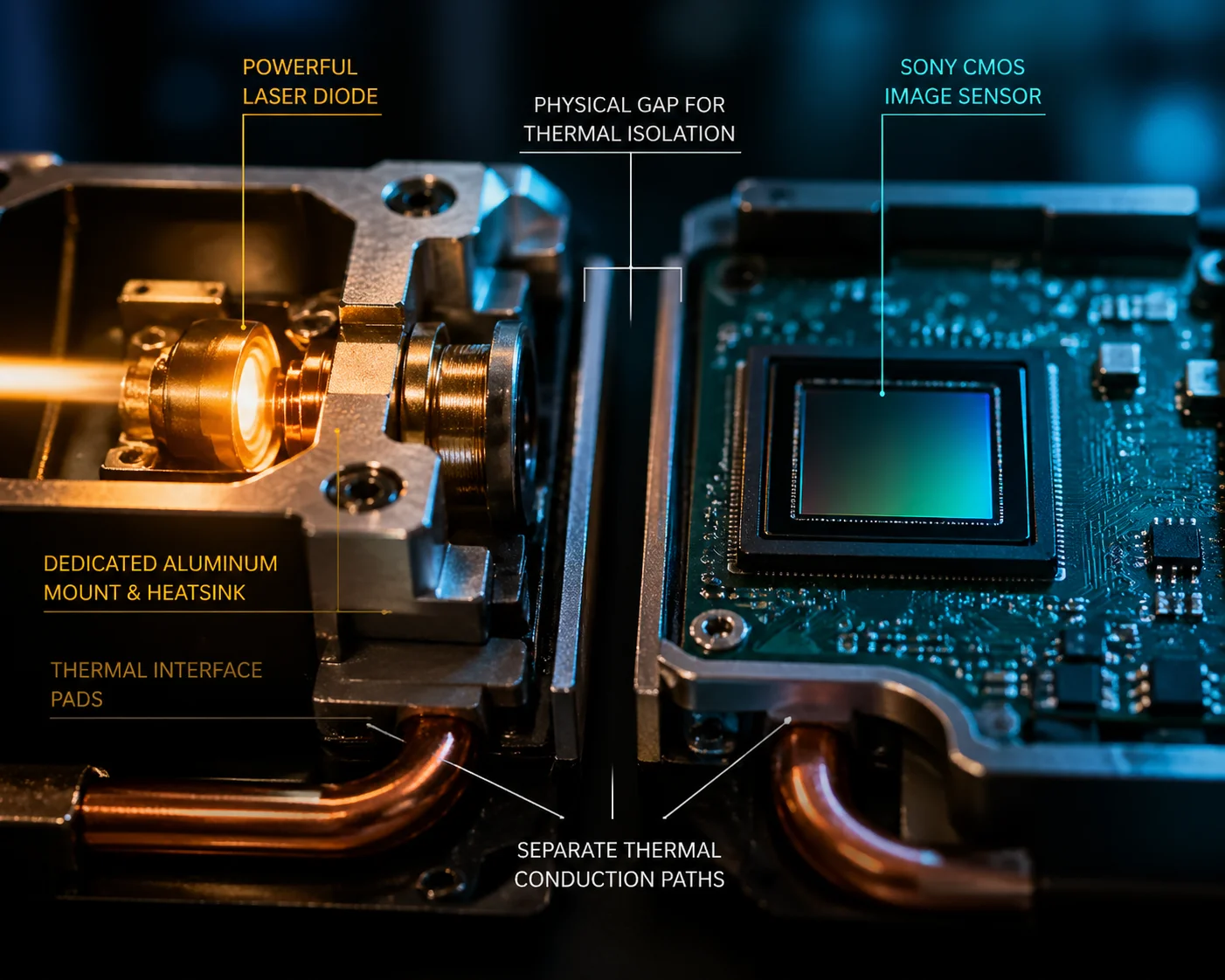
Yes, internal heat can shorten the lifespan of any image sensor if the thermal design is poor. But in a properly engineered PTZ camera, the laser module and the image sensor sit on separate thermal paths. Heat from the laser is directed away from the sensor through dedicated conduction channels.
How Heat Damages Image Sensors
Image sensors are semiconductors. When they get hot, several bad things happen. Dark current noise increases — this means the image gets grainy, especially at night. Color accuracy drifts. And over years of sustained high temperature, the sensor’s transistors degrade physically.
Sony rates most of their industrial CMOS sensors 1 for a maximum junction temperature of about 85°C. Above that, you start losing lifespan fast. The general rule in electronics is simple: every 10°C increase above the rated temperature cuts the component’s life in half. This is known as the Arrhenius equation 2 in reliability engineering.
Thermal Isolation: Keeping the Laser and Sensor Apart
A well-designed PTZ camera does not just manage heat — it manages heat directionally. The laser module generates the most heat. The image sensor is the most sensitive component. These two must be thermally isolated from each other.
Here is how we do it:
Dedicated Conduction Paths
The laser module sits on its own aluminum mounting bracket. This bracket is connected directly to the housing wall through a short, thick metal path. Heat flows from the laser → through thermal paste → into the bracket → through the housing wall → out to the air. This path is designed to be the path of least thermal resistance.
The image sensor, on the other hand, sits on a separate PCB with its own smaller heat sink. Its thermal path goes in a different direction — usually toward a different section of the housing.
The Role of Thermal Paste and Thermal Pads
Between every metal-to-metal joint, there is a layer of thermal interface material (TIM). Without TIM, microscopic air gaps between surfaces act as insulation. Air has a thermal conductivity of only 0.026 W/m·K. That is terrible. TIM fills those gaps and creates a continuous heat bridge.
| Thermal Interface Material | Thermal Conductivity | Best Use Case |
|---|---|---|
| Thermal paste (silicone-based) | 1–5 W/m·K | General chip-to-heatsink contact |
| Thermal pad (silicone sheet) | 3–8 W/m·K | Filling larger gaps with uneven surfaces |
| Indium foil | 80+ W/m·K | High-performance laser diode mounting |
| Phase-change material (PCM) | 3–6 W/m·K | Self-adjusting interface, softens at operating temp |
In our Loyalty-Secu laser PTZ cameras, the laser module uses high-grade thermal pads rated above 5 W/m·K. The Sony sensor uses a separate thermal pad on its own path. This separation is intentional. The laser’s heat never crosses into the sensor’s thermal zone.
What Happens When the Design Is Wrong
I have tested competitor cameras where the laser module and image sensor share the same metal bracket. After 4 hours of full-power laser operation, the sensor PCB reached 72°C. That is within spec — barely. But in a Middle Eastern summer with 50°C ambient temperature, that same camera would push the sensor past 90°C. That is how you get a dead sensor in 18 months instead of 10 years.
How Does the Camera Prevent Internal Condensation When the Laser Cools Down?
This is one of the smartest questions a buyer can ask. Most people focus on heat. Very few think about what happens when the heat goes away. But condensation kills electronics just as fast as overheating.
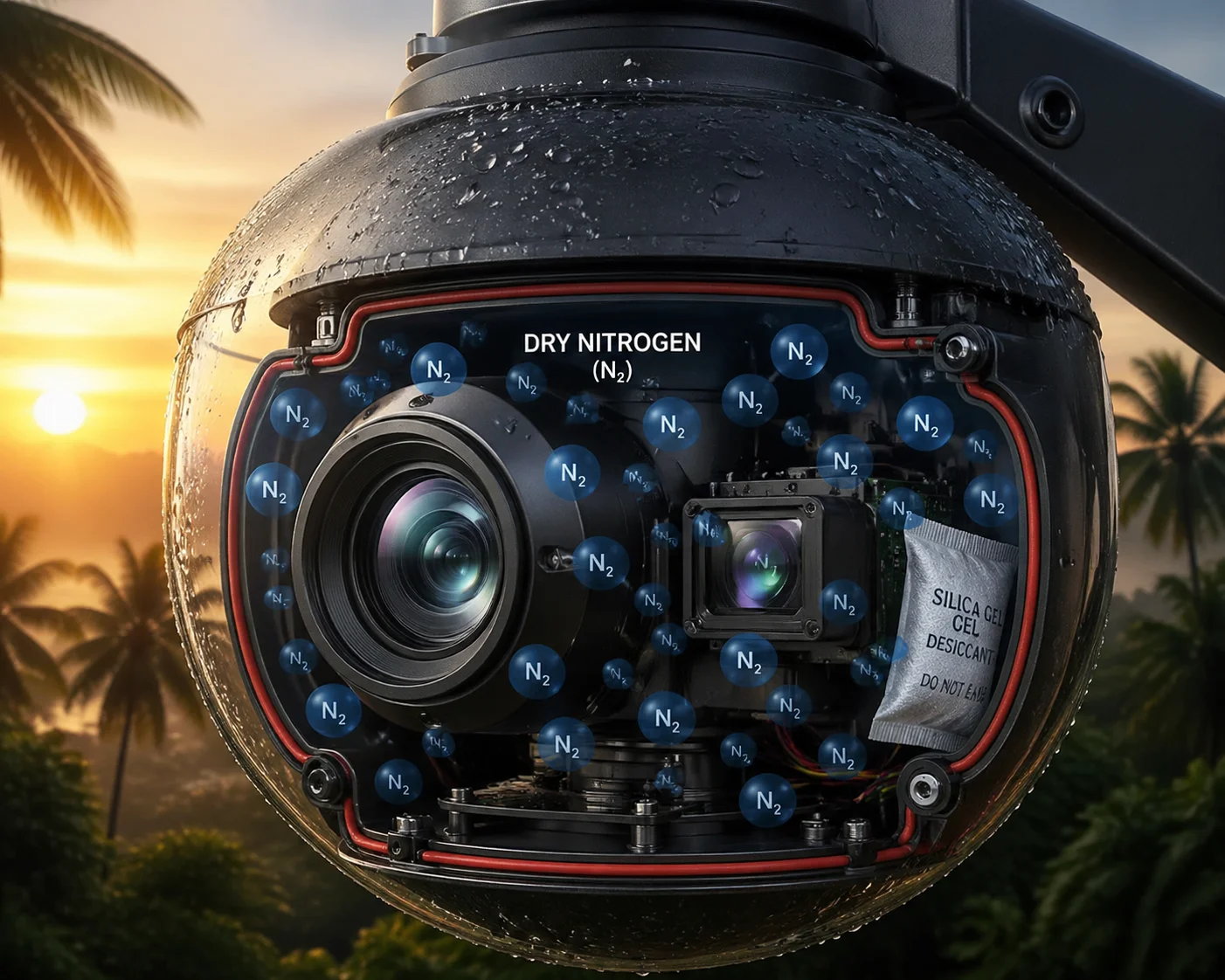
Sealed PTZ cameras prevent condensation by filling the housing with dry nitrogen gas during assembly and using desiccant packs inside the cavity. The sealed design keeps moisture out permanently. When the laser cycles off and temperatures drop, the dry internal atmosphere has no water vapor to condense.
Why Condensation Happens Inside Cameras
When the laser runs at full power, the inside of the camera gets hot. When the laser turns off — say, at sunrise — the temperature drops quickly. If there is any moisture inside the housing, it will condense on the coldest surface. That surface is usually the front glass window or the lens element. A thin film of water on the lens ruins image quality. Water on a PCB causes short circuits. Water on a laser diode facet causes permanent, irreversible damage.
This is not a theoretical risk. I have personally seen cameras returned from tropical sites with visible water droplets inside the front window. Every single one of those cameras had a failed seal.
The Three-Layer Anti-Condensation System
Layer 1: Hermetic Sealing
The housing must be truly sealed. This means every joint uses a compressed rubber gasket or O-ring. Every cable entry uses an IP-rated gland. The front window is bonded with structural adhesive, not just pressed in. At Loyalty-Secu, we pressure-test every housing before the electronics go in. If it cannot hold pressure, it does not ship.
Layer 2: Dry Nitrogen Fill
During final assembly, the sealed housing is purged with dry nitrogen gas (N₂). Nitrogen is inert — it does not react with any internal components. And it is bone dry. There is zero water vapor inside. This means that even if the temperature swings 40°C between day and night, there is nothing to condense.
This is the same technique used in high-end rifle scopes and military optics. It works.
Layer 3: Desiccant Backup
As an extra safety layer, a small silica gel desiccant pack is placed inside the housing. Over years of service, microscopic amounts of moisture may permeate through the gaskets. The desiccant absorbs that moisture before it can cause harm. Some cameras use replaceable desiccant cartridges accessible from outside — but in a fully sealed design, the desiccant is sized to last the full product lifetime.
What About the Laser Diode Facet?
The laser diode’s output facet is the most vulnerable surface in the entire camera. If even a microscopic water droplet lands on it, the next time the laser fires, the water absorbs the laser energy and causes a micro-explosion on the facet surface. This is called Catastrophic Optical Damage (COD). It is instant and permanent.
This is why the dry nitrogen atmosphere is not optional — it is a survival requirement for the laser. Research from RPM Lasers 3 confirms that cooling a laser diode below 15°C in a non-dry atmosphere will cause condensation damage to GaN and AlGaN laser facets. The sealed, nitrogen-filled housing eliminates this risk entirely.
Can I See a Thermal Imaging Report of the Camera Operating at Full Laser Power?
This is the question that separates serious buyers from casual shoppers. If a supplier cannot show you real thermal data, they either have not tested their product or they do not want you to see the results.
Yes, a reputable manufacturer should provide a thermal imaging report showing surface temperature distribution at full laser power. This report reveals hot spots, thermal bottlenecks, and confirms whether the housing design can keep the laser diode junction temperature within safe limits across all operating conditions.
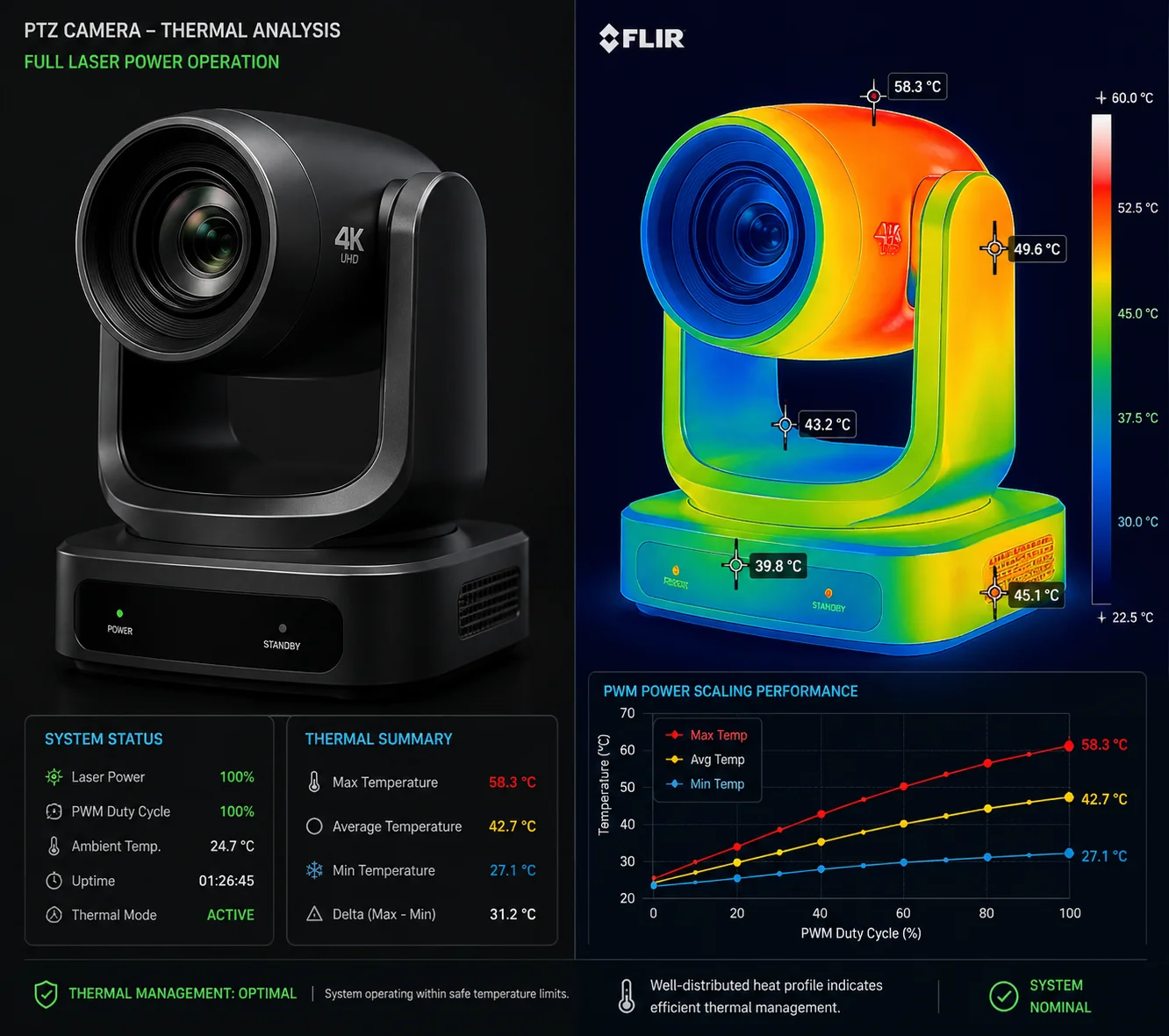
What a Thermal Report Should Show You
A proper thermal imaging report is not just a pretty color picture. It is an engineering document. Here is what to look for:
Key Data Points in a Thermal Report
The report should include at least these measurements:
- Laser module surface temperature at full power after thermal steady state (usually 2–4 hours of continuous operation)
- Housing external surface temperature at the hottest point
- Ambient temperature during the test
- Temperature delta (ΔT) between the laser module and the housing exterior
- Temperature at the image sensor location to confirm thermal isolation
If the supplier only shows you a snapshot taken after 10 minutes of operation, that is not useful. Thermal steady state takes time. The camera needs to run at full power for hours before the temperatures stabilize.
How to Read the Color Map
Thermal cameras produce a color-coded image. Red and white areas are hot. Blue and purple areas are cool. On a well-designed laser PTZ camera, you should see:
- A warm zone (yellow/orange) directly above or behind the laser module
- A gradual gradient from warm to cool across the housing
- No sharp red “hot spots” — these indicate a thermal bottleneck
- The front window area should be cooler than the laser area
If the entire housing is uniformly hot, that actually means the internal heat distribution is working well. The fan and conduction paths are spreading heat evenly.
The PWM Thermal Protection System
Here is something most buyers do not know about. The best laser PTZ cameras do not just dissipate heat — they actively manage it in real time.
Our Loyalty-Secu laser PTZ systems include a PWM (Pulse Width Modulation) dynamic power control 4 system. A temperature sensor sits directly on the laser module. It feeds real-time data to the control board. If the laser core temperature approaches the safety threshold — typically around 65–70°C — the system automatically reduces the laser pulse width.
This is called thermal derating. The laser still works. The night vision still functions. But the power drops slightly to prevent damage. When the temperature falls back to a safe range, full power resumes automatically.
| Thermal Management Feature | What It Does | Why It Matters |
|---|---|---|
| PWM dynamic power scaling | Reduces laser power when temperature rises | Prevents diode burnout in hot climates |
| Real-time temperature sensor | Monitors laser core temperature continuously | Enables instant response to thermal events |
| Thermal derating algorithm | Adjusts pulse width based on temperature curve | Extends laser lifespan beyond 30,000 hours |
| Automatic recovery | Restores full power when temperature drops | No manual intervention needed in the field |
This is the difference between a laser that lasts 5,000 hours and one that lasts 30,000 hours. The physics of heat do not change. But smart thermal management changes how the laser lives with that heat.
David, if you are deploying laser PTZ cameras in the Middle East or Southeast Asia where ambient temperatures hit 50°C regularly, this PWM protection is not a luxury. It is the only thing standing between your laser and a very expensive failure. And when your cameras are mounted on a 15-meter pole in a remote oil field, you do not want to send a technician to replace a burned-out laser module. That truck roll costs more than the camera itself.
Conclusion
Heat inside a sealed laser PTZ camera follows a designed path — from diode to metal to air. Smart thermal engineering and active PWM protection are what separate reliable systems from expensive failures.
1. How CMOS image sensors convert light into electronic signals. ↩︎ 2. Arrhenius equation for temperature-dependent component lifespan. ↩︎ 3. Laser diode facet damage from condensation and COD. ↩︎ 4. Pulse width modulation for dynamic power scaling. ↩︎ 5. ADC12 aluminum alloy thermal and mechanical properties. ↩︎ 6. Thermal interface material selection guide for electronics. ↩︎ 7. Catastrophic optical damage in high-power laser diodes. ↩︎ 8. Hermetic sealing standards for outdoor electronics. ↩︎ 9. How thermal imaging cameras measure surface temperatures. ↩︎ 10. Silica gel desiccant for moisture control in sealed enclosures. ↩︎