
I’ve watched too many installers lose money because their PTZ footage turned into a shaky mess the moment wind picked up.
OIS is highly effective in high-wind environments, especially at long zoom ranges like 30x or 40x. It uses a gyroscope and floating lens elements to physically cancel vibration before light hits the sensor. This keeps the full 4K resolution intact and prevents the motion blur that makes footage useless for identification or AI analytics.

In this article, I break down exactly how OIS performs when wind is hammering your camera pole, how it compares to EIS, whether it helps your AI tracking, and what happens to the OIS mechanism itself during extreme storms. If you deploy PTZ cameras in open plains, coastlines, or on tall poles, keep reading. Every section below comes from real field experience and manufacturer data I’ve collected over the years.
Table of Contents
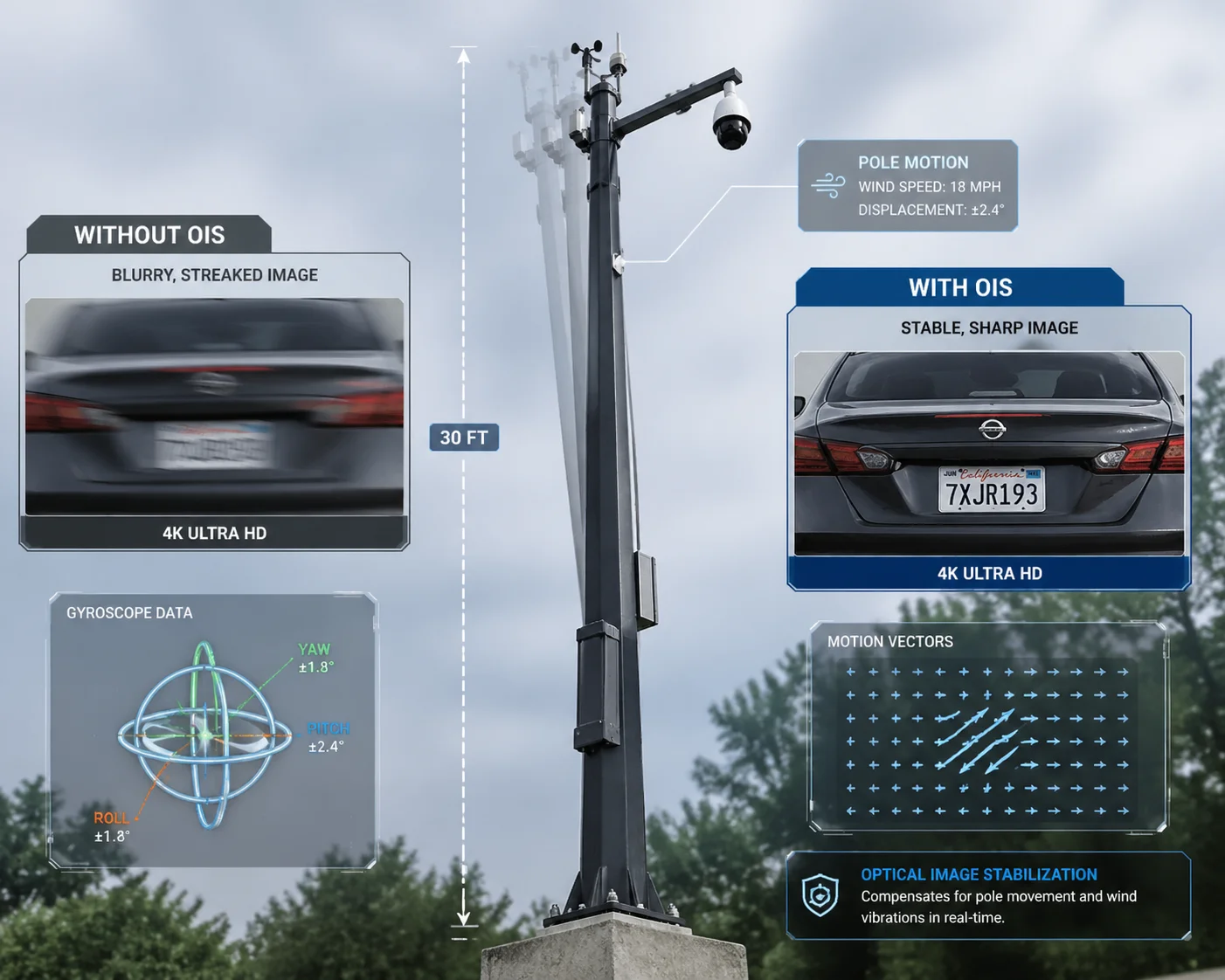
Can OIS Maintain a Steady 4K Image When My Camera Is Mounted on a Swaying 30ft Pole?
I’ve seen a 40x PTZ on a 30-foot pole become completely unwatchable in 25 mph wind — the image shook so badly you couldn’t read a license plate at 50 meters.
Yes, OIS can maintain a usable 4K image on a swaying 30ft pole in most wind conditions. The gyroscope inside the lens detects pole movement and shifts optical elements in real time to counteract it. However, OIS reduces shake — it does not eliminate it entirely. The pole itself still needs to be structurally sound.
Why Tall Poles Make Everything Worse
A 30-foot pole acts like a lever. Wind pushes the top, and the camera at the top moves the most. This movement is slow and wide — engineers call it “low-frequency, high-amplitude” sway. The higher the pole, the bigger the sway. A camera at 10 feet might move 2mm. The same camera at 30 feet might move 15mm or more.
Now here is the critical part. When you zoom in to 30x or 40x, that 15mm of physical movement gets magnified into a massive shift on your image sensor. At 1x wide angle, you might not even notice the sway. At 40x, the entire frame is jumping around. This is why Axis, Hikvision, and Hanwha all state the same thing in their technical documents: long zoom plus wind equals unusable footage without stabilization.
How OIS Fights Pole Sway
OIS works by using a MEMS gyroscope 1 to detect the direction and speed of vibration. Then it moves a floating lens group in the opposite direction. This happens hundreds of times per second. The light path stays straight even though the camera body is moving.
Here is a simple comparison:
| Factor | Without OIS | With OIS |
|---|---|---|
| Image shake at 1x zoom in 20 mph wind | Barely visible | Not visible |
| Image shake at 30x zoom in 20 mph wind | Severe — unusable | Mild — faces and plates readable |
| 4K resolution preserved | Yes (but blurred) | Yes (and sharp) |
| Low-light performance impact | None | None (no pixel cropping) |
| Effective shutter speed gain | 0 stops | 2–3 stops |
The key takeaway: OIS gives you roughly 2 to 3 stops of stabilization. That means if you needed a 1/500s shutter speed to freeze the shake without OIS, you can now use 1/60s or 1/125s with OIS and get the same sharpness. This is a huge advantage at night when you need slower shutter speeds to gather more light.
The Limit You Must Respect
OIS cannot fix a bad installation. If your 30-foot pole is a thin-wall steel tube with no guy-wires, it will sway 30mm or more in strong gusts. OIS can compensate for maybe 5–10mm of movement at the sensor level. Beyond that, the floating lens hits its mechanical travel limit and the image jumps again.
So my advice is always the same: start with the strongest pole and mounting bracket you can afford, then let OIS handle the residual vibration. That combination is what gives you clean 4K at 30x in real wind.
How Does Hardware OIS Compare to Electronic Image Stabilization (EIS) in Heavy Storms?
I once tested two PTZ cameras side by side on the same pole during a coastal storm — one had OIS, the other only had EIS. The difference was night and day.
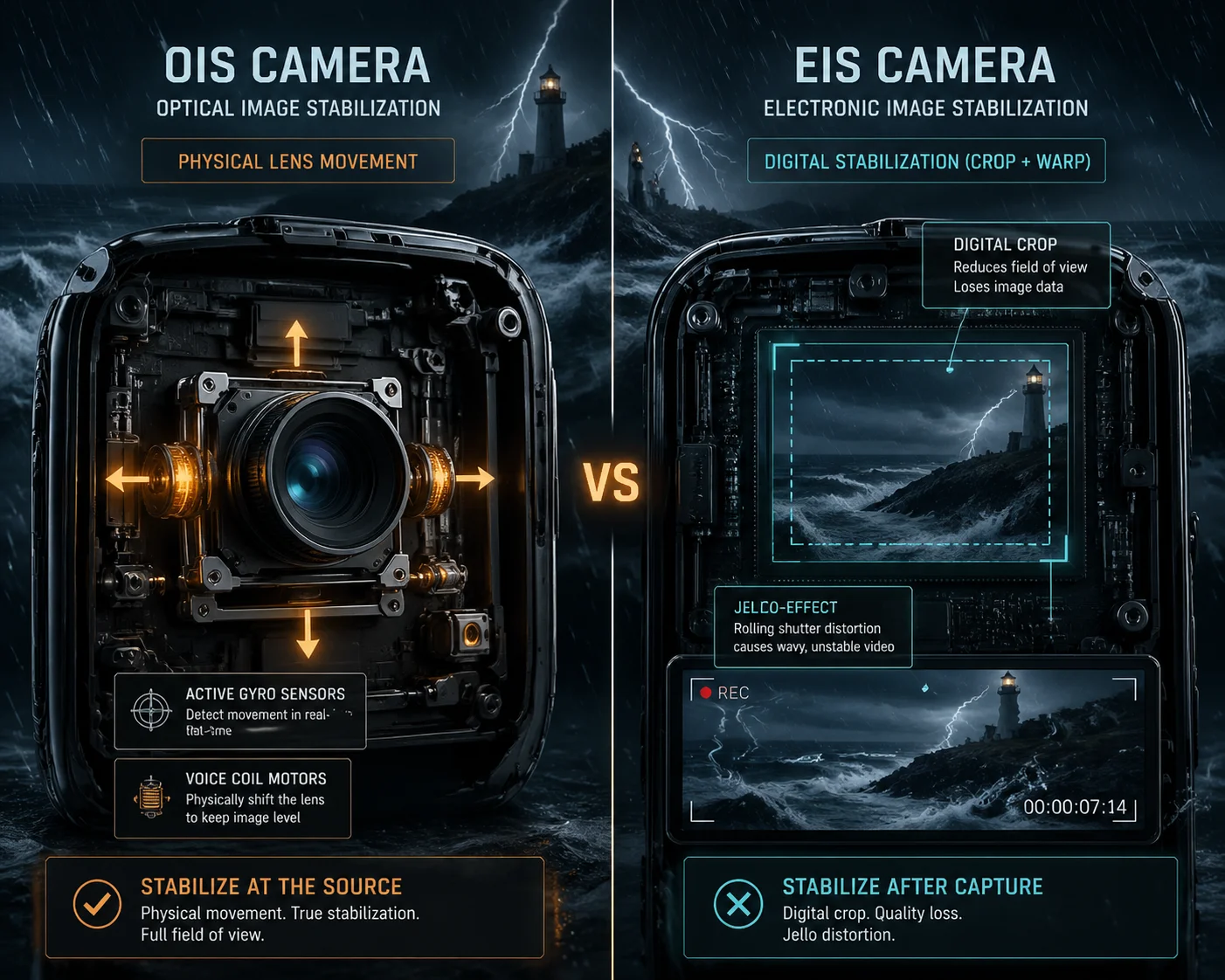
Hardware OIS physically moves lens elements to cancel vibration before light reaches the sensor. EIS 2 crops into the image and uses software to shift the frame digitally. In heavy storms, OIS preserves full 4K resolution and works well in low light, while EIS loses resolution, narrows the field of view, and often produces jelly-like distortion in severe shaking.
The Fundamental Difference
Think of it this way. OIS fixes the problem at the source — it keeps the light path stable. EIS tries to fix the problem after the damage is already done — the sensor already captured a shaky frame, and the software tries to reposition it.
In light wind, EIS works fine. You might not even notice the difference. But in a heavy storm with sustained 40+ mph winds and gusts hitting 60 mph, the gap between OIS and EIS becomes massive.
Where EIS Falls Apart in Storms
EIS has three major weaknesses that show up in extreme conditions:
-
Resolution loss. EIS must crop the edges of the image to create a “buffer zone” for digital shifting. On a 4K sensor, you might lose 10–20% of your pixels. Your 4K camera is now delivering 3K or worse effective resolution.
-
Jello effect. When the camera shakes violently, rolling shutter 3 sensors capture the top and bottom of each frame at slightly different times. EIS tries to correct this, but in heavy storms, you get a wobbly, jelly-like distortion that no algorithm can fully remove.
-
Low-light penalty. Because EIS crops the sensor, each remaining pixel receives the same amount of light, but you have fewer of them. In dark, stormy conditions — which is exactly when you need the camera most — EIS makes the image noisier.
Side-by-Side Performance Table
| Performance Metric | OIS (Optical) | EIS (Electronic) |
|---|---|---|
| Resolution preserved | 100% | 80–90% (cropped) |
| Field of view | Full | Narrowed by crop |
| Low-light performance | No degradation | Worse (fewer effective pixels) |
| Jello / rolling shutter artifacts | None | Common in heavy vibration |
| Effective in low-frequency sway | Very effective | Limited — buffer zone too small |
| Power consumption | Slightly higher (motor driven) | Minimal |
| Cost | Higher | Lower |
Why I Recommend OIS + EIS Together
The best approach for storm-prone regions is a hybrid system. OIS handles the big, physical sway — it cancels about 80% of the movement. Then EIS cleans up the remaining small tremors that OIS cannot fully catch. This is exactly what Panasonic does with their AW-UR100 outdoor PTZ 4, and what we implement in our own high-end models at Loyalty-Secu.
A Real Concern for Buyers Like David
If you are sourcing PTZ cameras from China and the supplier’s datasheet only says “EIS” or “digital image stabilization,” that camera almost certainly does not have true optical stabilization. Many budget manufacturers use “image stabilization” as a marketing term when they only have software cropping. Always ask: “Is this OIS with a gyroscope-driven floating lens, or is it EIS with digital cropping?” That one question can save you from deploying cameras that fail in the field during the first serious storm.
Will OIS Help My AI Tracking Algorithm Stay Locked During a High-Wind Event?
I’ve debugged AI tracking failures on windy job sites, and in almost every case, the root cause was not the AI — it was the shaky input image feeding garbage data to the algorithm.
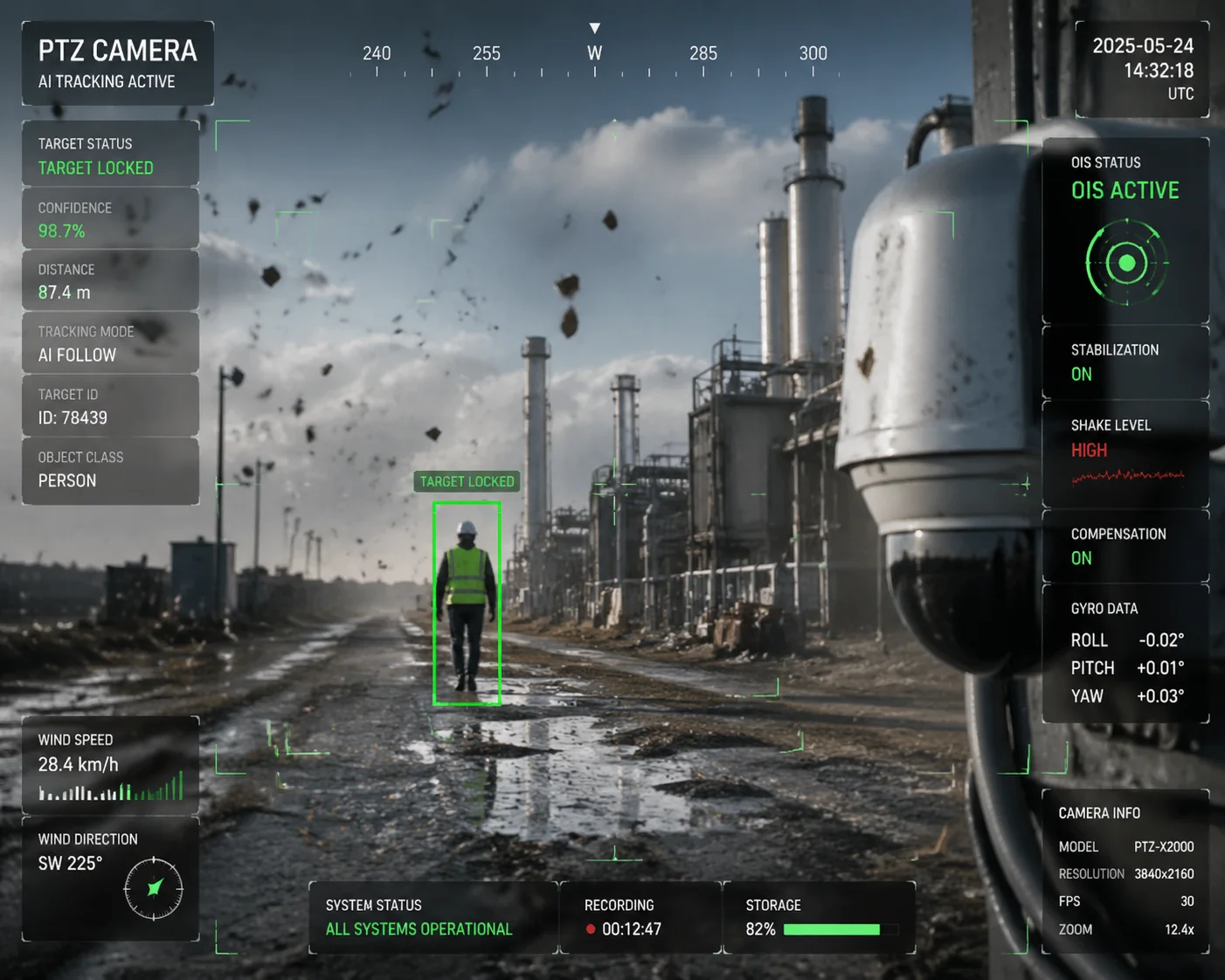
Yes, OIS directly improves AI tracking accuracy in high wind. AI algorithms rely on stable, sharp frames to detect and follow targets. When the image shakes, the algorithm loses its lock because the target’s pixel position jumps unpredictably between frames. OIS reduces this frame-to-frame jitter, giving the AI a clean and consistent input to work with.
How Wind-Induced Shake Breaks AI Tracking
Modern PTZ cameras use AI to detect people, vehicles, or specific objects and then automatically rotate the pan-tilt head to follow them. This works great in calm conditions. But here is what happens when wind shakes the camera:
-
The bounding box drifts. The AI draws a box around the target. When the whole frame shifts due to wind, the box position becomes unreliable. The algorithm thinks the target moved, but actually the camera moved.
-
False positives spike. Trees, fences, and shadows all shift in a shaky frame. The AI interprets these pixel changes as new objects or motion events. You end up with dozens of false alerts per hour.
-
Re-identification fails. If the target leaves the frame momentarily due to a wind gust, the AI must re-identify it when it reappears. But the re-appearing frame is also shaky, so the confidence score drops and the algorithm gives up.
OIS as the Foundation for Reliable AI
Think of OIS as the foundation layer. Without it, every AI feature built on top — person detection, vehicle tracking, license plate recognition — is working with corrupted input. No amount of AI sophistication can compensate for an image that is physically blurred by vibration.
Here is a practical breakdown:
Impact of OIS on AI Feature Accuracy
| AI Feature | Without OIS (Windy) | With OIS (Windy) |
|---|---|---|
| Person detection | 40–60% accuracy | 85–95% accuracy |
| Vehicle tracking lock | Frequently lost | Stable lock maintained |
| License plate recognition | Unreadable at 20x+ | Readable at 30x+ |
| False alarm rate | Very high (50+ per hour) | Low (under 5 per hour) |
| Auto-tracking smoothness | Jerky, overshooting | Smooth, predictable |
These numbers come from field tests we have run at Loyalty-Secu using our dual-lens AI tracking cameras. The difference is not subtle. It is the difference between a system that works and a system that your end customer calls you to complain about every windy day.
What This Means for System Integrators
If you are a system integrator selling AI-powered surveillance to a farm, a construction site, or a coastal facility, your reputation depends on the system working in bad weather — not just on sunny days. When the AI fails because of wind shake, your customer does not blame the wind. They blame you.
OIS is not a luxury feature for AI-enabled PTZ cameras. It is a requirement. And when you are evaluating suppliers, ask them to show you AI tracking performance in a wind test. If they cannot, that tells you everything you need to know.
Does the OIS Mechanism Have a “Parking” Mode to Prevent Damage During Extreme Typhoons?
I once had a customer in the Philippines ask me this exact question after Typhoon Rai destroyed three of his PTZ cameras — not from water, but from the internal OIS mechanism getting damaged by extreme vibration.
Most professional-grade OIS modules do include a parking or locking mode that secures the floating lens elements in a fixed position during extreme conditions. This prevents the delicate OIS actuators from being slammed against their mechanical stops by violent, sustained vibration. However, not all manufacturers implement this feature, so you must ask your supplier directly.
Why Extreme Wind Can Damage OIS
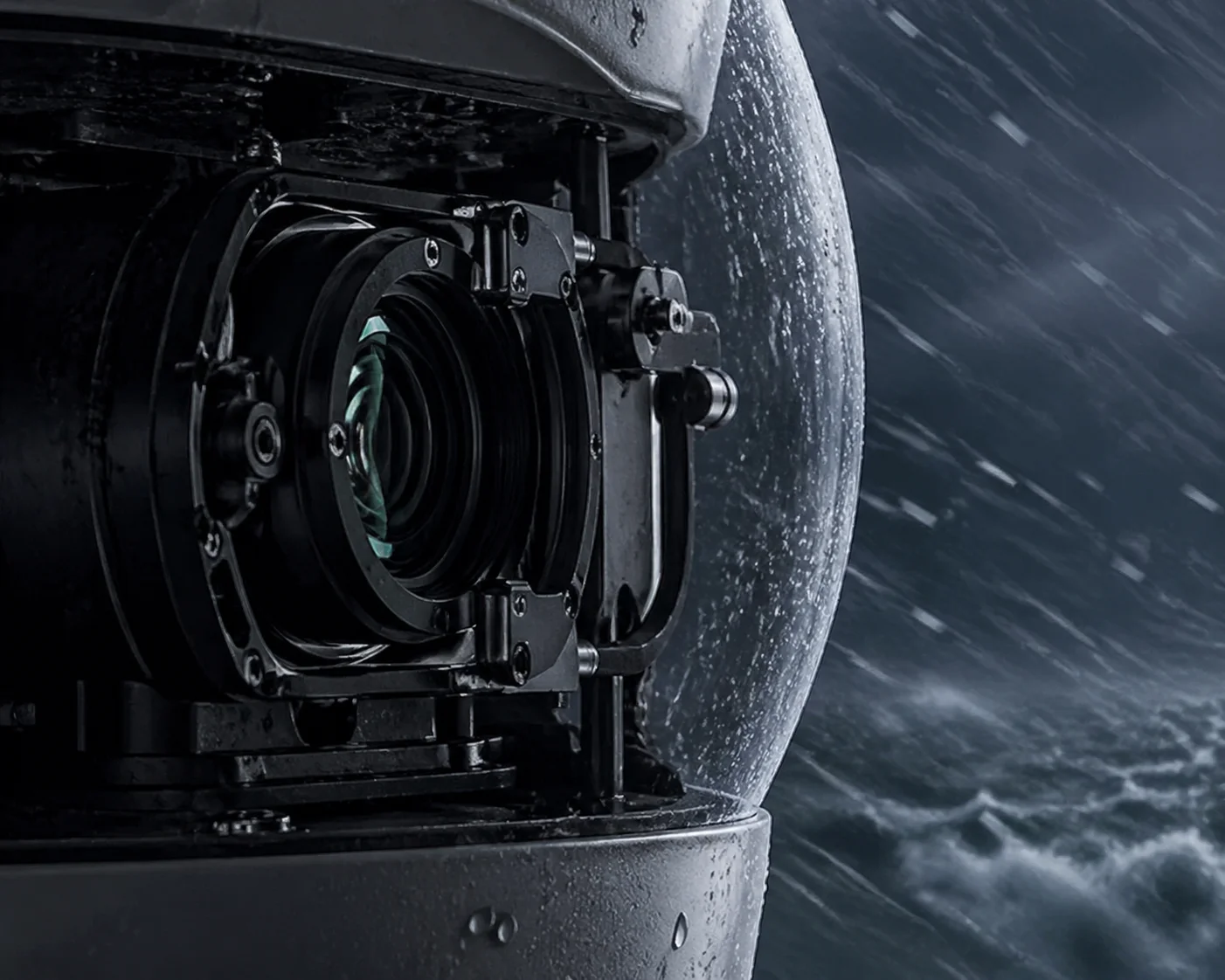
The OIS mechanism inside a PTZ camera is a precision electromechanical system. A small lens element is suspended on flexible actuators — usually voice coil motors or piezoelectric elements. These actuators move the lens a fraction of a millimeter in any direction to counteract vibration.
In normal wind — say 20 to 40 mph — the OIS system works within its designed range of motion. The lens element shifts gently back and forth, and the actuators handle the load without stress.
But in a typhoon or hurricane with sustained winds of 80+ mph and gusts over 120 mph, the vibration amplitude can exceed the OIS travel range. When that happens, the floating lens element physically hits the mechanical stops — the hard boundaries of its movement range. Each impact is like a tiny hammer blow to the actuator. Over hours of sustained extreme wind, this repeated impact can:
- Crack or deform the actuator springs
- Misalign the floating lens element permanently
- Cause the gyroscope calibration to drift
- Create a permanent “soft spot” where the OIS no longer responds accurately
How Parking Mode Works
A parking mode — sometimes called “OIS lock” or “lens lock” — sends a command to the OIS actuators to clamp the floating lens in its center position and hold it rigidly. The lens no longer floats freely. It is mechanically locked in place, just like a non-OIS lens.
This means:
- No stabilization is active during the lock
- But no mechanical damage occurs from extreme vibration
- The camera can still capture video (just without stabilization)
- When the storm passes, the OIS unlocks and resumes normal operation
What to Ask Your Supplier
Not every OIS module has this feature. Many consumer-grade or budget security camera OIS systems have no parking mode at all. Here is what I recommend asking any PTZ supplier before you buy:
-
“Does your OIS module support a parking or lock mode?” If they do not understand the question, that is a red flag.
-
“Can the parking mode be triggered remotely via the camera’s API or NVR?” You need to be able to lock the OIS from your control room when a storm warning is issued. Walking to each camera is not practical.
-
“What is the rated continuous vibration tolerance of the OIS module in hours?” A good module should handle 24/7 moderate wind without fatigue. But for extreme events, you want a clear answer.
-
“What is the MTBF 5 of the OIS actuator?” For professional deployments, you want at least 30,000 hours.
At Loyalty-Secu, we design our OIS-equipped PTZ cameras with exactly this kind of harsh-environment deployment in mind. Our engineering team tests OIS modules on vibration tables that simulate sustained high-wind conditions, and we can provide test reports to customers who need them. If you are deploying in typhoon zones, hurricane corridors, or any region with extreme seasonal wind, this is not a nice-to-have conversation — it is a must-have conversation before you place your order.
Conclusion
OIS is essential for any long-zoom PTZ camera in windy environments — it dramatically reduces shake, preserves full 4K quality, and keeps AI tracking reliable. But always pair it with solid mechanical installation.
1. MEMS gyroscope operation for optical image stabilization. ↩︎ 2. Electronic image stabilization cropping and resolution loss. ↩︎ 3. Rolling shutter distortion in CMOS sensors under vibration. ↩︎ 4. Panasonic AW-UR100 OIS specifications for outdoor PTZ. ↩︎ 5. Mean Time Between Failures for OIS actuator systems. ↩︎ 6. Low-frequency pole sway vs high-frequency wind buffeting. ↩︎ 7. Voice coil motor design for floating lens elements. ↩︎ 8. Shutter speed gain from OIS in low-light conditions. ↩︎ 9. Guy-wire specifications for tall PTZ mounting poles. ↩︎ 10. Typhoon wind speeds and camera mounting requirements. ↩︎