
I have seen too many laser PTZ cameras lose half their night vision range after just one summer. The root cause is almost always heat.
A well-designed cooling system uses heat pipes, aluminum heat sinks, and smart PWM power control to pull heat away from the laser diode fast enough to prevent crystal damage. Combined with temperature sensors and automatic power throttling, this keeps the laser running at full brightness for years, not months.
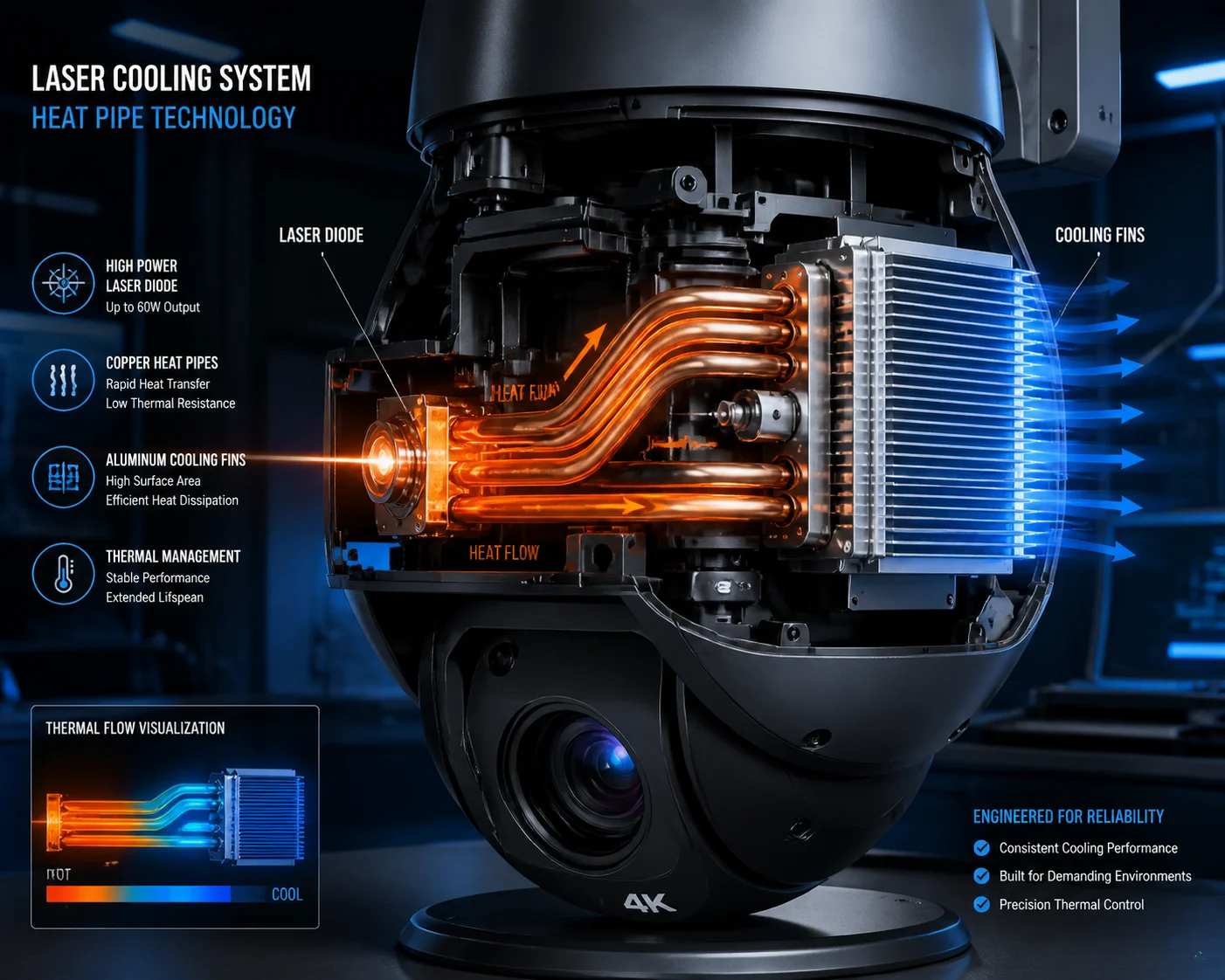
In this article, I will break down exactly how each layer of thermal protection works inside a professional PTZ camera. Whether you are deploying in the Texas heat or the African savanna, this will help you ask the right questions before you buy. Let’s dig in.
Table of Contents
Does the Laser Module Have an Independent Fan or a Dedicated Heat Pipe System?
I have opened up dozens of cheap PTZ cameras from different factories. Most of them just bolt the laser onto the same PCB as everything else. That is a recipe for failure.
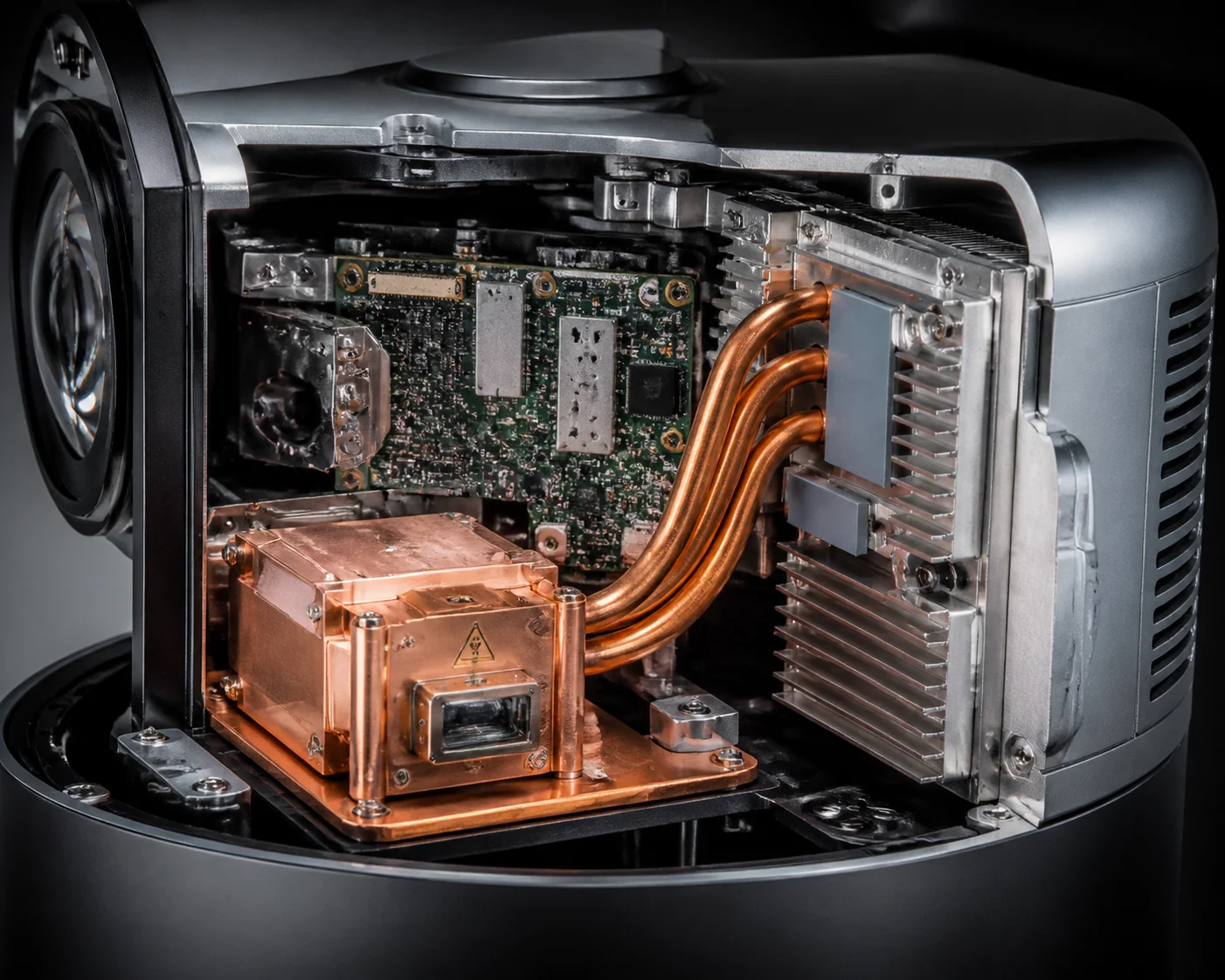
In a properly engineered PTZ, the laser module sits on its own thermal path — a dedicated copper base, thermal pads, and heat pipes that move heat directly to external aluminum fins. This keeps laser heat completely separate from the image sensor and main processor.
Why “Independent” Matters More Than You Think
The word “independent” here is not marketing talk. It means the laser has its own heat highway that does not share lanes with other components. Let me explain why this is critical.
A laser diode converts electricity into light. But a big chunk of that electricity becomes heat instead. For a 5-watt infrared laser illuminator, roughly 40–60% of the input power turns into waste heat. That heat sits right at the semiconductor junction — a tiny spot smaller than a grain of rice. If you do not move that heat away fast, the junction temperature climbs. And when it climbs past the safe limit, the crystal structure inside the laser starts to break down permanently.
The Three-Layer Heat Path
Here is how we build the thermal path in our PTZ systems:
| Layer | Component | Function |
|---|---|---|
| Layer 1 | Copper sub-mount 4 + thermal pad | Absorbs heat directly from the laser chip and spreads it across a larger area |
| Layer 2 | Heat pipe or thick aluminum base plate | Transports heat rapidly from the laser module to the outer shell |
| Layer 3 | External aluminum fins on the housing | Releases heat into the surrounding air through natural convection and radiation |
Heat Pipe vs. Fan: Which Is Better?
A fan moves air. A heat pipe 1 moves heat. They solve different problems.
Fans are great for general airflow inside a housing. But they have moving parts. Moving parts wear out. In a sealed outdoor PTZ camera rated IP66 or IP67, you cannot just put a fan inside and call it a day. Dust, moisture, and salt air will kill that fan within a year.
Heat pipes, on the other hand, have no moving parts. They use a small amount of liquid sealed inside a copper tube. When the hot end heats up, the liquid evaporates. The vapor travels to the cool end, condenses, and releases its heat. Then the liquid flows back by capillary action. This cycle repeats thousands of times per second. It is the same technology used in high-performance laptops and server CPUs.
What About TEC (Thermoelectric Coolers)?
For higher-power laser modules — especially those rated for 500 meters or more — some manufacturers add a TEC (Peltier cooler) 2 between the laser and the copper base. A TEC is a small solid-state device that actively pumps heat from one side to the other when you apply electricity. It can cool the laser junction by 10–20°C below the heat sink temperature.
The trade-off? TECs consume extra power and generate extra heat on their hot side. So you need an even better passive heat sink to handle the total thermal load. But for mission-critical deployments where laser wavelength stability matters, a TEC is worth it.
What to Look for When You Evaluate a Supplier
When you ask a Chinese PTZ factory about their laser cooling, here is what to request:
- A cross-section diagram showing the laser module’s thermal path
- Confirmation that the laser sits on a separate metal base, not directly on the main PCB
- Whether they use heat pipes, and if so, what diameter and material
- The thermal resistance value (°C/W) from laser junction to ambient air
If they cannot answer these questions, their laser cooling is probably an afterthought.
What Is the Expected Lifespan of the Laser Generator if Used 10 Hours Every Night?
I get this question from almost every system integrator I work with. They need to calculate total cost of ownership before they bid on a project. Fair enough.
A quality infrared laser diode, properly cooled, has a rated lifespan of 10,000 to 30,000 hours. At 10 hours per night, that translates to roughly 3 to 8 years of continuous nightly use before brightness drops below 70% of its original output.
How Laser Lifespan Is Actually Measured
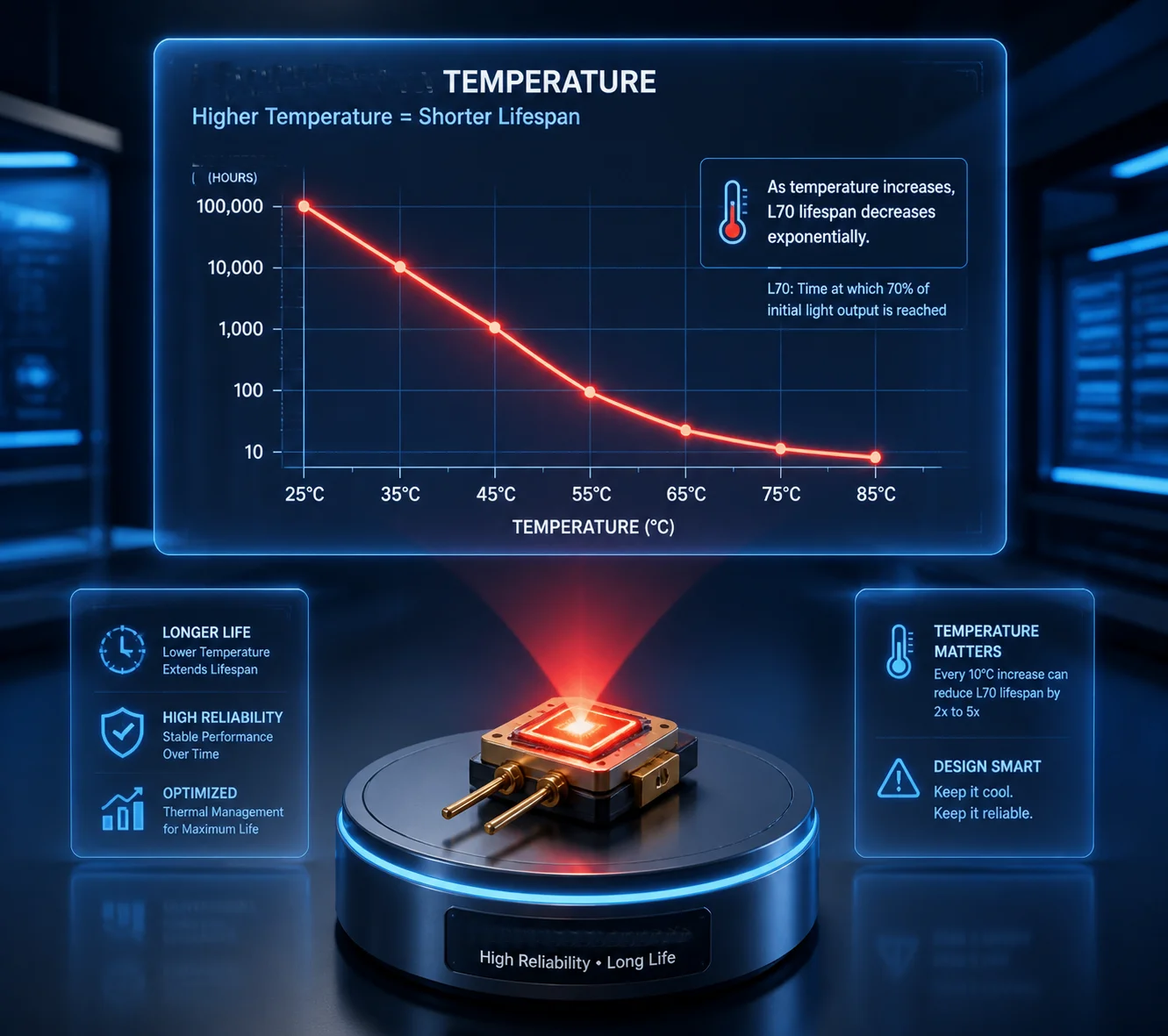
Laser manufacturers define “lifespan” as the number of hours until the output power drops to 70% of its initial value. This is called L70 lifetime. It does not mean the laser dies at that point. It means the brightness has faded enough that you will notice a shorter effective night vision range.
The key factor that determines whether your laser hits 10,000 hours or 30,000 hours is junction temperature. Every 10°C increase in junction temperature roughly cuts the laser’s lifespan in half. This is not a guess — it follows the Arrhenius equation 3, a well-established model in semiconductor reliability.
Real-World Lifespan Calculation
Let me put this into a table so you can see the numbers clearly:
| Junction Temperature | Expected L70 Lifespan | Years at 10 hrs/night |
|---|---|---|
| 25°C | ~30,000 hours | ~8.2 years |
| 45°C | ~15,000 hours | ~4.1 years |
| 65°C | ~7,500 hours | ~2.0 years |
| 85°C | ~3,500 hours | ~0.96 years |
These numbers show you exactly why cooling matters. The difference between a well-cooled laser at 45°C and a poorly cooled one at 85°C is the difference between a 4-year asset and a 1-year disposable.
The Hidden Cost of Cheap Lasers
David, here is something I tell every integrator who asks about price: the laser module itself might cost $30–$80 more in a properly designed camera. But if a cheap laser fails after 12 months, you are sending a technician to a remote oil field or a solar farm in the middle of nowhere. That single truck roll costs $500–$2,000. The math is simple.
How We Test for Long-Term Reliability
In our factory, we run a 1,000-hour accelerated aging test on every laser module design. We put the laser in a thermal chamber at 55°C ambient and run it at full power continuously. We measure the output power every 100 hours. If the power drop exceeds 5% at 1,000 hours, the design goes back to engineering. NTC thermistor 5 placement is critical for accurate junction temperature monitoring.
This test simulates roughly 3 years of real-world use in a hot climate. It is not cheap to run. But it is the only way to guarantee that the laser you receive today will still perform in year three.
What to Ask Your Supplier
- What is the rated L70 lifespan of the laser diode they use?
- At what junction temperature was that lifespan rated?
- Can they provide aging test data (power output vs. hours)?
- Do they use brand-name laser chips (like Osram, Ushio, or equivalent), or generic unbranded ones?
If they dodge these questions, you are taking a gamble.
Will the Laser’s Brightness Fade if the Internal Temperature Remains High for Hours?
I have personally tested PTZ cameras that lost 30% of their laser brightness after running for just two hours in a 40°C room. That is not acceptable for any professional deployment.
Yes, brightness will fade if the laser runs hot for extended periods without proper thermal management. High junction temperatures accelerate a process called semiconductor lattice degradation, which permanently reduces the laser’s ability to convert electricity into light.
What Happens Inside a Hot Laser
A laser diode is a semiconductor. It has a crystal structure that must stay intact to produce light efficiently. When the temperature stays high for hours, several things happen at the atomic level:
- Point defects multiply. Heat causes atoms in the crystal lattice to move out of position. These defects act as tiny roadblocks that absorb energy instead of letting it become light.
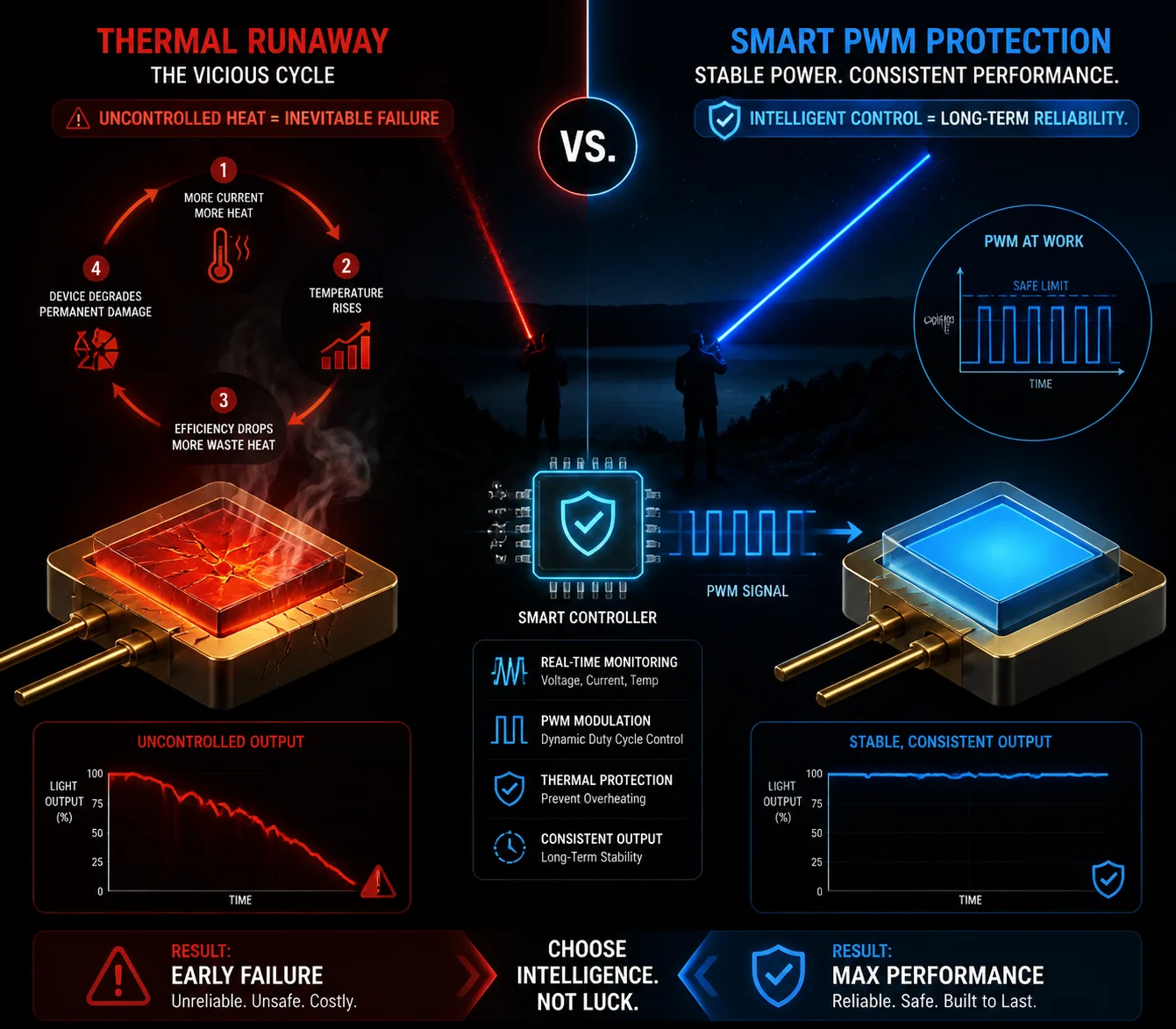
- Non-radiative recombination increases. This is a fancy way of saying: more electricity turns into heat instead of light. It creates a vicious cycle — heat causes more heat.
- Facet degradation. The front surface of the laser chip (where light exits) is the most vulnerable spot. High temperatures accelerate oxidation and contamination on this surface, which further reduces output.
The Vicious Cycle of Thermal Runaway
Here is the dangerous part. As the laser gets hotter, it becomes less efficient. Less efficiency means more waste heat. More waste heat means even higher temperature. This is called thermal runaway, and it can destroy a laser in minutes if there is no protection circuit. Pulsed laser operation 6 can help manage this by reducing average power.
How Smart PWM Control Breaks the Cycle
This is where the electronic layer of thermal protection comes in. Our PTZ systems use a closed-loop temperature control strategy. A PID temperature control loop 9 continuously adjusts laser current based on sensor feedback.
Temperature-Based Power Management
The laser module has a high-precision NTC thermistor mounted right next to the laser chip. The drive circuit reads this sensor continuously and adjusts the laser current in real time.
- Normal zone (below 50°C): Full rated power. No restrictions.
- Warning zone (50°C–65°C): The driver begins to linearly reduce laser current. You might lose 10–20% brightness, but the laser stays safe.
- Protection zone (above 65°C): The system cuts power by 50% or switches to pulsed mode. In pulsed mode, the laser fires in short bursts with rest periods in between, dramatically reducing average heat generation.
- Emergency shutdown (above 75°C): The watchdog circuit 7 kills the laser completely and logs a thermal fault event.
Adaptive Brightness Based on Scene
There is another smart layer on top of temperature control. The camera’s ISP (Image Signal Processor) analyzes the video feed in real time. If the scene is bright enough — maybe there is partial moonlight or nearby streetlights — the system automatically reduces laser power. Why run at 100% when 60% gives you a perfectly clear image?
This adaptive logic means the laser spends most of its operating life well below maximum power. That alone can double or triple the effective lifespan.
What “Brightness Fade” Looks Like in Practice
For a system integrator, brightness fade shows up as a gradual reduction in effective night vision range. A camera that could see 500 meters on day one might only reach 350 meters after a year of abuse. Your client calls and complains. You send a technician. The technician confirms the camera is “working” — but the laser is weak. Now you need to replace the entire laser module or the whole camera. That is the real cost of poor thermal design.
Is There an Automatic Shut-Off Feature to Protect the Laser from Thermal Damage?
I have had clients ask me: “What if the cooling fails? What if the fan stops or the heat sink gets blocked by dust?” These are the right questions to ask.
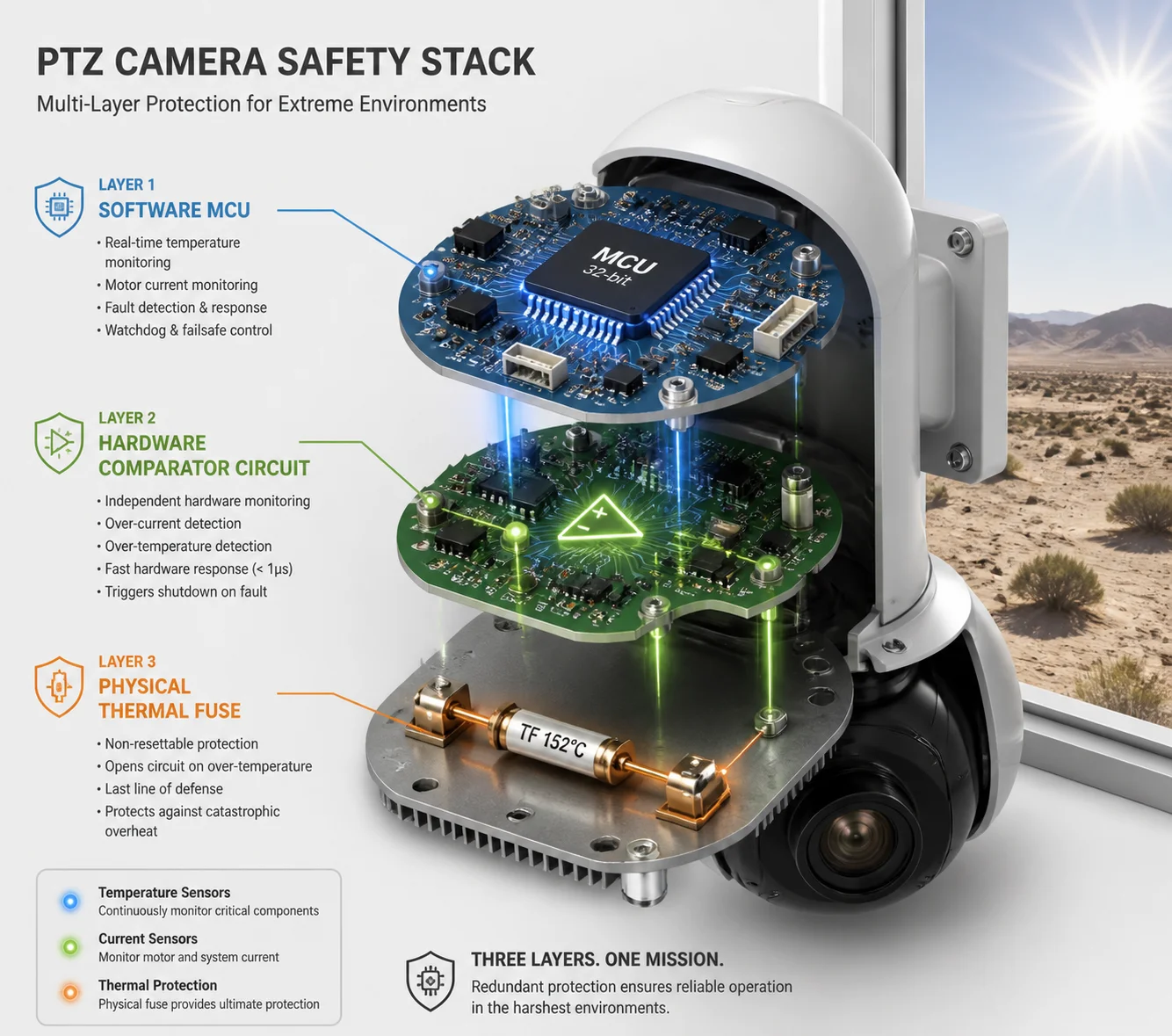
Yes, professional-grade PTZ cameras include automatic thermal protection that monitors the laser temperature in real time. When the temperature exceeds safe limits, the system reduces power progressively and will fully shut off the laser before permanent damage occurs.
Why Automatic Protection Is Non-Negotiable
In the real world, things go wrong. A bird builds a nest on top of your camera, blocking the heat sink fins. A sandstorm coats the housing in dust. The ambient temperature hits 50°C during a Texas summer. Any of these can push the laser into the danger zone.
Without automatic protection, the laser just keeps running until it burns out. With protection, the system gracefully degrades — it reduces brightness to stay alive, and it tells you something is wrong so you can fix it before it becomes a failure.
The Protection Stack
Our thermal protection works in layers. Each layer is independent, so even if one fails, the next one catches the problem.
| Protection Layer | Trigger Condition | Action Taken |
|---|---|---|
| Software PID control | Temperature rising above 50°C | Gradually reduces PWM duty cycle to lower laser current |
| Hardware comparator | Temperature exceeds 70°C | Forces laser driver to 50% maximum current regardless of software command |
| Watchdog circuit | Temperature exceeds 75°C or software hangs | Cuts power to laser driver completely via hardware relay |
| Thermal fuse (backup) 8 | Temperature exceeds 85°C | Permanently breaks the circuit — requires manual replacement to restart |
Why Software-Only Protection Is Not Enough
Some cheaper cameras rely only on software to monitor temperature. The MCU reads the sensor, and if it is too hot, the firmware reduces power. Sounds fine, right?
The problem is: software can crash. Firmware can hang. If the MCU locks up during a hot day, the laser keeps running at full power with no protection. That is why we add a hardware comparator — a simple analog circuit that compares the thermistor voltage against a fixed reference. It does not need software. It does not need a working MCU. If the voltage says “too hot,” it pulls the laser current down, period.
The watchdog circuit adds another layer. It expects a regular “heartbeat” signal from the MCU. If the heartbeat stops (meaning the software has crashed), the watchdog cuts power to the laser within seconds.
Thermal Fuse: The Last Line of Defense
The thermal fuse is a one-time-use device. It is a small component soldered in series with the laser power line. If the temperature at the fuse location exceeds its rated value (typically 85°C), it permanently opens the circuit. The laser stops. You cannot restart it without replacing the fuse.
This sounds extreme, but it exists for a reason. If every other protection layer has failed — software crashed, hardware comparator malfunctioned, watchdog did not trigger — the thermal fuse guarantees the laser will not catch fire or cause a safety hazard. It is the airbag of laser thermal protection.
Structural Isolation: Keeping Laser Heat Away from the Sensor
There is one more design feature worth mentioning. In our PTZ cameras, the laser module and the image sensor sit in separate sealed chambers inside the housing. This optical isolation serves two purposes:
- Prevents laser light leakage from contaminating the image with glare or flare.
- Prevents laser heat from warming up the image sensor. A hot CMOS sensor produces more thermal noise, which shows up as colored speckles in your video. By keeping the laser’s heat in its own compartment, the image stays clean even during long continuous operation.
For cameras deployed in extreme environments, IP66 sealed housing 10 passive cooling design is essential to maintain thermal isolation.
In cold climates like Alaska or northern Canada, this design has a bonus feature. The waste heat from the laser can be routed through the lens chamber to prevent frost buildup on the front glass. The heat that would otherwise be a problem becomes a free defroster.
What to Verify Before You Buy
When you evaluate a PTZ camera for a critical project, ask the supplier these specific questions:
- Does the camera have hardware-level thermal protection, or is it software-only?
- What are the exact temperature thresholds for power reduction and shutdown?
- Is there a thermal fault log you can access remotely via the camera’s web interface or ONVIF?
- Are the laser module and image sensor in separate thermal compartments?
If the supplier can answer all four with specifics, you are dealing with a serious manufacturer. If they give you vague answers like “don’t worry, it has protection,” keep looking.
Conclusion
A laser that runs cool lasts for years. A laser that runs hot dies in months. The cooling system — heat pipes, smart PWM control, automatic shut-off, and structural isolation — is what separates a professional PTZ camera from a disposable one. Choose wisely, and your 500-meter night vision will still be 500 meters three years from now.
1. Heat pipe phase-change cooling for high-power lasers. ↩︎ 2. Thermoelectric cooler (TEC) for active laser temperature control. ↩︎ 3. Arrhenius model for semiconductor laser lifespan prediction. ↩︎ 4. Copper sub-mount thermal conductivity for laser diode. ↩︎ 5. NTC thermistor placement for laser junction monitoring. ↩︎ 6. Pulsed laser operation for thermal runaway prevention. ↩︎ 7. Hardware watchdog circuit for laser safety cut-off. ↩︎ 8. Thermal fuse selection for laser over-temperature protection. ↩︎ 9. PID temperature control loop for laser PWM dimming. ↩︎ 10. IP66 sealed housing passive cooling design guidelines. ↩︎