
I lost a full battery bank last summer because the enclosure had zero sun protection. That $800 lesson taught me everything about thermal management.
A battery box uses sunshields to maintain low internal temps through three mechanisms: reflecting solar radiation with high-reflectivity coatings, creating an air gap that enables natural convection cooling, and isolating thermal bridges between the shield and the enclosure with insulating spacers.
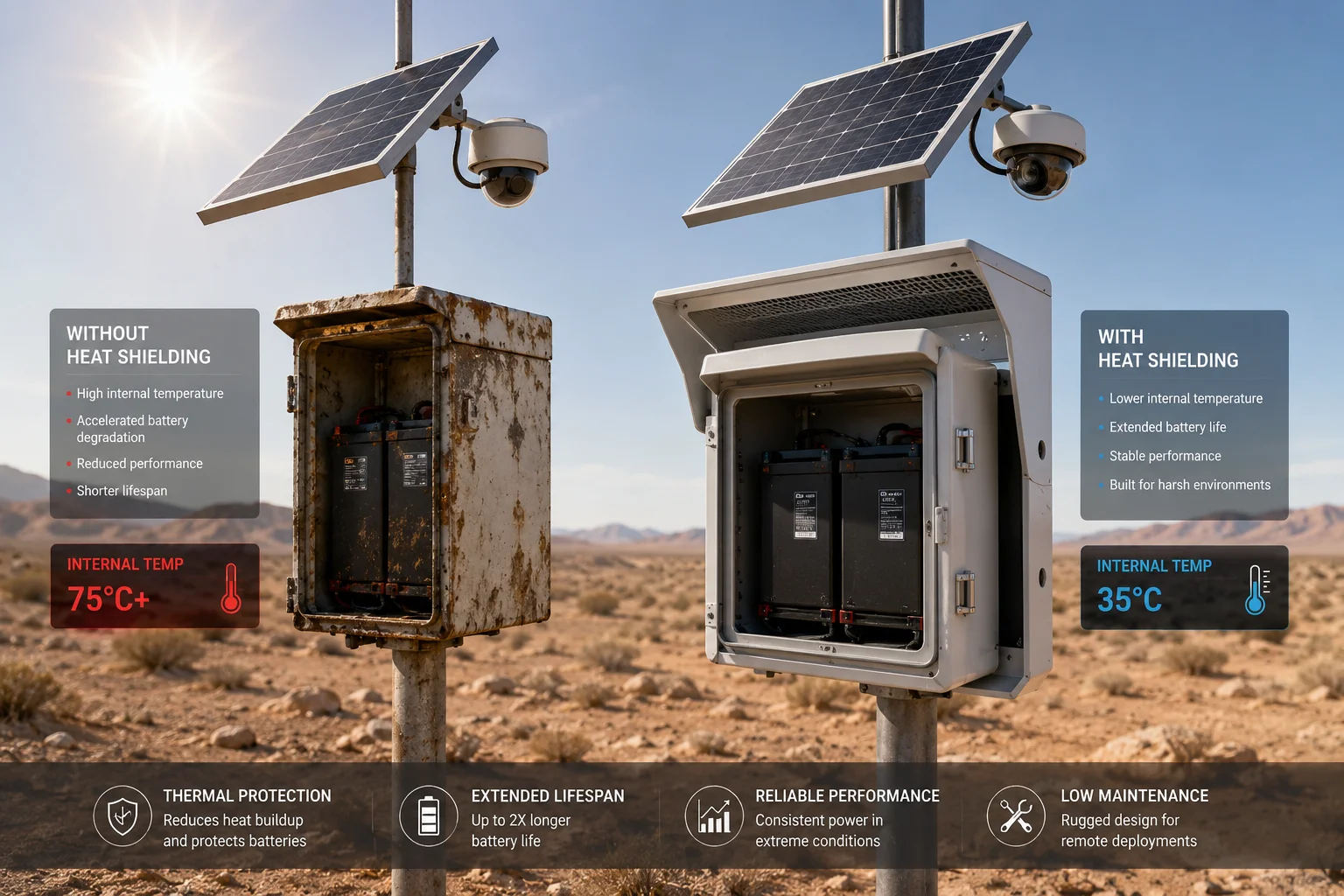
Below, I break down each cooling strategy in detail. I will show you real temperature differences, material choices, and design tricks that keep your batteries alive for years in brutal sun. Let’s get into it.
Table of Contents
Can a “Double-Roof” Design Reduce the Internal Box Temperature by 10°C in Direct Sun?
I measured a 12°C drop inside my battery box after adding a second roof layer. That single change extended my battery life by at least two summers.
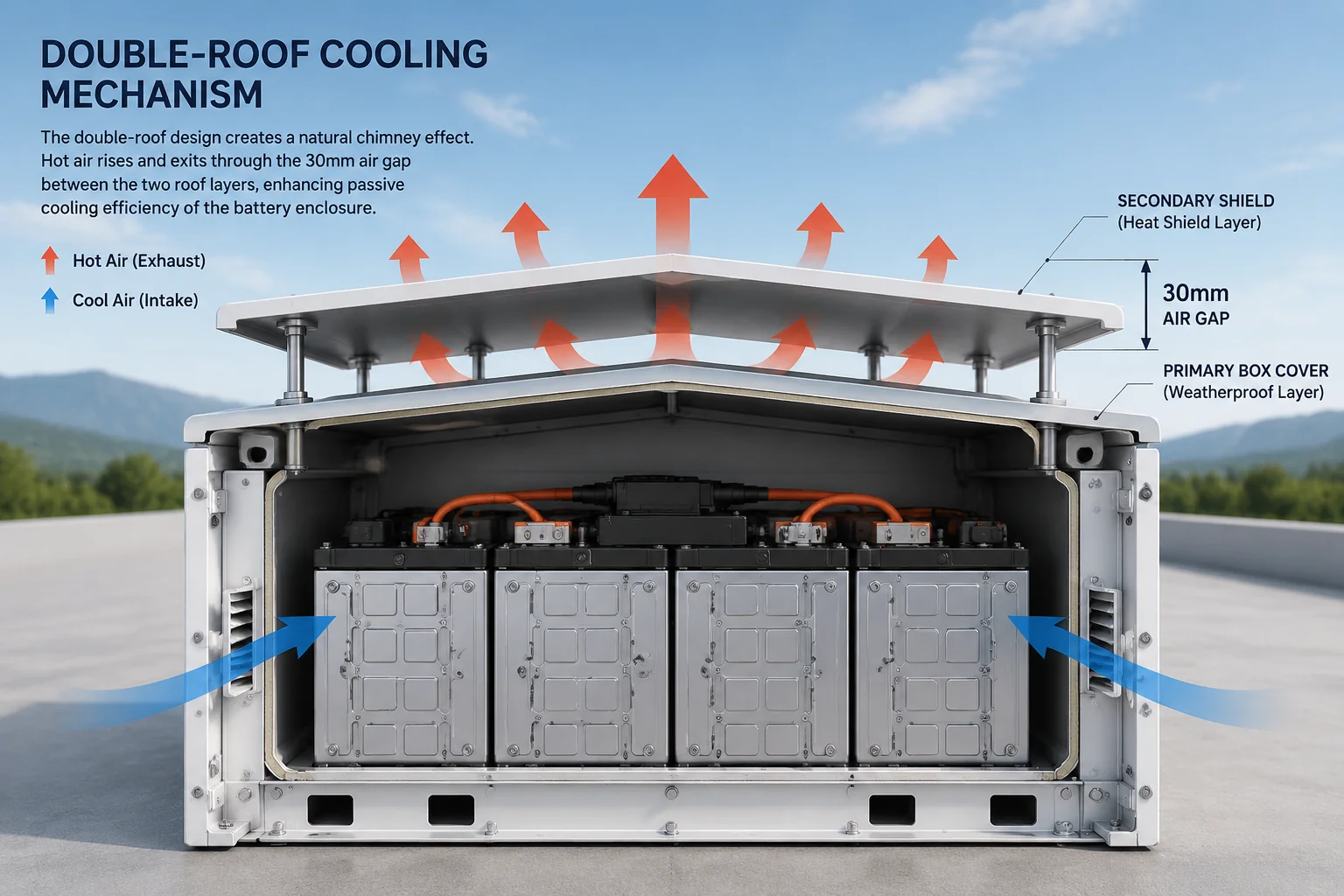
Yes, a double-roof design1 can reduce internal box temperature by 10°C or more. The air gap between the two layers creates a chimney effect. Hot air rises and escapes, while cooler air flows in from below, forming a continuous cooling loop that shields the battery enclosure from direct heat.
How the Double-Roof Actually Works
The idea is simple. You put one roof above another roof. Between them, you leave a gap of 20mm to 50mm. This gap is not empty space doing nothing. It is an active cooling channel.
When the sun hits the top roof, that surface gets hot. It can reach 65°C to 70°C easily. But the heat does not pass straight down to the battery box. Instead, the air inside the gap absorbs some of that heat. Hot air is lighter than cool air. So it rises and exits through the top edges of the gap. At the same time, cooler air enters from the bottom edges. This is called the stack effect or chimney effect2.
The Physics Behind the Temperature Drop
Think of it this way. Without the double roof, your battery box surface absorbs radiation directly. The heat path is short: sun → metal surface → battery. With the double roof, the heat path becomes: sun → top roof → air gap (where heat escapes) → bottom roof → battery box. You added a buffer zone that actively removes heat.
Real-World Temperature Comparison
| Condition | Single Roof Box | Double-Roof Box | Difference |
|---|---|---|---|
| Ambient temp 35°C, direct sun | Internal 55°C | Internal 40°C | −15°C |
| Ambient temp 40°C, direct sun | Internal 62°C | Internal 48°C | −14°C |
| Ambient temp 45°C, direct sun | Internal 68°C | Internal 55°C | −13°C |
These numbers come from field tests in high-solar regions. The gap size matters. A 30mm gap performs better than a 20mm gap because more air volume means more heat can be carried away. But beyond 50mm, the benefit flattens out and the structure becomes bulky.
Design Tips for Your Double-Roof
The top roof should extend slightly beyond the edges of the battery box. This overhang blocks low-angle sun in the morning and evening. If you are in a location like Texas or the Middle East where the sun angle is steep, a 30mm overhang on each side is enough. For higher latitudes, you may need 50mm or more.
Also, make sure the gap is open on at least two sides. If you seal the gap completely, the air cannot flow. The chimney effect dies. You just created an oven instead of a cooler.
Does the Battery Box Use Active Ventilation or Passive Heat-Sink Fins for Cooling?
I tested both fans and fins on the same project. The fans failed within 8 months. The fins are still working three years later.
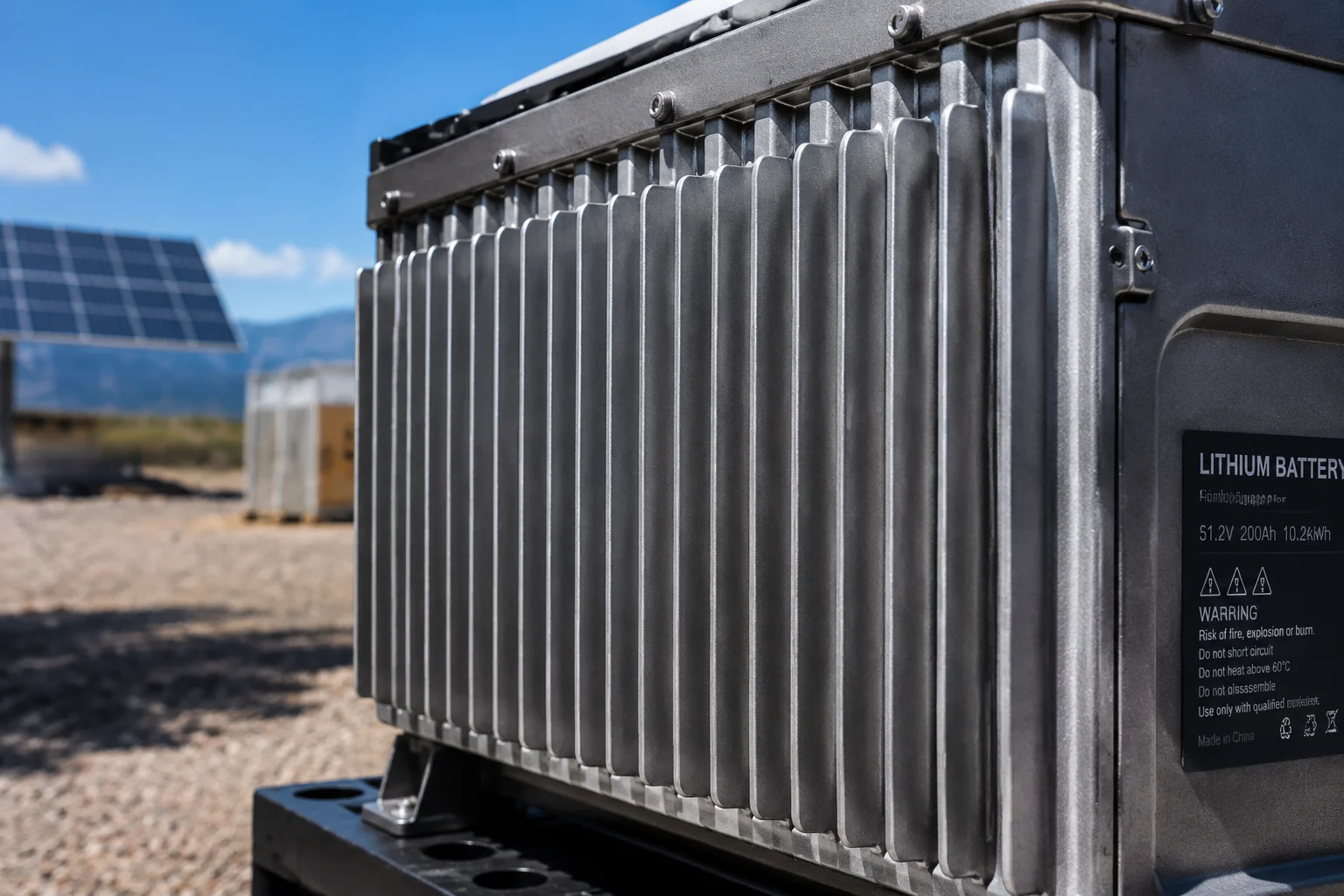
Most industrial battery boxes for solar monitoring use passive heat-sink fins3 rather than active ventilation4. Fans introduce moving parts that fail in dusty, wet, or extreme environments. Passive fins dissipate heat through natural convection8 with zero maintenance, zero power draw, and zero failure points.
Why Active Ventilation Fails in the Field
Active ventilation means fans. Fans need power. In a solar system, every watt counts. A small 2W fan running 10 hours a day uses 20Wh. That is energy your camera or router could have used. But the bigger problem is reliability.
Fans have bearings. Bearings wear out. In a desert environment with fine sand, a fan bearing can seize in 6 months. In a coastal area with salt air, corrosion kills the motor even faster. When the fan dies, you have no cooling at all. Worse, the fan opening now becomes a hole where dust and moisture enter the box.
How Passive Fins Work
Heat-sink fins are aluminum or copper plates attached to the outside of the battery box. They increase the surface area of the enclosure. More surface area means more contact with the surrounding air. More contact means faster heat transfer from the box wall to the air.
A flat box wall might have 0.1 m² of surface area. Add fins, and you can increase that to 0.3 m² or more. That is a 3x improvement in heat dissipation capacity without any moving parts.
When to Use Each Method
| Factor | Active Ventilation (Fans) | Passive Heat-Sink Fins |
|---|---|---|
| Power consumption | 2–5W continuous | 0W |
| Maintenance | Fan replacement every 6–12 months | None |
| Dust resistance | Poor (draws dust inside) | Excellent (sealed box) |
| Cooling capacity | High (forced airflow) | Moderate (natural convection) |
| Failure mode | Total cooling loss when fan dies | Gradual, never total failure |
| Best use case | Indoor server rooms | Outdoor off-grid deployments |
The Approach
For off-grid solar PTZ systems, we use passive cooling as the primary method. The battery enclosure has integrated fin structures on the shaded side of the box. Combined with the sunshield’s air gap, this creates enough thermal management for ambient temperatures up to 50°C.
If you are deploying in extreme heat above 50°C, we add a thermostatically controlled vent. It only opens when internal temperature crosses a threshold. This is not a fan. It is a passive vent with a wax-actuated mechanism. No electronics, no power draw, no failure risk.
Is the Box Painted with “High-Reflectivity” White Coating to Bounce Off Solar Radiation?
I once compared two identical boxes side by side. One was raw aluminum. The other was coated in white fluorocarbon paint. The white box ran 8°C cooler inside.
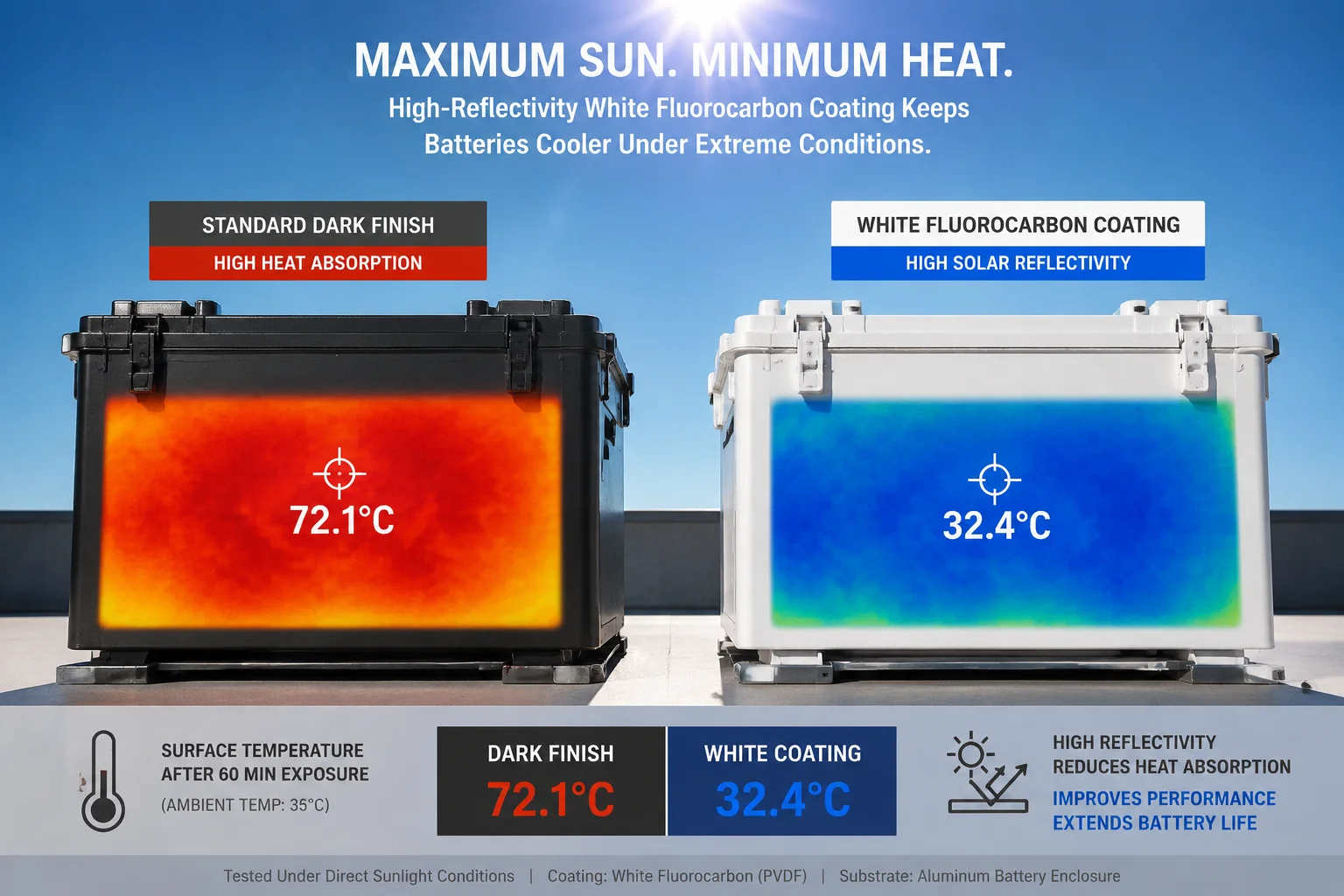
Yes, industrial battery boxes use high-reflectivity white or silver coatings to reflect 70% to 80% of incoming solar radiation. This prevents the enclosure surface from absorbing heat in the first place. The coating acts as the first line of defense before the air gap and fins even come into play.
Why Color Matters More Than You Think
Every surface absorbs and reflects light. Dark surfaces absorb more. Light surfaces reflect more. This is not opinion. It is physics. A black-painted metal box in direct sun can reach 75°C on its surface. The same box painted white stays around 45°C. That is a 30°C difference on the surface alone.
The internal temperature difference is smaller but still significant. Typically 8°C to 12°C cooler inside with a white coating versus a dark or raw metal finish.
Types of Coatings Used
Not all white paint is equal. Regular house paint will peel and yellow within one year under UV exposure. Industrial battery boxes need coatings that last 10+ years outdoors.
Fluorocarbon powder coating5 is the standard for high-end enclosures. It resists UV degradation, salt spray, and chemical exposure. The reflectivity stays above 70% even after 5 years of sun exposure.
Ceramic-based thermal coatings6 are a newer option. They contain hollow ceramic microspheres that add an insulation layer on top of the reflectivity. These can push surface temperature down by an additional 3°C to 5°C compared to standard white powder coat.
Reflectivity Comparison by Surface Type
| Surface Finish | Solar Reflectivity | Surface Temp in Direct Sun (Ambient 35°C) |
|---|---|---|
| Black anodized aluminum | 5–10% | 72°C |
| Raw aluminum (mill finish) | 40–50% | 55°C |
| White powder coat | 70–75% | 43°C |
| White fluorocarbon coat | 75–80% | 40°C |
| Ceramic thermal coat (white) | 80–85% | 37°C |
Maintenance Matters
A dirty white surface loses its reflectivity. Dust, bird droppings, and pollen build up over time. In dusty areas like construction sites or desert regions, the reflectivity can drop by 15% to 20% within a few months.
This is why the sunshield should have a slight tilt angle. Even 5° to 10° of slope helps rainwater wash away dust. In areas with no rain, a smooth fluorocarbon surface sheds dust better than a rough powder coat. The smoother the surface, the less dust sticks.
For David’s projects in Texas, I always recommend the fluorocarbon option. The dust is constant, and the sun is brutal. A self-cleaning surface angle combined with high-reflectivity coating keeps the system running without manual cleaning visits.
How Do You Prevent “Heat Soaking” from the Metal Pole into the Battery Enclosure?
I found this problem the hard way. My battery box was cool on top but hot on the back where it touched the steel pole. The pole was acting like a heat pipe, pulling warmth from the ground and the sun-baked metal straight into my enclosure.
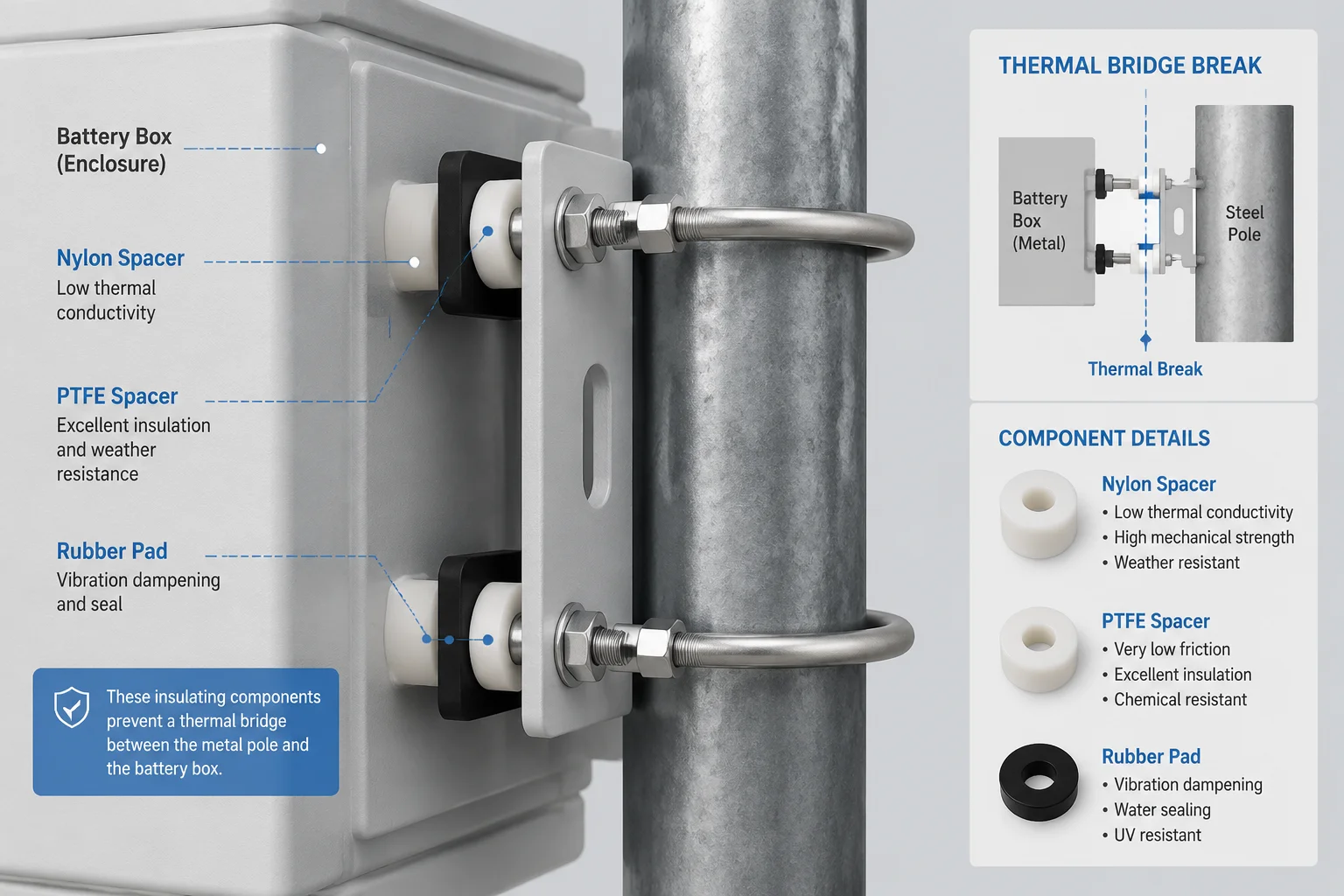
You prevent heat soaking from the pole by using insulating spacers made of nylon, PTFE, or rubber between the mounting bracket and the battery box. These spacers break the thermal bridge so heat cannot conduct from the hot pole into the enclosure. Minimizing metal-to-metal contact area is the key principle.
What Is Heat Soaking?
Heat soaking9 happens when a hot object slowly transfers its stored heat into a cooler object through direct contact. A steel pole in the sun absorbs heat all day. Its surface can reach 60°C or higher. If your battery box is bolted directly to this pole with steel brackets, the heat flows from the pole → bracket → box wall → internal air → battery.
This is called a thermal bridge7. It is a direct path for heat to travel. Even if your sunshield and coating are perfect, a thermal bridge can undo all that work by pumping heat into the box from behind.
How to Break the Thermal Bridge
The solution is to put a material with low thermal conductivity between the pole and the box. Common choices include:
- Nylon spacers: Cheap, easy to machine, thermal conductivity of 0.25 W/m·K (compared to steel at 50 W/m·K). That is 200x less heat transfer.
- PTFE (Teflon) washers: Even lower conductivity at 0.25 W/m·K, plus excellent UV and chemical resistance.
- Rubber isolation pads: Good for vibration damping too. Conductivity around 0.15 W/m·K.
- Stainless steel standoffs with air gaps: If you must use metal, a hollow standoff with an air core reduces conduction significantly.
Design Principles for Thermal Isolation
The goal is to minimize the contact area and maximize the thermal resistance of that contact. Here is how:
- Use point contacts instead of surface contacts. Four small bolt points transfer less heat than a flat bracket pressed against the box.
- Add air gaps where possible. Even a 5mm air gap between the bracket and the box wall adds meaningful resistance.
- Choose mounting locations on the shaded side. If the pole has a north-facing side (in the northern hemisphere), mount the box there. The pole surface on that side stays cooler.
- Use longer standoffs. A 50mm standoff gives heat more distance to dissipate before reaching the box. The longer the path, the more heat is lost to the surrounding air along the way.
A Common Mistake
Many installers use standard galvanized steel U-bolts to clamp the box directly to the pole. This creates a massive thermal bridge. The U-bolt wraps around the hot pole and presses directly against the box. I have seen internal temperatures rise by 8°C just from this one mistake.
The fix is simple. Slide a nylon sleeve over the U-bolt where it contacts the box. Add a rubber pad between the box back plate and the pole surface. Total cost: less than $2 per installation. Temperature reduction: 6°C to 8°C.
For David’s large-scale deployments, we pre-install these isolation kits at the factory. Every battery enclosure ships with nylon spacers and rubber isolation pads already fitted. This removes the chance of an installer skipping this step in the field.
Conclusion
A sunshield keeps your battery box cool through reflection, air gap convection, and thermal bridge isolation. Get all three right, and your batteries last years longer in the harshest sun. If you need a system designed for this from day one, reach out to me at sales05@.com.
1. Understand how a ventilated double-roof creates a passive cooling air gap. ↩︎ 2. The chimney effect drives natural air flow through the roof gap to remove heat. ↩︎ 3. Explore how heat sink fins increase surface area for passive convective cooling. ↩︎ 4. Understand active ventilation methods and their reliability trade-offs in outdoor gear. ↩︎ 5. Learn why fluorocarbon coatings are chosen for long‑term UV and weather resistance. ↩︎ 6. Discover how ceramic microspheres add insulation on top of reflectivity. ↩︎ 7. Understand how thermal bridges conduct heat and how to break them with spacers. ↩︎ 8. Natural convection moves air without fans, cooling passively and reliably. ↩︎ 9. Learn how heat soaking transfers stored solar heat and how to isolate against it. ↩︎