
I’ve seen too many PTZ cameras 1 fail not because of bad sensors, but because nobody thought about the sun angle at the install site.
An adjustable sunshield adapts to different U.S. latitudes by letting installers change its extension depth and tilt angle. In southern states, the shield stays compact to block high-angle overhead sun. In northern states, it extends further out to cut low-angle glare that washes out the image.
The sun does not hit a camera the same way in Miami as it does in Montana. The U.S. stretches from about 25°N to 49°N latitude. That means the solar elevation angle 2 changes a lot from south to north. A fixed sunshield cannot handle this range. It will either block too much of the view in the north or let too much light in down south. Below, I break down four real-world scenarios where this adjustable design makes or breaks image quality.
Table of Contents
Can I Slide the Sunshield Forward to Prevent Lens Flare During a Low-Angle Florida Sunset?
I lost an entire week of usable footage on a Florida coastal project because the sunset hit the lens at just the right angle to create a white-hot flare across the frame.
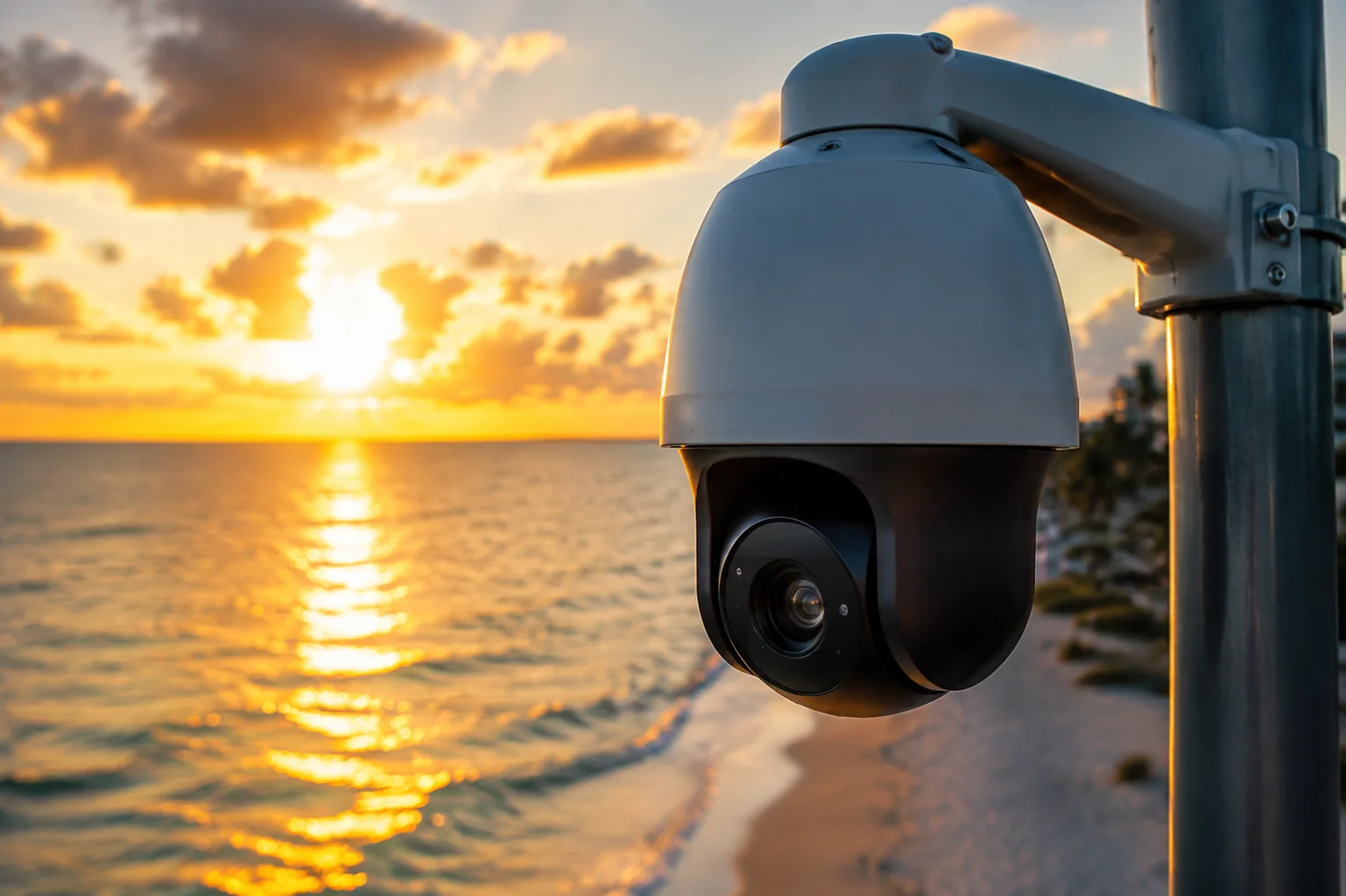
Yes. You can slide the sunshield forward to block low-angle sunset light in Florida. The shield’s extended position creates a physical barrier that cuts off direct sunlight before it reaches the lens surface, which eliminates flare and ghosting that no software can fix.
Why Florida Sunsets Are a Special Problem
Florida sits between 24°N and 31°N latitude. During sunset, the sun drops to very low angles — often below 15° above the horizon. At these angles, sunlight enters the lens almost horizontally. This is the worst-case scenario for any camera without proper shielding.
The result is two optical problems:
- Lens Flare 3: Direct sunlight hits the front element and scatters inside the lens barrel. You see bright streaks or a hazy wash across the entire image.
- Ghosting: Light bounces between internal lens elements and creates faint duplicate images of the sun, often as green or purple circles.
No amount of Wide Dynamic Range (WDR) 4 processing or AI-based exposure correction can remove true optical flare. The light has already contaminated the sensor data. The only fix is physical: stop the light before it enters the lens.
How the Slide Mechanism Works
The adjustable sunshield on a well-designed PTZ camera uses a telescoping rail system. The installer can pull the shield forward along the camera’s optical axis. This increases what we call the “shading depth” — the distance the shield extends past the front of the lens.
| Sun Position | Solar Angle | Recommended Shield Extension |
|---|---|---|
| Midday (overhead) | 70°–85° | Minimal (flush or slightly extended) |
| Late afternoon | 25°–40° | Medium (50% extension) |
| Sunset / Sunrise | 5°–15° | Full extension |
When the shield is fully extended, its lower edge physically blocks any light ray coming from below about 10°–15° relative to the lens axis. This is enough to cut off Florida sunset light in most mounting scenarios.
The Anti-Reflective Interior Matters Too
Extending the shield is only half the solution. If the inside surface of the shield is shiny or reflective, sunlight hitting the shield’s inner wall will bounce into the lens anyway. This is called secondary reflection.
Professional-grade sunshields use one of two interior treatments:
- Matte black Teflon coating 5: Absorbs light with very low reflectance.
- Anti-reflective flocking: A velvet-like material that traps light in its fibers.
Both prevent the shield itself from becoming a source of stray light. For 4K cameras 6, this detail is critical. Even a small amount of internal reflection can reduce contrast and make the image look “milky.”
Will the Shield Prevent Snow Buildup on the Camera’s Face in Northern Canadian Regions?
I had a client near the U.S.–Canada border call me in January. His cameras were blind. Snow had packed onto every lens in the system overnight.
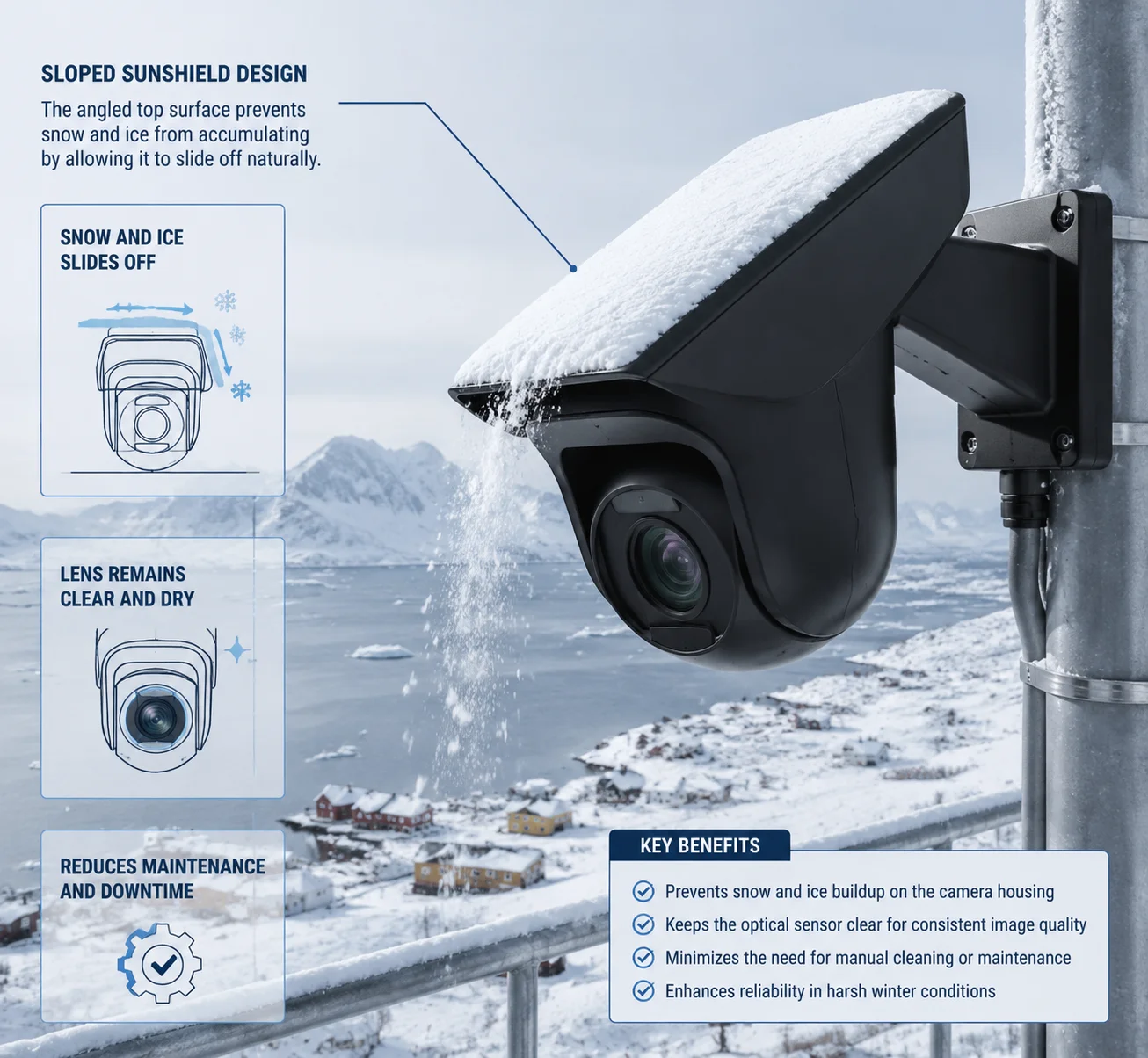
Yes. When fully extended, the sunshield acts as a physical canopy over the lens. Its angled surface lets snow slide off instead of piling up on the camera’s front glass. This keeps the lens clear without heaters in many light-snow conditions.
The Snow Problem at High Latitudes
Northern U.S. states and Canadian border regions (40°N–50°N+) get heavy snowfall for months. Cameras mounted on poles or building corners are fully exposed. Without protection, snow sticks to the front glass and blocks the view completely.
Heated lens covers exist, but they draw significant power. For solar-powered or off-grid PTZ systems — like the 4G LTE solar surveillance systems 7 we build at Loyalty-Secu — every watt matters. A passive solution is always better than an active one when power is limited.
How the Shield Geometry Helps
The sunshield’s shape is key. When extended to its full position, it creates a sloped roof over the lens area. Snow lands on the top surface of the shield, not on the lens glass. Because the shield surface is angled (typically 15°–45° from horizontal), gravity pulls the snow downward and off the edge.
This works best when:
- The shield material is smooth (powder-coated aluminum or UV-stabilized polycarbonate).
- The shield angle is set to at least 15° from horizontal.
- The camera is mounted with a slight downward tilt, so the shield slopes away from the lens.
Latitude-Based Shield Angle for Snow Regions
In snow-prone areas, the shield angle serves double duty. It blocks low-angle winter sun AND sheds snow. Here is a simplified guide:
| Region | Latitude Range | Winter Sun Angle (Noon) | Recommended Shield Angle | Snow Benefit |
|---|---|---|---|---|
| Northern U.S. (Chicago, Detroit) | 40°–45°N | 20°–25° | 10°–20° | Moderate snow shedding |
| U.S.–Canada Border (Buffalo, Seattle) | 45°–49°N | 15°–20° | 15°–25° | Good snow shedding |
| Southern Canada (Toronto, Vancouver) | 49°–52°N | 12°–18° | 20°–30° | Excellent snow shedding |
The steeper the shield angle, the better snow slides off. But too steep and you start blocking the camera’s own field of view. The sweet spot is usually between 15° and 25° for these regions.
A Note on Ice
Snow is one thing. Ice is harder. If freezing rain coats the shield and lens, no passive design will help. For those conditions, you need a heated enclosure 8 or a wiper system. But for regular snowfall — which is the majority of winter precipitation — the extended sunshield handles it well.
How Does the Sunshield’s Ventilation Gap Prevent “Heat Soaking” of the Camera Body?
I measured the surface temperature of a black PTZ housing in direct Texas sun last summer. It hit 74°C. The chipset inside was throttling hard, and the video stream was dropping frames.
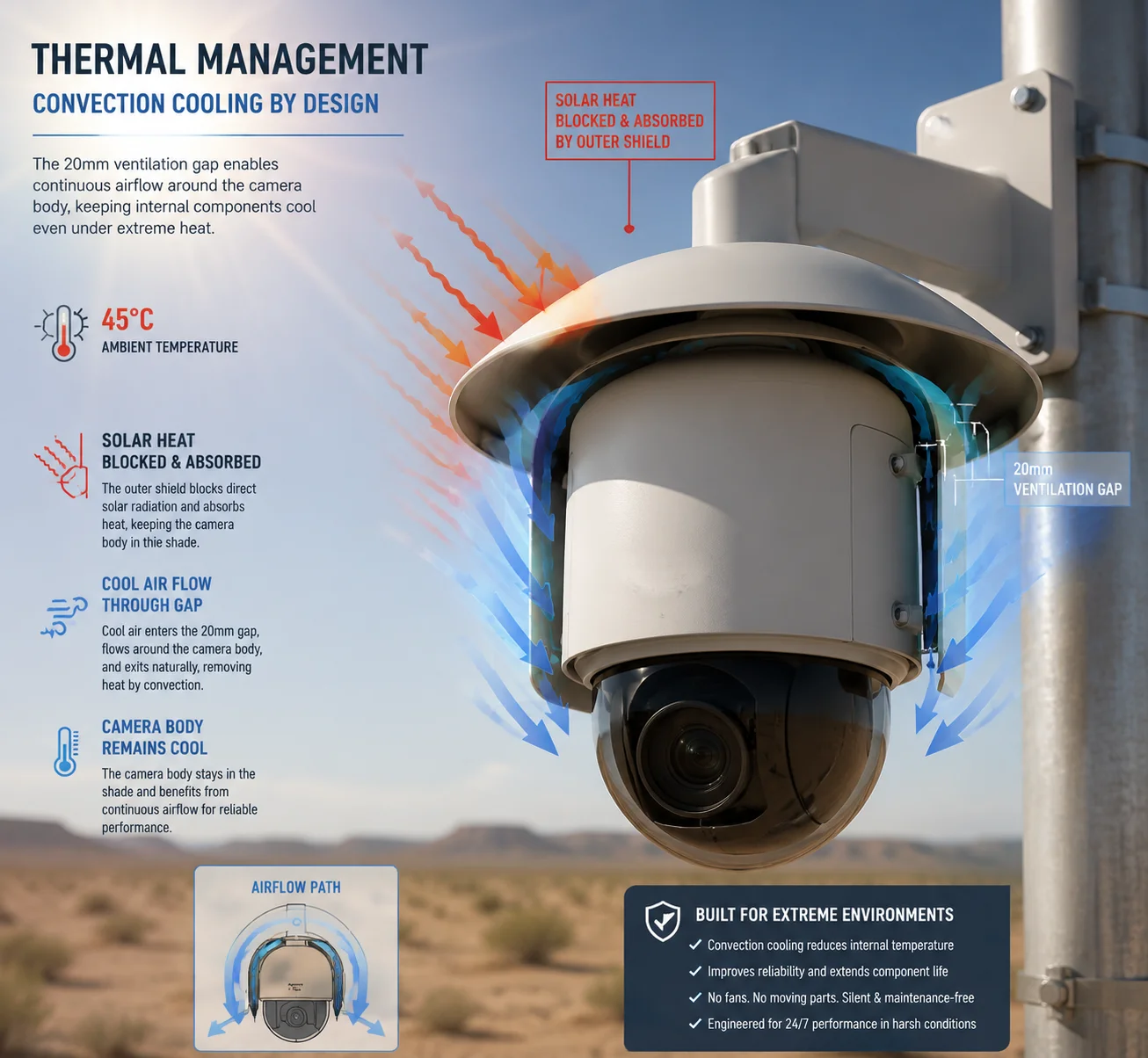
The sunshield creates an air gap between itself and the camera body. This gap acts as a thermal buffer. The shield absorbs direct solar radiation and heats up, but the air space between the shield and the camera body allows natural convection to carry heat away, keeping internal temperatures up to 10°C lower.
Why Heat Soaking Kills Cameras
“Heat soaking” means the camera body absorbs solar energy faster than it can release it. Over hours of direct sun exposure, the internal temperature climbs until the processor starts to throttle its clock speed. This causes:
- Lower frame rates
- Reduced image processing (less effective WDR, slower autofocus)
- Shorter component lifespan
- In extreme cases, thermal shutdown
This is a real problem in the American Southwest — Arizona, Nevada, Texas, New Mexico. Ambient air temperatures can reach 45°C (113°F), and direct solar radiation adds another 20–30°C to surface temperatures.
The Physics of the Air Gap
The sunshield-to-body air gap works on two simple principles:
Principle 1: Radiation Blocking
The shield intercepts direct solar radiation before it hits the camera housing. The shield surface heats up instead. Because the shield is a separate piece with its own thermal mass, it absorbs and re-radiates heat independently from the camera body.
Principle 2: Convective Cooling
The gap between the shield and the camera body creates a channel for air movement. Even a light breeze (1–2 m/s) flowing through this gap carries away heat from the camera’s outer surface. This is sometimes called a simplified Venturi effect 9 — the narrow channel can slightly accelerate airflow, improving cooling.
| Condition | Camera Surface Temp (No Shield) | Camera Surface Temp (With Shield + Gap) | Difference |
|---|---|---|---|
| 35°C ambient, full sun, no wind | ~65°C | ~52°C | –13°C |
| 40°C ambient, full sun, light breeze | ~72°C | ~58°C | –14°C |
| 45°C ambient, full sun, no wind | ~78°C | ~68°C | –10°C |
These numbers come from field observations across multiple desert installations. The exact values depend on shield material, color, and gap width. But the pattern is consistent: the air gap provides meaningful thermal relief.
Adjusting the Gap for Different Climates
In extreme heat regions, installers can slightly increase the gap by adjusting the shield’s standoff distance from the camera body. A wider gap means more airflow but less direct shading coverage. A narrower gap means better shade but less ventilation.
For most installations in the southern U.S., a gap of 15–25mm provides the best balance. In moderate climates (mid-latitudes), the gap can be tighter because thermal management is less critical.
This is another reason why the adjustable design matters. A fixed shield with a fixed gap cannot serve both Phoenix and Portland equally well.
Is the Sunshield Material UV-Stabilized to Prevent Warping in High-Heat Desert Areas?
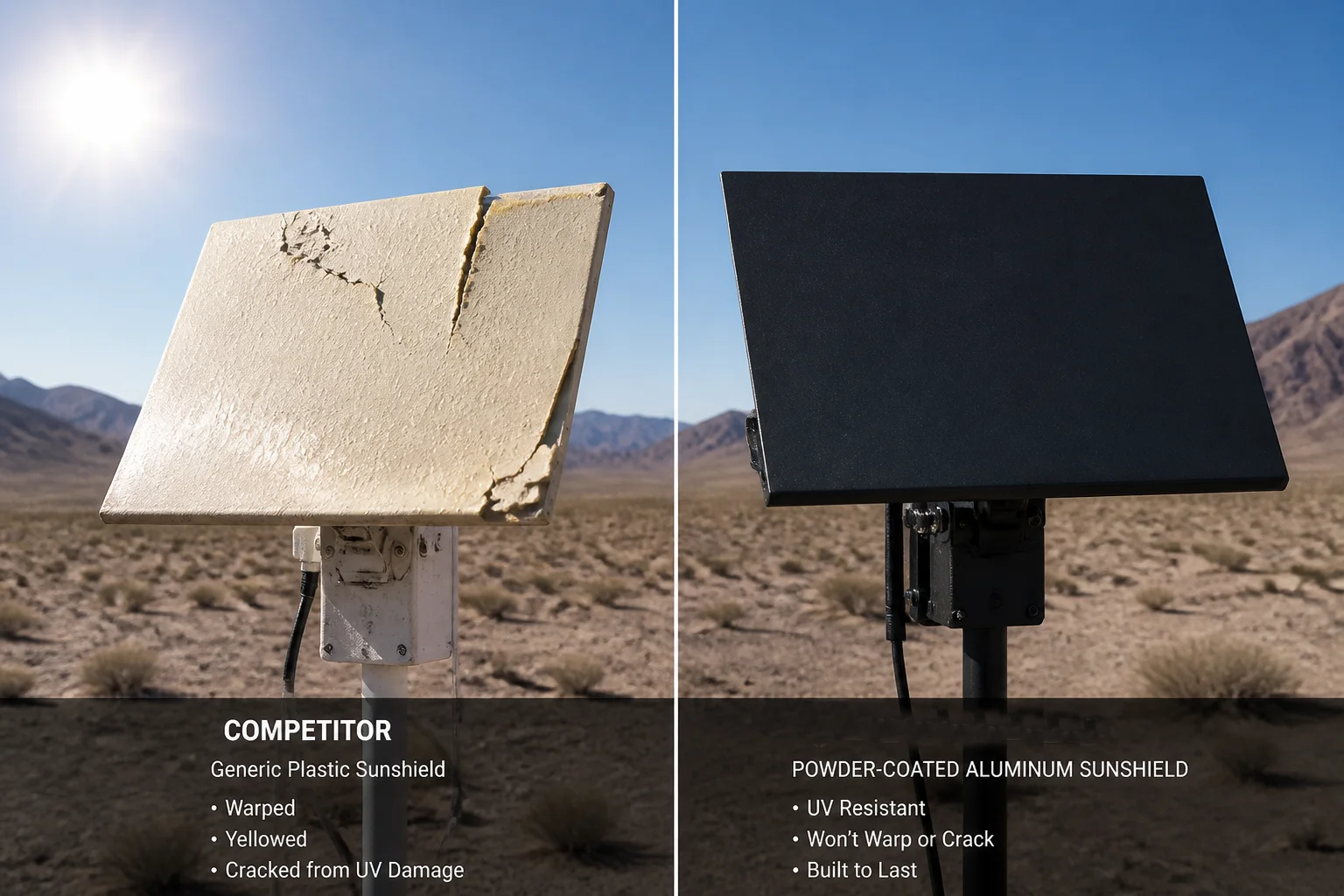
I once inspected a competitor’s camera after two years in a Nevada desert installation. The sunshield had warped so badly it was actually focusing sunlight onto the camera body like a crude magnifying glass.
Yes. Professional-grade sunshields use UV-stabilized materials — typically ASA plastic, powder-coated aluminum, or UV-treated polycarbonate. These materials resist degradation from years of intense ultraviolet exposure, preventing warping, cracking, and discoloration that would compromise the shield’s protective function.
What UV Radiation Does to Unprotected Plastics
Ultraviolet light breaks down polymer chains in plastic materials. This process is called photodegradation. Over months and years of exposure, the material becomes:
- Brittle: The surface cracks and chips. Small cracks grow into large fractures.
- Warped: Uneven degradation causes the material to bend or curl. A flat shield becomes curved.
- Discolored: White plastics turn yellow. Black plastics fade to gray. This changes the thermal absorption properties.
In desert areas like Arizona, Nevada, and West Texas, the UV index 10 regularly reaches 10–11+ during summer. This is among the highest sustained UV exposure anywhere in North America. A sunshield made from standard ABS or untreated polycarbonate will show visible degradation within 12–18 months.
Material Options for Long-Term UV Resistance
There are three main material choices for UV-stable sunshields:
Option 1: Powder-Coated Aluminum
This is the most durable option. Aluminum does not degrade under UV light at all. The powder coating provides color stability and additional corrosion resistance. It is heavier and more expensive than plastic, but it will last 10+ years in any climate.
Option 2: ASA (Acrylonitrile Styrene Acrylate)
ASA is an engineering plastic specifically designed for outdoor use. It has built-in UV resistance without needing additional coatings. It holds its color and shape for 5–8 years in high-UV environments. It is lighter and cheaper than aluminum.
Option 3: UV-Stabilized Polycarbonate
Polycarbonate is strong and lightweight, but it needs UV stabilizer additives or a UV-blocking surface coating. Without treatment, it yellows and becomes brittle within 2 years. With proper stabilization, it can last 5–7 years.
Why This Matters for Your Bottom Line
David, if you are deploying cameras across multiple U.S. states, material choice directly affects your total cost of ownership. A shield that warps after 18 months means a truck roll to replace it. In remote locations — oil fields, solar farms, highway corridors — that truck roll can cost $500–$1,500 per site. Multiply that across dozens or hundreds of cameras, and the math is clear.
At Loyalty-Secu, we use powder-coated aluminum for our high-end PTZ sunshields and UV-stabilized ASA for our standard models. Both are tested in our aging chamber before production release. We simulate 5 years of UV exposure in accelerated testing to verify that no warping or cracking occurs. This is part of our vertical supply chain advantage — we control the mold shop, the material selection, and the testing process end to end.
A Quick Field Check
When evaluating any PTZ camera’s sunshield, ask the manufacturer three questions:
- What is the shield material?
- Has it been tested for UV resistance, and for how many equivalent years?
- Is the material the same across all SKUs, or do lower-cost models use cheaper plastic?
If they cannot answer clearly, that is a red flag.
Conclusion
The adjustable sunshield is not a cosmetic accessory. It is a precision tool that compensates for solar geometry across U.S. latitudes, protects optics, manages heat, and reduces your long-term maintenance costs.
1. Comprehensive guide to PTZ camera features and specifications. ↩︎ 2. Calculator for determining solar angles at different latitudes. ↩︎ 3. Technical explanation of lens flare causes and prevention. ↩︎ 4. How Wide Dynamic Range technology improves camera performance. ↩︎ 5. Benefits of Teflon coating for optical applications. ↩︎ 6. Guide to 4K camera resolution and image quality factors. ↩︎ 7. Overview of solar-powered surveillance system components. ↩︎ 8. Heated enclosure solutions for extreme weather conditions. ↩︎ 9. Explanation of Venturi effect in thermal management. ↩︎ 10. Understanding UV index and material degradation risks. ↩︎