
I’ve seen too many integrators install an 800m laser camera at a coastal site, then call me when the image turns white in fog. Real-world range is not spec-sheet range.
800m laser night vision1 delivers full range only in clear, dry conditions. In fog, heavy rain, or high humidity2, water droplets scatter the laser beam and cut effective range3 by 30% to 50% or more. For reliable all-weather performance4, pair laser PTZ cameras5 with optical defog technology6 and thermal imaging sensors7.
 800m laser night vision weather performance PTZ camera
In this article, I’ll break down exactly how weather affects your laser night vision. I’ll share what I’ve learned from years of supplying laser PTZ cameras to integrators across North America, Europe, and the Middle East. You’ll learn what works, what doesn’t, and how to avoid expensive mistakes on your next project.
Table of Contents
Can My Laser PTZ Camera Penetrate Heavy Fog or Rain in Coastal Areas?
I get this question weekly from integrators on port and border projects. They want a straight answer. Laser alone won’t save you in thick fog.
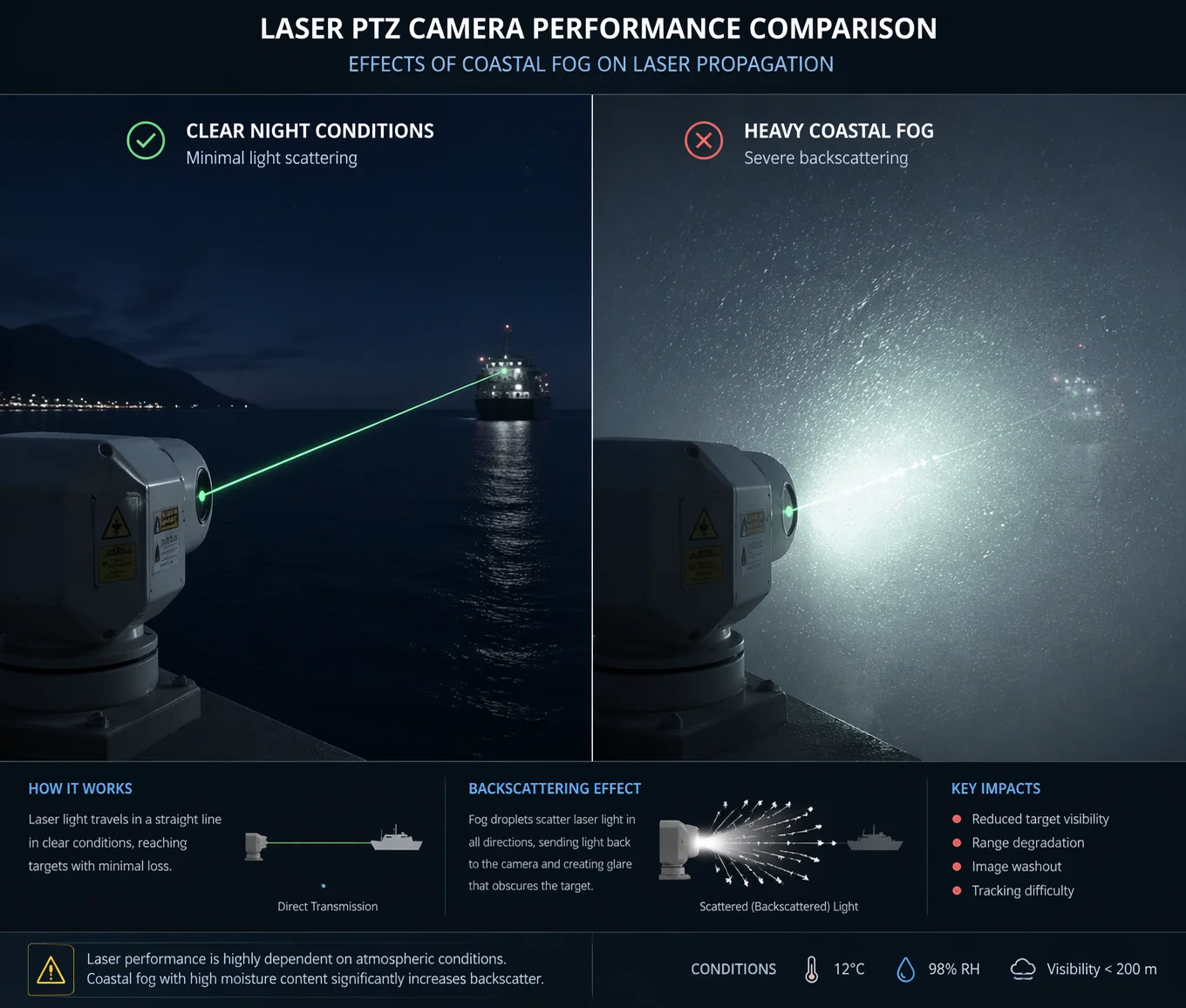
A laser PTZ camera cannot fully penetrate heavy fog or torrential rain. Near-infrared laser beams at 808–905 nm scatter heavily off water droplets larger than 100 μm. In dense coastal fog8 with visibility below 100 meters, your 800m laser camera may only reach 100 to 300 meters effectively.
 laser PTZ camera fog rain coastal area performance
Why Laser Isn’t a Magic Penetration Lens
Many manufacturers show perfect demo videos shot in clear labs. I’ve been in this industry since 2013, and I can tell you the truth. Laser does not penetrate thick fog much better than standard LED IR. The real advantage of laser is its high energy density and narrow beam. It can push light very far in a tight column. But when that column hits dense water droplets or aerosols, it scatters badly. This is called backscattering9.
In backscattering, the laser light bounces off water particles and returns to your camera sensor. The result is a white, washed-out image. You see the fog, not the target. I’ve tested this myself with our cameras at a port site in Guangdong during monsoon season. At full laser power10, the image looked worse than with the laser turned off. The backscatter was that strong.
What Actually Works in Coastal Fog
For coastal projects, I always recommend two things on top of laser:
- Optical Defog (IR-pass filtering): This is a physical filter that blocks visible light and only lets near-infrared wavelengths through. It reduces the fog’s visual noise on the sensor. This is not the same as digital defog, which is just software processing and often makes the image grainy.
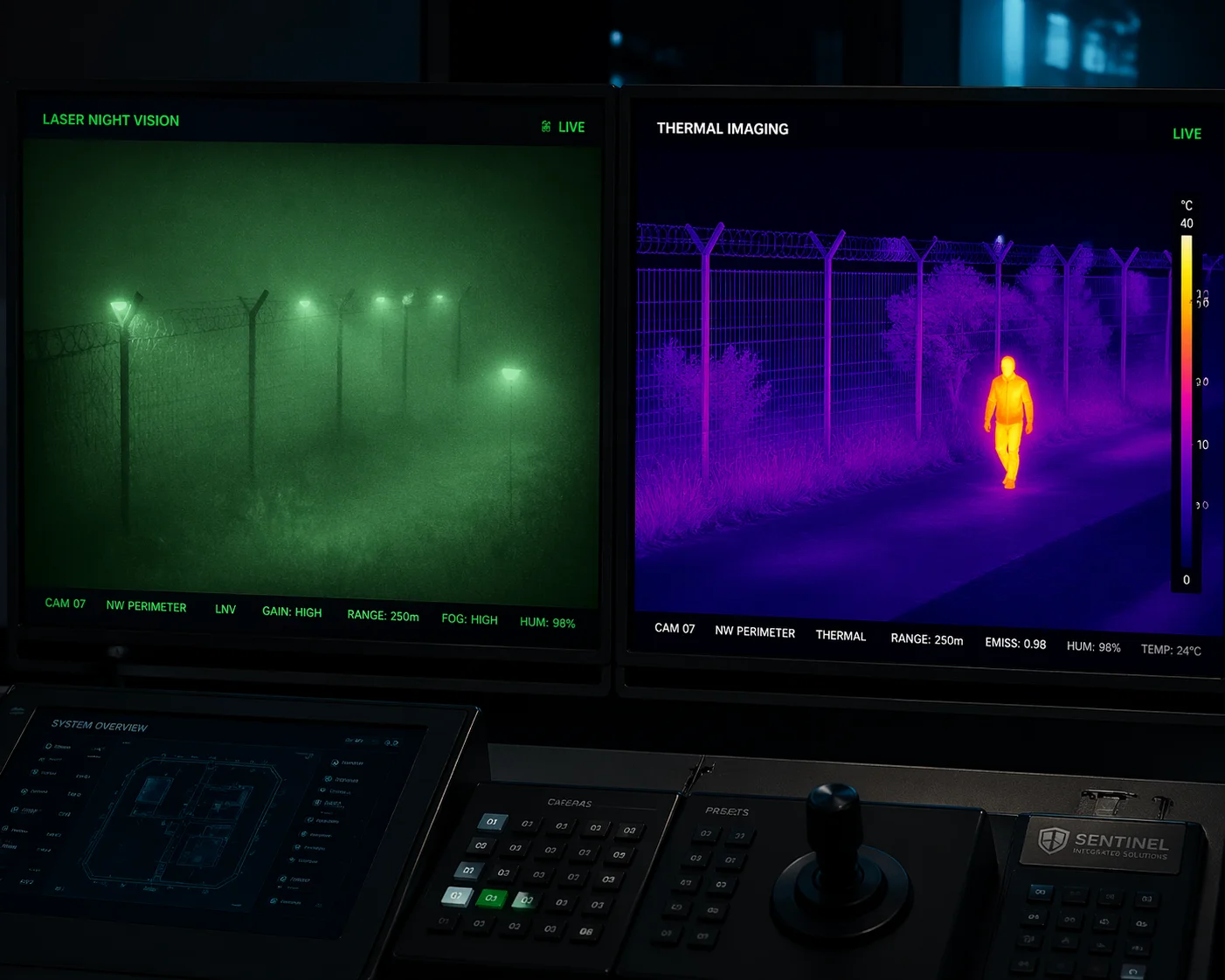
- Dual-spectrum setup (Laser + Thermal): Thermal imaging sees heat, not light. Fog doesn’t block heat signatures the same way. So thermal finds the target first, and then your laser PTZ zooms in to identify it.
Range Reduction by Weather Type
| Weather Condition | Visibility | Estimated Range Reduction | Effective Range (from 800m) |
|---|---|---|---|
| Clear, dry air | >10 km | 0% | 800 m |
| Light haze | 2–5 km | 10%–20% | 640–720 m |
| Light rain | 1–2 km | 20%–30% | 560–640 m |
| Heavy rain | 500 m–1 km | 40%–60% | 320–480 m |
| Light fog | 200–500 m | 50%–70% | 240–400 m |
| Dense fog | <100 m | 70%–90% | 80–240 m |
This table is based on field tests and atmospheric attenuation models. Every site is different. But the pattern is clear. Fog is the biggest enemy of laser night vision.
I tell my clients this: if your project is in a coastal area with regular fog, don’t rely on laser alone. Budget for a dual-spectrum solution11 from the start. It costs more upfront. But it saves you from failed acceptance tests and angry end users.
How Do I Adjust My Laser Intensity Settings for High-Humidity Environments?
I’ve watched installers crank their laser to maximum power in humid conditions, thinking more light means a better image. It actually makes things worse.
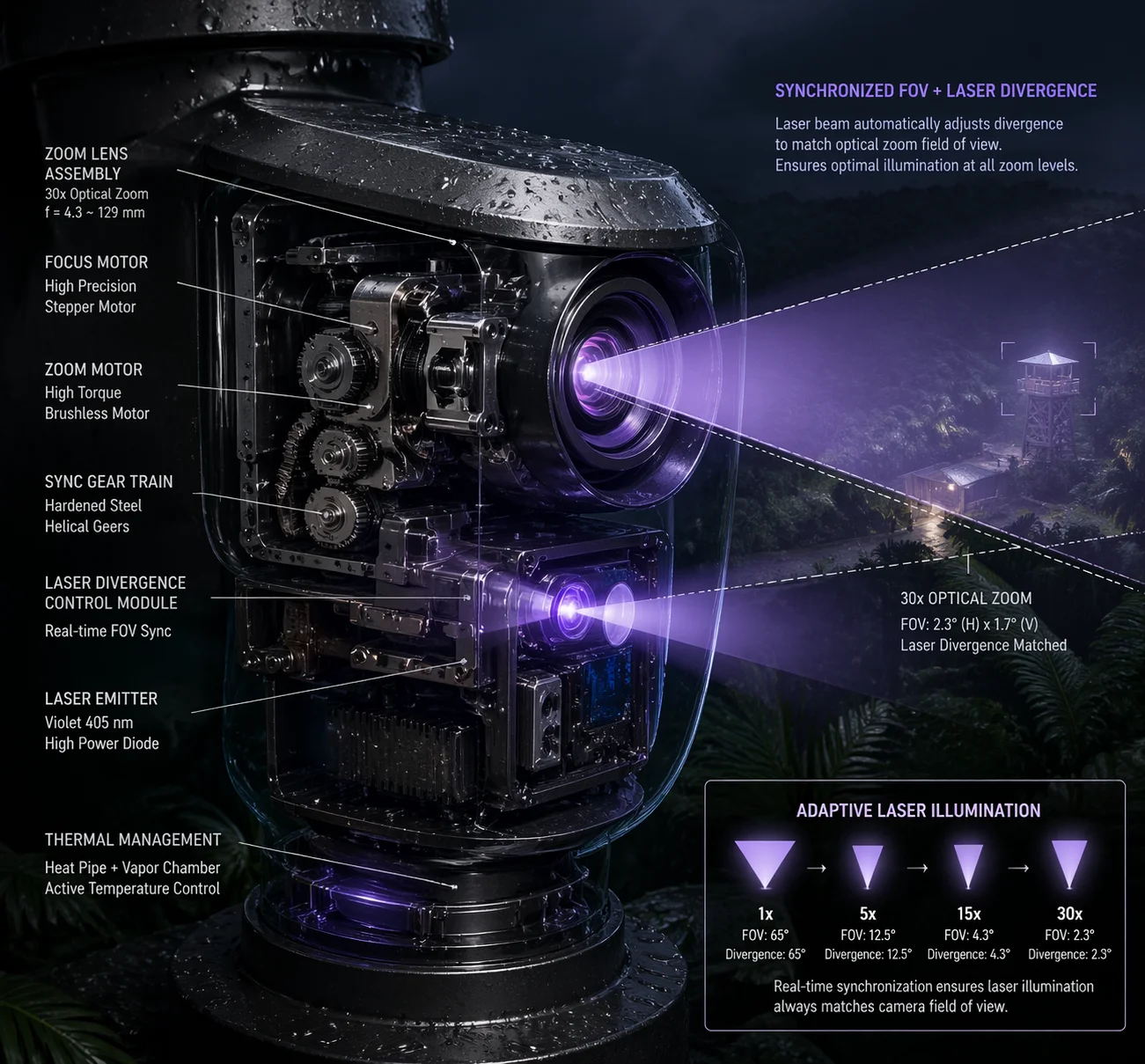
In high-humidity environments, reduce laser intensity to minimize backscatter glare. Use your camera’s synchronous zoom function12 to match the laser beam width13 to the lens field of view. This keeps the image balanced and prevents the flashlight effect — a bright white spot in the center of the frame.
 laser intensity adjustment high humidity environment settings
The Flashlight Effect Problem
When your PTZ is zoomed out to 1X and the laser beam is narrow, you get a bright hot spot in the middle of the image. The edges stay dark. This looks like someone shining a flashlight at the camera. It’s useless for surveillance.
When your PTZ is zoomed in to 40X and the laser beam is too wide, the light spreads thin. The far target doesn’t get enough light. The image is dark and noisy.
This is why beam divergence angle matters so much. Cheap laser illuminators have a fixed beam angle. They can’t adapt. You get either the flashlight effect or a dim image, depending on your zoom level. I’ve seen this ruin project demos in front of end clients. It’s not a good look for the integrator.
How Synchronous Zoom Laser Solves This
At Loyalty-Secu, our laser PTZ cameras use a synchronous linkage algorithm. The laser beam physically adjusts its width in real time to match the lens zoom level. When you zoom in to 40X, the beam narrows automatically. When you zoom out to 1X, the beam widens. The image stays evenly lit at every zoom level.
This isn’t just a software trick. The laser optics physically move. This is a mechanical and optical design that cheap cameras skip to save cost. I always show this feature in live demos because the difference is obvious right away.
Humidity and Internal Condensation
There’s another hidden risk in humid environments that most people don’t think about. Laser modules generate a lot of heat. When hot laser parts meet cool, humid air, condensation forms inside the housing. Water droplets on the internal lens surface scatter the beam before it even leaves the camera.
Our industrial-grade thermal management system handles this. We use sealed chambers, desiccant packs, and heat-sink designs that prevent condensation at humidity levels up to 90%. I’ve shipped hundreds of units to Southeast Asia and the Middle East. Internal fogging has never been a warranty issue for us.
Laser Adjustment Best Practices
| Scenario | Recommended Laser Power | Beam Mode | Notes |
|---|---|---|---|
| Clear night, 800m target | 100% | Narrow (synced to zoom) | Full power for maximum range |
| Humid night, 500m target | 60%–80% | Medium | Reduce power to cut backscatter |
| Light fog, 300m target | 40%–60% | Wide | Lower power, wider beam, use defog |
| Heavy fog, <200m target | 30%–50% or off | Wide or off | Switch to thermal for detection |
The key rule is simple. Less laser is often better in bad weather. More power just creates more backscatter. I always tell my integrators to test on site at night, in real conditions, before locking in their settings.
Will the 800m Range Be Significantly Reduced During a Typical North American Winter?
I supply laser PTZ cameras across the northern U.S. and Canada. Winter is a real test for any long-range camera. It’s a serious challenge.
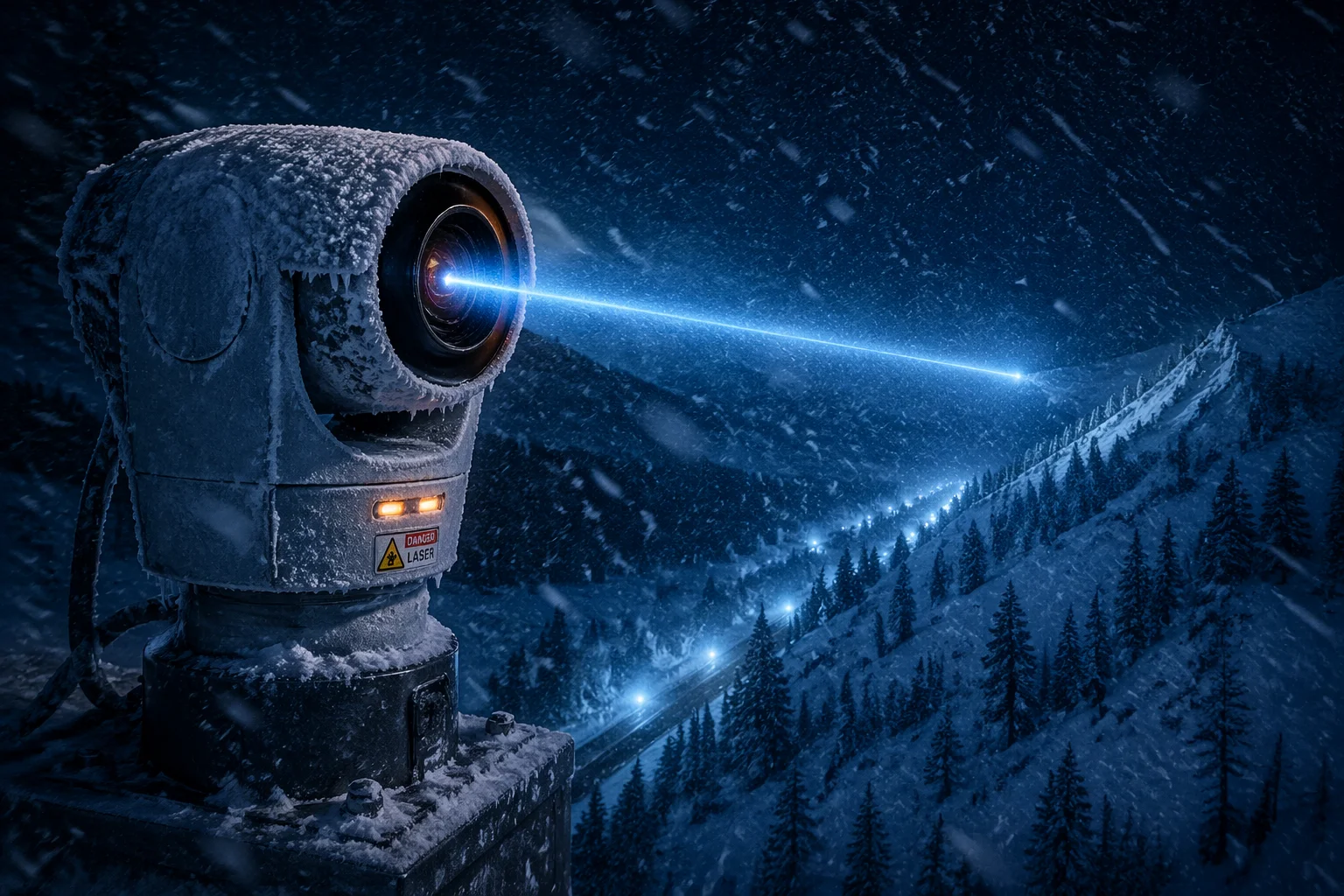
Yes, 800m laser range drops notably in North American winter14s. Snow, sleet, and sub-zero temperatures reduce effective range by 30% to 60%. Blowing snow scatters the laser beam like fog. Extreme cold can also stress camera electronics and slow down PTZ motor response if the unit lacks a built-in heater.
 800m laser night vision winter snow North America performance
How Snow Affects Laser Transmission
Snowflakes act like tiny mirrors. They scatter near-infrared light in all directions. Blowing snow is especially bad because it fills the air with dense particles, much like fog. Even when snow is falling gently, it creates a curtain of reflective particles between your camera and the target.
I’ve seen field test results where an 800m system dropped to about 400m effective range in moderate snowfall. In a blizzard, you’re looking at 100–200m at best. The snow doesn’t absorb the laser. It scatters it. And that scattered light comes back to your sensor as noise.
Cold Temperature Stress on Hardware
Winter isn’t just about snow. It’s about cold. At -30°C to -40°C, which is common in parts of Canada and the northern U.S., several things happen to your camera:
- PTZ motors slow down. Grease thickens. Pan and tilt response becomes sluggish. If your camera lacks a low-temperature rated motor, it may freeze entirely.
- Lens fog-up. When you power on a cold camera, the internal temperature rises quickly. If there’s no heater or defroster, moisture condenses on the front glass.
- Battery and power issues. For solar-powered systems, shorter daylight hours and snow-covered panels reduce available power. I’ve had clients in Alberta call me about dead batteries after three cloudy days in January.
Winter-Proofing Your Laser PTZ
At Loyalty-Secu, our laser PTZ cameras are rated for -40°C to +70°C operation. We build in a heater circuit that turns on automatically below 0°C. The front window has a defrost function. The PTZ motor uses low-temperature grease rated for arctic conditions.
For solar-powered deployments in winter, I recommend oversizing the solar panel by at least 30% and using lithium iron phosphate (LiFePO4) batteries. These hold charge much better in cold than standard lithium-ion cells. I share this advice with every client planning a northern site.
Seasonal Planning for Integrators
I always advise my North American clients to plan their system around worst-case winter conditions, not summer demos. If you need 800m identification in July, you probably need a dual-spectrum system to maintain that capability in January. Design for winter. Everything else is a bonus. Your client will thank you when the system still works in February.
Why Is My Long-Range Night Vision Blurry When the Air Is Damp?
I hear this complaint often. The camera works perfectly on dry nights. Then the humidity rises, and the image turns soft and hazy. It’s frustrating.
Damp air causes blurry long-range night vision15 because water vapor and micro-droplets scatter the laser beam and reduce contrast. The longer the optical path to the target, the worse the effect. High humidity also causes condensation on external lens surfaces, adding another layer of blur.
 long-range night vision blurry damp air humidity cause
Understanding Atmospheric Scattering
When the air is damp, it’s full of tiny water particles. These particles are often too small to see with your eyes, but they interact with near-infrared laser light. Two things happen:
- Forward scattering: Light bends slightly as it passes through damp air16. This softens the image. Fine details like license plates or facial features become unreadable at long distances.
- Backscattering: Some light bounces back toward the camera. This creates a hazy glow across the image. It reduces contrast — the difference between dark and light areas.
At 800m range, the laser beam passes through a lot of air. Even if each meter of air only causes a tiny amount of scattering, the total effect over 800 meters adds up fast. That’s why the blur gets worse at longer distances. A target at 200m might look fine, but the same target at 600m looks like a smudge.
Laser vs. Thermal: Solving the Identification Problem
Here’s an important distinction I make with every client:
- Laser night vision solves the identification problem. It lets you read a license plate, see a face, or tell the type of vehicle at long range.
- Thermal imaging solves the detection problem. It sees heat signatures through fog, haze, and darkness. But it can’t show you details. A person is just a bright blob.
I often explain it this way: laser tells you who is there, thermal tells you that someone is there. For 800m monitoring in damp conditions, I recommend the dual-spectrum approach. Thermal finds the target. Laser PTZ follows up for evidence-grade video. This combination cuts false alarm handling costs by up to 50% for your end clients.
Practical Steps to Reduce Blur
| Action | Effect | Difficulty |
|---|---|---|
| Clean external lens regularly | Removes water film and dirt | Easy — schedule weekly |
| Enable optical defog (IR-pass) | Filters visible-light scatter | Easy — camera setting |
| Reduce laser power in high humidity | Lowers backscatter glare | Easy — camera setting |
| Use synchronous zoom laser | Matches beam to field of view | Built into Loyalty-Secu cameras |
| Add thermal camera for detection | Bypasses atmospheric scatter | Moderate — requires dual-spectrum setup |
| Install lens heater or wiper | Prevents condensation on glass | Moderate — check camera model |
I’ve learned from experience that most blurry-image complaints come down to three things: dirty lenses, no defog function, or laser power set too high. Fix those first. If the image is still soft, it’s the atmosphere. And at that point, thermal is your answer.
The Bottom Line on Damp Air
You can’t control the weather. But you can control your equipment choices. A well-designed laser PTZ with synchronous zoom, optical defog, and proper sealing handles humidity much better than a cheap alternative. And when conditions get truly bad, thermal imaging fills the gap. I’ve built my recommendations around this principle for years, and my clients’ projects are better for it.
Conclusion
Weather is the biggest variable in long-range laser night vision. Design your system for worst-case conditions, pair laser with thermal for true all-weather coverage, and choose cameras built for real-world humidity and cold.
-
Understanding the limitations of 800m laser night vision can help you make informed decisions for your surveillance needs. ↩
-
Explore the impact of humidity on laser night vision to improve your surveillance strategies. ↩
-
Learn about the factors that influence effective range to optimize your camera setup. ↩
-
Explore best practices to enhance the weather performance of your laser cameras. ↩
-
Explore how laser PTZ cameras perform in different weather conditions to ensure reliable surveillance. ↩
-
Learn how optical defog technology enhances image clarity in challenging weather conditions. ↩
-
Discover the benefits of combining thermal imaging with laser night vision for better detection. ↩
-
Understanding the effects of coastal fog can help you choose the right equipment for coastal surveillance. ↩
-
Understanding backscattering can help you optimize your camera settings for clearer images. ↩
-
Explore how adjusting laser power can improve performance in various environmental conditions. ↩
-
Learn about dual-spectrum solutions and how they enhance surveillance capabilities in challenging conditions. ↩
-
Learn how a synchronous zoom function can enhance image quality and usability in various conditions. ↩
-
Understanding the impact of beam width can help you optimize your camera settings for better results. ↩
-
Explore how winter conditions impact laser night vision to prepare your systems accordingly. ↩
-
Understanding the challenges of long-range night vision in damp conditions can help you mitigate issues. ↩
-
Understanding the effects of damp air can help you improve image quality in humid conditions. ↩