
I have seen zoom motors burn out in the field. The root cause was simple — the wrong grease turned into wax at -40°C, and the gears locked up.
To prevent grease freezing in a PTZ zoom mechanism at -40°C, you need three things working together: aerospace-grade synthetic low-temperature grease that stays fluid below -50°C, a built-in pre-heating system that warms the internals before any motor movement, and high-torque motors with Teflon-coated tracks designed to overcome cold-start friction.
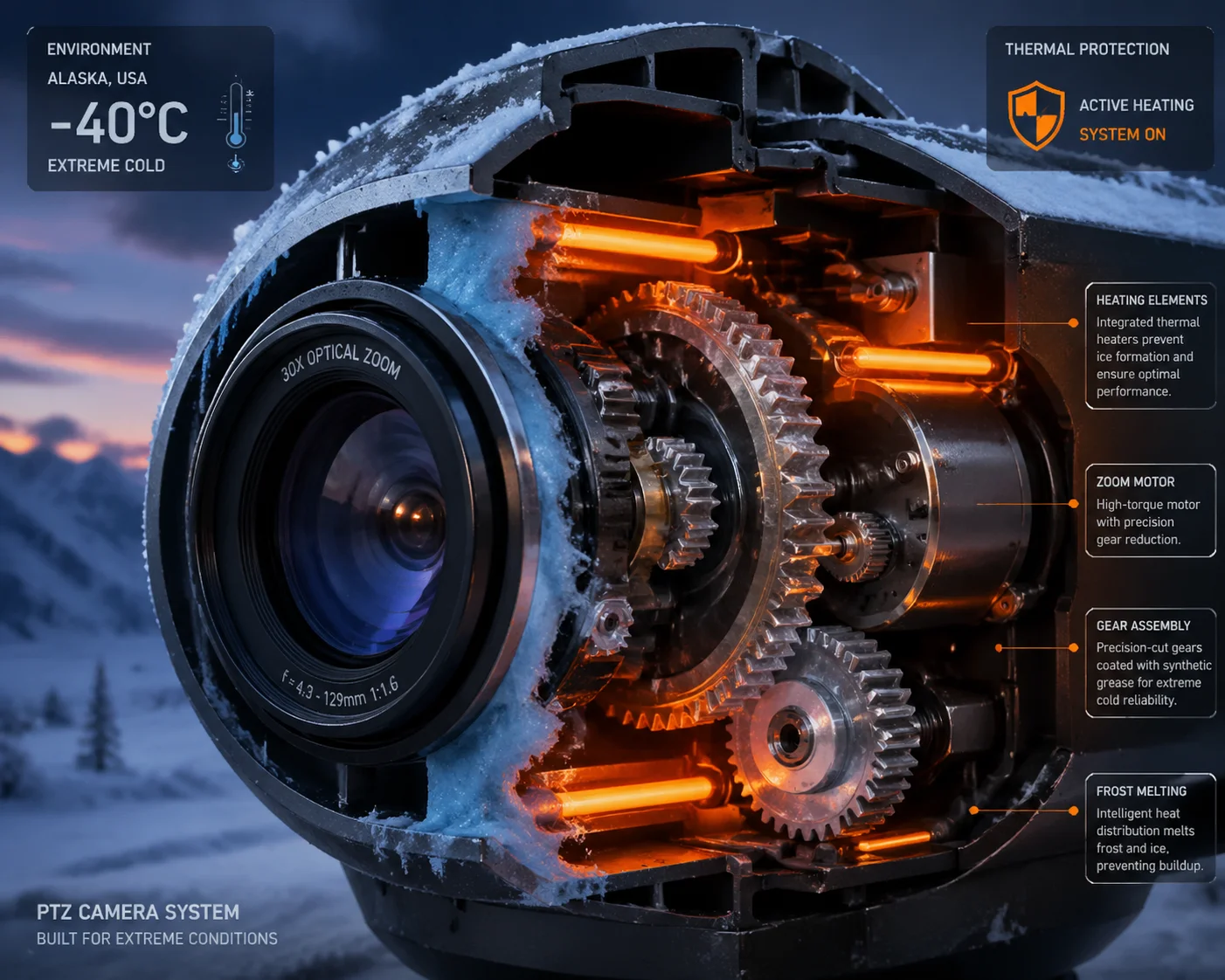
In this article, I will walk you through each layer of our cold-weather defense system. I will explain the exact grease type we use, how our heaters protect internal parts, what happens during the cold-start cycle, and why the motor will not burn out — even in the worst Alaskan winter. If you are sourcing PTZ cameras for sub-zero projects, this is the technical breakdown you need before signing any purchase order.
Table of Contents
What Type of Low-Temperature Industrial Grease Is Used in Your Alaskan-Grade PTZs?
Most PTZ factories use cheap lithium-based grease. I stopped using it years ago because it fails badly below -10°C.
Our Alaskan-grade PTZ cameras use fully synthetic, aerospace-grade low-temperature grease with a working range of -50°C to +250°C. This grease maintains stable viscosity at -40°C, produces minimal starting torque, and does not crystallize, harden, or migrate onto optical surfaces.
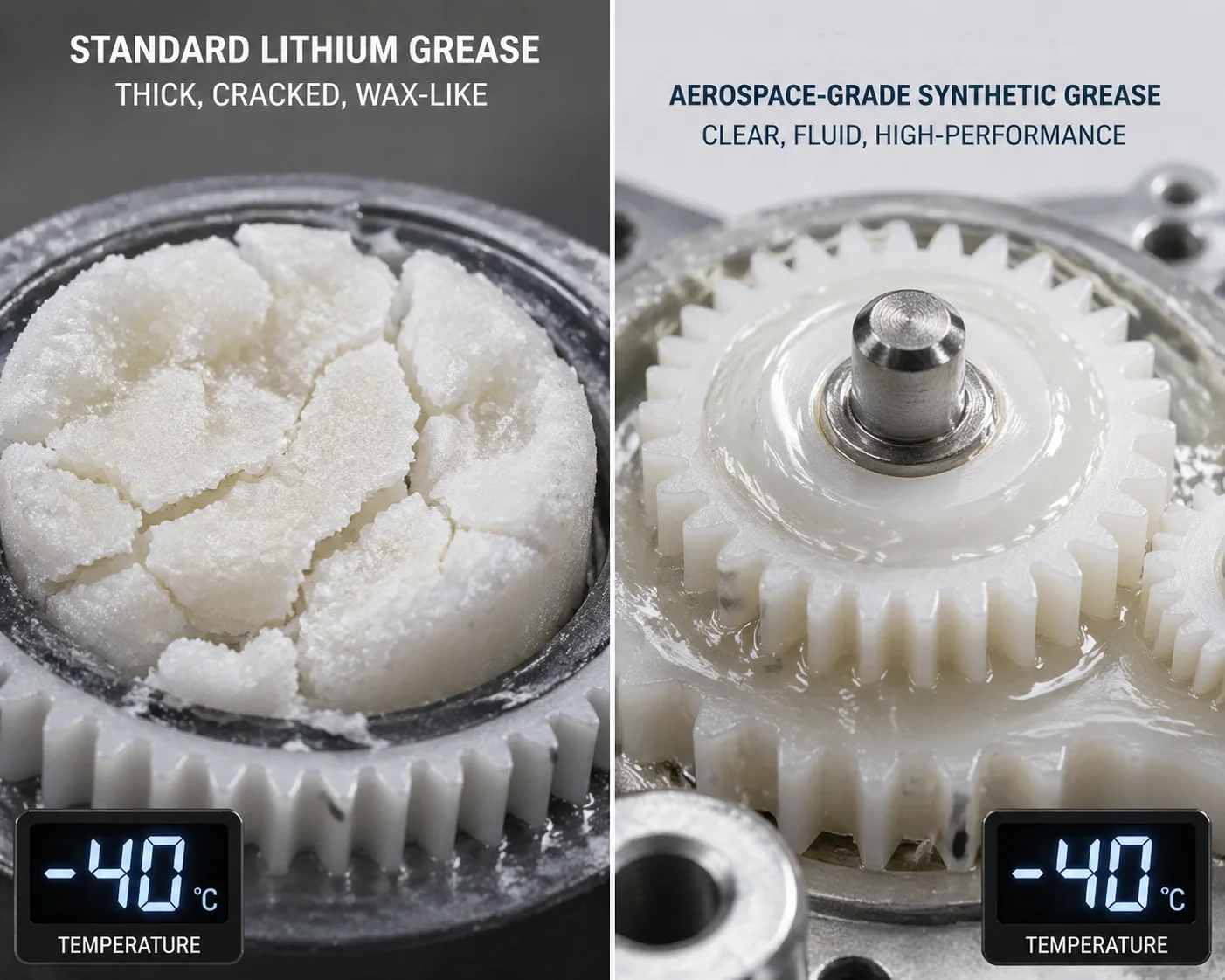
Why Standard Grease Fails in Extreme Cold
Regular calcium-based or lithium-based grease has a working temperature floor around -10°C. Below that point, the grease thickens fast. At -40°C, it becomes almost solid. When the zoom motor tries to push through this resistance, two things happen. First, the gears slow down or stall completely. Second, the motor draws excessive current and overheats internally. I have received returned units from Canada where the entire zoom barrel was locked in place. When we opened them up, the grease looked like dried candle wax.
What Makes Our Grease Different
At Loyalty-Secu, I specify a silicone-based synthetic grease designed for precision instruments. This is the same category of lubricant used in optical telescopes and aerospace actuators. Here is how it compares to standard options:
| Property | Standard Lithium Grease | Our Synthetic Low-Temp Grease |
|---|---|---|
| Working Temp Range | -10°C to +120°C | -50°C to +250°C |
| Viscosity at -40°C | Solidifies / wax-like | Remains fluid and spreadable |
| Starting Torque at -40°C | Very high (motor stall risk) | Low and predictable |
| Oil Bleed / Migration | High (contaminates lens) | Very low (stays in place) |
| Plastic Compatibility | May degrade some plastics | Safe for POM, Nylon, PTFE |
Application Control Matters Too
Choosing the right grease is only half the job. How much you apply and where you apply it matters just as much. I require our assembly team to follow a strict lubrication map. Each contact point on the zoom helicoid, the guide rails, and the gear teeth gets a measured amount — typically less than 0.3 grams per point. Too much grease creates a thick mass that freezes into a solid block at low temperatures. Too little grease causes metal-on-metal wear. I also require the grease data sheet (TDS) to be attached to every shipment, so my clients like David can verify the specs independently. This is not something I leave to chance on the production floor.
Will the Zoom Motor Burn Out if It Attempts to Move While the Internal Parts Are Frozen?
This is the question that keeps project managers up at night. I understand why — a dead motor in a remote Alaskan site means a $2,000 truck roll.
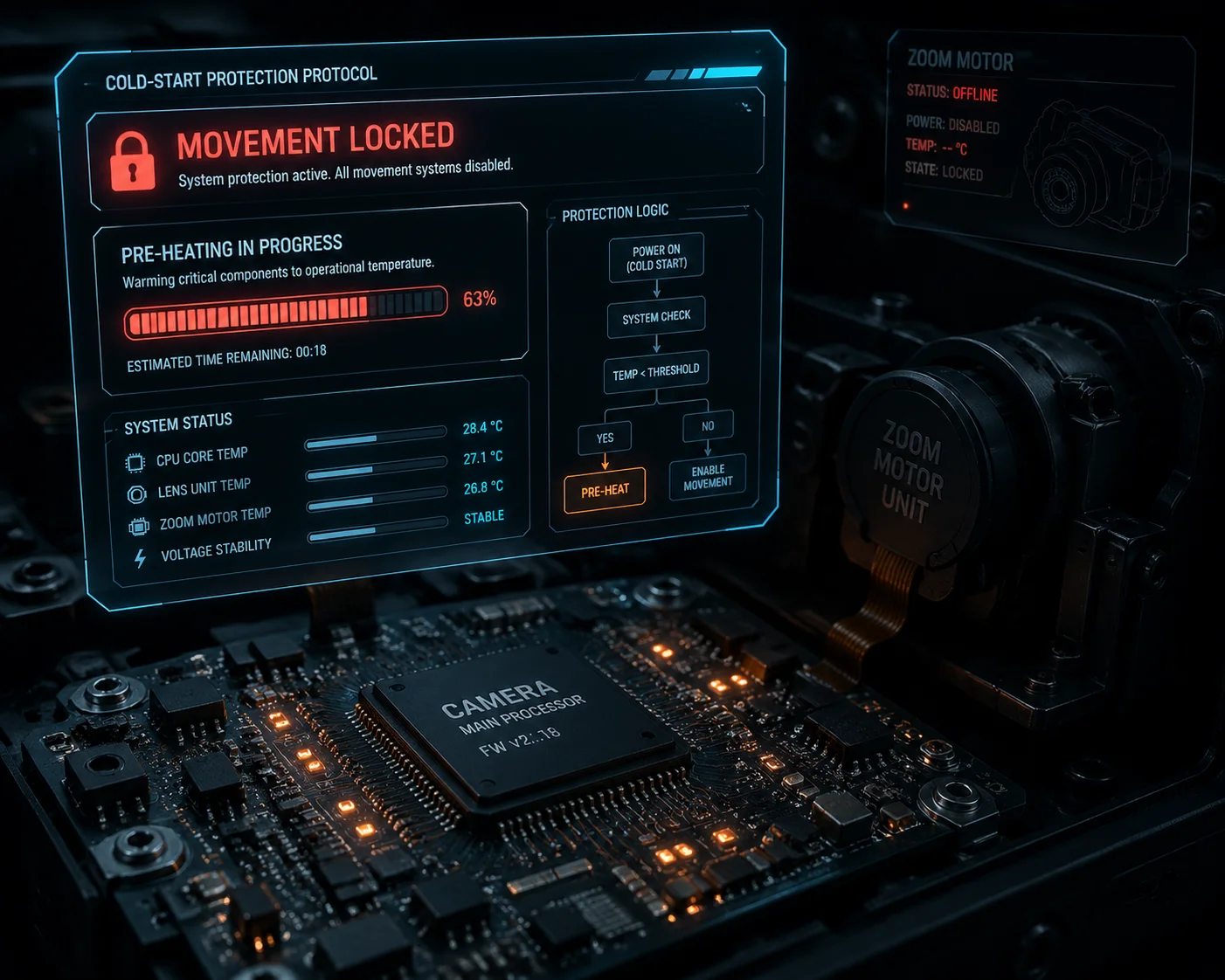
No, the zoom motor will not burn out. Our firmware includes a cold-start protection protocol that blocks all mechanical movement until the internal temperature reaches a safe threshold. The motor simply will not receive power to move while parts are still frozen.
The Real Danger: Unprotected Cold Starts
In a cheap PTZ camera without firmware protection, here is what happens at -40°C. The system powers on. The controller immediately sends a command to the zoom motor: “Go to home position.” The motor tries to spin. But the grease is stiff, the gears resist, and the motor stalls. A stalled motor draws maximum current continuously. Within seconds, the coil windings overheat. The motor burns out. The camera is now a paperweight on top of a 30-foot pole in the middle of nowhere. I have heard this story from integrators more times than I can count.
How Our Protection Protocol Works
At Loyalty-Secu, I built a simple but effective safeguard into the firmware. The logic works like this:
- Power on. The system boots and reads the internal temperature sensor.
- Temperature check. If the internal temp is below -10°C, the system activates the heater circuit first.
- Lock-out period. All PTZ movement commands — pan, tilt, zoom — are blocked. The camera streams video, but nothing moves.
- Threshold reached. Once the sensor reads above the safe temperature, the system unlocks the self-test routine and allows full mechanical operation.
Motor Specification: Built for Resistance
Even with the firmware safeguard, I do not rely on software alone. I also select motors that can handle higher-than-normal starting loads. Here is what I specify:
| Motor Parameter | Standard PTZ Motor | Our Cold-Rated Motor |
|---|---|---|
| Starting Current Tolerance | 1.2x rated | 2.0x rated |
| Stall Duration Before Damage | < 3 seconds | > 10 seconds |
| Operating Temp Range | -10°C to +50°C | -40°C to +60°C |
| Gear Material | Standard ABS plastic | Cold-rated POM + Teflon coating |
This means even if the firmware fails — which I have never seen happen — the motor itself can survive a brief stall without burning out. I call this “defense in depth.” Software protects first. Hardware protects second. The grease protects third. You need all three layers, not just one.
How Long Does the “Cold Start” Pre-Heating Cycle Take Before the PTZ Becomes Functional?
I know what you are thinking. “If the camera cannot move for 20 minutes after power-on, that is a problem.” I hear you. Let me explain the trade-off.
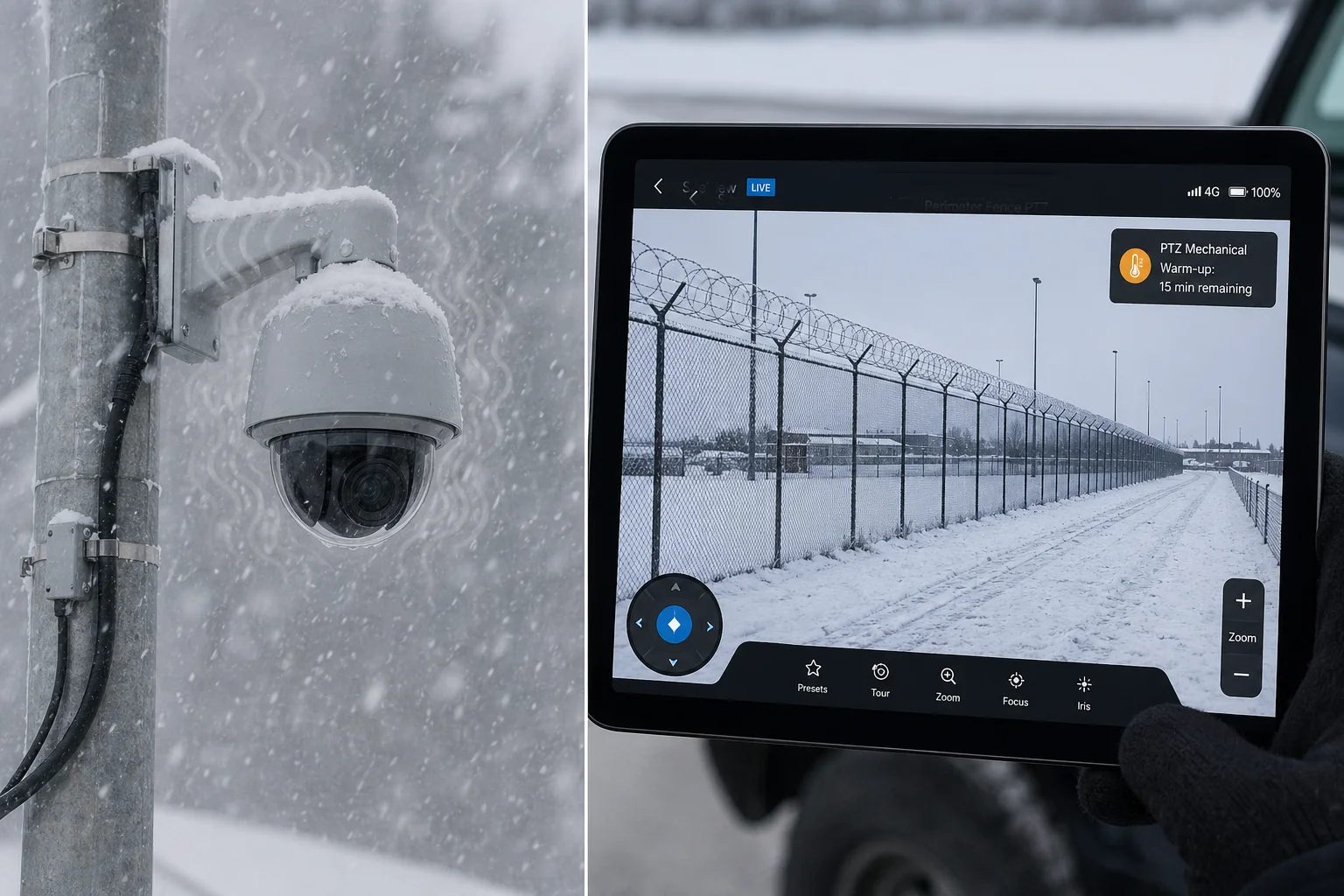
The cold-start pre-heating cycle takes approximately 15 to 20 minutes at -40°C. During this time, the internal heater raises the temperature inside the sealed housing to a safe operating level. Video streaming begins immediately — only mechanical movement is delayed.
Why 15–20 Minutes Is the Right Number
I did not pick this number randomly. We tested it in a climate chamber. At -40°C, the internal air volume of a typical PTZ housing takes about 12 minutes to rise from -40°C to -10°C using our 15W heater element. I add a safety margin of 3–8 minutes because the metal parts — gears, shafts, brackets — absorb heat slower than air. Metal has higher thermal mass. If I cut the pre-heat short, the air might be warm, but the gear surfaces are still cold. The grease on those surfaces is still stiff. So I wait until the metal surfaces are warm too.
What Happens During the Pre-Heat Period
This is important. The camera is not “dead” during pre-heat. Here is what works and what does not:
| Function | Available During Pre-Heat? |
|---|---|
| Video streaming (live view) | ✅ Yes |
| Network access (IP/RTSP/ONVIF) | ✅ Yes |
| OSD menu and settings | ✅ Yes |
| Pan and tilt movement | ❌ No (locked) |
| Zoom and focus | ❌ No (locked) |
| Preset tour / auto-patrol | ❌ No (locked) |
| IR illuminator | ✅ Yes |
So your NVR or VMS sees the camera immediately. You get a live image right away. You just cannot move the PTZ head or zoom until the heater finishes its job. For most surveillance applications, this is a perfectly acceptable trade-off. The alternative — no pre-heat, immediate movement, burned motor, dead camera — is far worse.
Can You Shorten the Pre-Heat Time?
Yes, but it requires hardware changes. A higher-wattage heater — say 25W instead of 15W — can cut the time to around 8–10 minutes. But there is a cost. Higher wattage means higher power draw. If your camera runs on solar power with a battery bank, that extra 10W matters a lot. I always ask my clients about their power budget first. For grid-powered installations, I recommend the higher-wattage heater option. For solar-powered sites, I keep it at 15W and accept the longer warm-up. This is a design decision I make with each customer based on their actual site conditions — not a one-size-fits-all answer.
Continuous Heating After Startup
The heater does not turn off after the pre-heat cycle. It switches to a maintenance mode. The temperature sensor keeps monitoring the internal air. If the temperature drops back toward the threshold — say during a sudden wind gust or temperature drop — the heater kicks back on automatically. This keeps the grease warm and fluid throughout the entire operating period. I designed this as a closed-loop system, not a one-time warm-up.
Can the Internal Heater Prevent Ice Buildup on the Mechanical Gears and Belts?
Ice inside a PTZ housing is worse than stiff grease. I have seen frost crystals lock a gear train solid — no amount of motor torque will fix that.
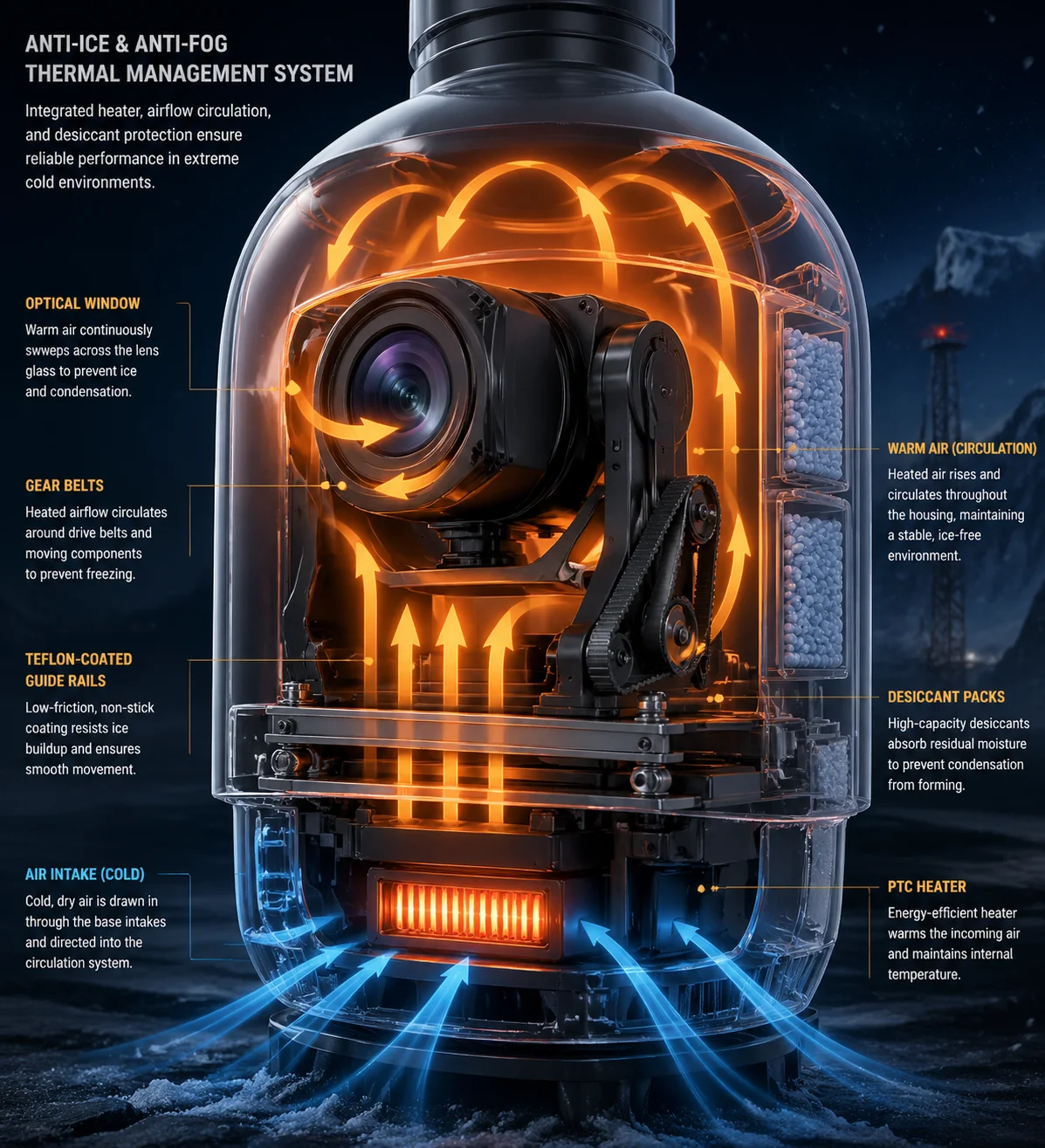
Yes, the internal heater prevents ice buildup by maintaining the housing temperature above the dew point. Combined with IP66/IP67 sealing and internal desiccant 1 packs, our system stops moisture from entering and condensing on gears, belts, and optical surfaces.
Where Does the Ice Come From?
This surprises many people. The ice does not come from outside. It comes from inside. Every sealed housing contains a small amount of trapped air. That air holds moisture. When the temperature drops sharply — say from -10°C during the day to -40°C at night — that moisture condenses on the coldest metal surfaces inside the housing. If the temperature keeps falling, the condensation freezes. Now you have ice crystals sitting directly on gear teeth, guide rails, and even the lens surface. This is why you sometimes see “foggy” PTZ images in cold weather — that is condensation on the inside of the front glass.
How Our Heater Solves This
Our heater element is positioned near the zoom module and the main sensor board. It does two jobs at once.
First, it keeps the metal parts above the dew point. As long as the gear surfaces are warmer than the surrounding air, moisture will not condense on them. No condensation means no ice.
Second, it creates a gentle convection current inside the sealed housing. Warm air rises from the heater, circulates past the front glass, and returns to the bottom. This air movement distributes heat evenly and prevents cold spots where ice might form. I think of it like a tiny climate control system inside the camera body.
Sealing and Desiccant: The Other Half of the Solution
The heater alone is not enough. If the housing leaks, fresh humid air keeps entering. That means new moisture keeps condensing, and the heater cannot keep up. This is why I require IP66 2 or IP67 sealing on every cold-weather unit we ship. The gaskets, cable glands, and window seals must pass a pressure-decay test before the unit leaves our factory.
I also place desiccant packs inside the housing during final assembly. These silica gel packets absorb any residual moisture trapped during manufacturing. Between the seal, the desiccant, and the heater, the internal environment stays dry and warm. No moisture means no ice. No ice means no jammed gears.
Material Selection for Anti-Icing
There is one more layer I want to mention. At -40°C, different materials shrink at different rates. Steel shrinks a little. Aluminum shrinks more. Plastic shrinks the most. If a steel shaft sits inside a plastic gear hub, the plastic might tighten around the shaft as it contracts. This mechanical squeeze can lock the assembly just like ice would. I solve this by matching the thermal expansion coefficients 3 of mating parts. I use cold-rated POM (polyoxymethylene) for plastic gears — it has a similar expansion rate to the steel shafts we use. I also apply Teflon coatings on guide rails. Teflon provides “dry lubrication” — even if the grease fails and ice forms, the Teflon surface has such low friction that the motor can still break through. This is my last line of defense, and I have never seen it fail in the field.
Conclusion
Preventing grease freezing at -40°C requires the right lubricant, active heating, smart firmware, and proper sealing — all designed in from the start, not added later.
1. Silica gel desiccant packs for moisture control in sealed enclosures. ↩︎ 2. IP66 ingress protection rating for dust and water jets. ↩︎ 3. Thermal expansion coefficient matching for cold-rated plastic gears. ↩︎ 4. Synthetic low-temperature grease data sheet (TDS) for -50°C operation. ↩︎ 5. Stall current protection circuit for DC motors in PTZ cameras. ↩︎ 6. Dew point calculation for moisture condensation prevention. ↩︎ 7. Pressure-decay testing for IP66 housing seal integrity. ↩︎ 8. POM vs ABS plastic low-temperature mechanical properties. ↩︎ 9. Teflon coating coefficient of friction at sub-zero temperatures. ↩︎ 10. Closed-loop heater control system for PTZ cold weather operation. ↩︎