
I have seen too many installers blame the sensor or the firmware when their PTZ goes blurry at night. The real problem is almost always optical.
IR-Corrected coatings, combined with special ED glass, force visible light and infrared light to land on the same focal plane inside the lens. This eliminates the “focus shift” that happens when a PTZ camera switches from daytime color mode to nighttime IR mode. The result is sharp images around the clock without constant refocusing.
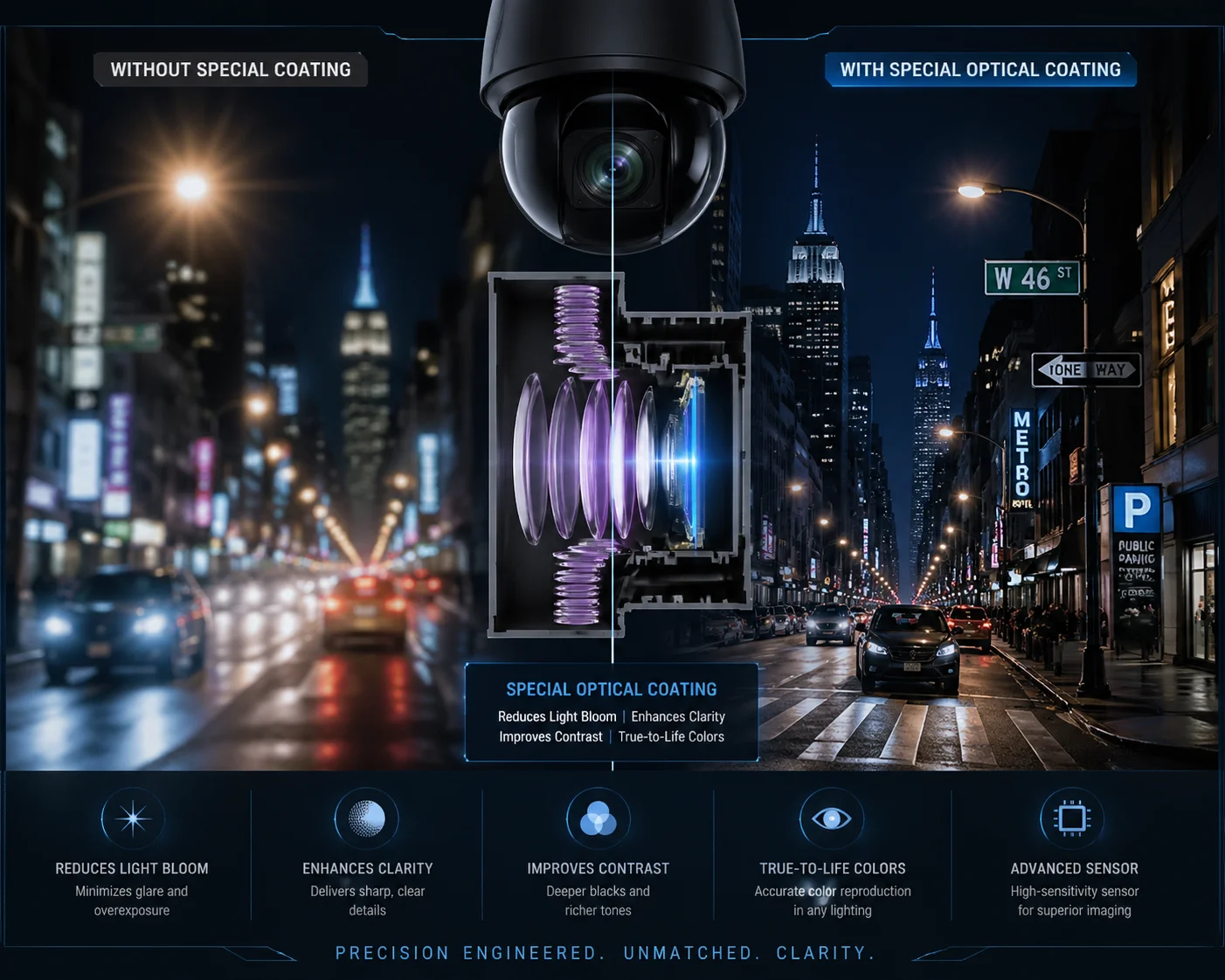 IR-Corrected PTZ camera night vision clarity
In this article, I will break down exactly why night blur happens, how IR-Corrected lens design fixes it, and what you should look for when sourcing PTZ cameras from China. If you buy cameras for security projects, this knowledge can save you thousands in warranty calls and site revisits.
Table of Contents
Why Does My Camera Lose Focus When Switching From Daytime to IR Night Mode?
I used to think night blur meant the autofocus motor was broken. I was wrong. The physics of light itself is the real cause.
When a PTZ camera removes its IR-cut filter at night, infrared light enters the lens. Because infrared has a longer wavelength than visible light, it bends differently through glass. Its focal point lands behind the sensor, not on it. This mismatch is called “IR focus shift,” and it makes the entire image look soft or blurry.
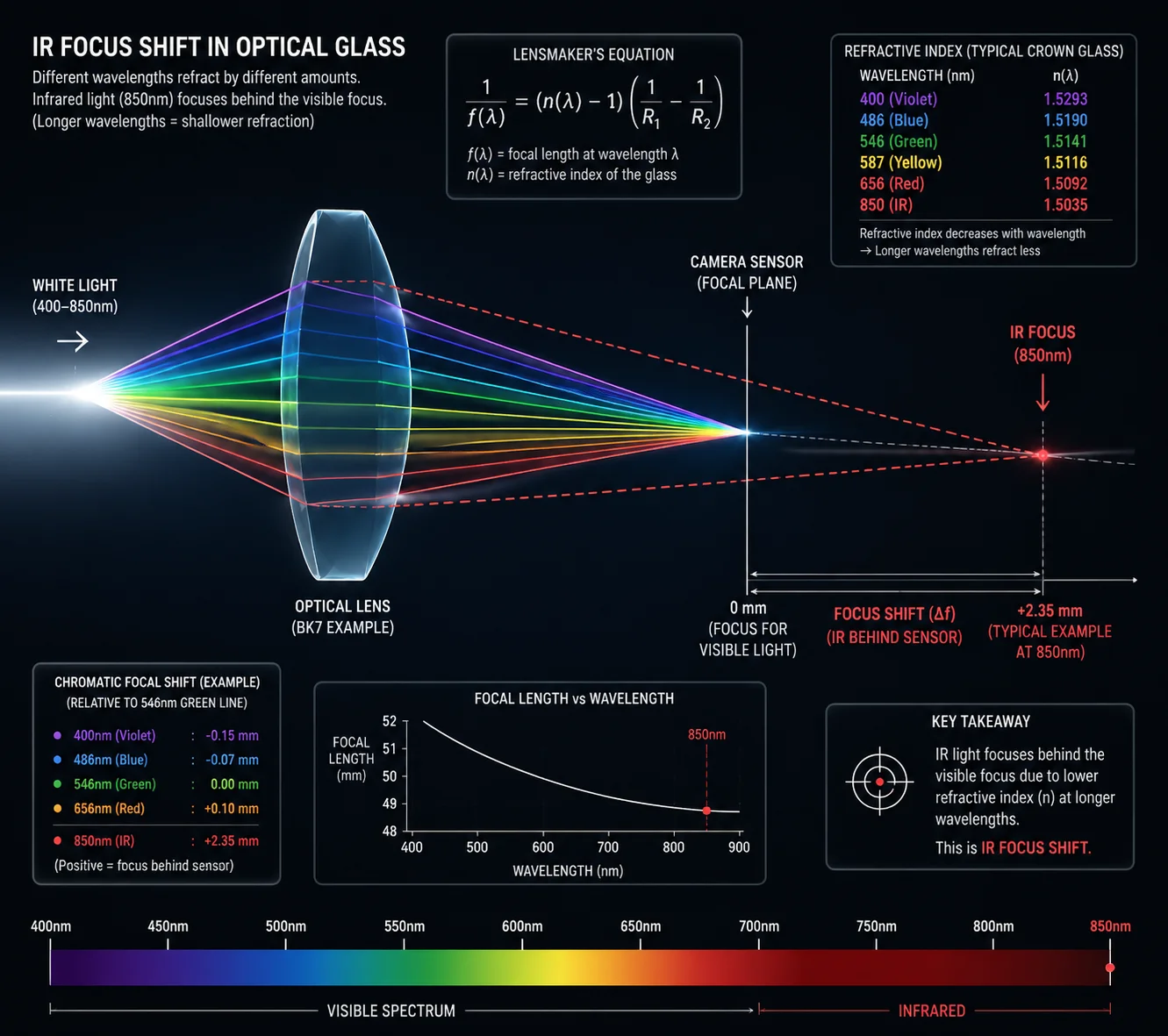 PTZ camera IR focus shift diagram
How Light Wavelength Creates the Problem
To understand this, you need one basic fact: different colors of light bend at different angles when they pass through glass. This is the same reason a prism splits white light into a rainbow. In optics, we call this chromatic aberration.
During the day, your PTZ camera has an IR-cut filter sitting in front of the sensor. This small glass filter blocks all infrared light. Only visible light (about 400nm to 700nm) reaches the sensor. The lens is designed to focus this visible light perfectly onto the sensor surface. Everything looks sharp.
At night, the camera needs more light. So it mechanically moves the IR-cut filter out of the way. Now, infrared light from IR LEDs (usually around 850nm) floods into the lens along with whatever visible light remains. Here is the problem: the lens was optimized for 400–700nm light. The 850nm infrared light bends less. It focuses at a point slightly behind the sensor.
The Numbers Behind the Blur
| Parameter | Visible Light (Daytime) | Near-Infrared (Night IR) |
|---|---|---|
| Wavelength range | 400–700nm | 700–1100nm |
| Typical IR LED peak | N/A | 850nm |
| Focal point position | On the sensor | Behind the sensor |
| Image result | Sharp and clear | Soft and blurry |
The focal shift can be tiny — sometimes just tens of microns. But at high zoom levels like 30X or 40X, even a small shift destroys image sharpness. The longer the focal length, the more visible the problem becomes.
Why PTZ Cameras Suffer More Than Fixed Cameras
A fixed camera with a short focal length (like 4mm) has a deep depth of field. Even if the IR focal point shifts a little, the image may still look acceptable. But a PTZ camera with 40X optical zoom can reach focal lengths of 200mm or more. At that range, the depth of field is extremely shallow. A few microns of focal shift will turn a license plate into an unreadable blob.
This is why so many integrators report that their PTZ “works fine during the day but goes blurry at night.” The camera is not broken. The optics are simply not corrected for infrared wavelengths.
How Does the IR-Corrected Lens Prevent the “Focus Shift” Caused by Different Light Wavelengths?
I have tested dozens of PTZ lenses over the years. The difference between a standard lens and an IR-Corrected lens at night is not subtle. It is dramatic.
An IR-Corrected lens uses two key technologies together: ED (Extra-low Dispersion) glass 1 elements and multi-layer wideband AR coatings. The ED glass reduces the gap between visible and IR focal points. The coatings ensure infrared light passes through evenly without scattering. Together, they pull both wavelengths onto the same focal plane.
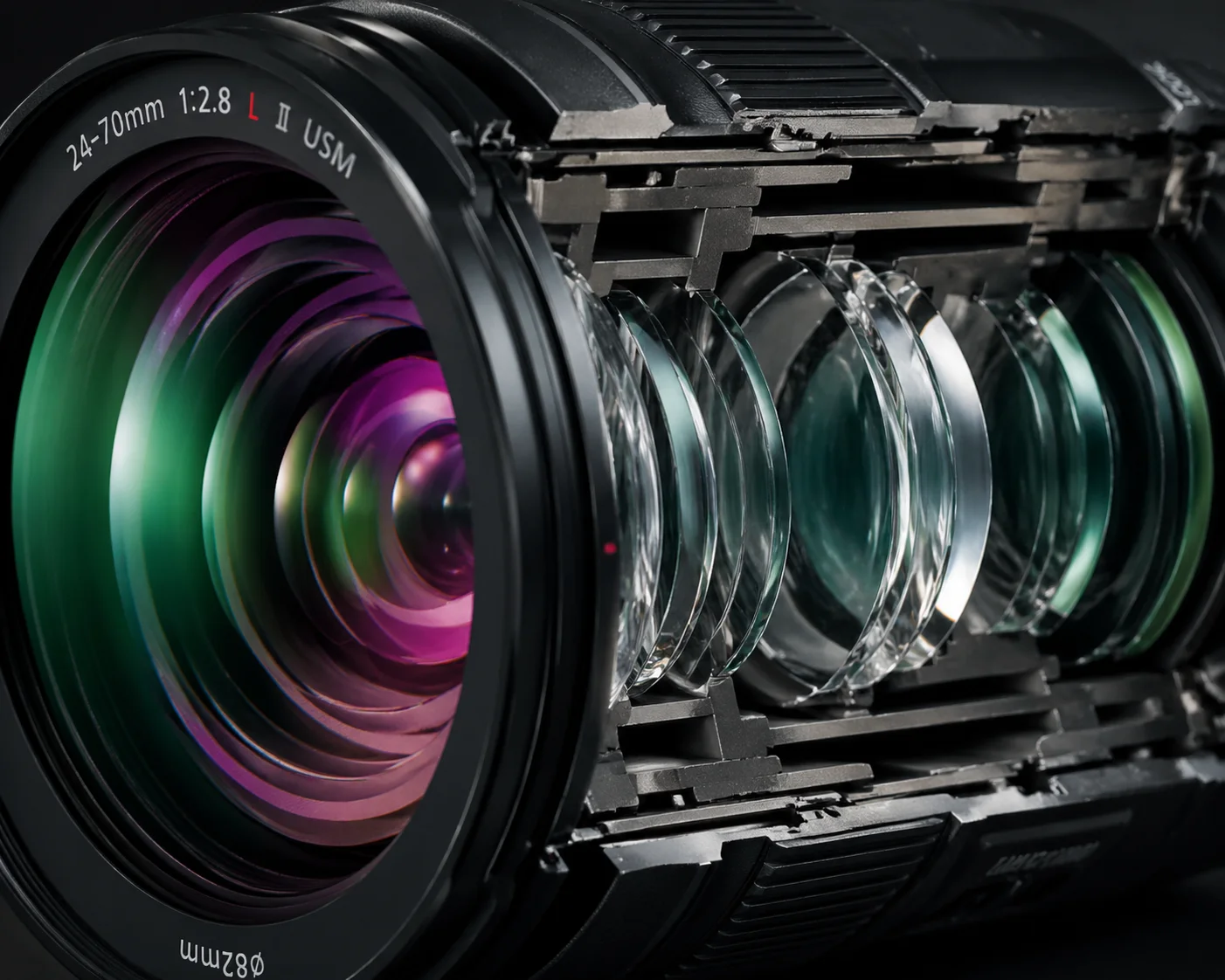 IR-Corrected lens coating structure
The Role of ED Glass
Standard optical glass has a fixed dispersion characteristic. When you design a lens group, you combine positive and negative elements to cancel out chromatic aberration. But standard glass can only correct within the visible spectrum. It does not account for the near-infrared band.
ED glass (Extra-low Dispersion glass) has a special molecular structure. It bends different wavelengths more uniformly than standard glass. When you place ED elements at critical positions in the lens group, the focal point difference between 550nm (green, peak visible sensitivity) and 850nm (IR LED peak) shrinks dramatically.
Think of it this way: standard glass might produce a 50-micron focal shift between visible and IR. ED glass can reduce that to under 10 microns. At that level, the shift falls within the sensor’s depth of focus, and the image stays sharp.
The Role of Multi-Layer IR Coatings
Glass surfaces reflect light. Each lens element in a PTZ zoom lens has two surfaces. A 15-element lens has 30 air-to-glass surfaces. Without coatings, each surface reflects about 4% of the light. That adds up fast. You lose brightness, and you get internal reflections that reduce contrast.
Standard AR (anti-reflection) coatings are designed for visible light only. They work well at 550nm but may not perform at 850nm. IR-Corrected lenses use wideband multi-layer coatings that maintain high transmittance 2 from 400nm all the way to 950nm.
This does two things:
- More IR light reaches the sensor. Brighter night images with less noise.
- Consistent refraction behavior. The coating helps control how IR light bends at each surface, supporting the ED glass in keeping the focal plane aligned.
How the Two Technologies Work Together
| Technology | What It Does | Effect on Image |
|---|---|---|
| ED Glass | Reduces focal point gap between visible and IR wavelengths | Keeps day and night focus on the same plane |
| Wideband AR Coating | Increases IR transmittance, reduces internal reflections | Brighter night image, higher contrast |
| Lens Group Design | Precisely calculated element spacing and curvature | Optimizes correction across the full zoom range |
Neither technology alone is enough. ED glass without proper coatings still loses IR light to reflections. Coatings without ED glass still leave a focal gap. You need both.
At Loyalty-Secu, our 38X and 40X PTZ modules use IR-Corrected lens assemblies with ED glass and wideband coatings as standard. This is not an upgrade option. It is built into every unit because we know our customers — system integrators and project engineers — cannot afford to send a technician back to a remote site just because the night image is soft.
Can I Achieve Sharp Night Images Without Manually Refocusing Every Time the IR Turns On?
I have had customers tell me they assigned a security guard to manually trigger refocus every evening. That is not a solution. That is a workaround for a bad lens.
Yes, with an IR-Corrected lens, your PTZ camera will maintain sharp focus automatically when switching between day and night modes. The optical correction keeps the focal shift within the sensor’s depth of focus, so the autofocus system needs little or no adjustment during the ICR (IR-Cut Removable) transition.
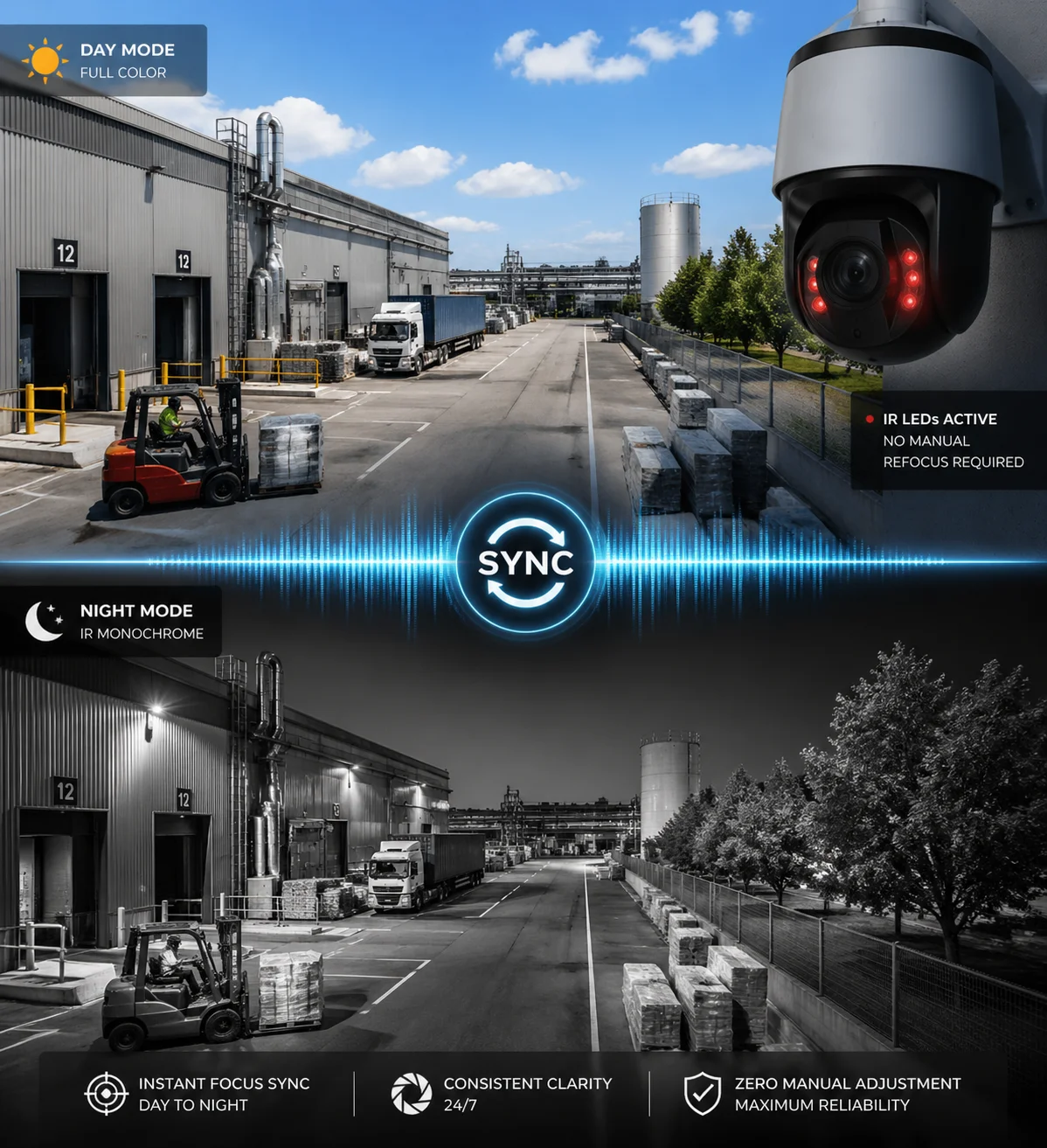 PTZ camera day night auto switch without refocus
What Happens During the Day-Night Switch
When light levels drop below a threshold, the camera’s ISP triggers the ICR mechanism. The IR-cut filter slides out. The image switches from color to black-and-white. IR LEDs or laser illuminators turn on.
On a camera with a standard (non-IR-Corrected) lens, this is the moment everything falls apart. The autofocus motor starts hunting. It moves forward, backward, forward again — the infamous “focus hunting” or “breathing” effect. Sometimes it finds a reasonable focus point. Sometimes it does not. The user sees several seconds of blur during every transition.
On a camera with an IR-Corrected lens, the transition is almost invisible. The focal plane barely moves. The autofocus system may make a tiny micro-adjustment, but it happens in milliseconds. The user sees a smooth switch from color to black-and-white with no visible blur.
The Three Practical Benefits for PTZ Deployments
Here is why this matters for real-world projects:
1. No “transition blur” window. In security, the moment between day and night is often critical. Criminals know when cameras switch modes. If your camera spends 3–5 seconds hunting for focus during every transition, that is a security gap. IR-Corrected lenses close that gap.
2. Reduced mechanical wear. Every time the autofocus motor hunts, it wears down. Over months and years, this shortens the lifespan of the focus mechanism. With IR-Corrected optics, the motor barely moves during ICR transitions. Less movement means longer life.
3. Stable zoom performance at night. This is the big one for PTZ cameras. When an operator zooms in at night, a standard lens may lose focus at every zoom step. The autofocus has to re-hunt each time. With IR-Corrected optics, the focus tracking curve stays consistent across the zoom range. You zoom in, and the image stays sharp.
A Note on Firmware-Level IR Compensation
Some higher-end PTZ cameras also store an IR focus offset table in firmware. This table maps each zoom position to a small focus motor correction value. When the ICR switches, the firmware applies the offset instantly, before the autofocus even starts evaluating. This works hand-in-hand with the optical correction.
At Loyalty-Secu, our PTZ firmware includes this compensation table. It is calibrated during factory testing for each zoom module. This is one reason why our cameras maintain consistent night sharpness across the full 38X or 40X zoom range — the optics and the software are both doing their part.
What Is the Visual Difference Between a Standard Lens and an IR-Corrected Lens at 40X Zoom?
I always tell my customers: do not trust spec sheets alone. Ask for night samples at maximum zoom. That is where the truth shows up.
At 40X zoom, a standard lens produces visibly soft images at night with IR on — edges blur, text becomes unreadable, and contrast drops. An IR-Corrected lens at the same 40X zoom delivers crisp edges, readable text, and strong contrast under IR illumination. The difference can mean 30% or more loss in usable detail with a standard lens.
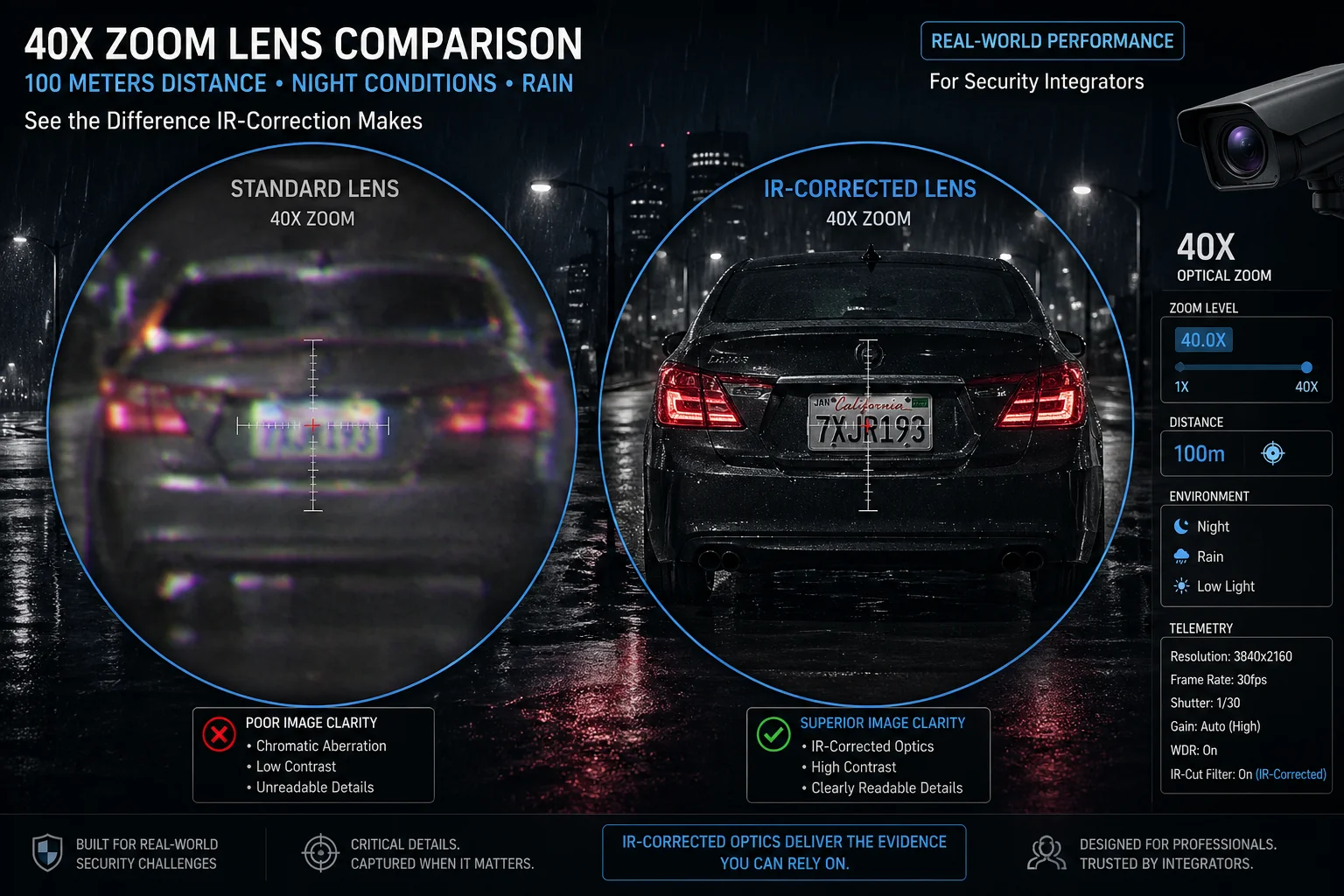 Standard vs IR-Corrected lens comparison at 40X zoom night
Why 40X Zoom Makes the Problem Worse
At wide angle (1X), the depth of field is large. Even a noticeable focal shift might still fall within the acceptable focus range. The image looks “okay” at night even with a standard lens.
But as you zoom in, two things happen:
- Depth of field shrinks. At 40X, the depth of field can be just a few centimeters at typical surveillance distances. Any focal shift — even 20 microns — pushes the image out of the sharp zone.
- Aberrations get magnified. Chromatic aberration that was invisible at wide angle becomes obvious at long focal lengths. You see purple fringing on edges, loss of micro-contrast, and an overall “hazy” look.
Real-World Comparison
| Attribute | Standard Lens at 40X (Night/IR) | IR-Corrected Lens at 40X (Night/IR) |
|---|---|---|
| Edge sharpness | Soft, blurred edges | Crisp, defined edges |
| Text readability | License plates unreadable beyond 80m | License plates readable at 120m+ |
| Contrast | Low, washed-out appearance | High, strong black-white separation |
| Purple fringing | Visible on high-contrast edges | Minimal or absent |
| Autofocus behavior | Frequent hunting, slow to lock | Quick lock, stable hold |
| Detail loss estimate | 30%+ loss vs. daytime | Less than 10% loss vs. daytime |
What This Means for Your Projects
If you are a system integrator bidding on a city surveillance project or a perimeter security contract, your client will test the cameras at night. They will zoom in. They will look at license plates, faces, and fence lines. If the image is soft, you fail the acceptance test. You eat the cost. You damage your reputation.
This is not a theoretical risk. I have heard from customers who lost contracts because they sourced cheap PTZ cameras with non-IR-Corrected lenses. The daytime demo looked great. The nighttime reality did not.
How to Verify Before You Buy
When you evaluate a PTZ supplier, ask for these specific test materials:
- Night video at maximum optical zoom with IR illumination on. Not a still image — a video, so you can see autofocus behavior.
- Side-by-side comparison of the same scene in daytime and nighttime at the same zoom level.
- Confirmation in the datasheet that the lens is marked “IR-Corrected” or “Day/Night Confocal.”
If the supplier cannot provide these, that is a red flag. At Loyalty-Secu, we provide full day/night test footage for every PTZ model before order confirmation. We do this because we know our customers need proof, not promises.
Conclusion
IR focus shift is a physics problem, not a quality defect. IR-Corrected lenses with ED glass and wideband coatings solve it at the optical level. For any PTZ camera above 20X zoom, this technology is not optional — it is essential for reliable 24/7 surveillance performance.
1. Extra-low dispersion glass properties for chromatic aberration correction. ↩︎ 2. Lens transmittance and its impact on night vision range. ↩︎ 3. IR-cut filter mechanism for day/night camera switching. ↩︎ 4. Depth of field calculation at telephoto focal lengths. ↩︎ 5. Wavelength-dependent refraction index of optical glass. ↩︎ 6. Anti-reflection coating performance across visible and NIR spectra. ↩︎ 7. Autofocus hunting during ICR transition with non-corrected lenses. ↩︎ 8. Purple fringing due to uncorrected chromatic aberration at 850nm. ↩︎ 9. IR focus offset table calibration for zoom tracking. ↩︎ 10. Depth of focus vs. sensor positioning tolerance in PTZ assemblies. ↩︎