
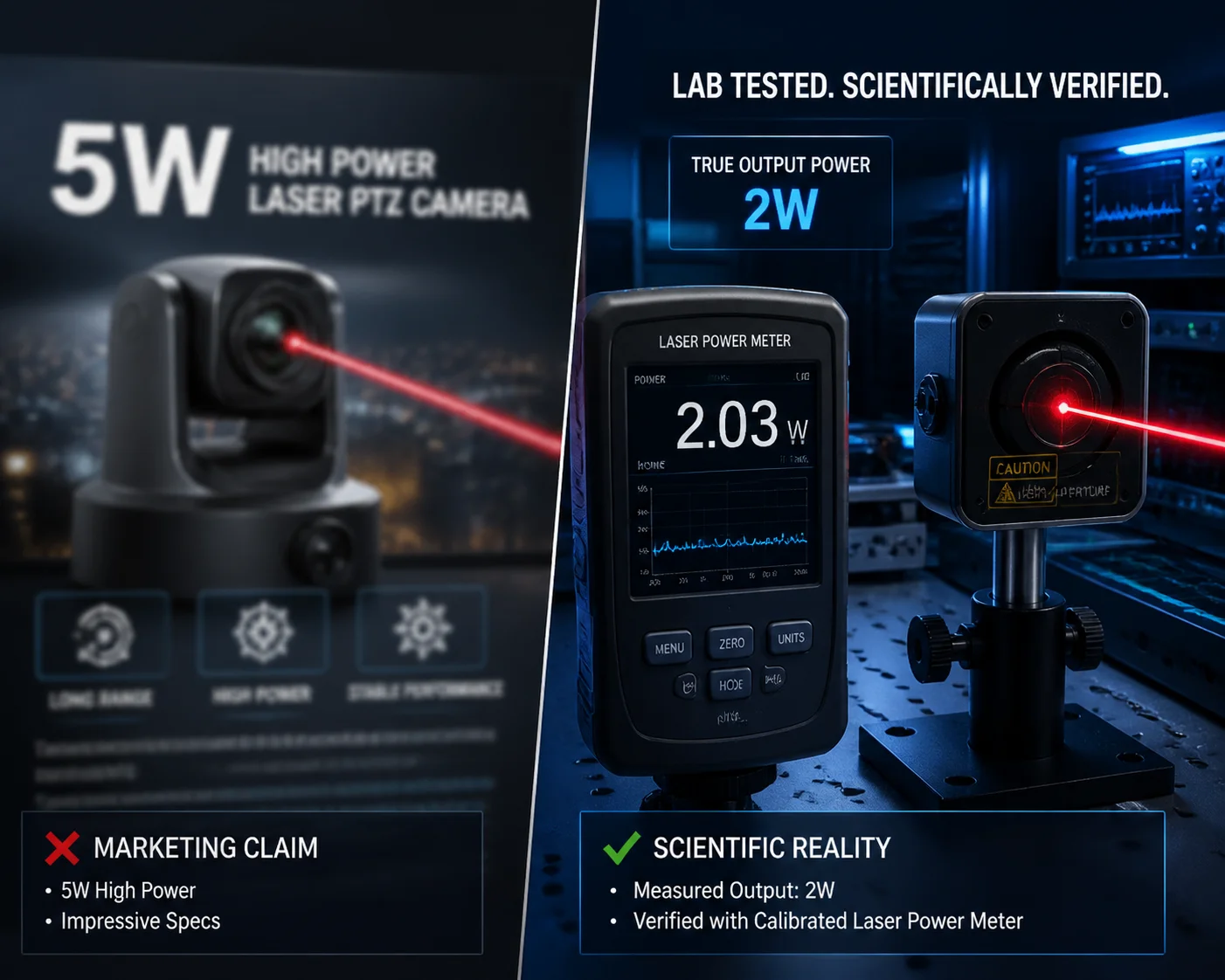
I’ve seen it too many times. A Chinese factory writes “5W laser” on the spec sheet, but the real output is barely 2W. If you buy based on that number, your project fails at night.
To verify if a Chinese factory’s laser output power is real, you need three methods: direct measurement with a laser power meter, electrical power back-calculation using input current and conversion efficiency, and cross-checking the claimed safety class against IEC 60825-1 1 standards.
In this article, I will walk you through each method step by step. You will learn how to catch fake specs before you place a bulk order. I will also show you how laser power connects to real-world night vision distance, why some “high-power” lasers disappoint, and what safety certifications actually matter. Let’s get into it.
Table of Contents
Can I Request a Third-Party Lab Test to Confirm the Laser’s Peak Milliwatt Output?
I once trusted a supplier’s spec sheet without testing. The cameras arrived. At 600 meters, the image was black. That mistake cost me a full project re-do.
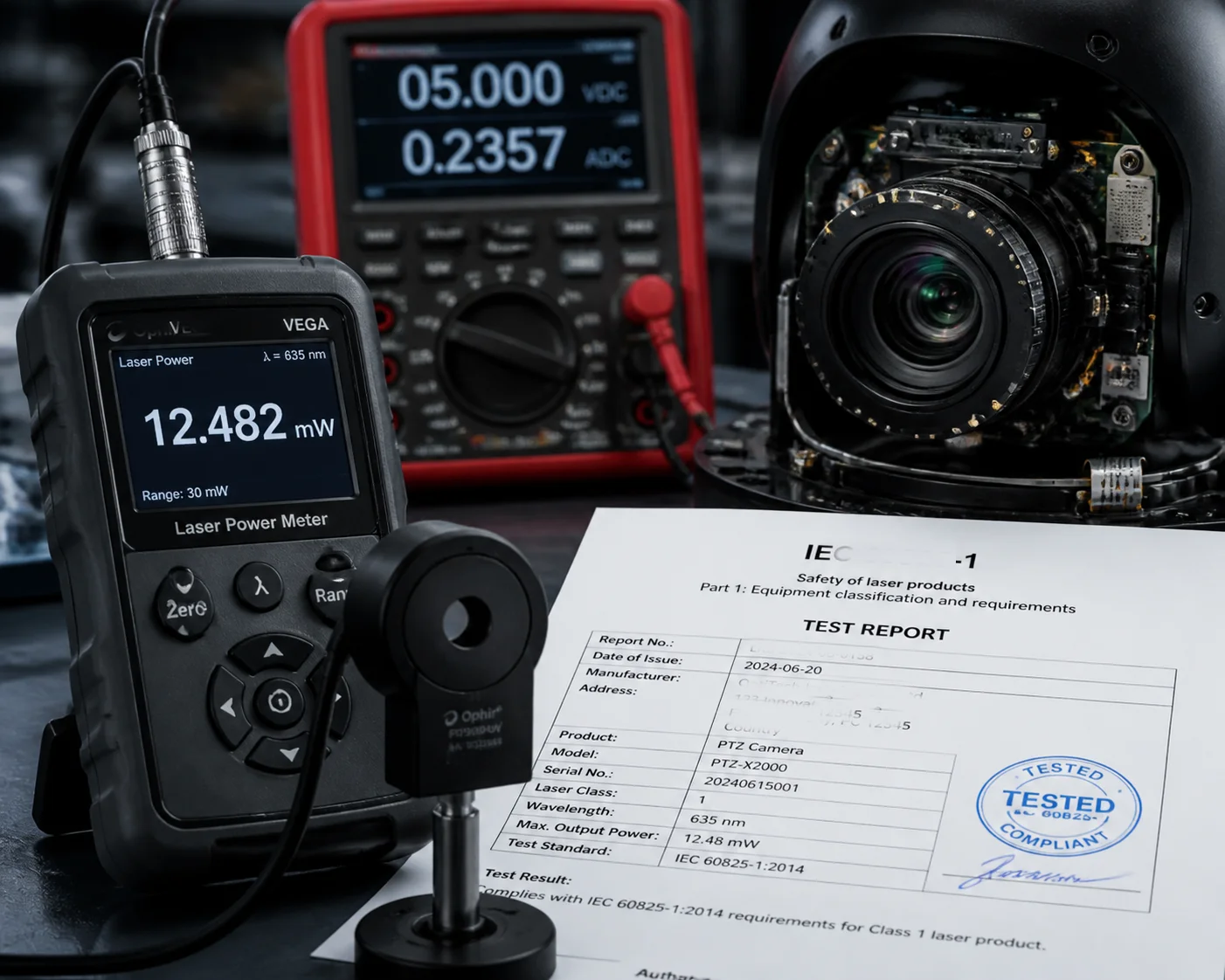
Yes, you can and should request a third-party lab test. Ask the factory for an IEC 60825-1 test report from an accredited lab. This report shows the actual measured optical output power under controlled conditions, not just the number the sales team typed into a brochure.
How to Use a Laser Power Meter Yourself
If you don’t want to wait for a lab report, you can measure the laser output yourself. You need a laser power meter with a thermopile or photodiode sensor head. The sensor must cover the wavelength of your laser. Most security PTZ cameras use 808nm, 850nm, or 940nm infrared lasers. Pick a power meter with a range of 0 to 10W. Brands like Thorlabs 2, Coherent 3, and Ophir 4 make portable models that work well for this.
Here is how to do it:
- Set up a dark room. Any ambient light will affect your reading.
- Remove the front glass cover of the PTZ if it blocks or absorbs laser energy.
- Place the sensor head very close to the laser output window. Make sure the entire beam hits the sensor area.
- Turn on the laser to 100% power through the camera’s management software.
- Wait 10 seconds for the reading to stabilize. Write down the number.
If the factory says “5W optical output” and your meter reads 2.1W, you have a problem. That is a 58% overstatement.
The Electrical Back-Calculation Method
When you don’t have a power meter on hand, you can still catch fake numbers. Use a DC power supply to feed the camera. Record the current draw with the laser off. Then record the current draw with the laser at full power. The difference tells you how much electrical power the laser module consumes.
| Step | What to Measure | Example Value |
|---|---|---|
| 1. Laser OFF current | Camera idle current at 12V | 0.5A |
| 2. Laser ON current | Camera + laser at 12V | 1.5A |
| 3. Laser electrical power | (1.5A – 0.5A) × 12V | 12W |
| 4. Estimated optical output | 12W × 35% efficiency | ~4.2W |
The key number here is the electro-optical conversion efficiency. For most infrared laser diodes, this is between 30% and 40%. This is known as the wall-plug efficiency 8 of the laser diode. If the factory claims 5W optical output but the laser module only draws 5W of electrical power, that means 100% conversion efficiency. That breaks the laws of physics. It is impossible.
What a Proper IEC 60825-1 Report Looks Like
A real test report will include the measurement distance, the aperture size, the wavelength, the beam divergence, and the measured accessible emission. It will also assign a laser safety class. If the report says “Class 1” but the factory claims 5W at 850nm with a narrow beam, something is wrong. A 5W, 850nm laser with a tight beam angle is Class 3B or Class 4. It is not eye-safe. When you see this mismatch, the factory is either lying about the power or lying about the safety class. Either way, walk away.
You can also ask the factory to provide the LD chip datasheet. If the laser diode chip inside the module has a maximum rated output of 2W, the system cannot produce 5W. The chip is the ceiling.
How Does the Laser’s Output Power Translate to the Actual Nighttime Viewing Distance?
I get this question from almost every project manager I work with. They see “500 meters” on a spec sheet and assume they will get a clear face at that distance. That is not how it works.
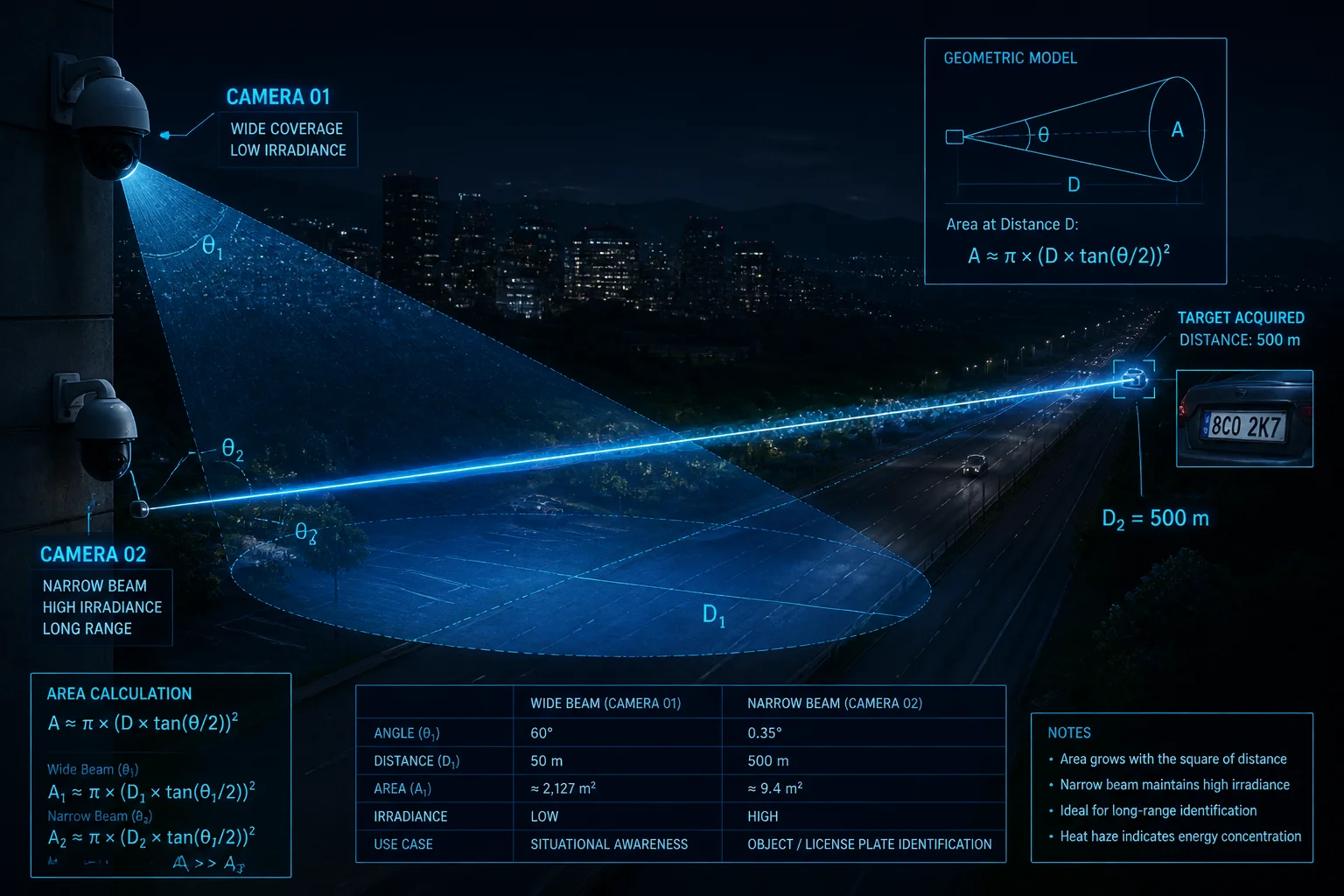
Laser output power is only one factor in nighttime viewing distance. The beam angle, sensor sensitivity, lens focal length, and atmospheric conditions all play equal roles. A 2W laser with a tight 0.5° beam can outperform a 5W laser with a wide 10° beam at long range.
Why Raw Power Alone Means Nothing
Think of a laser like a flashlight. A 1000-lumen flashlight with a wide flood beam lights up a room. But it cannot illuminate a target 500 meters away. A 200-lumen flashlight with a tight spot beam can reach much farther. The same logic applies to laser illuminators on PTZ cameras.
The laser’s beam angle determines how the energy spreads. A narrow beam concentrates all the power into a small area. A wide beam spreads the same power over a large area. At 500 meters, a 2° beam creates a spot about 17 meters wide. A 0.3° beam creates a spot about 2.6 meters wide. The narrow beam puts roughly 40 times more energy per square meter on the target.
The Distance Formula You Should Know
There is no single universal formula, but here is a practical way to compare two laser illuminators:
Irradiance at target = Optical Power / Illuminated Area
The illuminated area at distance D with beam angle θ is approximately:
Area ≈ π × (D × tan(θ/2))²
So if you double the power but also double the beam angle, you actually get less irradiance at the target. This is why a well-designed 2W laser with motorized zoom optics beats a cheap 5W laser with a fixed wide angle. This is known as the inverse square law 5 applied to laser illumination.
What “Effective Distance” Really Means
Most Chinese factories define “effective distance” as the distance where you can see “something” on screen. That might just be a white blob. For security work, you need to identify a person or read a license plate. That requires much higher irradiance.
| Distance Claim | What Factory Means | What You Actually Need |
|---|---|---|
| 500m detection | A bright spot visible on screen | A recognizable human shape |
| 500m recognition | A human shape visible | A face clear enough for ID |
| 500m identification | Rarely tested | License plate or face detail readable |
Always ask the factory: “At 500 meters, can I read a license plate?” If they say yes, ask for a real demo video shot at night with the actual product. Not a marketing render. Not a daytime photo. A real nighttime video with metadata showing the timestamp and camera settings.
The Role of the Camera Sensor
The laser only provides the light. The camera sensor captures it. A sensor with high quantum efficiency at 850nm will produce a brighter image than a sensor with low sensitivity at that wavelength. The lens matters too. A 40X optical zoom lens at full telephoto has a very narrow field of view. It collects light from a small area. This matches well with a narrow laser beam. If the laser beam is wider than the lens field of view, you are wasting energy lighting up areas the camera cannot even see.
This is why I always tell my clients: test the laser and the camera together as a system. A spec sheet for the laser alone tells you very little about real-world performance.
Why Do Some “High-Power” Lasers Perform Poorly Compared to Lower mW Models?
I have tested side-by-side comparisons in our lab. A 3W laser PTZ from one factory produced sharper images at 800 meters than a 5W laser PTZ from another factory. The numbers on paper meant nothing.
“High-power” lasers perform poorly when the beam quality is bad, the optics are misaligned, the beam angle does not match the camera’s field of view, or the factory inflated the number by reporting electrical consumption instead of actual optical output.
The Beam Quality Problem
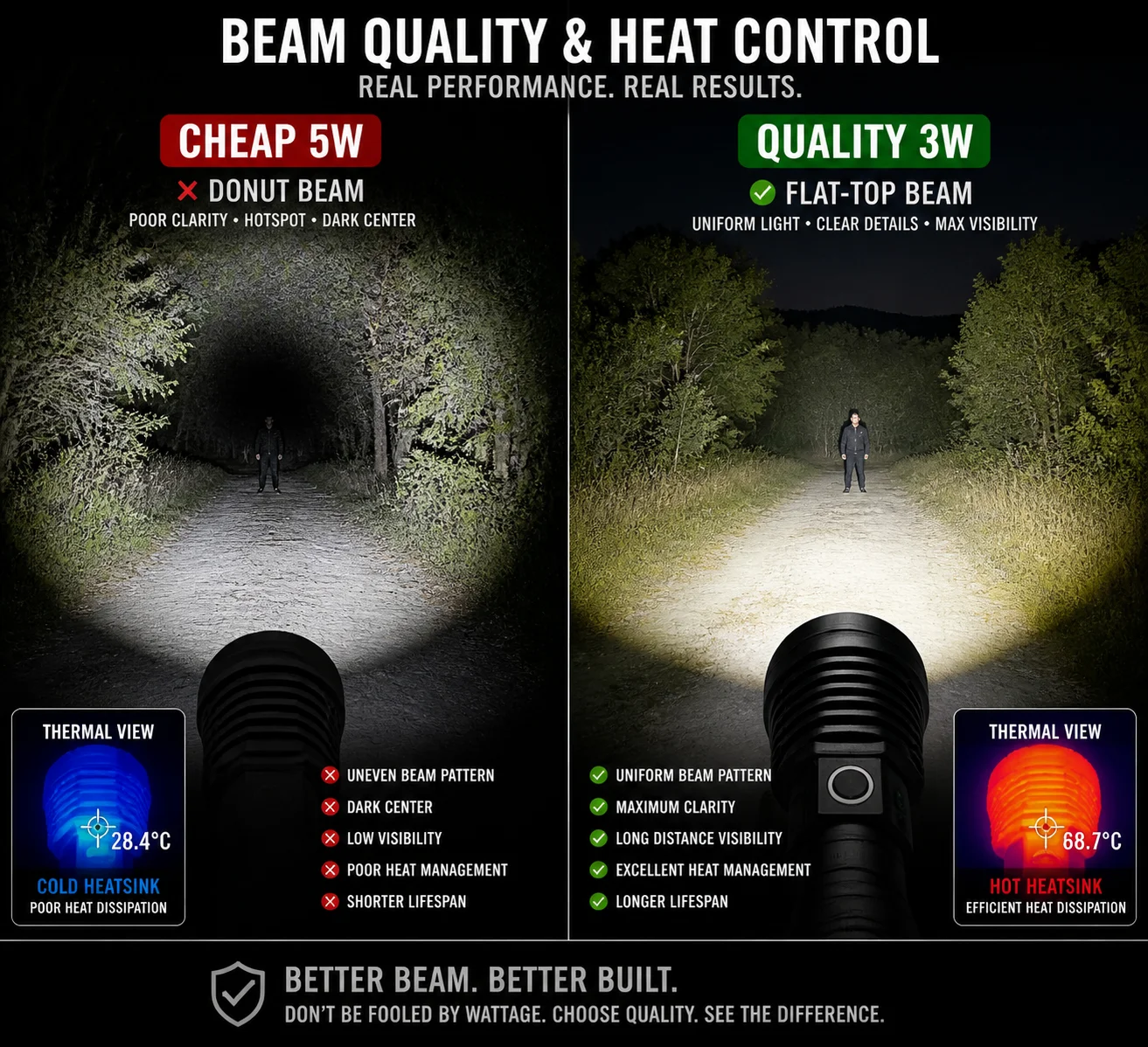
Not all laser diodes produce the same quality of light. A cheap laser diode might have a donut-shaped beam profile 6. This means the center of the beam is dark and the edges are bright. When this beam hits a target at 500 meters, the center of your image is dim while the edges are over-exposed. The result is an unusable image even though the total power is high.
A good laser module uses a carefully designed collimation lens and sometimes a diffuser to create a uniform, flat-top beam profile. This costs more. Cheap factories skip this step. They buy the cheapest laser diode, slap on a basic lens, and call it done.
Synchronous Zoom: The Feature Most People Ignore
This is the single most important feature for long-range laser PTZ cameras. And most buyers never ask about it.
Synchronous zoom means the laser beam angle automatically adjusts to match the camera’s zoom level. When the camera zooms in to 40X, the laser narrows its beam to cover only the small area the camera sees. When the camera zooms out to 1X, the laser widens its beam to cover the full scene.
Without synchronous zoom, the laser stays at one fixed angle. If it is set wide, you lose all long-range capability. If it is set narrow, you get a tiny bright spot in the middle of a dark wide-angle image.
Heat Management Tells the Truth
A real 5W laser generates a lot of heat. The electro-optical efficiency is about 35%. That means 65% of the input power becomes heat. For a 5W optical output, the laser module consumes roughly 14W of electrical power. About 9W of that becomes heat inside a small metal housing.
Here is a simple test:
- Turn the laser to 100% power.
- Wait 15 minutes.
- Touch the metal heatsink on the back of the laser module.
If it is barely warm, the laser is not drawing much current. The real output power is low. A genuine 5W laser module will be too hot to touch comfortably after 15 minutes.
Common Tricks Factories Use
| What They Say | What They Actually Mean |
|---|---|
| “10W laser power” | 10W total electrical consumption, not optical output |
| “Reaches 1000m” | Algorithm-boosted brightness, not raw laser illumination |
| “Military-grade laser” | Marketing term with no standard definition |
| “Imported laser diode” | May be true, but the diode might be a low-bin reject |
| “Eye-safe design” | Could mean they reduced power so much it barely works |
The only way to cut through this noise is to test the product yourself or demand verified third-party data. Words on a brochure are free. Real performance costs money to achieve.
What Are the Safety Certifications (Like FDA/IEC) Required for These Laser Modules?
I had a client in the EU who imported 200 laser PTZ cameras without checking the safety class. Customs held the shipment for 6 weeks. He almost lost the entire project deadline because the paperwork was wrong.
For laser-equipped PTZ cameras, the key certifications are IEC 60825-1 (international laser safety standard) and FDA 21 CFR 1040 7 (required for any laser product entering the United States). The laser module must be classified into the correct safety class, and the product must carry the proper warning labels.
IEC 60825-1: The Global Baseline
IEC 60825-1 is the international standard for laser product safety. It defines how to measure the accessible emission from a laser product and how to classify it into safety classes. Every country that follows IEC standards (which includes the EU, most of Asia, and many other regions) requires compliance with this standard for laser products.
The standard defines these classes:
- Class 1: Safe under all conditions of normal use. Very low power.
- Class 1M: Safe for the naked eye, but potentially hazardous if viewed with magnifying optics.
- Class 2: Visible lasers only. Low power. Eye protection by blink reflex.
- Class 3R: Low risk but can be hazardous under direct viewing. Up to 5× the Class 2 limit.
- Class 3B: Direct beam viewing is hazardous. Typically 500mW and below for visible, varies for IR.
- Class 4: High power. Hazardous to eyes and skin. Fire risk.
For security cameras with infrared lasers, the relevant classes are usually Class 1, Class 1M, Class 3B, or Class 4. A laser illuminator with 500mW or more of optical output at 850nm will almost certainly be Class 3B or higher. If a factory tells you their 5W 850nm laser is “Class 1 eye-safe” with no special optical design to justify it, the power claim is fake. This is exactly why you need to understand laser product classification 9 before purchasing.
FDA Requirements for the US Market
If you sell laser products in the United States, you must comply with FDA 21 CFR 1040.10 and 1040.11. This requires:
- Product registration with the FDA Center for Devices and Radiological Health (CDRH).
- Accession number for each laser product model.
- Proper labeling with the laser class, warning statements, and aperture location.
- A variance or exemption if the product does not meet all performance standards (for example, if it lacks certain safety interlocks).
Many Chinese factories do not have FDA laser product registration. If you import their laser PTZ cameras into the US without this registration, you are the importer of record. You are legally responsible. US Customs can seize the products. The FDA can issue a warning letter or fine.
How to Use Safety Class as a Lie Detector
This is one of my favorite tricks. The safety class acts as a built-in truth check for the claimed power.
Here is the logic:
- The factory claims 3W optical output at 850nm.
- You ask: “What is the IEC 60825-1 class?”
- They say: “Class 1.”
- You know that Class 1 at 850nm for a continuous-wave laser with a small beam divergence allows only a few milliwatts of accessible emission.
- 3W is thousands of times above the Class 1 limit for that configuration.
- Conclusion: either the power is fake, or the safety class is fake. Both are red flags.
Some advanced systems genuinely achieve Class 1 with high power by using 1550nm wavelength (which is absorbed by the cornea and does not reach the retina), very large beam divergence, or pulsed operation with low duty cycles. But these are specialized designs. A standard 850nm PTZ camera laser does not have these features.
What to Ask Your Supplier
Before you place an order, send these questions to your Chinese supplier:
- Please provide the IEC 60825-1 test report for the laser module.
- What is the laser safety class?
- What is the measured optical output power in the test report?
- Do you have FDA CDRH registration for the US market?
- Can you provide the laser diode chip datasheet showing maximum rated power?
If they cannot answer these questions, or if the answers contradict each other, find a different supplier. Make sure the laser module also meets the CDRH accession number 10 requirements if you are importing into the US. At Loyalty-Secu, we provide full IEC 60825-1 documentation and LD chip specifications to every B2B client. We do this because we know our clients need to pass their own compliance checks before they can deploy the cameras in the field.
Conclusion
Verify laser power with a meter, back-calculate from electrical input, cross-check safety class, and demand third-party test reports. Never trust a spec sheet alone.
1. IEC 60825-1 laser safety classification and measurement standards. ↩︎ 2. Thorlabs laser power meter product line for NIR measurement. ↩︎ 3. Coherent laser measurement instruments for OEM testing. ↩︎ 4. Ophir photonics power meter sensor selection guide. ↩︎ 5. Inverse square law for laser irradiance over distance. ↩︎ 6. Doughnut beam profile in laser diode emission. ↩︎ 7. FDA 21 CFR 1040 laser product registration requirements. ↩︎ 8. Wall-plug efficiency of laser diodes explained. ↩︎ 9. Laser product classification and safety standards. ↩︎ 10. CDRH accession number verification for laser imports. ↩︎