
I’ve seen shipments stuck at U.S. ports for weeks. The reason? Missing FDA laser safety paperwork. If you import laser PTZ cameras into America, this one mistake can cost you the entire order.
To obtain compliant FDA safety access documents for laser PTZ cameras, you need your manufacturer to submit a Product Report to FDA’s CDRH division under 21 CFR 1040.10, receive an Accession Number, and provide you with the Acknowledgement Letter, test reports, compliant labels, and user manuals before shipping.
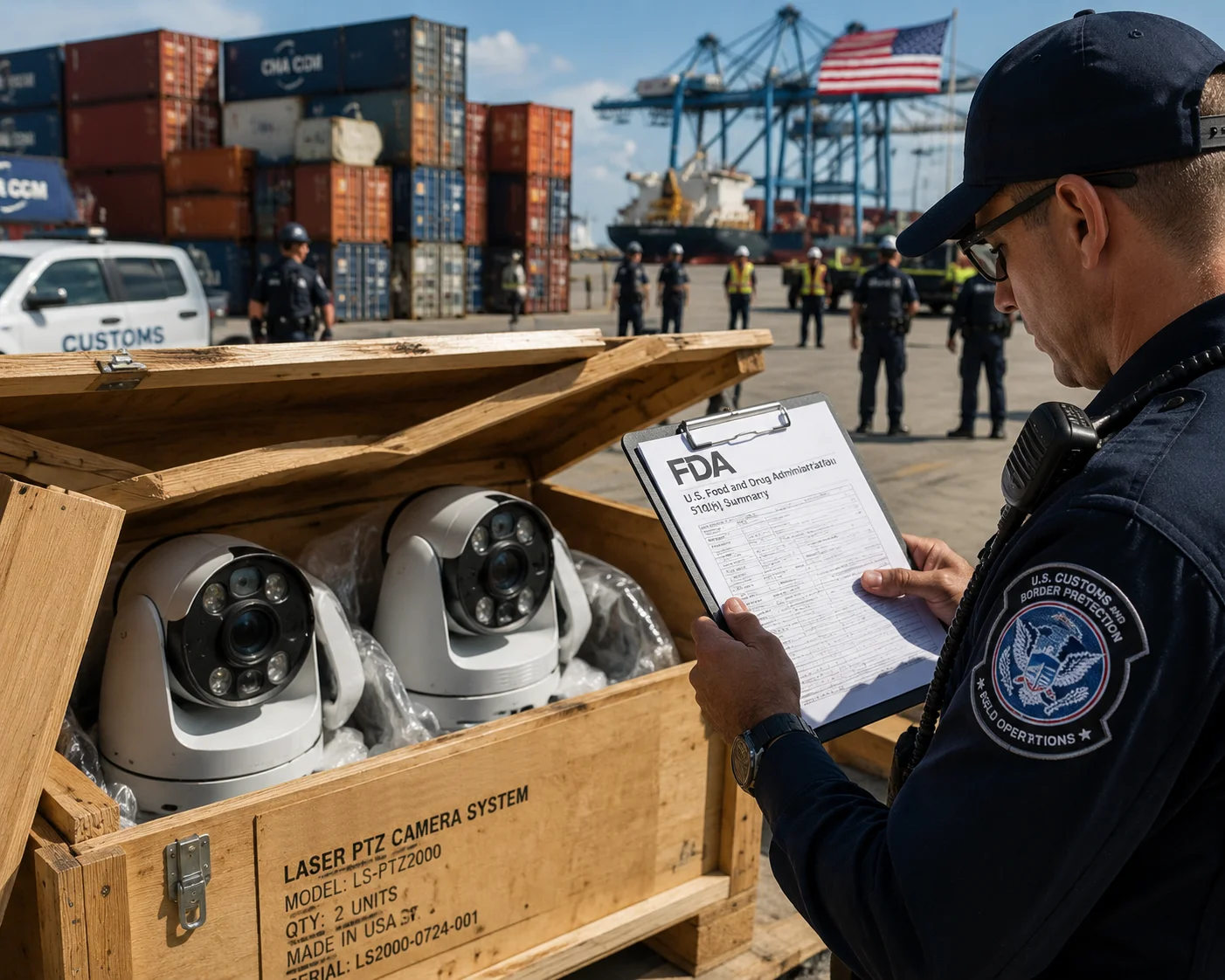
Getting these documents is not something you do alone. The process starts at the factory level. Your supplier must test the laser, file the report, and get FDA’s confirmation. Then you, as the importer, must collect and verify every piece of paper before the goods leave China. Below, I break down each step so you know exactly what to ask for, what to check, and what to avoid.
Table of Contents
Will My Shipment Be Seized by U.S. Customs if the FDA 2877 Form Is Missing?
I lost sleep over this question on my first laser PTZ shipment. The container was already on the water. My broker called and asked for the FDA 2877 form. I didn’t have it.
Yes, your shipment can be detained by U.S. Customs if the FDA Form 2877 is missing or incomplete. [Laser products fall under Import Alert 95-04]8, which allows FDA to issue a DWPE (Detention Without Physical Examination) order, holding your goods at the port without even opening the box.
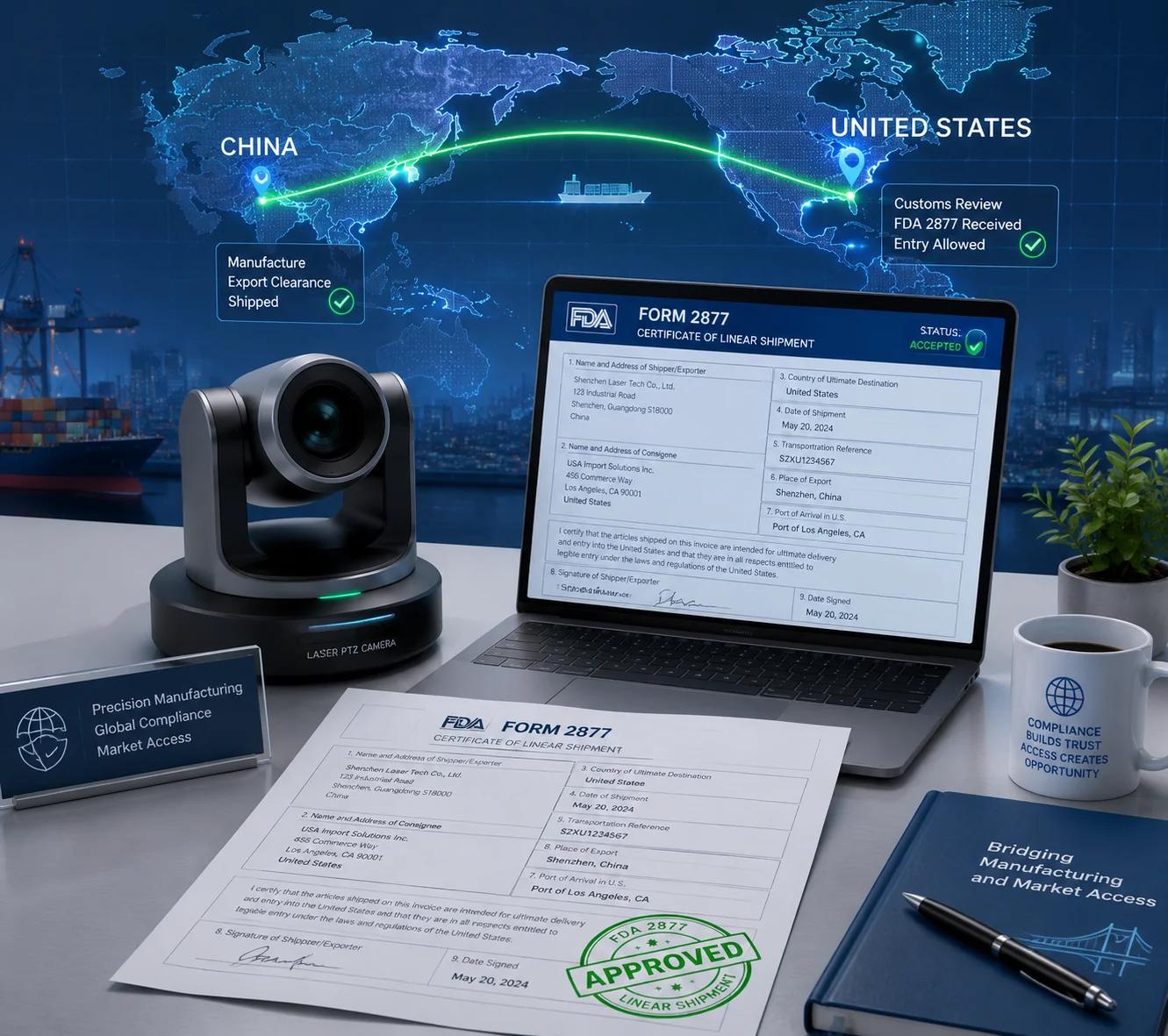
What Is FDA Form 2877 and Why Does It Matter?
FDA Form 28771 is officially called the “Declaration for Imported Electronic Products Subject to Radiation Control Standards.” Every time a laser product enters the United States, this form must be filed with U.S. Customs and Border Protection (CBP). It tells FDA that the product meets the radiation safety standards in 21 CFR 10402.
On this form, you must fill in a declaration code. For most laser PTZ cameras that already have FDA compliance, you use Code D. This code means the product has a valid Product Report on file with FDA and the manufacturer has an Accession Number.
If you cannot provide this form, or if the information on it is wrong, here is what happens:
| Scenario | What Happens | Your Cost |
|---|---|---|
| Form 2877 missing entirely | DWPE detention at port | Storage fees + delays (weeks to months) |
| Wrong declaration code used | FDA review triggered, possible refusal | Re-filing fees + broker charges |
| Accession Number invalid or expired | Goods held pending manufacturer verification | Potential re-export or destruction |
| Form filled correctly with valid Accession Number | Normal clearance | None — smooth entry |
How Import Alert 95-04 Works Against You
FDA maintains a list called Import Alert 95-04. This alert targets laser products that do not comply with 21 CFR 1040. If your product or your supplier appears on this list, every future shipment gets automatically flagged.
The alert allows FDA to detain goods without even inspecting them physically. They just look at the paperwork. If something is missing, the container sits at the port. You pay storage fees every day. After a certain period, FDA can order the goods destroyed or re-exported at your expense.
What You Should Do Before the Ship Leaves China
The fix is simple but must happen early. Before your goods leave the factory, make sure your customs broker in the U.S. has:
- A completed FDA Form 2877 with the correct declaration code
- The manufacturer’s Accession Number
- A copy of the FDA Acknowledgement Letter
- The product’s laser classification and test report reference
I always send these documents to my broker at least two weeks before the vessel arrives. This gives them time to review everything and ask questions. If something is wrong, I still have time to get the right paperwork from my supplier.
A Common Mistake I See Importers Make
Many importers assume their freight forwarder handles FDA paperwork. They don’t. Your freight forwarder moves boxes. Your customs broker handles FDA declarations. Make sure you have a broker who understands radiation-emitting electronic products. Not every broker knows what 21 CFR 1040 means. If your broker has never cleared a laser product before, find one who has.
How Do I Confirm the Laser Classification Is Correctly Labeled on the Camera Body?
I once received a batch of laser PTZ cameras where the label said “Class 1” but the test report said “Class 3R.” That mismatch almost killed the deal with my client. Labels matter more than most people think.
To confirm correct laser classification3 labeling, physically inspect the camera body for a permanent warning label that states the laser class, wavelength, output power, and a compliance statement referencing 21 CFR 1040.10. Then cross-check this label against the third-party test report and the FDA Product Report.
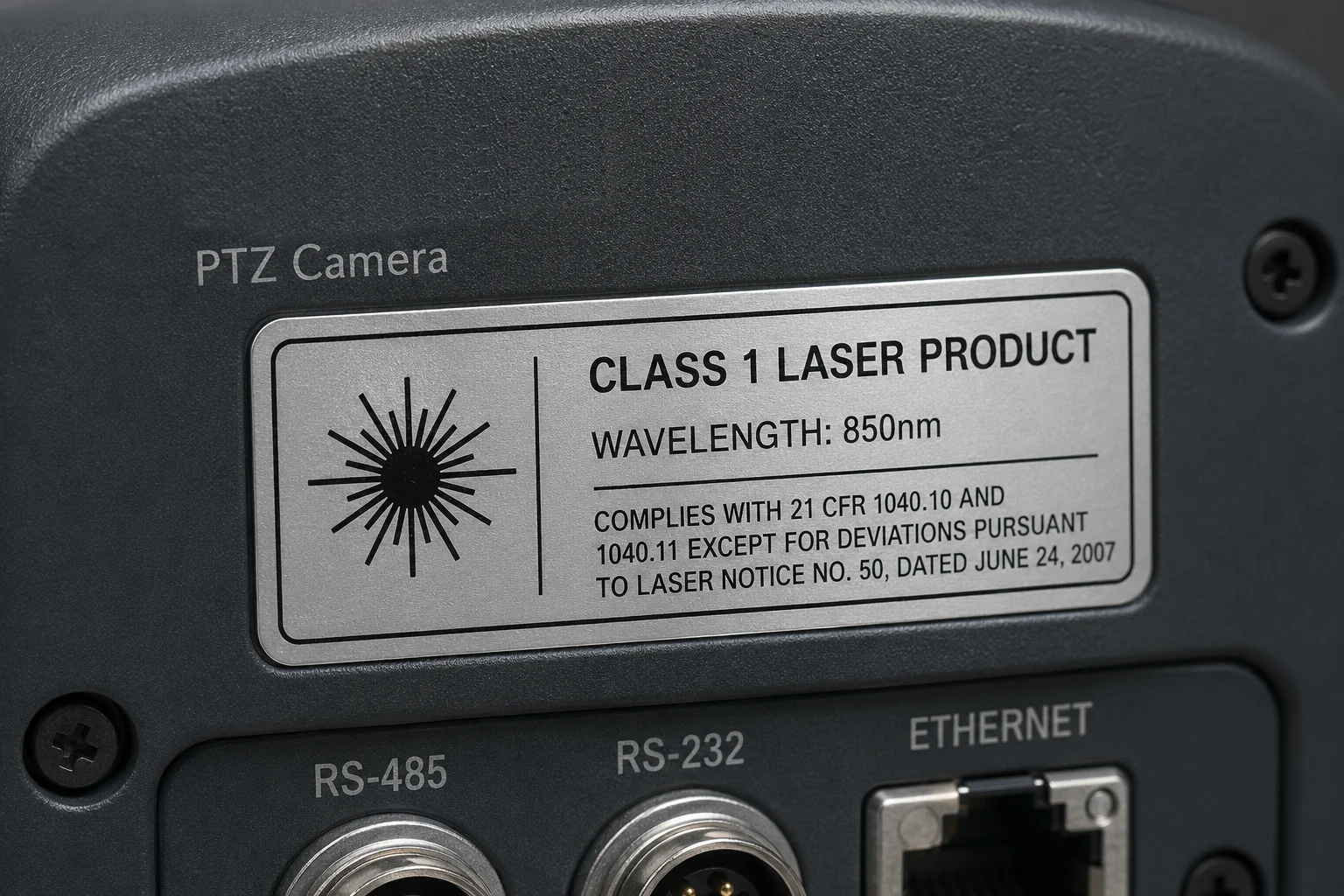
What FDA Requires on the Physical Label
FDA has very specific rules about what must appear on the outside of any laser product. These are not suggestions. They are legal requirements. If any of these items are missing, FDA can seize the product at the border.
Here is what must be on the camera body:
| Label Element | Requirement | Example |
|---|---|---|
| Laser Class | Must state the IEC/FDA class clearly | “Class 1 Laser Product” |
| Wavelength | Must list the laser wavelength in nanometers | “808 nm” or “850 nm” |
| Output Power | Must state maximum output power | “Max Output: 3.5 mW” |
| Compliance Statement | Must reference the specific CFR sections | “Complies with 21 CFR 1040.10 and 1040.11” |
| Warning Logotype | Standard laser warning symbol (sunburst) | Yellow triangle with laser beam symbol |
| Aperture Label | Must mark the laser exit point on the housing | “AVOID EXPOSURE — Laser radiation is emitted from this aperture” |
| Manufacturer Info | Company name, model number, date of manufacture | “Loyalty-Secu, Model LS-PTZ808, Mfg Date: 2025-01” |
Why Label Accuracy Is a Compliance Deal-Breaker
The label is the first thing an FDA inspector looks at. It is also the first thing your client’s safety officer checks on a job site. If the label says Class 1 but the laser inside is actually Class 3B, you have a serious legal problem. This is not just a paperwork issue. It is a safety issue.
In the United States, Class 3B and Class 4 lasers can cause eye injuries. If a worker gets hurt and the label was wrong, you face product liability lawsuits. The manufacturer faces FDA enforcement action. Everyone in the supply chain is at risk.
How to Cross-Check the Label Against the Test Report
When I receive sample units from a supplier, I follow a three-step check:
Step 1: Read the label on the camera body. Write down the class, wavelength, power, and compliance statement.
Step 2: Open the third-party test report. Find the section where the lab measured the laser output. Compare the numbers. The class on the label must match the class determined by the lab. The wavelength and power numbers must match too.
Step 3: Check the FDA Product Report or Accession Letter. The product model listed on the FDA filing must be the same model on the label. If the supplier changed the model number or updated the laser module but did not update the FDA filing, the Accession Number may not cover this unit.
What If the Labels Are Wrong?
If you find a mismatch, do not ship the product. Go back to the supplier immediately. Ask them to:
- Correct the labels to match the test report
- If the laser module changed, get a new test done
- Update the FDA Product Report if needed
- Send you photos of the corrected labels before shipping
I put this requirement in every purchase order now. The contract says the supplier must send me close-up photos of every label on the camera body before the goods leave the factory. This one step has saved me from multiple problems.
Can the Manufacturer Provide an FDA Accession Letter for the Laser Radiation Safety?
I asked a supplier once for their FDA Accession Letter. They sent me a CE certificate instead. That told me everything I needed to know about their readiness for the U.S. market.
Yes, the manufacturer can and must provide an FDA Accession Letter if their laser PTZ camera requires a Product Report under 21 CFR 1040. This letter is issued by FDA’s CDRH after they receive and review the manufacturer’s Product Report. It contains a unique Accession Number that you need for customs clearance.
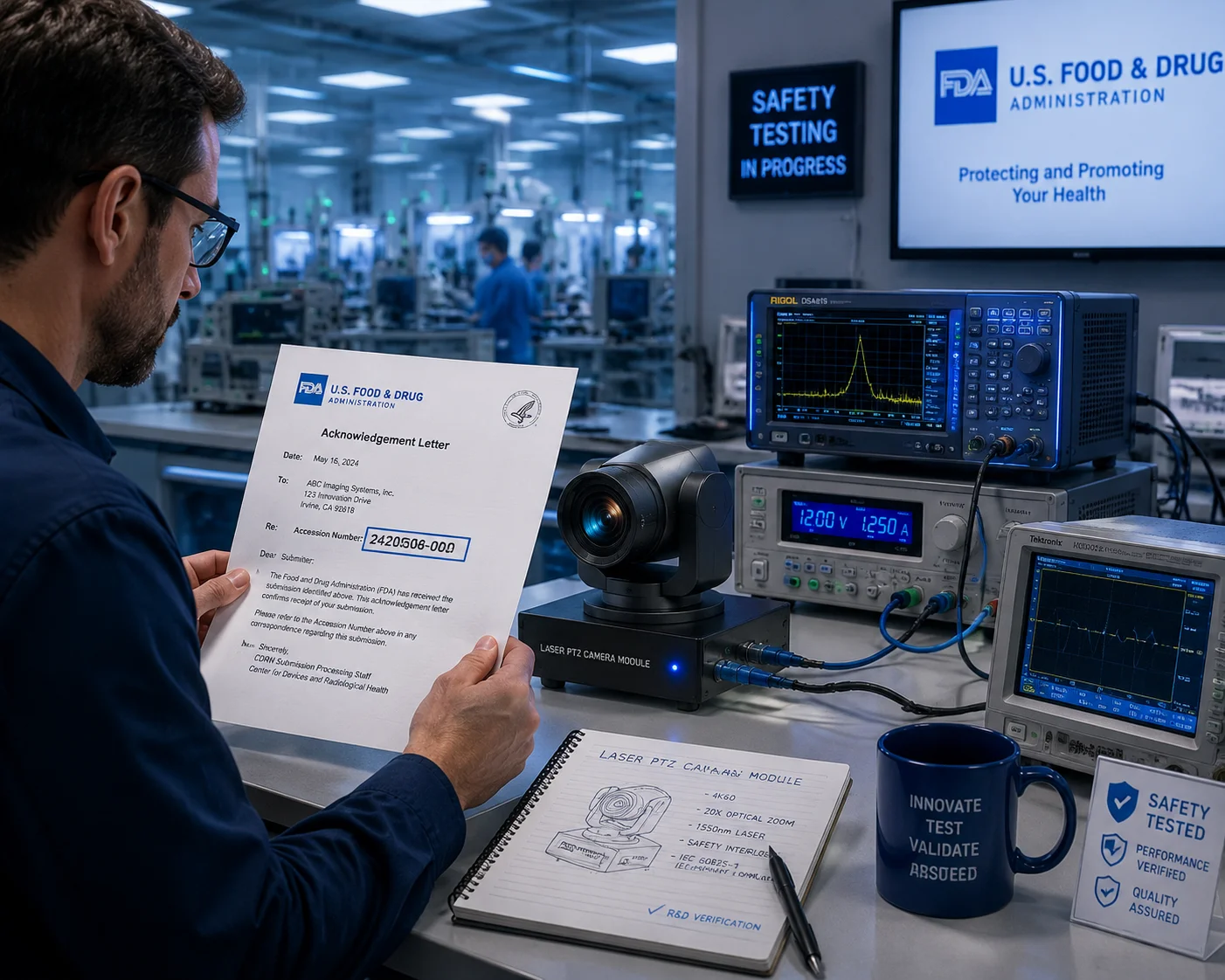
What Is the Accession Letter Exactly?
The Accession Letter is a confirmation document from FDA. It is not a “certificate” or an “approval.” FDA does not “approve” laser products the way they approve drugs. Instead, they receive the manufacturer’s Product Report, review it, and send back an Acknowledgement Letter with an Accession Number.
This Accession Number is like a file reference. It tells FDA and U.S. Customs that the manufacturer has submitted the required technical documentation for this specific laser product. Without it, there is no record in FDA’s system that this product exists.
How the Manufacturer Gets the Accession Number
The process works like this:
First, the manufacturer tests the laser product according to 21 CFR 1040.10 (and 1040.11 if applicable). They usually hire a third-party lab that FDA recognizes. Labs like BACL or CTB-Lab in China can do this testing.
Second, the manufacturer prepares a Product Report under 21 CFR 1002.10. This report includes the product description, laser specifications, safety features, label photos, user manual, and test data.
Third, the manufacturer submits this Product Report to FDA electronically. FDA reviews the submission and sends back the Acknowledgement Letter with the Accession Number.
Fourth, the manufacturer must submit an Annual Report5 every year before September 1st. This report covers sales volume, any safety incidents, and quality control updates. If the manufacturer skips the Annual Report, the Accession Number can become inactive.
How to Verify the Accession Letter Is Real
Fake documents exist in this industry. I have seen suppliers photoshop Accession Letters. Here is how I verify them:
-
Check the format. A real FDA Acknowledgement Letter comes on FDA letterhead. It includes the CDRH division name, a specific date, the manufacturer’s name and address, the product model, and the Accession Number.
-
Call or email FDA CDRH. You can contact FDA’s Division of Industry and Consumer Education (DICE) and ask them to confirm the Accession Number. They will tell you if it is valid and which product it covers.
-
Match the product model. The Accession Number covers a specific product or product family. If your supplier changed the laser module, the housing, or the model number after getting the Accession Number, the old number may not cover the new product.
-
Check the Annual Report status. Ask the supplier when they last submitted their Annual Report. If they cannot answer this question, their Accession Number might be inactive.
What If the Supplier Does Not Have an Accession Number?
If your supplier cannot provide an Accession Number, you have two options:
Option A: Ask them to complete the FDA registration process before you place the order. This takes time — usually 4 to 8 weeks depending on the lab and FDA’s review queue. But it is the right way to do it.
Option B: If the product is truly a Class 1 enclosed laser system (meaning the laser is fully sealed inside the housing and cannot be accessed during normal use or single-fault conditions), a full Product Report may not be required. But the supplier still needs to prove Class 1 status with a valid test report and proper labeling. Do not take their word for it. Get the test report.
At Loyalty-Secu, we handle this process for our clients. When David or any of our partners asks for the Accession Letter, we provide the original document along with the test report, label photos, and user manual. We also keep our Annual Reports current so there are never gaps in our FDA filing.
What Are the Specific Safety Interlocks Required for Importing Class 3B Laser Devices?
A client once asked me to source a 2-kilometer laser PTZ for a border project. The laser was Class 3B. That changed everything about the compliance requirements. The paperwork tripled. The safety features had to be built into the hardware itself.
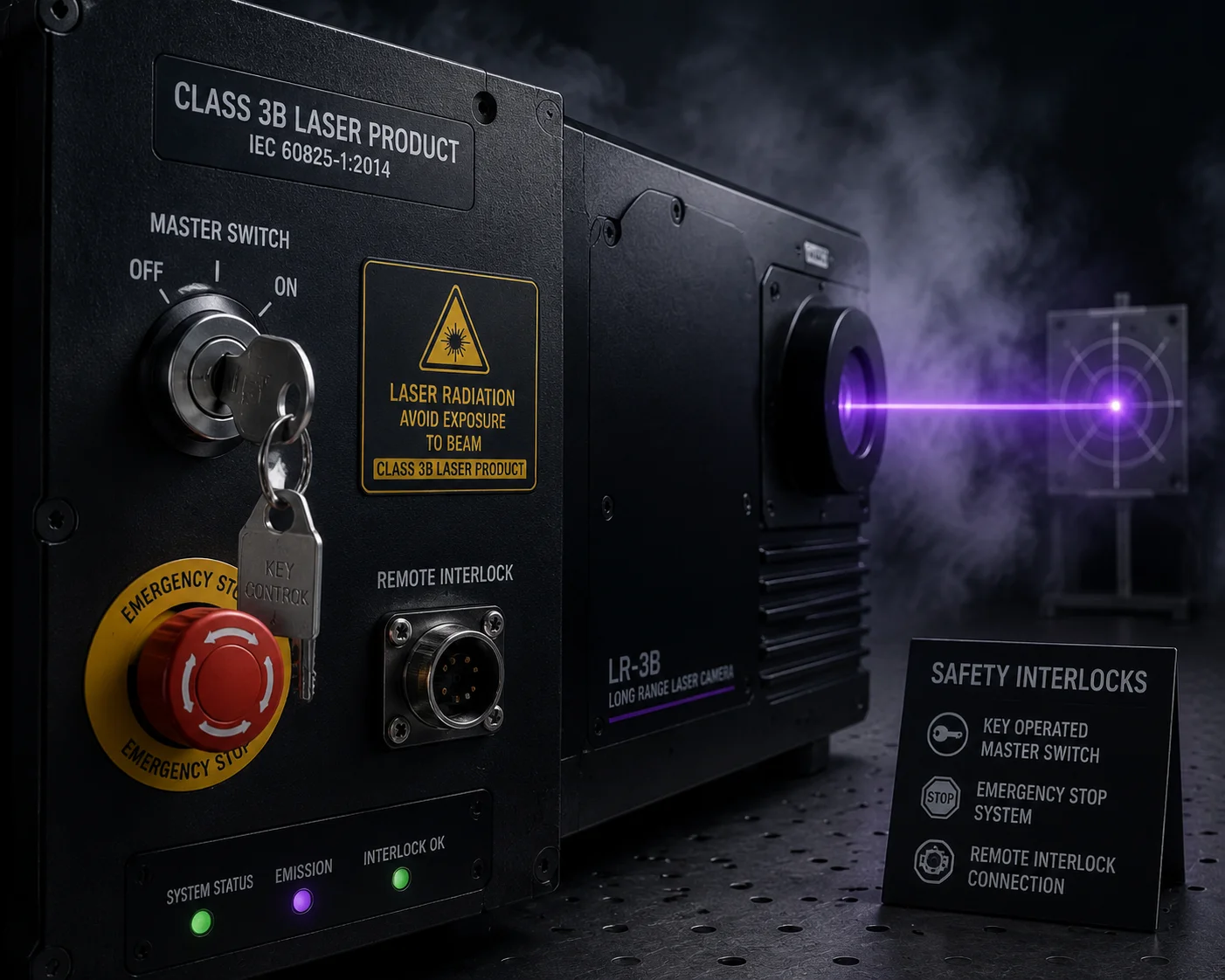
Class 3B laser6 devices imported into the U.S. must include specific safety interlocks7 such as a key-operated master switch, a beam attenuator or shutter, a remote interlock connector, a delayed start (emission delay), and an audible or visible emission indicator. These requirements come from 21 CFR 1040.10(f) and are mandatory for FDA clearance.
Why Class 3B Changes Everything
Class 1 laser PTZ cameras are considered eye-safe under normal conditions. The laser is enclosed. Users cannot access the beam. But Class 3B is different. A Class 3B laser can cause permanent eye damage in a fraction of a second. The beam is powerful enough to reach targets at 500 meters, 1 kilometer, or even further.
Because of this danger, FDA requires hardware-level safety features built into the device. Software-only controls are not enough. The safety must be physical, mechanical, and electrical.
Required Safety Interlocks for Class 3B
Here is a breakdown of what FDA requires under 21 CFR 1040.10(f) for Class 3B and Class 4 laser products:
| Safety Feature | Description | Purpose |
|---|---|---|
| Key-operated master switch | A physical key that must be inserted and turned to enable the laser | Prevents unauthorized use |
| Beam attenuator / shutter | A mechanical device that blocks the beam when not in active use | Stops accidental exposure |
| Remote interlock connector | An external connector that allows the laser to be disabled by a remote safety system | Enables integration with room/area safety systems |
| Emission delay | A time delay (typically 2-5 seconds) between turning on the laser and actual beam emission | Gives people time to clear the beam path |
| Emission indicator | A visible or audible warning that activates when the laser is about to fire or is currently firing | Alerts nearby personnel |
| Protective housing | The laser must be enclosed in a housing that prevents human access to the beam during normal operation | Reduces accidental exposure risk |
| Safety labels | All required warning labels must be permanently attached to the housing | Informs users of the hazard class |
How These Interlocks Affect Your Product Selection
When I evaluate a Class 3B laser PTZ camera from a Chinese manufacturer, I check every single one of these features on the sample unit. I do not rely on the datasheet alone. I physically test them.
For example, I remove the key from the master switch and try to turn on the laser. It should not fire. I disconnect the remote interlock connector and try again. The laser should shut down immediately. I power on the laser and count the seconds before the beam appears. There should be a clear delay.
If any of these features are missing or do not work correctly, the product will fail FDA inspection. It will be detained at the port. And if it somehow gets through and causes an injury, you are looking at a product liability case.
What About Laser Notice No. 50 and No. 56?
FDA recognizes that the international standard IEC 60825-1 is very similar to 21 CFR 1040.10. To avoid duplicate testing, FDA issued Laser Notice No. 504 (and later No. 56). These notices allow manufacturers to use IEC 60825-1 test results as evidence of compliance with FDA requirements, as long as they also meet certain additional FDA-specific conditions.
But here is the catch: Laser Notice No. 50 does not eliminate the need for safety interlocks on Class 3B devices. It only addresses how the testing and classification are done. The hardware safety features are still required regardless of which standard you test to.
My Advice for High-Power Laser PTZ Projects
If your project requires a Class 3B or Class 4 laser PTZ camera, do not cut corners on compliance. The cost of FDA registration, proper testing, and safety interlocks is small compared to the cost of a detained shipment or a lawsuit.
Work with a manufacturer who has already gone through this process. Ask for their Accession Number. Ask for photos of the safety interlocks. Ask for the test report showing each interlock was verified. And put all of this in your purchase contract.
At Loyalty-Secu, our 800-meter laser night vision PTZ systems are designed with these safety requirements in mind from the engineering stage. We do not add interlocks as an afterthought. They are part of the original circuit design and mechanical housing. When our clients need FDA documentation, we provide the complete package — test reports, Accession Letters, label photos, and user manuals — before the goods ship.
Conclusion
Getting FDA-compliant documents for laser PTZ cameras starts with your supplier. Confirm the laser class, get the Accession Number, verify every label, and never ship without a completed Form 2877.
1. Official FDA form required for importing electronic products that emit radiation, including laser PTZ cameras. ↩︎ 2. The specific U.S. regulation for laser product radiation safety standards. ↩︎ 3. FDA classification system (Class 1, 2, 3R, 3B, 4) based on laser power and hazard level. ↩︎ 4. FDA policy that harmonizes 21 CFR 1040.10 with IEC 60825-1 for testing and classification. ↩︎ 5. Yearly submission required by manufacturers to maintain active FDA Accession Number status. ↩︎ 6. Medium-power laser class that requires mandatory safety interlocks under 21 CFR 1040.10(f). ↩︎ 7. Hardware features (key switch, shutter, remote interlock, delay) required for Class 3B/4 lasers. ↩︎ 8. FDA import alert targeting non-compliant laser products; allows detention without physical examination. ↩︎