
I’ve seen too many outdoor PTZ cameras turn chalky and brittle after just two summers in Texas sun. That failure costs real money.
Yes, our industrial-grade PTZ camera housing coating has passed over 1,000 hours of accelerated UV aging testing under ASTM G154 standards. This equals 3 to 5 years of real outdoor exposure in high-UV regions like Texas or California, with a color shift (Delta-E) below 3.0 and gloss retention above 85%.
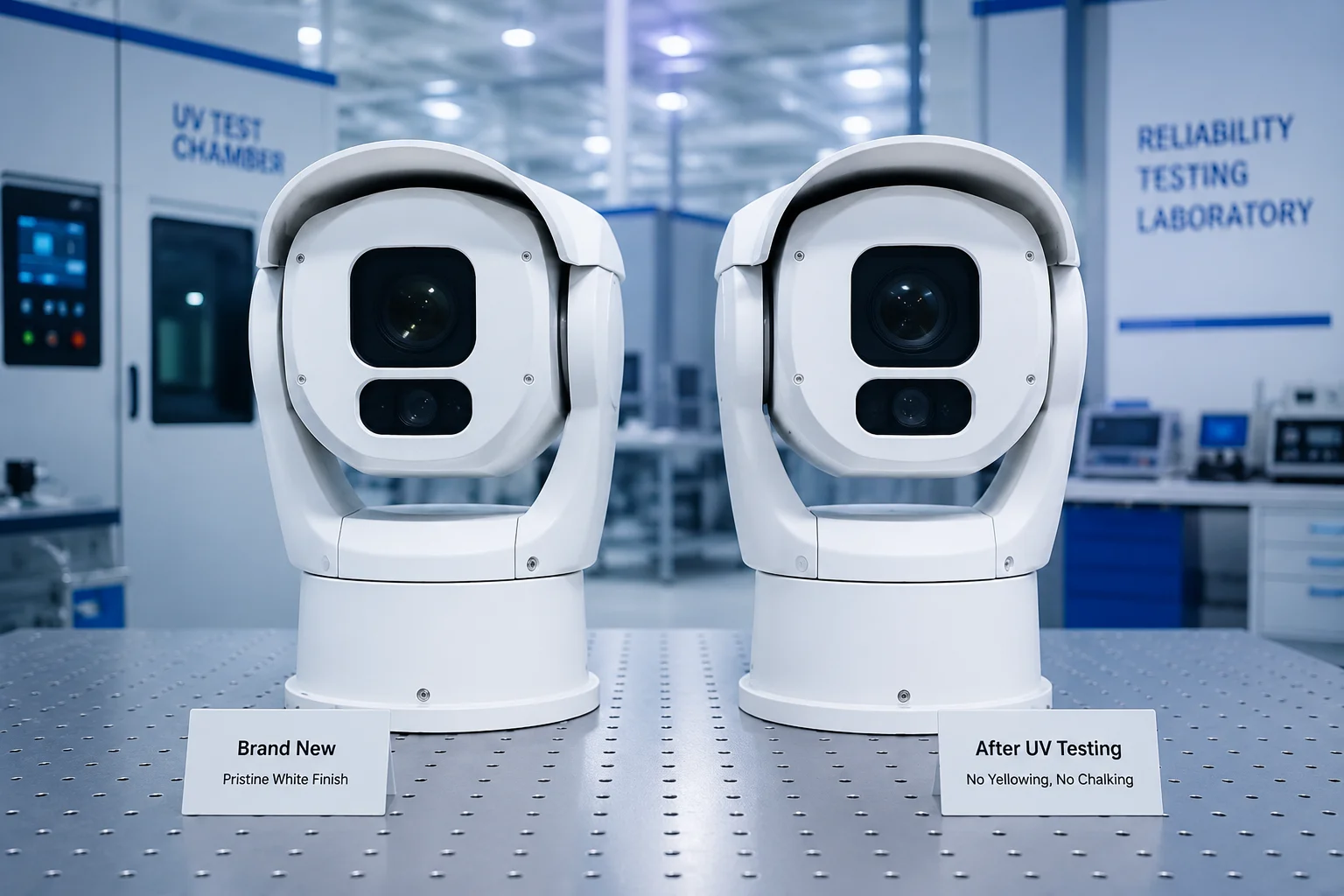 PTZ camera exterior coating UV aging test results
Below, I’ll break down exactly what this test proves, what numbers you should demand from any supplier, and why this matters for your asset value over a 5-year deployment cycle.
Table of Contents
Does the UV Aging Test (ASTM G154) Prove That the White Finish Will Stay White for Over 5 Years?
I’ve had customers send me photos of competitor cameras where the white housing turned yellow-gray in 18 months. That’s not just ugly — it signals coating breakdown.
Our ASTM G154 Cycle 1 test results confirm the white finish maintains a Delta-E below 3.0 after 1,000 hours of accelerated aging. This is physically equivalent to 3–5 years of outdoor exposure in high-UV zones, meaning the white stays white throughout a typical project lifecycle.
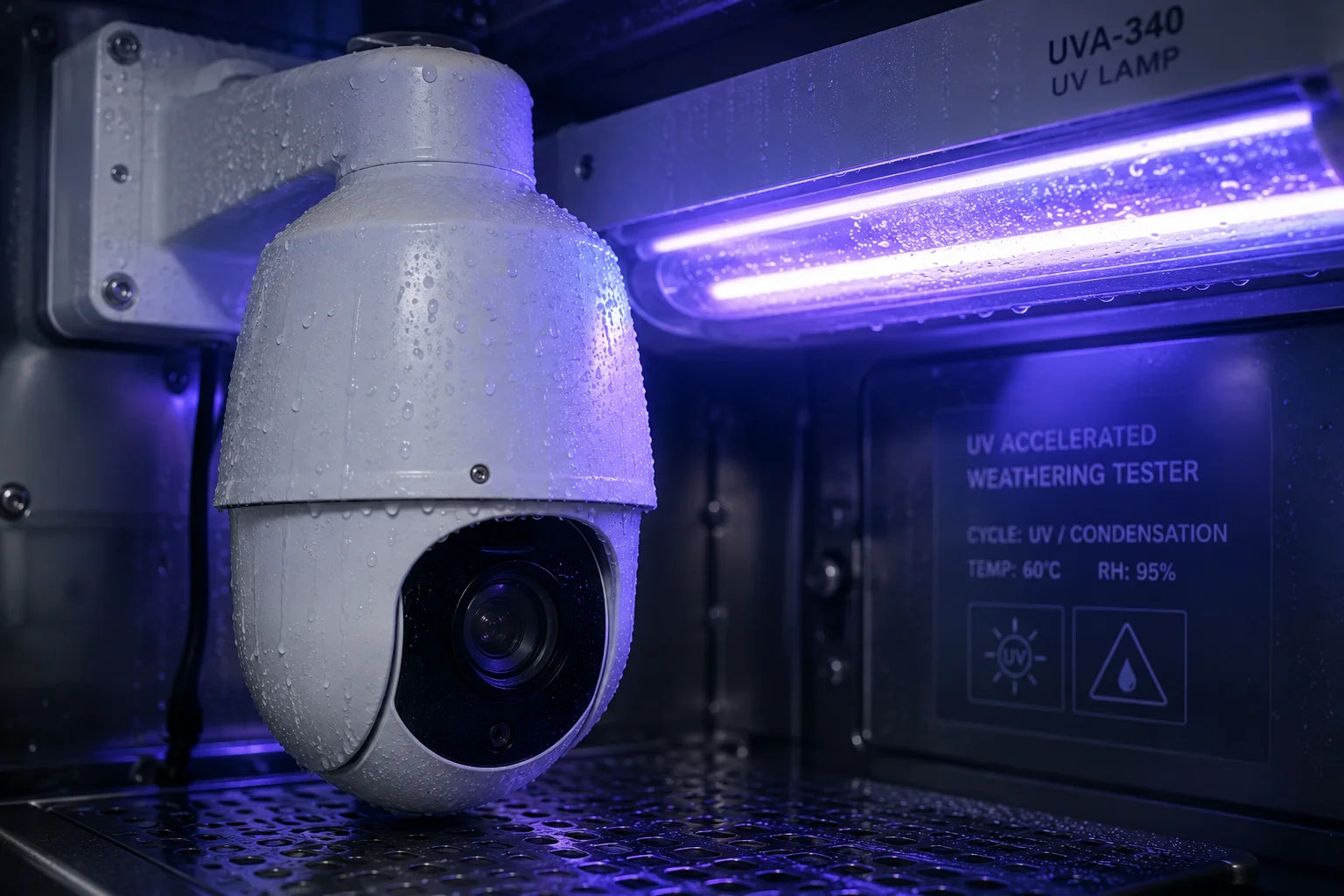 ASTM G154 UV aging test white finish PTZ camera
What ASTM G154 Actually Tests
ASTM G154 is not a gentle test. It uses UVA-340 lamps1 that copy the most damaging part of noon sunlight — the short-wave 340nm ultraviolet rays. The test runs in cycles: 8 hours of UV blasting at 60°C, then 4 hours of moisture condensation at 50°C. This hot-cold, dry-wet cycle attacks the coating from two directions at once.
Most consumer-grade PTZ cameras either skip this test entirely or only run 200 hours. That’s like testing a car tire by driving it around a parking lot. Our 1,000-hour minimum is the real stress test.
Why 1,000 Hours Equals 3–5 Years Outdoors
The acceleration factor depends on your deployment location. In Arizona or West Texas, where UV index regularly hits 10+, 1,000 hours of ASTM G154 maps to roughly 3 years of real exposure. In the Pacific Northwest or Northern Europe, that same 1,000 hours equals closer to 5–7 years. For most North American deployments, you can safely count on 5 years of white-stays-white performance.
The Three-Layer Defense System
We don’t rely on a single coat of paint. Our process uses three layers:
- chromate pre-treatment7 layer — This bonds chemically to the aluminum alloy surface. It stops corrosion from starting at the metal level.
- polyurethane primer8 — This is the main anti-corrosion shield. Even if the top coat gets scratched, this layer keeps moisture out.
- High-weatherability fluorocarbon/polyester topcoat with UV absorbers9 — This outer skin absorbs UV energy and converts it to harmless heat before it can break down the molecular chains underneath.
Acceleration Factor Comparison by Region
| Deployment Region | UV Index (Avg. Summer) | 1,000h ASTM G154 Equals | Expected White Retention |
|---|---|---|---|
| Texas / Arizona / California | 9–11 | ~3 years outdoor | Delta-E < 3.0 |
| Mid-Atlantic / Midwest US | 6–8 | ~4–5 years outdoor | Delta-E < 2.0 |
| Northern Europe / Pacific NW | 4–6 | ~5–7 years outdoor | Delta-E < 1.5 |
The bottom line: if you’re deploying in a high-UV area, this test is your insurance policy. Without it, you’re gambling with your project’s long-term appearance and structural integrity.
What Is the Delta-E Color Shift Value After the 1,000-Hour Intensive UV Exposure?
I get this question from every serious integrator. They know that “UV tested” means nothing without a number attached to it.
After 1,000 hours of ASTM G154 exposure, our coating delivers a Delta-E value below 3.0. In practical terms, this means the human eye cannot detect any meaningful color change. Most of our production batches actually come in between Delta-E 1.5 and 2.5.
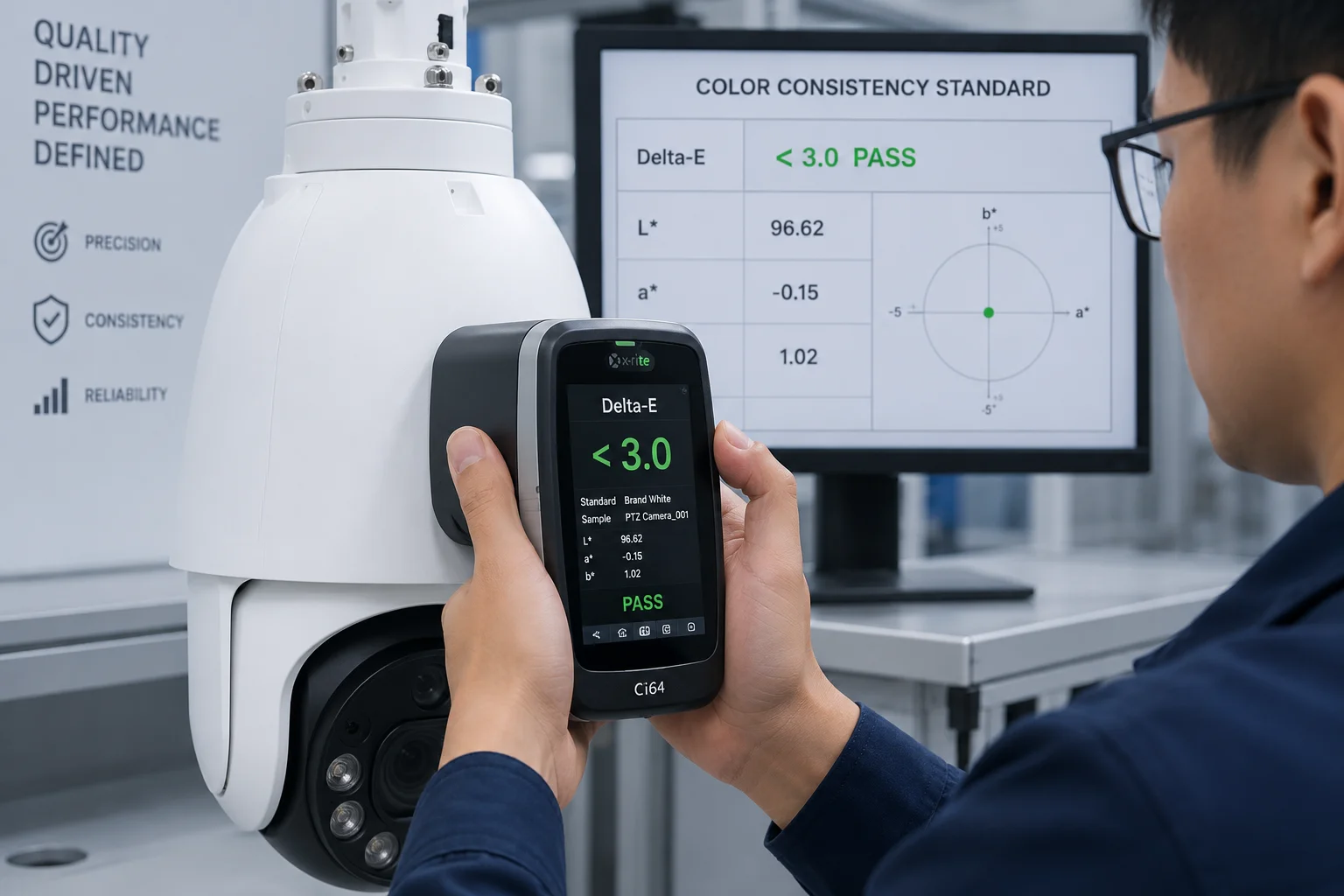 Delta-E color shift measurement PTZ camera coating
What Delta-E Numbers Actually Mean
Delta-E is a scientific measurement of color difference. It uses the CIE Lab* color space to calculate how far a color has moved from its original point. Here’s what the numbers mean in real life:
- Delta-E 0–1: No visible difference. Only lab instruments can detect it.
- Delta-E 1–3: A trained eye might notice a slight shift under perfect lighting. Normal people won’t see it.
- Delta-E 3–5: You can see the difference if you put old and new samples side by side.
- Delta-E 5+: Obvious color change. This is where customers start complaining.
Our target is below 3.0. That keeps your installed cameras looking uniform even when you add new units to an existing site years later.
Why This Matters for Your Brand
If you’re a system integrator selling under your own brand — say you’ve white-labeled our cameras as “LinkSecure” or your own name — color consistency is a brand issue. Imagine a client walks past a row of cameras on their building. Two look bright white. One looks yellowish. That’s a bad look. It makes your whole installation seem cheap.
How We Measure Delta-E
We use a spectrophotometer (X-Rite or BYK-Gardner) to take readings before and after the UV chamber test. The measurement follows ASTM D2244 standards. We take readings at three points on each sample panel and average them. This removes any single-point error.
Delta-E Performance by Coating Type
| Coating Material | Delta-E After 500h | Delta-E After 1,000h | Delta-E After 2,000h |
|---|---|---|---|
| Standard powder coat (consumer) | 3.5–5.0 | 6.0–9.0 | 10+ (visible yellowing) |
| Outdoor polyester (mid-grade) | 1.5–2.5 | 2.5–4.0 | 4.0–6.0 |
| FEVE Fluorocarbon2 (our standard) | 0.8–1.5 | 1.5–2.5 | 2.5–3.5 |
The Signal White Advantage
I always recommend Signal White (RAL 90033) for outdoor deployments. There are two reasons. First, white reflects about 70% of solar heat radiation. This keeps the internal AI chipset cooler, which extends its lifespan. Second, white coatings show UV aging less than dark colors. A dark gray camera might show chalking patterns within 2 years. White hides those same effects for much longer.
If your project spec calls for a custom color, we can still hit Delta-E < 3.0 — but white gives you the best margin of safety.
Does the Test Report Include “Gloss Retention” Data to Ensure the Housing Doesn’t Become Porous?
Color is only half the story. I’ve seen cameras that still look white but feel rough like sandpaper. That’s gloss loss — and it means the coating is breaking down at the surface level.
Yes, our test reports include gloss retention data measured per ASTM D523. After 1,000 hours of UV aging, our coating maintains above 85% of its original gloss value. This proves the surface remains sealed and non-porous, preventing moisture and salt from reaching the aluminum substrate.
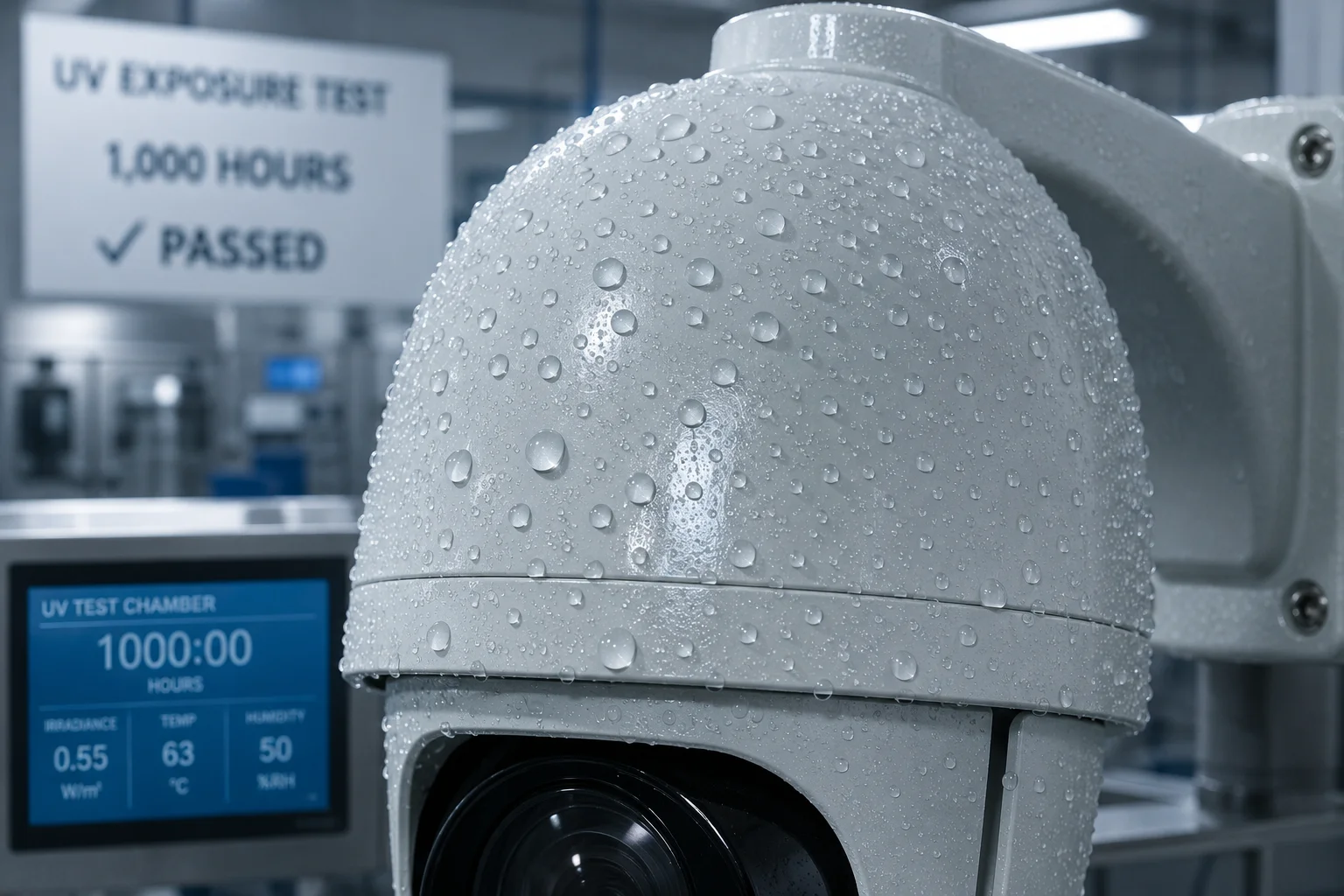 Gloss retention test PTZ camera housing coating
Why Gloss Loss Is More Dangerous Than Color Shift
When a coating loses gloss, it means the surface is becoming microscopically rough. Think of it like skin getting dry and cracked. Those tiny cracks and pores let water in. In coastal areas, salt water gets in. In industrial zones, chemical pollutants get in. Once moisture reaches the aluminum alloy underneath, you get galvanic corrosion10. The housing weakens. Screws loosen. Seals fail. Water enters the electronics compartment.
This is why gloss retention matters more than color for structural integrity.
How We Measure Gloss Retention
We use a gloss meter set at 60° angle (the standard for semi-gloss and gloss finishes) following ASTM D523. The process is simple:
- Measure original gloss before the UV chamber test.
- Measure gloss at 250h, 500h, 750h, and 1,000h intervals.
- Calculate retention as a percentage of the original value.
Our pass/fail threshold is 85%. Most of our batches come in at 88–92% retention after 1,000 hours.
What Happens When Gloss Drops Below 70%
Below 70% gloss retention, the coating has entered what we call the “chalking zone.” You can run your finger across the surface and pick up a fine white powder. This powder is the topcoat literally disintegrating into dust. At this stage:
- Water absorption rate increases by 300–400%
- Salt spray resistance drops from 1,000+ hours to under 200 hours
- The coating can no longer protect against thermal cycling stress
Most consumer-grade PTZ cameras reach this chalking stage within 12–18 months of outdoor deployment in high-UV areas. That’s why they fail so quickly.
The Connection Between Gloss and Porosity
A high-gloss surface is a sealed surface. The molecules are tightly packed and aligned. As UV breaks those molecular bonds, the surface becomes irregular. Pores form. These pores are invisible to the naked eye but measurable with a contact angle goniometer. Our coating maintains a water contact angle above 75° after 1,000 hours, meaning water still beads up and rolls off rather than soaking in.
Our Anti-Chalking Architecture
The UV absorbers in our topcoat work like sunscreen for the paint. They intercept UV photons and convert that energy into low-level heat. This sacrificial protection keeps the main resin matrix intact. Over time, the UV absorbers do get consumed — which is why even our coating will eventually degrade after 7–10 years. But for a 5-year deployment cycle, you have a large safety margin.
Will the Factory Provide the Official Laboratory Certificate for the UV Resistance of the Paint Batch?
Trust but verify. I respect that mindset. Every serious B2B buyer should demand documentation, not just verbal promises.
Yes, we provide official third-party laboratory certificates for every paint batch used in production. These certificates include ASTM G154 UV aging results, Delta-E values, gloss retention data, and ASTM D3359 adhesion test results. We can issue batch-specific certificates tied to your purchase order number.
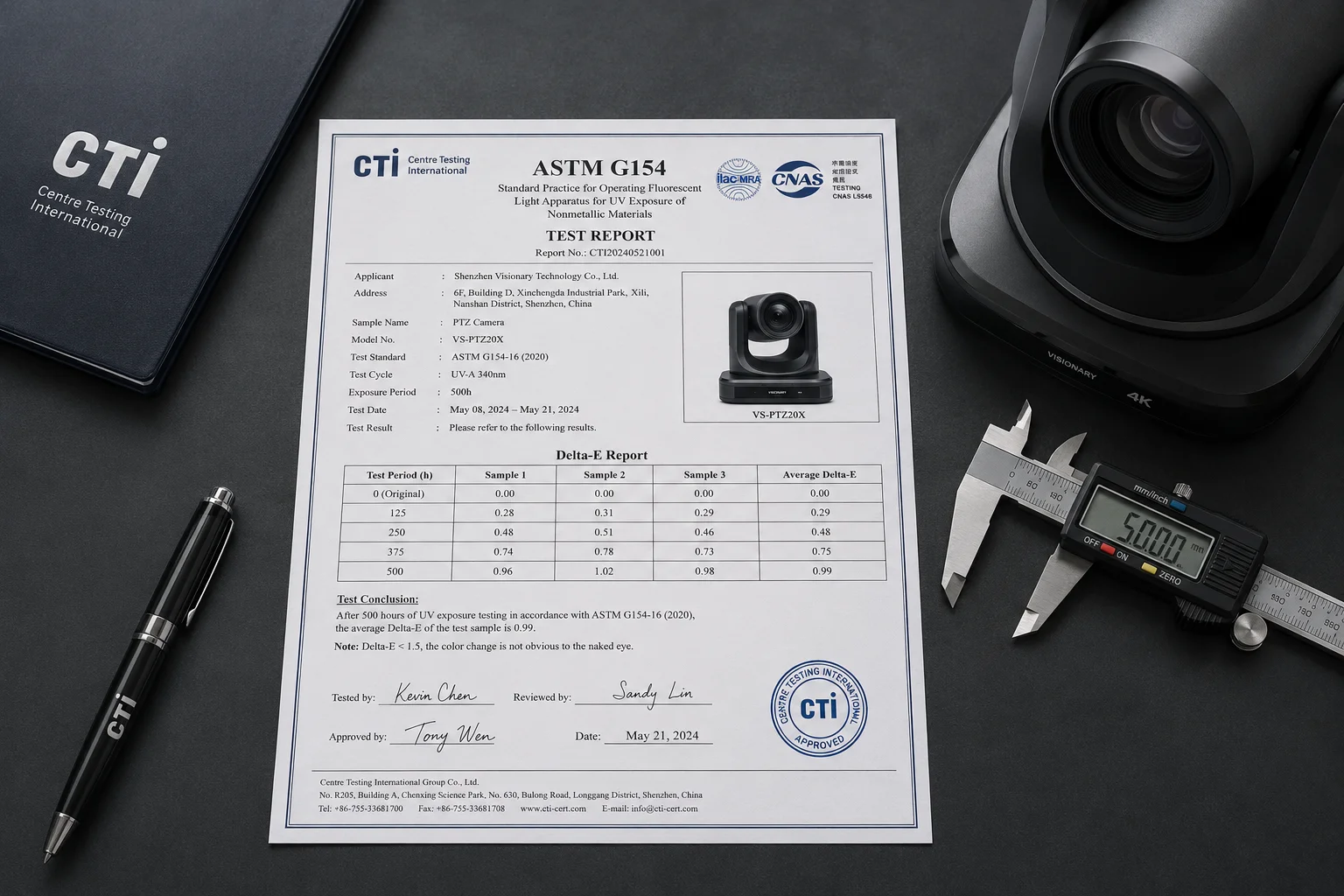 Official UV resistance laboratory certificate PTZ camera
What Our Certificate Package Includes
When you place an order, you can request our full coating certification package. Here’s what you get:
- ASTM G154 test report — Shows hours completed, cycle type, lamp type, and chamber conditions.
- Color measurement report (ASTM D22444) — Delta-E values at multiple test intervals.
- Gloss measurement report (ASTM D523) — 60° gloss readings at multiple intervals.
- Adhesion test report (ASTM D33595) — Cross-hatch tape test results. Our standard is 5B (zero flaking).
- Salt spray test report (ASTM B1176) — Over 1,000 hours of neutral salt spray exposure results.
Third-Party vs. In-House Testing
We run both. Our in-house QUV chamber handles routine batch testing — every production run gets a sample panel tested. For formal certification that you can show to your end clients, we use accredited third-party labs (SGS, TÜV, or Intertek). These labs issue certificates with their own stamp and accreditation number.
How Batch Traceability Works
Each paint batch has a lot number. We record which lot number goes onto which production order. If you order 500 cameras in March and 500 more in September, each shipment can have its own batch certificate. This matters for large government or infrastructure projects where documentation is part of the acceptance criteria.
What to Look for in a Supplier’s Certificate
| Certificate Element | What It Should Show | Red Flag If Missing |
|---|---|---|
| Test standard reference | ASTM G154, D2244, D523, D3359 | “UV tested” with no standard cited |
| Test duration | 1,000h minimum | Only 200–500h shown |
| Specific lamp type | UVA-340 | No lamp type specified |
| Delta-E value | < 3.0 after 1,000h | No color data provided |
| Gloss retention % | > 85% after 1,000h | No gloss data provided |
| Lab accreditation | ISO 17025 or equivalent | No lab name or stamp |
| Batch/lot number | Traceable to your PO | Generic certificate for “all products” |
Why Generic Certificates Are Worthless
Some factories will hand you a single certificate from 2019 and claim it covers everything they make today. That’s meaningless. Paint suppliers change formulations. Factories switch vendors to save cost. A certificate is only valid if it matches the actual batch of paint on your actual cameras. We tie every certificate to a production lot. If you need to make a warranty claim in year 3, we can trace back to the exact paint batch and test data.
My Recommendation for David’s Projects
If you’re bidding on a municipal or DOT contract in North America, having batch-specific UV certificates gives you a competitive edge. Most of your competitors cannot provide this level of documentation. It shows your end client that you’ve done your homework on long-term asset durability — and that separates you from the low-bid crowd.
Conclusion
Our industrial PTZ camera coating passes 1,000+ hours of ASTM G154 testing with Delta-E below 3.0 and gloss retention above 85%. We back every claim with batch-specific third-party lab certificates. For high-UV deployments, this is your guarantee against premature failure and costly truck rolls.
1. Fluorescent UV lamps that simulate sunlight in the short-wave UV region. ↩︎ 2. Fluoropolymer resin known for excellent UV and weather resistance in coatings. ↩︎ 3. Standard color reference for Signal White, recommended for outdoor cameras. ↩︎ 4. Standard practice for calculation of color tolerances and color differences from instrumentally measured color coordinates. ↩︎ 5. Standard test method for measuring adhesion by tape test. ↩︎ 6. Standard practice for operating salt spray (fog) apparatus. ↩︎ 7. Chemical conversion coating that bonds to aluminum to improve corrosion resistance. ↩︎ 8. Coating used as an anti-corrosion shield under the topcoat. ↩︎ 9. Additives that absorb UV radiation to protect the coating from degradation. ↩︎ 10. Electrochemical corrosion when dissimilar metals contact in presence of electrolyte. ↩︎