
I have seen too many so-called “traffic-grade PTZ cameras” 1 fail within months on highway gantries. The root cause? They never passed real vibration testing.
A true traffic-grade PTZ must pass the NEMA TS2 vibration test 2 — specifically Section 2.2.8 (Shock) and Section 2.2.9 (Vibration). This means the camera must keep working normally while being shaken across three axes at frequencies from 5 Hz to 30 Hz. Without this certification, the label “traffic-grade” is just a marketing word.
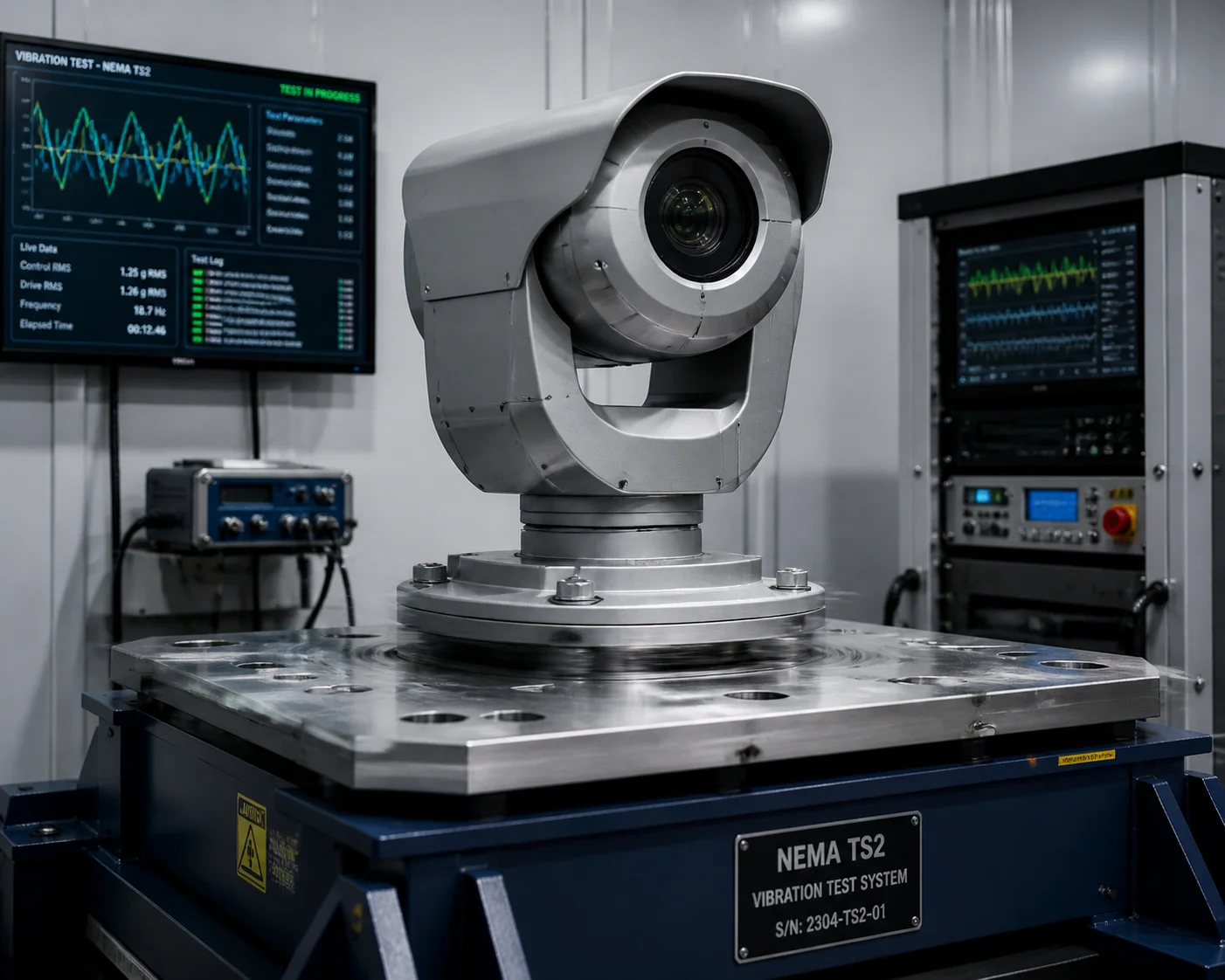
But here is the thing most integrators miss. Many Chinese factories call their PTZ “traffic-grade” simply because it has an LPR algorithm 3 or an IP67 rating. That is not the same thing. NEMA TS2 is a complete environmental and mechanical standard built for roadside ITS equipment. Below, I break down the four questions I hear most from engineers and procurement managers. Each answer will help you tell the real traffic-grade PTZ from the fake ones.
Table of Contents
Can My Camera Maintain a Stable Image When Mounted on a Vibrating Highway Gantry?
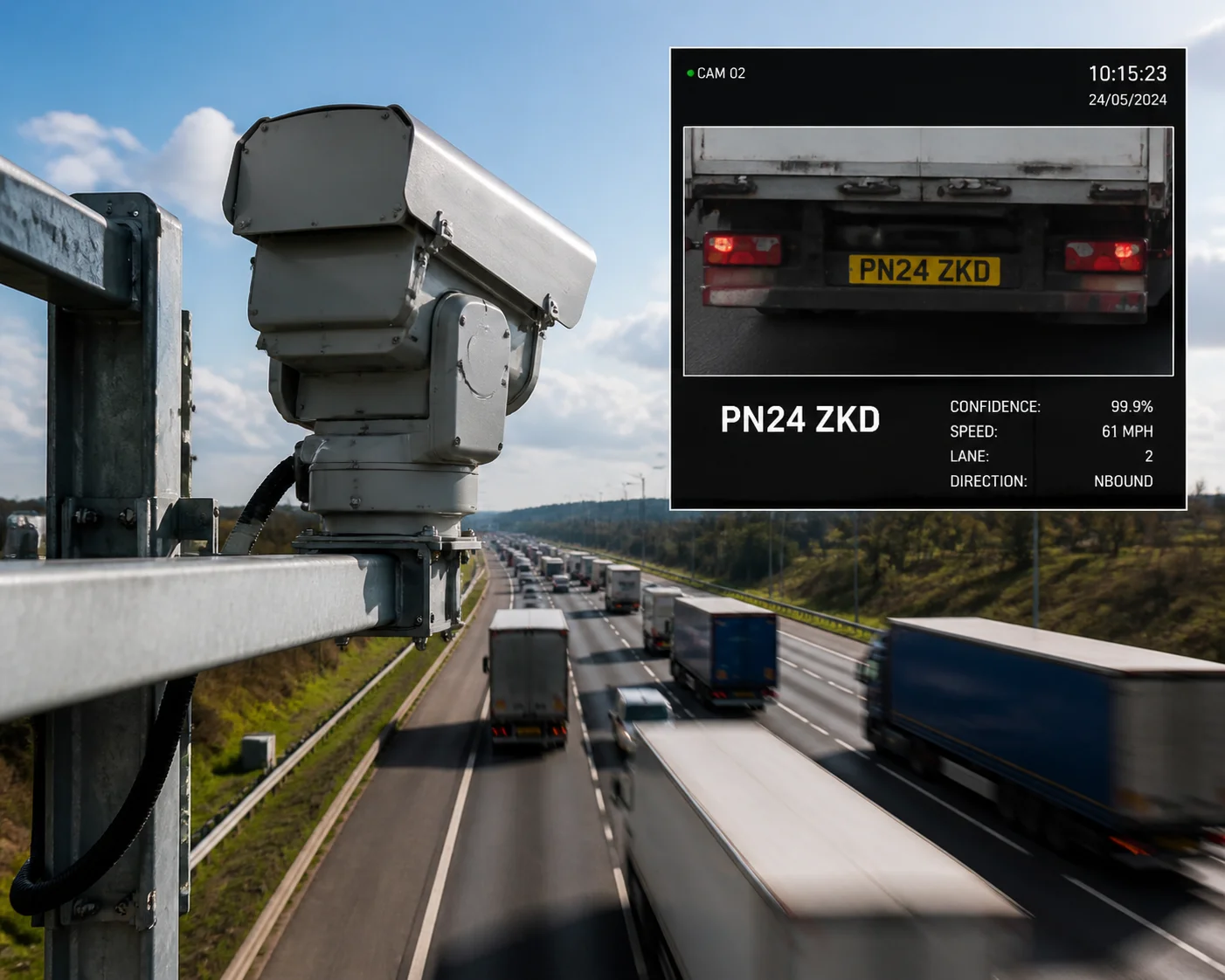
I once had a client in Texas call me because his PTZ images looked like jelly on a windy day. The camera was “outdoor rated” — but nobody checked if it could handle gantry vibration 4.
Yes, a properly built traffic-grade PTZ can maintain a stable image on a vibrating highway gantry. But only if its mechanical structure and electronic image stabilization (EIS) 5 are both designed to meet NEMA TS2 Section 2.2.9 vibration requirements. Without both layers working together, the image will shake.
Why Highway Gantries Vibrate So Much
Highway gantries are tall metal structures. Most are 10 to 15 meters high. Every time a heavy truck passes underneath, the gantry shakes. Wind adds more movement. In open areas like Texas, Florida, or the Canadian prairies, wind speeds can reach 60 mph or more on a normal day. This creates low-frequency vibrations — usually between 5 Hz and 15 Hz. These are the exact frequencies that cause the most damage to camera motors 6 and lens assemblies.
The Two Layers of Image Stability
A good traffic-grade PTZ uses two systems to fight vibration:
| Layer | What It Does | Limitation |
|---|---|---|
| EIS (Electronic Image Stabilization) | Software crops and shifts the image frame to offset small movements | Cannot fix large physical displacement of the lens |
| Mechanical Structure (NEMA TS2 Compliant) | The housing, motor mounts, and internal chassis are built to absorb vibration without transferring it to the lens | Adds weight and cost to the camera |
EIS alone is not enough. If the PTZ motor physically shifts during vibration, EIS can only compensate for a few pixels of movement. Once the displacement exceeds that range, you get blurry frames. That is why the mechanical design matters more than the software.
What Happens Without NEMA TS2 Compliance
When a non-compliant PTZ is mounted on a highway gantry, three things happen over time. First, the stepper motor loses its reference position. This means your preset tours start drifting. Second, the zoom lens group vibrates inside its barrel, which creates micro-scratches on the lens guides. Third, the entire image becomes unstable during peak traffic hours — exactly when you need clear footage the most.
Preset Position Accuracy
A NEMA TS2 compliant PTZ should hold its preset position within ±0.1° even after sustained vibration. I always tell my clients: if your camera cannot return to the same spot after a windy night, it was never traffic-grade to begin with.
How Does the Internal Suspension System Protect the Lens from Constant Road Vibrations?
Most buyers focus on resolution and zoom range. But I have learned that the internal suspension design 7 is what separates a 2-year camera from a 10-year camera on a busy highway.
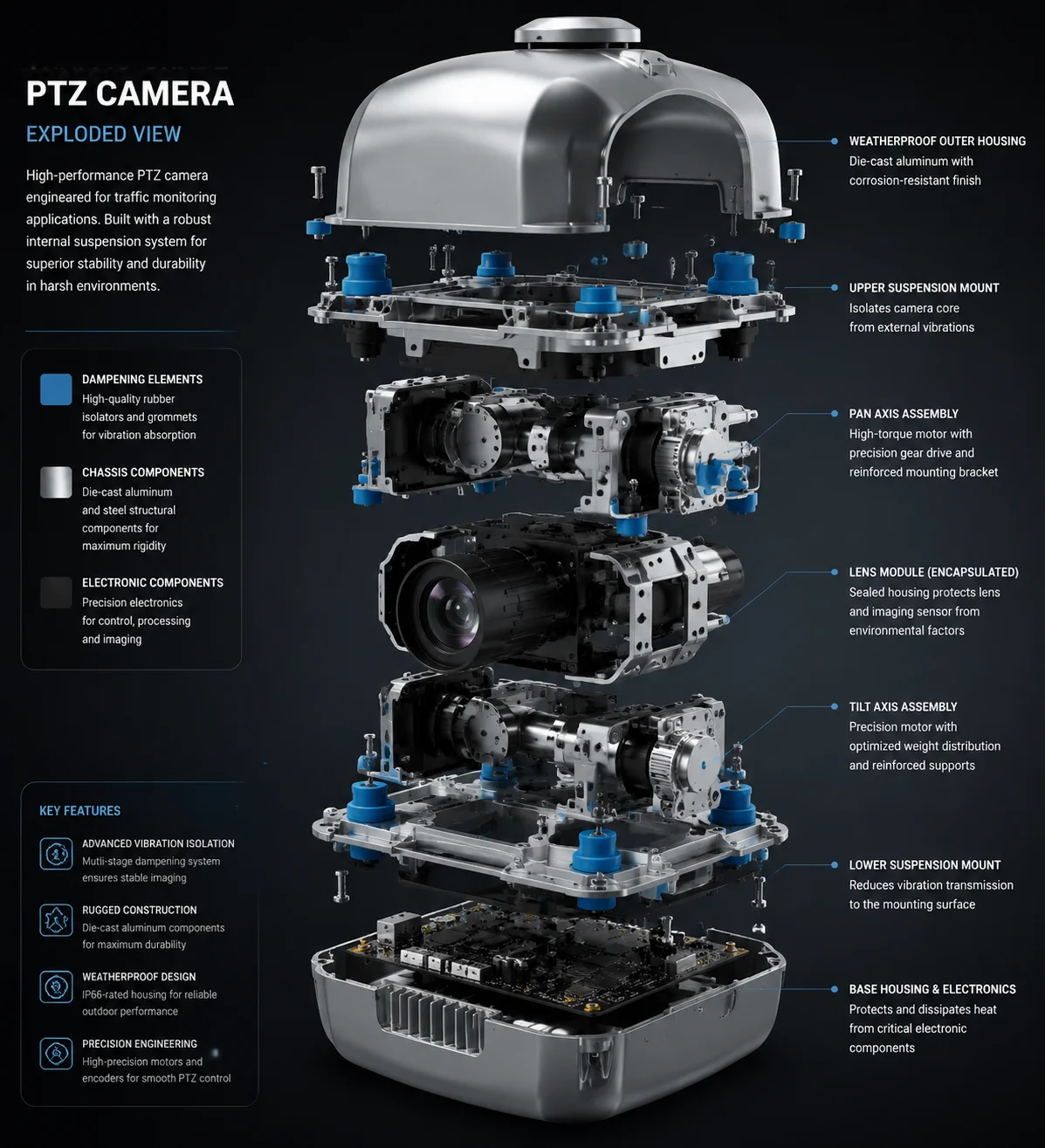
A traffic-grade PTZ uses a combination of dampening mounts, reinforced motor brackets, and isolated lens modules to absorb road vibrations before they reach the optical assembly. This internal suspension system is what NEMA TS2 Section 2.2.9 is designed to test and validate.
How Vibration Damages a PTZ from the Inside
Road vibration is not a one-time event. It is constant. Every day, thousands of vehicles pass below the gantry. Each one sends a small shock wave up the pole and into the camera. Over weeks and months, these tiny shocks add up. They loosen screws. They wear down bearing surfaces. They fatigue solder joints on circuit boards. A camera that works fine on day one can fail silently by month six.
Key Components of an Internal Suspension System
Not all PTZ cameras have a real suspension system. Here is what to look for inside a traffic-grade unit:
| Component | Purpose | What to Check |
|---|---|---|
| Rubber dampening mounts | Isolate the camera core from the outer housing | Look for shore hardness rating — too soft and the camera sags; too hard and it does not absorb vibration |
| Reinforced motor brackets | Prevent the pan/tilt motors from shifting under vibration | Should be die-cast aluminum, not stamped sheet metal |
| Isolated lens module | Separate the zoom lens group from the main chassis so vibrations do not transfer directly | Check if the lens barrel has its own mounting frame |
| Locking gear teeth | Prevent backlash in the pan/tilt gears during vibration | Worm-gear designs are better than belt-drive for vibration resistance |
Why Belt-Drive Systems Fail in Traffic Applications
Many mid-range PTZ cameras use belt-drive systems for pan and tilt movement. Belts are cheaper and quieter. But on a vibrating gantry, belts stretch over time. Once a belt stretches even 0.5 mm, the preset accuracy drops. The camera cannot return to the same position reliably. For traffic ITS projects, I always recommend worm-gear or direct-drive motor systems. They cost more, but they last.
The Role of Conformal Coating
One detail that many buyers overlook is conformal coating 8 on the internal circuit boards. NEMA TS2 environments include not just vibration, but also humidity and temperature swings. A good traffic-grade PTZ will have all PCBs coated with a thin layer of protective material. This prevents micro-cracks in solder joints from becoming full failures under vibration stress. When you ask your supplier for a teardown photo, check if the boards have a shiny or slightly cloudy coating. If the boards look bare, that is a red flag.
What Is the G-Force Rating of the PTZ’s Mechanical Drive Under High-Frequency Shaking?
I get this question a lot from engineers who write procurement specs for DOT projects. They want a number. And that number matters.
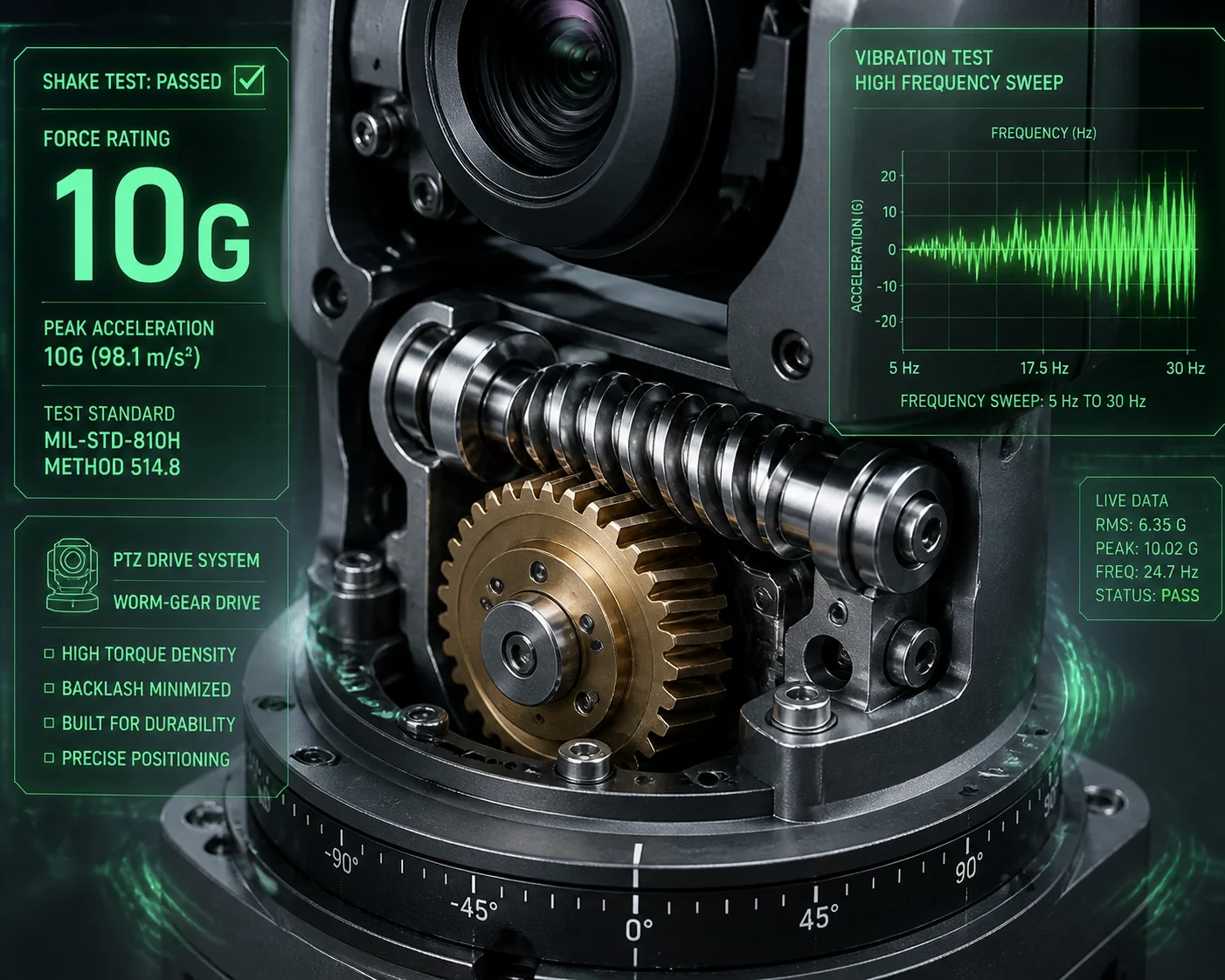
Most NEMA TS2 compliant PTZ cameras are tested to withstand at least 10G of shock and continuous vibration at 0.5 mm displacement across the 5–30 Hz frequency range. The exact G-force rating depends on the test axis and duration, but these are the baseline numbers you should see in the datasheet.
Understanding the NEMA TS2 Vibration Test Setup
The NEMA TS2 vibration test is not a single shake. It is a sweep. The test equipment starts at 5 Hz and slowly increases the frequency up to 30 Hz, then sweeps back down. This is done on each of the three axes — X, Y, and Z. During the entire sweep, the camera must stay powered on and functioning. The image must remain stable. The motors must respond to commands. If anything fails during the sweep, the camera does not pass.
NEMA TS2 vs. IEC 60068: Know the Difference
Many Chinese PTZ manufacturers will tell you their camera passes IEC 60068-2-6 9 (sinusoidal vibration) or IEC 60068-2-27 (shock). These are valid international standards. But they are not the same as NEMA TS2. Here is why:
| Standard | Scope | Used For | Accepted by US DOTs? |
|---|---|---|---|
| IEC 60068-2-6 | General sinusoidal vibration test for electronics | Consumer and industrial products worldwide | Not on its own — must be paired with NEMA TS2 reference |
| IEC 60068-2-27 | Mechanical shock test | General electronic equipment | Same as above |
| NEMA TS2 Sec. 2.2.8 | Shock test specific to traffic control equipment | ITS devices installed at roadside | Yes |
| NEMA TS2 Sec. 2.2.9 | Vibration test specific to traffic control equipment | ITS devices installed at roadside | Yes |
The key difference is context. NEMA TS2 defines the specific test conditions that simulate real roadside environments. IEC 60068 is a general framework. A camera can pass IEC 60068 at a low G-force level and still fail NEMA TS2. Always ask your supplier: “Did you test to NEMA TS2 conditions, or just IEC 60068?”
How to Read a Test Report
When you receive a third-party test report, look for these details:
- Test lab name — Should be a recognized lab like MET Labs, Intertek, or TÜV.
- Standard referenced — Must say “NEMA TS2” and list the specific section numbers.
- Device under test (DUT) — Must match the exact model and hardware revision you are buying.
- Test conditions — Frequency range, displacement, number of axes, duration.
- Pass/fail result — The report should clearly state “PASS” for each axis.
If any of these are missing, the report is incomplete. Do not accept it.
Will Long-Term Vibration Cause the Internal Ribbon Cables to Loosen or Disconnect?
This is the failure mode that scares me the most. Because it is invisible. The camera looks fine from the outside. But inside, a ribbon cable has worked itself loose after 18 months of constant shaking.
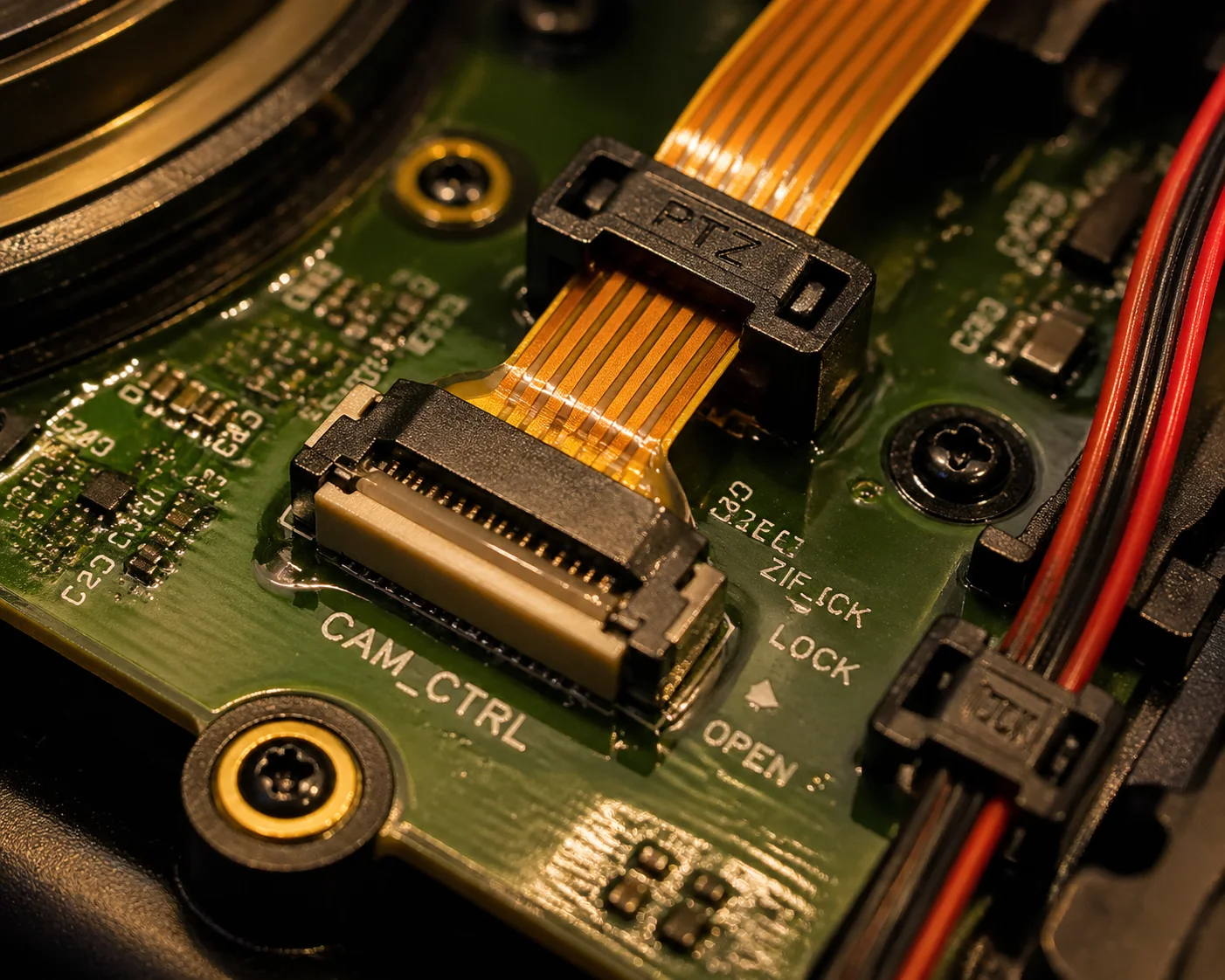
Yes, long-term vibration can and will cause internal ribbon cables to loosen or disconnect — if the camera was not designed for traffic-grade use. A NEMA TS2 compliant PTZ uses locking connectors 10, strain relief clips, and secured cable routing to prevent this exact failure mode.
Why Ribbon Cables Are the Weak Point
Inside every PTZ camera, ribbon cables connect the main board to the image sensor, the motor driver board, and the IR LED board. These cables are flat, thin, and flexible. That flexibility is good for assembly — but bad for vibration. Every time the camera shakes, the cable moves slightly in its connector. Over thousands of cycles, the connector pins lose contact. The result? Intermittent video loss. Random motor freezes. IR LEDs that flicker at night. These problems come and go, which makes them very hard to diagnose remotely.
What a Traffic-Grade Design Looks Like Inside
A real traffic-grade PTZ addresses ribbon cable failure in three ways:
Locking Connectors
Standard FFC (Flat Flexible Cable) connectors use a friction fit. The cable sits in a slot and is held by a small plastic latch. Under vibration, this latch can open. Traffic-grade cameras use ZIF (Zero Insertion Force) connectors with positive-lock latches. Some designs add a drop of adhesive on the latch for extra security.
Strain Relief Clips
The cable should be clamped to the chassis at a point near the connector. This way, vibration moves the cable body — not the connection point. Without strain relief, the full force of each vibration cycle is transferred directly to the connector pins.
Secured Cable Routing
In a cheap PTZ, cables are often left loose inside the housing. They can swing freely and hit other components. In a traffic-grade unit, every cable is routed through channels or tied down with clips. This reduces movement and prevents abrasion against sharp PCB edges.
How to Check Before You Buy
Before you place a bulk order, ask your supplier for internal photos or a teardown video. Look at how the ribbon cables are connected. Are there locking clips? Is there strain relief? Are cables tied down? If the supplier refuses to show internal photos, that tells you something. At Loyalty-Secu, I always offer teardown photos to serious buyers. If a factory is proud of its engineering, it will show you the inside.
The Real Cost of Cable Failure
Let me put this in dollars. If you install 50 PTZ cameras along a 20-mile stretch of highway, and 10% of them develop ribbon cable failures after 18 months, that is 5 truck rolls. Each truck roll in a rural area costs $800 to $1,500 including labor, travel, and traffic control. That is $4,000 to $7,500 in unplanned costs — for a problem that should have been prevented at the factory for less than $2 per camera.
Conclusion
Do not trust the label “traffic-grade” without proof. Ask for NEMA TS2 Section 2.2.8 and 2.2.9 test reports. Check the inside, not just the spec sheet.
1. Overview of traffic-grade PTZ cameras and their applications. ↩︎ 2. Official NEMA TS2 standard for traffic equipment testing. ↩︎ 3. How license plate recognition (LPR) technology works. ↩︎ 4. Engineering analysis of highway gantry vibration patterns. ↩︎ 5. Guide to electronic image stabilization (EIS) in cameras. ↩︎ 6. Technical specifications for PTZ camera motors. ↩︎ 7. Importance of suspension systems in vibration-prone environments. ↩︎ 8. Benefits of conformal coating for PCB protection. ↩︎ 9. IEC 60068 standards for environmental testing. ↩︎ 10. Types of locking connectors for vibration resistance. ↩︎