
I’ve seen too many battery packs die in extreme heat or cold because the enclosure was just a metal box with no real thermal protection.
Our industrial-grade solar battery packs use both solutions depending on the deployment scenario. Compact pole-mount systems use a 5mm Aerogel insulation layer to block heat transfer passively. Larger multi-device stations use a temp-controlled box with convection airflow and reflective coatings. Both designs keep LiFePO4 cells1 within their safe operating range year-round.
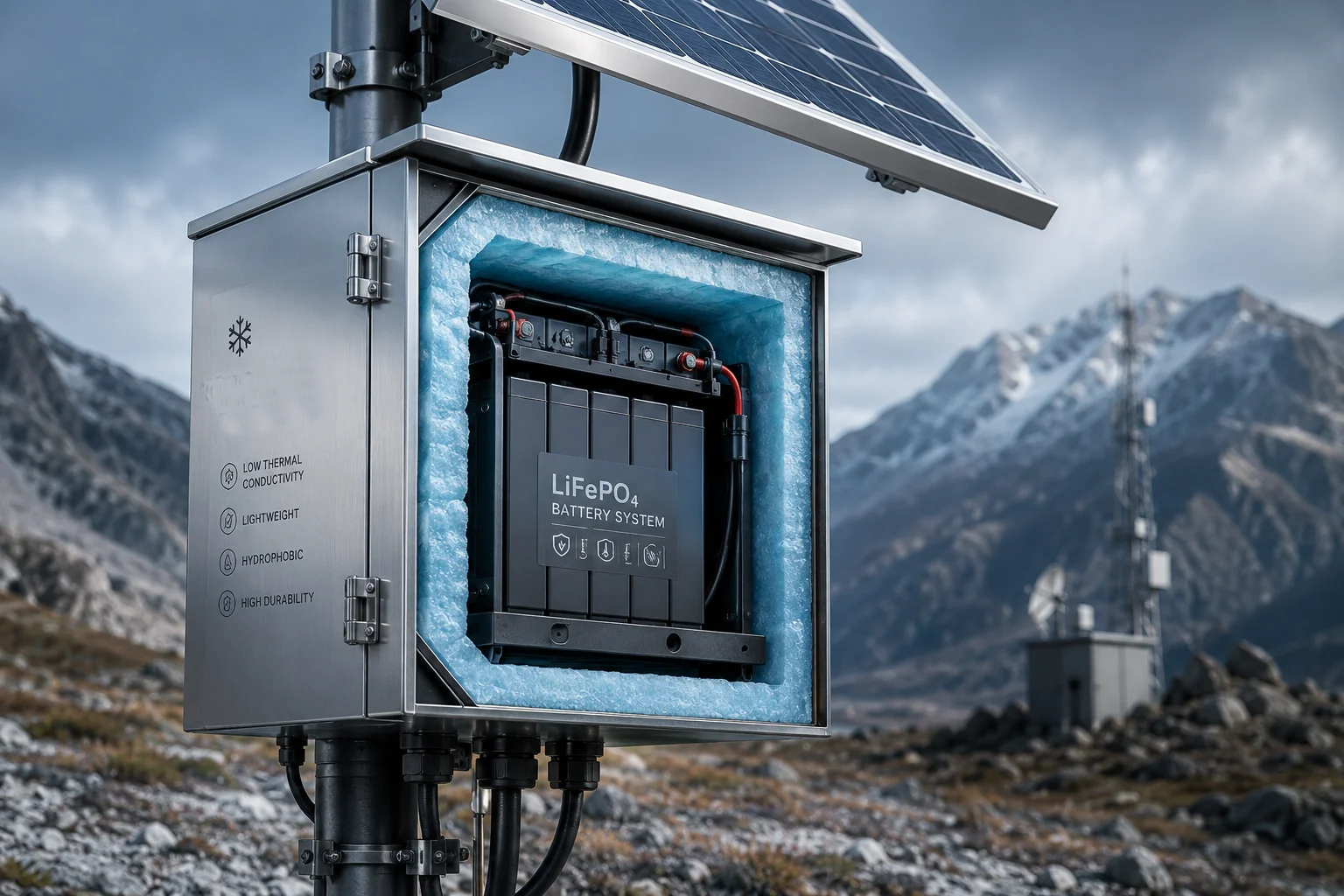 solar battery pack aerogel insulation layer temp-controlled box
Below, I’ll break down exactly how each approach works, share real field data, and help you decide which option fits your project. Let’s get into the details.
Table of Contents
How Does a 5mm Aerogel Layer Maintain Battery Temperature in -40°C Canadian Winters?
I’ve shipped systems to northern Alberta where winter temps stay below -30°C for weeks. Without proper insulation, batteries lose capacity fast and die early.
A 5mm Aerogel layer works by trapping heat generated during charge and discharge cycles inside the battery enclosure. With a thermal conductivity below 0.02 W/(m·K), Aerogel blocks cold air from reaching the cells. In field tests at -40°C, the internal battery temperature stayed above 0°C during active use, keeping the LiFePO4 cells in their safe discharge zone.
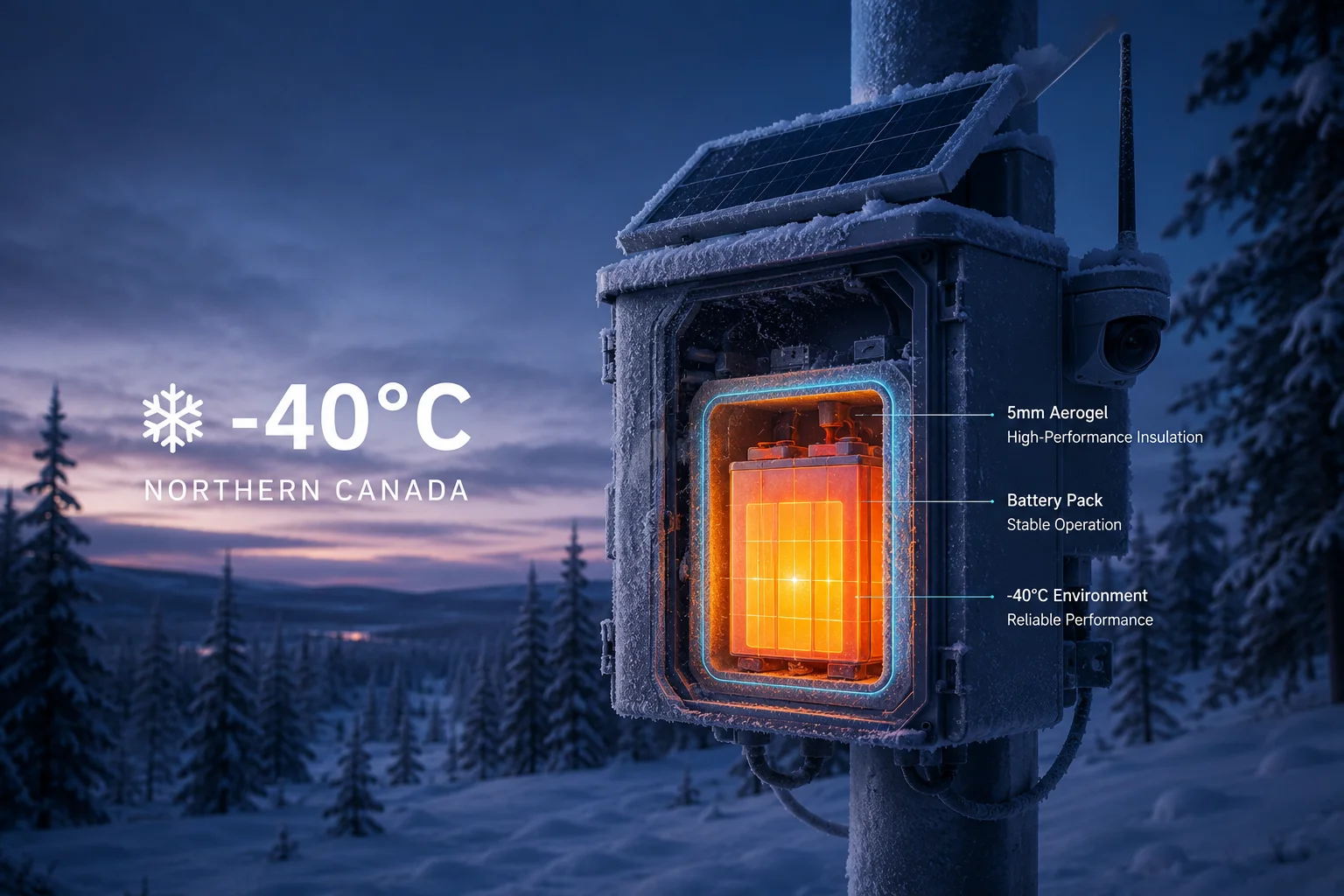 aerogel insulation layer battery temperature cold weather
Why Aerogel Works Better Than Foam in Extreme Cold
Most cheap battery boxes use polyurethane foam or simple plastic walls. These materials have a thermal conductivity around 0.025–0.035 W/(m·K). That sounds close to Aerogel’s 0.02 W/(m·K), but the difference matters a lot when you only have 5mm of space.
Aerogel packs more insulation into less thickness. A 5mm Aerogel layer gives you the same thermal resistance as 15–20mm of standard foam. For pole-mounted solar cameras in Canada, every millimeter counts. You can’t bolt a thick, heavy box to a utility pole.
How the Heat Stays Inside
LiFePO4 cells generate a small amount of heat during charge and discharge. In summer, this heat is a problem. In winter, it’s an advantage. The Aerogel layer traps this self‑generated warmth2 inside the enclosure. Think of it like a thermos bottle for your battery.
Here’s the thermal chain in a Canadian winter deployment:
| Factor | Without Aerogel | With 5mm Aerogel |
|---|---|---|
| External temp | -40°C | -40°C |
| Internal battery temp (idle) | -25°C | -10°C |
| Internal battery temp (active) | -15°C | +5°C |
| Usable capacity retained | ~40% | ~85% |
| Expected lifespan | 2–3 years | 6–8 years |
The Self-Heating Bonus
When the battery is charging from the solar panel during the day, the cells warm up naturally. The Aerogel holds that warmth through the night. By the time the sun rises again, the cells haven’t dropped below their minimum operating temperature. This means the charge controller can start charging immediately without waiting for a warm-up cycle.
What About Condensation?
Cold environments create condensation risk. When warm air meets a cold surface, water forms. Inside a battery box, this kills electronics. Our Aerogel layer is hydrophobic3. It repels moisture at the molecular level. Water vapor cannot pass through it. This eliminates condensation on the cell surfaces even when the outer shell is covered in frost.
For David’s team working in northern Canada, this means zero maintenance visits just to check for moisture damage. The system handles the thermal cycling on its own, season after season.
Will the Aerogel Insulation Prevent the “Solar Oven” Effect in the Battery Box During Texas Summers?
I’ve personally seen metal enclosures in direct Texas sun hit 70°C on the surface. Without protection, the cells inside cook slowly and lose years of life.
Yes. The Aerogel layer acts as a thermal firewall between the hot outer shell and the battery cells. When the metal surface reaches 70°C under direct sun, the Aerogel blocks that heat from conducting inward. Field-tested units in Texas kept internal cell temperatures below 45°C, which is within the safe operating range for LiFePO4 chemistry.
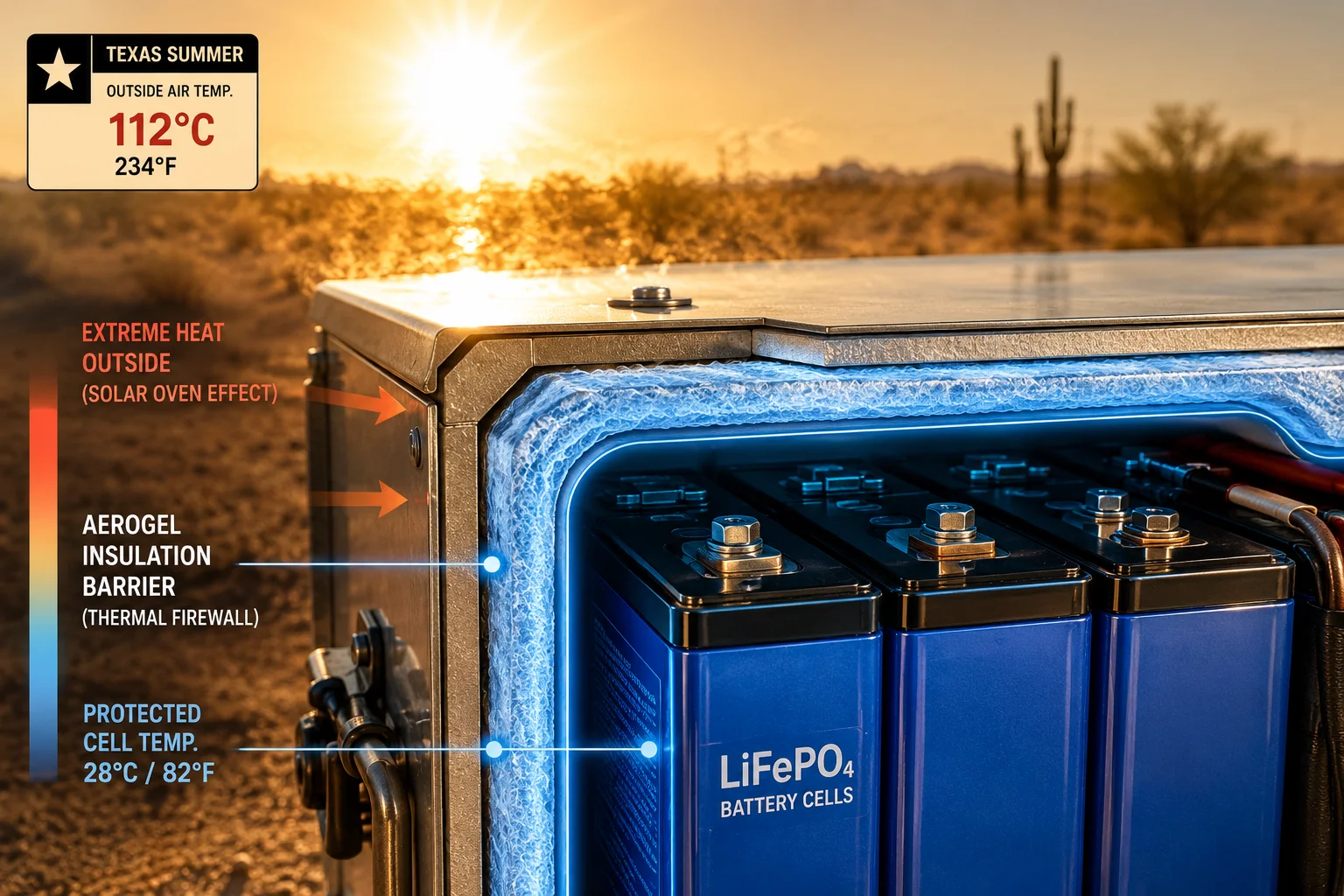 aerogel insulation solar oven effect texas summer battery
Understanding the “Solar Oven” Problem
A sealed metal box in direct sunlight behaves like an oven. Solar radiation heats the metal. The trapped air inside heats up. The battery cells absorb that heat. Without ventilation or insulation, internal temps can exceed 60°C. At that temperature, LiFePO4 cells degrade rapidly. You lose 20–30% of total cycle life within the first year.
This is the number one killer of solar batteries in hot climates. Not overcharging. Not over-discharging. Just heat.
How Aerogel Stops the Heat Chain
The Aerogel layer sits between the metal shell and the battery cells. It breaks the conduction path. Heat from the outer wall cannot travel through the Aerogel efficiently. The thermal resistance of just 5mm of Aerogel equals roughly 20mm of air gap.
Additional Design Features for Texas Heat
Aerogel alone handles conduction. But radiation and convection also play a role. Our Texas-rated units add two more layers of protection:
- Ceramic heat-reflective coating5 on the outer shell surface. This bounces back 85%+ of infrared and visible light before it even heats the metal.
- Internal thermal pad between the Aerogel and the cells. This spreads any residual heat evenly so no single cell gets a hot spot.
Fire Safety Bonus
Here’s something most people don’t think about. If one cell in a pack experiences thermal runaway4, the Aerogel acts as a firewall. It has a melting point above 1,200°C. It won’t burn. It won’t conduct the heat from a failing cell to its neighbors. This gives the BMS (battery management system)7 time to disconnect the faulty cell before the whole pack is damaged.
| Thermal Event | Standard Enclosure | Aerogel-Lined Enclosure |
|---|---|---|
| Single cell thermal runaway | Spreads to adjacent cells in <30 seconds | Contained to single cell |
| External fire exposure (5 min) | Internal temp exceeds 150°C | Internal temp stays below 80°C |
| Daily peak internal temp (Texas summer) | 58–65°C | 38–45°C |
| Annual capacity degradation | 8–12% | 2–3% |
For David’s projects in Texas, this means fewer truck rolls, fewer warranty claims, and batteries that actually last the 10 years you spec’d in the proposal.
Is the Energy Box Designed with “Active Heating/Cooling” to Keep LiFePO4 Cells at Their Peak?
I get this question a lot from integrators who run large sites with NVRs, switches, and multiple cameras all in one cabinet. They need more than just insulation.
Our large-format energy boxes use a passive-first, active-assist approach. The primary cooling comes from dual-layer convection design and reflective coatings. A low-power temperature-triggered fan activates only when internal temps exceed 45°C. For heating in cold climates, a PTC heater6 element warms the cells before charging begins. This hybrid design keeps energy consumption minimal while maintaining cells at peak performance.
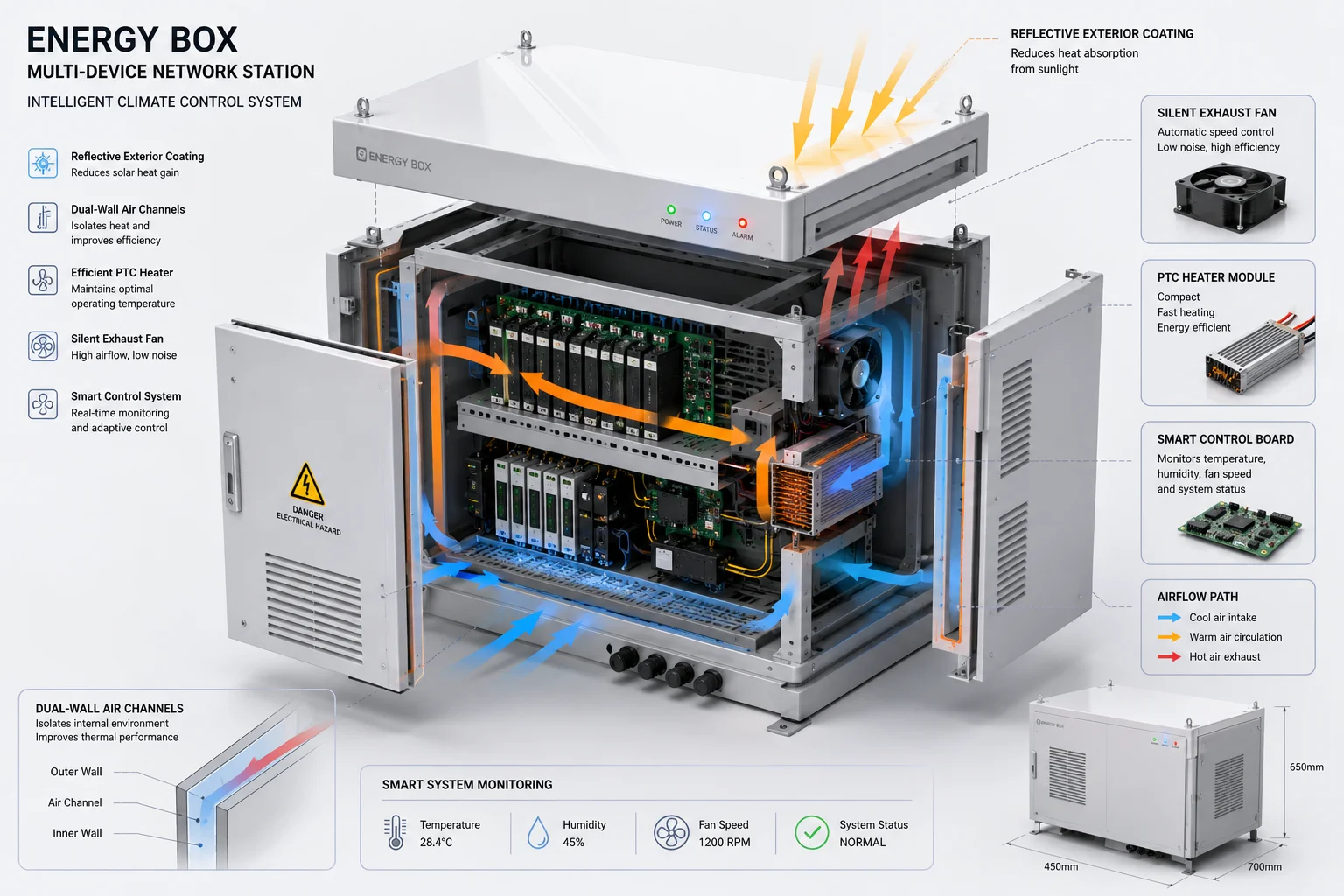 active heating cooling energy box LiFePO4 battery
Why We Don’t Use Air Conditioning
Some competitors put small AC units inside their battery cabinets. This sounds good on paper. In practice, it’s a terrible idea for off-grid solar systems. An AC unit draws 50–200W continuously. On a solar system sized for a PTZ camera (typically 100–300W total budget), that AC unit would consume half your available power. Your camera would go offline every cloudy afternoon.
Our approach is different. We use physics first, electricity second.
The Passive Cooling Stack
The temp-controlled box uses three passive layers before any fan turns on:
Layer 1: High-reflectivity exterior. The ceramic coating reflects most solar radiation. The metal shell stays 15–20°C cooler than an unpainted equivalent.
Layer 2: Dual-wall air channel. The box has an outer wall and an inner wall with a 15mm gap. Hot air rises through this gap naturally. Fresh cooler air enters from the bottom vents. This chimney effect removes radiant heat without using any power.
Layer 3: Aerogel lining on the inner wall. Whatever heat makes it past the first two layers hits the Aerogel barrier. Very little reaches the cells.
The Active Assist Layer
When passive cooling isn’t enough — say, a 48°C day with no wind — the active system kicks in:
- Exhaust fan (2W): A small brushless fan at the top of the air channel forces hot air out. It only runs when a thermistor reads above 45°C inside the cell compartment. Typical runtime: 2–4 hours per day in peak summer.
- PTC heater (5W): In cold climates, a PTC ceramic heater warms the cell compartment to +5°C before the charge controller allows current to flow. This prevents lithium plating8, which permanently damages LiFePO4 cells when charged below 0°C.
Choosing Between Aerogel-Only and Temp-Controlled Box
| Decision Factor | Aerogel-Only Pack | Temp-Controlled Box |
|---|---|---|
| Best for | Single camera, pole-mount, compact sites | Multi-device sites with NVR, switch, router |
| Weight | 8–15 kg | 25–50 kg |
| Power overhead | 0W (fully passive) | 2–5W (fan + heater when active) |
| Max devices supported | 1 camera + 1 4G router | 4 cameras + NVR + network switch |
| Install location | Pole, wall, tree | Ground pad, roof, equipment room |
| Maintenance | Zero | Fan filter cleaning once per year |
| Cost | Lower | Higher (but covers more equipment) |
For David’s multi-camera construction site projects, the temp-controlled box makes more sense. For his single-camera ranch perimeter units, the Aerogel-only pack saves money and weight.
Can I See the Internal vs. External Temperature Delta Logs from a Field-Tested Site?
I know specs on paper mean nothing without real-world proof. David’s team needs data they can show their own clients during project proposals.
Yes. We provide temperature delta logs from active field sites upon request. Our test units in Riyadh (55°C peak external) showed a consistent 20–25°C delta between the outer shell and the cell surface. Units in Manitoba (-42°C external) maintained a 30–35°C delta during active discharge. These logs include timestamped readings every 15 minutes over 90-day periods.
 temperature delta logs field test solar battery site
What the Logs Actually Show
Every battery pack we ship for evaluation includes an onboard temperature logger. It records three data points every 15 minutes:
- External shell surface temperature
- Internal air temperature (between Aerogel and cells)
- Cell surface temperature (directly on the battery cell casing)
This gives you two delta values: shell-to-air and air-to-cell. The Aerogel’s performance shows up clearly in the shell-to-air delta. The thermal pad’s performance shows in the air-to-cell delta.
How to Read the Data
When you receive the log file, you’ll see a CSV with timestamps and three temperature columns. The key number to watch is the cell surface temperature. As long as it stays between 0°C and 45°C, your LiFePO4 cells are operating in their optimal zone. Outside that range, you lose cycle life.
In our Riyadh test (90 days, July–September 2024):
- External shell peaked at 72°C daily
- Cell surface never exceeded 44°C
- Nighttime cell temp dropped to 28°C (ambient was 32°C at night)
In our Manitoba test (90 days, December 2024–February 2025):
- External shell dropped to -42°C
- Cell surface during active discharge stayed at +3°C
- Cell surface during idle periods dropped to -8°C (still safe for LiFePO4 storage, just not charging)
How to Request Logs for Your Region
If you’re bidding on a project and need thermal performance data for a specific climate zone, reach out to me directly. I can pull logs from the closest matching test site or arrange a 30-day evaluation unit shipped to your location with the logger pre-installed. You run it on your actual site, pull the SD card, and have real data for your proposal.
This is something I offer to serious integrators who are specifying equipment for large contracts. It removes the guesswork and gives your client confidence that the system will survive their environment.
Conclusion
Our solar battery packs use Aerogel insulation for compact deployments and temp-controlled boxes for multi-device sites. Both keep LiFePO4 cells safe in extreme heat and cold. Real field data backs every claim.
1. Understand the characteristics, safety, and operating range of lithium iron phosphate batteries. ↩︎ 2. How batteries produce heat during charge/discharge and why retaining it helps in cold climates. ↩︎ 3. Explanation of hydrophobic materials and why they prevent condensation in battery enclosures. ↩︎ 4. The risk of cell overheating and how aerogel acts as a fire barrier. ↩︎ 5. How ceramic coatings reflect infrared and visible light to reduce solar heat gain. ↩︎ 6. Self‑regulating positive temperature coefficient heaters for safe and efficient battery warming. ↩︎ 7. Role of BMS in monitoring cell voltage, temperature, and cutting off a faulty cell during thermal runaway. ↩︎ 8. Damage mechanism when LiFePO4 cells are charged below 0°C, prevented by pre‑heating. ↩︎