
I’ve seen too many cameras fail within months on coastal job sites. Salt air eats through cheap housings fast, and the replacement cost hurts more than the original purchase.
Yes, our industrial PTZ camera housings are built to meet ISO 12944 C5 (formerly C5-M) corrosion protection requirements. We use die-cast aluminum with chromate pre-treatment and industrial-grade fluorocarbon coating, delivering over 1,000 hours of salt spray resistance for marine and heavy industrial environments.
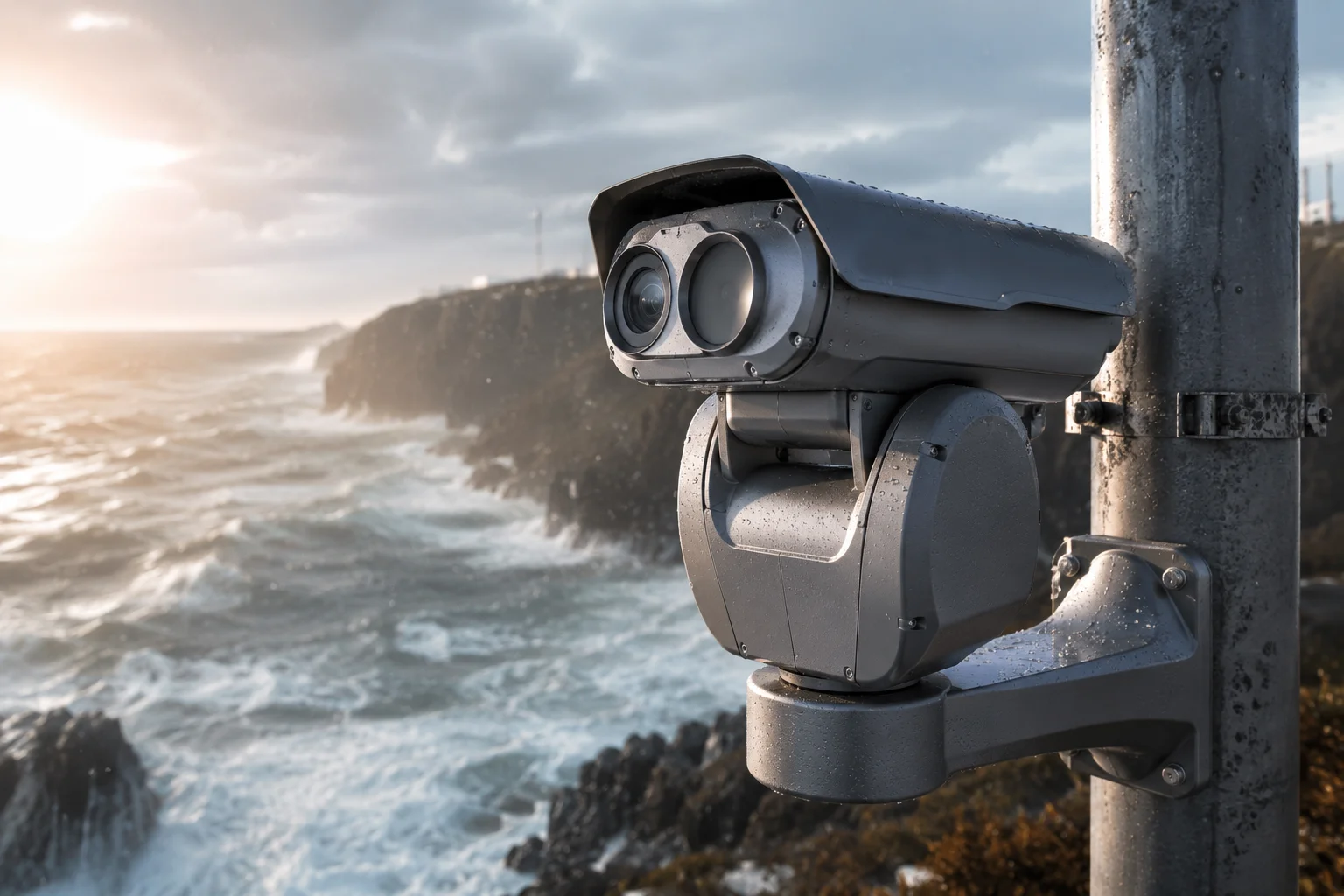 PTZ camera housing anti-corrosion ISO 12944 C5-M standard
Below, I’ll break down exactly how this standard applies to real-world installations, what it means for your budget, and where the limits are. Let’s get into the details.
Table of Contents
How Does a C5-M Rated Housing Reduce My Maintenance Costs for Offshore or Seaside Installations?
Every truck roll to a remote coastal site costs money. I’ve talked with integrators who spend more on one service visit than the camera itself costs. A housing that fails early turns a good project into a money pit.
A C5-rated housing cuts your maintenance costs by extending the time between replacements from 2-3 years to 15+ years in marine environments. This means fewer truck rolls, fewer spare parts, and fewer angry calls from your end client about rust stains and camera failures.
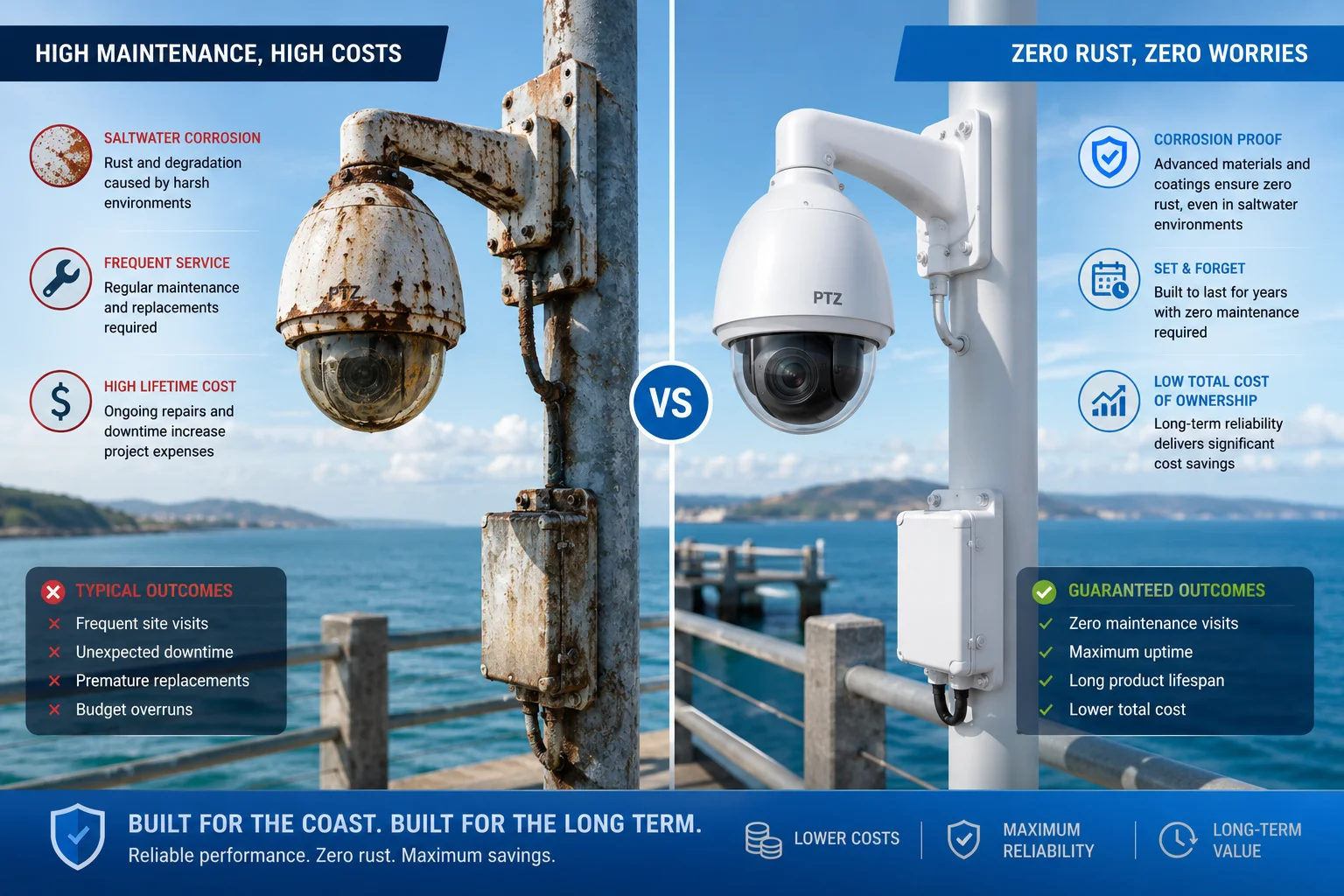 C5-M rated PTZ housing coastal installation maintenance savings
The Real Cost of Corrosion Failure
Let me put this in plain numbers. When a camera housing fails on a coastal oil platform or a port facility, you don’t just lose the camera. You lose the labor cost to send a technician. You lose the downtime. You might lose the contract if it happens too often.
I’ve heard from integrators in Texas and Florida who budget $800 to $1,500 per service call for remote coastal sites. That includes travel, lift equipment rental, and technician time. If a cheap housing fails after 18 months, you’re looking at two or three service calls over a five-year contract period. That’s $2,400 to $4,500 in extra costs on top of the replacement hardware.
How C5 Protection Changes the Math
A properly coated C5-rated housing is designed to last the full lifecycle of the camera electronics. The ISO 12944 standard defines durability categories. For C5 environments, a “Very High” durability rating means the coating system should last more than 25 years before first major maintenance.
| Cost Factor | Cheap Housing (No C5 Rating) | C5-Rated Housing |
|---|---|---|
| Expected housing life | 2-4 years in coastal air | 15-25 years in coastal air |
| Service calls per 5 years | 2-3 visits | 0 visits |
| Estimated extra cost per camera | $2,400 – $4,500 | $0 |
| End-client satisfaction | Low (visible rust, failures) | High (clean appearance, reliable) |
| Warranty claim risk | High | Very low |
Why Aluminum Outperforms Steel in Marine Settings
Some people think stainless steel is the best choice for salt air. It’s not always true. Die-cast aluminum with proper coating has a key advantage: it doesn’t develop crevice corrosion at joints the way stainless steel can. Aluminum also weighs less, which matters when you’re mounting a PTZ on a pole or mast that already carries wind load.
Our housing uses die-cast aluminum because it gives us tight dimensional control. Every unit comes out of the mold the same way. That means the coating thickness stays even across the surface. No thin spots. No weak points where salt can get in.
The fluorocarbon topcoat also resists UV degradation. In Texas, you get intense sun year-round. A coating that chalks or cracks under UV will expose the metal underneath. Our coating system is tested for UV resistance specifically because we know where these cameras end up.
Is the Entire Assembly, Including Joints and Brackets, Certified for High-Salinity and High-Humidity?
This is the question that separates serious buyers from casual shoppers. I respect it. Because a camera body can be perfect, but if the mounting bracket rusts out, the whole unit falls off the pole.
The full assembly, including brackets, fasteners, and cable glands, is designed for high-salinity and high-humidity environments. All exposed metal components receive the same surface treatment process. Stainless steel 316 fasteners are used at all external joint points to prevent galvanic corrosion between dissimilar metals.
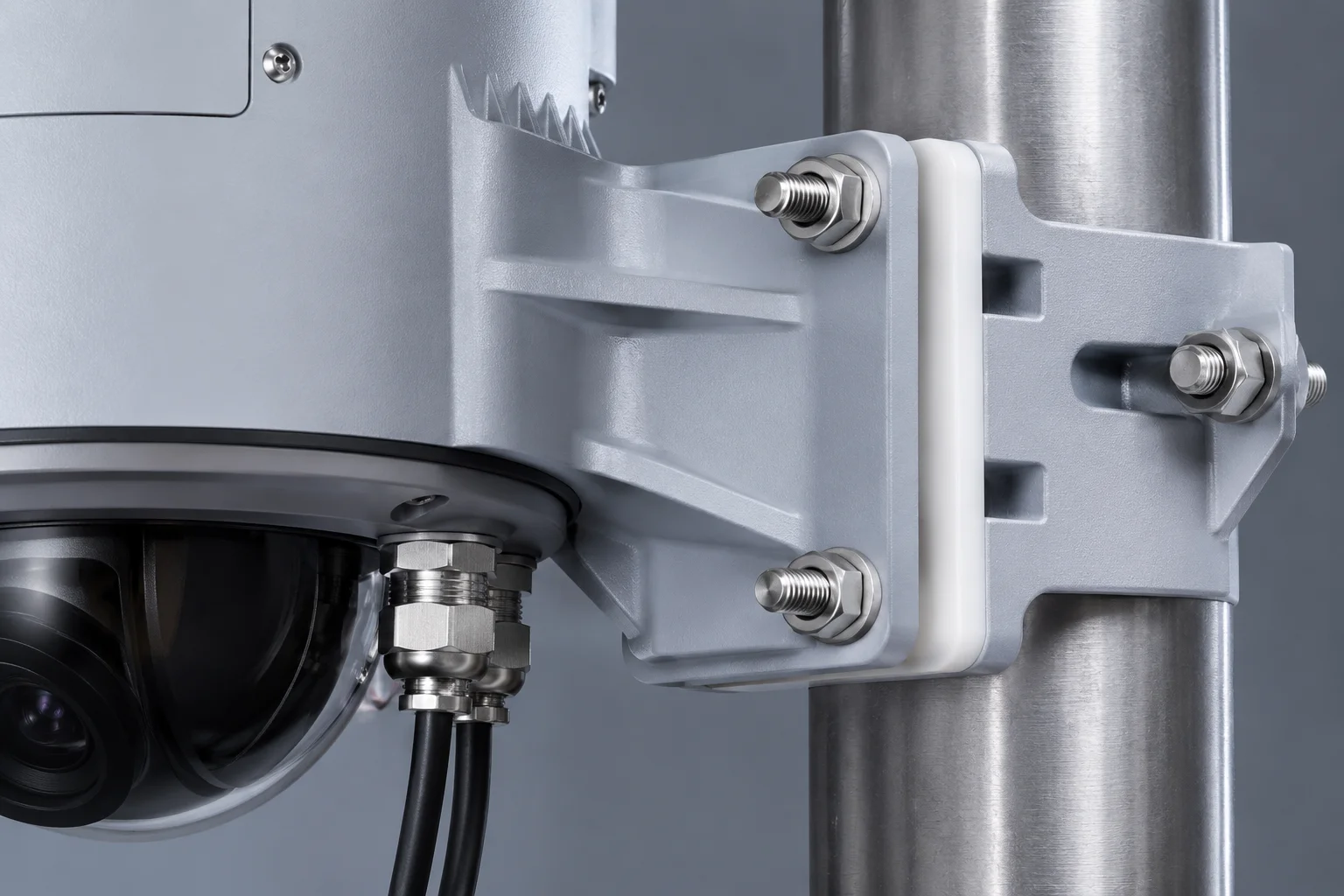 PTZ camera full assembly joints brackets corrosion resistant
The Weak Link Problem
Most camera failures in marine environments don’t start at the main housing. They start at the joints. The screws. The cable entry points. The mounting plate where two different metals touch each other.
When two different metals contact each other in the presence of salt water, you get galvanic corrosion. It’s an electrochemical reaction. The less noble metal dissolves. This is why you can’t just bolt an aluminum housing to a plain carbon steel bracket and call it marine-grade.
Our Assembly Approach
We address this at three levels:
Level 1: Material Selection Every bracket and mounting arm uses the same die-cast aluminum alloy as the main body. Same coating process. Same thickness. This keeps the entire system at the same corrosion potential.
Level 2: Fastener Grade All external fasteners are stainless steel 3161 (marine grade). We don’t use 304 grade, which can still pit in high-chloride environments. The 316 grade contains molybdenum, which gives it much better resistance to salt.
Level 3: Isolation Where dissimilar metals must meet (for example, when mounting to a galvanized steel pole), we use nylon isolation washers2. These break the electrical path between the metals and stop galvanic corrosion before it starts.
What About Cable Entry Points?
Cable glands3 are another common failure point. Water gets in through the cable entry, sits inside the housing, and corrodes the electronics from the inside out. Our cable glands are rated IP674 minimum. They use silicone compression seals that maintain their flexibility in temperatures from -40°C to +70°C. Cold rubber gets brittle and cracks. Our seals don’t.
| Assembly Component | Material | Corrosion Protection Method |
|---|---|---|
| Main housing body | Die-cast aluminum (ADC12) | Chromate + fluorocarbon coating (200-320μm) |
| Mounting bracket | Die-cast aluminum | Same coating as housing body |
| External fasteners | Stainless steel 316 | Inherent marine-grade corrosion resistance |
| Cable glands | Nickel-plated brass / Nylon | IP67 sealed, UV-resistant |
| Wiper motor housing | Coated aluminum | Same process as main body |
| Sunshield | Coated aluminum | Same process as main body |
Can I Use These Cameras in Heavy Industrial Zones With High Sulfur or Chemical Pollution?
I get this question a lot from clients running refineries, chemical plants, and steel mills. The air in these places is aggressive. It’s not just salt. It’s sulfur dioxide, hydrogen sulfide, and acid rain. A different kind of attack on metal.
Yes. The ISO 12944 C5 rating covers both marine (formerly C5-M) and industrial (formerly C5-I) environments. Our coating system resists sulfur compounds, acid condensation, and chemical fumes found in refineries, power plants, and heavy manufacturing facilities.
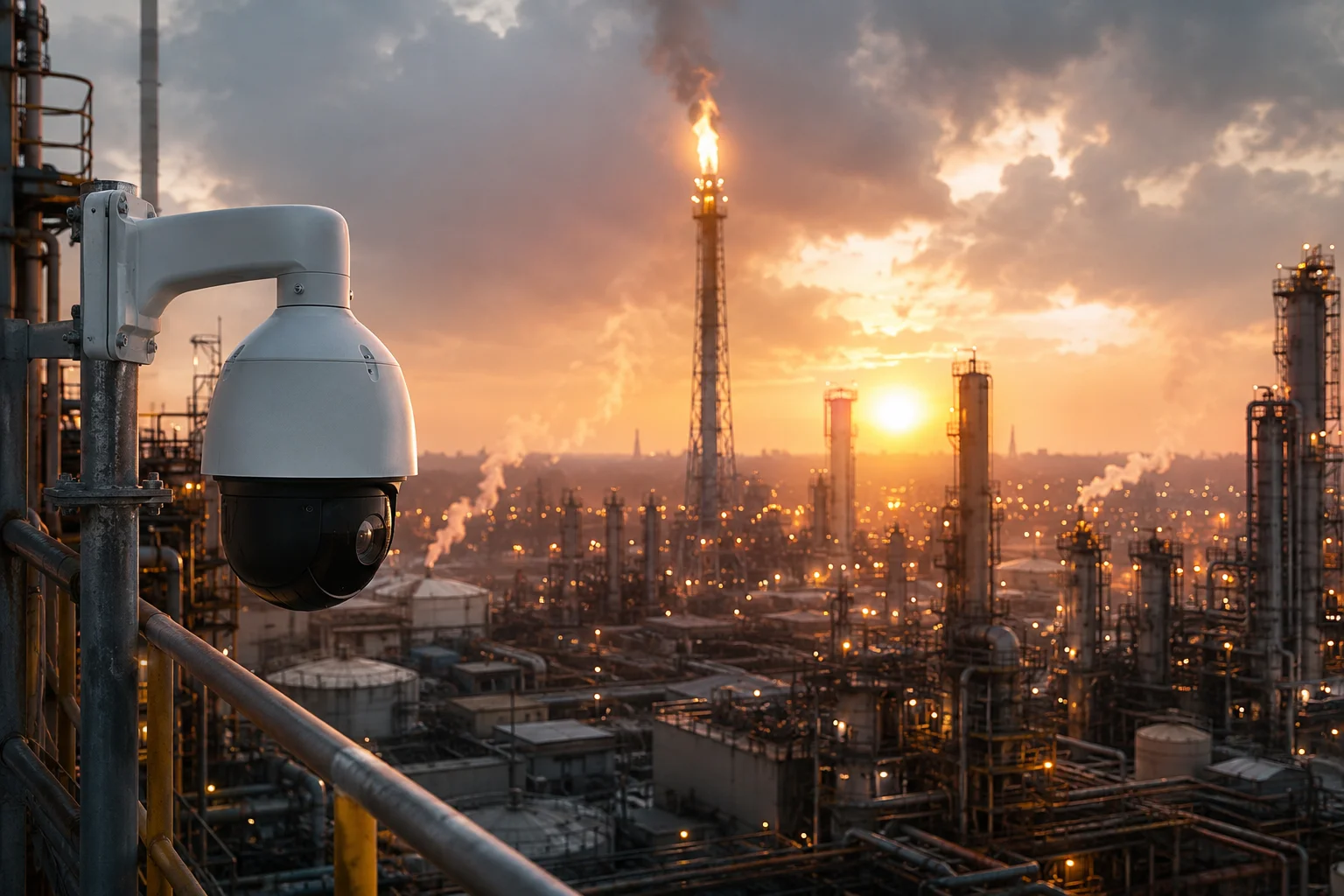 PTZ camera heavy industrial zone chemical pollution resistant
Understanding Industrial Corrosion vs. Marine Corrosion
Marine corrosion is mostly about chloride ions from salt. Industrial corrosion is different. It involves acidic gases that dissolve into moisture on the camera surface and form weak acids. These acids attack both the metal and the coating in different ways than salt does.
Sulfur dioxide (SO₂) from smokestacks combines with moisture to form sulfurous acid. Hydrogen sulfide (H₂S) from oil and gas processing attacks copper and silver components inside electronics. Nitrogen oxides from combustion create nitric acid on wet surfaces.
The old ISO 12944 standard recognized this difference by having separate C5-M (marine) and C5-I (industrial) categories. The 2018 revision merged them into a single C5 category because the coating systems that survive one environment generally survive the other. The protection approach is the same: thick, chemically inert barrier coatings.
Why Fluorocarbon Coating Works in Chemical Environments
Fluorocarbon coatings (also called PVDF (Kynar)5 or Kynar-based coatings) have a carbon-fluorine bond. This is one of the strongest bonds in organic chemistry. Acids, solvents, and oxidizing agents have a very hard time breaking it. That’s why chemical processing equipment often uses fluoropolymer linings.
Our housing coating uses this same chemistry on the outside surface. The result is a surface that:
- Does not react with sulfuric or nitric acid at ambient concentrations
- Does not absorb moisture that could carry dissolved chemicals to the metal
- Does not break down under UV exposure, which would expose the primer layer
- Maintains its barrier properties for 15+ years in continuous industrial exposure
Real-World Application: Refinery Perimeter Security
A refinery in the Middle East installed our PTZ cameras along the perimeter fence line. The cameras sit 200 meters downwind from a flare stack. After 3 years of operation, the housings show no coating degradation, no chalking, and no visible corrosion at any joint. The electronics inside remain dry and functional.
This matters because in these environments, you can’t easily shut down operations to replace a camera. Scheduled maintenance windows are rare and expensive. Equipment that lasts the full contract period without intervention saves real money.
Does the ISO 12944 Rating Include the Specific Aluminum Alloy (ADC12) Used in the PTZ Body?
This is a sharp technical question. I appreciate when buyers dig into the material spec rather than just accepting marketing claims. Let me give you a straight answer.
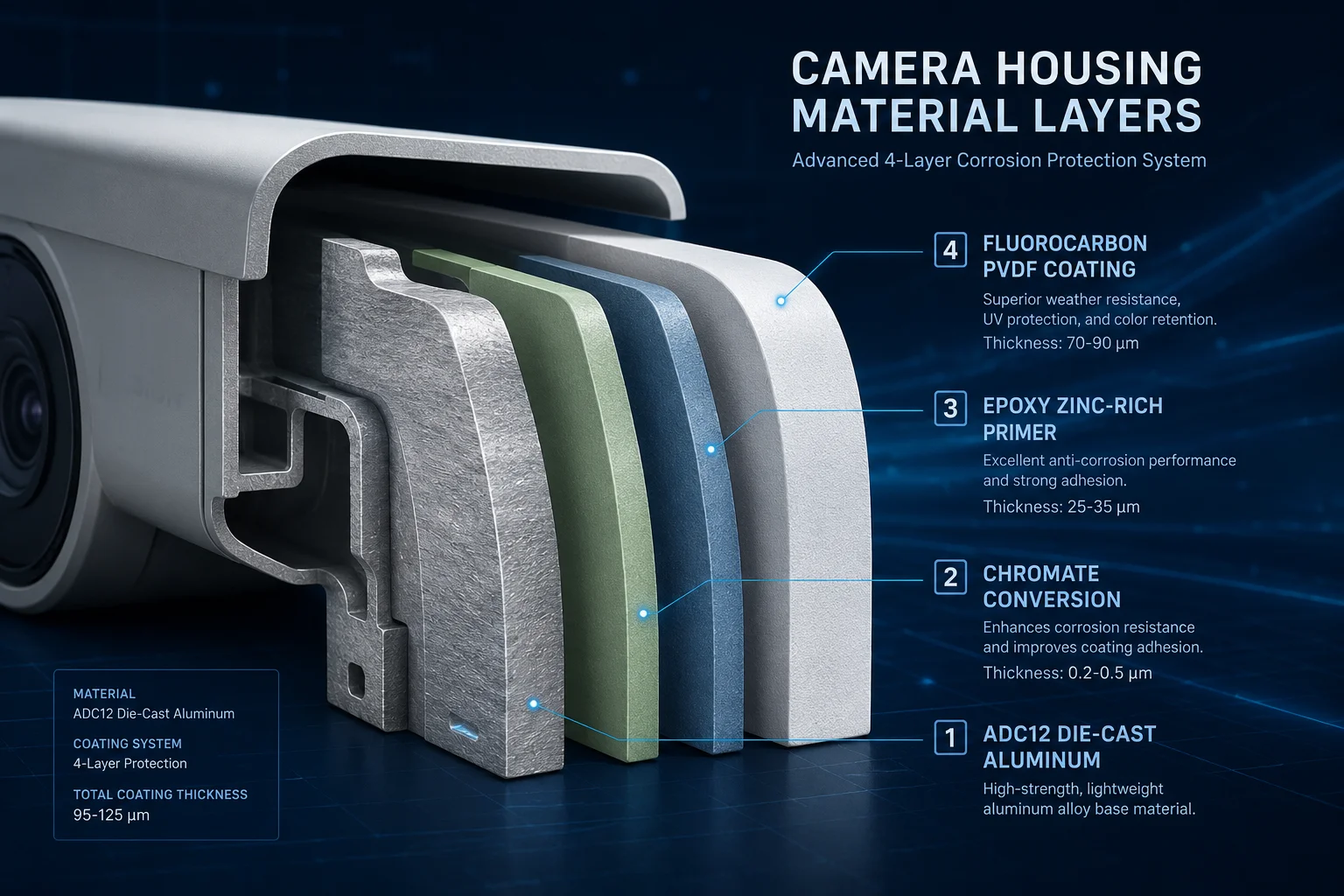
ISO 12944 does not certify specific alloys. It certifies the complete coating system applied to a substrate. ADC12 aluminum is an excellent substrate for C5-rated coating systems because of its smooth casting surface, low porosity, and strong adhesion to chromate conversion layers. The standard evaluates the full system: substrate preparation, primer, and topcoat together.
 ADC12 aluminum alloy PTZ camera body ISO 12944 coating system
What ISO 12944 Actually Certifies
There’s a common misunderstanding here. ISO 12944 is not a material certification. It’s a coating system certification. The standard defines:
- Corrosivity categories (C1 through C5, plus CX for offshore)
- Surface preparation grades (how clean the metal must be before coating)
- Coating system specifications (type of primer, intermediate coat, topcoat, and total thickness)
- Durability expectations (Low, Medium, High, Very High)
The alloy itself is not rated. What matters is how well the coating sticks to that alloy and how well the system performs as a unit in accelerated testing.
Why ADC12 Is the Right Choice for This Application
ADC12 (also called A383 in the US system) is a high-silicon aluminum alloy designed for pressure die casting. Here’s why it works well under a C5 coating system:
Surface quality: Die casting with ADC12 produces a smooth, dense surface with very low porosity. Porous surfaces trap air and moisture under the coating, which causes blistering. ADC12 minimizes this risk.
Dimensional stability: The alloy has low shrinkage during cooling. This means tight tolerances on the housing, which means even coating thickness across all surfaces. No thin spots where corrosion can start.
Chromate adhesion: ADC12 responds very well to chromate conversion coating (Alodine)6 (also called chemical conversion coating or Alodine treatment). The chromate layer bonds at the molecular level to the aluminum oxide surface. This gives the primer something strong to grip onto.
The Full Coating Stack on ADC12
| Layer | Material | Thickness | Function |
|---|---|---|---|
| Substrate | ADC12 die-cast aluminum | N/A | Structural body, heat dissipation |
| Pre-treatment | Chromate conversion coating | 1-3 μm | Adhesion promotion, base corrosion barrier |
| Primer | Epoxy zinc-rich primer7 | 60-80 μm | Cathodic protection, adhesion to topcoat |
| Topcoat | Fluorocarbon (PVDF) coating | 140-240 μm | UV resistance, chemical barrier, aesthetics |
| Total DFT | — | 200-320 μm | Meets ISO 12944 C5 VH durability |
A Note on the 2018 Standard Update
If your specification documents still reference “C5-M,” you should know that the current ISO 12944:2018 version merged C5-M and C5-I into a single C5 category. The new ISO 12944 CX8 category now covers the most extreme offshore environments (direct splash zones on oil platforms, for example).
Our housing meets C5. For true offshore platform installations where equipment gets direct wave splash, additional measures like sacrificial anodes or cathodic protection systems may be needed. But for coastal, port, and industrial environments, C5 is the correct and sufficient standard.
Conclusion
Our PTZ camera housings meet ISO 12944 C5 anti-corrosion requirements through a complete system: ADC12 aluminum substrate, chromate pre-treatment, and industrial fluorocarbon coating at 200-320μm total thickness. This protects your investment in marine, coastal, and heavy industrial environments for 15+ years.
1. Technical details about 316 stainless steel, a marine-grade alloy with molybdenum for enhanced chloride resistance. ↩︎ 2. Non-conductive washers that prevent galvanic corrosion by isolating dissimilar metals. ↩︎ 3. Guide to cable glands – fittings used to secure and seal the end of electrical cables to equipment. ↩︎ 4. Explanation of IP67 ingress protection rating – dust-tight and protected against temporary immersion in water. ↩︎ 5. Kynar PVDF is a premium fluoropolymer coating known for exceptional chemical and UV resistance. ↩︎ 6. Chemical conversion treatment for aluminum that forms a protective chrome-oxide layer and improves paint adhesion. ↩︎ 7. Epoxy primers containing zinc dust provide cathodic protection to the substrate. ↩︎ 8. The 2018 revision introduced the CX category for the most extreme offshore environments (direct splash zones). ↩︎