
I’ve watched too many installers waste hours re-aiming laser modules that drift off target after dark. That frustration ends here.
Yes, our industrial-grade firmware fully supports AI-Targeted Illumination1. This technology dynamically aligns the laser beam with the AI-detected target in real time, ensuring the strongest center point of the beam always covers the subject’s geometric centroid — not the ground beside them or the sky above.
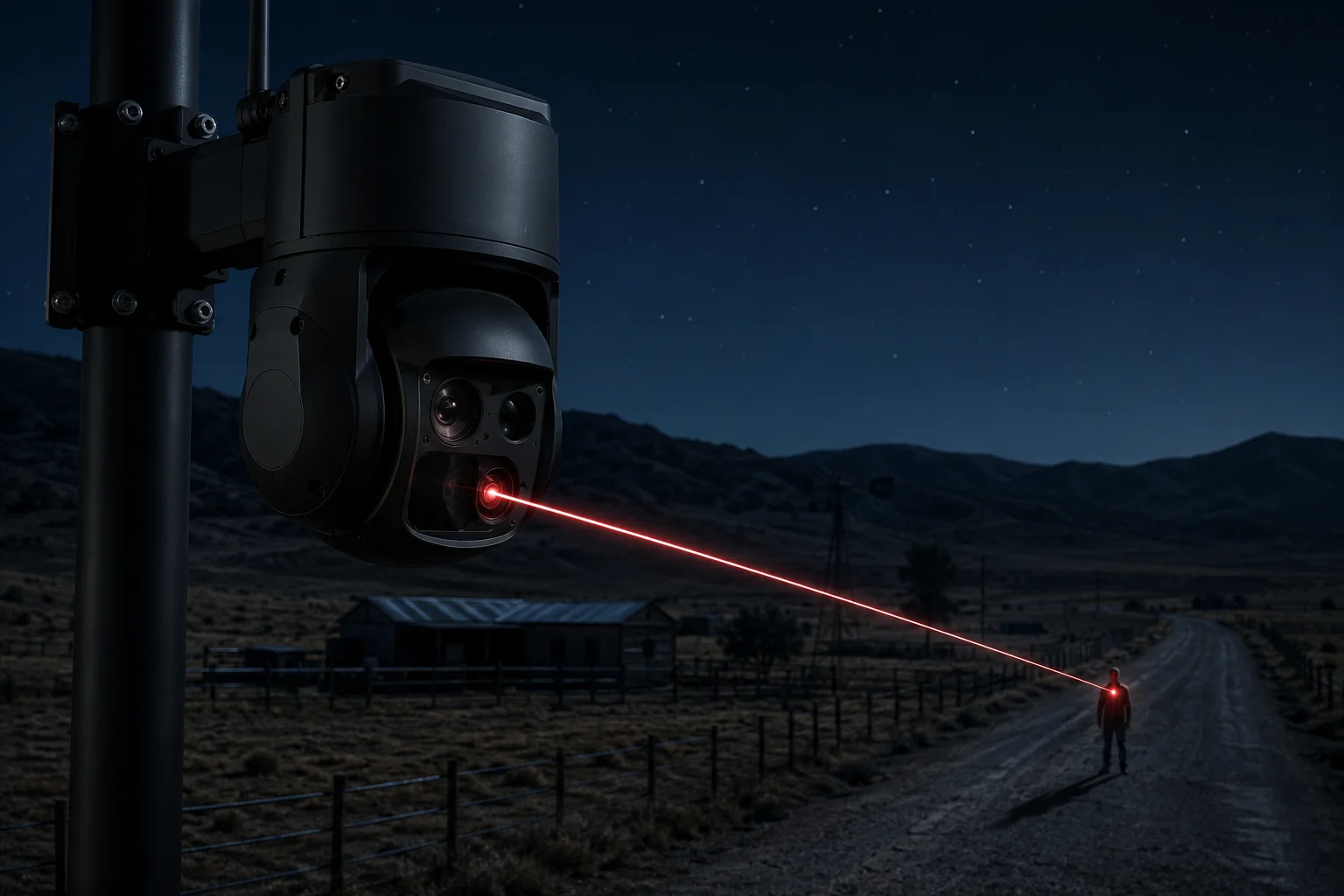
Below, I’ll break down exactly how this works, what it means for light pollution, neighbor safety, long-range contrast, and automatic tracking across the full field of view.
Table of Contents
Can the Laser Beam Be Restricted to Only the AI-Detected Bounding Box to Reduce Light Pollution?
Traditional IR arrays flood the entire scene with light. Most of that energy hits empty ground. I’ve seen power bills and battery drain that made no sense until I looked at how much light was wasted on nothing.
Our firmware restricts the laser output to the AI-detected bounding box2 by adjusting the beam’s divergence angle in real time. The system calculates the target’s pixel ratio in the frame and narrows or widens the beam to cover only 1.2× the target area, cutting wasted light by up to 80%.
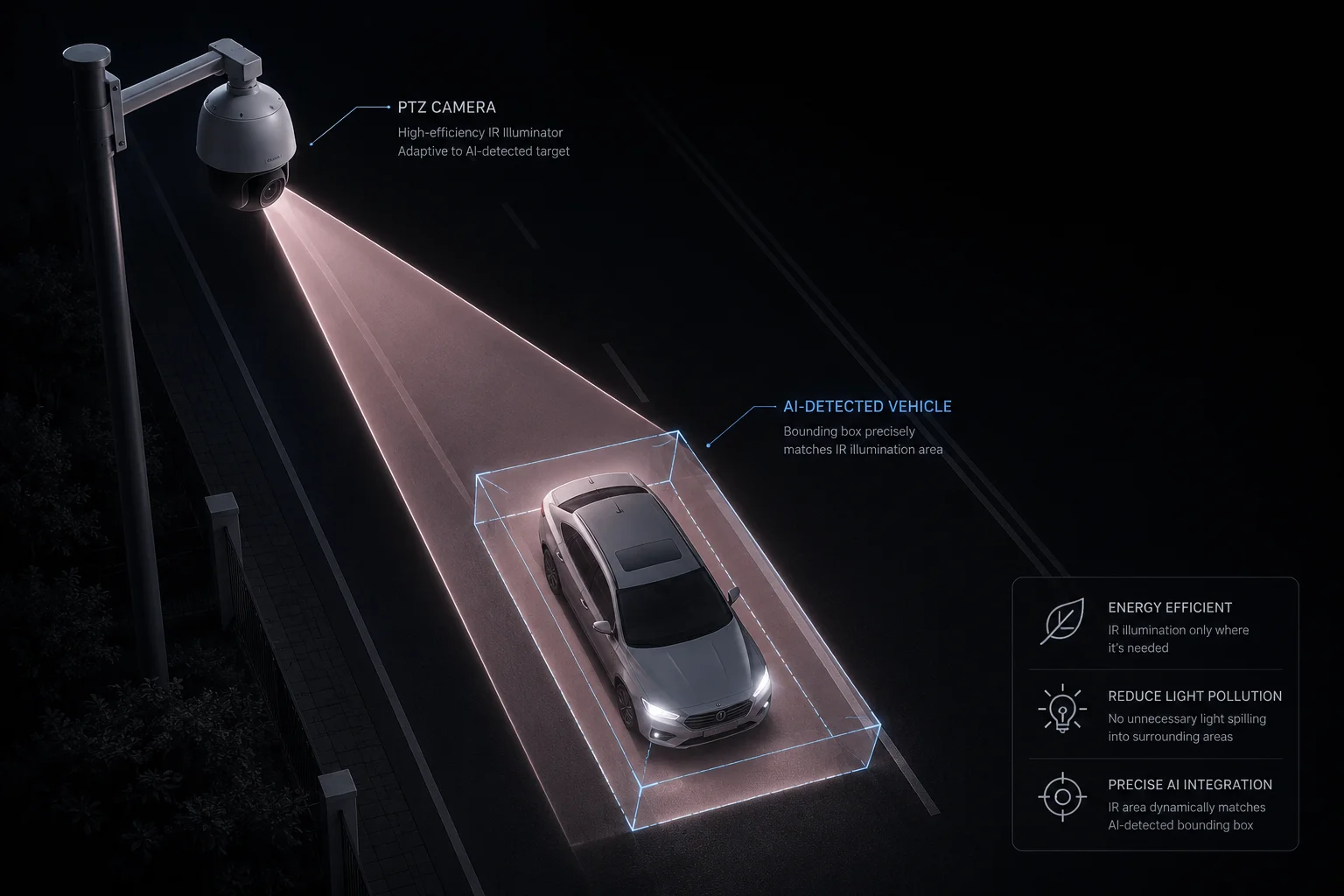
How the Beam Restriction Actually Works
The key here is what we call Zoom-Sync3. As the PTZ lens4 changes magnification, the laser module’s internal motor adjusts its focal length to match. The AI engine feeds the laser controller two pieces of data every frame cycle:
- The bounding box coordinates of the detected target.
- The current optical zoom level of the visible-light lens.
From these two inputs, the firmware calculates the ideal divergence angle5. A narrow angle concentrates energy on a small area. A wider angle covers a larger target like a vehicle. The result is a beam that “shrinks” around a person and “expands” around a truck — automatically.
Energy Savings in Off-Grid Deployments
This matters most for solar-powered systems. A traditional 850nm IR array running at full power draws 15–25W continuously. Our AI-targeted approach keeps the laser in low-power scan mode (under 5W) until a target appears. Only then does it ramp to full output — and only toward the target.
| Mode | Power Draw | Coverage Area | Battery Impact |
|---|---|---|---|
| Traditional IR Array (always on) | 15–25W | Full FOV (wasted on empty space) | Drains battery fast overnight |
| AI-Targeted (idle scan) | 3–5W | None until target detected | Minimal drain during quiet hours |
| AI-Targeted (active lock) | 10–18W | 1.2× bounding box only | Short bursts, then back to idle |
For David’s ranch deployments in Texas where the nearest power line is miles away, this difference means the system survives two extra cloudy days on battery alone.
What About Multiple Targets?
When the AI detects more than one person or vehicle, the firmware applies priority rules. You can configure these rules through the web interface:
- Closest target first — the object nearest to the camera gets the beam.
- Boundary violation priority — any target crossing a virtual tripwire gets immediate illumination.
- Largest target — useful for vehicle-focused scenarios.
The laser can also split time between targets using rapid alternation (switching every 200ms), though single-target lock gives the best image quality.
Does This Feature Prevent the Laser from Blinding Nearby Neighbors While Tracking an Intruder?
I’ve had customers ask me this directly: “If my camera points toward my neighbor’s property line, will the laser hit their windows?” It’s a fair concern, especially in suburban or semi-rural areas.
The AI-Targeted Illumination firmware includes a geo-fenced exclusion zone6 feature. You define areas on the map where the laser must never fire. Even if the PTZ tracks a target into that zone, the laser shuts off instantly — within one frame cycle (33ms at 30fps).
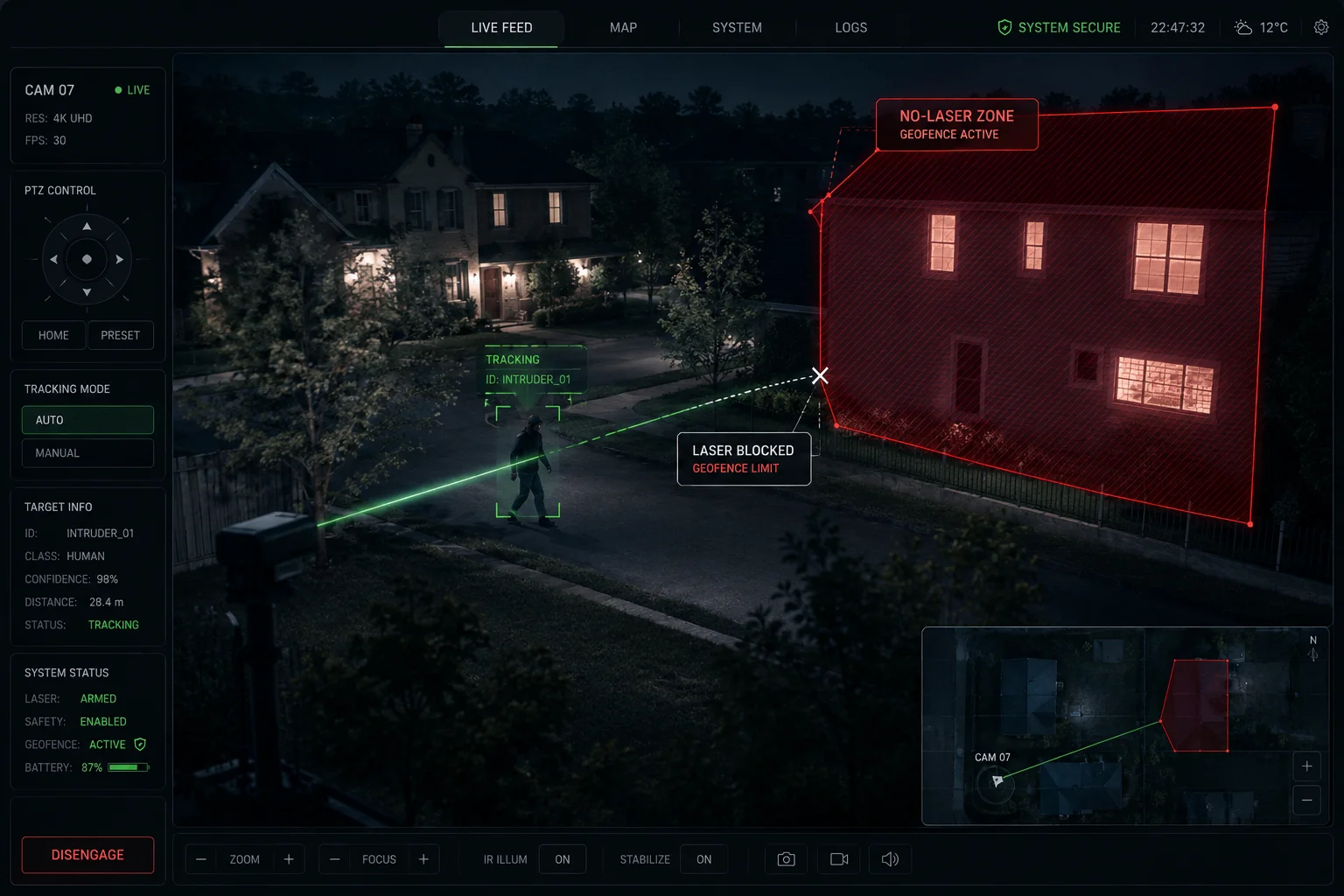
How Exclusion Zones Protect Neighbors
The setup is simple. Through the camera’s web interface or our CMS software, you draw polygons on the live view. These polygons become “laser-off” regions. The firmware checks the laser’s aim point against these polygons 30 times per second. If the aim point enters a polygon, the laser power drops to zero.
This is not the same as turning off tracking. The PTZ head still follows the intruder. The visible-light camera still records. Only the laser stops firing. Once the target moves back into a safe zone, the laser re-engages.
850nm vs 940nm and the “Red Glow” Problem
Even though near-infrared lasers are invisible to the naked eye, 850nm lasers produce a faint red glow at the emitter lens. A neighbor looking directly at your camera at night might see a dim red dot. Our 940nm option eliminates this glow entirely — it is truly invisible.
However, 940nm has about 30% less range than 850nm at the same power level. Here’s the trade-off:
| Wavelength | Visible Glow | Effective Range | Best Use Case |
|---|---|---|---|
| 850nm | Faint red dot visible | Up to 800m | Open land, no neighbors nearby |
| 940nm | Completely invisible | Up to 500m | Suburban, close neighbors, covert ops |
Stealth Mode and Power Ramping
Our firmware also supports what we call Stealth Mode7. In this mode, the laser stays at minimum power (just enough for the sensor to detect movement) until the AI confirms a valid target. Then it ramps to full power in under 100ms. This reduces the total time the laser is active, which means less chance of stray light reaching places it shouldn’t.
For integrators working in HOA-regulated communities or near public roads, this feature removes a common objection from end clients who worry about liability.
How Does the “Dynamic Spot Adjustment” Improve the Contrast of the Target Area at 500 Meters?
At 500 meters, even a good camera struggles to separate a person from the background at night. I’ve tested dozens of units where the IR was technically “reaching” the target, but the image was flat — no contrast, no detail. The target was just a gray blob.
Dynamic Spot Adjustment solves this by matching the laser spot size to the target size at any given distance. At 500 meters, the firmware tightens the beam to a 2–3 meter diameter circle centered on the target, creating a high-contrast “spotlight effect” that lifts the subject out of the dark background.
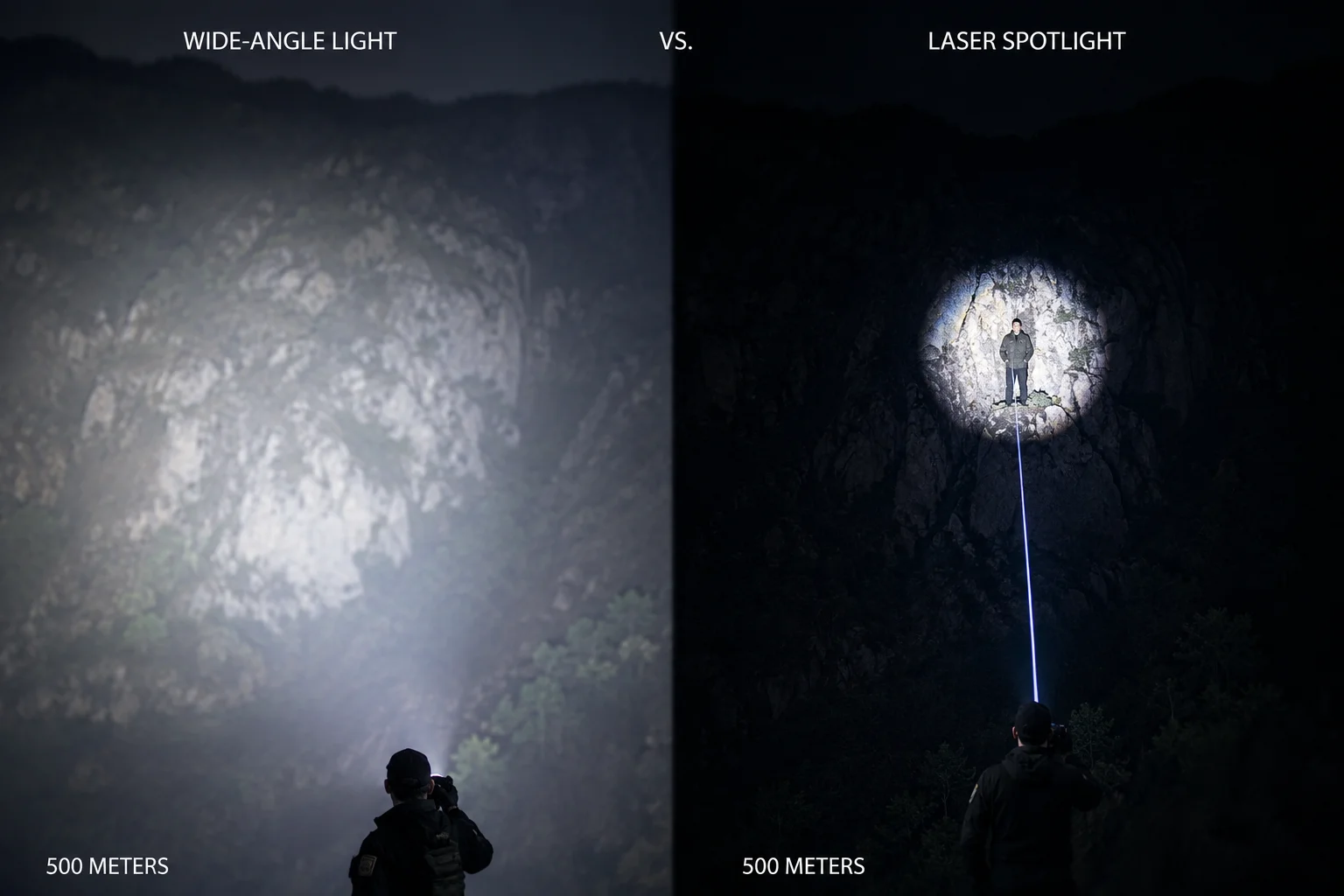
Why Spot Size Matters for Image Quality
Think of it like a flashlight. A wide beam lights up everything evenly — the ground, the bushes, the fence, and the person. Your eye (or the camera sensor) can’t easily separate the person from the background because everything has similar brightness.
Now imagine a tight spotlight that only hits the person. The background stays dark. The person is bright. The contrast ratio8 jumps dramatically. The AI can now extract facial features, clothing color, and gait patterns that were invisible before.
The Math Behind It
At 500 meters with a standard divergence angle of 3 milliradians (mrad), the beam spreads to about 1.5 meters in diameter. That’s fine for a single person. But if the divergence is 8 mrad (common in cheap units), the beam is 4 meters wide — most of that light hits empty ground.
Our firmware adjusts the divergence between 0.5 mrad and 5 mrad depending on:
- Target distance (calculated from PTZ encoder position and lens focal length)
- Target size (from the AI bounding box)
- Atmospheric conditions (humidity sensor input, if available)
Real-World Contrast Improvement
In our factory testing at 500 meters on a clear night:
| Beam Mode | Spot Diameter at 500m | Target Contrast Ratio | Face Detail Visible? |
|---|---|---|---|
| Fixed wide beam (8 mrad) | 4.0m | 1.8:1 | No — gray blob |
| Fixed narrow beam (1.5 mrad) | 0.75m | 6.2:1 | Partial — often misaligned |
| AI Dynamic Spot (auto) | 1.8–2.5m | 5.5:1 | Yes — consistent coverage |
The AI Dynamic Spot mode gives nearly the same contrast as a fixed narrow beam, but without the alignment risk. A fixed narrow beam works great in the lab. In the field, with wind and vibration, it drifts off target within minutes. The AI keeps re-centering it every frame.
Gyroscope-Assisted Stability
At 500 meters, even a 0.1-degree shift in the laser module moves the spot by 0.87 meters. Wind gusts on a tall pole can easily cause this. Our firmware reads the built-in gyroscope and applies counter-corrections to the laser motor in real time. The result: the spot stays locked on target even in 40 km/h wind.
Will the Targeted Illumination Automatically Follow the Person’s Movement Across the Entire FOV?
I’ve seen systems that track well in the center of the frame but lose the laser lock when the target moves toward the edges. The PTZ follows, but the laser lags behind. By the time it catches up, the target has moved again.
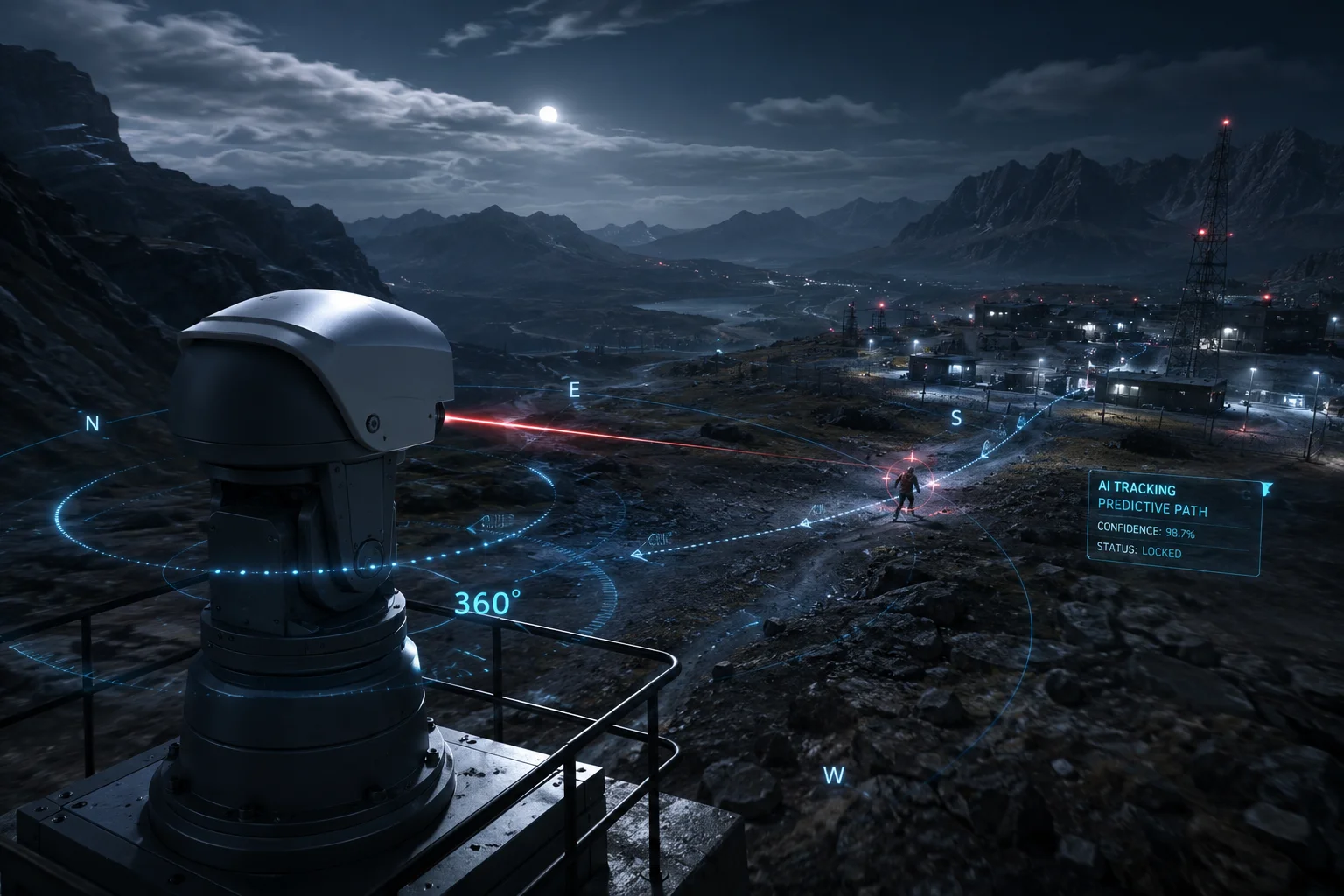
Our firmware maintains laser-target lock across the full 360° pan and 90° tilt range. The laser motor receives position commands from the AI tracker at 30Hz, synchronized with the PTZ movement. There is no dead zone — if the PTZ can see it, the laser can light it.
How the Tracking Loop Works
The system runs a tight feedback loop:
- AI Detection — The neural network identifies and classifies the target (person, vehicle, animal).
- Centroid Calculation — The firmware computes the geometric center of the bounding box.
- PTZ Command — The pan-tilt motors receive speed and direction commands to keep the target centered in frame.
- Laser Offset Correction — Because the laser module is physically offset from the camera lens by a few centimeters, the firmware applies a parallax correction that changes with distance.
- Repeat — This entire cycle runs 30 times per second.
Edge-of-Frame Performance
Most tracking failures happen when the target is near the edge of the frame. The PTZ is accelerating to catch up, and the laser is still pointed at where the target was 100ms ago. Our firmware uses predictive positioning — it calculates the target’s velocity vector and pre-aims the laser slightly ahead of the current position. This eliminates the visible “lag” effect.
Handoff Between Zones
For large properties with multiple cameras, the AI can hand off tracking from one PTZ to the next. When a target exits Camera A’s coverage, Camera B picks up the track and its laser locks on within 500ms. This requires our CMS platform, but the firmware on each camera supports the handoff protocol natively.
What Happens When the Target Stops?
When a person stops moving, the system holds the laser on their last known centroid. If they remain stationary for a configurable period (default: 30 seconds), the laser drops to low-power mode to save energy but stays aimed. Any movement triggers an instant return to full power.
This is important for scenarios like a trespasser hiding behind a structure. The camera remembers where they were last seen and keeps the laser ready. The moment they step out, full illumination returns before they take their second step.
Conclusion
AI-Targeted Illumination turns a basic laser PTZ into a precision tool. It saves power, protects neighbors, sharpens images at distance, and tracks without gaps. If you need this level of control in your next project, reach out — I’ll walk you through a live demo.
1. Overview of how AI dynamically aligns illumination with detected targets. ↩︎ 2. Explanation of bounding boxes used in object detection. ↩︎ 3. Detailed description of zoom synchronization between lens and laser. ↩︎ 4. Information about pan-tilt-zoom camera lenses and their functions. ↩︎ 5. Physics of laser beam divergence and how it affects spot size. ↩︎ 6. How geofencing is used to restrict laser firing in sensitive areas. ↩︎ 7. Description of low-power scanning modes for covert surveillance. ↩︎ 8. Explanation of how contrast ratio affects image quality in low-light scenes. ↩︎