
I have seen 4G modules burn out after a single lightning storm. The replacement cost was nothing compared to the truck roll. That one failure killed the whole project budget.
Most 4G modules inside Chinese PTZ cameras only pass basic IEC 61000-4-5 1 surge tests at 1kV to 2kV. This does not automatically meet U.S. industrial or telecom-grade standards like GR-1089-CORE 2 or IEEE C62.41 3. To truly protect your system in high-lightning zones, you need to verify the actual test level and add external surge protection.
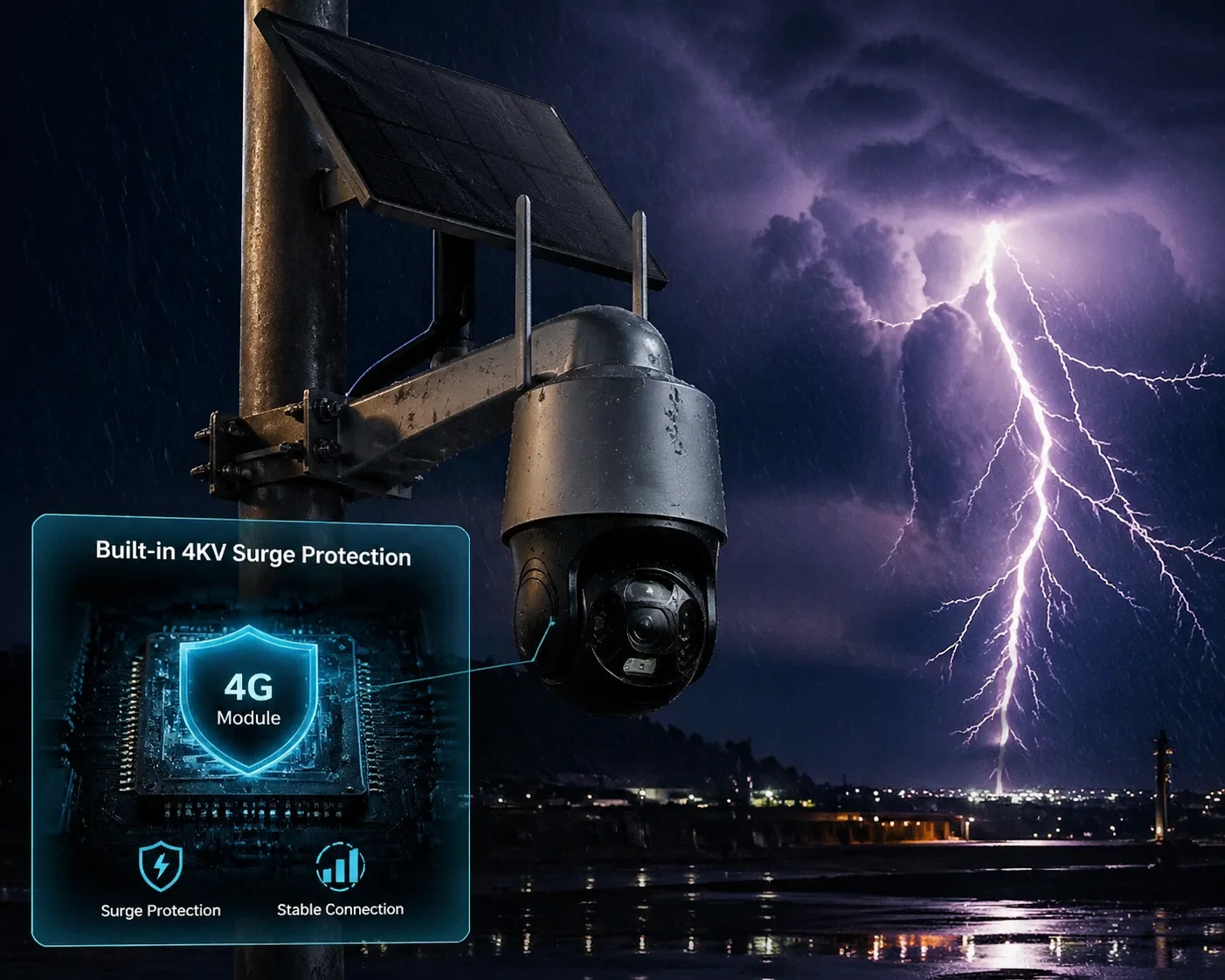
Below, I break down the real-world surge risks for 4G-connected PTZ cameras. I cover antenna port protection, internal PCB shielding, external lightning arrestors, and what happens during a voltage spike in your solar system. Every section gives you the technical facts you need to make a safe buying decision.
Table of Contents
Is the Antenna Port Protected Against 2KV or 4KV Surges During Lightning Storms?
I lost three cameras in one season because the antenna port had zero dedicated surge protection. The RF connector was the weakest link every time.
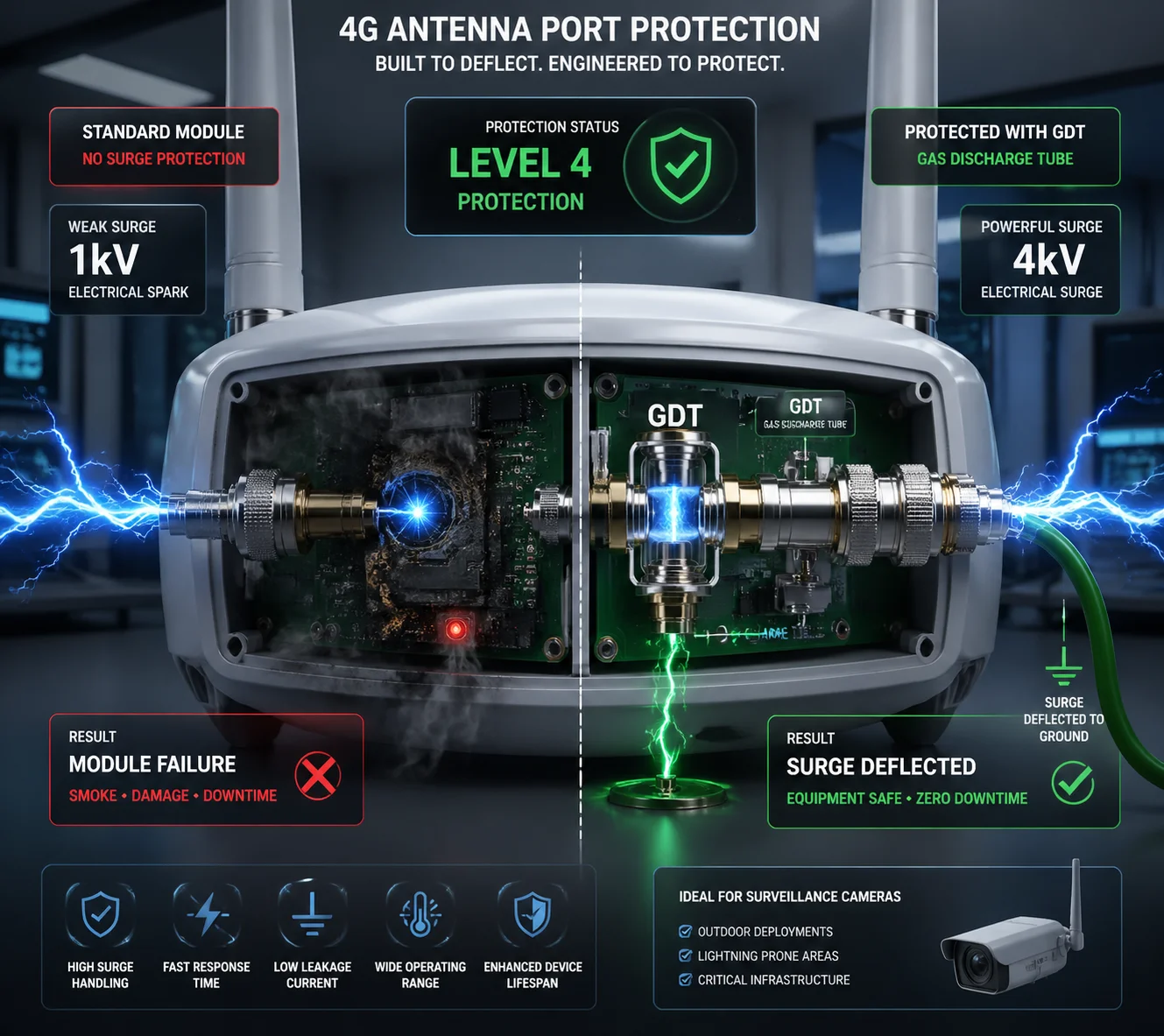
The antenna port on most industrial-grade 4G modules should withstand at least 2kV surges per IEC 61000-4-5. However, true industrial deployments in the U.S. Southern states demand 4kV or higher. Always ask your supplier for the specific test level on the RF port, not just the power input.
Why the Antenna Port Is the Most Vulnerable Point
The 4G antenna sits on top of a pole. It is the highest point in the system. Lightning does not need to hit it directly. A nearby strike creates a strong electromagnetic pulse. This pulse travels down the coax cable and enters the 4G module through the RF connector.
Most camera manufacturers test surge protection on the power input and Ethernet port. They often skip the antenna port. This is a big problem. The RF path connects directly to the 4G chipset. One surge through this path can destroy the radio frequency front-end. Once that is gone, your camera is offline.
What the Standards Actually Require
Here is a comparison of common surge test levels for antenna and RF ports:
| Standard | Test Level | Waveform | Typical Application |
|---|---|---|---|
| IEC 61000-4-5 Level 2 | 1.0 kV | 1.2/50 μs – 8/20 μs | Consumer electronics, indoor use |
| IEC 61000-4-5 Level 3 | 2.0 kV | 1.2/50 μs – 8/20 μs | Light industrial, sheltered outdoor |
| IEC 61000-4-5 Level 4 | 4.0 kV | 1.2/50 μs – 8/20 μs | Heavy industrial, exposed outdoor |
| GR-1089-CORE (Intra-building) | 1.0 kV – 1.5 kV | Various | Telecom equipment, indoor |
| GR-1089-CORE (Aerial/Outdoor) | 2.0 kV – 6.0 kV | Various | Telecom equipment, outdoor exposed |
If your project is in Texas, Florida, or anywhere along the Gulf Coast, you are in a high-exposure zone. Level 2 (1kV) is not enough. You need Level 4 (4kV) on the antenna port at minimum.
How We Handle This at Loyalty-Secu
Our 4G PTZ cameras use a Gas Discharge Tube (GDT) 4 right at the antenna connector. This GDT sits between the RF signal path and the ground plane. When a surge hits, the GDT fires in nanoseconds. It dumps the energy to ground before it reaches the 4G chipset.
Behind the GDT, we place a TVS diode 5 for secondary clamping. This two-stage approach on the RF path alone gives us tested protection at the IEC 61000-4-5 Level 4 threshold. But I always tell my clients: ask for the test report. If a supplier cannot show you a third-party lab report with the antenna port tested separately, assume it was not tested.
How Does the Internal PCB Shield the 4G Module From Electromagnetic Interference?
I once opened a competitor’s camera and found the 4G module sitting on the main board with no shielding at all. The PTZ motor noise was bleeding straight into the RF circuit.
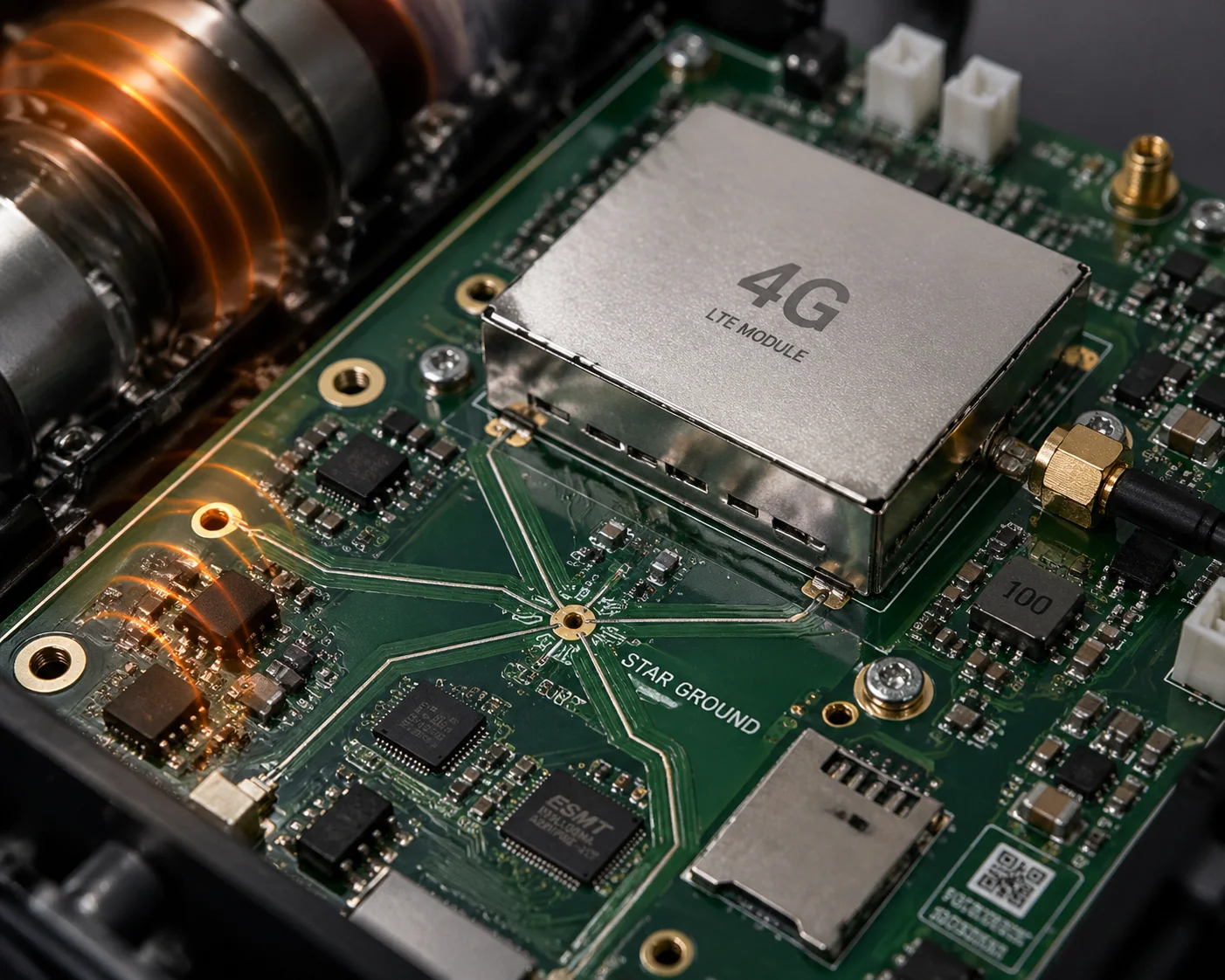
A properly designed PCB uses metal RF shielding cans, ground plane isolation, and filtered power rails to protect the 4G module from internal electromagnetic interference. Without these, the 4G signal drops, reconnects constantly, and your live feed becomes unreliable.
The Three Layers of Internal Protection
Surge protection stops the big hits. But electromagnetic interference (EMI) is a constant, low-level threat. Inside a PTZ camera, you have multiple noise sources:
- PTZ motors generate switching noise every time the camera pans or tilts.
- IR LED drivers create high-frequency ripple on the power bus.
- Video processing chips radiate broadband noise from high-speed data lines.
All of these can interfere with the 4G module’s ability to maintain a stable connection. Here is how a well-designed PCB handles it.
Layer 1: RF Shielding Cans
The 4G module itself should be covered by a metal shielding can. This is a stamped metal box soldered directly over the module on the PCB. It blocks radiated EMI from reaching the sensitive RF circuits inside the module. Without this can, the 4G module picks up noise from every other component on the board.
Layer 2: Ground Plane Isolation
A good PCB design uses separate ground planes for the 4G section and the rest of the camera electronics. These ground planes connect at only one point. This prevents noise currents from the motor driver or video processor from flowing through the 4G module’s ground path. We call this “star grounding.” It is simple but very effective.
Layer 3: Filtered and Isolated Power Rails
The 4G module gets its own dedicated voltage regulator. This regulator has input and output filtering capacitors. Some designs also add a ferrite bead or a small common-mode choke on the power line. This stops conducted noise from traveling along the power trace into the 4G module.
At Loyalty-Secu, we go one step further. We use an isolated DC-DC converter to power the 4G section. This creates a galvanic barrier between the 4G module’s power and the rest of the system. The result is a cleaner power supply and fewer random disconnections in the field.
What to Ask Your Supplier
When you evaluate a 4G PTZ camera, ask these questions:
- Does the 4G module have a metal RF shielding can?
- Is the 4G power rail isolated from the main board power?
- Has the camera been tested for radiated emissions under EN 55032 Class B?
If the answer to any of these is “no” or “I don’t know,” that is a red flag.
Do I Need an External Lightning Arrestor for My 4G Antenna in High-Risk Zones?
I used to think the built-in protection was enough. Then a client in Florida sent me photos of a melted SMA connector after a summer storm. That changed my mind fast.
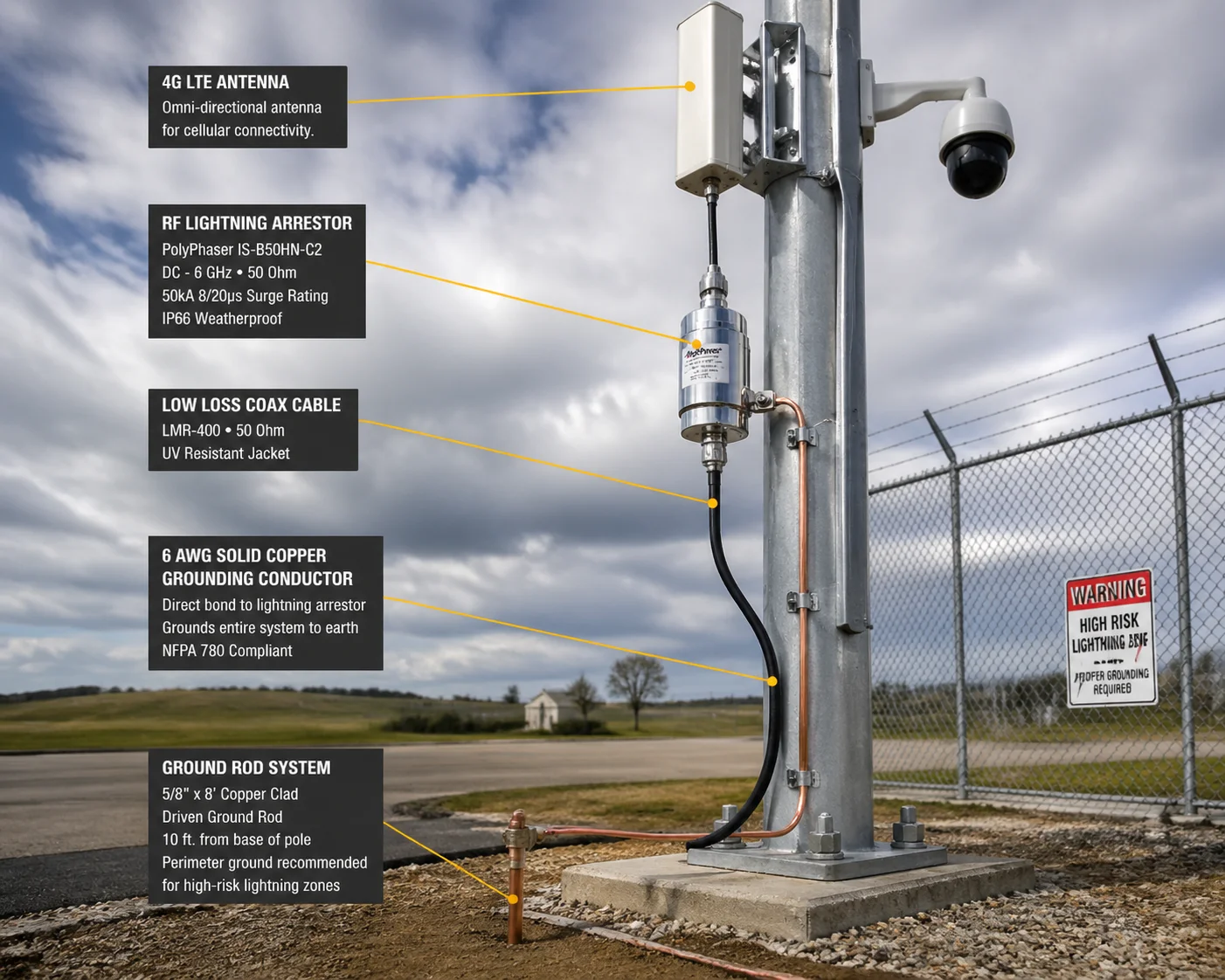
Yes, you need an external lightning arrestor for your 4G antenna in high-risk zones. Built-in surge protection handles moderate surges, but a direct or near-direct lightning strike can deliver energy far beyond what any internal component can absorb. An external arrestor is your first line of defense.
Why Internal Protection Is Not Enough by Itself
Internal surge protection components like GDTs and TVS diodes are small. They are designed to handle the residual energy that gets past the first barrier. They are not designed to take the full hit from a close lightning strike.
A typical lightning stroke delivers 20,000 to 200,000 amperes. Even an induced surge on a nearby antenna cable can reach 5kV to 10kV. The internal GDT on a 4G module is rated for maybe 2kA to 5kA of surge current. That is a huge gap.
What an External Lightning Arrestor Does
An external RF lightning arrestor mounts inline on the coax cable between the antenna and the camera. It contains a heavy-duty GDT or spark gap rated for much higher energy levels. When a surge comes down the cable, the arrestor fires first. It diverts most of the energy to the grounding system. Only a small residual pulse reaches the camera.
Choosing the Right Arrestor
Here is what to look for:
| Feature | Recommended Spec | Why It Matters |
|---|---|---|
| Frequency Range | 700 MHz – 2700 MHz | Must cover all 4G LTE bands |
| Surge Current Rating | ≥ 10 kA (8/20 μs) | Handles near-strike induced surges |
| Insertion Loss | ≤ 0.3 dB | Does not weaken your 4G signal |
| Connector Type | N-type or SMA (match your cable) | Must fit your existing cable setup |
| Grounding Method | Direct bonding to ground bus | Must have a short, low-impedance path to earth |
Grounding Is Everything
I cannot stress this enough. An external arrestor is useless without proper grounding. The ground wire from the arrestor must be short, thick, and connected to a dedicated ground rod or the pole’s grounding system. A long, thin ground wire adds impedance. High impedance means the surge energy cannot flow to earth fast enough. It backs up and enters the camera anyway.
For pole-mounted 4G solar cameras, I recommend bonding the arrestor ground directly to the metal pole. Then connect the pole base to a ground rod with a minimum 6 AWG copper wire. Keep the total ground path under 3 meters if possible.
At Loyalty-Secu, we include grounding recommendations in our installation guide for every 4G solar PTZ system. We also offer optional RF arrestor kits matched to our antenna connectors. This way, your installer does not have to guess which parts to buy.
What Happens to the 4G Module if There Is a Sudden Voltage Spike in the Solar System?
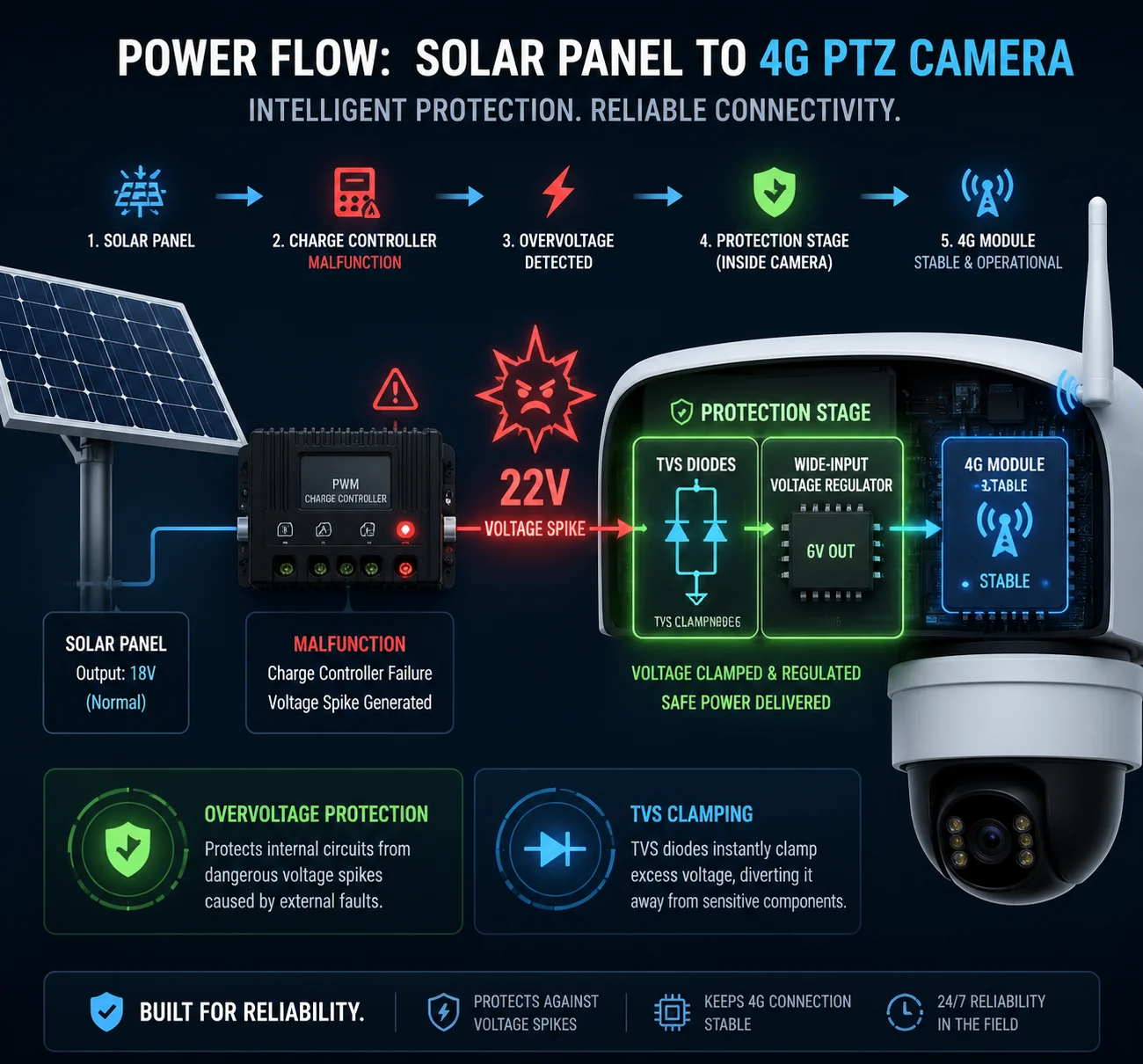
I had a client whose solar charge controller failed. It sent 18V into a system rated for 12V. The 4G module died instantly. The camera body survived, but without 4G, it was just a very expensive paperweight on a pole.
A sudden voltage spike from the solar system can permanently damage the 4G module if the camera lacks proper input voltage clamping and overvoltage protection. Quality industrial cameras use TVS diodes, fuses, and voltage regulators with wide input ranges to absorb these spikes before they reach the 4G chipset.
Where Do Solar Voltage Spikes Come From?
Solar power systems are not as stable as grid power. Several things can cause a voltage spike:
- Charge controller failure. If the MPPT 6 or PWM controller malfunctions, it can pass the full open-circuit voltage of the solar panel directly to the camera. A 12V system with a 100W panel can see open-circuit voltages of 22V or more.
- Battery disconnection under load. If the battery cable comes loose while the solar panel is charging, the voltage on the bus can jump instantly. Without the battery acting as a buffer, the voltage is unregulated.
- Load dump. If another device on the same power bus suddenly turns off, the stored energy in the wiring can create a transient spike.
- Lightning-induced surges on the solar panel wiring. Long cable runs between the panel and the camera act as antennas. They pick up induced voltage from nearby lightning.
How a Well-Designed Camera Handles This
A good solar PTZ camera has multiple protection stages on the DC power input:
Stage 1: Input TVS Diode
A high-power TVS diode sits right at the DC input connector. It clamps any voltage spike above a set threshold. For a 12V system, this clamp voltage is usually around 18V to 20V. The TVS absorbs the spike energy and converts it to heat. This happens in picoseconds.
Stage 2: Polyfuse or Resettable Fuse
A polyfuse limits the current if the voltage stays high for too long. Unlike a regular fuse, it resets itself after the fault clears. This prevents a sustained overvoltage from cooking the internal circuits.
Stage 3: Wide-Input Voltage Regulator
The DC-DC converter that powers the camera internals should accept a wide input range. At Loyalty-Secu, our solar PTZ cameras accept 10V to 36V DC input. This means even if the charge controller sends a brief 22V spike, the regulator handles it without passing the overvoltage downstream.
Stage 4: Dedicated 4G Module Power Filtering
After the main regulator, the 4G module gets its own secondary regulator with additional filtering. This isolates the 4G chipset from any residual noise or ripple on the main power bus.
What Happens Without These Protections
| Failure Scenario | Without Protection | With Full Protection |
|---|---|---|
| Charge controller sends 22V | 4G module burns out | TVS clamps to 18V, regulator handles the rest |
| Battery disconnects under charge | Voltage spike to 25V+ | TVS + fuse cut the spike, system stays online |
| Lightning induces 2kV on solar cable | Main board destroyed | GDT + TVS absorb energy, camera reboots normally |
| Slow overvoltage (15V sustained) | Components overheat and fail over weeks | Wide-input regulator operates normally at 15V |
The bottom line is simple. If your solar PTZ camera does not have documented overvoltage protection on the DC input, you are gambling with every storm and every charge controller glitch. Ask your supplier for the input voltage range and the TVS clamping voltage. If they cannot answer, move on.
Conclusion
Do not trust marketing claims about surge protection. Ask for IEC 61000-4-5 test reports, check the actual kV rating on every port, and always add external arrestors in high-lightning zones.
1. IEC 61000-4-5 surge immunity standard test levels. ↩︎ 2. GR-1089-CORE telecom equipment surge requirements. ↩︎ 3. IEEE C62.41 surge withstand for low-voltage AC power. ↩︎ 4. Gas Discharge Tube surge protection for RF ports. ↩︎ 5. Transient Voltage Suppression diode clamping circuits. ↩︎ 6. MPPT charge controller failure modes and overvoltage. ↩︎ 7. EN 55032 Class B radiated emissions testing. ↩︎ 8. Lightning strike current levels and induced surge energy. ↩︎ 9. Grounding impedance for surge protection effectiveness. ↩︎ 10. Polyfuse resettable overcurrent protection for solar PTZ. ↩︎