
I’ve seen too many solar surveillance sites fail because someone picked the wrong battery placement. It’s a decision that haunts you for years.
For most off-grid security camera projects, a standalone battery box works better for long-term reliability, while an integrated behind-panel design wins on speed and clean aesthetics. The right choice depends on your site conditions, maintenance access, and how much heat your batteries will face.
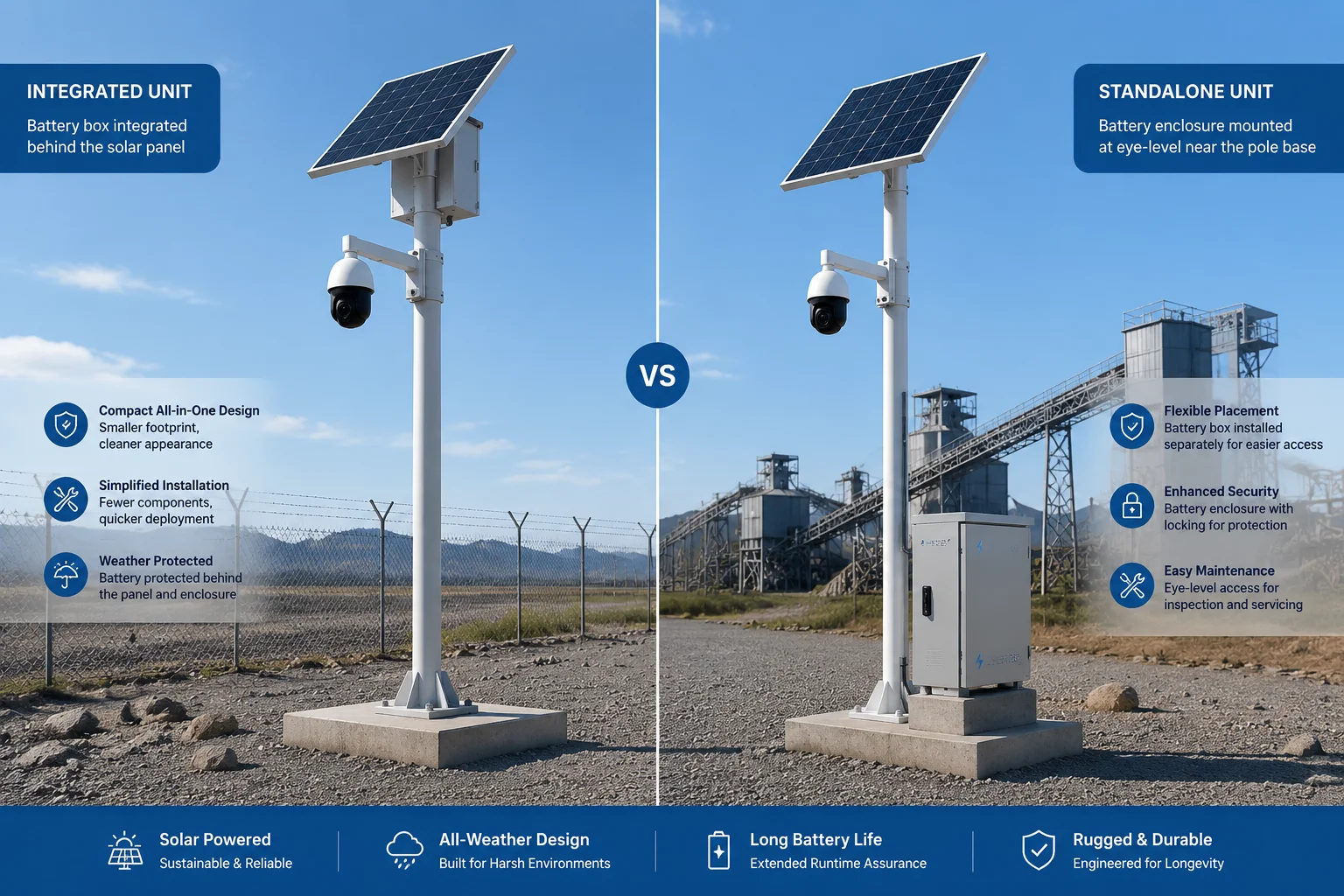
Below, I break down the four questions I hear most from integrators and project managers when they’re choosing between these two designs. Each answer comes from real deployment experience across Texas heat, Canadian cold, and Middle Eastern dust.
Table of Contents
Does Mounting the Battery Behind the Solar Panel Provide Extra Shade to Keep It Cool?
I used to think the panel would shade the battery. Then I checked the actual temperatures on a job site in July. I was wrong.
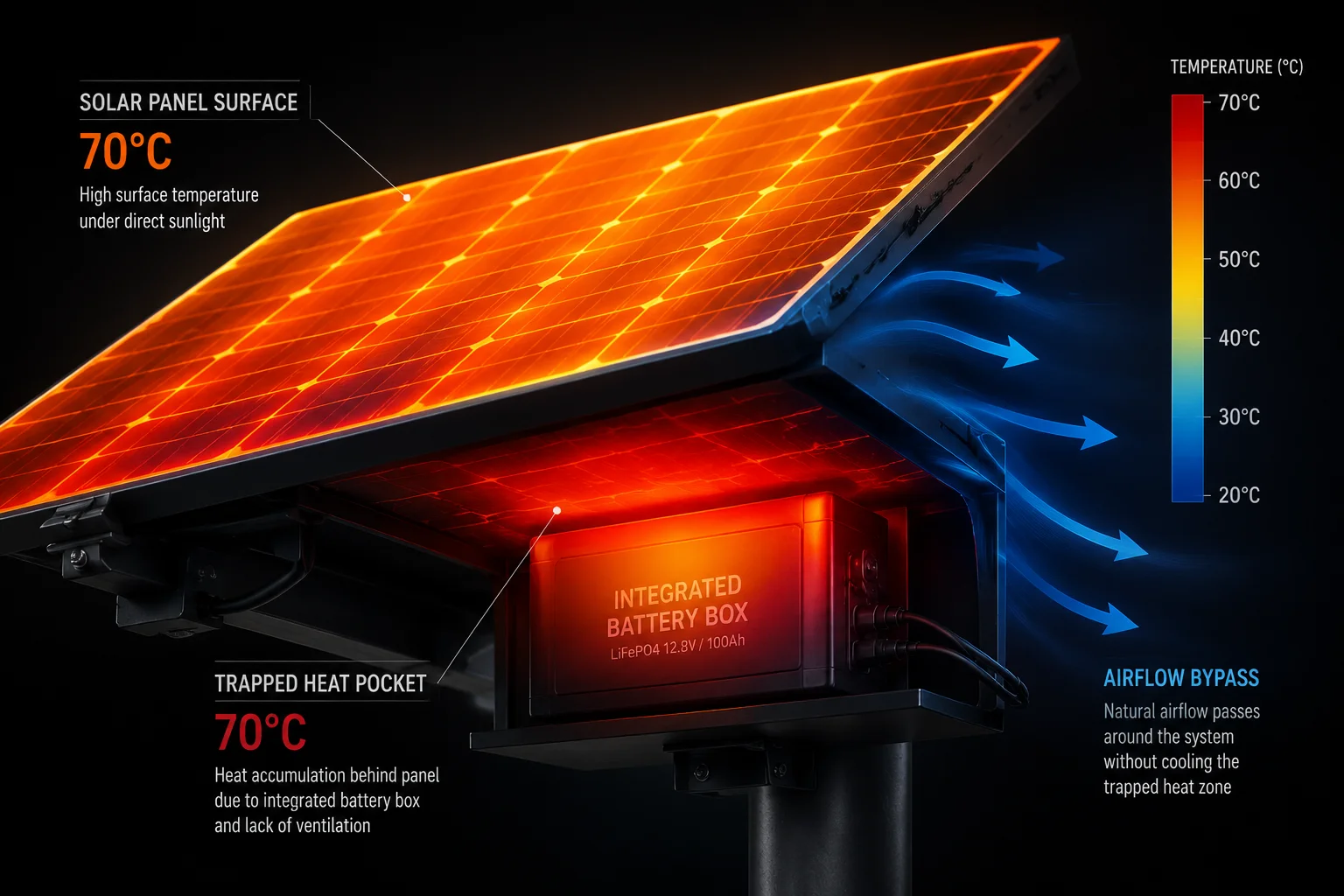
No. Mounting the battery behind the solar panel does not keep it cool. The panel’s backside radiates heat, often reaching 70°C in direct sun. This trapped heat actually accelerates battery degradation rather than protecting it.
Why the “Shade” Theory Fails
Many people assume the solar panel acts like a roof. It blocks direct sunlight from hitting the battery box. That part is true. But here’s what they miss: the panel itself becomes a heat source.
When sunlight hits a solar panel, only about 20% converts to electricity. The rest becomes heat. That heat radiates from the back surface. If your battery sits 2-3 cm behind that surface, it’s sitting in a pocket of hot air with no ventilation.
Real Temperature Data
I’ve measured backside panel temperatures8 across different climates. Here’s what the numbers look like:
| Climate Zone | Panel Backside Temp (Peak) | Battery Ideal Temp | Actual Battery Temp (Integrated) |
|---|---|---|---|
| Texas Summer | 70-75°C | 25°C | 55-65°C |
| Arizona Desert | 75-80°C | 25°C | 60-70°C |
| Canadian Summer | 45-55°C | 25°C | 35-45°C |
These numbers tell a clear story. In hot climates, the integrated battery runs 30-40°C above its ideal operating temperature. Every 10°C above 25°C cuts lithium battery cycle life by roughly 50%.
What This Means for Your Project
If you deploy in northern climates like Canada or northern Europe, the heat penalty is manageable. The panel backside stays under 55°C for most of the year. Your battery will still last 3-5 years.
But if your projects are in Texas, the Middle East, or Southeast Asia, this heat will kill your batteries in 12-18 months. That means truck rolls, replacement costs, and unhappy clients.
The Airflow Problem
Some manufacturers add ventilation slots to the integrated enclosure. This helps a little. But at pole-top height (3-5 meters), wind patterns are unpredictable. On calm days, that ventilation does almost nothing. The hot air just sits there.
A standalone box at ground level or mid-pole with a reflective coating and proper spacing stays 20-30°C cooler than an integrated unit. That temperature difference translates directly into battery lifespan.
Will a Standalone Battery Box Be Easier to Service or Replace in the Future?
Every time I quote a project, I calculate the total cost of ownership over 5 years. The maintenance math always favors standalone boxes in the long run.
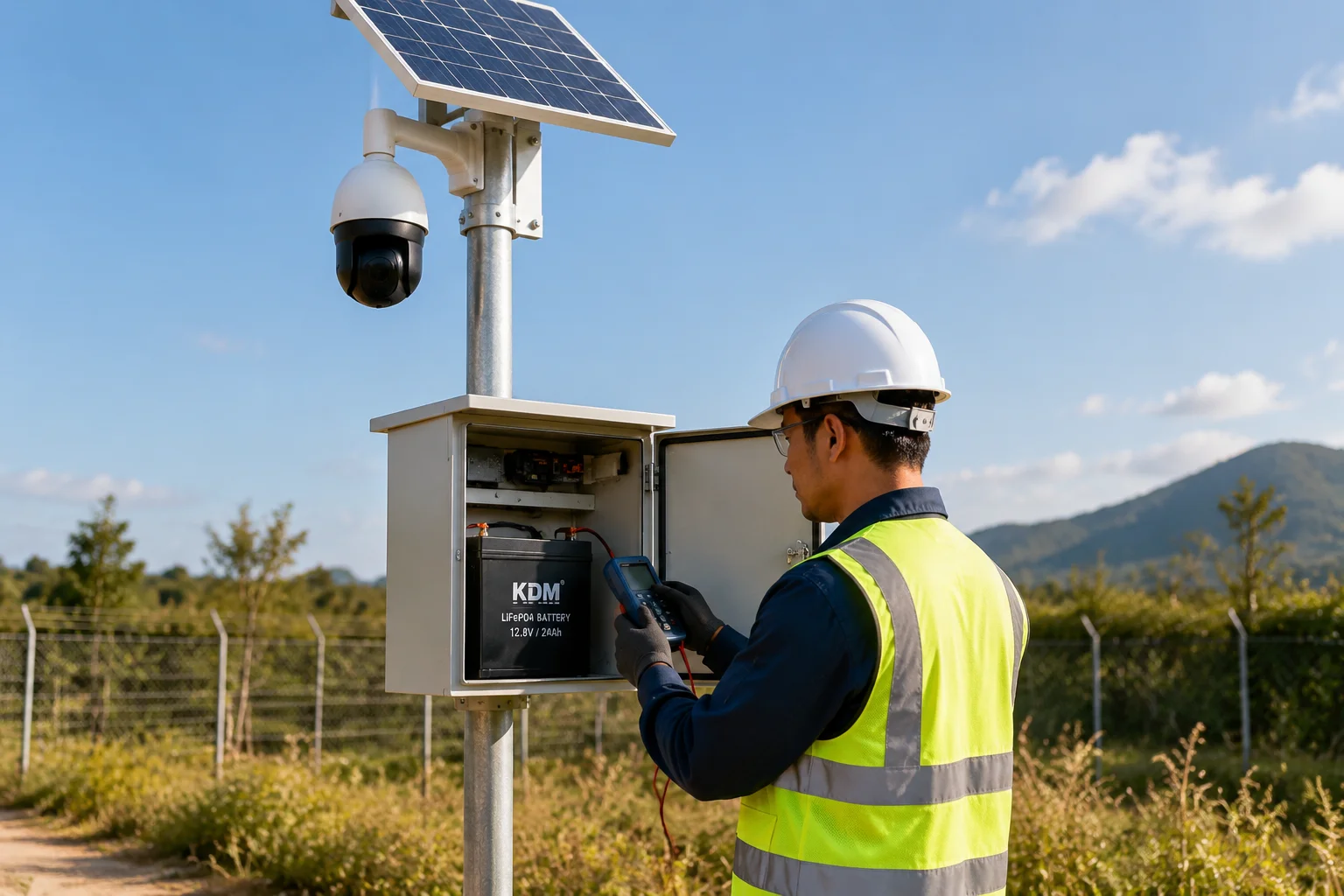
Yes. A standalone battery box mounted at accessible height is significantly easier to service. One technician can swap batteries in 15 minutes without a bucket truck, cutting maintenance costs by 60-70% compared to integrated units that require high-altitude access equipment.
The Hidden Cost of “Simple” Installation
Integrated designs look great on paper. One unit, one connection, done. But that simplicity has a shelf life. After 2-3 years, when the battery needs replacement, you face a different reality.
To access an integrated battery at 4-5 meters, you need either a ladder (risky for one person) or a bucket truck2 (expensive to dispatch). In rural areas like oil fields or farm perimeters, getting a bucket truck on-site can cost $500-$1,500 per visit. If your battery fails in winter and you need emergency service, that cost doubles.
Maintenance Comparison
| Task | Integrated (Pole-Top) | Standalone (Ground/Mid-Pole) |
|---|---|---|
| Battery swap | 2 technicians + bucket truck, 2 hours | 1 technician, 15 minutes |
| Controller inspection | Same as above | Open box, visual check |
| Firmware update (if wired) | Climb required | Ground-level access |
| Average service cost | $800-$1,500 per visit | $100-$200 per visit |
| Annual maintenance budget | High | Low |
Design for the Inevitable
Batteries are consumables. Even the best lithium iron phosphate (LiFePO4)1 cells lose capacity after 2,000-3,000 cycles. That’s roughly 5-7 years in ideal conditions. In hot climates, it’s 2-3 years.
When I design a system for a client, I always ask: “Who will maintain this in year three?” If the answer is a local contractor with a pickup truck and basic tools, standalone is the only responsible choice.
Modular Replacement Strategy
With a standalone box, you can also pre-stage replacement batteries. Ship a fresh battery pack to the site. The local tech opens the box, disconnects two cables, swaps the pack, and closes the box. No special training. No height certification. No liability.
This matters especially for distributed deployments. If you have 50 solar cameras across a county, you don’t want to schedule 50 bucket truck visits. You want a technician in a van who can hit 8-10 sites per day.
How Does the Weight Distribution of an Integrated Panel-Battery Unit Affect Pole Stability?
I learned this lesson the hard way on a windy site in Oklahoma. The top-heavy unit swayed so much that the PTZ image was unusable at 38X zoom.
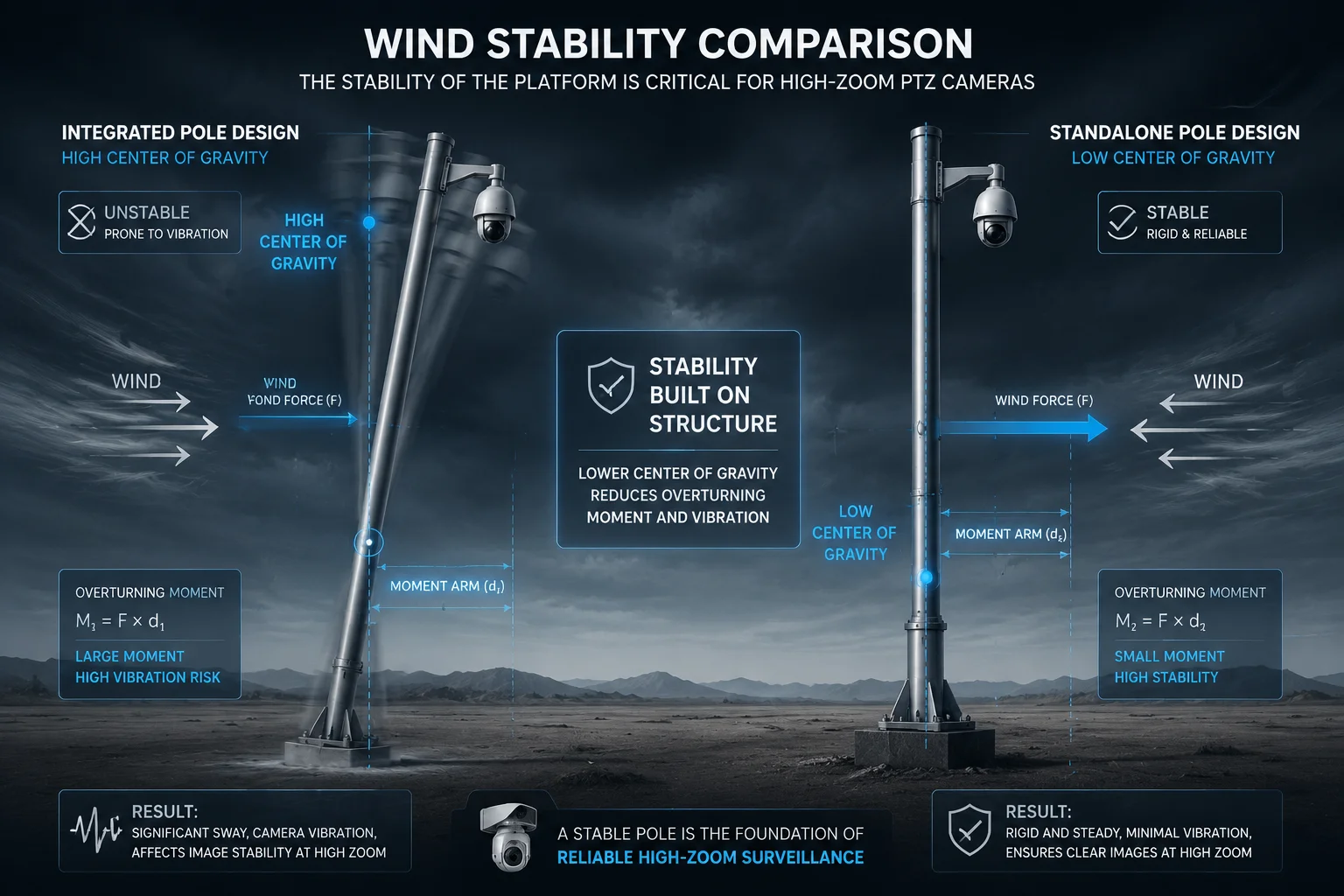
An integrated panel-battery unit concentrates all weight at the pole top, creating a high center of gravity that increases wind-induced vibration. This vibration degrades image quality at high zoom levels and can fatigue the pole mount over time.
Understanding the Physics
A solar panel already acts as a wind sail. It catches gusts and transfers lateral force to the pole. When you add 10-15 kg of batteries behind it, you increase the moment arm. The pole tip deflects more under the same wind load.
For a standard 4-meter galvanized steel pole (76mm diameter, 3mm wall), here’s what the numbers look like:
- Panel only (8 kg): tip deflection under 60 km/h wind = ~12mm
- Panel + integrated battery (22 kg): tip deflection under 60 km/h wind = ~25mm
- Panel only + standalone battery at base: tip deflection under 60 km/h wind = ~12mm
That 25mm sway at the pole tip translates to significant image shake when your PTZ is zoomed to 38X or 40X. At 800 meters distance, even 1mm of camera movement shifts the field of view by several meters.
Wind Load Calculations
| Configuration | Top Weight | Wind Sail Area | Pole Tip Deflection3 (60 km/h) | Image Stability at 38X |
|---|---|---|---|---|
| Panel + PTZ only | 12 kg | 0.5 m² | 12 mm | Good |
| Panel + PTZ + Integrated Battery | 25 kg | 0.6 m² | 25 mm | Poor in gusts |
| Panel + PTZ (battery at base) | 12 kg | 0.5 m² | 12 mm | Good |
Structural Fatigue
Weight at the top doesn’t just cause sway. It causes fatigue. Every wind gust creates a stress cycle at the pole base and mounting bolts. Over thousands of cycles, micro-cracks develop. I’ve seen pole mounts fail after 3-4 years in high-wind areas because the integrated unit was too heavy for the original pole specification.
The Zoom Factor
This is critical for our 38X and 40X optical zoom PTZ cameras4. These cameras are designed to read license plates at 200 meters or identify faces at 100 meters. Any vibration at the mount point gets amplified by the zoom ratio.
If your pole sways 2mm at the camera mount, at 40X zoom that looks like 80mm of movement in the image. The auto-stabilization can compensate for some of this, but it reduces effective resolution and wastes processing power.
My Recommendation for High-Zoom Deployments
Keep the pole top as light as possible. Move the battery to mid-pole or base level. Use a thicker-wall pole or guy wires if the site is exposed to sustained winds above 80 km/h. This gives your 800-meter laser PTZ the stable platform it needs to deliver sharp images day and night.
Which Design Is Better for Preventing Theft and Tampering in Unmonitored Rural Sites?
Theft is a real problem. I’ve had clients lose entire solar camera systems overnight at construction sites and remote farms.
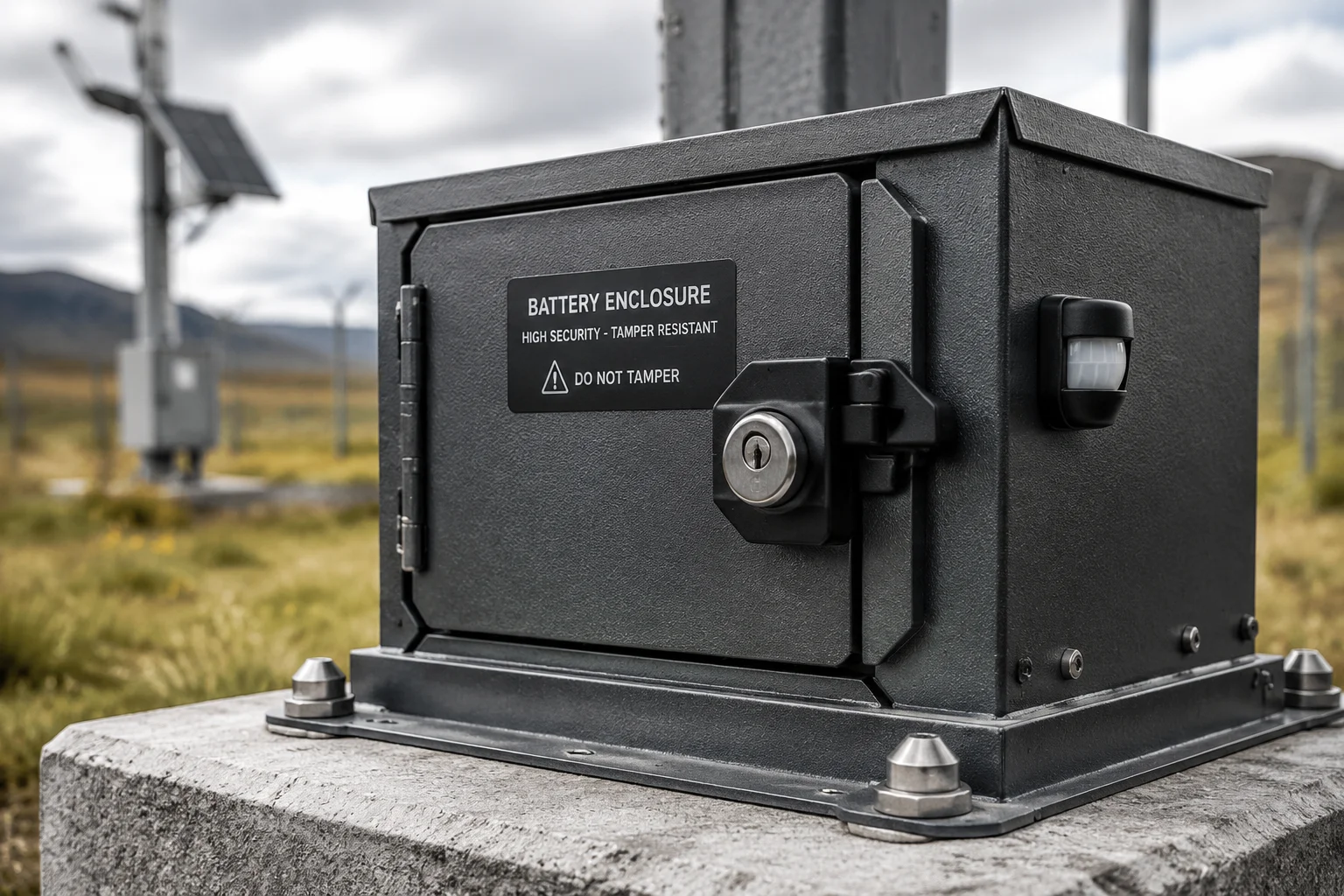
Integrated behind-panel designs offer better theft resistance because the battery is hidden at pole-top height (3-5 meters), making it physically difficult to access without tools and a ladder. Standalone ground-level boxes are more vulnerable but can be hardened with anchoring, locks, and tamper alarms.
The Theft Profile
Most solar equipment theft is opportunistic. Someone drives by, sees a shiny box at ground level, and grabs it. They’re not bringing ladders or climbing gear. They want quick, easy targets.
An integrated battery at 4-5 meters height eliminates this casual theft entirely. The thief would need to either climb the pole (difficult with anti-climb guards5) or bring equipment. Most won’t bother.
Ground-Level Hardening Options
If you choose a standalone box for thermal or maintenance reasons, you can still make it theft-resistant:
- Concrete anchor bolts: Bolt the enclosure to a poured concrete pad. This requires power tools to remove.
- Tamper-proof fasteners: Use security screws that need special bits. Common tools won’t open the box.
- Steel cable locks: Loop aircraft-grade cable through the enclosure and around the pole.
- Tamper detection6: Wire a contact sensor to the 4G modem7. If the box opens unexpectedly, you get an instant alert.
- Camouflage: Paint the box to match the environment. A green box in tall grass is harder to spot from the road.
Site-Specific Risk Assessment
Not every site has the same theft risk. A camera monitoring a government building in a city has security guards nearby. A camera watching a pipeline valve in the middle of nowhere has zero human presence.
For high-risk sites (construction zones, remote farms, border areas), I recommend the integrated approach unless heat is a serious concern. The peace of mind is worth the maintenance trade-off.
For medium-risk sites with regular human traffic, a hardened standalone box works fine. The tamper alarm gives you response time, and the presence of the camera itself deters most people.
Combining Both Approaches
Some of our clients use a hybrid strategy. They mount a small backup battery (20Ah) integrated behind the panel for immediate power. Then they place the main battery bank (100Ah+) in a locked, anchored ground box. If someone steals the ground box, the system stays online for 24-48 hours on the backup, giving the owner time to respond.
This hybrid approach gives you the thermal benefits of ground-level storage, the security of height-mounted backup, and the maintenance convenience of accessible main batteries. It costs more upfront but solves all three problems at once.
Insurance and Liability
One more thing to consider: insurance companies in North America often require proof of anti-theft measures for remote equipment. A documented hardening strategy (photos of anchor bolts, serial numbers, tamper sensors) can reduce your insurance premiums and speed up claims if theft does occur.
Conclusion
Choose integrated for fast urban deployments where aesthetics and theft resistance matter most. Choose standalone for hot climates, large battery needs, and sites where easy maintenance saves you thousands over the system’s lifetime. Match the design to your site, not to a brochure.
1. Learn more about the chemistry, lifespan, and safety of LiFePO4 batteries. ↩︎ 2. Overview of bucket trucks used for elevated maintenance access. ↩︎ 3. Engineering formulas for calculating pole deflection under wind load. ↩︎ 4. Explanation of optical zoom and its impact on image stability. ↩︎ 5. Products and methods to deter climbing on pole-mounted equipment. ↩︎ 6. Types of tamper sensors used for remote equipment security. ↩︎ 7. How cellular modems enable remote equipment monitoring. ↩︎ 8. Explanation of how solar panels generate heat and affect surroundings. ↩︎