
I’ve seen too many off-grid cameras die in the field. The battery drained overnight. The system never came back. The client called me angry. This is a real problem.
Yes, most solar surveillance systems will force a “Charge Only” mode when the battery drops below 10%. The solar charge controller triggers a Low Voltage Disconnect (LVD) to cut all loads — camera, 4G modem, and PTZ motor — so every milliamp of solar power goes straight into recharging the battery. This protects the battery from permanent chemical damage caused by deep discharge.
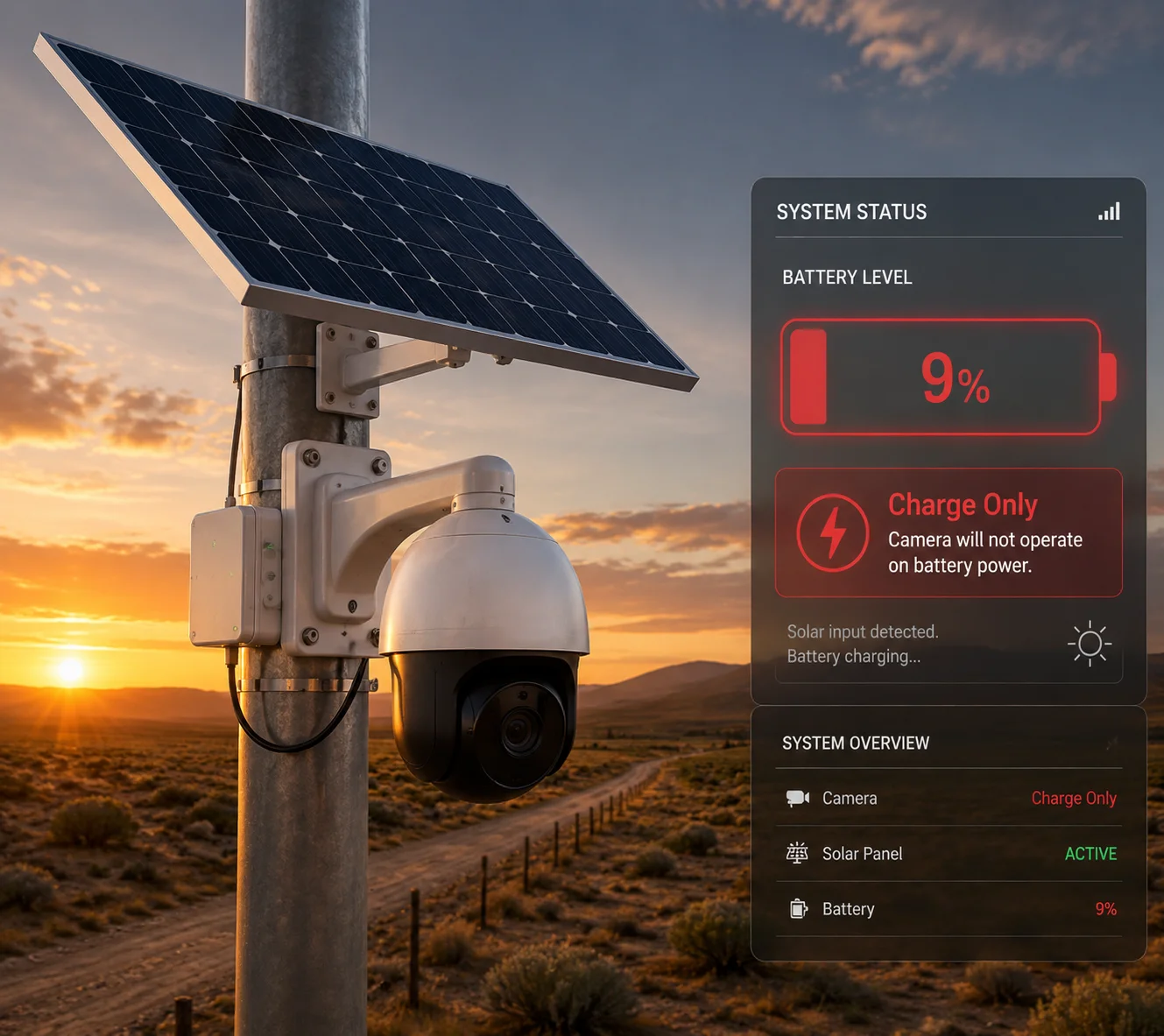
This sounds scary. Your camera goes dark. Your client sees “Device Offline” on their phone. But this is actually the system doing its job. It is saving itself so it can come back to life later. Below, I break down exactly what happens at each stage — what shuts down first, when 4G comes back, and whether you can override any of it.
Table of Contents
Does the System Shut Down the 4G Modem to Protect the Battery From Deep Discharge?
I once had a client in West Texas lose three batteries in one winter. The 4G modem kept running all night, pulling current from a nearly empty battery. Each morning, the voltage was so low the cells were permanently damaged. That was an expensive lesson.
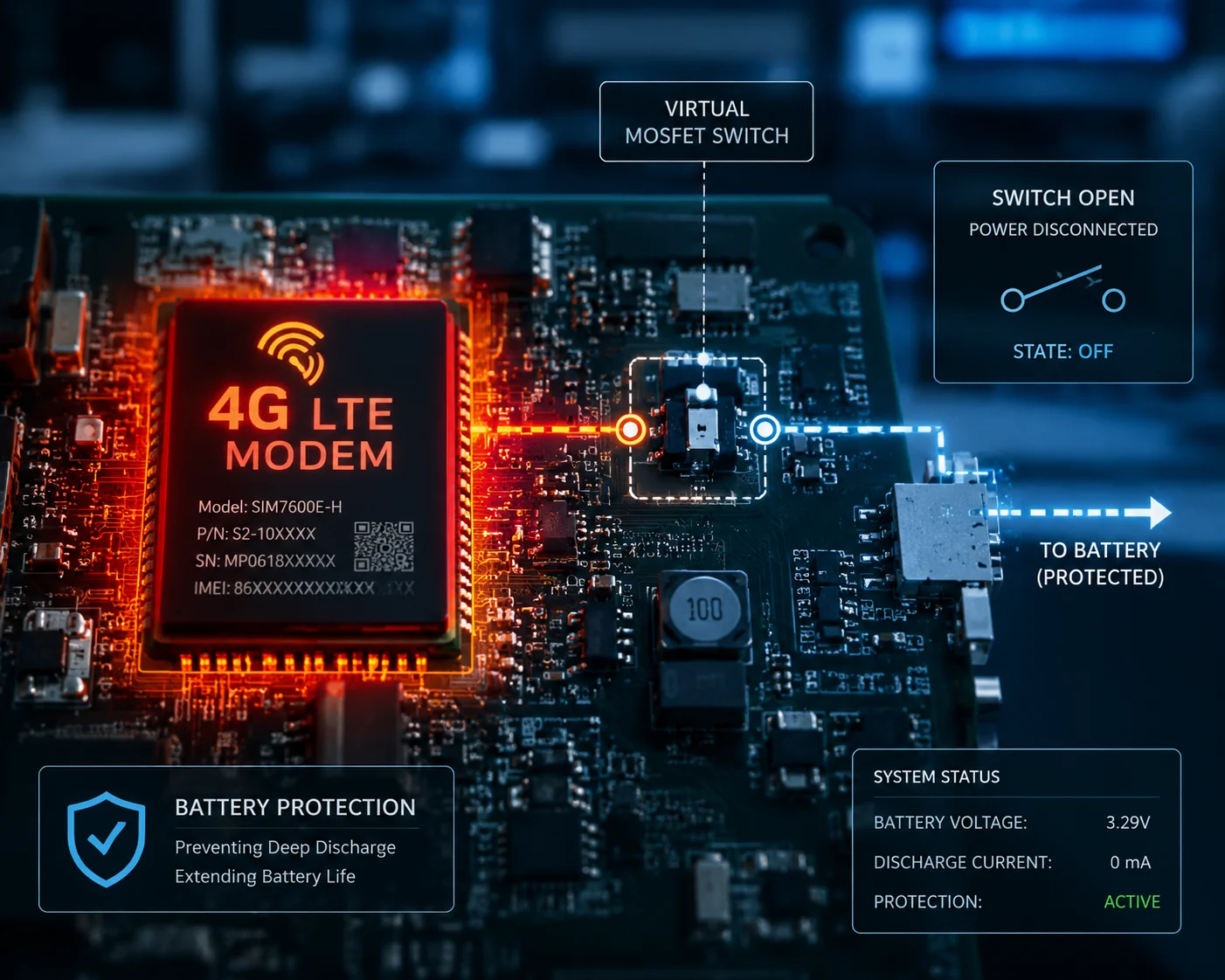
Yes, the system shuts down the 4G modem along with all other loads when the battery hits the LVD threshold (typically 10% SOC). The 4G module is actually one of the highest power consumers in the system, especially during data transmission bursts, so cutting it first makes the biggest impact on preserving remaining battery life.
Why the 4G Modem Is the Biggest Threat to a Dying Battery
Most people think the camera sensor is the main power drain. It is not. The 4G LTE module is the real killer. When it transmits video or even just maintains a heartbeat signal with the cloud server, it can pull 1.5A to 2.5A in short bursts. On a battery that is already at 10%, those bursts can cause the voltage to sag below the critical threshold in seconds.
Here is what happens inside the system when SOC drops below 10%:
| Stage | Battery SOC | System Action | What Stays On |
|---|---|---|---|
| Normal Operation | 100% – 30% | All systems running | Camera, 4G, PTZ, IR LEDs |
| Warning Zone | 30% – 15% | Optional: reduce PTZ movement, dim IR | Camera, 4G (reduced bitrate) |
| LVD Trigger | 10% | MOSFET cuts load terminals | Only the charge controller MCU |
| Deep Protection | Below 8% | BMS hard cutoff (lithium batteries) | Nothing — full disconnect |
The Chemistry Behind the Cutoff
For LiFePO₄1 batteries — the most common type in solar surveillance — the nominal cell voltage is 3.2V. A fully charged cell sits at 3.65V. When it drops to 2.5V per cell, you enter the danger zone. Below 2.0V, the copper current collector on the anode starts to dissolve into the electrolyte. This is not reversible. The cell loses capacity forever.
For lead-acid batteries, the damage mechanism is different but equally destructive. When a lead-acid battery sits in a discharged state, lead sulfate crystals form on the plates. Over time, these crystals harden and become impossible to break down through normal charging. This is called sulfation2, and it is the number one cause of premature lead-acid battery death in solar installations.
What the Charge Controller3 Actually Does
The charge controller has a small microcontroller unit (MCU) inside. This MCU runs on microamps — so little power that it can monitor the battery voltage for months without making a dent. When the solar panel voltage rises above the battery voltage (usually at sunrise), the MCU activates the MPPT4 or PWM5 charging circuit and begins pushing current into the battery.
During this “Charge Only” phase, the load output terminals remain physically disconnected. The MOSFET6 switch stays open. No matter how much solar power is coming in, the camera and 4G modem get zero. Every electron goes into the battery.
This is not a bug. This is the system protecting your most expensive and hardest-to-replace component — the battery pack.
Will the Camera Still Record to the SD Card While the Network Is Forced Offline?
This question comes up in almost every project meeting. The client wants to know: “If the 4G goes down, do I lose footage?” I understand the concern. You are paying for 24/7 surveillance. A gap in recording feels like a failure.
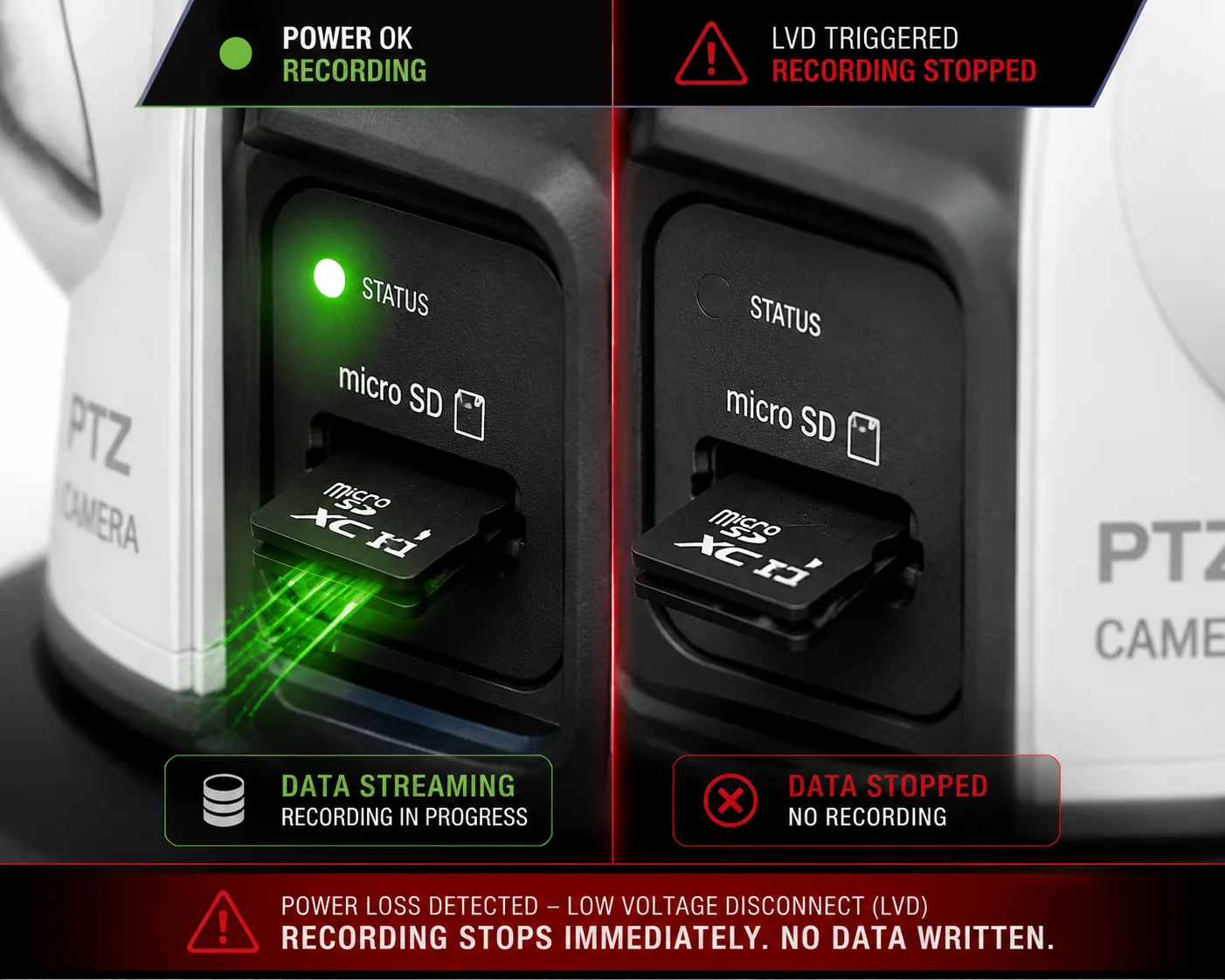
No, the camera will not record to the SD card during a forced LVD shutdown. When the charge controller cuts the load terminals, the camera loses power completely. There is no recording, no local storage, and no motion detection. The entire camera system is off. However, once the battery recovers and the system restarts, the camera resumes recording automatically — including to the SD card.
Understanding the Difference Between “Network Offline” and “Power Off”
This is where many people get confused. There are two very different scenarios:
Scenario A: Network offline, camera still powered. This can happen if the 4G signal drops due to carrier issues, or if you manually disable the SIM card. In this case, the camera is still running. It still records to the local SD card. It still detects motion. It just cannot send alerts or stream video to the cloud. When the network comes back, some systems can even upload the buffered footage.
Scenario B: LVD shutdown — everything is off. This is what happens at 10% battery. The charge controller does not selectively turn off the 4G while keeping the camera alive. It cuts all loads at once. The camera, the 4G modem, the PTZ motor, the IR illuminator — everything goes dark.
Why Not Keep the Camera Running Without 4G?
This is a fair question. In theory, you could design a system that shuts down the 4G modem at 15% and keeps the camera recording locally until 10%. Some advanced systems do offer this kind of tiered load shedding. But there are practical problems:
| Approach | Pros | Cons |
|---|---|---|
| Cut everything at 10% | Simple, reliable, protects battery | No recording during shutdown |
| Tiered shedding (4G off at 15%, camera off at 10%) | Extra recording time | More complex firmware, risk of camera draining battery to dangerous levels |
| Keep camera on until 5% | Maximum recording | High risk of deep discharge, battery damage likely |
Most industrial-grade solar charge controllers use the first approach. They cut everything at once. The reason is simple: reliability. The more complex the logic, the more things can go wrong. And in a remote deployment — a construction site in Nevada, a farm in Saskatchewan, an oil pipeline in the Middle East — you cannot afford things to go wrong.
What Happens to the SD Card Data?
The good news: your existing recordings on the SD card are safe. The SD card is non-volatile storage. It does not need power to hold data. When the system restarts, all previous recordings are still there.
The bad news: you will have a gap in your timeline. The gap starts when the LVD triggers and ends when the battery recovers enough to restart the system. In summer, this gap might be 2-3 hours. In winter, during consecutive cloudy days, it could be 24-48 hours.
This is why proper solar panel sizing and battery capacity planning matter so much. If your system is correctly designed for the location’s worst-case solar conditions, the battery should rarely — if ever — hit 10%.
At What Battery Percentage Will the System Automatically Restore 4G Connectivity?
I get this question from every integrator I work with. They want a number. “Just tell me when it comes back online, Han.” I wish it were that simple. But the answer involves a critical concept that most people overlook.
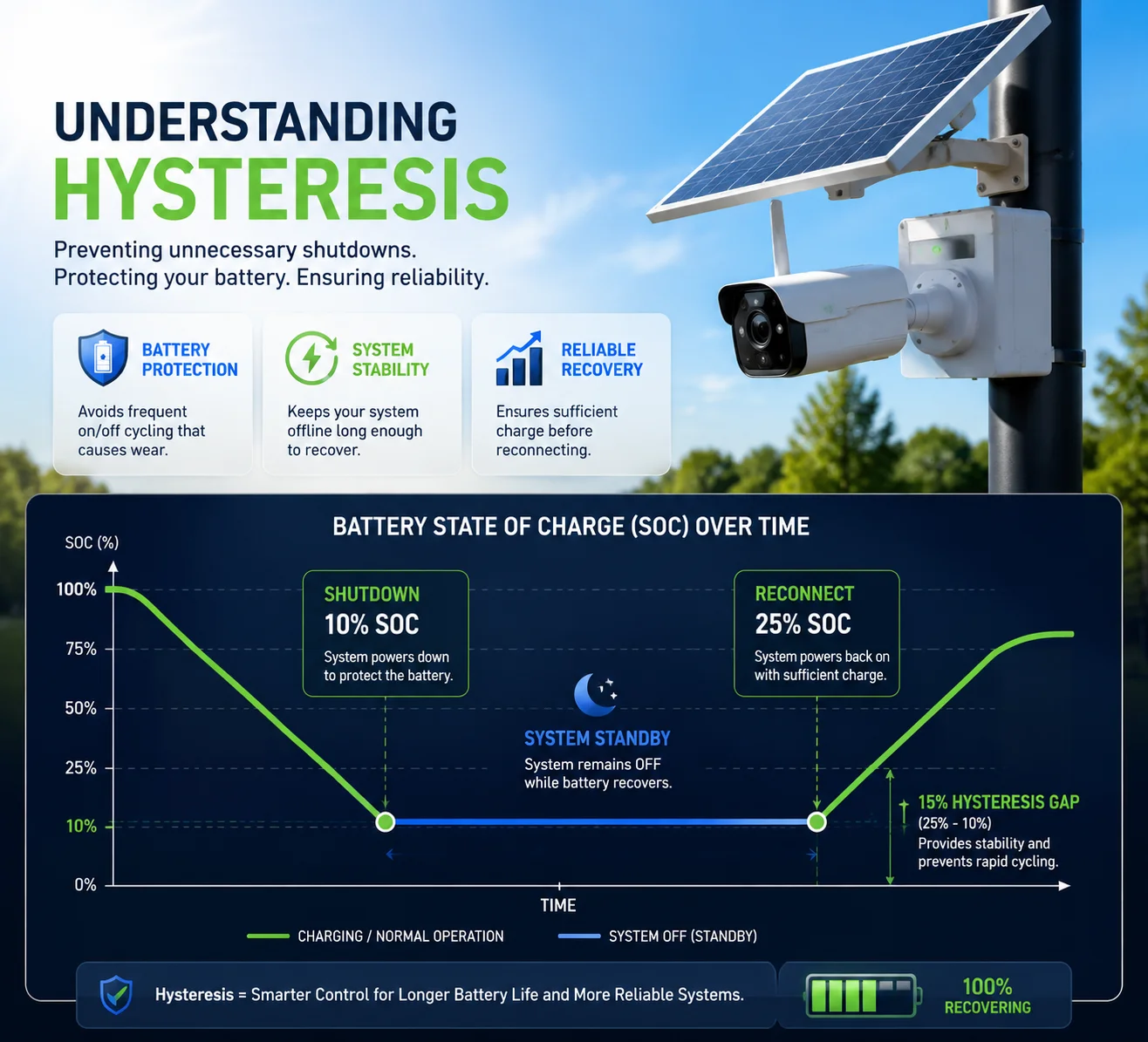
The system does not restore power at 11% — it waits until the battery reaches approximately 20% to 30% SOC before reconnecting the load. This gap between the cutoff point (10%) and the restart point (20-30%) is called hysteresis7, and it exists to prevent the system from cycling on and off repeatedly at the threshold voltage.
Why Hysteresis Matters More Than You Think
Imagine this: the battery hits 10% at midnight. The system shuts down. The sun rises at 6 AM. By 7 AM, the battery has charged back to 11%. If the system turned on immediately, the camera and 4G modem would draw a sudden burst of current. The 4G module alone needs about 2A during its initial network registration. This sudden load would pull the battery voltage right back down below the cutoff point. The system would shut down again. Then charge to 11%. Then restart. Then shut down.
This is called oscillation or relay chatter, and it is extremely damaging. Each restart cycle stresses the battery with high inrush current. The 4G modem never fully connects. The camera never finishes its boot sequence. The SD card file system can get corrupted from repeated unclean shutdowns.
Hysteresis solves this by creating a buffer zone. The system says: “I turned off at 10%. I will not turn back on until I have a comfortable margin — say, 25%.”
Typical Hysteresis Settings by Battery Type
| Battery Type | LVD Cutoff (SOC) | LVD Cutoff (Voltage, 12V system) | Recovery Threshold (SOC) | Recovery Threshold (Voltage) |
|---|---|---|---|---|
| LiFePO₄ | 10% | 11.2V | 25-30% | 12.8V |
| AGM Lead-Acid | 10% | 11.5V | 20-25% | 12.6V |
| Gel Lead-Acid | 10% | 11.6V | 20-25% | 12.7V |
What This Means for Your Project Timeline
If you are deploying in a location with strong, consistent sunlight — Arizona, Saudi Arabia, Northern Australia — the recovery time is short. The battery might go from 10% to 25% in 2-3 hours of morning sun. Your system is back online before lunch.
But if you are in the Pacific Northwest, Northern Europe, or any location with extended overcast periods, recovery can take much longer. I have seen systems stay offline for two full days during winter storms in British Columbia. The solar panel was producing less than 10% of its rated output because of thick cloud cover and short daylight hours.
How to Check Your Recovery Settings
Most quality charge controllers let you view and adjust the LVD and recovery settings through a small LCD screen on the controller, or through a companion app via Bluetooth. Look for these parameters:
- LVD Voltage (sometimes called “Low Voltage Cutoff” or “Discharge Stop Voltage”)
- LVR Voltage (Low Voltage Reconnect, or “Discharge Restart Voltage”)
If your charge controller does not let you adjust these values, they are hard-coded. This is common in integrated solar surveillance kits. The manufacturer has already set them based on the battery chemistry included in the kit. In our Loyalty-Secu solar PTZ systems, these values are pre-configured and tested during our 72-hour aging test before shipment. You do not need to touch them.
Can I Override the Emergency Shutdown for a “Critical Last Look” During a Crisis?
This is the question that keeps me up at night. A client calls during a security incident. Their camera just went offline because the battery hit 10%. They need eyes on the site right now. Can they force the system back on?
In most standard solar surveillance systems, you cannot override the LVD shutdown remotely. The cutoff is enforced at the hardware level by the charge controller and the BMS (Battery Management System)8, not by software. However, some advanced systems offer a “forced load” mode that temporarily bypasses the LVD for a short window — typically 5 to 15 minutes — before the BMS hard-cuts the circuit to prevent irreversible battery damage.
The Two Layers of Protection You Are Fighting Against
When you try to override the shutdown, you are not just fighting one system. You are fighting two independent safety layers:
Layer 1: The Solar Charge Controller. This is the first line of defense. It monitors battery voltage and controls the MOSFET switch on the load output. When voltage drops below the LVD setting, it opens the switch. Some controllers have a “Force Load” button or a software command that can temporarily close this switch. But the controller will keep monitoring. If the voltage drops further, it will cut the load again within minutes.
Layer 2: The BMS (Battery Management System). This is the second line of defense, and it is built into the battery pack itself. The BMS has its own voltage monitoring circuit, completely independent of the charge controller. If the cell voltage drops below the BMS cutoff (typically 2.5V per cell for LiFePO₄), the BMS will physically disconnect the battery using its own internal MOSFET or relay. You cannot override this from outside the battery. It is a hard safety cutoff designed to prevent thermal runaway and permanent cell damage.
What Happens If You Force It?
Let’s say you manage to bypass the charge controller’s LVD. Here is the sequence of events:
- The camera boots up. This takes 30-60 seconds. During boot, it draws about 0.8A.
- The 4G modem starts searching for a network. It draws 1.5-2.5A in bursts.
- The combined load causes the battery voltage to sag sharply.
- If the voltage drops below the BMS threshold, the BMS disconnects. Everything goes dark instantly — no graceful shutdown, no file saving.
- The SD card may suffer file system corruption from the sudden power loss.
- The battery cells may have been pushed below their safe voltage, causing permanent capacity loss.
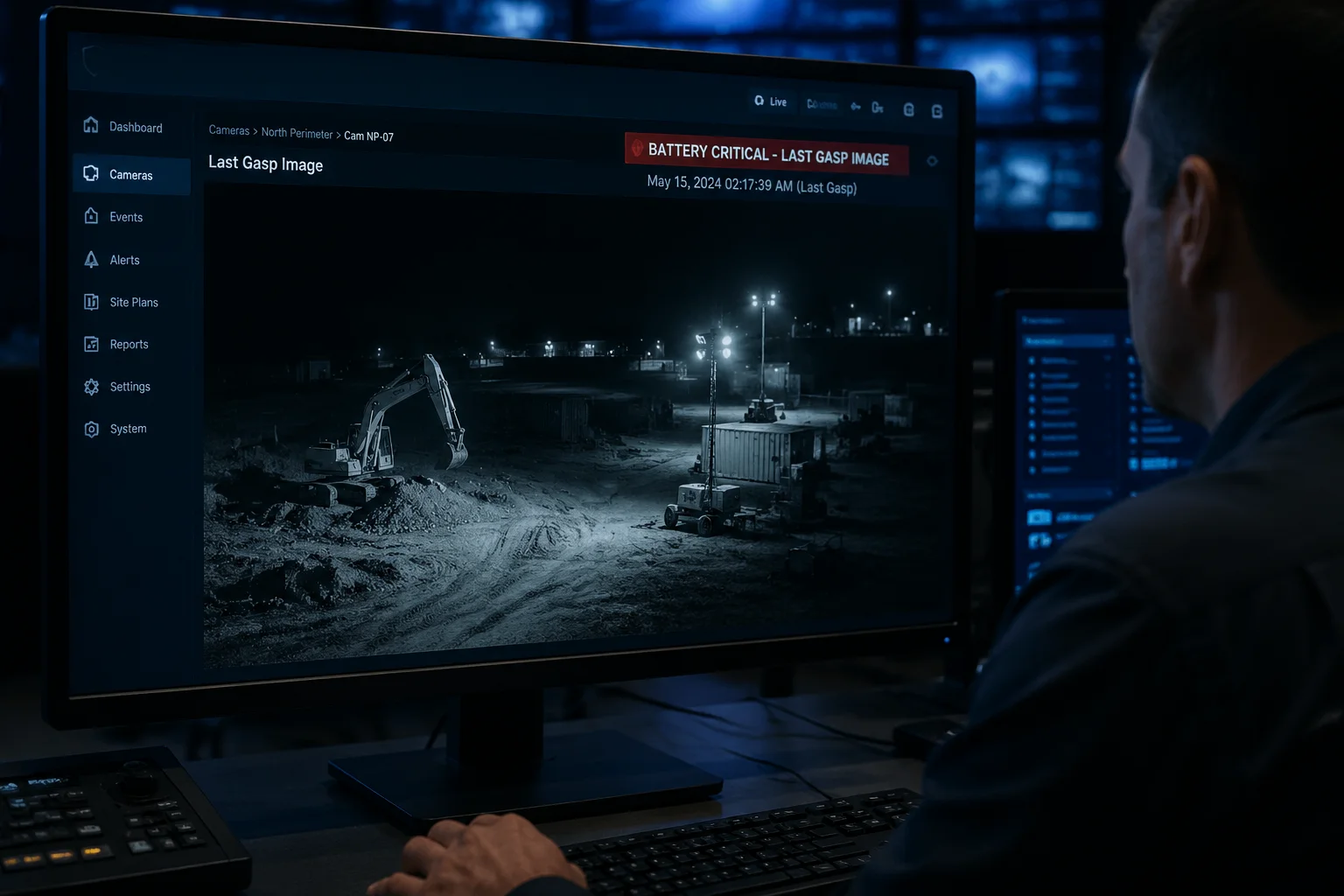
A Smarter Alternative: The “Last Gasp” Design
Instead of trying to override the shutdown during a crisis, the better approach is to design the system with a “last gasp” feature from the beginning. Here is how it works:
When the battery reaches 12% (just before the 10% LVD), the system captures a burst of high-resolution snapshots — typically 5 to 10 images — and transmits them over 4G. It also sends a GPS-tagged alert to the monitoring platform with the message: “Battery critical. Going offline. Last images attached.”
This gives the operator a final visual record of the site before the system goes dark. It is not a live stream, but it is enough to assess the situation and decide whether to send someone to the site.
At Loyalty-Secu, we have been working with integrators to implement this kind of logic in our firmware. It is a much safer approach than forcing the system to stay on and risking permanent battery damage.
My Honest Advice
If you are deploying in a location where security is truly critical — a border crossing, a high-value asset yard, a remote infrastructure site — do not rely on overriding the shutdown. Instead, size your solar and battery system with enough margin that you never hit 10% in the first place. Add a second battery. Add a larger panel. The cost of extra capacity is always less than the cost of a dead battery and a truck roll to replace it.
Conclusion
Your solar system’s “Charge Only” mode is not a flaw — it is a survival mechanism. Size your battery and panel correctly, and you will never need to worry about it.
1. Learn about lithium iron phosphate chemistry and its advantages for solar storage. ↩︎ 2. Discover how sulfation destroys lead‑acid batteries when left discharged. ↩︎ 3. Overview of how solar charge controllers manage battery charging and loads. ↩︎ 4. Understand how MPPT charge controllers maximize solar harvest. ↩︎ 5. Compare PWM and MPPT charge controller technologies. ↩︎ 6. See how MOSFET switches are used in charge controllers for load control. ↩︎ 7. Learn why hysteresis prevents battery oscillation in solar systems. ↩︎ 8. Understand the critical safety role of a BMS in lithium batteries. ↩︎