
I have seen radomes crack like eggshells after two summers in Texas. The root cause is always the same: wrong plastic, wrong additive, wrong supplier.
Yes, radome material can cause both signal attenuation and physical aging under high UV exposure. Cheap plastics like standard ABS degrade fast, changing their dielectric properties and causing up to 3 dB of signal loss. Industrial-grade ASA with HALS UV stabilizers is the proven solution — it keeps insertion loss below 0.5 dB and maintains structural integrity for 10+ years in extreme sunlight.
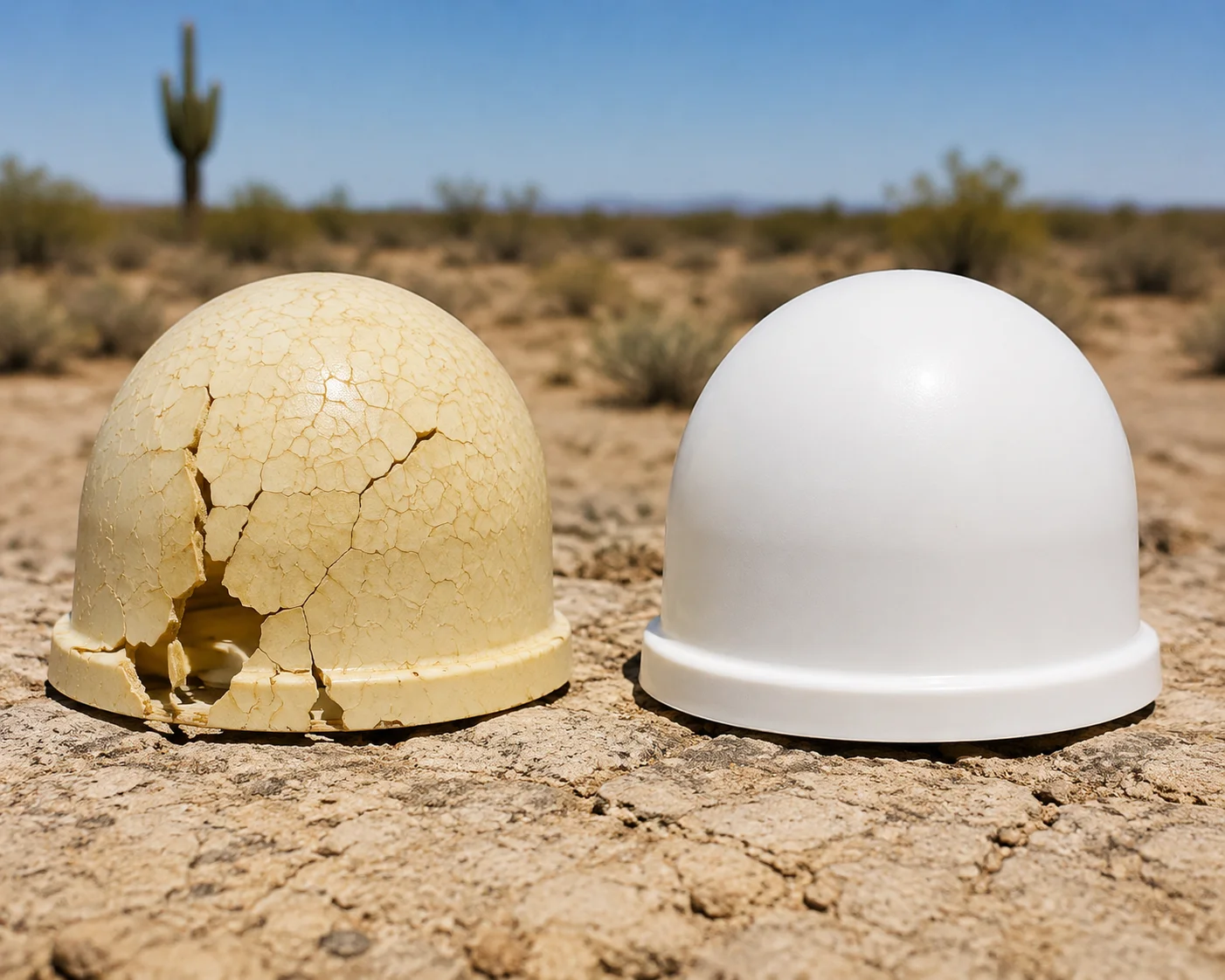
I wrote this guide because I keep getting the same question from integrators deploying solar 4G PTZ cameras in the American Southwest. Below, I break down exactly how UV damages your radome, what materials survive, and how to test before you buy.
Table of Contents
Does the Plastic Antenna Cover (Radome) Lose Its Transparency to RF Waves Over Time?
I had a client in Phoenix who blamed his carrier for weak 4G signal. Turns out, his radome had yellowed so badly that it was blocking half the RF energy. The carrier was fine. The plastic was not.
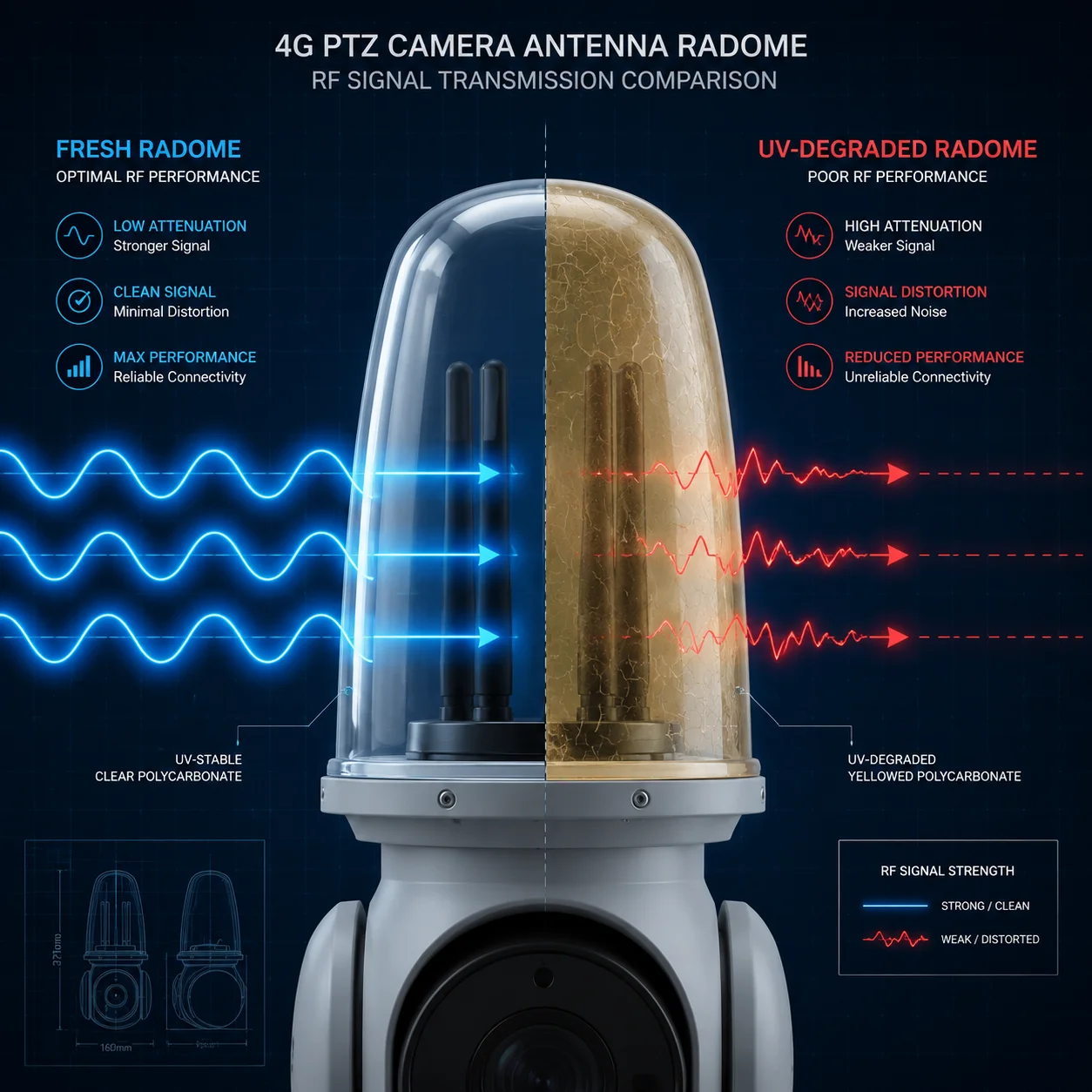
Yes, a radome can lose its RF transparency over time. UV radiation changes the molecular structure of cheap plastics, which shifts the dielectric constant and increases the loss tangent. This means more signal gets absorbed or reflected instead of passing through to the antenna.
How RF Signals Pass Through a Radome
A radome is supposed to be invisible to radio waves. Think of it like a window for light — if the glass is clean, light passes through easily. If the glass gets dirty or foggy, less light gets in. The same idea applies to RF signals and plastic.
Two numbers control how well a radome lets signals through:
- Dielectric constant ($\varepsilon_r$): This measures how much the material slows down the radio wave. Lower is better. ASA1 sits around 2.6–3.0, which is good for 4G frequencies.
- Loss tangent ($\tan\delta$): This measures how much energy the material absorbs. Again, lower is better. A fresh ASA radome has a loss tangent below 0.01.
When UV light hits a plastic radome day after day, it breaks the polymer chains. This process is called photodegradation. As the chains break, the chemical structure changes. The dielectric constant shifts. The loss tangent goes up. Your antenna now sits behind a wall that eats signal.
The Carbon Black Trap
Here is a mistake I see often. Some factories use black-colored plastic for the radome because it looks professional. But they add carbon black1 as the pigment. Carbon black is electrically conductive. Tiny conductive particles inside your radome act like thousands of small antennas — they absorb and scatter the signal.
| Radome Material | Dielectric Constant ($\varepsilon_r$) | Loss Tangent ($\tan\delta$) | Typical Insertion Loss | UV Resistance |
|---|---|---|---|---|
| ASA (no filler) | 2.6–3.0 | < 0.01 | < 0.5 dB | Excellent |
| ABS (standard) | 2.4–3.2 | 0.005–0.019 | 0.3–0.8 dB | Poor |
| ABS + Carbon Black | 3.0–5.0+ | 0.02–0.05 | 1.5–3.0+ dB | Moderate |
| Polycarbonate (PC) | 2.9–3.0 | 0.006–0.01 | 0.3–0.6 dB | Moderate |
The takeaway is simple. If your radome is black, ask the factory what pigment they used. If they say carbon black, walk away. There are RF-safe black pigments available, but they cost more. Cheap factories skip them.
What Happens After 3 Years in the Sun?
On a fresh radome, you might measure 0.3 dB of insertion loss2. After three years of Texas sun on a standard ABS radome, that number can climb to 1.5 dB or more. That does not sound like much, but 3 dB means you lost half your signal power. For a solar 4G PTZ camera on Band 717 or Band 13 — where every decibel matters — this can be the difference between a stable video stream and constant buffering.
At Loyalty-Secu, we test every radome batch with a network analyzer before and after accelerated UV aging. If the insertion loss increases by more than 0.2 dB, that batch gets rejected.
How Many Years Can the Antenna Housing Last in the Arizona Desert Without Cracking?
I once received a warranty claim with photos that told the whole story. The radome had split open along the seam like a cracked walnut. It was only 18 months old. The material was standard ABS with no UV protection. In Arizona. That is a recipe for failure.
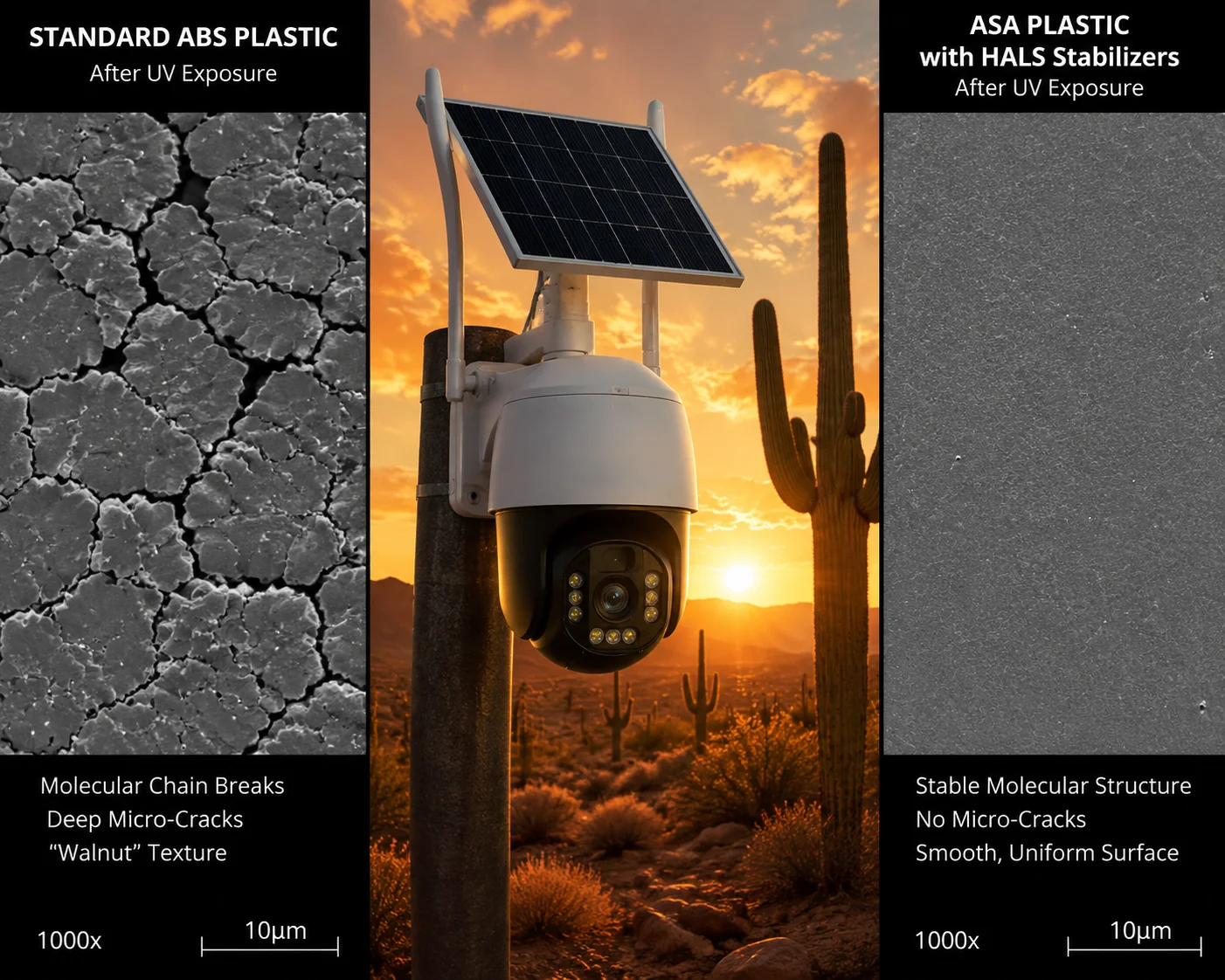
A properly made ASA radome with HALS UV stabilizers can last 10 to 15 years in the Arizona desert without cracking. Standard ABS without UV protection will start showing surface cracks within 1 to 3 years. The key difference is the base resin and the additive package.
Why Plastic Cracks in the Desert
The Arizona desert hits plastic with a triple threat: intense UV radiation, extreme heat cycling, and very low humidity. Let me explain each one.
UV radiation breaks polymer chains through a process called photo-oxidation6. When UV photons hit the plastic surface, they create free radicals. These free radicals attack nearby polymer chains and break them apart. Over time, the surface becomes brittle. Tiny micro-cracks form. These cracks grow deeper with each thermal cycle.
Heat cycling makes things worse. Daytime surface temperatures on a dark-colored radome can reach 80°C (176°F) or higher. At night, it drops to near freezing in winter. This constant expansion and contraction stresses the already-weakened surface layer. The micro-cracks become macro-cracks.
Low humidity means there is no moisture to slow down the oxidation process. In humid climates, a thin water layer on the surface can actually absorb some UV. In the desert, the plastic gets the full dose.
ASA vs. ABS: A Material Comparison
The reason ASA outperforms ABS comes down to chemistry. ABS uses butadiene rubber as its toughening agent. Butadiene contains carbon-carbon double bonds (C=C). These double bonds are the weak point — UV radiation attacks them first. Once the butadiene phase degrades, the plastic loses its impact strength and becomes brittle.
ASA replaces butadiene with acrylic rubber. Acrylic rubber has no double bonds. UV radiation simply has less to attack. This is not an additive solution — it is a fundamental material advantage.
The Role of HALS Additives
Even with ASA, we add HALS (Hindered Amine Light Stabilizers) to our custom housings. HALS work differently from UV absorbers. UV absorbers try to block UV light before it reaches the polymer. HALS do something smarter — they catch the free radicals after they form and neutralize them before they can break polymer chains.
The beauty of HALS is that they regenerate themselves during the process. One HALS molecule can neutralize thousands of free radicals over its lifetime. This is why HALS-stabilized ASA can pass 1,000+ hours of xenon arc testing and still retain over 90% of its original impact strength.
| Test Parameter | ABS (No UV Stabilizer) | ABS + UV Absorber | ASA + HALS |
|---|---|---|---|
| Impact strength after 1,000h xenon arc | < 30% retained | 50–60% retained | > 90% retained |
| Surface crazing onset | 200–400 hours | 600–800 hours | > 2,000 hours |
| Color change ($\Delta E$) after 3 years outdoor | > 8.0 | 4.0–6.0 | < 3.0 |
| Expected outdoor life (Arizona) | 1–3 years | 3–5 years | 10–15 years |
A Note on Wall Thickness
Material choice is not the only factor. Wall thickness matters too. A radome that is too thin will crack sooner because the UV-degraded layer makes up a larger percentage of the total wall. A radome that is too thick will cause more signal loss. We target a wall thickness of 2.0–2.5 mm for our 4G radomes. This gives a good balance between mechanical strength and RF performance.
Does the Factory Use UV-Stabilized ASA or ABS for the Antenna’s Exterior Shell?
I always tell my clients: do not ask the factory what material they use. Ask them to prove it. I have seen too many suppliers claim “UV-stabilized material” on their spec sheet while actually using recycled ABS with no additives at all.
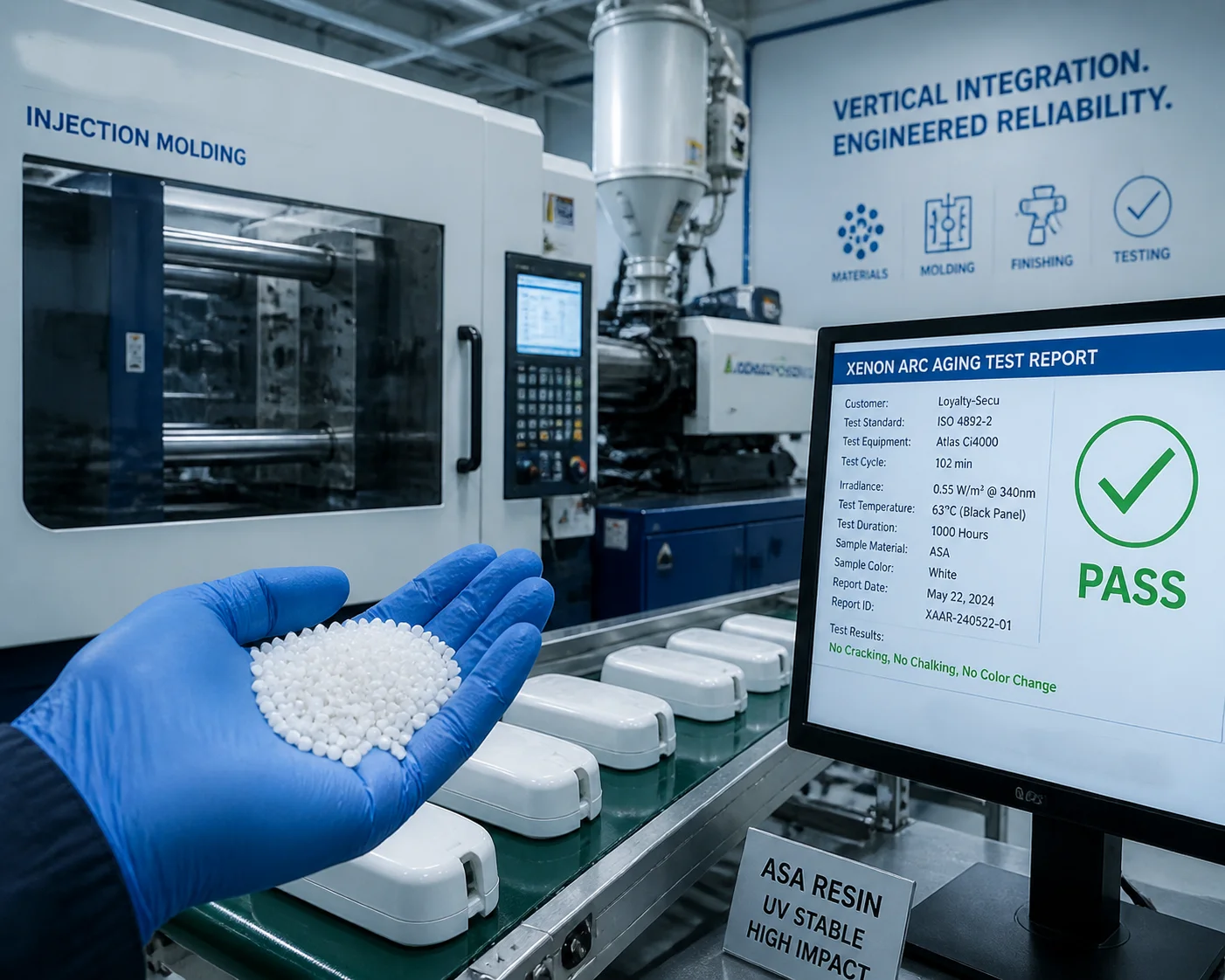
Most budget factories use standard ABS or even recycled plastics for the antenna shell. Professional manufacturers like Loyalty-Secu use virgin ASA resin with HALS UV stabilizers. The only way to know for sure is to request material certificates (COA) and aging test reports from the resin supplier.
How to Verify Material Claims
David, if you are evaluating a new PTZ supplier, here is exactly what to ask for:
Step 1: Request the Material Data Sheet (MDS). This document comes from the resin manufacturer — not the camera factory. It lists the base polymer, filler content, UV stabilizer type, and key mechanical properties. If the factory cannot provide this, they probably do not control their material sourcing.
Step 2: Check the resin grade. Look for well-known ASA grades from major resin producers like BASF (Luran S), LG Chem, or Chi Mei. These companies publish detailed weathering data for each grade. If the factory uses a no-name resin, you have no way to predict long-term performance.
Step 3: Ask for xenon arc test results. This is the gold standard for accelerated weathering. The test exposes the material to intense UV light, heat, and moisture in a controlled chamber. 1,000 hours of xenon arc exposure roughly simulates 3–5 years of outdoor exposure in the southern United States. You want to see impact strength retention above 85% and color change ($\Delta E$) below 3.0.
Why In-Mold Color Beats Paint
I strongly recommend choosing radomes with in-mold color — meaning the color is mixed into the plastic pellets before injection molding. Here is why:
Paint creates a separate layer on top of the plastic. Under UV exposure, the paint layer and the plastic layer age at different rates. The paint cracks and peels first. Peeling paint flakes hanging near the antenna element create unpredictable signal reflections. I have measured VSWR4 jumps of 0.5 or more just from paint peeling on a radome.
With in-mold color, the color is part of the plastic itself. There is no separate layer to peel. The surface ages uniformly. And if you choose a light color like white or light gray, you get a bonus — the surface absorbs less heat, which reduces thermal stress on the entire housing.
Our Quality Control Process
At Loyalty-Secu, we own our mold shop. This gives us full control over the injection molding process. Every batch of ASA resin is tested for melt flow index (MFI)8 before it goes into the machine. If the MFI is out of spec, the batch is rejected. After molding, we pull random samples and run a 72-hour accelerated aging test in our in-house UV chamber. Only batches that pass go into production.
This level of control is only possible because we have a vertical supply chain. If a factory outsources their housing to a third-party molder, they lose visibility into material quality. That is a risk you do not want to take on a 5-year deployment in the desert.
Will “Chalking” on the Radome Surface Interfere with the 4G Signal Quality?
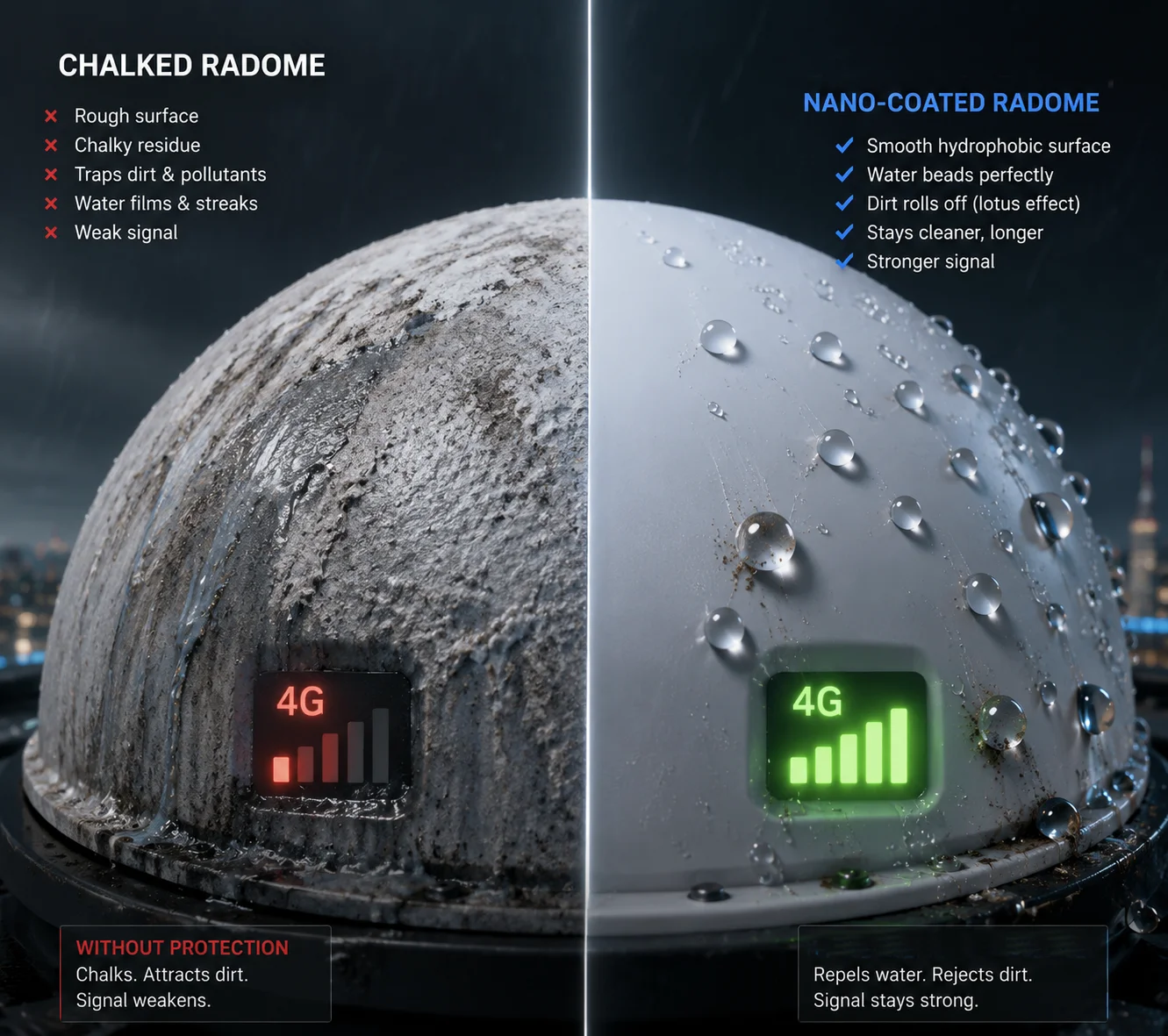
I got a call from a project manager in West Texas last year. He said his cameras were “losing bars” every summer. We asked him to send a photo of the radome. The surface was covered in a white, powdery film. That is chalking. And yes, it was killing his signal.
Chalking — the white powdery residue that forms on UV-degraded plastic surfaces — can interfere with 4G signal quality. The degraded surface layer has altered dielectric properties, and the rough texture traps dust and moisture, both of which increase signal attenuation. A hydrophobic nano-coating on the radome surface is the most effective prevention.
What Is Chalking and Why Does It Happen?
Chalking is the visible result of surface-level polymer degradation. When UV breaks down the top layer of plastic, the polymer chains fragment into short, loose segments. These fragments lose their bond to the bulk material and sit on the surface as a fine white powder. You can wipe it off with your finger, but it comes back because the degradation continues underneath.
Chalking is most common on ABS and low-grade polypropylene. ASA is much more resistant, but even ASA can chalk after many years without proper stabilization.
How Chalking Affects RF Performance
The chalked surface layer is not the same material as the original plastic. Its dielectric properties have changed. But the bigger problem is what the rough, chalked surface attracts:
Dust accumulation. A smooth radome sheds dust in the wind and rain. A chalked radome acts like sandpaper — dust particles stick to the rough surface and build up over time. A thick dust layer adds dielectric loss and can increase insertion loss by 0.3–0.8 dB depending on thickness and composition.
Water film retention. This is the real killer. A smooth, hydrophobic surface lets rain water bead up and roll off. A chalked surface holds water in a thin, continuous film. Water has a dielectric constant of about 80 — compared to about 3 for ASA. Even a thin water film on the radome dramatically increases signal reflection and absorption. I have measured signal drops of 3–5 dB during rain on a chalked radome versus less than 1 dB on a coated one.
The Hydrophobic Nano-Coating Solution
We apply a hydrophobic nano-coating5 to all our outdoor radomes. This coating creates a surface with a water contact angle greater than 110°. Water beads up into droplets and rolls off immediately, carrying dust with it. This is sometimes called the “lotus effect.”
| Surface Condition | Water Contact Angle | Dust Accumulation Rate | Signal Loss During Rain | Expected Cleaning Interval |
|---|---|---|---|---|
| New ASA (uncoated) | 70–80° | Moderate | 1.0–2.0 dB | Every 6 months |
| Chalked ABS (no coating) | 30–50° | High | 3.0–5.0 dB | Every 1–2 months |
| ASA + Hydrophobic coating | > 110° | Very low | < 0.5 dB | Every 12–18 months |
Practical Advice for Long-Term Deployments
David, for your off-grid solar PTZ projects, here are three things you can do right now to protect your radome investment:
1. Request a VSWR comparison test. Ask the factory to measure the antenna’s VSWR with and without the radome installed. If the VSWR jumps from 1.5 to anything above 2.0, the radome material is not RF-friendly. A good radome should add less than 0.3 to the VSWR reading.
2. Ask for the Yellowing Index ($\Delta E$) after aging. A $\Delta E$ value below 3.0 after 1,000 hours of xenon arc testing means the material will hold up for years. Anything above 5.0 means visible yellowing and likely chalking within 2–3 years.
3. Demand a drop test after aging. This is the test most factories skip. It is easy to pass a drop test on fresh plastic. The real question is: will the housing survive a drop after sitting in the sun for three years? We run a ball drop impact test on samples that have already been through 1,000 hours of UV aging. If the sample cracks, the material fails. No exceptions.
These three tests — VSWR, Yellowing Index, and post-aging drop test — will tell you more about a radome’s real-world performance than any marketing brochure ever could.
Conclusion
The radome is not just a plastic cover — it is a critical RF component. Choose ASA with HALS stabilizers, avoid carbon black pigments, apply hydrophobic coatings, and always verify with real test data. Your 4G signal and your hardware will last years longer.
1. Understand why ASA outperforms ABS in UV resistance. ↩︎ 2. Key metric for signal power lost through the radome. ↩︎ 3. Conductive pigment that can ruin RF transparency – avoid in radomes. ↩︎ 4. Voltage Standing Wave Ratio – indicator of impedance matching and signal reflection. ↩︎ 5. Prevents water film and dust buildup that cause signal loss. ↩︎ 6. UV-triggered chain scission that makes plastics brittle. ↩︎ 7. Low-band LTE frequency critical for long-range rural coverage. ↩︎ 8. Indicator of polymer consistency and processing behavior. ↩︎