
I’ve seen too many solar PTZ cameras drop offline in the field — right when the client needed them most. The root cause? A single antenna that can’t handle real-world signal conditions.
High-end solar PTZ cameras must use dual antennas to enable 2×2 MIMO (Multiple-Input Multiple-Output). This design doubles data throughput, fights signal fading in harsh environments, and cuts packet retransmission — all of which are critical for stable 4K video over 4G in off-grid locations where power and bandwidth are both limited.
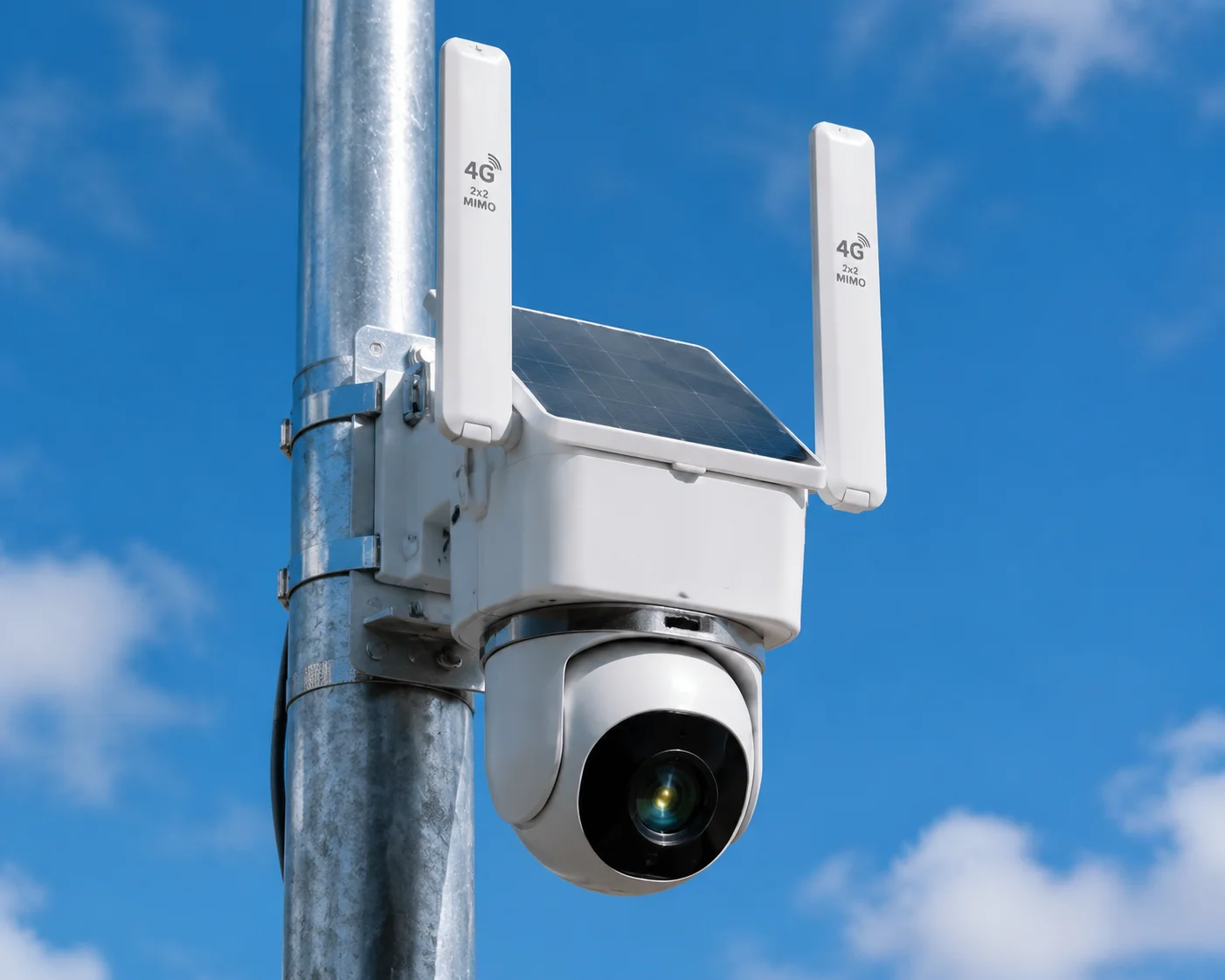
Below, I break down the four most common questions I get from integrators and engineers about MIMO in solar PTZ cameras. Each answer is based on real deployment data and the RF engineering behind it. If you’re sourcing high-end solar PTZs from China, this is the technical foundation you need to understand before signing a PO.
Table of Contents
How Does MIMO (Multiple-Input Multiple-Output) Increase My Upload Speed for 4K?
Every integrator I work with asks the same thing first: “Can this camera actually push 4K over 4G?” The honest answer depends entirely on whether the camera uses real MIMO or not.
MIMO uses two antennas to create two independent data streams over the same frequency band. This doubles the theoretical upload speed — from around 50 Mbps (SISO) to 100 Mbps (2×2 MIMO) on LTE Cat 4. For 4K video compressed with H.265, you need 6–12 Mbps of stable uplink. Only MIMO can reliably deliver this in weak-signal areas.
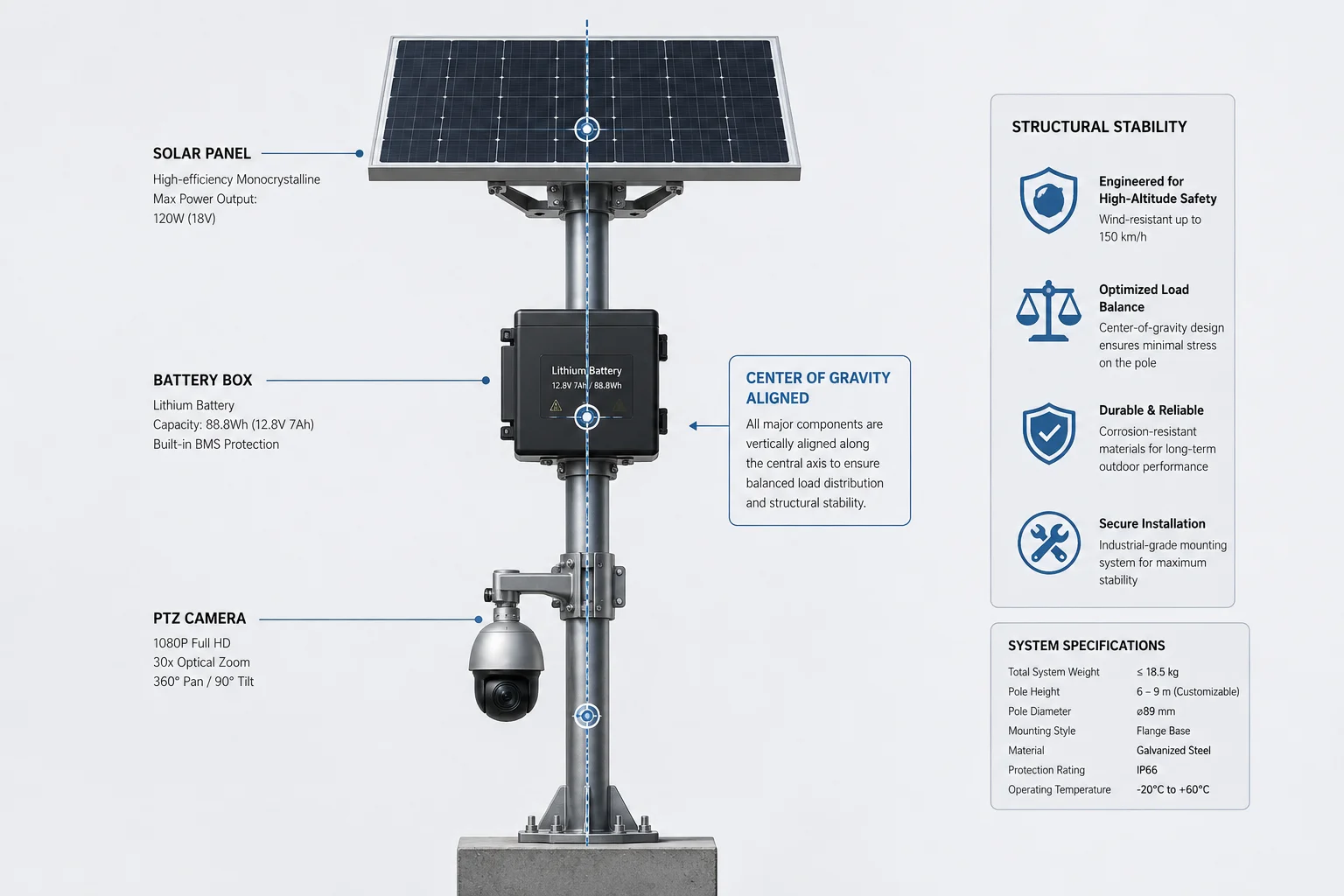
How Spatial Multiplexing Works in Practice
MIMO doesn’t just “boost” the signal. It does something smarter. It splits your data into two separate streams and sends each stream through a different antenna at the same time, on the same frequency. The base station receives both streams through its own antennas and recombines them. This is called spatial multiplexing1.
Think of it like a two-lane highway versus a single-lane road. The road width (frequency band) stays the same. But you’re moving twice the traffic.
Why This Matters for 4K Solar PTZ Cameras
A 4K video stream compressed with H.265 typically needs 6–12 Mbps of sustained upload bandwidth. Add AI metadata, alarm snapshots, and two-way audio, and you’re looking at 10–15 Mbps total.
Now consider where solar PTZ cameras are deployed: construction sites, farms, remote warehouses, border areas. These locations often sit at the edge of cell tower coverage. Signal strength (RSRP2) is low. In these conditions, a single-antenna (SISO) 4G module might only achieve 10–20 Mbps downlink and 5–10 Mbps uplink. That’s barely enough for 1080p — and nowhere near enough for 4K with AI features running.
With 2×2 MIMO, the same module in the same location can push 30–50 Mbps downlink and 15–25 Mbps uplink. That headroom is the difference between smooth 4K and a frozen frame.
Real-World Speed Comparison
| Metric | Single Antenna (SISO) | Dual Antenna (2×2 MIMO) |
|---|---|---|
| LTE Cat 4 Peak Download | 150 Mbps | 150 Mbps |
| LTE Cat 4 Peak Upload | 50 Mbps | 50 Mbps |
| Typical Upload at -90 dBm RSRP | 3–8 Mbps | 8–18 Mbps |
| 4K H.265 Stream Feasibility | Unstable / not possible | Stable and reliable |
| Concurrent AI + Video + Audio | Frequent buffering | Smooth operation |
The key takeaway: MIMO doesn’t change the theoretical peak speed of LTE Cat 4. But it dramatically improves the real-world speed you actually get in weak signal conditions. And weak signal is the default condition for solar PTZ deployments.
A Note on “Fake” Dual Antennas
I need to mention this because I’ve seen it too many times. Some low-cost PTZ cameras have two antennas on the outside, but inside, only one antenna is connected to the 4G module. The second antenna is just for looks. A real MIMO design requires the 4G module to have two RF ports: MAIN and DIV (diversity). If you open the camera and see only one coaxial cable running to the module, it’s not MIMO. It’s marketing.
At Loyalty-Secu, every dual-antenna solar PTZ we build has both RF ports connected and tested. We can provide internal photos and RF test reports to verify this.
Can Dual Antennas Help Maintain a Link in Multipath Environments Like Urban Alleys?
Multipath is the silent killer of wireless video. I’ve personally debugged installations where the camera had full signal bars but still dropped frames every few seconds. The problem wasn’t signal strength — it was multipath fading.
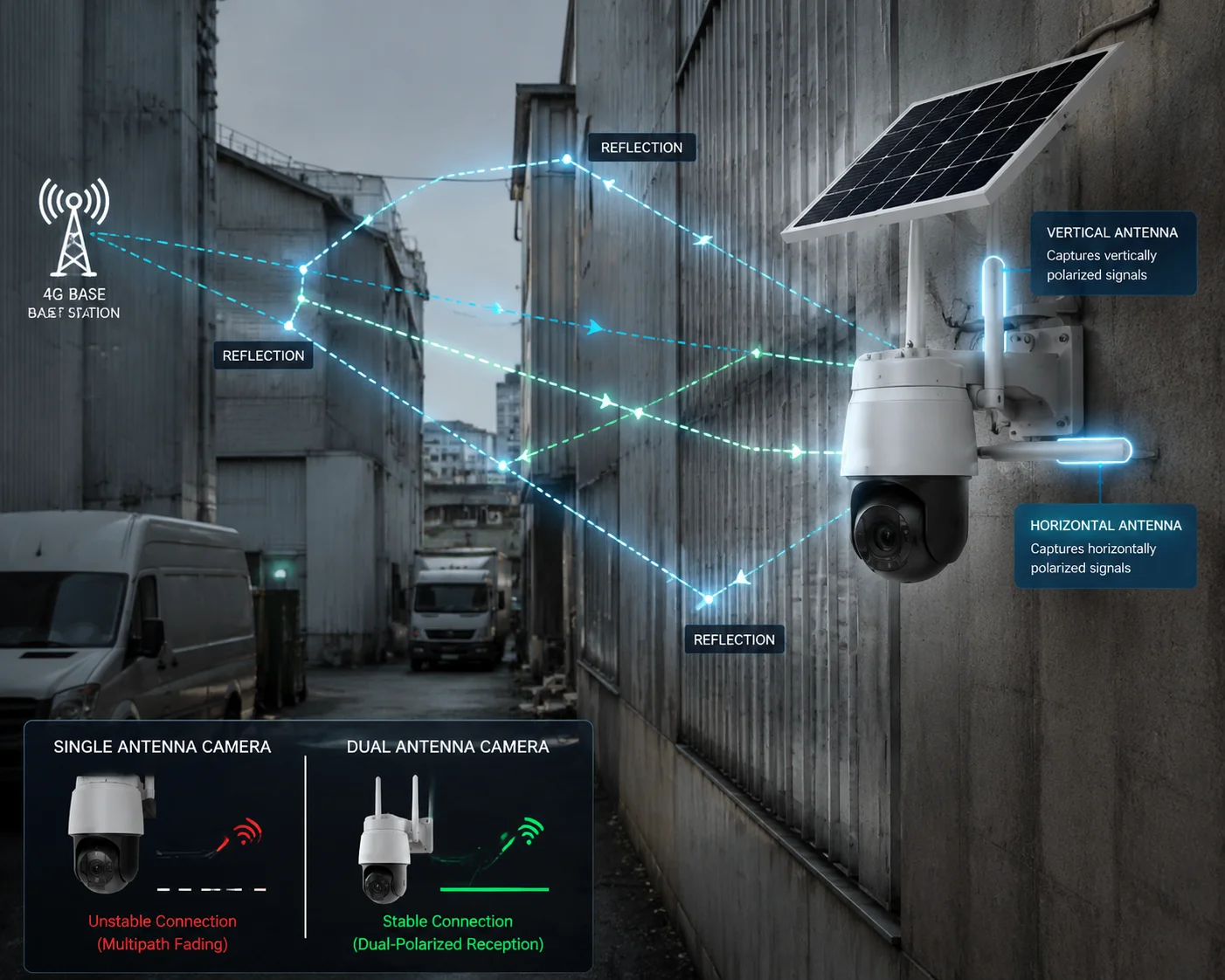
Yes. Dual antennas provide spatial diversity, which is the most effective way to combat multipath fading. When a signal bounces off walls, vehicles, or metal structures in an urban alley, the two antennas receive different versions of that signal. The 4G module combines them intelligently, avoiding the “dead spots” that cause a single antenna to lose connection.
What Is Multipath Fading and Why Does It Kill Video?
When a 4G signal travels from a cell tower to your camera, it doesn’t just go in a straight line. It bounces off buildings, cars, fences, the ground, and even trees. These reflected copies of the signal arrive at the antenna at slightly different times and phases.
Sometimes, the reflected signal and the direct signal arrive out of phase — meaning their waves cancel each other out. This is called destructive interference or deep fading. When it happens, the signal strength at the antenna drops sharply, sometimes by 20–30 dB in an instant. That’s enough to kill a video stream mid-frame.
In urban alleys, construction corridors, and warehouse yards, multipath is everywhere. Metal walls, concrete surfaces, and narrow passages create intense reflections.
How Spatial Diversity Solves This
The two antennas on a MIMO-equipped PTZ are spaced apart — typically by a quarter wavelength (about 4 cm at 1800 MHz). This physical separation means that when one antenna sits in a fading null (a dead spot), the other antenna is almost certainly not in a null. The probability of both antennas experiencing deep fading at the same time is extremely low.
The 4G module uses one of two strategies:
- Selection diversity: It picks the antenna with the stronger signal at any given moment.
- Maximal ratio combining (MRC)3: It combines signals from both antennas, weighting each by its quality, to produce a single stronger signal.
Both methods result in a much more stable connection.
Cross-Polarized Antenna Design
High-end solar PTZ cameras from Loyalty-Secu use cross-polarized antennas4. One antenna is oriented vertically, the other horizontally. This captures signal energy from both polarization planes.
Why does this matter? Because when a signal reflects off a surface, its polarization rotates. A vertically polarized signal might become partially horizontal after bouncing off a metal wall. A single vertical antenna would miss that energy. But a cross-polarized pair captures it.
This provides an additional 3–5 dB of effective gain. In a marginal signal area, 3 dB means doubling the effective signal power. That’s often the difference between a stable 1080p stream and a “No Signal” error on your VMS screen.
Multipath Performance: SISO vs. MIMO
| Scenario | SISO (Single Antenna) | 2×2 MIMO (Dual Antenna) |
|---|---|---|
| Urban alley with metal walls | Frequent deep fades, video freezes | Stable link via diversity combining |
| Construction site with cranes | Signal drops when crane moves | Maintains connection through reflections |
| Warehouse yard with containers | Dead zones between containers | Covers gaps with dual-path reception |
| Signal fluctuation range | -75 to -105 dBm (wide swings) | -78 to -92 dBm (narrow, stable) |
| Equivalent gain from diversity | 0 dB (baseline) | +3 to +6 dB |
For any deployment where the camera is surrounded by reflective surfaces — and that includes most real-world sites — dual-antenna MIMO is not optional. It’s the minimum requirement for a reliable video link.
Does the Camera’s 4G Module Support “Diversity Reception” to Reduce Packet Loss?
Packet loss5 is the metric that keeps my engineering clients up at night. A 2% packet loss rate might sound small, but for real-time video, it means visible artifacts, frozen frames, and angry end users calling your support line.
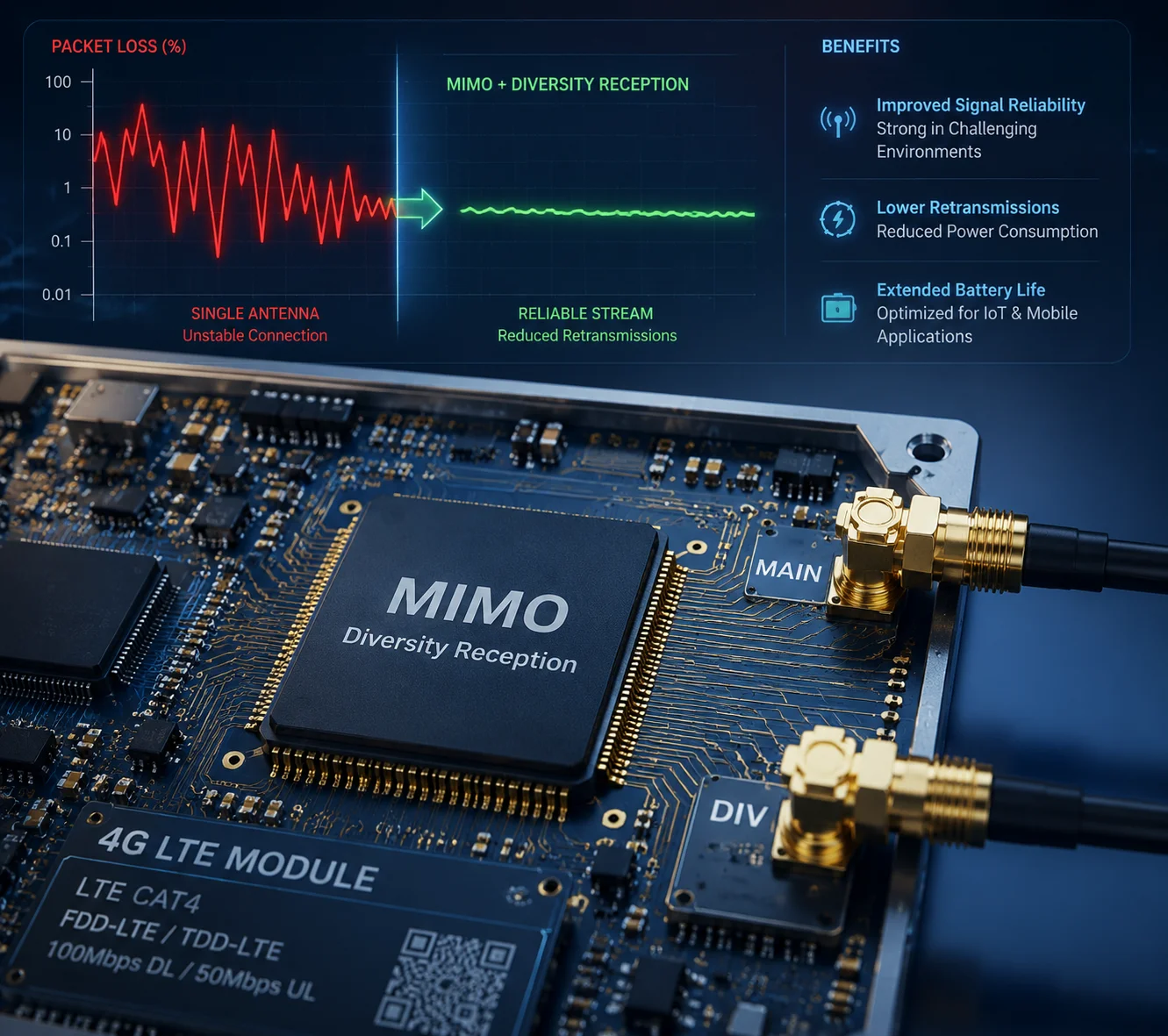
Yes. A properly designed dual-antenna 4G module supports diversity reception (also called RX diversity). The module continuously monitors signal quality on both antennas and combines or selects the best signal in real time. This reduces packet loss by 30–50% compared to a single-antenna setup, which directly translates to smoother video and fewer retransmissions.
How Packet Loss Happens in Solar PTZ Deployments
Packet loss in 4G connections happens for several reasons:
- Signal fading: Momentary drops in signal strength cause the modem to miss data packets.
- Interference: Other devices or cell users on the same frequency create noise.
- Handover failures: The camera switches between cell towers and loses packets during the transition.
- Buffer overflow: The modem can’t process incoming data fast enough during signal recovery.
In a solar PTZ deployment, all four of these happen regularly. The camera is outdoors, exposed to weather, far from the tower, and sharing bandwidth with other users.
The Role of the DIV (Diversity) Antenna Port
A real MIMO 4G module has two antenna connectors:
- MAIN: The primary antenna port. Used for both transmitting (TX) and receiving (RX).
- DIV (Diversity/Auxiliary): The secondary antenna port. Used for receiving (RX) only in most LTE Cat 4 modules.
The DIV port enables receive diversity. The module compares the signal received on MAIN and DIV, then uses the better one — or combines both. This is especially powerful against fast fading, where the signal quality changes rapidly (e.g., wind moving tree branches, vehicles passing nearby).
Impact on Retransmission and Power Consumption
When a packet is lost, the 4G protocol (RLC layer6) requests a retransmission. Retransmissions are expensive:
- They consume extra airtime and battery power.
- They add latency to the video stream.
- They reduce effective throughput.
For a solar-powered camera, every retransmission wastes precious energy. The 4G module stays in high-power TX mode longer, draining the battery faster.
With diversity reception, the module catches more packets on the first attempt. Fewer retransmissions mean:
- 10–30% lower power consumption for the 4G module.
- Faster sleep cycles: The module finishes uploading alarm clips sooner and returns to deep sleep mode.
- Longer battery life during cloudy days: This is critical for solar PTZ cameras that need to survive 7–15 days without sunlight.
What to Check in the Datasheet
When you evaluate a solar PTZ camera, look for these indicators of real diversity support:
- 4G module model: Check if it’s a known MIMO-capable module (e.g., Quectel EC257, SIMCom A7600, etc.).
- Antenna ports: The spec sheet should list both MAIN and DIV antenna connectors.
- Antenna gain: Both antennas should have specified gain values (typically 3–5 dBi for external antennas).
- RF test report: Ask the manufacturer for conducted sensitivity and TRP/TIS test data showing both ports active.
If the manufacturer can’t provide this information, the second antenna is likely decorative.
Will the Camera Still Function If One of the Two Antennas Is Damaged or Blocked?
This is a question I hear from every experienced integrator. They’ve all had a bird nest on an antenna, a branch fall on a cable, or ice coat an antenna in winter. They want to know: does the system go down?
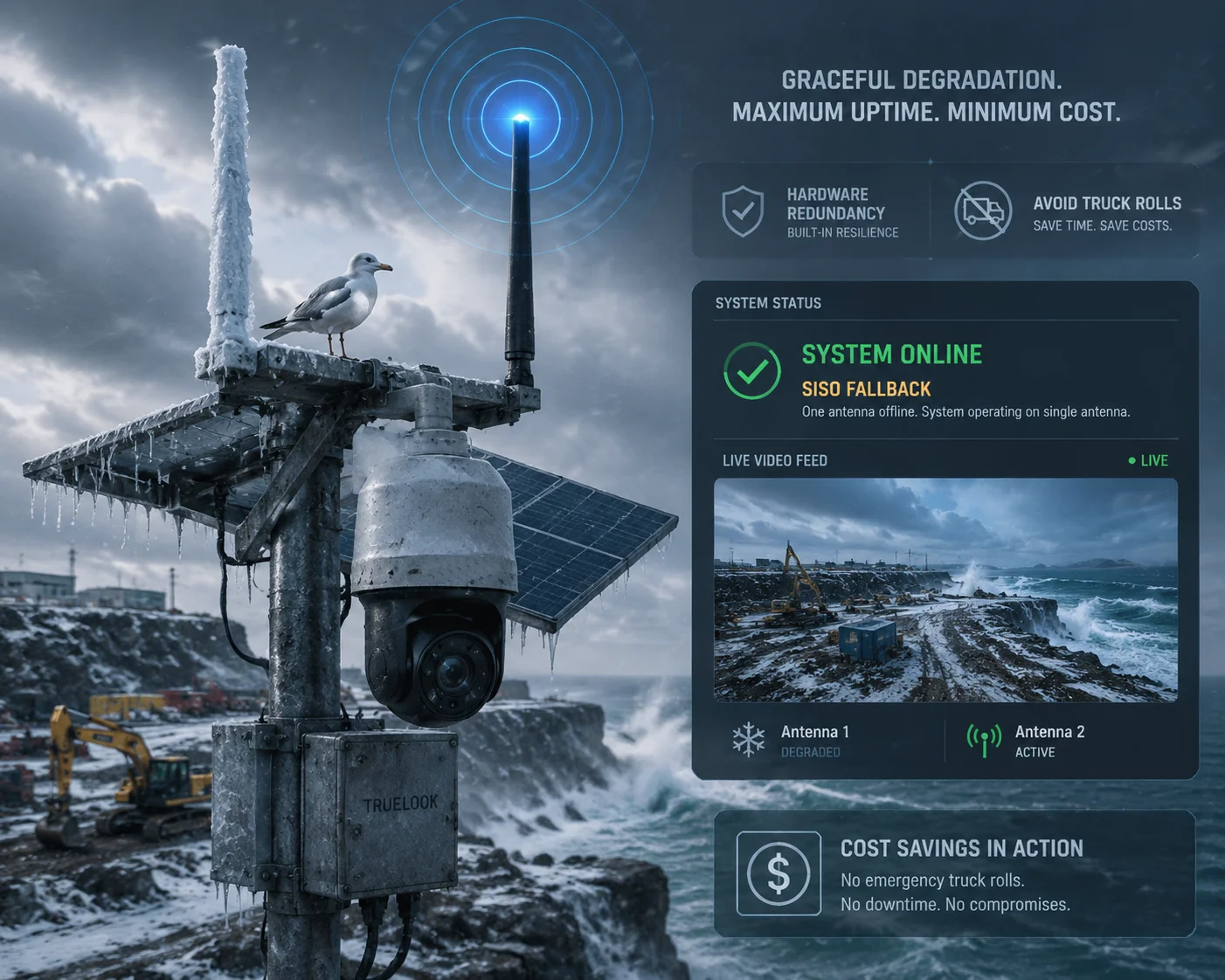
No, the camera will not go down. If one antenna is damaged or blocked, the 4G module automatically falls back to single-antenna (SISO) mode using the remaining functional antenna. Video quality may decrease and latency may increase, but the camera stays online. This built-in redundancy is one of the strongest arguments for dual-antenna design in remote, hard-to-service locations.
Graceful Degradation, Not Total Failure
This is what engineers call graceful degradation. The system doesn’t crash. It adapts. When the 4G module detects that one antenna port has poor or no signal, it stops using that port for diversity combining and operates on the remaining antenna alone.
In SISO fallback mode, you lose the benefits of spatial diversity and spatial multiplexing. But you keep the connection. The camera continues to:
- Stream video (possibly at reduced resolution, e.g., 1080p instead of 4K).
- Send motion detection alerts.
- Respond to PTZ control commands.
- Upload alarm clips to cloud storage.
For a camera mounted on a 6-meter pole at a remote construction site, this redundancy is invaluable. The alternative — a single-antenna camera that goes completely offline when that one antenna fails — means a truck roll, a technician, a ladder, and half a day of lost coverage.
Common Causes of Antenna Failure in the Field
Based on feedback from our clients across the US, Middle East, and Southeast Asia, here are the most common reasons an antenna stops working:
- Bird activity: Birds perch on antennas, build nests around them, or peck at cables.
- Ice and snow: Ice coating changes the antenna’s resonant frequency and blocks RF energy.
- UV degradation: Cheap antenna housings crack after 1–2 years of sun exposure, allowing moisture in.
- Physical impact: Falling branches, hail, or vandalism.
- Connector corrosion: Salt spray in coastal areas corrodes SMA connectors8 over time.
With dual antennas, any single failure leaves the system operational. The site manager gets a signal quality alert (RSSI drop) and can schedule maintenance at a convenient time — not as an emergency.
Redundancy Comparison: Single vs. Dual Antenna
| Failure Scenario | Single Antenna (SISO) | Dual Antenna (MIMO) |
|---|---|---|
| One antenna blocked by bird nest | Total signal loss, camera offline | Falls back to SISO, stays online |
| Antenna cable damaged by UV | No connection until repaired | Operates on remaining antenna |
| Ice coating on one antenna | Severe signal degradation or dropout | Diversity switches to clear antenna |
| Connector corrosion (coastal site) | Intermittent connection, unreliable | Redundant path maintains stability |
| Time to schedule repair | Immediate (emergency truck roll) | Planned maintenance at convenience |
The Cost of a Truck Roll vs. the Cost of a Second Antenna
Let me put this in business terms. In the US, a single truck roll to a remote site costs $300–$800 (fuel, labor, equipment). In some cases, it requires a bucket truck or crane, pushing costs above $1,500.
The cost difference between a single-antenna and dual-antenna 4G module inside the camera is roughly $3–$8 at the component level. The cost of a second external antenna is $2–$5.
So for less than $15 in hardware cost, you avoid a potential $500+ emergency service call. For any integrator running a portfolio of 50–200 remote cameras, this math is obvious.
At Loyalty-Secu, we design every high-end solar PTZ with dual-antenna MIMO as standard — not as an upgrade option. Because in the field, redundancy isn’t a luxury. It’s a requirement.
Conclusion
Dual-antenna MIMO in high-end solar PTZ cameras is not a feature — it’s a structural necessity. It doubles throughput, fights multipath fading, cuts packet loss, saves battery, and provides antenna redundancy. If your solar PTZ doesn’t have real 2×2 MIMO, it’s not ready for the field.
1. How MIMO uses spatial multiplexing to send multiple data streams over the same frequency. ↩︎ 2. Definition of Reference Signal Received Power, a key metric for 4G signal strength. ↩︎ 3. An antenna combining technique that weights signals by quality to maximize SNR. ↩︎ 4. Explanation of how using both vertical and horizontal polarization improves signal capture. ↩︎ 5. Overview of packet loss in networks and its effects on real-time video streaming. ↩︎ 6. Explanation of the Radio Link Control protocol in 4G that handles retransmissions. ↩︎ 7. Specifications of the Quectel EC25 LTE module, a common MIMO-capable module. ↩︎ 8. Standard RF connector type used for antenna connections in many wireless devices. ↩︎