
I have seen small screws ruin good outdoor systems. I choose SS316 because I want to stop rust, protect the housing, and avoid costly field failures.
SS316 external fasteners help outdoor systems survive salt, moisture, and mixed-metal contact. They resist pitting better than SS304, reduce galvanic corrosion risk, and stay serviceable after years of exposure.
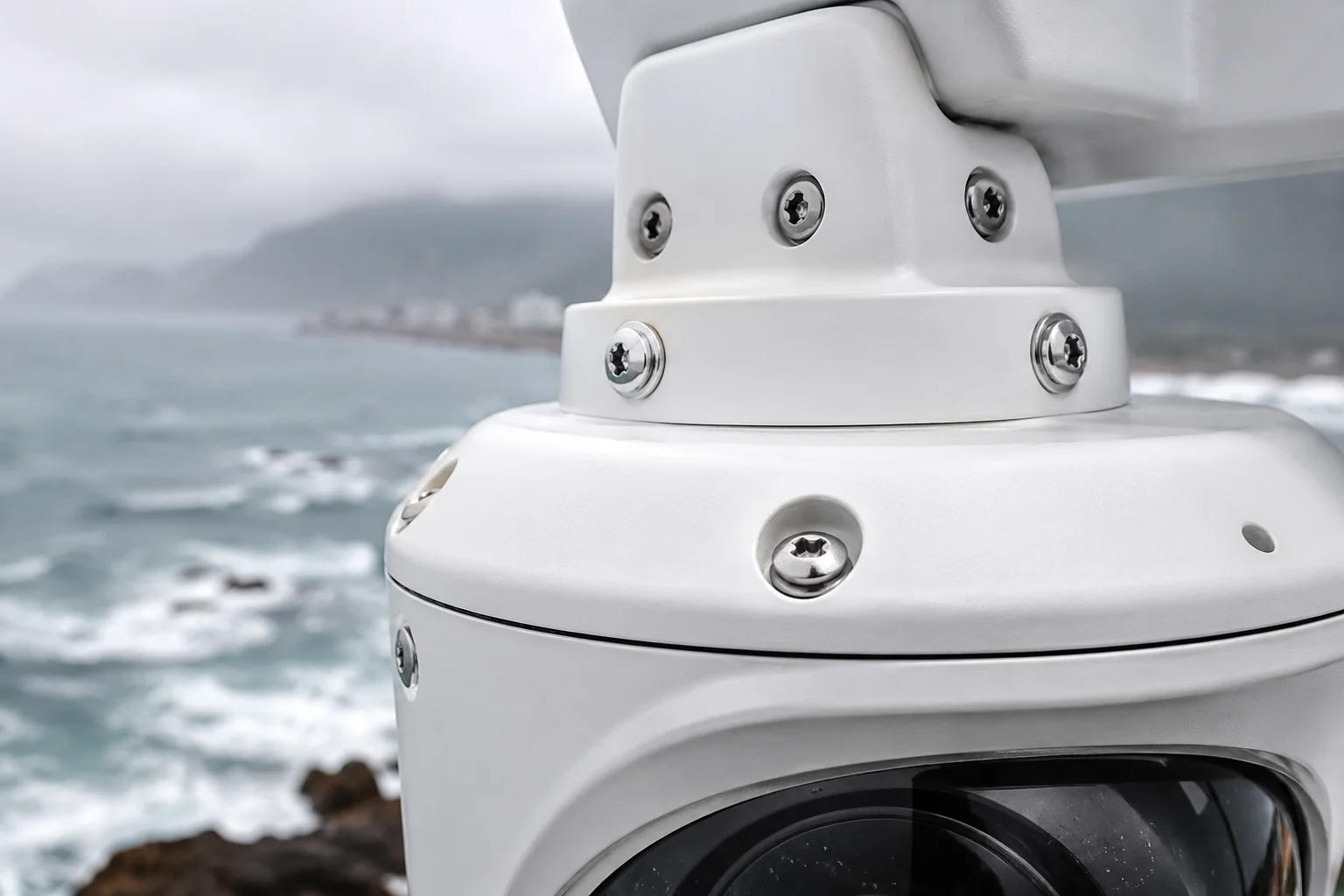
I always look at the full outdoor picture, not just the camera body. When I build for coastal air, rain, heat, and long service life, the fastener choice matters as much as the lens or the PCB.
Table of Contents
Will standard SS304 screws develop “tea staining” rust after just six months near the ocean?
I have watched clean-looking systems turn ugly far too fast near the sea. I do not want a customer to see brown streaks after only one season.
Yes, SS304 screws can show tea staining2 in coastal air within months, because salt and moisture attack the passive layer. SS316 performs better because its molybdenum content3 improves resistance to chloride-driven corrosion.
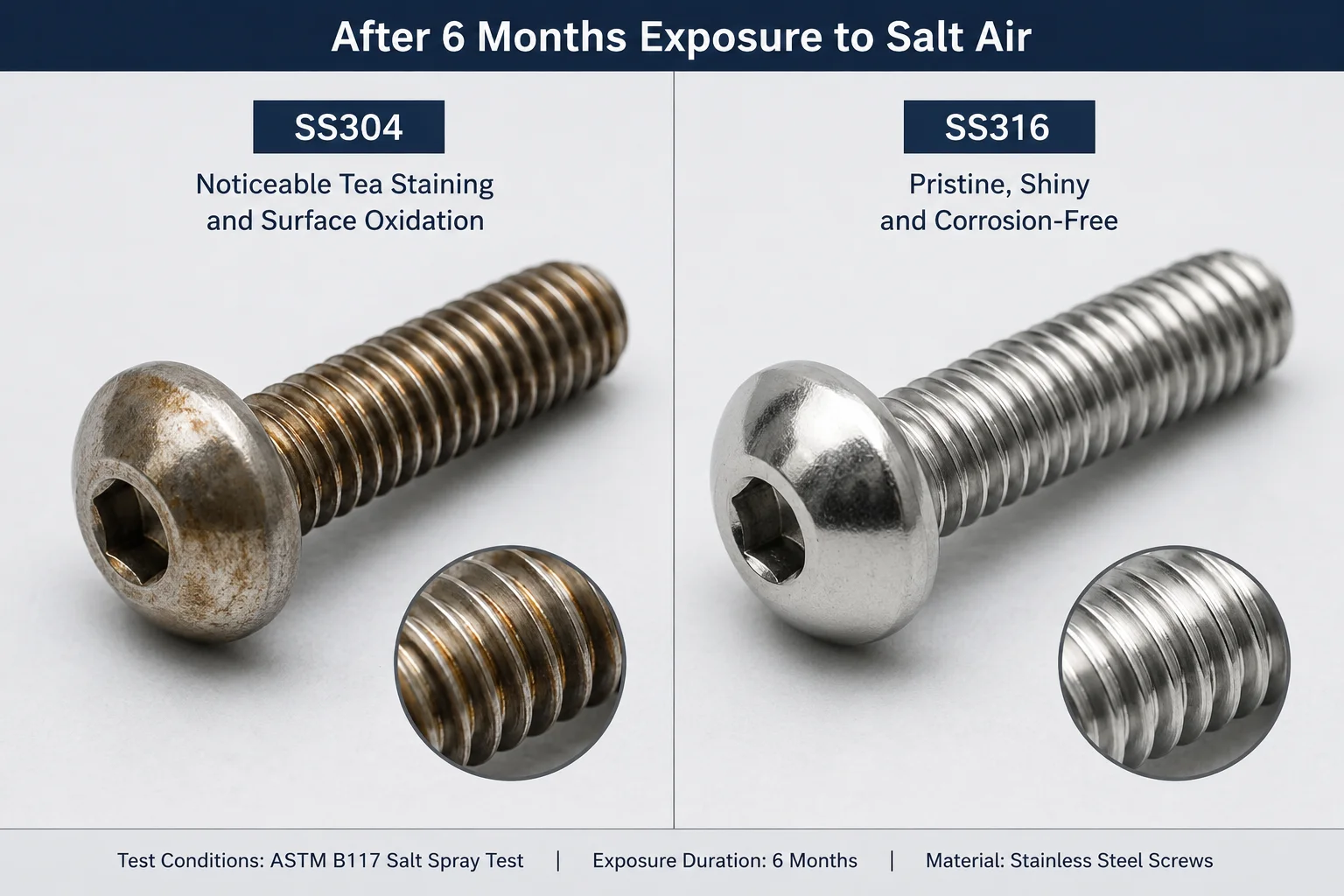
When I talk about tea staining, I mean that weak brown film that appears on the surface before real damage gets worse. I do not treat it as a minor cosmetic issue, because it often tells me the environment is already harsh. Near the ocean, the air carries fine salt. Rain, fog, and condensation keep the fastener wet. That wet film lets chlorides sit on the metal and break down the protective layer over time.
What tea staining really means in the field
I do not see tea staining as simple dirt. I see it as an early warning sign. A screw may still hold at first, but the surface is already losing its defense. If I leave that problem alone, the fastener can pit, seize, and weaken. Then I get a bigger repair job later.
Why SS304 often struggles in coastal use
SS304 is a good general-purpose steel, but I do not trust it for long-term ocean exposure. It has less protection against chlorides. That means the surface can stain faster, and tiny pits can form under the stain. Once pits start, the corrosion can go deeper than people expect. I have seen this happen on brackets, screws, and washers that looked fine from a distance.
Why SS316 holds up better
SS316 has molybdenum, and that makes a real difference. I use it because the extra chemical resistance helps the passive film stay stable. That matters most when salt keeps landing on the metal again and again. If I am building for a marine edge, a coastal factory, or a rooftop near the sea, I would rather pay a little more for SS316 than explain rust marks later.
| Condition | SS304 Risk | SS316 Risk | My View |
|---|---|---|---|
| Inland dry area8 | Low to medium | Low | SS304 may be fine |
| Humid city with rain | Medium | Low | SS316 is safer |
| Coastal air | High | Medium to low | SS316 is the better choice |
| Direct salt spray7 | Very high | Medium | SS316 is strongly preferred |
I also remind myself that the screw is part of the whole assembly. If the camera shell is white aluminum and the screw stains, the whole product looks old. If the screw rusts into the housing, service gets harder. So I do not judge corrosion by the screw alone. I judge it by the full lifecycle of the device.
How does using SS316 fasteners prevent galvanic corrosion between the screw and the aluminum body?
I have seen aluminum housings suffer because the wrong screw was chosen. The damage often starts small, but it grows in damp weather and becomes expensive fast.
SS316 fasteners help reduce galvanic corrosion because they are more stable in wet outdoor conditions, and they work better when paired with insulating washers or PTFE sleeves. This lowers the metal-to-metal reaction that can eat into aluminum bodies.
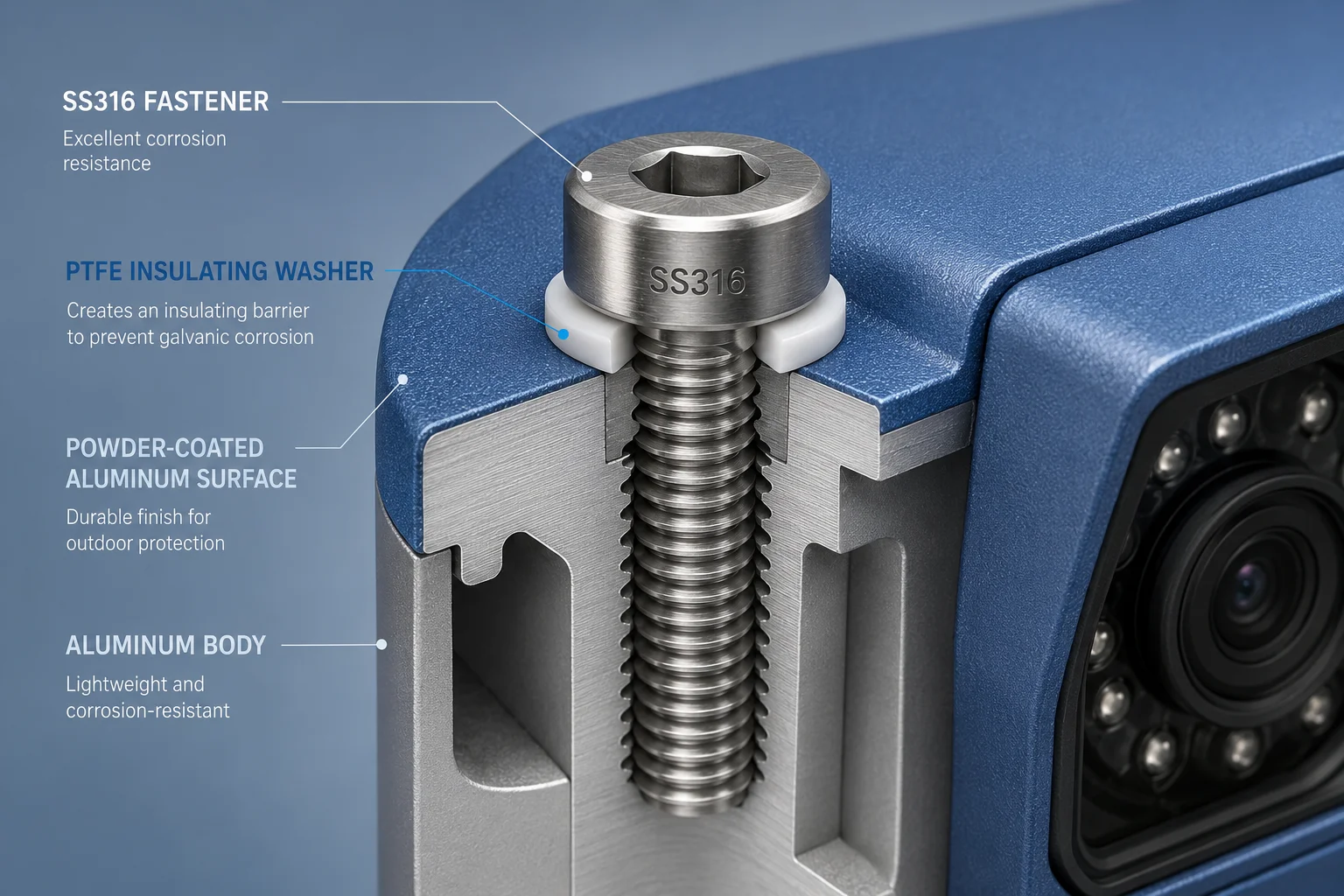
I think about galvanic corrosion as a quiet fight between different metals. When two different metals touch each other and water is present, one metal can give up material faster than the other. In many outdoor PTZ systems, the aluminum body is the weaker partner. That means the screw hole, the edge around the bracket, or the contact point around the washer can start to corrode first. I do not want a strong stainless screw to slowly damage a much softer aluminum shell.
Why the metal pair matters
I always check what the screw is touching. If the screw goes into aluminum, the risk is not only about rust on the screw. The real problem is what happens to the housing around it. The aluminum can pit, powder, or seize around the threads. Then a simple maintenance task becomes a broken part replacement. That is a bad trade for any installer or distributor.
How SS316 helps in a real assembly
I prefer SS316 because it keeps its own surface more stable in wet and salty conditions. That does not mean it stops all galvanic action by itself. I still need a good design. I use PTFE washers4, nylon spacers, sealing grease where suitable, and proper torque control. These simple steps help break the electrical path and reduce the chance of damage. I also avoid over-tightening, because extra pressure can cut through coatings and make the problem worse.
Why this matters for long-term service
If I sell a system to a farm, a bridge site, or a coastal yard, I know the owner wants low service calls. A corroded screw hole can turn into a loose camera, a water leak path, or a full replacement body. I do not want that. I want a technician to open the unit years later and remove the screw without drama. That is why I see SS316 not as a luxury, but as a safe baseline for outdoor hardware.
| Design choice | Effect on galvanic corrosion | My comment |
|---|---|---|
| SS304 screw into aluminum | Medium to high risk | Works short term, weaker for harsh sites |
| SS316 screw into aluminum | Lower risk | Better for outdoor and coastal use |
| SS316 + PTFE washer | Much lower risk | Best simple field choice |
| SS316 + PTFE washer + sealant | Lowest practical risk | Strong option for demanding deployments |
I also think people often miss the washer. The washer is small, but it can change the whole outcome. A good washer can spread load, reduce direct contact, and slow down corrosion. I do not see fastener selection as a tiny detail. I see it as one of the first lines of defense for the whole product.
Can I verify the material grade of the fasteners using a handheld XRF analyzer on-site?
I want proof, not guesses, when I accept a bulk order. A shiny screw can still be the wrong grade, and that can hurt the project later.
Yes, I can use a handheld XRF analyzer5 on-site to check elemental composition and help verify SS316 fasteners. It is a fast screening tool, but I still prefer a material certificate and supplier traceability for final confirmation.
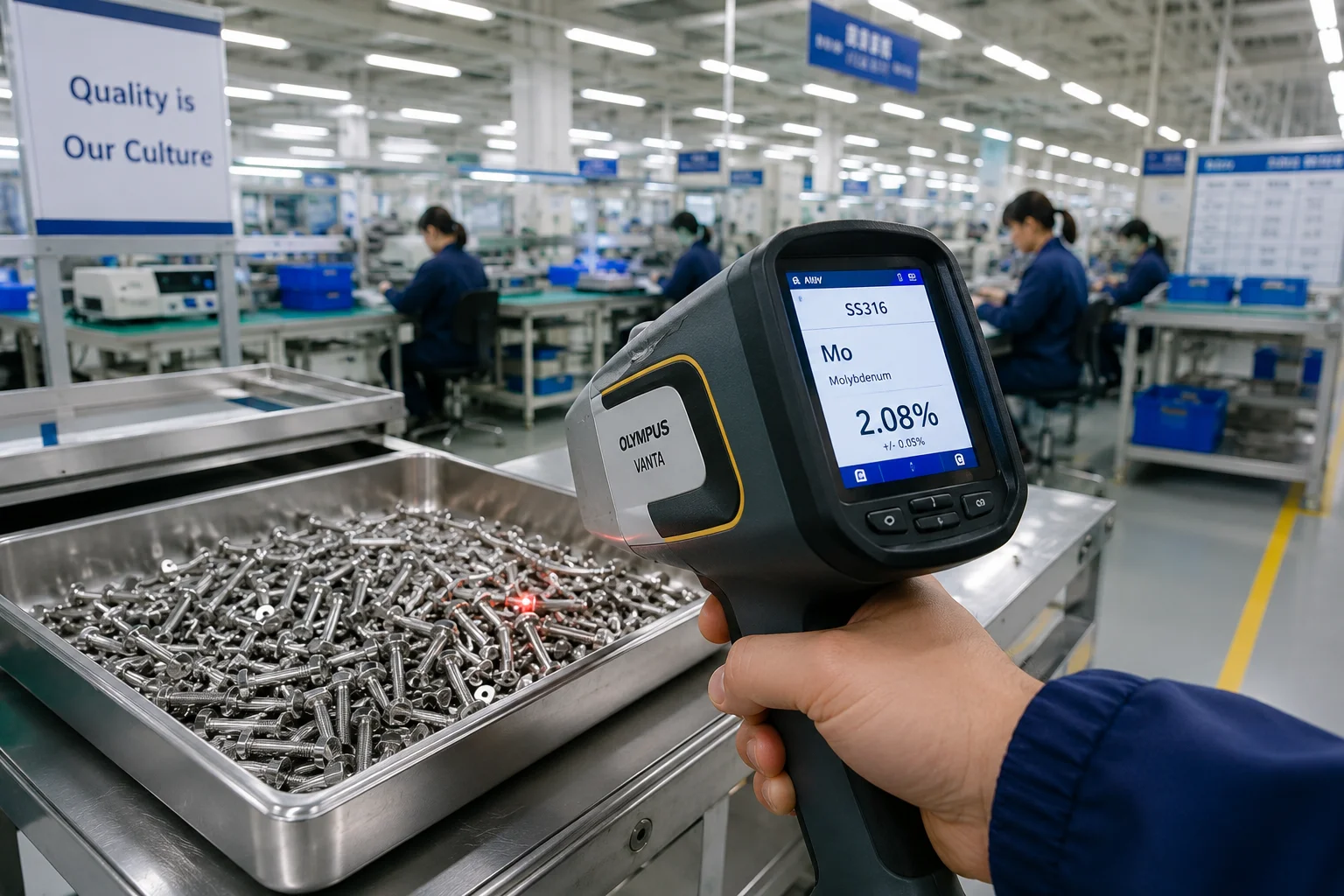
I like XRF because it gives me quick field data. I can point the device at a screw and see if the chemical pattern matches what I expect. For SS316, I look for signs of molybdenum, along with the right balance of chromium and nickel. That helps me catch obvious mistakes before the hardware goes into a shipment or an installed unit. But I do not treat XRF as magic. I know its limits, and that matters.
What XRF can tell me
XRF can tell me the alloy family and help me spot a wrong part. If I test a screw and the reading shows no molybdenum, I know I should question the claim right away. If the reading looks close to SS316, I still want to check the lot label, the paperwork, and the supplier records. I use the tool as one layer in a larger check process.
What XRF cannot tell me
XRF does not always tell me everything. It does not fully prove how the screw was made, how clean the material is, or whether the piece meets every mechanical rule. It also cannot replace a good certificate from the factory. So I do not rely on one reading alone. I use it to catch bad surprises, not to replace a complete quality system.
How I use it in buying and inspection
When I receive fasteners for a PTZ camera project, I can test random samples from each box. I can compare readings across the lot. I can also check a suspect part if the finish looks odd or the supplier label feels weak. This helps me protect the project before installation. If I am managing a large B2B order, that quick test saves time and may save the job.
| Check method | What it shows | My use |
|---|---|---|
| Handheld XRF | Alloy composition screening | Fast on-site verification |
| Material certificate | Supplier declaration and batch data | Traceability and paperwork check |
| Random sample testing | Consistency across a lot | Quality control for bulk orders |
| Installation inspection | Visual and fit check | Final field confirmation |
I also tell myself that the best quality control starts before the truck leaves the factory. If I can match the XRF reading with a certificate, and then match both with the physical part number, I have a much stronger chain of trust. That is what I want when I ship to North America, Europe, or any coastal site where failure is expensive.
Does the factory provide a “Fastener Material Certificate” for every bulk order?
I care about paperwork because paperwork protects both sides. Without it, I have no clean way to prove what was shipped when a customer asks later.
A good factory should provide a fastener material certificate6 for every bulk order9, with batch numbers, alloy grade, and traceable test data. This document supports quality control, customer trust, and project compliance.
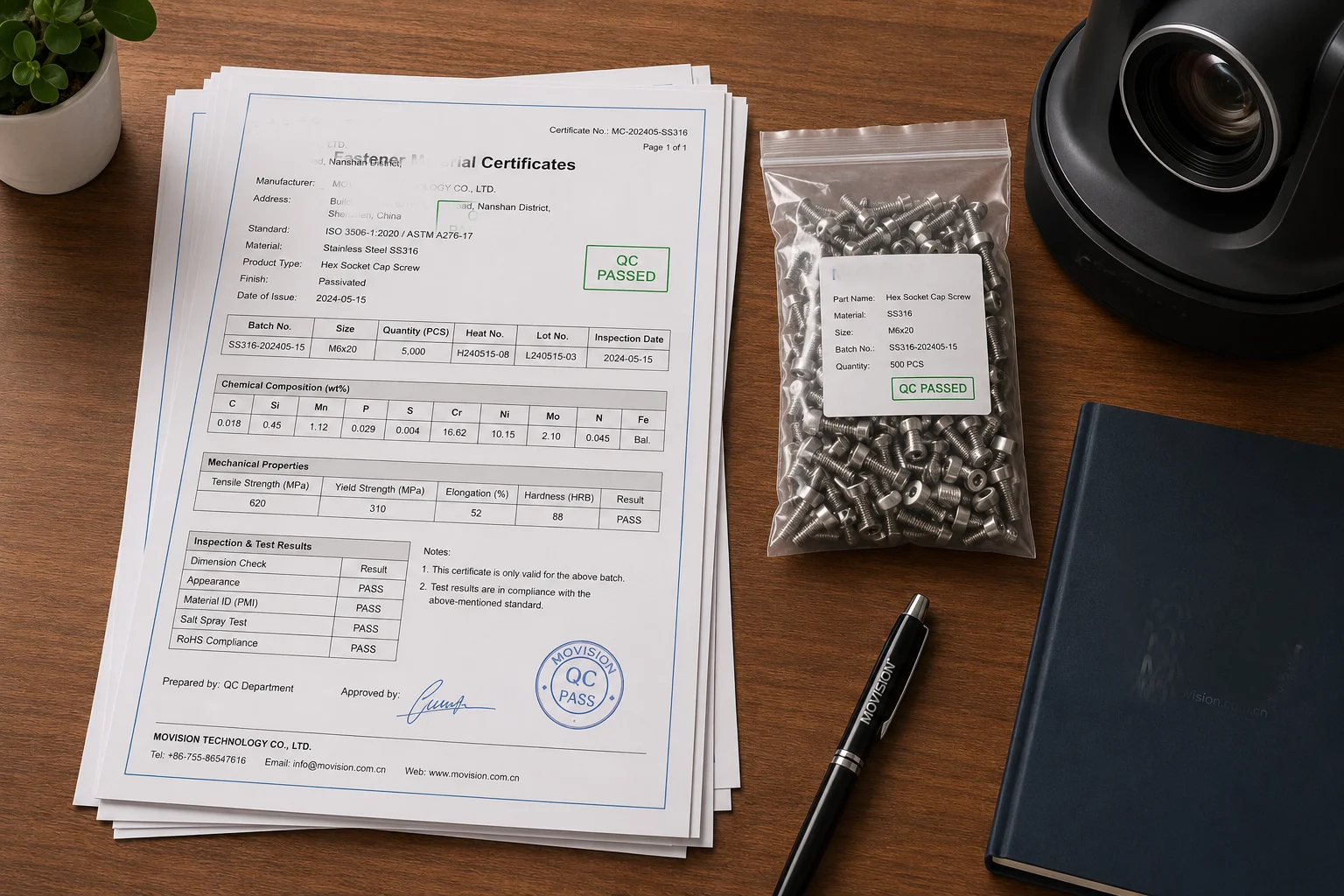
I treat the certificate as part of the product, not as extra paperwork. When I sell to a serious system integrator or a project buyer, I know they may need proof for their own records. They may need it for a customer audit, a site handover, or a warranty claim. If I cannot give them clear batch data, I make their job harder. That is not how I want to work.
Why the certificate matters
I want every bulk order to link the part, the batch, and the grade. If one batch is good and another batch is not, I need to know where the difference is. A certificate gives me that trail. It also helps me prove that I did not switch materials after approval. In B2B sales, that trust is a major part of the deal.
What a good certificate should include
I expect the document to show the alloy grade, the heat or batch number, the supplier name, and the test result or declaration. If needed, I also want the file date and the order reference. That way I can connect the screws in the box to the camera system in the field. I do not want a vague note that only says “stainless steel1.” That is too weak for serious outdoor hardware.
How I use certificates in my own process
When I work with a customer like David Miller, I know he wants direct answers and low risk. I can give him a certificate, an inspection report, and if needed, an XRF check result. That helps him feel safe when he signs off on the project. It also helps me protect my own reputation. If a product runs in rain, heat, and salt air for years, I want every small part to support that promise.
| Document type | Main purpose | Why I want it |
|---|---|---|
| Fastener material certificate | Grade and batch proof | Traceability |
| Incoming inspection report | Internal quality record | Lot control |
| XRF test record | Field verification | Quick confirmation |
| Packing list with part code | Shipment match | Order accuracy |
I also believe good documentation shows discipline. A factory that tracks fasteners well usually tracks other parts well too. That includes housings, cables, seals, and boards. For me, the fastener certificate is not just about screws. It is a signal that the supplier respects the full system.
Conclusion
I choose SS316 external fasteners because they help my outdoor systems stay clean, strong, and serviceable in harsh weather for the long term.
1. Detailed properties of SS316 stainless steel, including molybdenum content and corrosion resistance. ↩︎ 2. Explanation of tea staining on stainless steel, causes, and prevention. ↩︎ 3. How molybdenum improves chloride resistance in stainless steel. ↩︎ 4. How PTFE washers isolate metals and reduce galvanic corrosion. ↩︎ 5. How XRF analyzers verify alloy composition on-site. ↩︎ 6. ISO standard for material certificates and traceability. ↩︎ 7. ASTM standard for salt spray (fog) testing of coatings. ↩︎ 8. Contrast between inland dry climates and coastal humidity for corrosion risk. ↩︎ 9. Overview of bulk fastener ordering and quality assurance practices. ↩︎