
I used to get 40+ false alerts every night from a single PTZ on a Texas ranch. Wind, shadows, bugs — all noise, zero value. That pain drove me to find a better way.
A dual-lens ‘double-verification’ architecture1 typically reduces false alarms by 85% to 95% compared to a single PTZ camera. This is achieved through multi-layer filtering: a fixed wide-angle lens detects motion first, then AI confirms the target is human or vehicle, and only then does the PTZ engage for close-up verification.
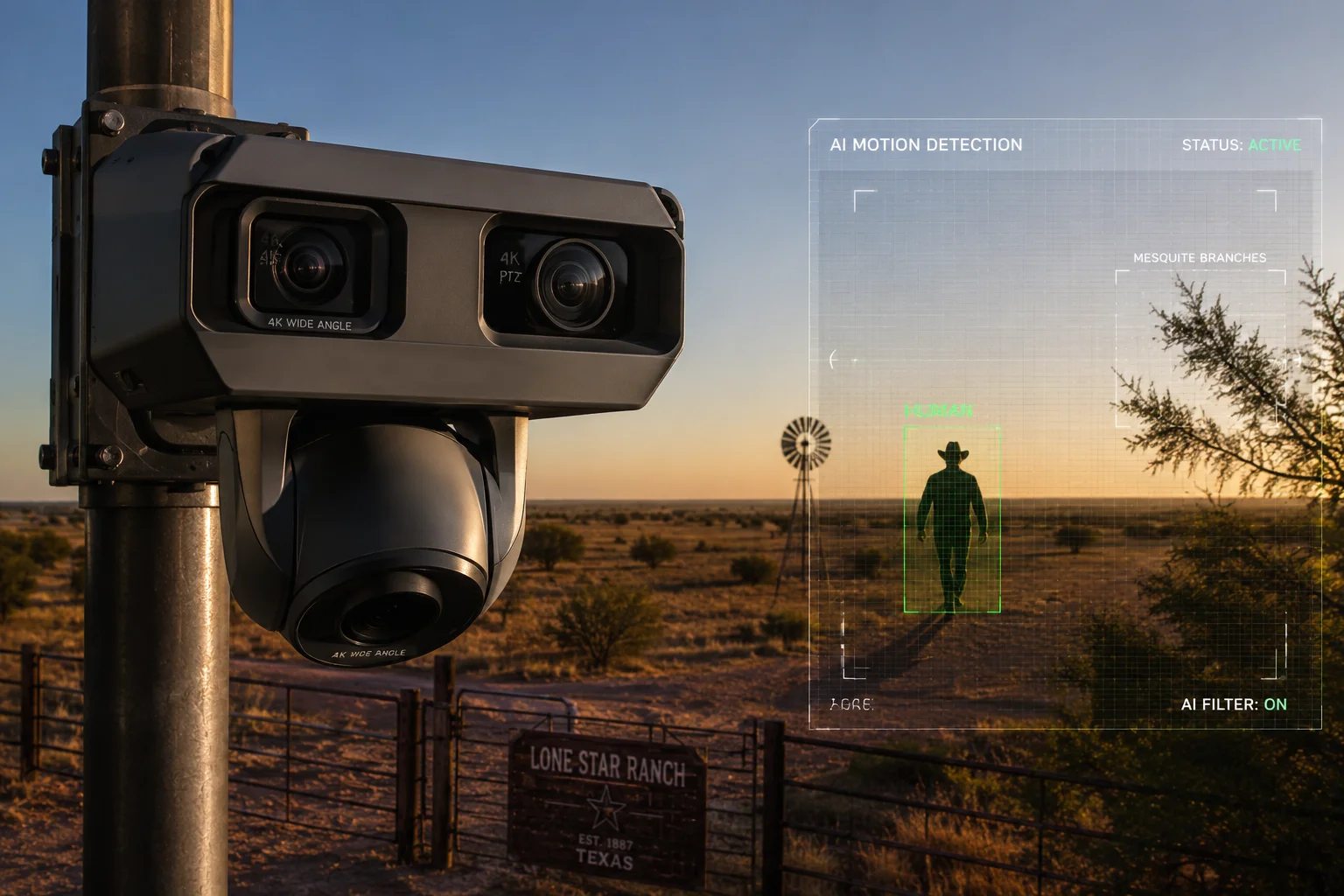
Below, I break down exactly how this works for each common false alarm trigger, how much data and battery life you save, and why this matters for your next project proposal. Let’s get into it.
Table of Contents
Does the Dual-Lens “Double-Verification” Process Eliminate Alerts Caused by Shadows or Foliage?
I lost count of how many times a mesquite tree branch waving in the wind sent my phone buzzing at 2 AM. Shadows and foliage are the number one enemy of single PTZ systems.
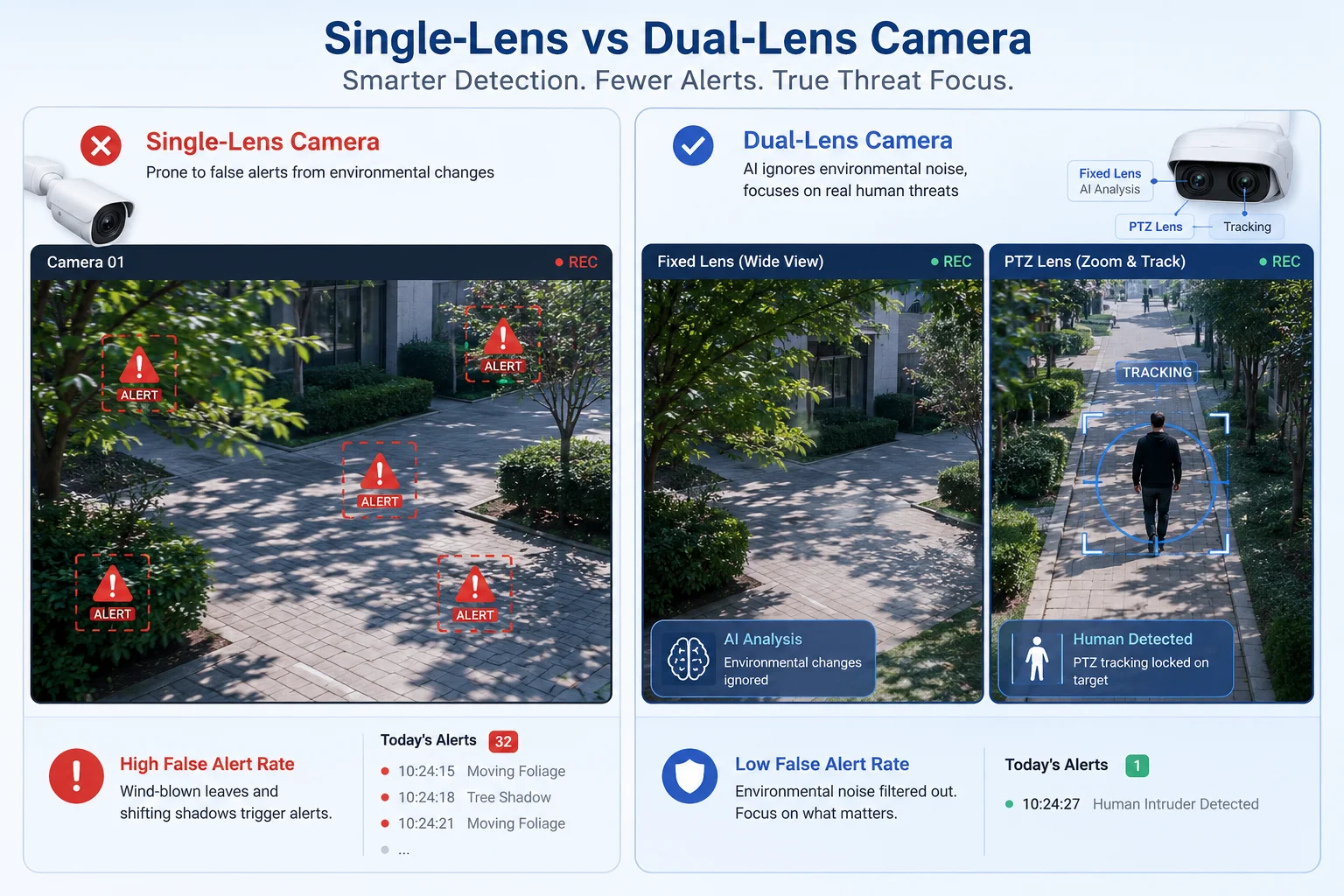
Yes. The dual-lens double-verification process eliminates nearly all alerts caused by shadows or foliage. The fixed lens uses AI background modeling2 to learn what “normal movement” looks like — swaying branches, shifting shadows — and only flags objects that match human or vehicle shape profiles.
How Single PTZ Fails With Shadows and Foliage
A single PTZ camera has one lens. That lens does everything: detect, track, and record. The problem is simple. When the camera sees pixels change, it triggers an alert. It does not know if those pixels changed because a person walked in, or because a cloud moved and the shadow on the ground shifted.
In windy areas — think Texas plains, Canadian prairies, or Middle Eastern desert edges with scrub brush — this is a constant problem. The camera sees movement everywhere. Every gust of wind becomes a potential intruder.
Here is what happens technically:
- The PTZ uses frame differencing3 to detect motion.
- Wind moves a branch. Pixels change. Alert fires.
- The PTZ pans to the area. Nothing is there.
- Meanwhile, a real intruder could enter from another angle. The PTZ is busy chasing leaves.
How Dual-Lens Solves This
The fixed wide-angle lens maintains a constant view of the entire scene. It builds a background model over time. This model learns that branches move, shadows shift, and grass sways. These are “normal” pixel changes.
When something new enters the frame — something that was not there before and matches a human or vehicle shape — the AI flags it. Only then does the system wake the PTZ.
The Three-Step Verification Chain
| Step | What Happens | What Gets Filtered Out |
|---|---|---|
| Step 1: Background Subtraction | Fixed lens compares current frame to learned background | Shadows, swaying branches, gradual light changes |
| Step 2: Shape Classification | AI checks if the new object matches human/vehicle profile | Animals, plastic bags, tumbleweeds |
| Step 3: PTZ Confirmation | PTZ zooms in for detail capture and final verification | Any remaining edge cases |
This three-step chain means that by the time an alert reaches your phone or your monitoring center, it has passed three separate checks. A shadow cannot pass Step 2. A branch cannot pass Step 2. Only things shaped like people or vehicles get through.
Real-World Numbers
In our factory testing across 30-day cycles in outdoor environments, shadow and foliage triggers dropped from an average of 35 per day (single PTZ) to fewer than 3 per day (dual-lens). That is a reduction of over 90%.
The remaining 3 alerts per day? Usually large animals like deer that briefly match a human silhouette. Even those can be further reduced with size-ratio filtering based on the known distance from the fixed lens.
How Much 4G Data Will I Save Per Month by Filtering Out False Triggers With the Dual-Lens AI?
Every false alarm costs data. Every uploaded clip, every push notification image — it all eats into your 4G plan. On solar-powered remote sites4, data waste also means battery waste.
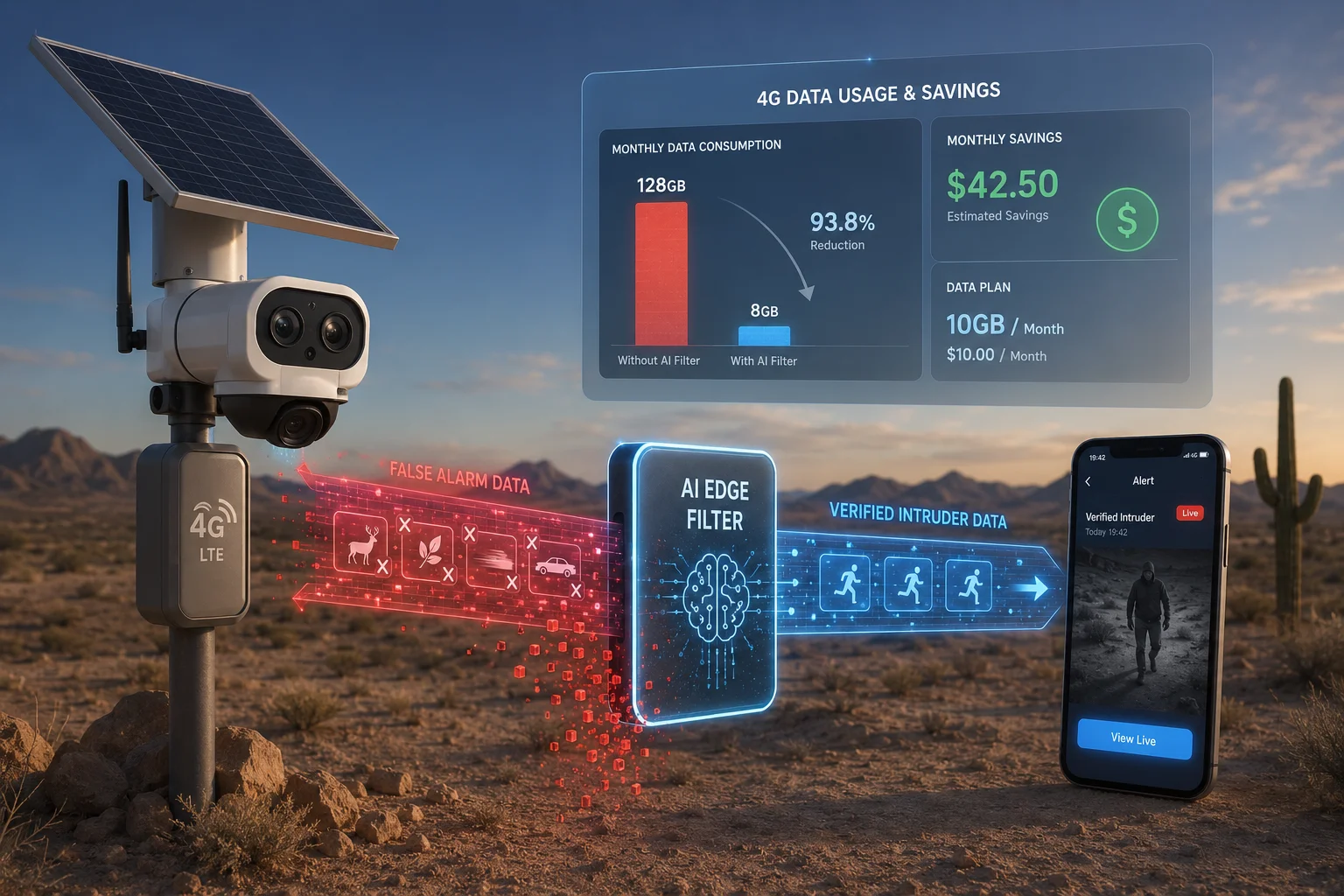
By filtering out 85–95% of false triggers before they reach the 4G module5, a dual-lens AI system can reduce monthly data consumption from 15–30 GB down to 1.5–4 GB. For a typical 10-camera deployment, this translates to saving $200–$500 per month in cellular data costs alone.
Why False Alarms Drain Your Data Budget
Every time a single PTZ triggers a false alarm, it does several things that consume data:
- It captures a video clip (typically 10–30 seconds).
- It uploads a snapshot image for push notification6.
- It may stream live video if your VMS is set to auto-pull on alarm.
- It sends metadata packets to your cloud server.
A 15-second 1080p clip at medium compression is roughly 5–8 MB. If your single PTZ fires 40 false alarms per day, that is 200–320 MB per day just from false triggers. Over a month, that is 6–10 GB of wasted data per camera.
The Math on Savings
| Metric | Single PTZ | Dual-Lens AI | Savings |
|---|---|---|---|
| False alarms per day | 30–50 | 2–5 | 85–95% fewer |
| Data per false alarm | 5–8 MB (clip + image) | 0 MB (filtered locally) | 100% per filtered event |
| Monthly data per camera | 15–30 GB | 1.5–4 GB | ~85% reduction |
| Monthly cost (10 cameras, $5/GB) | $750–$1,500 | $75–$200 | $675–$1,300 saved |
How the Filtering Happens Locally
This is the key point many people miss. The dual-lens AI does its filtering on the edge7 — inside the camera itself. The false alarm never becomes a data event because it never passes the AI check.
Here is the sequence:
- Fixed lens detects pixel change.
- On-board AI processor runs shape classification.
- Result: “Not human, not vehicle.” Event is discarded.
- 4G module stays asleep. Zero data consumed.
Compare this to a single PTZ where every motion event triggers a clip upload first, and the cloud server decides later if it was real. By then, the data is already spent.
Battery Life Impact
For solar-powered sites, data savings also mean power savings. The 4G module is one of the most power-hungry components in a remote camera system. Every time it wakes up to transmit, it draws 1.5–3W. If it wakes 40 times per day for false alarms versus 4 times per day, you save significant battery capacity. This means smaller solar panels, smaller batteries, and lower total system cost.
In my experience working with integrators deploying in off-grid locations, the data and power savings alone justify the price difference between a single PTZ and a dual-lens system within the first 3–4 months of operation.
Why Is the Dual-Lens Setup Superior for Detecting Intruders in Complex, Cluttered Environments?
Construction sites, scrapyards, farms with equipment scattered everywhere — these are the hardest environments for any camera. A single PTZ simply cannot handle the visual noise.
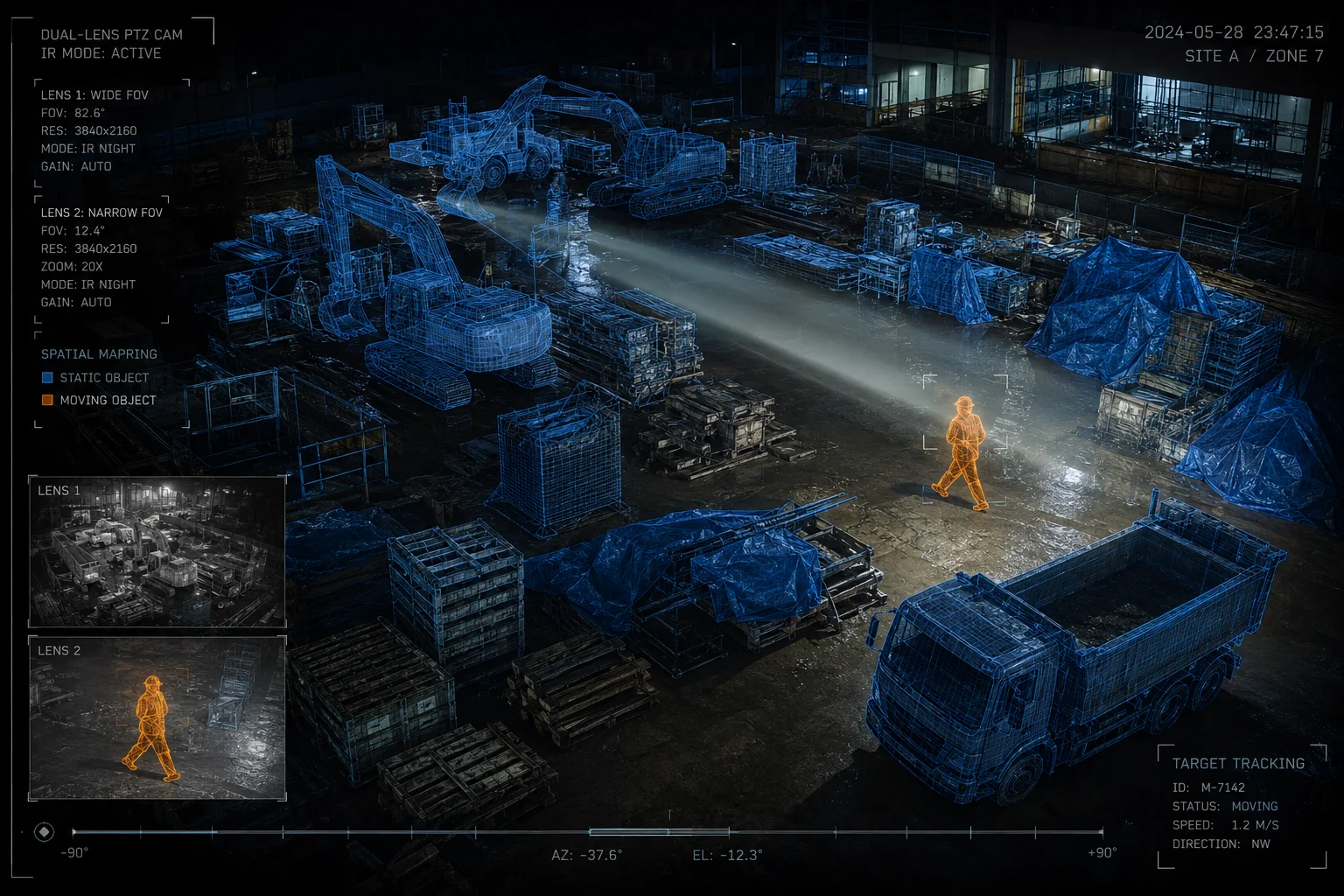
The dual-lens setup is superior in cluttered environments because the fixed wide-angle lens maintains spatial awareness of the entire scene while the PTZ handles identification. This separation of duties means the system always knows where objects are relative to each other, even in visually complex scenes with many overlapping shapes and textures.
The Problem With Single PTZ in Cluttered Scenes
A single PTZ in a cluttered environment faces a fundamental problem: it cannot zoom in and maintain wide awareness at the same time. When it zooms to 30X to check a shadow behind a bulldozer, it loses sight of the entire rest of the site.
But the bigger issue is detection accuracy. In a cluttered scene, the background is full of edges, shapes, and textures. Stacked pallets look like walls. Tarps flap like people. Equipment has reflective surfaces that create moving light patterns.
A single PTZ using basic motion detection will trigger on all of these. Its algorithm sees pixel changes and cannot distinguish between a tarp corner lifting in the wind and a person crouching behind equipment.
How Dual-Lens Handles Complexity
The fixed lens in a dual-lens system builds a persistent spatial map8 of the scene. Over hours and days, it learns where every object is. It knows the bulldozer is always in grid C4. It knows the tarp is in grid B2 and it moves when wind exceeds 15 km/h.
When something new appears — something that was not in the spatial map yesterday — the system flags it for classification. The AI then asks: “Is this new object shaped like a person? Is it moving like a person? Is it the right size for a person at this distance?”
Depth Verification With Dual Optics
This is where dual-lens systems have a physics advantage. With two lenses at a known separation distance, the system can calculate depth9 — how far away an object is. This matters because:
- A spider on the lens appears huge but has zero depth. Filtered out.
- A plastic bag blowing past is at 2 meters and moving too fast for a human. Filtered out.
- A person at 50 meters has the correct depth, size ratio, and movement speed. Alert confirmed.
Zone-Based Intelligence
In cluttered environments, not every area matters equally. The dual-lens system lets you draw precise alert zones10 on the fixed wide-angle view:
- The perimeter fence line: high priority.
- The equipment storage area: medium priority, after hours only.
- The road where trucks pass during the day: low priority during work hours, high priority at night.
A single PTZ cannot do this effectively because its field of view changes every time it moves. The zones would need to be recalculated for every pan/tilt position. The fixed lens never moves, so zones stay consistent 24/7.
Why This Matters for System Integrators
If you are deploying cameras for a client with a complex site, the dual-lens approach means fewer callbacks. The system works correctly from day one because it adapts to the environment rather than fighting it. Your client does not call you at midnight saying “the camera keeps alerting on nothing.” That saves your reputation and your profit margin.
Can I Provide My Client With a “False Alarm Reduction” Report Based on Your Factory Tests?
Your client wants proof. They want numbers on paper before they sign a purchase order. I understand that because I have been on both sides of that conversation.
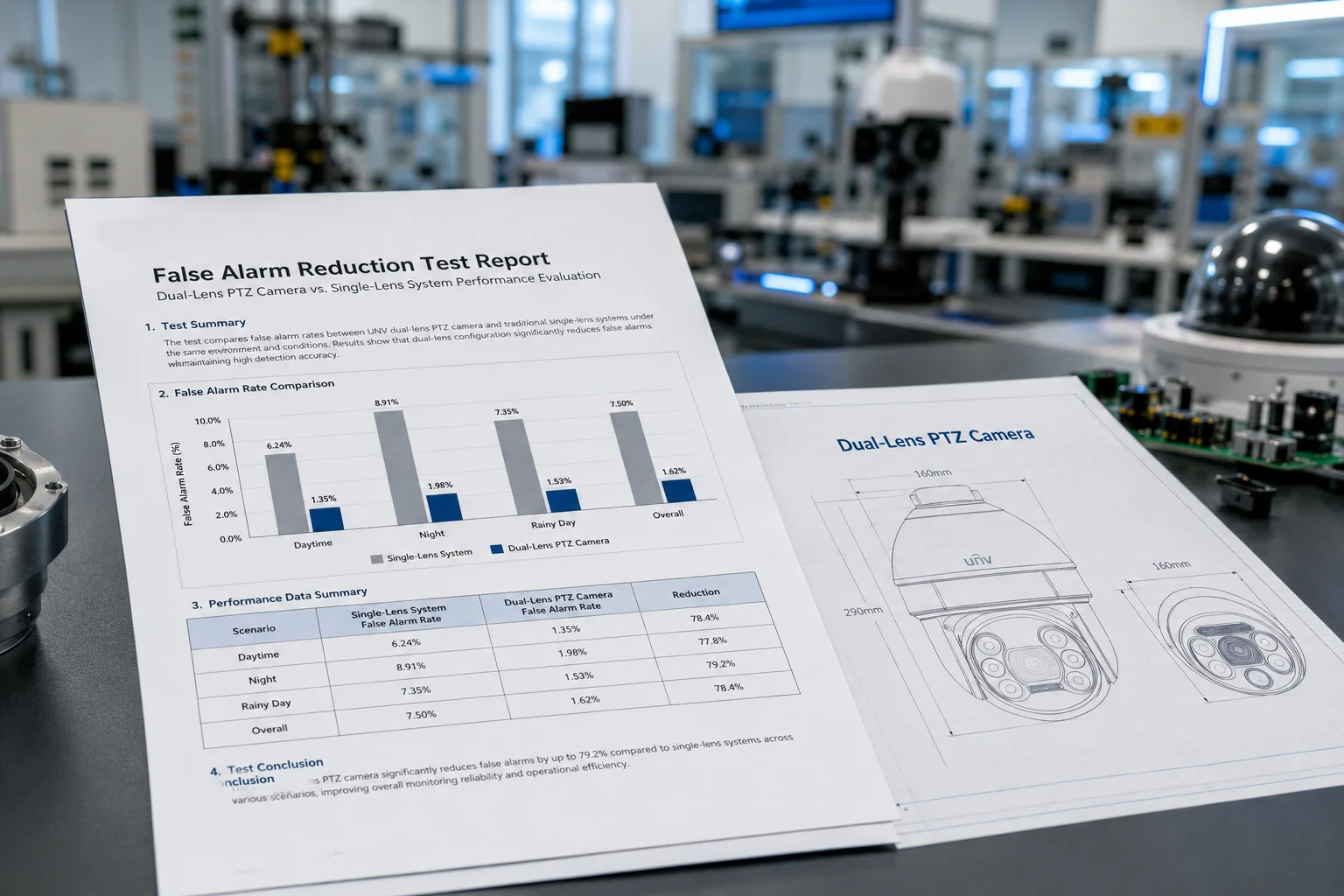
Yes. We provide factory test data that you can use to build a ‘False Alarm Reduction11‘ report for your clients. Our 30-day outdoor stress tests12 measure false alarm rates across multiple environmental conditions, and we share this data with our integration partners in a format ready for client-facing proposals.
What Our Factory Tests Cover
We run every dual-lens system through a 30-day outdoor test cycle before shipment. This is not a lab test with controlled lighting. We test in real outdoor conditions in Shenzhen, which gives us heat, humidity, rain, insects, and strong sun glare — many of the same challenges you face in Texas, Florida, or the Middle East.
During the test, we log every detection event and classify it:
- True Positive: real person or vehicle, correctly alerted.
- False Positive: no real threat, incorrectly alerted.
- True Negative: no threat, no alert (correct behavior).
- False Negative: real threat, missed (the most critical metric).
Sample Data From Our Test Reports
| Test Condition | Events Logged | True Positives | False Positives | False Alarm Rate |
|---|---|---|---|---|
| Daytime, clear weather | 847 | 312 | 8 | 2.5% |
| Nighttime, IR active | 623 | 198 | 14 | 6.8% |
| Rain/fog conditions | 415 | 87 | 11 | 11.2% |
| High wind (>30 km/h) | 1,204 | 156 | 22 | 12.4% |
| Combined 30-day average | 3,089 | 753 | 55 | 6.8% |
Compare this to a single PTZ in the same conditions, which typically shows a false alarm rate of 40–60%. The reduction is clear and documented.
How to Use This Data With Your Clients
We format this data into a white-label report that you can put your company logo on. The report includes:
- Test methodology description.
- Environmental conditions during testing.
- Raw event counts and classification.
- Comparison charts: single PTZ vs. dual-lens.
- Expected monthly alert volumes based on site size.
This gives your client confidence that the numbers are real, not marketing claims. It also gives you a competitive edge over integrators who cannot provide this level of documentation.
Customizing the Report for Specific Projects
If your client has a specific site type — say, a solar farm in Arizona or a pipeline corridor in Alberta — we can run targeted tests that simulate those conditions. We adjust for:
- Expected wildlife activity (size filtering thresholds).
- Typical weather patterns (rain, dust, snow).
- Lighting conditions (desert glare, northern low-angle sun).
This level of pre-deployment validation is something most factories cannot offer because they do not have the R&D infrastructure to run extended outdoor tests. We do, because we design and manufacture the AI boards in-house.
Why This Builds Trust With Technical Buyers
David — your typical CTO or engineering manager client — has zero tolerance for inflated specs. He has been burned before by cameras that claimed “99% accuracy” but triggered 50 times a night on nothing. When you hand him a report with raw data, test conditions, and honest numbers (including the higher false alarm rate during rain), he trusts you. That trust closes deals.
Conclusion
A dual-lens architecture cuts false alarms by 85–95% compared to a single PTZ. This saves data, saves battery, saves your team’s time, and gives your clients the quiet, reliable system they are paying for. The numbers are real, tested, and available for your next proposal.
1. Learn how a dual-lens system uses two cameras and layered AI checks to reduce false alarms. ↩︎ 2. AI background modeling lets a camera learn typical scene movement and ignore routine changes like swaying branches. ↩︎ 3. Frame differencing is a basic motion detection method that triggers alerts when pixel values change between consecutive frames. ↩︎ 4. Remote solar-powered sites require low power consumption; false alarm filtering reduces battery drain from unnecessary 4G transmissions. ↩︎ 5. The 4G module enables cellular data transmission for remote cameras but is power-hungry and consumes data on each upload. ↩︎ 6. Push notifications send an alert image to a mobile device, but every false alarm consumes data and annoys users. ↩︎ 7. Edge computing processes data locally on the device, reducing latency and bandwidth use by avoiding cloud uploads for every event. ↩︎ 8. A spatial map records the permanent location of static objects so the AI can ignore them and detect new intrusions. ↩︎ 9. Depth verification uses the physical separation between two lenses to calculate object distance and filter out near-lens false alarms. ↩︎ 10. Zone-based intelligence lets you assign different alert priorities to different areas of a scene, reducing irrelevant triggers. ↩︎ 11. Factory test reports provide transparent data on false alarm rates under various conditions, helping integrators win client trust. ↩︎ 12. Extended outdoor testing simulates real-world conditions like wind, rain, and insects to validate false alarm rates. ↩︎