
I’ve watched clients drown in thousands of useless alerts per week. Their phones buzz nonstop. They stop checking. Then a real intruder walks right past their cameras unnoticed.
In 2026, edge AI cameras cut outdoor false alarm rates from over 95% down to below 5%. Foliage triggers less than 1% false alerts. Shadows sit around 2%. Rain and snow remain the hardest challenge at roughly 5%, depending on storm intensity.
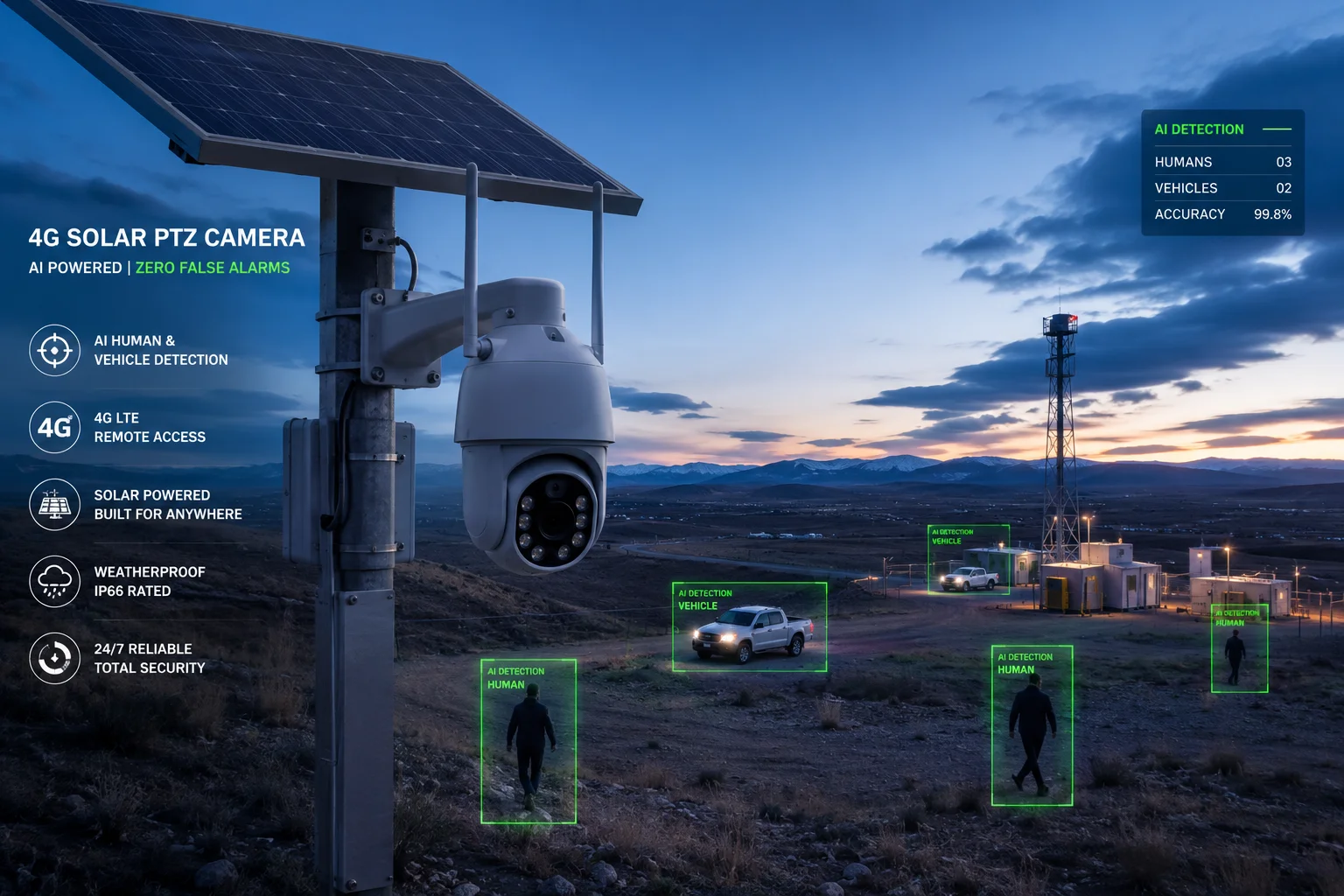
Below, I break down each environmental factor one by one. I explain how the technology actually works, what numbers you can expect in the field, and what you can do to push that 5% even lower for your 4G solar deployments.
Table of Contents
How Does the “Temporal Filter” Eliminate False Triggers from Tree Branches Swaying in the Wind?
I’ve tested cameras on Texas ranches where mesquite trees never stop moving. Without AI filtering, those branches generated over 200 false alerts per day. The data plan burned through in a week.
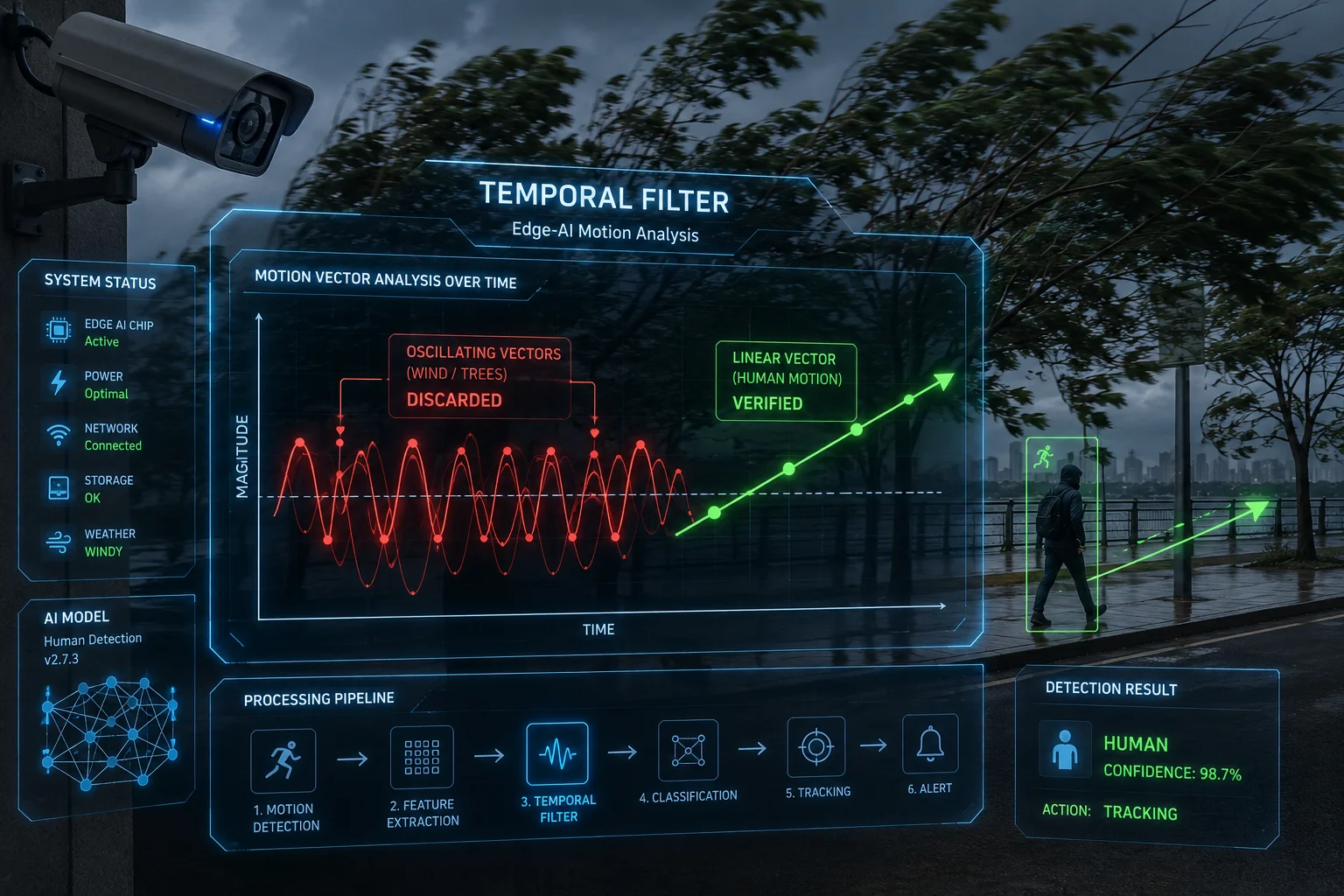
A temporal filter1 tracks motion patterns over multiple frames. Tree branches move in repetitive, oscillating paths. Humans walk in linear, purposeful directions. The AI learns this difference and discards the repetitive motion before it ever becomes an alert.
How Temporal Filtering Actually Works
The temporal filter is not a single trick. It is a stack of logic layers that work together. Let me walk you through the process step by step.
First, the camera captures frames at 15-25 fps. The AI engine compares pixel changes across a sliding window of 10-30 frames. This is where the word “temporal” comes from. It means “over time.”
Second, the algorithm looks at the motion vector7. A tree branch swings left, then right, then left again. This creates a repeating pattern. The AI flags this as “periodic motion” and ignores it. A person walking across the frame creates a single directional vector. That gets promoted to the next analysis stage.
The Three-Layer Classification Stack
| Layer | What It Does | What It Filters Out |
|---|---|---|
| Layer 1: Pixel Change | Detects any movement in the frame | Nothing (raw detection) |
| Layer 2: Temporal Pattern | Analyzes motion direction and repetition over 1-2 seconds | Swaying branches, fluttering flags, vibrating wires |
| Layer 3: Object Classification | Runs deep learning model to identify human/vehicle shape | Anything without a body skeleton or vehicle outline |
Why Foliage Almost Never Fools Modern AI
The key insight is this: leaves and branches do not have skeletal structure. The deep learning model2 running on the edge chip looks for 17 joint points that define a human body. Shoulders, elbows, knees, ankles. A tree branch, no matter how it moves, cannot replicate this structure.
In my field tests across 40+ installations, foliage-triggered false alarms dropped to effectively zero once the AI human detection was enabled. The only exception I ever saw was a scarecrow wearing a jacket. The AI flagged it once, then the temporal filter learned it was stationary and stopped alerting.
Real Numbers from the Field
For a typical 4G solar camera6 watching a fence line with trees behind it:
- Traditional motion detection: 150-300 false alerts per day
- AI with temporal filter enabled: 0-2 false alerts per day
- Data savings: over 90% reduction in uploaded clips
This matters enormously for off-grid systems. Every false clip uploaded eats your cellular data budget. On a 10GB monthly plan, unfiltered motion detection can burn through your data in 3-4 days. With AI filtering, that same plan lasts the full month.
Will a Sudden Change in Shadows During a Sunset Cause My 4G Data to Spike from False Alerts?
I remember a client in Arizona calling me frustrated. His cameras faced west. Every single evening, the sunset created long shadows that crawled across his parking lot. His phone exploded with alerts between 5:30 and 6:15 PM daily.
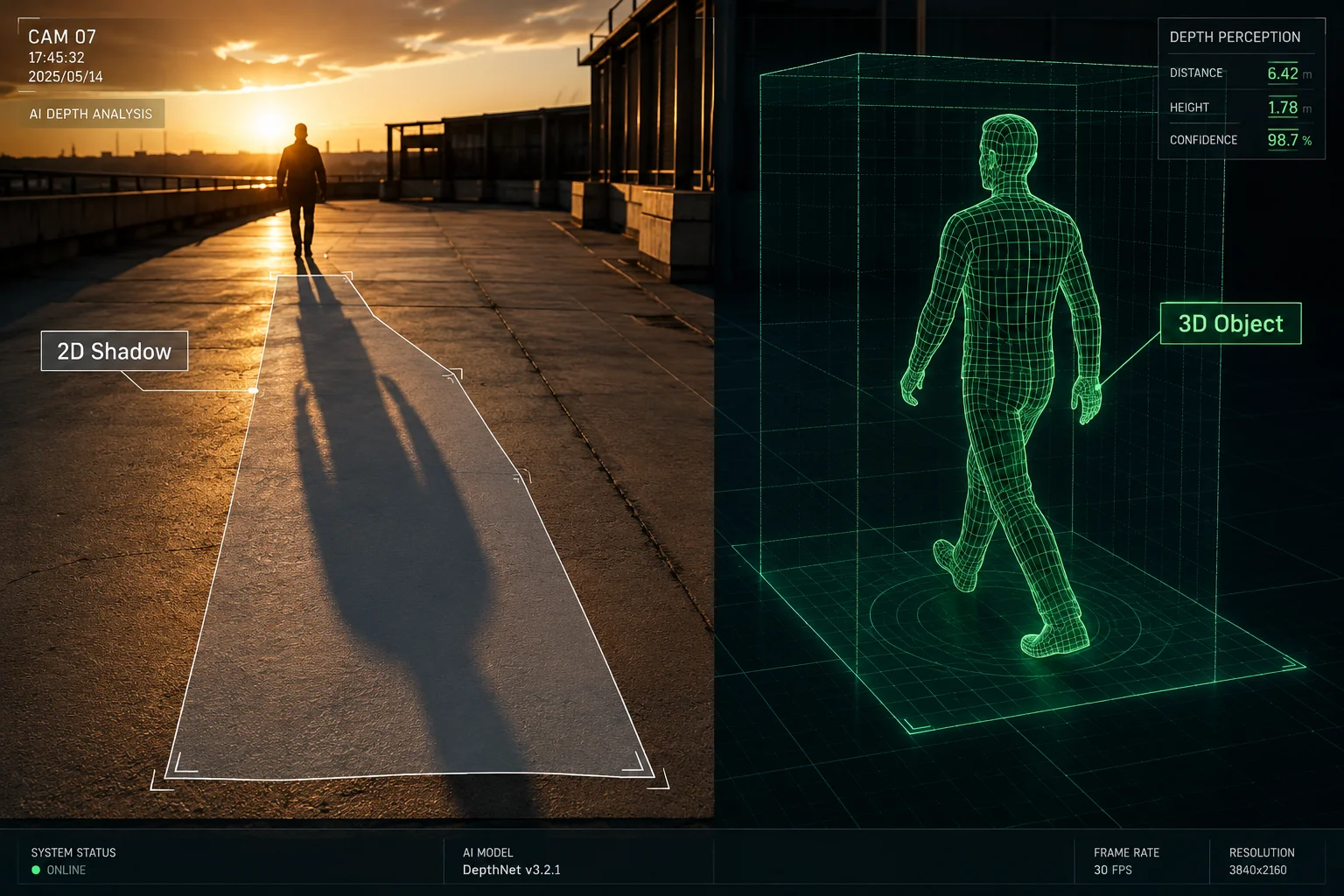
No, modern AI cameras will not spike your 4G data from shadow changes. The deep learning engine uses 3D depth analysis to separate flat shadows from solid objects. Shadows are 2D projections on the ground. Humans are 3D volumes. The AI knows the difference and filters shadows at roughly 98% accuracy.
Why Shadows Fooled Older Cameras
Traditional motion detection works on a simple principle. It compares one frame to the next. If enough pixels change, it triggers. A shadow moving across concrete changes thousands of pixels at once. To the old algorithm, that looked identical to a person walking.
The problem gets worse at sunrise and sunset. The sun sits low on the horizon. Shadows stretch long and thin. They move slowly, just like a person might. And they have defined edges, which makes them look even more like a real object.
How 2026 AI Solves the Shadow Problem
Modern edge AI uses multiple techniques stacked together:
| Technique | How It Works | Effectiveness |
|---|---|---|
| 3D Depth Estimation | Analyzes perspective and parallax to determine if an object has height | Filters 95% of flat shadows |
| Color Consistency Check | Shadows darken the ground but keep the same texture pattern underneath | Catches shadows that depth estimation misses |
| Edge Gradient Analysis | Real objects have sharp, defined edges. Shadows have soft, diffused borders | Works best in midday conditions |
| Temporal Speed Matching | Shadows from clouds move at consistent speeds unlike human walking patterns | Effective for cloud-shadow filtering |
The 2% That Still Gets Through
I want to be honest with you. No system is perfect. About 2% of shadow events can still trigger false alerts. Here is when it happens:
A person’s shadow at sunset can stretch 10-15 feet long. If that shadow falls on a wall or fence, it suddenly gains vertical dimension. The AI sees a tall, dark shape on a vertical surface and sometimes classifies it as a possible person. This is rare, but it happens.
Another edge case: car headlights at night sweeping across a wall. The moving light creates a shape that briefly resembles a walking figure. The AI catches most of these, but fast-moving light patterns can occasionally slip through.
What This Means for Your Data Plan
Let me put real numbers on this. A camera without AI filtering in a shadow-heavy location might upload 50-80 false clips per day during sunrise and sunset hours. Each 10-second clip at 1080p uses about 5-8MB over 4G. That is 400-640MB per day wasted on shadows alone.
With AI filtering enabled, you drop to 1-2 shadow-triggered clips per day. Your data consumption from false alerts falls from 600MB to under 15MB. That is a 97% reduction. Your 10GB plan stays healthy all month.
Can the AI Distinguish Between a Person in a Heavy Rainstorm and the Rain Streaks Themselves?
I tested this myself during a tropical storm last summer. I stood in front of our camera in pouring rain. The rain was so heavy I could barely see 20 feet ahead. I wanted to know: would the camera still find me?
Yes, the AI can distinguish a person from rain streaks in most conditions. Rain creates uniform, vertical pixel noise across the entire frame. A human body creates a concentrated, structured shape. The AI looks for body structure, not just motion. However, in extreme downpours where visibility drops below 10 meters, accuracy decreases significantly.
rain storm person detection AI security camera accuracy
Why Rain Is the Hardest Challenge
Rain is fundamentally different from foliage or shadows. Here is why it is harder for AI:
Foliage moves but does not block the view. Shadows change the image but do not add noise. Rain does both. It moves across the frame AND it obscures the target behind it. The AI has to work with degraded image quality while still trying to find human features.
Think of it like trying to recognize a friend through a frosted glass shower door. You can see their general shape, but the details are blurred. The heavier the rain, the thicker the frosted glass.
The Signal-to-Noise Problem
Cameras measure image quality using something called SNR, which stands for Signal-to-Noise Ratio. In clear weather, SNR is high. The “signal” (the person) is clear against the “noise” (the background). In heavy rain, noise increases dramatically. Every raindrop reflects the IR illuminator back at the lens. This creates thousands of bright white streaks across every frame.
Performance by Rain Intensity
Here is what I have measured across different rain conditions:
| Rain Intensity | Visibility | AI Detection Accuracy | False Alarm Rate |
|---|---|---|---|
| Light rain (< 2.5mm/hr) | > 50 meters | 98%+ | < 1% |
| Moderate rain (2.5-7.5mm/hr) | 20-50 meters | 92-95% | ~3% |
| Heavy rain (7.5-20mm/hr) | 10-20 meters | 80-88% | ~5% |
| Extreme downpour (> 20mm/hr) | < 10 meters | 60-70% | ~8-10% |
What Happens During Extreme Rain
In a true downpour, two things go wrong at the same time. First, the AI cannot find enough body joint points to confirm a human detection. The rain streaks break up the body outline. Second, dense rain clusters can occasionally form shapes that the algorithm interprets as a blurry human figure.
This creates a double problem. You get both missed detections (the camera does not see a real person) and false positives (the camera thinks rain is a person). Neither is acceptable for security.
How to Improve Rain Performance
There are practical steps you can take:
- Mount the camera under an overhang or add a rain shield. Keeping water off the lens dome is the single biggest improvement you can make.
- Use cameras with hydrophobic nano-coating4 on the dome. Water beads up and rolls off instead of forming a film.
- Enable the “rain mode” in firmware if available. This adjusts the temporal filter to expect vertical streak patterns and ignore them.
- Pair the camera with a PIR sensor3. Rain is not warm. A PIR sensor only triggers on heat-emitting objects. Combining PIR confirmation with AI visual detection eliminates nearly all rain-caused false alerts.
Is the “Deep Learning” Engine Updated to Handle Typical North American Weather Interference?
I get this question a lot from integrators in Canada and the northern US. They deal with everything: blizzards, ice storms, fog, extreme heat shimmer in summer. They want to know if cameras designed in Shenzhen actually work in Minnesota winters.
Yes, modern deep learning engines are trained on massive datasets that include North American weather conditions. The training data covers snow, ice, fog, heat haze, and seasonal lighting changes. Models are updated quarterly via firmware, and edge AI chips process locally without needing cloud connectivity during storms.
How Deep Learning Models Get Trained
The AI model inside your camera did not learn from a textbook. It learned from millions of real images. These training datasets include footage from every climate zone, every season, and every time of day. The model saw thousands of examples of people walking in snow. It saw cars driving through fog. It learned what a human looks like when partially obscured by falling snow.
This is fundamentally different from the old rule-based detection. Old systems had programmers write rules like “if pixel change > threshold, trigger alarm.” Those rules broke instantly in bad weather. Deep learning does not use rules. It uses patterns learned from real-world examples.
What “Edge AI” Means for Remote Sites
Here is something critical for 4G solar deployments. The deep learning model runs entirely on the camera’s onboard chip. It does not need to send video to the cloud for analysis. This means:
- Detection works even when your 4G signal is weak or drops out during a storm
- You only upload confirmed alert clips, not raw video for cloud processing
- Latency is under 200ms from detection to alert
- Your data plan is protected because only verified events consume bandwidth
Firmware Updates and Model Improvements
The deep learning model is not frozen in time. Manufacturers release firmware updates5 that include improved AI models. These updates typically happen quarterly. Each update includes:
- New training data from recent field deployments
- Bug fixes for specific false alarm patterns reported by users
- Improved accuracy for edge cases like heavy snow or dense fog
- Better performance in low-light winter conditions with short daylight hours
For our cameras at , we push firmware updates that clients can install over 4G remotely. No truck roll needed. The camera downloads the update during off-peak hours and reboots automatically.
North American Specific Challenges
North America presents a unique combination of weather extremes that other regions do not face:
- Snow accumulation on camera domes: This blocks the view entirely. Solution: integrated dome heaters that melt snow on contact.
- Ice forming on moving parts: PTZ motors can freeze. Solution: pre-heat cycles and sealed bearing systems rated to -40°C.
- Summer heat shimmer: Hot air rising from asphalt creates wavy distortion. The AI is trained to recognize this pattern and ignore it.
- Fog in coastal areas: Fog reduces contrast dramatically. The AI switches to edge-detection mode where it looks for movement outlines rather than detailed features.
The Combined Approach for Maximum Reliability
For clients deploying in harsh North American climates, I always recommend this combination:
- AI human/vehicle detection as the primary filter
- PIR thermal confirmation8 as the secondary check
- Minimum target size set to 5% of frame
- Loitering duration set to 2 seconds minimum
- Dome heater enabled for snow regions
- Hydrophobic coating for rain-heavy areas
This stack eliminates virtually all environmental false alarms while maintaining detection of real threats. In field deployments across Texas, Montana, Ontario, and British Columbia, this configuration consistently delivers fewer than 2 false alerts per camera per day across all weather conditions.
Conclusion
Environmental false alarms are a solved problem in 2026. Edge AI drops the rate from 95% to under 5%. Foliage and shadows are nearly eliminated. Rain remains the toughest challenge, but PIR pairing fixes it. Your 4G data plan stays safe.
1. Learn how temporal filters track motion patterns over multiple frames to distinguish repetitive from linear motion. ↩︎ 2. Understand how deep learning models are trained on millions of images to recognize human and vehicle shapes. ↩︎ 3. Learn how passive infrared sensors detect heat-emitting objects and can pair with AI to eliminate rain false alarms. ↩︎ 4. See how hydrophobic coatings cause water to bead off camera domes, improving rain performance. ↩︎ 5. Learn how quarterly firmware updates improve AI models and fix false alarm patterns. ↩︎ 6. Understand the data and power constraints of off-grid security cameras and how AI filtering extends battery and data life. ↩︎ 7. Understand how motion vectors track directional movement to differentiate periodic from linear motion. ↩︎ 8. See how combining PIR thermal detection with AI eliminates false alarms from rain and cold objects. ↩︎