
I sell PTZ cameras for hard jobs, and I see the same problem again and again: day looks easy, but night changes everything fast.
AI recognition is usually stronger in the day because it gets more color, detail, and cleaner edges, while night mode loses color, adds noise, and makes detection and tracking less stable.
 AI recognition day vs night PTZ camera performance
When I explain this to buyers like David, I focus on one thing first: the camera does not just “see less” at night. It also has less useful data to think with.
Table of Contents
Is there a significant drop in “Vehicle Classification” accuracy when switching to laser mode?
I hear this question a lot from system integrators, and I ask it myself when I test a new unit in the field.
Yes, I usually see a drop in vehicle classification2 accuracy when a camera switches to laser mode3, but the size of the drop depends on how well the camera keeps contrast, focus, and scene detail.
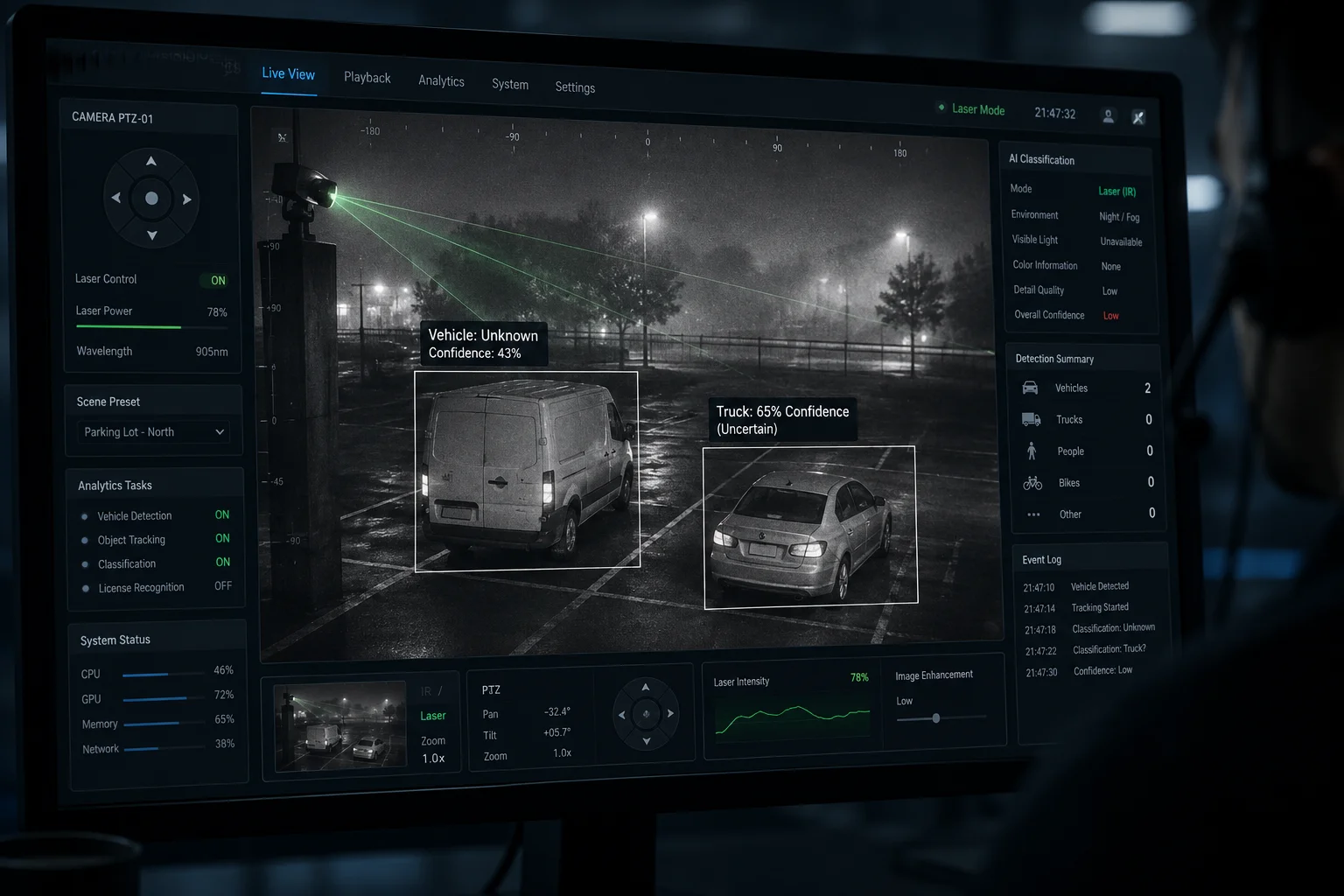 Vehicle classification in laser mode
When I look at vehicle AI in daylight, the model can use color, body shape, window lines, tire edges, and even small marks on the car. At night, laser mode changes the game. The image often becomes black and white, so the model loses color clues. It then leans more on outline, size, movement, and shape. That still works, but it is not as rich.
What I watch during field tests
| Test item | Day mode | Laser night mode | What changes |
|---|---|---|---|
| Color cues | Strong | Missing | The model loses a major feature source |
| Edge sharpness | High | Medium to high | Depends on laser strength and lens quality |
| False vehicle matches | Low | Slightly higher | Noise and glare can confuse the model |
| Plate reading support | Better in clear light | Depends on exposure | Motion blur1 can rise at night |
I also pay attention to the scene itself. A white van, a dark pickup, and a small sedan can look very different in the day, but they can look much more alike at night. That makes the model work harder. If the camera uses a strong laser and a good sensor, the AI can still do a solid job. But if the laser is weak, or if the scene has dust, rain, or fog, the accuracy can fall more. I also know that night does not fail in one single way. Sometimes the model still detects the vehicle, but it classifies the wrong type. Other times it sees the vehicle too late. For David, that matters a lot, because a wrong class can break a rule in a smart parking, gate control, or alarm project.
Why classification becomes harder at night
| Main reason | Simple effect | Field result |
|---|---|---|
| Loss of color | Fewer visual clues | Same shape can mean more than one vehicle type |
| Lower contrast | Harder to separate parts | Wheels, mirrors, and roof lines become less clear |
| Added noise | More false details | The AI may misread small bright spots |
| Motion blur | Moving cars are harder to freeze | Fast vehicles can lose shape |
I think the real point is this: laser mode is useful, but it does not fully replace daylight detail. It helps the camera keep working in the dark, and that is valuable. But if I need high vehicle classification accuracy, I still try to improve the full setup, not only the light source. I look at exposure, shutter speed, lens quality, and how the AI model was trained. If the model was trained on mixed day and night scenes, it usually performs better. If it was trained only on bright images, the night drop can be much worse. In my experience, the best result comes when the hardware and the AI are built together for the same job.
How does the AI compensate for the loss of “Color Metadata” in black-and-white night vision?
I know this problem very well, because color is one of the fastest ways for the brain and the camera to tell objects apart.
The AI compensates by using shape, motion, contrast, edge detail, and learned patterns, so it can still identify people and vehicles even when black-and-white night vision5 removes color.
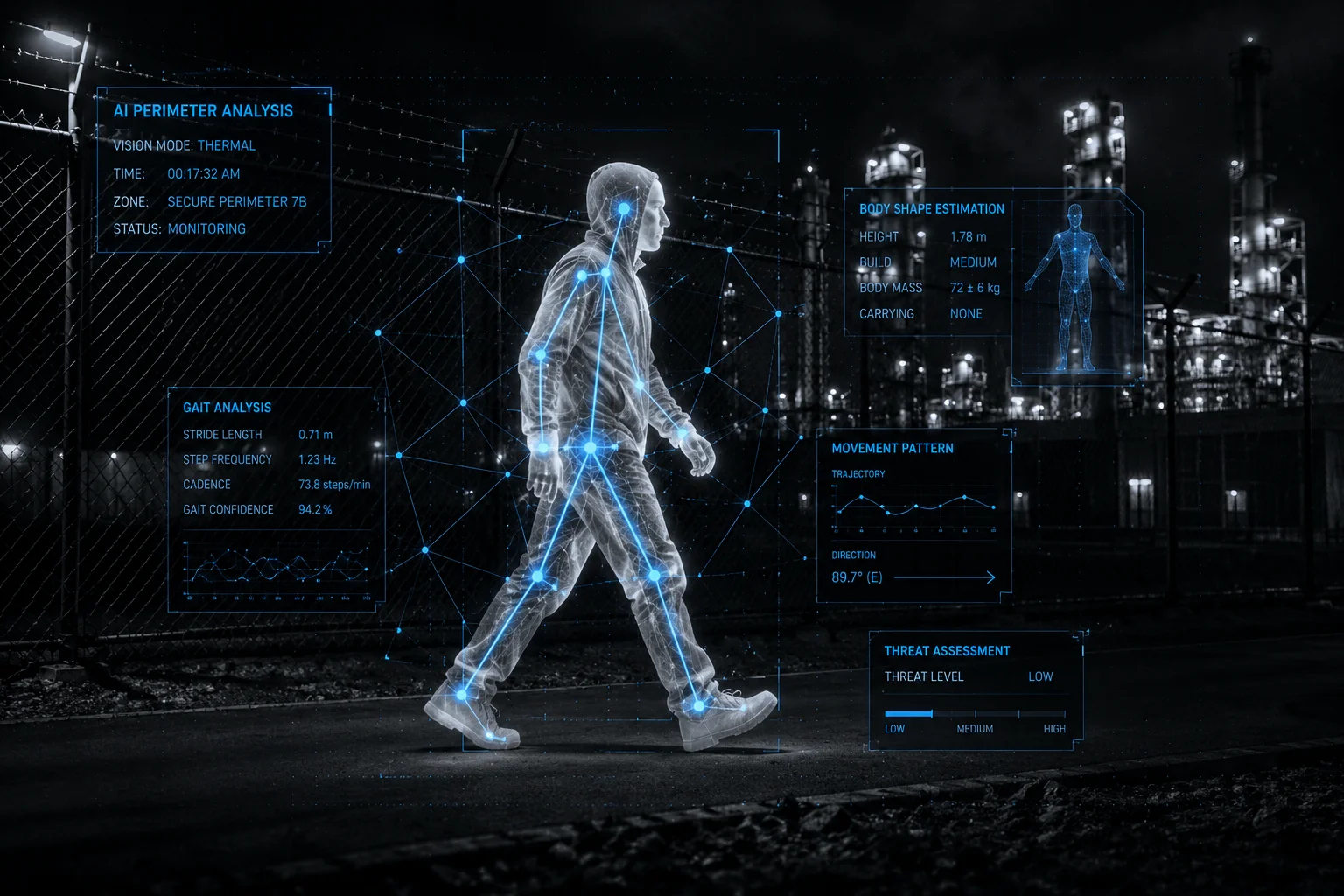 Black and white night vision AI compensation
At night, the camera can no longer depend on red shirts, blue cars, or yellow helmets. So the AI shifts to other clues. I like to think of it as a trade. The camera gives up color, but it gains a more focused look at outlines and movement. For example, a person walking usually has a clear head-shoulder shape and a repeated arm swing. A car usually has a long body, two lights, a windshield line, and a fixed wheel spacing. The AI uses these patterns to make a guess. In a good camera, that guess is often strong enough for real work.
The main clues the model still uses
| Clue type | What the AI sees | Why it helps |
|---|---|---|
| Body shape | Human or vehicle outline | It separates major object types |
| Motion pattern | How the object moves | It helps tell people, cars, and animals apart |
| Edge contrast | Bright and dark lines | It defines the object boundary |
| Size ratio | Height, width, and depth | It reduces confusion between classes |
I also rely on training data6. A model that has seen many night scenes can adapt much better than a model that only knows bright daylight images. This matters a lot for B2B buyers who want stable results in real sites, not just demo videos. If I deploy a camera on a farm, a gate, or a road, I expect rain, dust, low light, and random reflections. The AI must learn that a small bright point near the lens may be an insect, not a person. It must learn that a shiny road sign is not a moving target. That is why the best night AI is not only about the sensor. It is also about the data and the logic inside the firmware7.
What good night AI logic usually does
- It lowers the chance of tiny light spots becoming fake targets.
- It checks the full shape before it sends an alarm.
- It watches movement speed and direction.
- It uses time-based tracking to avoid one-frame errors.
I also like to explain one simple fact to buyers: night AI does not need to be perfect to be useful. It needs to be stable and predictable. In a security project, a camera that detects a person a little later but still correctly can be better than a camera that triggers too many false alarms8. That is why I always balance sensitivity with filter rules. In my own work, I test the camera against trees, shadows, road lights, car headlights, and rain. These are the things that hurt night AI most. When the system handles these scenes well, I know the loss of color has been handled in a practical way.
Can I expect the same 98% detection rate at 300m during a clear day and a dark night?
I would never promise the same number without testing both scenes, because distance and light change the result in a real way.
No, I do not expect the exact same 98% detection rate at 300m in both a clear day and a dark night, because night mode usually reduces usable detail and makes long-range recognition harder.
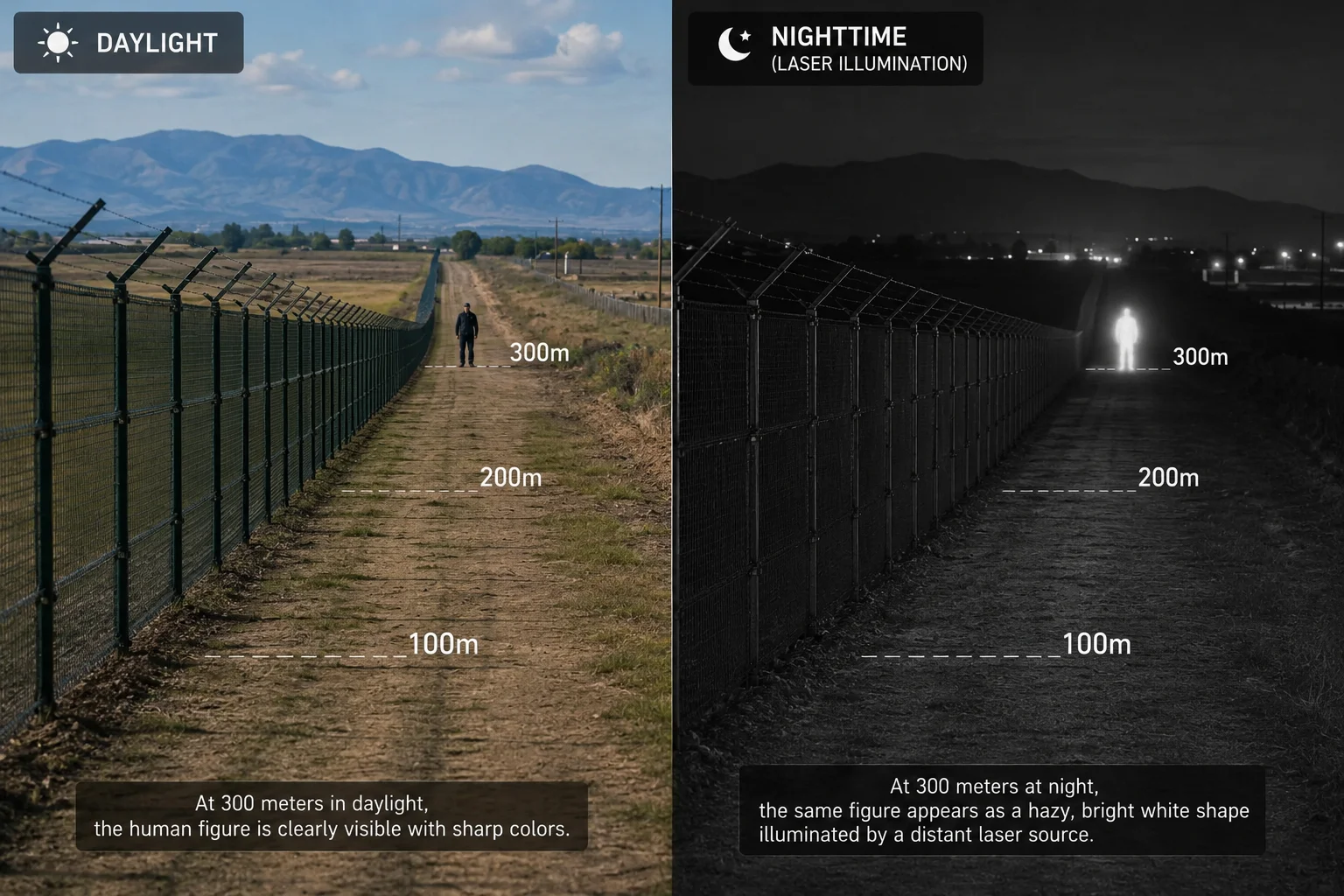 300m day vs night detection rate
I tell customers that 300m is not just one distance. It is also a test of light, lens power, air clarity, target size, and camera tuning. In a clear day, the camera can use the sun as a huge light source. The image is bright, the contrast is strong, and the AI has more data. At night, even with laser light, the scene is different. Light spreads, fades, or reflects back in a less perfect way. If the weather is dry and clear, the result can still be strong. But if there is haze, rain, or dust, the performance can drop more.
What changes between day and night at 300m
| Factor | Clear day | Dark night |
|---|---|---|
| Light source | Natural and strong | Active illumination only |
| Target detail | Rich and stable | Less rich and more limited |
| AI confidence | Higher | Often lower |
| Small object visibility | Better | Harder at long range |
I also think people often mix up detection and recognition9. Detection means the camera finds something is there. Recognition means the camera knows what it is. At 300m, the camera may still detect a moving object at night, but it may not classify it with the same confidence as it does in the day. That is normal. For David, this matters because he may need different alarm zones for day and night. In a daytime scenario, a camera can watch a wider perimeter. At night, I often suggest a tighter zone, a slower preset, or stronger laser support. That keeps the system honest and reduces false calls.
How I judge real 300m performance
| Checkpoint | What I look for |
|---|---|
| Detection | Does the camera see the object at all? |
| Classification | Does it know whether it is a person, car, or truck? |
| Tracking | Can it keep the target centered? |
| Alarm stability | Does it trigger once, or does it keep firing? |
I also tell buyers to ask for test clips, not just spec sheets. A clean sheet can say a lot, but a field clip says more. I want to see the target move through the full range. I want to see the camera at noon and at midnight. I want to see the edges, the glare, and the effect of weather. If a factory can show me that, I can judge if the 98% claim is real in a useful way. In my view, a good night result at 300m is possible, but the same number across day and night is not the right expectation unless the whole system has been designed and tuned for that level.
Does the factory provide a “Day vs. Night” accuracy chart for the 800m laser PTZ model?
I get this request from serious buyers all the time, and I think it is a very smart request.
Yes, a good factory should provide a day vs. night accuracy chart11 for an 800m laser PTZ10 model, because that chart shows real performance under different light levels, not just marketing claims.
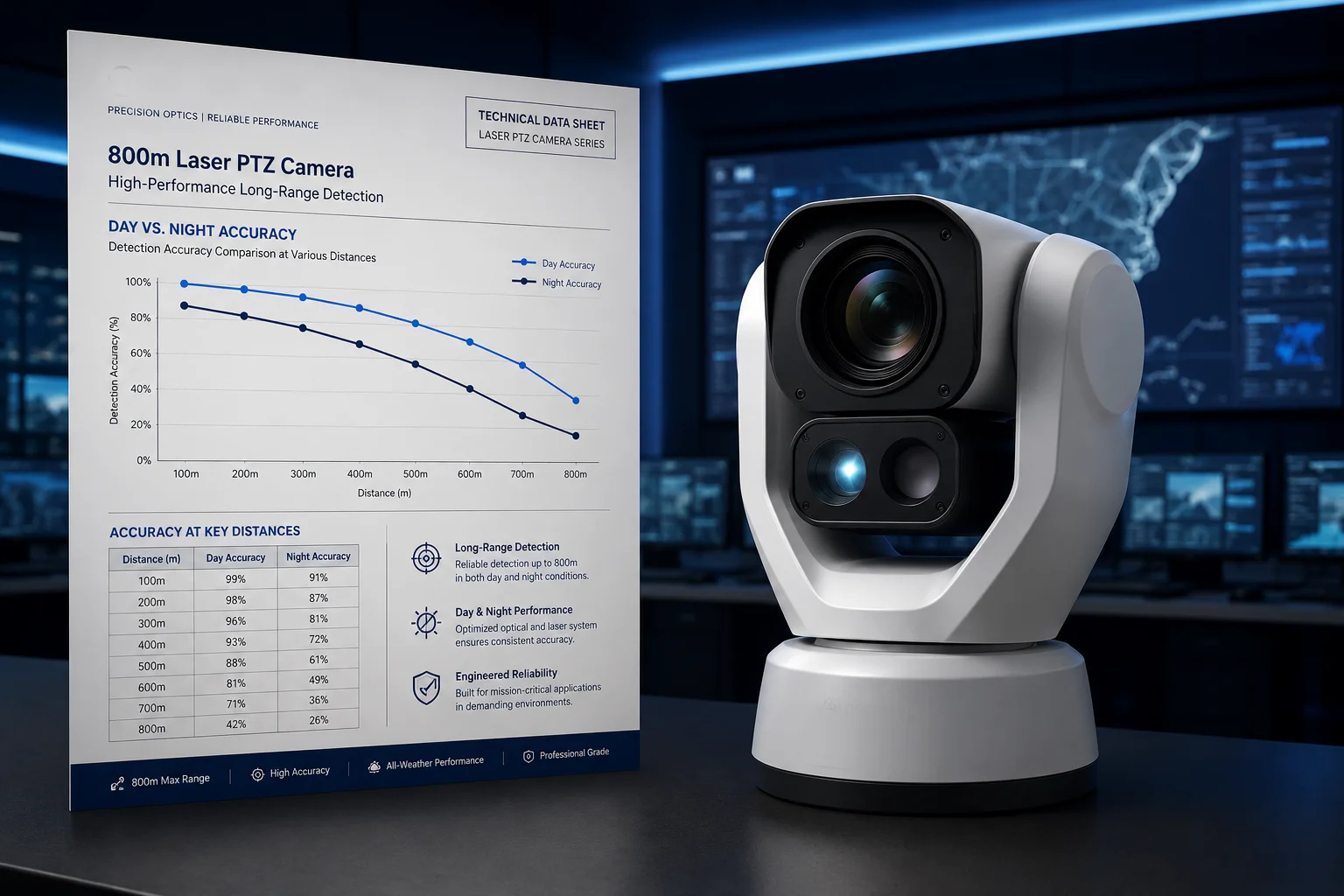 Day vs night accuracy chart PTZ
I always encourage buyers to ask for this kind of chart, because it helps them compare products in a fair way. A long-range PTZ camera is not only about zoom power. It is also about how the camera behaves when light drops. For an 800m laser model, the chart should show detection, recognition, and tracking at different ranges. It should also separate daytime, dusk, and full night results. If a supplier only gives one top number, I become careful. A real project needs more than one number.
What a useful chart should show
| Chart item | Why it matters |
|---|---|
| Detection rate by distance | Shows where the camera can still find a target |
| Recognition rate by distance | Shows where the AI can still classify the target |
| Day and night split | Shows how much light affects the result |
| Weather notes | Shows if rain, haze, or dust were part of the test |
For an 800m laser PTZ, I also want to know the test target. A person, a car, and a truck are not the same. A camera may detect a truck at a long range more easily than a person because the truck is bigger. So I ask the factory to state the target size, the movement speed, the scene background, and the lens setting. I also want to know if the camera used real AI or only basic motion detection. These are very different things. If the chart is honest, it helps me plan the project. If the chart is vague, it helps me know the supplier is not ready for hard work.
What I ask the factory before I trust the chart
- Was the test done indoors or outdoors?
- Was the scene clear, dusty, rainy, or foggy?
- What was the target size and speed?
- Did the test use the real shipping firmware?
- Was the chart made by the factory or by a third party?
I also care about repeatability. One good test is not enough. I want to know if the camera can do it again and again. A chart is useful only when it matches the actual site. For my own B2B work, I use these charts to help David and his team choose the right model faster. It saves time, and it reduces risk. If I see a camera with strong daytime numbers but weak nighttime numbers, I may still recommend it, but only for projects where day use matters most. If the project is a perimeter site that runs all night, I push harder for a stronger laser, a better sensor, and smarter AI tuning.
Conclusion
I see day and night as two different test worlds, and I choose the camera, the light, and the AI setup based on both, not just one.
1. Motion blur can degrade AI performance at night by obscuring vehicle shapes; understanding it helps choose better camera settings. ↩︎ 2. Understand how vehicle classification works in AI recognition systems, especially under different lighting conditions. ↩︎ 3. Explore how laser illumination is used in PTZ cameras to enable night vision for long-range surveillance. ↩︎ 4. Understand the role of color information in computer vision and how its loss affects object recognition at night. ↩︎ 5. Learn about the principles of black-and-white night vision technology and its trade-offs for AI detection. ↩︎ 6. High-quality training data that includes night scenes improves AI model robustness in low-light conditions. ↩︎ 7. Camera firmware contains the logic that optimizes AI performance for nighttime environments. ↩︎ 8. Understand how AI filtering reduces false alarms in security systems, especially during night operation. ↩︎ 9. Learn the difference between detection (seeing an object) and recognition (identifying it) in computer vision. ↩︎ 10. Discover the features and specifications of long-range laser PTZ cameras for day/night surveillance. ↩︎ 11. Learn how to interpret day vs. night accuracy charts to evaluate camera performance in real-world conditions. ↩︎