
I’ve seen too many integrators spend thousands on cameras, only to get grainy, washed-out footage at night. The sensor size is usually the problem.
The 1/1.2″ sensor has roughly 5.5 times more light-gathering area than a 1/2.8″ sensor. This means it captures far more light per pixel, producing cleaner images in low light, better dynamic range in harsh contrast scenes, and more natural depth of field — all of which matter most when you’re deploying cameras in challenging, real-world environments.
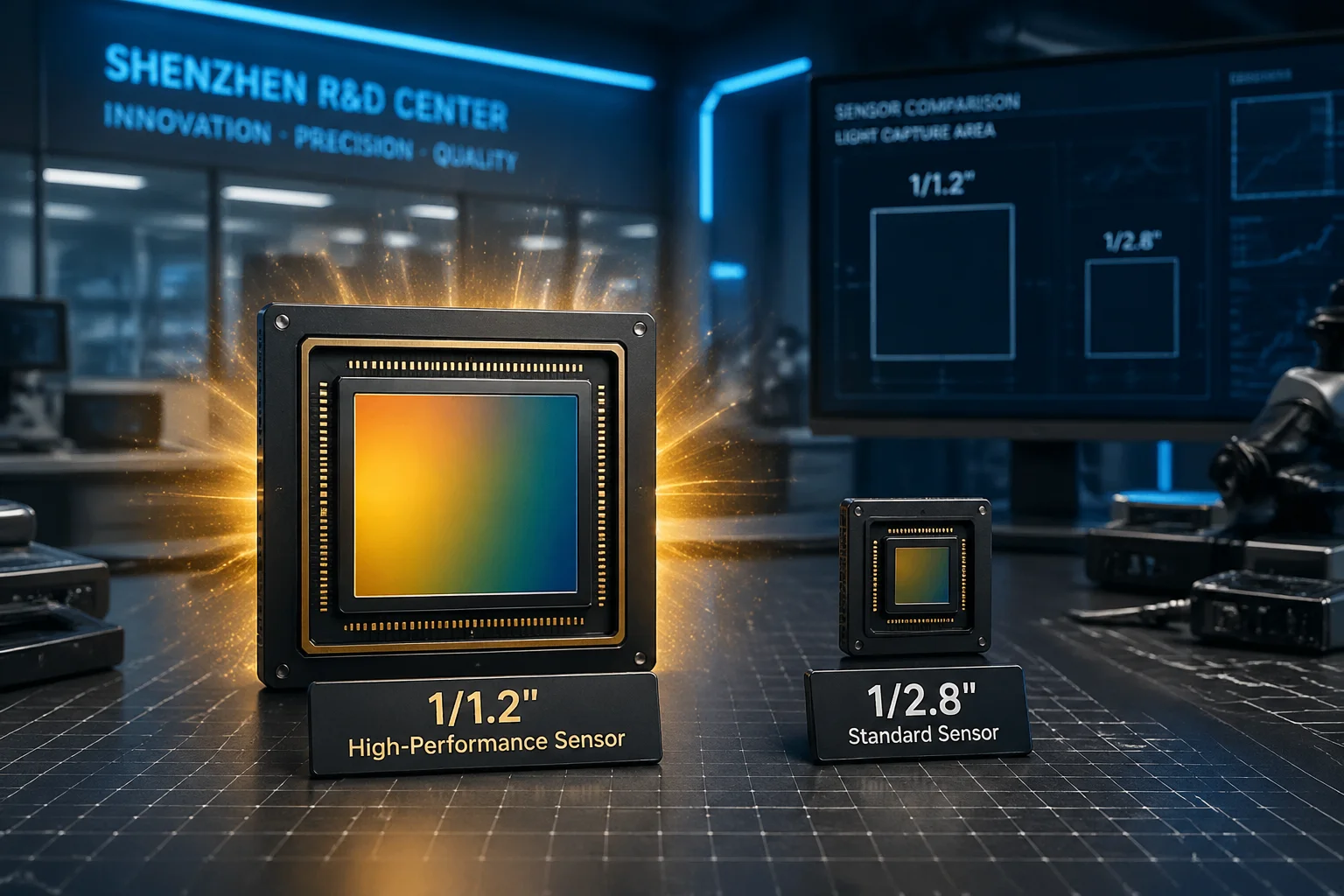 sensor size comparison 1/1.2 vs 1/2.8 security camera
Below, I’ll break down the four questions I hear most from integrators like David Miller when they’re choosing between these two sensor sizes. Each answer is backed by physics, real-world data, and lessons I’ve learned from years of building PTZ cameras at our Shenzhen R&D facility. Let’s get into it.
Table of Contents
How Much More Light Can My 1/1.2″ Sensor Capture Compared to a Standard 1/2.8″ Sensor?
This is the first question every serious integrator asks me. And it should be. Because if you get this wrong, your cameras will fail at night — and your client will call you, not the manufacturer.
A 1/1.2″ sensor captures about 5.5 times more light than a 1/2.8″ sensor at the same resolution. This is because its physical sensing area is roughly 191 mm² versus 35 mm². More area means bigger pixels, more photons per pixel, and a much higher signal-to-noise ratio 1 in dark conditions.
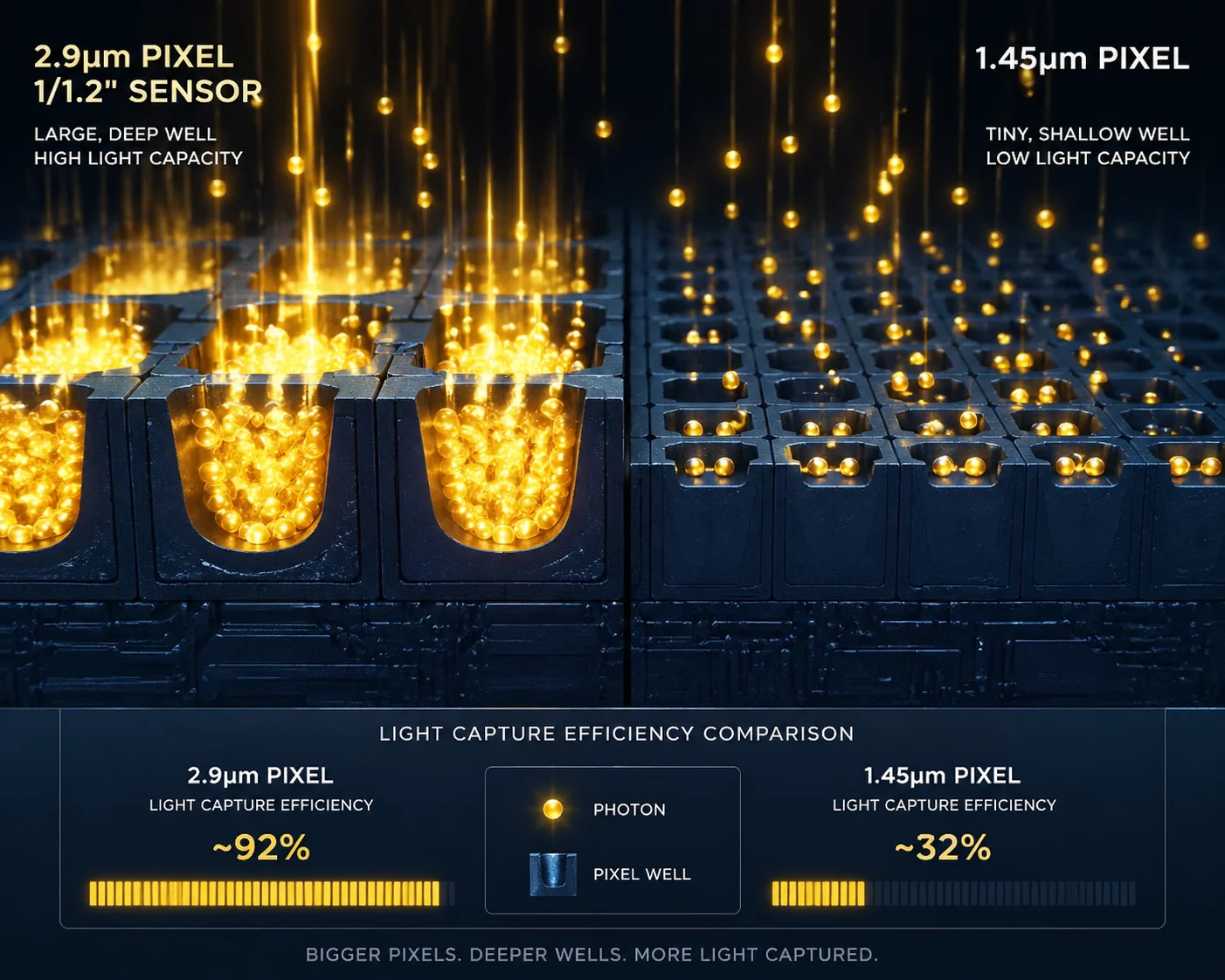 1/1.2 inch sensor vs 1/2.8 inch sensor light capture comparison
Understanding the Naming Convention
The numbers “1/1.2” and “1/2.8” refer to the sensor’s diagonal length, not its actual area. A smaller denominator means a larger sensor. This confuses a lot of people. So let me put it in a simple table.
| Sensor Size | Approximate Area | Typical Pixel Size (at 4K) | Relative Light Capture |
|---|---|---|---|
| 1/2.8″ | ~35 mm² | ~1.45 μm | 1x (baseline) |
| 1/1.8″ | ~85 mm² | ~2.0 μm | ~2.4x |
| 1/1.2″ | ~191 mm² | ~2.9 μm | ~5.5x |
The area difference is a square relationship. When the diagonal doubles, the area roughly quadruples. That’s why the jump from 1/2.8″ to 1/1.2″ is so dramatic.
Why Pixel Size Matters More Than Pixel Count
Here’s where many buyers get tricked. They see “8MP” on two different cameras and assume the image quality is the same. It’s not.
An 8MP camera with a 1/2.8″ sensor has to cram 8 million pixels into 35 mm². Each pixel ends up tiny — around 1.0 μm. A pixel that small collects very few photons in dim light. The camera’s processor then has to amplify the weak signal, which adds electronic noise. That noise shows up as ugly grain or “snow” in your footage.
Now take an 8MP camera with a 1/1.2″ sensor. The same 8 million pixels spread across 191 mm². Each pixel is about 2.9 μm — nearly three times wider. A wider pixel collects more photons. More photons mean a stronger signal. A stronger signal needs less amplification. Less amplification means less noise.
The Real-World Impact
I’ve had customers switch from a 1/2.8″ PTZ to one of our 1/1.2″ models and tell me the difference is “night and day.” That’s not marketing language. It’s literally true. At night, the 1/1.2″ sensor delivers clean, colorful images while the 1/2.8″ sensor is stuck in black-and-white IR mode with visible grain.
For integrators deploying cameras in areas with no street lights — think farms, border zones, or remote construction sites — this 5.5x light advantage is not a luxury. It’s a requirement.
Is the Price Premium for a Large-Format Sensor Worth It for My Specific Project?
I get this question every week. The honest answer is: it depends on where you’re putting the camera. But in most cases, the premium pays for itself by reducing callbacks and failed inspections.
Yes, the price premium is worth it for any project where low-light performance, dynamic range, or long-range identification matters. The larger sensor reduces noise, improves color accuracy at night, and cuts down on the need for expensive external IR illuminators 2 — saving money across the total project lifecycle.
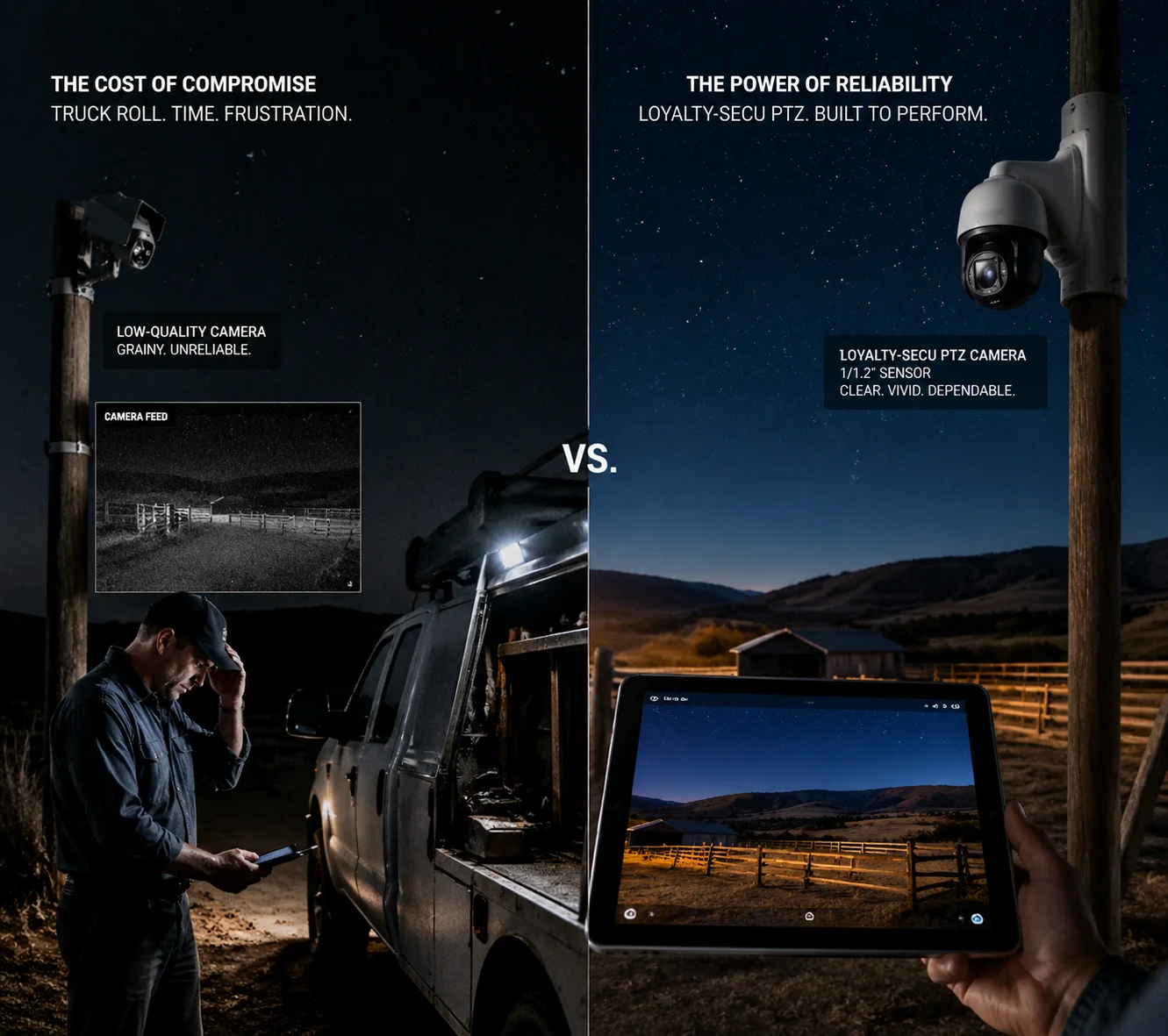 large format sensor PTZ camera cost benefit analysis
Upfront Cost vs. Total Cost of Ownership
A 1/1.2″ PTZ camera typically costs 30–60% more than a comparable 1/2.8″ model. That sounds like a lot. But let me show you what happens when you factor in the full project cost.
| Cost Factor | 1/2.8″ System | 1/1.2″ System |
|---|---|---|
| Camera unit price | Lower | 30–60% higher |
| External IR illuminator needed? | Often yes | Usually no |
| Night image quality complaints | Common | Rare |
| Truck roll for re-adjustment | More likely | Less likely |
| Client satisfaction at acceptance | Risk of rejection | High pass rate |
| 3-year total cost of ownership | Often higher | Often lower |
When David Miller installs a camera on a ranch 90 miles from the nearest city, a single truck roll to fix a complaint costs $500–$800 in labor and fuel. If the 1/2.8″ camera produces grainy night footage and the client rejects the installation, that’s a second truck roll — plus the cost of swapping the camera. The $150 premium on a 1/1.2″ sensor suddenly looks cheap.
When 1/2.8″ Is Good Enough
I’m not going to tell you that every project needs a large sensor. That would be dishonest. For well-lit indoor environments — retail stores, office lobbies, warehouses with 24/7 fluorescent lighting — a 1/2.8″ sensor at 4K or 5MP delivers excellent results. The light is abundant. The sensor doesn’t need to work hard.
The same goes for outdoor locations with strong street lighting. A parking lot with LED pole lights at every 30 feet doesn’t need a 1/1.2″ sensor. A good 1/2.8″ camera with a quality lens will do the job fine.
When You Must Go Large
But the moment you step into low-light, high-contrast, or long-range scenarios, the 1/2.8″ sensor hits a wall. These are the projects where I always recommend 1/1.2″:
- Remote solar-powered sites with zero ambient light
- Highway ALPR where you need fast shutter speeds at night
- Perimeter security where the camera must identify a person at 300+ meters
- Critical infrastructure where footage must hold up as legal evidence
In these cases, the sensor is not just a component. It’s the foundation of the entire project’s success.
Will the Larger Sensor Size Provide a Better Depth of Field for My Long-Range Monitoring?
This one surprises a lot of people. Most integrators think depth of field is only a photography thing. But it directly affects how your PTZ camera performs at high zoom levels.
Yes, a 1/1.2″ sensor produces a shallower depth of field than a 1/2.8″ sensor at the same focal length and aperture. For long-range monitoring, this can actually help — the subject stays sharp while the cluttered background softens, making it easier for both human operators and AI algorithms to identify targets.
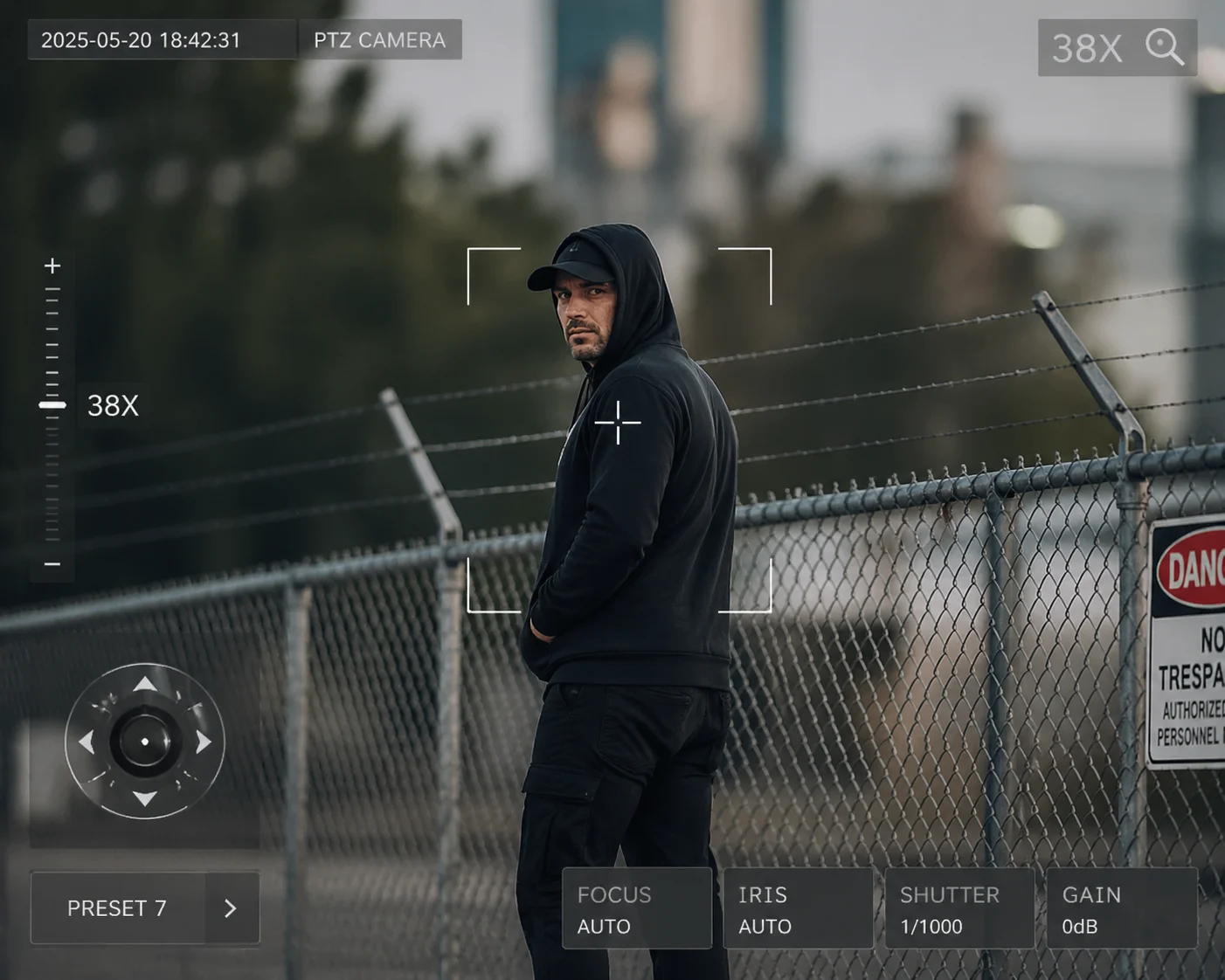 depth of field comparison large sensor vs small sensor PTZ camera
How Sensor Size Affects Depth of Field
Depth of field (DoF) is the range of distance that appears sharp in an image. Three things control it: aperture, focal length, and sensor size.
With a larger sensor, you need a longer actual focal length to get the same field of view. A longer focal length naturally produces a shallower depth of field. So at any given zoom level, the 1/1.2″ sensor will blur the background more than the 1/2.8″ sensor.
Why Shallower DoF Helps at Long Range
When you’re zoomed in at 38X on a target 500 meters away, the background behind that target is often a mess — trees, fences, buildings, heat haze. With a 1/2.8″ sensor, everything from 400m to 600m might be in focus. The target blends into the clutter.
With a 1/1.2″ sensor, the depth of field is narrower. The target at 500m is sharp. The fence at 520m is slightly soft. The trees at 600m are blurred. This separation makes the target pop out of the scene.
The AI Advantage
This matters even more when you’re running AI analytics. Modern AI-based detection — person tracking, vehicle classification, intrusion alerts — works by extracting features from the image. When the background is cluttered and sharp, the algorithm has to work harder to separate the target from the noise. False alarms go up. Detection accuracy goes down.
A naturally shallow depth of field acts like a built-in filter. It tells the AI: “Focus here. Ignore the rest.” At our factory, we’ve tested this with our dual-lens AI tracking PTZ cameras. The 1/1.2″ sensor models consistently show lower false-positive rates in cluttered outdoor environments compared to 1/2.8″ models running the same firmware.
When Deep DoF Is Better
I should mention the flip side. For wide-angle overview shots — like monitoring an entire parking lot from a single camera — you want deep depth of field. You want everything from 5 meters to 50 meters to be sharp. In that case, the 1/2.8″ sensor’s naturally deeper DoF is an advantage.
So the right answer depends on your use case. For long-range PTZ surveillance with high zoom, the 1/1.2″ sensor’s shallower DoF is a clear benefit. For wide-angle fixed cameras, the 1/2.8″ sensor’s deep DoF works in your favor.
Can My 1/2.8″ Camera Compete With Larger Sensors When Using High-Power IR Illuminators?
This is the workaround question. “Can I just throw more IR light at the scene and make my cheap sensor perform like an expensive one?” I hear it all the time.
Adding high-power IR illuminators can improve a 1/2.8″ camera’s night performance, but it cannot close the gap entirely. The smaller sensor still has smaller pixels, which means more noise, less dynamic range, and poorer color reproduction. IR light also only enables black-and-white imaging, while a 1/1.2″ sensor can often deliver full-color footage without any supplemental light.
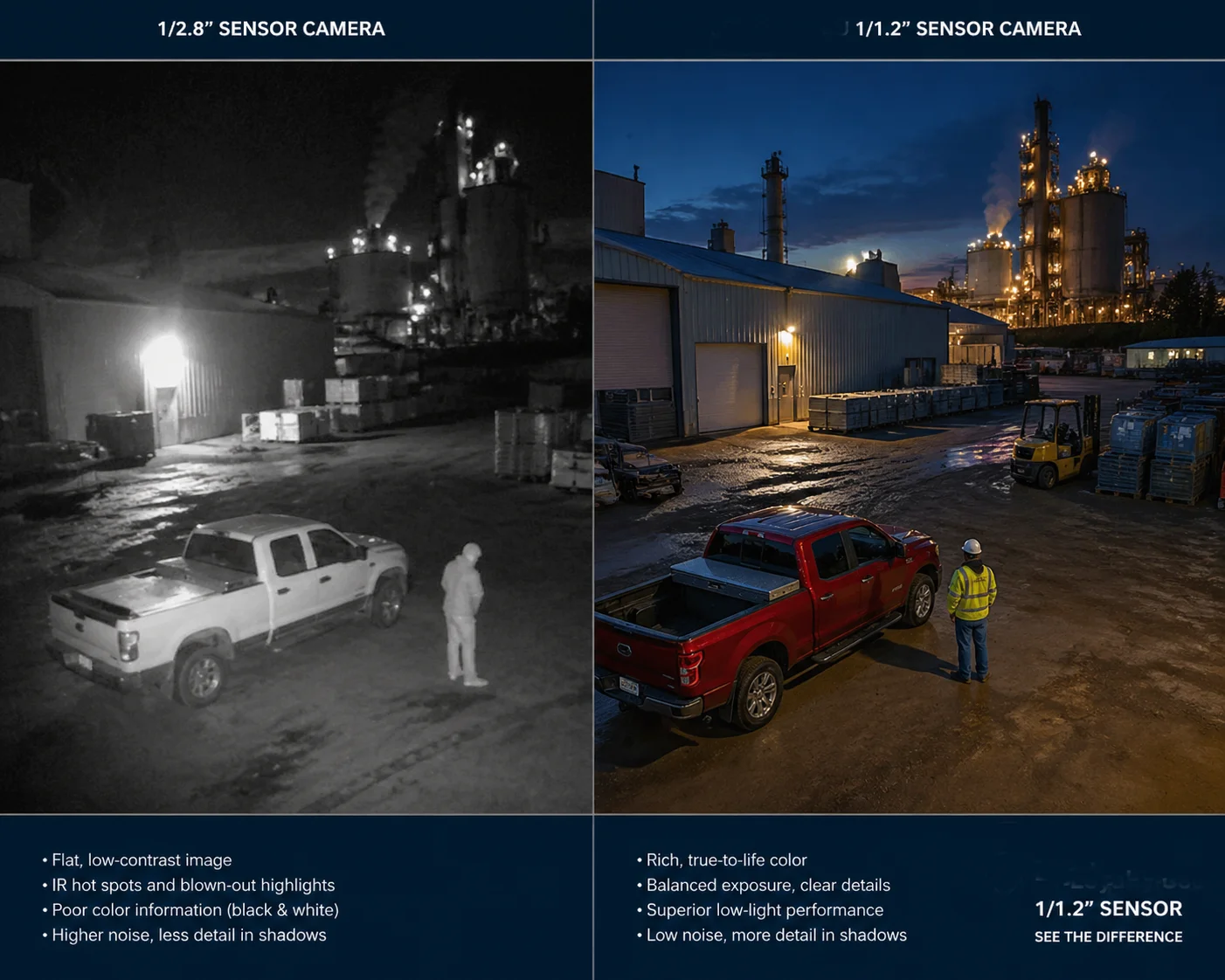 IR illuminator vs large sensor low light security camera comparison
What IR Illuminators Can Fix
Let me be fair. A good external IR illuminator does help. It floods the scene with infrared light that’s invisible to the human eye but visible to the camera sensor. This gives the sensor more photons to work with, which reduces noise and improves contrast.
For a 1/2.8″ camera in a moderately dark environment — say, a suburban street with some ambient light — adding a 50W IR illuminator can produce a usable black-and-white image at 50–80 meters. That’s a real improvement over the camera’s built-in IR LEDs, which typically max out at 30–50 meters.
What IR Illuminators Cannot Fix
But here’s what IR light cannot do:
- It cannot make pixels bigger. The 1/2.8″ sensor’s pixels are still 1.0–1.45 μm. They still saturate quickly in bright spots and struggle in shadows. The dynamic range problem remains.
- It cannot produce color images. When a camera switches to IR mode, it removes the color filter from the sensor. You get grayscale only. A 1/1.2″ sensor in “black light full color” mode can deliver color footage in near-total darkness — without any IR light at all.
- It cannot reduce heat haze or atmospheric distortion. At long range (200m+), IR light scatters in humid or dusty air. The image gets hazy. A larger sensor with better signal-to-noise ratio handles this degradation more gracefully.
The Hidden Costs of IR Dependence
There’s also a practical cost issue. High-power IR illuminators are not free.
| Item | Typical Cost | Notes |
|---|---|---|
| 50W IR illuminator | $80–$150 | Covers 50–80m range |
| 100W IR illuminator | $150–$300 | Covers 100–150m range |
| Mounting bracket + wiring | $30–$60 | Extra labor at install |
| Power supply (separate) | $20–$40 | Must be weatherproof |
| Annual electricity cost | $30–$70 | Runs all night, every night |
| Replacement every 2–3 years | $80–$300 | LED degradation over time |
Add it up. Over three years, a high-power IR setup can cost $300–$800 on top of the camera. And you still get black-and-white footage with limited dynamic range.
Compare that to spending an extra $150–$250 upfront for a 1/1.2″ sensor camera that delivers full-color night vision with no external illuminator. The math speaks for itself.
My Recommendation
If your project budget is truly fixed and you already own 1/2.8″ cameras, then yes — add IR illuminators as a stopgap. They will improve your night image. But if you’re specifying new equipment for a project, invest in the larger sensor from the start. You’ll get better images, lower total cost, and fewer complaints from your end client.
At Loyalty-Secu, we build both types. Our 1/2.8″ models are solid for daytime and well-lit environments. But for any project where night performance is critical, I always steer integrators toward our 1/1.2″ PTZ cameras with Sony IMX485 3 sensors. The difference in the field is not subtle. It’s obvious.
Conclusion
Sensor size is the single biggest factor in image quality. A 1/1.2″ sensor captures 5.5x more light than a 1/2.8″, and that gap shows most at night. Choose based on your site conditions, not just price.
1. Signal-to-noise ratio explained for image sensor performance. ↩︎ 2. How infrared illuminators enhance night vision cameras. ↩︎ 3. Sony IMX485 4K sensor specifications for security cameras. ↩︎ 4. Depth of field calculation based on sensor size and focal length. ↩︎ 5. Photon shot noise limitation in small-pixel sensors. ↩︎ 6. Dynamic range comparison between 1/2.8″ and 1/1.2″ CMOS sensors. ↩︎ 7. False alarm reduction in AI detection with larger sensors. ↩︎ 8. Total cost of ownership calculator for security cameras. ↩︎ 9. LED IR diode lumen depreciation over time. ↩︎ 10. Atmospheric scattering effects on long-range IR illumination. ↩︎