
I’ve seen lightning kill a perfectly good PTZ camera — not because the camera was bad, but because the antenna connector failed first.
The main difference is not about the connector itself. SMA and TNC connectors do not have built-in surge protection. The real protection comes from the coaxial surge arrestor2 behind the connector, the internal TVS or GDT circuits, and the grounding design7. However, TNC connectors1 offer a larger contact area, stronger mechanical lock, and better environmental sealing, which indirectly improves long-term surge protection reliability in harsh outdoor installations.
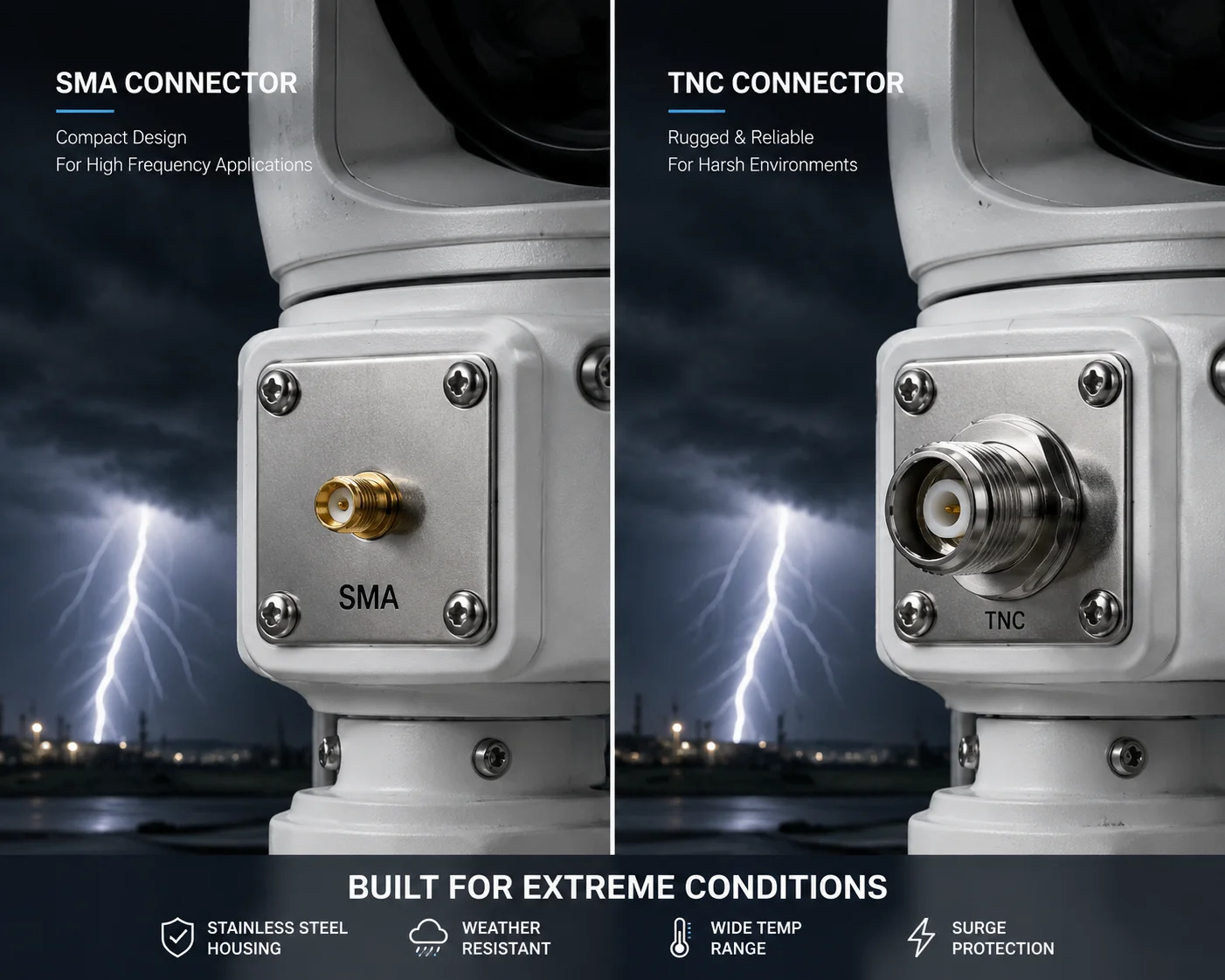
I will break this down section by section below. If you are sourcing PTZ cameras from China for outdoor 4G solar projects, this guide will help you ask the right questions and avoid costly field failures.
Table of Contents
Is the TNC Connector More Rugged Than SMA for High-Vibration Industrial Sites?
I once had a customer in West Texas lose signal on three cameras after a single windstorm. The root cause was not the 4G module. It was loose SMA connectors.
Yes, TNC is significantly more rugged than SMA in high-vibration environments. TNC uses a threaded locking mechanism derived from BNC, with a larger body and thicker center pin. This design resists loosening from wind, engine vibration, and thermal expansion — all common on industrial poles, highway gantries, and mobile trailers.
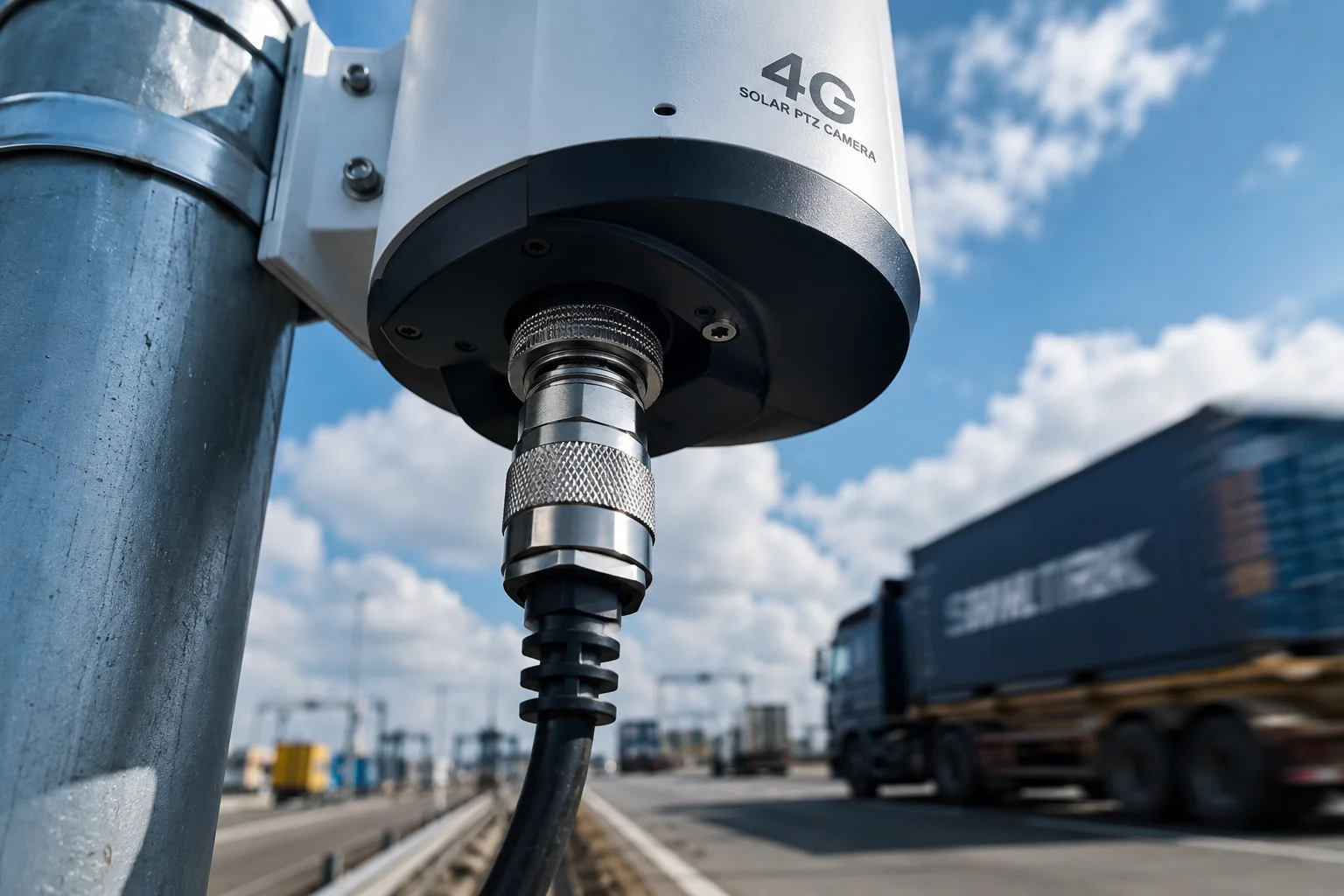
Why Vibration Matters More Than You Think
Vibration does not just shake a connector loose. It creates micro-gaps between the center pin and the socket. These micro-gaps cause two problems at the same time.
First, the RF signal degrades. You get packet loss on your 4G link. The camera drops offline for a few seconds, reconnects, drops again. Your VMS shows “intermittent connection,” and your field tech drives two hours to find nothing visibly wrong.
Second, and more dangerous, the ground path becomes unreliable. The outer shield of a coaxial connector is your ground reference. When it loosens, the shield contact resistance goes up. Now imagine a lightning-induced surge hitting that antenna. The surge needs a low-impedance path to ground. A loose connector blocks that path. The energy has nowhere to go — so it punches through your 4G module8 instead.
Mechanical Comparison: SMA vs TNC
| Feature | SMA | TNC |
|---|---|---|
| Locking method | Small threaded nut | Threaded nut with larger engagement area |
| Center pin diameter | ~1.3 mm (thin) | ~1.6 mm (thicker) |
| Torque resistance | Lower — loosens under repeated thermal cycling | Higher — maintains contact under vibration |
| Body diameter | ~6.35 mm | ~11 mm |
| Typical use case | Indoor routers, compact devices | Outdoor base stations, vehicle-mounted systems |
What This Means for Your Field Deployment
If your PTZ camera sits on a short pole behind a building, SMA is usually fine. The camera housing shields it from wind. The antenna is short. The risk is low.
But if you mount a 4G antenna on top of a 30-foot steel pole with a coax cable running down to the camera, you need TNC. That long cable acts like a sail in the wind. Every gust transfers vibration to the connector. Over six months, an SMA joint will loosen. A TNC joint will not.
I always tell my customers: the connector is the weakest link in your RF chain. If it fails, your entire solar surveillance system goes dark — and sending a truck to a remote ranch in Montana costs more than the camera itself.
How Does the Connector Type Impact the Effectiveness of a Lightning Arrestor6?
Many buyers assume that switching from SMA to TNC will make their system lightning-proof. That is not how it works.
The connector type does not determine lightning protection by itself. A coaxial lightning arrestor — installed between the antenna and the device — does the actual work. It uses gas discharge tubes3 (GDT) and TVS diodes to clamp voltage and shunt surge current to ground. However, the connector affects how well the arrestor bonds to the system ground, and a poor bond can make even a good arrestor useless.
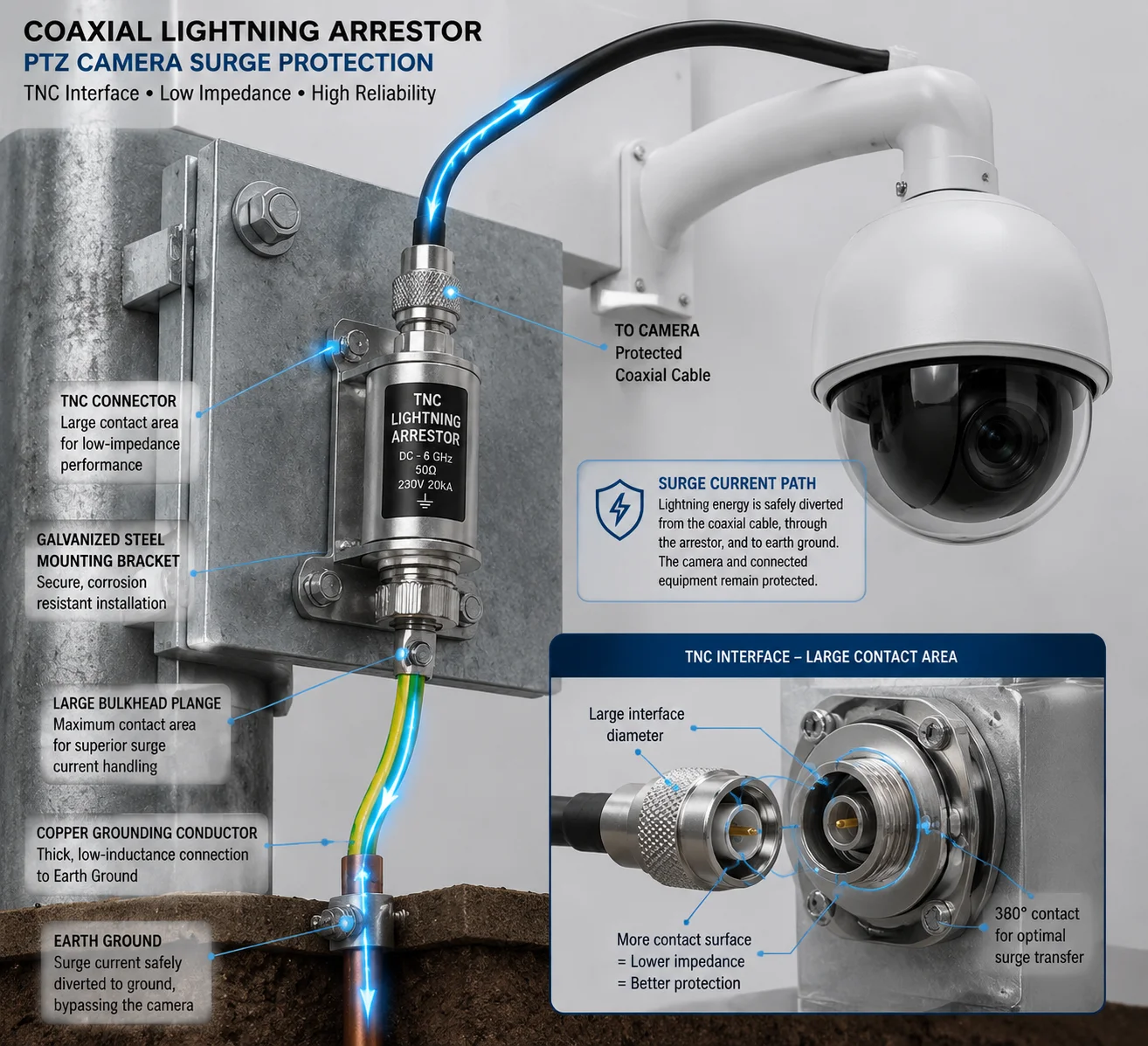
How a Coaxial Surge Arrestor Actually Works
A coaxial surge arrestor sits inline on your antenna cable. It has two connectors — one facing the antenna, one facing the device. Inside, there is a gas discharge tube (GDT) connected between the center conductor and the outer shield.
When a lightning strike hits nearby, it induces a voltage spike on the antenna cable. This spike can reach thousands of volts in microseconds. The GDT inside the arrestor fires at a set voltage — typically 90V or 230V. Once it fires, it creates a short circuit between the center pin and the shield. The surge current flows through the shield, into the mounting bracket, and down to earth ground.
Here is the critical part: that mounting bracket must make solid metal-to-metal contact with the pole or enclosure. And the connector on the arrestor must make solid contact with the cable. If either connection is loose, the surge current cannot flow. It backs up and destroys your equipment.
Where the Connector Type Matters
The connector is the bridge between the arrestor and the cable. A good bridge has low impedance. A bad bridge has high impedance.
SMA connectors have a smaller ground contact area — roughly 20 mm² of shield-to-shield contact. TNC connectors have roughly 35–40 mm² of contact area. That difference matters during a surge event. More contact area means lower transient impedance. Lower impedance means the surge current flows out faster.
Think of it like a water pipe. A narrow pipe slows the flow. A wide pipe lets it rush through. During a lightning surge, you want the widest pipe possible.
Arrestor Interface Comparison
| Parameter | SMA Arrestor | TNC Arrestor |
|---|---|---|
| Ground contact area | ~20 mm² | ~35–40 mm² |
| Typical surge rating | 2.5–5 kA (8/20 μs) | 5–10 kA (8/20 μs) |
| Mounting method | Inline, panel-mount (small flange) | Inline, bulkhead-mount (large flange) |
| Grounding path | Through device chassis | Direct to pole/enclosure via flange |
| Best for | Short stub antennas on camera body | External antennas on pole top with feedline |
My Recommendation for Pole-Mounted 4G Antennas
If your antenna is mounted on top of a steel pole and connected to the camera via a coax feedline, that feedline is an energy collector. A nearby lightning strike will induce current on that cable. You need a TNC-type arrestor bolted directly to the pole with a heavy copper ground wire — 6 mm² minimum — running to your ground rod.
An SMA arrestor can work for a short rubber-duck antenna plugged directly into the camera body. In that case, the camera housing itself acts as the first line of defense, and the surge energy is relatively small.
The bottom line: the arrestor does the protection. The connector determines how well that protection connects to your grounding system. A loose or undersized connector can turn a good arrestor into an expensive paperweight.
Which Connector Provides a Better Environmental Seal Against Salt-Mist and Moisture?
Corrosion is a silent killer. I have pulled SMA connectors off cameras after 18 months outdoors and found green oxidation all over the center pin. The camera still powered on, but the 4G signal was gone.
TNC connectors provide a significantly better environmental seal than SMA. Industrial-grade TNC connectors use thicker O-ring gaskets and a larger threaded body that compresses the seal more evenly. This keeps moisture, salt mist, and dust out of the contact zone — which is critical because corrosion increases contact resistance and degrades both signal quality and surge protection over time.
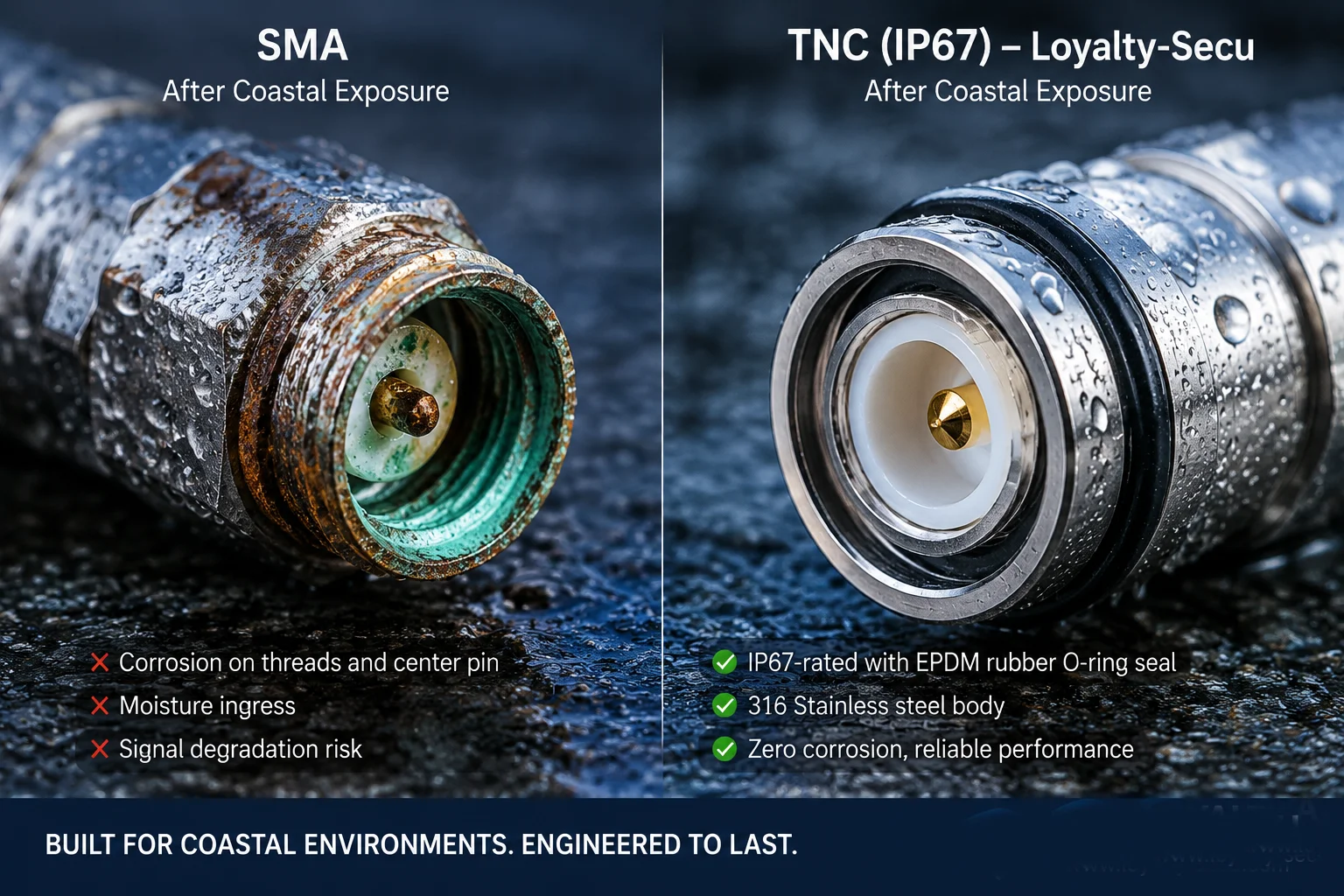
How Moisture Destroys Surge Protection
This is the part most people miss. They think about moisture as a signal problem. It is. But it is also a surge protection problem.
Here is why. When water gets into a coaxial connector, it sits between the center pin and the outer shield. Over time, electrolytic corrosion builds up. This corrosion is a resistive layer. It increases the contact resistance at the connector joint.
Now, when a surge hits, the arrestor fires and tries to shunt current through the shield to ground. But the corroded connector adds resistance to that path. The surge current slows down. The voltage across the connector rises. If it rises high enough, it arcs — and that arc can melt the center pin or damage the arrestor itself.
I have seen this happen on coastal installations in Florida and the Gulf region. Salt mist accelerates corrosion dramatically. An SMA connector without proper weatherproofing can degrade in as little as six months.
Sealing Differences Between SMA and TNC
SMA connectors rely on a very small O-ring — if they have one at all. Many standard SMA connectors are not rated for outdoor use. You can add heat-shrink tubing or self-amalgamating tape, but these are field fixes, not engineered solutions.
TNC connectors, especially IP675-rated versions, come with a molded rubber boot and a compression gasket built into the coupling nut. When you torque the nut to spec, the gasket compresses evenly around the full circumference. This creates a reliable seal that lasts years, not months.
What to Specify When Ordering from China
When you source PTZ cameras from a Chinese manufacturer, do not just ask for “outdoor-rated connectors.” Be specific. Ask for:
- TNC connectors with IP67 or IP68 rating
- Silicone or EPDM gaskets (not generic rubber)
- Stainless steel coupling nuts (not zinc-plated brass, which corrodes in salt air)
- A weatherproofing kit included with each antenna cable assembly
If the supplier cannot provide a data sheet showing the IP rating of the connector, that is a red flag. At Loyalty-Secu, we specify the sealing grade for every external connector on our PTZ cameras because we know where these cameras end up — on oil rigs, coastal highways, and desert solar farms where the environment is brutal.
Are There Built-in TVS Diodes at the Base of the SMA Connector to Prevent ESD?
This is a question I get from engineers who read data sheets carefully. They see “ESD protection” listed in the specs and assume it is built into the antenna connector. Usually, it is not.
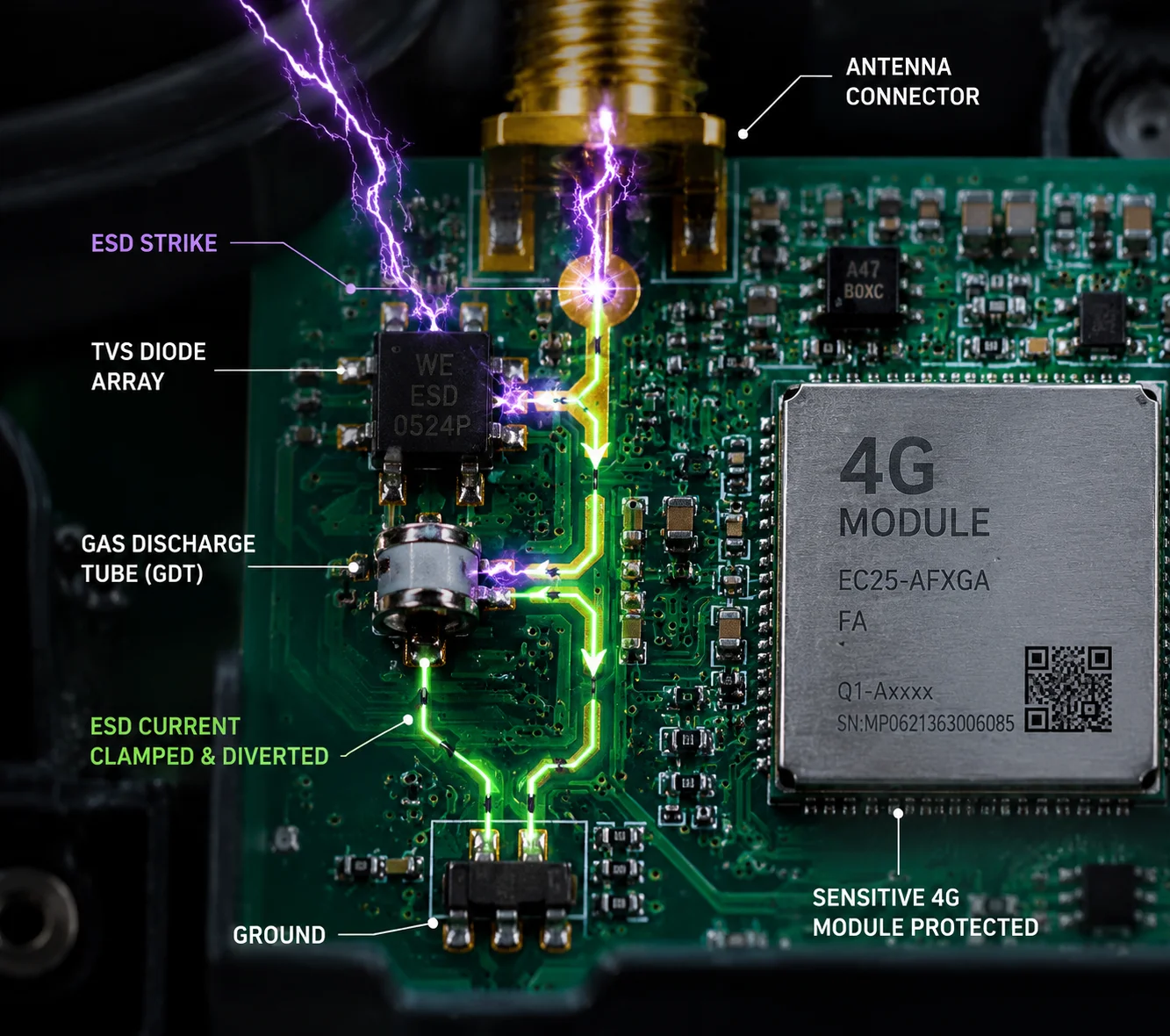
Most SMA and TNC connectors on PTZ cameras do not have built-in TVS diodes at the connector base. ESD protection9 is typically implemented on the PCB, downstream from the connector, using TVS diode arrays or varistors placed across the RF input trace. The connector itself is just a mechanical interface — it passes energy through, it does not block it. Always ask your supplier where the ESD protection components are located in the circuit.
Where ESD Protection Actually Lives
Let me be very clear about this. The SMA or TNC connector on the outside of your camera is a metal-and-plastic fitting. It has no active electronic components. It cannot clamp a voltage spike. It cannot absorb energy. It is a doorway — nothing more.
The real ESD protection sits inside the camera, on the printed circuit board (PCB). A good design places a TVS (Transient Voltage Suppressor) diode array right at the point where the coax center conductor meets the RF input trace on the board. This TVS diode reacts in nanoseconds. When a static discharge hits the antenna — say, from a technician touching it during installation — the TVS clamps the voltage to a safe level before it reaches the 4G module’s sensitive RF front end.
Some designs also add a series resistor or a gas discharge tube (GDT) in front of the TVS for a two-stage protection approach. The GDT handles the big, slow surges. The TVS handles the fast, sharp ESD events.
What to Look for in a Supplier’s Documentation
When you evaluate a PTZ camera from any Chinese manufacturer, ask for the following:
- ESD test report per IEC 61000-4-24. This standard defines contact discharge and air discharge levels. A good camera should pass at least ±6 kV contact and ±8 kV air discharge on all external ports, including the antenna connector.
- Schematic or block diagram showing protection components. You do not need the full schematic. Just a block diagram that shows where the GDT, TVS, or MOV (metal oxide varistor) sits relative to the antenna connector.
- Component brand and rating. A Littelfuse or Bourns TVS array rated for the correct frequency band is very different from a no-name component that may not survive a real event.
The Difference Between ESD and Lightning Surge
Many people confuse ESD with lightning. They are very different threats.
| Parameter | ESD (Electrostatic Discharge) | Lightning Surge (Indirect) |
|---|---|---|
| Source | Human touch, tool contact | Nearby lightning strike |
| Voltage | 2–15 kV | 10–100+ kV (induced) |
| Current | Very low (mA range) | Very high (kA range) |
| Duration | Nanoseconds | Microseconds (8/20 μs or 10/350 μs) |
| Protection device | TVS diode on PCB | Coaxial arrestor + GDT + grounding |
| Connector relevance | Minimal — protection is on the board | Moderate — connector affects ground path |
A TVS diode on the PCB can handle ESD. It cannot handle a 5 kA lightning surge. For that, you need an external coaxial arrestor with proper grounding. The connector type — SMA or TNC — affects how well that external arrestor integrates into the system, as I explained in the earlier sections.
My Advice for Buyers
Do not let a supplier tell you “our SMA connector has built-in lightning protection.” That statement is almost certainly misleading. Ask them to show you the protection circuit. Ask for the IEC test report. If they cannot provide it, move on.
At Loyalty-Secu, we design our RF input stages with multi-stage protection — GDT at the antenna port, TVS on the PCB, and proper ground planes tied to the chassis. We test every batch to IEC 61000-4-2 and can provide the report on request. That is what real ESD protection looks like — not a marketing claim printed next to a connector photo.
Conclusion
SMA and TNC connectors do not protect against surges by themselves. Real protection comes from arrestors, TVS diodes, and grounding. But TNC’s stronger mechanical lock, larger ground contact, and better sealing make it the smarter choice for any outdoor pole-mounted 4G PTZ deployment.
1. Threaded Neill-Concelman connector known for ruggedness and better environmental sealing. ↩︎ 2. Device that clamps voltage and shunts surge current to ground, essential for lightning protection. ↩︎ 3. Gas-filled component that fires at a set voltage to create a short circuit for surge current. ↩︎ 4. International standard for electrostatic discharge immunity testing of electronic equipment. ↩︎ 5. Ingress Protection rating indicating complete protection against dust and temporary immersion in water. ↩︎ 6. Device installed on coaxial cable to protect equipment from lightning-induced surges. ↩︎ 7. Proper grounding ensures surge current has a low-impedance path to earth, critical for protection. ↩︎ 8. Cellular modem that provides 4G connectivity; sensitive to surges and ESD. ↩︎ 9. Circuit protection against electrostatic discharge, typically implemented with TVS diodes. ↩︎