
I’ve seen PTZ camera brackets fall apart in under three years. The cause? Wrong material choice for the environment.
Hot-dip galvanized steel uses a sacrificial zinc layer that wears away over time, while 304 stainless steel forms a self-healing chromium oxide film that resists corrosion for decades. In coastal or high-humidity deployments, 304 stainless steel lasts 3 to 5 times longer than hot-dip galvanized steel before showing any rust.
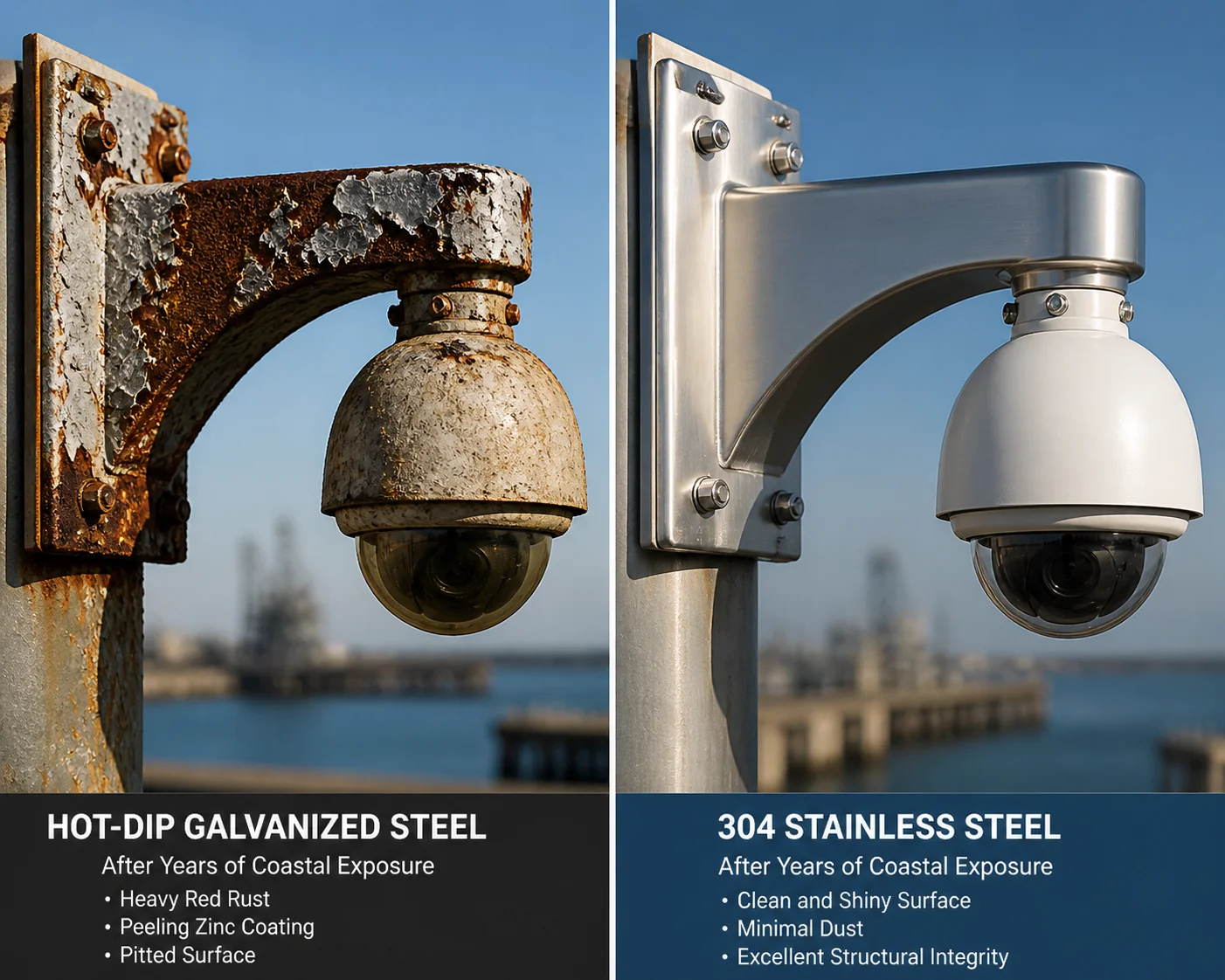
Below, I break down the real-world differences between these two materials. I cover rust speed, structural strength, cost impact, and tea staining. Each section gives you data and field-tested advice so you can pick the right bracket material for your next PTZ project.
Table of Contents
Will a Hot-Dip Galvanized Bracket Rust Faster Than Stainless Steel in Florida?
I had a client in Tampa Bay lose six PTZ cameras in one hurricane season. Not from wind. From rusted-out brackets that snapped at the base.
Yes. In Florida’s salt-heavy, humid air, a hot-dip galvanized bracket will show visible rust in 3 to 5 years. A 304 stainless steel bracket in the same spot can last 25 years or more without red rust, because its chromium oxide film repairs itself continuously.
How the Two Corrosion Mechanisms Work
The core difference is simple. Hot-dip galvanized (HDG) steel and 304 stainless steel fight corrosion in completely different ways.
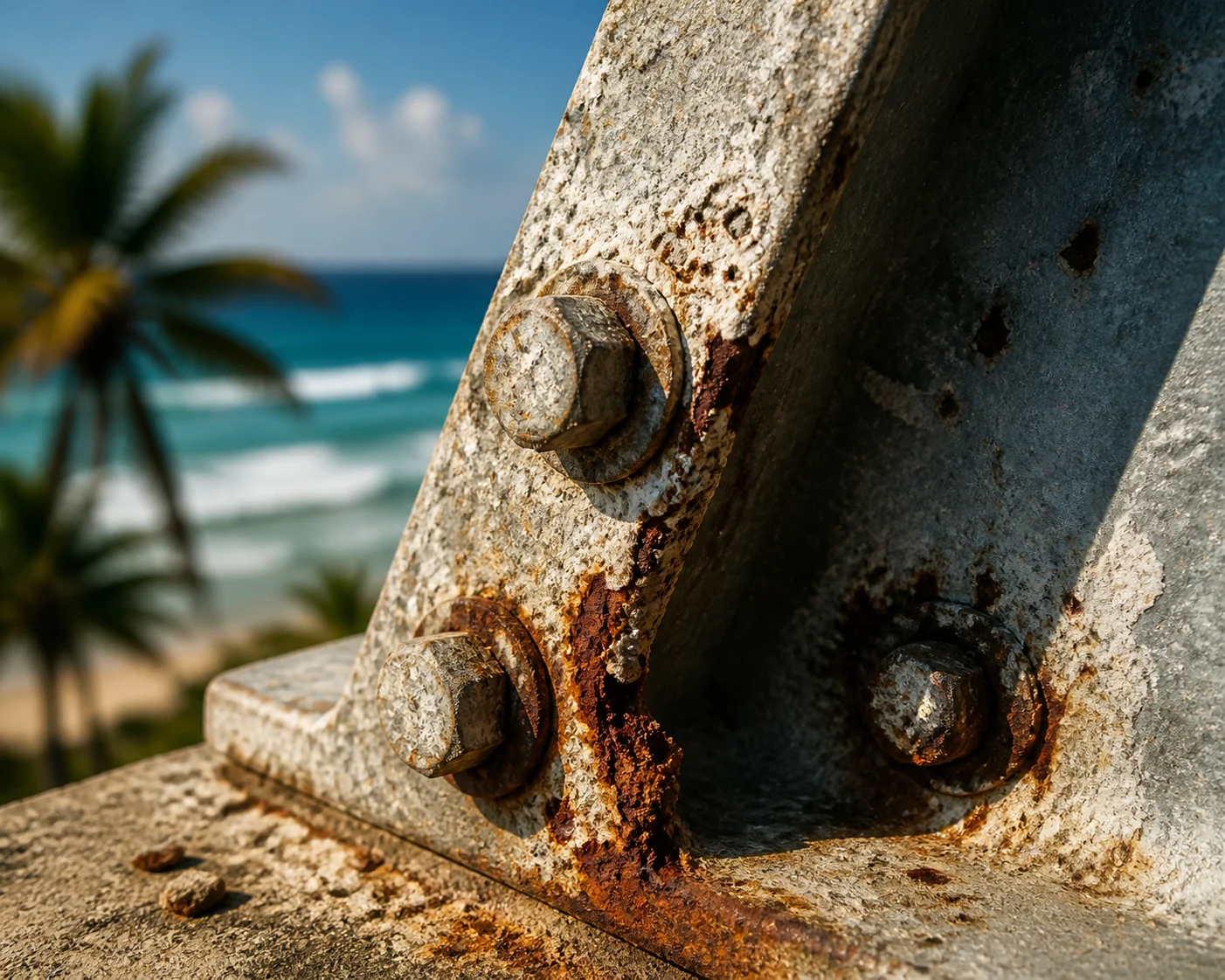
Hot-dip galvanized steel works through sacrificial protection. The steel is dipped into molten zinc at about 450°C. This creates a thick zinc-iron alloy layer on the surface. When moisture and salt hit the bracket, the zinc corrodes first. It “sacrifices” itself to protect the steel underneath. This sounds great. But the zinc layer has a fixed thickness. Once it’s gone, the bare carbon steel is exposed. And bare carbon steel in Florida air rusts fast.
304 stainless steel works through a passive film. The steel contains at least 18% chromium. Chromium reacts with oxygen in the air and forms a very thin, invisible layer of chromium oxide on the surface. This layer is the real hero. If you scratch it, it grows back on its own. As long as oxygen is present, the film keeps repairing itself.
Salt Spray Test Data: HDG vs. 304 SS
Lab tests under ASTM B117 salt spray testing standards 1 show a clear gap:
| Test Metric | Hot-Dip Galvanized (HDG) | 304 Stainless Steel (304 SS) |
|---|---|---|
| Hours to first red rust | 500 – 1,000 hours | 1,500 – 2,000+ hours (often no rust) |
| Expected coastal lifespan | 5 – 10 years | 25 – 50+ years |
| Surface appearance over time | Turns dark gray, then white rust, then red rust | Keeps metallic shine with minor surface deposits |
What This Means for Florida Deployments
Florida is one of the worst environments for metal. You get high humidity year-round, salt air blowing inland from both coasts, and frequent rain that keeps surfaces wet. In this kind of environment, the zinc layer on an HDG bracket can thin out in just a few years. I’ve seen HDG pole mounts near the Gulf Coast develop white rust within 18 months and red rust by year three.
With 304 stainless steel, the passive film handles Florida conditions much better. But I should be honest here: 304 is not perfect for every coastal spot. If your cameras are within 300 feet of the ocean, or near a saltwater canal, you may see pitting corrosion on 304 over time. For those extreme spots, 316 stainless steel for marine environments 2 is the safer choice. It contains molybdenum, which adds extra resistance against chloride attack.
For a deeper technical comparison, refer to this guide to atmospheric corrosion resistance of stainless steels 3.
Is the Structural Strength of 304 Stainless Steel Sufficient for a Heavy 40X PTZ?
I’ve been asked this question by at least a dozen integrators. They worry that stainless steel is “softer” than carbon steel and can’t hold a 15 kg PTZ camera in high wind.
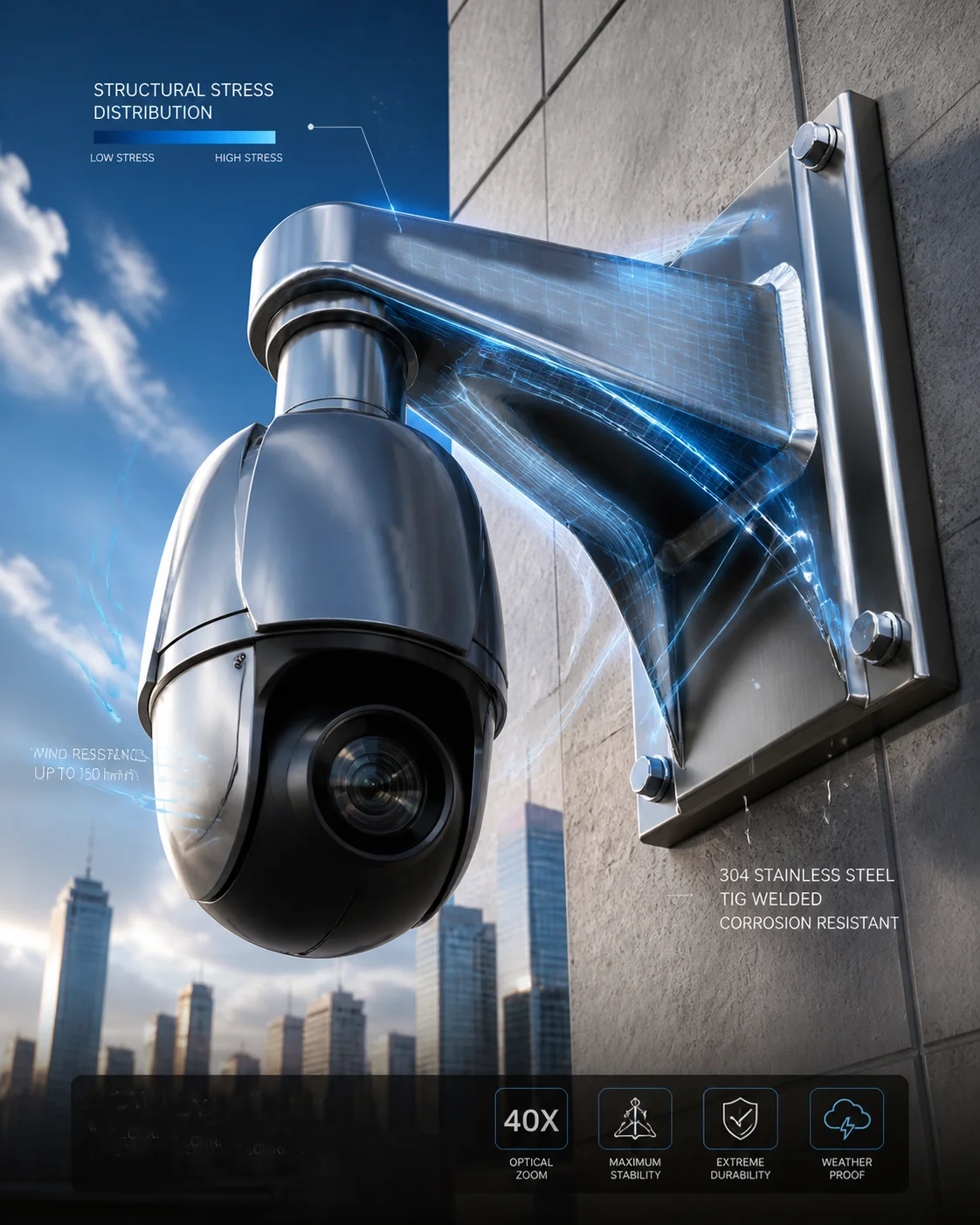
304 stainless steel has a tensile strength of 505–620 MPa and a yield strength of 215 MPa, which is more than enough to support a heavy 40X PTZ camera. When the bracket is properly designed with correct wall thickness, 304 SS handles wind loads, vibration, and camera weight without any issue.
Comparing Mechanical Properties
Let’s put the numbers side by side so you can see the real picture:
| Property | Hot-Dip Galvanized Carbon Steel (A36) | 304 Stainless Steel |
|---|---|---|
| Tensile Strength | 400 – 550 MPa | 505 – 620 MPa |
| Yield Strength | 250 MPa | 215 MPa |
| Elongation at Break | ~20% | ~40% |
| Density | 7.85 g/cm³ | 8.00 g/cm³ |
What the Numbers Actually Tell You
Yes, 304 stainless steel has a slightly lower yield strength than A36 carbon steel. This means it starts to bend at a slightly lower force. But look at the tensile strength. 304 SS is actually stronger at its breaking point. And the elongation number is twice as high. This means 304 SS stretches more before it breaks. In real-world terms, a 304 bracket will flex under extreme wind load instead of snapping suddenly. That’s actually a safety advantage.
Does Wall Thickness Matter More Than Material?
Absolutely. I’ve seen poorly designed carbon steel brackets fail under a 10 kg camera, and well-designed 304 SS brackets hold a 20 kg PTZ through Category 3 winds. The bracket design matters more than the raw material choice. Key design factors include:
- Wall thickness: For a 40X PTZ weighing 12–18 kg, I recommend at least 3 mm wall thickness for 304 SS brackets.
- Base plate size: A wider base plate spreads the load and reduces stress at the mounting bolts.
- Weld quality: 304 SS requires TIG welding with proper filler rod (308L). Bad welds create weak points.
- Bolt grade: Use A2-70 or A2-80 stainless steel bolts. Never mix carbon steel bolts with a stainless bracket. This causes galvanic corrosion between dissimilar metals 4 and weakens the joint.
At Loyalty-Secu, we design our PTZ mounting systems with these factors built in. Our engineering team runs load calculations for each bracket model before production. If you’re deploying a heavy 40X PTZ in a high-wind zone, we can provide the structural data sheet so your engineers can verify it independently.
How Does the Cost Difference Impact My Total Project Budget for 50+ Units?
I get it. When you’re quoting a 50-camera project, every dollar per unit matters. Stainless steel brackets look expensive on a line-item quote.
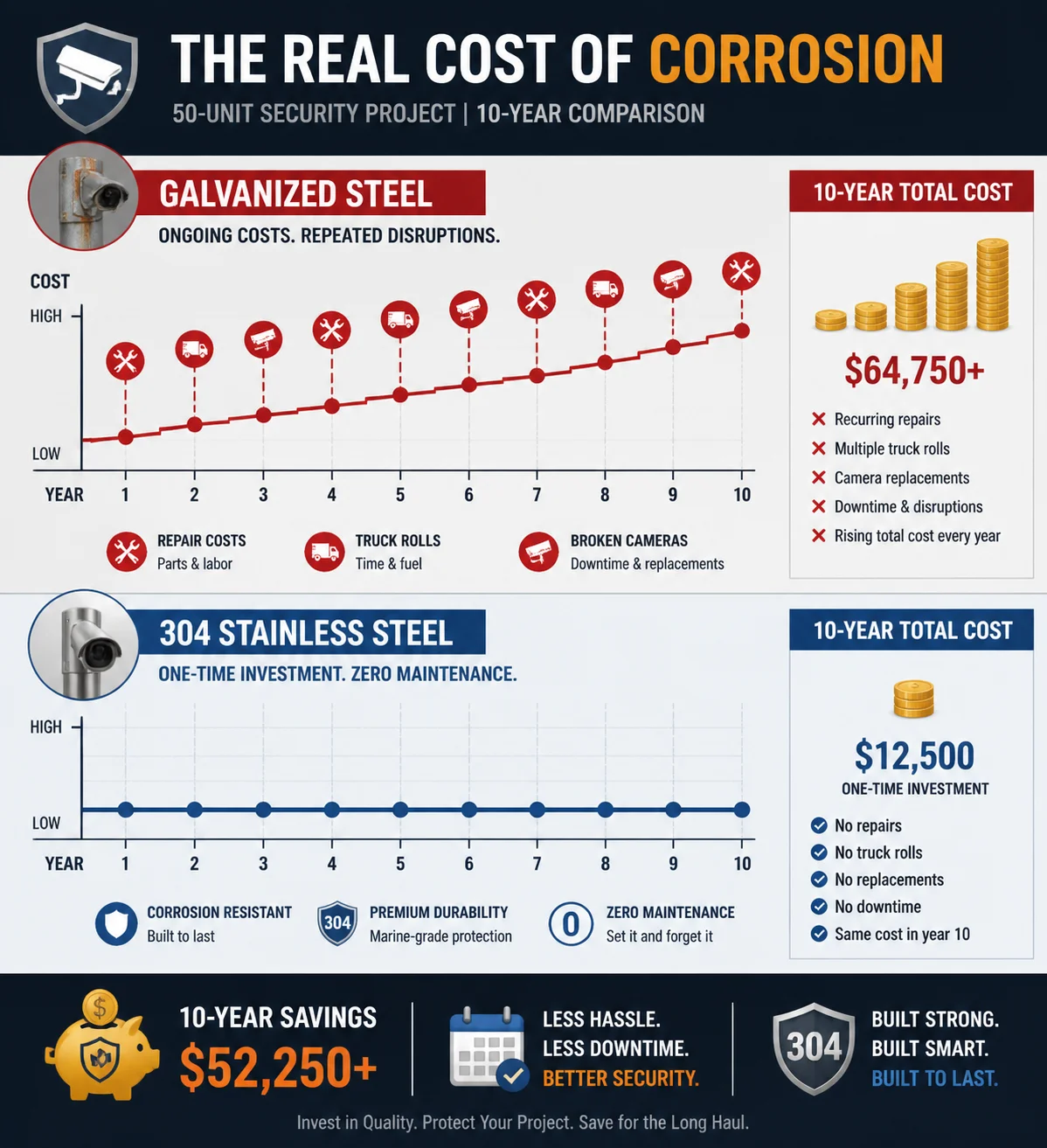
304 stainless steel brackets cost 4 to 5 times more than hot-dip galvanized brackets upfront. But for coastal or high-humidity projects with 50+ units, the total cost of ownership over 10 years is often lower with stainless steel, because you eliminate bracket replacement, truck rolls, and camera damage from corrosion failure.
The Upfront Cost Trap
Most project managers compare material cost per bracket and stop there. A typical HDG bracket for a heavy PTZ might cost $30–$50. The same bracket in 304 SS might cost $120–$200. Multiply that by 50 units, and you see a $4,500–$7,500 difference. That’s real money.
But this is where the math gets interesting.
Total Cost of Ownership: A 10-Year View
Let’s model a real scenario. You’re deploying 50 PTZ cameras in a coastal Texas city. The cameras are on 20-foot poles along a waterfront. Here’s what happens over 10 years with each material:
With HDG brackets:
- Year 0: You install 50 brackets at $40 each = $2,000.
- Year 3–5: White rust appears. You send a crew to inspect. Some brackets show structural weakness. You replace 15 brackets. Parts: $600. Labor (truck roll + lift rental + 2 technicians): $4,500.
- Year 6–8: Red rust is widespread. Another 20 brackets need replacement. Parts: $800. Labor: $6,000. Two cameras fell due to bracket failure. Camera replacement: $3,000.
- 10-year total: ~$16,900.
With 304 SS brackets:
- Year 0: You install 50 brackets at $150 each = $7,500.
- Year 3–10: No corrosion issues. No replacements. No truck rolls for bracket failure.
- 10-year total: ~$7,500.
The stainless steel option saves you over $9,000 in this scenario. And that doesn’t count the reputation damage if a camera falls on someone’s property.
For a more detailed model, see this total cost of ownership calculator for security hardware 5.
When HDG Still Makes Sense
I’m not saying HDG is always wrong. For inland, dry-climate deployments — like a ranch in West Texas or a warehouse in Nevada — HDG is a great choice. The zinc layer lasts decades in dry air. The cost savings are real, and the corrosion risk is low.
The rule is simple: match the material to the environment. Don’t put cheap brackets in expensive environments.
One Critical Warning: Never Mix HDG and Stainless Steel
This is a mistake I see often. An installer uses an HDG bracket with stainless steel bolts, or vice versa. When two different metals touch each other in the presence of moisture, you get galvanic corrosion. The less noble metal (zinc) corrodes at an accelerated rate. Your HDG bracket can lose its zinc layer in months instead of years. Always use the same metal family for brackets, bolts, washers, and nuts.
Which Material Is Better for Preventing “Tea Staining” in High-Salt Coastal Air?
I first heard the term “tea staining” from an Australian integrator. He was furious because his brand-new stainless steel camera housings looked like they were rusting after just six months near the ocean.
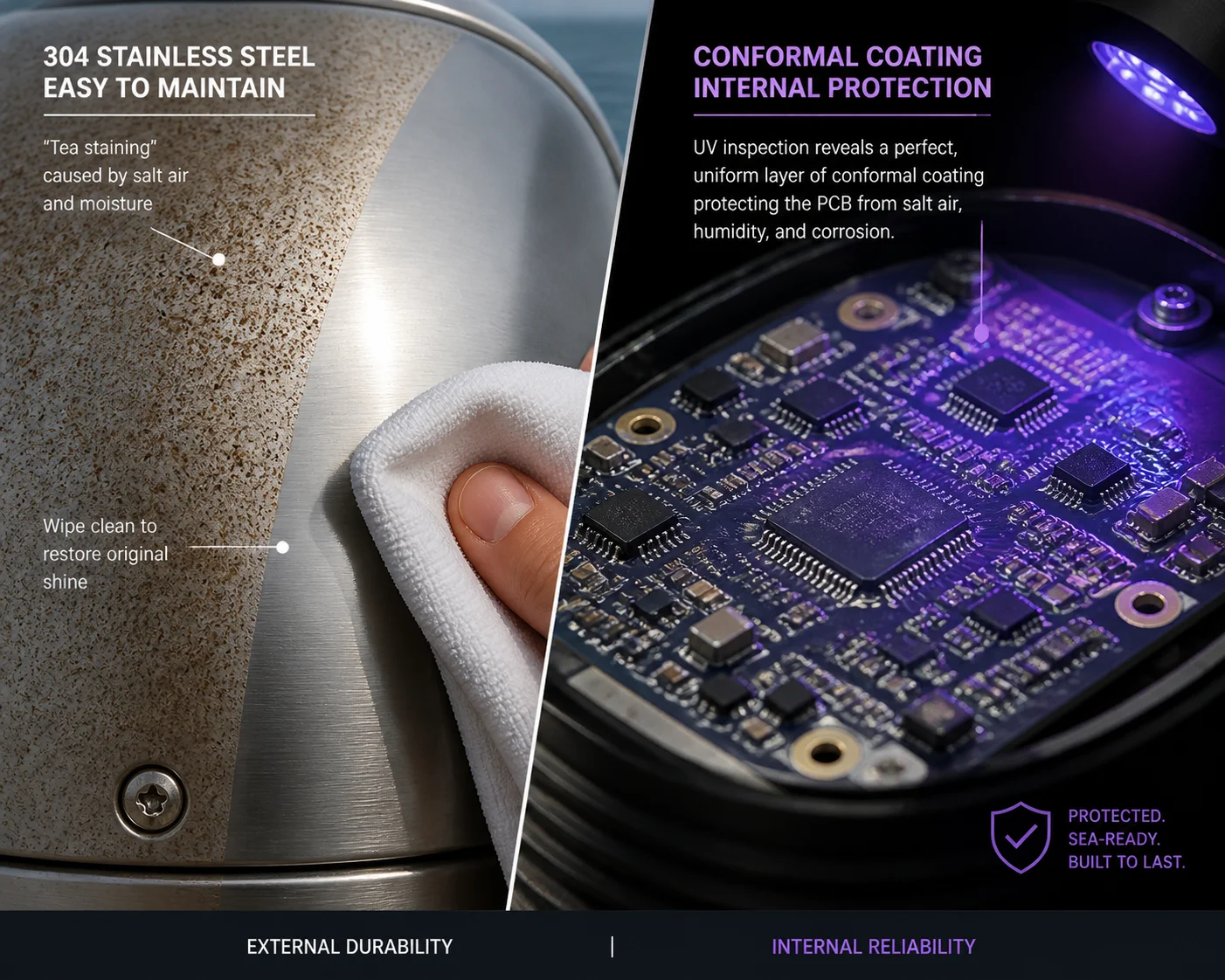
304 stainless steel is far more resistant to tea staining than hot-dip galvanized steel, but it is not immune. Tea staining is a cosmetic brown discoloration caused by salt deposits on the surface. It does not mean the steel is structurally failing. Regular cleaning or upgrading to 316 SS eliminates the problem almost entirely.
What Is Tea Staining, Exactly?
Tea staining is not rust in the traditional sense. It’s a light brown or orange discoloration that appears on stainless steel surfaces in marine environments. It happens when airborne salt and moisture sit on the surface for extended periods. The salt breaks down the passive chromium oxide film in tiny spots. A very thin layer of iron oxide forms. It looks bad, but it’s usually only a few microns deep. The structural integrity of the steel is not affected.
On HDG steel, you don’t get “tea staining.” You get something worse: actual corrosion. The zinc layer turns white first (white rust / zinc oxide), then eventually exposes the carbon steel underneath, which develops real red rust. This is structural damage, not just cosmetic.
How to Prevent Tea Staining on 304 SS
If you’re deploying PTZ cameras in coastal areas and you choose 304 SS brackets, here are practical steps to minimize tea staining:
- Surface finish matters. A smoother, more polished surface (like a #4 or electropolished finish) sheds salt and water better than a rough mill finish. Fewer places for salt to sit means less tea staining.
- Orientation helps. Brackets that allow rainwater to wash over them naturally stay cleaner. Avoid designs with flat horizontal surfaces where salt water can pool.
- Periodic cleaning. A simple freshwater rinse every 3–6 months removes salt deposits before they cause discoloration. For most PTZ pole mounts, rain does this job naturally.
- Upgrade to 316 SS for extreme locations. If your cameras are within 100 meters of breaking surf, 316 stainless steel with its added molybdenum content handles chloride attack much better than 304.
For more details, read this technical paper on tea staining and its prevention 6.
Don’t Forget What’s Inside the Camera
The bracket is only half the story. The PCB inside your PTZ camera also needs protection from humidity and salt air. This is where conformal coating comes in.
Conformal coating is a thin polymer layer applied to the circuit board. It seals out moisture, salt, dust, and chemical vapors. Without it, copper traces corrode, solder joints grow green deposits, and surface insulation resistance drops. This causes glitches, reboots, and eventually total failure.
Not every Chinese PTZ manufacturer applies conformal coating. Many cheap models skip it entirely, or only coat the power supply board. For high-humidity deployments, you need to verify that all PCBs — main control board, PTZ driver board, and power board — are fully coated.
How to Verify Conformal Coating from Your Supplier
Here’s what I recommend you ask for and check:
| Verification Step | What to Look For | Red Flag |
|---|---|---|
| Spec sheet review | Explicit mention of “conformal coating” or “IPC-CC-830 compliance” | Only mentions “IP66 housing” with no PCB coating reference |
| Material type | Silicone (SR) or Parylene for high-humidity use | No material type specified, or only acrylic (AR) for marine use |
| UV lamp inspection | Fluorescent glow under 365 nm UV light on all PCB surfaces | Large bare areas with no glow, only partial spot coating |
| Coverage scope | All PCBs coated except connector pins and heat sink contacts | Only power board coated, main board left bare |
Learn more about IPC-CC-830 conformal coating standards for electronics 7 to ensure your supplier meets industry requirements.
Conclusion
Choose 304 stainless steel for coastal and humid sites. Use hot-dip galvanized for dry inland areas. Never mix them. Always verify conformal coating inside the camera.
For additional reading, explore this comprehensive guide to outdoor PTZ camera deployment best practices 8, and review these corrosion protection strategies for surveillance equipment 9. If you are sourcing from international suppliers, also check this overview of ISO 1461 hot-dip galvanizing specifications 10 to understand coating thickness requirements.
1. Official ASTM B117 standard for salt spray (fog) testing. ↩︎ 2. Why molybdenum in 316 stainless resists chloride pitting. ↩︎ 3. Stainless Steel Association guide to atmospheric corrosion. ↩︎ 4. Explanation of galvanic corrosion when metals contact. ↩︎ 5. TCO calculator for security hardware lifecycle costing. ↩︎ 6. Technical paper on tea staining causes and prevention. ↩︎ 7. IPC industry standard for conformal coating verification. ↩︎ 8. Best practices for outdoor PTZ camera installation. ↩︎ 9. NACE corrosion protection strategies for metal assets. ↩︎ 10. ISO 1461 specification for hot-dip galvanized coatings. ↩︎